
🔌 The Art of Digital Detox and Analog Living

Updated: May 20
By Justin Nepa, DO, FAPA | Board-Certified Psychiatrist | Refresh Psychiatry and Therapy
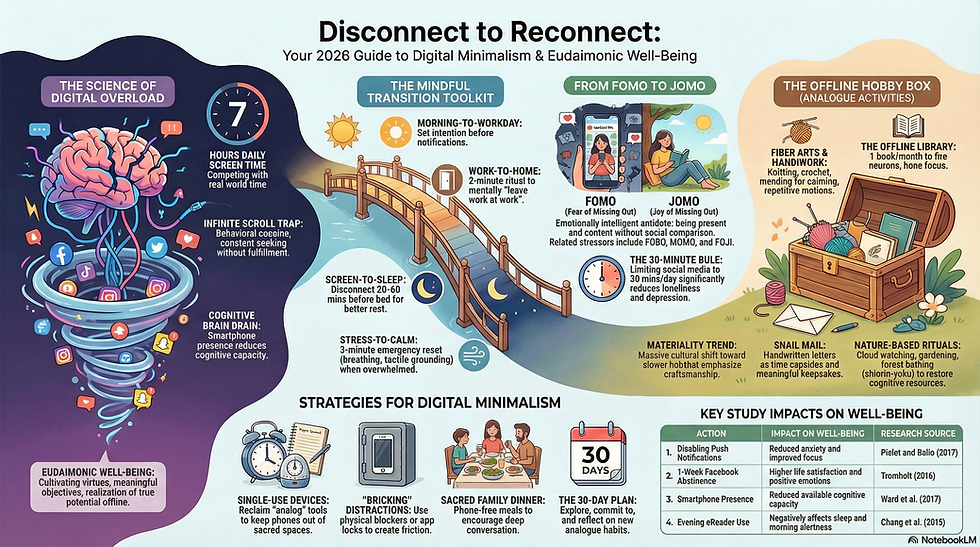
You pick up your phone to check the time. Twenty minutes later, you have scrolled through three social media platforms, watched a video you do not remember clicking on, and forgotten why you picked up the phone in the first place.
This is not a character flaw. It is a neurological hijack — and it is happening to nearly everyone, 7 hours and 2 minutes per day on average for American adults.
But something interesting is happening in 2026. Gen Z — the most digitally native generation in history — is leading a mass retreat from screens. Vinyl record sales crossed $1 billion for the first time since 1983. Dumbphones are trending. Journaling is outselling productivity apps. CNN called it "committing to the analog lifestyle." And 63% of Gen Z now intentionally embrace screen-free habits for their mental health.
As a psychiatrist, I find this fascinating — not because screens are inherently evil, but because what we are seeing is an entire generation instinctively course-correcting in response to what the neuroscience has been telling us for years: your brain was not built for this much stimulation.
What Screens Are Doing to Your Brain: The Neuroscience
The Dopamine Trap
Every notification, every like, every new piece of content triggers a small release of dopamine. Social media platforms are specifically engineered to exploit this using variable ratio reinforcement schedules — the same mechanism found in slot machines.
Research shows your brain releases more dopamine while anticipating a reward than when actually receiving it. The uncertainty of "did anyone like my post?" produces a bigger neurochemical hit than the like itself. Over time, this creates tolerance — and when you put the phone down, your brain enters a dopamine-deficit state. That restless, "I should check my phone" feeling? That is withdrawal.
Structural Brain Changes
Brain imaging studies have documented structural changes: decreased grey matter density in the prefrontal cortex (impulse control), increased amygdala activity (emotional reactivity), and reduced dopamine receptor availability (less enjoyment from normal activities). The more compulsively you use your phone, the harder it becomes to enjoy things that are not your phone.
The Mental Health Toll
Anxiety and depression symptoms increase significantly above 3-5 hours per day of social media
The average adult spends 2 hours 21 minutes on social media daily; Gen Z averages over 9 hours total screen time
Burnout, insomnia, attention difficulties, and relationship strain are all downstream effects

Why the Analog Movement Is More Than a Trend
When Gen Z calls 2026 "the year of the analog," they are naming something they feel in their bodies: digital overload has a physical and emotional cost, and the antidote is tangible, embodied experience.
US vinyl sales hit $1.04 billion in 2025 — 19th consecutive year of growth
The "analog bag" trend — curated offline tools (journals, books, film cameras, playing cards) replacing the phone reflex
The dumbphone movement — young adults switching to basic phones and telling friends to call or write letters
80% of Gen Z professionals use AI at work but deliberately go analog after 5 PM
One writer captured it perfectly: "The trend is not really retro. The trend is wanting your life to feel less slippery."
The Evidence: What a Digital Detox Actually Does to Your Brain
A 2025 study published in JAMA Network Open tracked young adults through a one-week social media reduction and found:
16.1% reduction in anxiety symptoms
24.8% reduction in depression symptoms
14.5% reduction in insomnia symptoms
The improvements were most pronounced in people with moderate to severe baseline depression — meaning the people who need help the most benefit the most from unplugging.
And the good news: your brain can recover. Neuroplasticity means dopamine sensitivity and impulse control improve with sustained reductions in compulsive screen use.

A Psychiatrist's Guide to Digital Detox (That You Will Actually Follow)
I am not going to tell you to throw your phone in a lake. What works is intentional friction — small structural changes that shift your default behavior from compulsive to conscious.
1. Protect the Bookends of Your Day. The first 30 minutes after waking and last 60 minutes before sleep are the most neurologically impactful. Replace phone time with journaling, stretching, or reading a physical book.
2. Eliminate the Triggers, Not the Technology. Remove social media from your home screen. Turn off non-essential notifications. Log out after each session. Each step creates friction between you and compulsive use.
3. Introduce One Analog Ritual. A handwritten journal, a weekly board game night, cooking without a recipe video, a walk without headphones. The key is sensory engagement that screens cannot replicate.
4. Schedule Your Scrolling. "I check Instagram from 12:30-1:00 PM" is fundamentally different from picking up your phone 47 times a day on autopilot. Scheduled use is conscious. Unscheduled use is compulsive.
5. Use the "Phone Stack" at Meals. Everyone stacks phones face-down at the table. First person to reach for theirs picks up the check. Playful, but effective.
6. Build an Analog Bag. A pocket notebook, a paperback, a deck of cards, a pen. When the urge to scroll hits, reach for the bag instead. You are not removing stimulation — you are replacing fast, empty stimulation with slower, richer stimulation.
7. Try a 24-Hour Analog Day. Once a month, go screen-free for a full day. Cook, walk, read, play music, have an unhurried conversation. Most people report not deprivation, but relief.
When Digital Overload Is Masking Something Deeper
Sometimes compulsive screen use is a symptom, not the problem:
ADHD — The ADHD brain craves stimulation, and phones provide infinite novelty with zero effort. Treating the ADHD often dramatically reduces compulsive phone use.
Anxiety — Scrolling can function as avoidance behavior, a way to numb anxious thoughts without addressing them.
Depression — When low on energy, passive scrolling requires the least activation energy of any activity. The depression is driving you toward the screen.
Insomnia — Late-night scrolling is often a response to inability to fall asleep, not the cause.
If you have tried multiple digital detox strategies and cannot make them stick, it is worth asking: is there something underneath this that needs treatment?
Frequently Asked Questions
How much screen time is too much for mental health?
Symptoms increase significantly above 3-5 hours of social media daily. Reducing to under 30 minutes per day produces meaningful improvements in anxiety, depression, and sleep.
What are the mental health benefits of a digital detox?
A 2025 JAMA study found one week of reduced social media use led to a 16% reduction in anxiety, 25% reduction in depression, and 14.5% reduction in insomnia.
Why is social media so addictive?
Platforms use variable ratio reinforcement — the same mechanism as slot machines. Your brain releases more dopamine anticipating a reward than receiving one, creating a compulsive checking cycle that mirrors substance addiction patterns.
When should I see a psychiatrist about screen time?
If you cannot reduce screen time despite repeated attempts, experience anxiety when separated from your phone, or suspect that ADHD, anxiety, or depression is driving your compulsive use. At Refresh Psychiatry, we offer telehealth evaluations anywhere in Florida.
Unplug. Reconnect. Take the Next Step.
The goal is not to become a Luddite. It is to move from unconscious consumption to conscious choice — to use technology as a tool instead of being used by it.
Ready to explore what is underneath? Contact us or call Refresh Psychiatry at (954) 603-4081 to schedule your evaluation.
We accept Aetna, United Healthcare, Cigna, Blue Cross Blue Shield, UMR, and Oscar insurance plans.
This blog is for informational purposes only and does not constitute medical advice. Please consult a qualified mental health professional for personalized guidance.