
🧠 Depression Memory Loss and How to Reclaim Focus

You walk into the kitchen and the reason disappears. Later, you miss an appointment, lose track of a conversation, or recognize a familiar name without being able to retrieve it. If persistent low mood, exhaustion, withdrawal, or loss of interest are present too, these lapses can feel frightening. You may worry that you are careless, losing your abilities, or developing dementia.
Depression memory loss is a real cognitive symptom, not a character flaw. Cognitive impairment is common during acute depressive episodes and can remain for some people after recovery. Difficulties with executive function may appear alongside slowed thinking, poor concentration, and reduced working memory. A clinical review from the NCBI Bookshelf describes these patterns.

The useful question is not only, “Why am I forgetting?” Ask where the process is breaking down. Depression can reduce attention and interfere with the first recording of information, much like a camera that never captures a clear image. Sleep problems, anxiety, medications, medical conditions, substance use, ADHD, and neurodegenerative illness can produce similar complaints, so evaluation matters.
This guide explains what depression-related memory problems may look like, why attention and encoding often come first, which memory systems may be involved, and how clinicians compare depression with other causes. It also covers treatment and daily supports. If fatigue is part of your experience, read more about whether depression can make you tired.
This blog is for informational purposes only and does not constitute medical advice. Consult a qualified mental health professional for personalized guidance.
How Depression Affects Memory and Thinking
Memory isn't one single container in the brain. It's a sequence of actions: pay attention, take in information, encode it, hold it briefly, and retrieve it later. Depression can disrupt several points in that sequence.
The memory systems involved
Attention is the entry point. If your mind is occupied by hopeless thoughts, worry, fatigue, or self-criticism, fewer details receive focused processing. You might hear a colleague explain a task but fail to register the instructions clearly.
Encoding means converting an experience or piece of information into a form the brain can store. Think of it as saving a document. If the mental Wi-Fi signal is weak, the file may never save properly. Later, trying to remember can feel like searching for a document that was only partially recorded.
Working memory temporarily holds information while you use it. It's like keeping several sticky notes visible on a desk while completing a task. Depression can make that desk feel crowded, so you lose track of a phone number while dialing it, forget the next step in a recipe, or reread the same paragraph without absorbing it.
Episodic memory involves personal experiences, such as what happened during a meeting or where you parked. People with depression may struggle more with recalling recent events or learning new material, especially when attention was poor at the time.
Core idea: Many memory complaints in depression begin as an attention and encoding problem, not as permanent erasure of stored memories.
What this looks like day to day
At work, you may open an email, become distracted by a negative thought, and later feel certain you never read it. In school, you may understand a lecture in the moment but struggle to recall it during studying. At home, you may set down your keys while thinking about an argument and then have no clear memory of where they went.
The pattern can fluctuate. On a day with better sleep and more energy, recall may seem almost normal. During a low-mood period, the same person may lose track of conversations, deadlines, and multi-step tasks.
Research supports a measurable cognitive pattern rather than a vague feeling of “brain fog.” A systematic review and meta-analysis found depression-related deficits in executive function, memory, and attention, with effect sizes ranging from Cohen's d = -0.34 to -0.65. Memory difficulties were also observed in people whose depressive symptoms had remitted (Maastricht University review).
For low-pressure mental engagement, some people use familiar activities such as solitaire. A resource on the Play Solitaire Gaming cognitive boost discusses how structured games may provide an approachable way to practice attention. Such activities can complement care, but they shouldn't replace an evaluation or treatment plan. If you're curious about the brain chemicals often discussed in depression, dopamine versus serotonin offers additional context.
Why Depression Can Make Memory Worse
Depression changes the conditions memory needs in order to work well. Low mood can narrow attention toward painful thoughts. Low motivation can make ordinary information feel unimportant, so the brain invests less effort in processing it. Slower processing speed can leave less time and mental capacity for organizing what you've just heard.
Sleep is another major factor. When insomnia, fragmented sleep, or excessive sleeping accompanies depression, the brain may not get the restorative rhythm needed for learning and recall. Depression and insomnia often reinforce each other, which is why addressing depression and insomnia can be relevant to cognitive symptoms as well as mood.
Five forces that crowd the mind
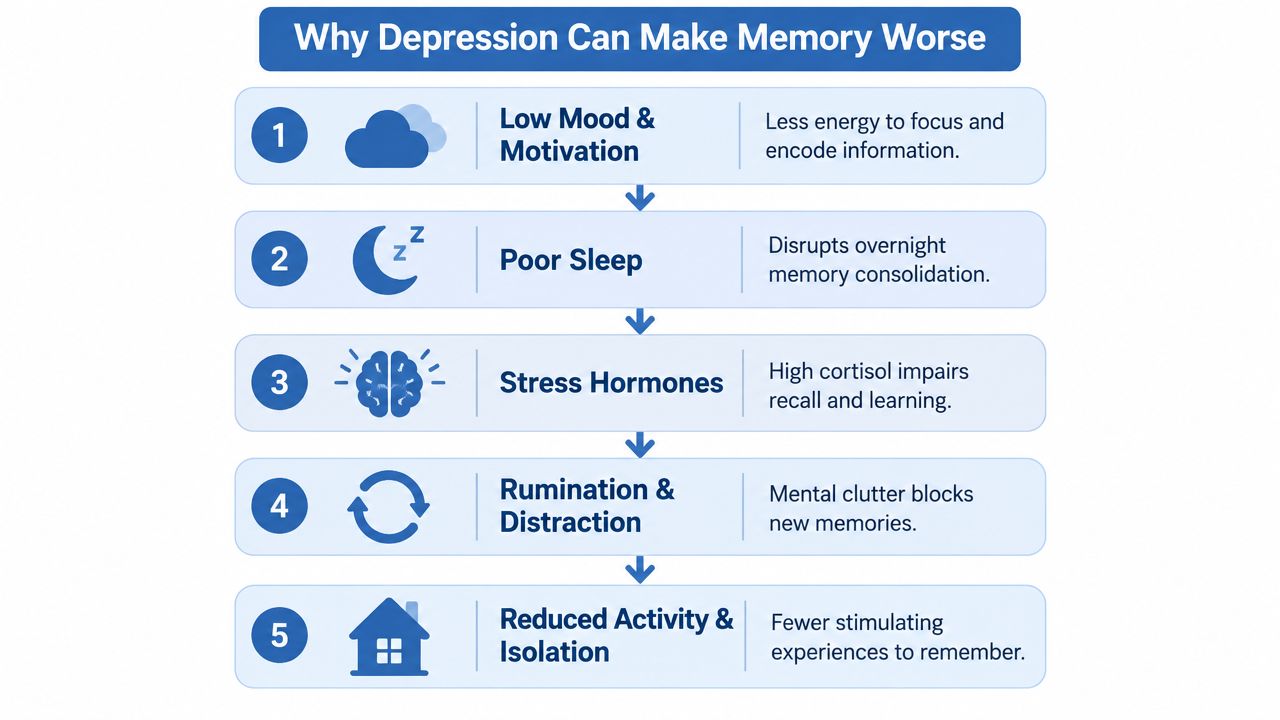
Low mood and motivation: Less energy makes it harder to focus long enough to encode information.
Poor sleep: Tiredness reduces alertness and makes learning less efficient.
Stress activation: Ongoing stress can interfere with concentration, learning, and recall.
Rumination: Repetitive thoughts use working-memory space that could otherwise hold a conversation or task.
Reduced activity and isolation: Fewer new experiences mean fewer opportunities to practice attention and create clear episodic memories.
These mechanisms explain why forgetting may feel inconsistent. You may remember a highly emotional event but forget a routine instruction. Emotional material receives strong attention, while neutral details may pass through with little encoding.
Depression affects memory domains unevenly
The cognitive profile isn't a uniform decline across every type of memory. A meta-analysis found that greater depression severity correlated with poorer episodic memory, executive function, and processing speed, but not with semantic memory or visuospatial memory (PubMed analysis of depression severity and cognition).
Semantic memory is general knowledge, such as knowing what a grocery store is or recognizing the meaning of a familiar word. Visuospatial memory helps you remember visual layouts and spatial relationships. Preserving these abilities doesn't invalidate the experience of forgetfulness. It helps identify which systems are under strain.
Working memory findings show a similar pattern. A systematic review and meta-analysis of 31 studies involving 1,666 participants found that depressed individuals performed worse than controls on 1-back, 2-back, and 3-back tasks, while 0-back performance wasn't significantly impaired. The largest accuracy deficit appeared on the 2-back task (PubMed working-memory meta-analysis).
That pattern is consistent with a brain that can recognize and respond to simple information but struggles when it must hold, update, and manipulate several pieces of information at once. The problem isn't willful forgetfulness. It's a measurable reduction in the mental resources available for complex processing.
Is It Depression or Something Else Common Causes Compared
Depression often overlaps with other conditions, and more than one cause can be present. Anxiety can pull attention toward threat. Sleep deprivation can slow thinking. ADHD can cause lifelong difficulties with organization and working memory. Medication effects, alcohol or other substances, thyroid disorders, hormonal changes around perimenopause, and early neurodegenerative changes can also resemble depression memory loss.
The timeline provides useful clues, but it doesn't provide a diagnosis by itself. A person whose concentration problems began during a depressive episode may have a different explanation from someone who has had lifelong distractibility or steadily worsening disorientation.
Depression memory loss versus other common causes
Cause | Typical Memory Pattern | Clues That Point This Way |
|---|---|---|
Depression | Difficulty concentrating, learning, recalling recent experiences, and managing complex mental tasks | Low mood, loss of interest, fatigue, rumination, sleep change, and symptoms that vary with mood |
Anxiety | Attention pulled toward worry, making information harder to encode | Persistent apprehension, physical tension, reassurance seeking, and mental replay |
Sleep deprivation | Slower attention, reduced alertness, and inconsistent recall | Short or disrupted sleep, unrefreshing rest, nighttime awakenings, or irregular schedule |
ADHD | Working-memory and organization difficulties across settings | Lifelong pattern, distractibility, lost items, time-management problems, and symptoms predating depression |
Medication effects | New or worsened fogginess, slowed thinking, or sedation | Symptoms began after a medication or dose change, including prescriptions that cause drowsiness |
Substance use | Variable attention, learning, and retrieval problems | Relationship to alcohol, cannabis, sedatives, stimulants, or withdrawal |
Thyroid or other medical conditions | Cognitive slowing or reduced concentration | Physical symptoms, medical history, or abnormal findings that require medical evaluation |
Perimenopause | Subjective forgetfulness and concentration changes | Menstrual or hormonal changes, sleep disruption, hot flashes, or mood shifts |
Neurodegenerative change | Progressive impairment that may affect orientation, familiar abilities, or independent functioning | Gradual worsening, safety problems, loss of previously reliable skills, or limited improvement as mood changes |
Why dementia concerns deserve a careful response
Depression and memory decline can influence each other over time. A longitudinal analysis of 8,268 adults found that higher depressive symptoms at baseline and worsening symptoms over time were associated with faster memory decline. Depressive symptoms were also associated with poorer memory at baseline, with β intercept = -0.018, SE = 0.004, P < .001 (JAMA Network Open longitudinal study).
That finding doesn't mean depression automatically becomes dementia. It means clinicians shouldn't dismiss cognitive change, particularly in middle-aged and older adults. A newer longitudinal analysis also describes a bidirectional relationship, where depressive symptoms and memory change can reinforce each other (PMC longitudinal analysis).
Track when the problem began, what situations trigger it, whether it fluctuates, and how it affects work, finances, driving, medication use, and relationships. Bring that record to a clinician rather than trying to decide the cause alone. If inattentiveness has been present since childhood or adolescence, information about inattentive ADHD may also help you prepare for a broader discussion.
How Clinicians Evaluate Depression Related Memory Loss
A person may remember an event later but lose track of it in the moment because depression interrupted attention. Evaluation therefore starts with the symptom's context, not a single score: when it began, how it changed, and whether mood, sleep, medication, or substance use shifted alongside it.
What the appointment usually covers
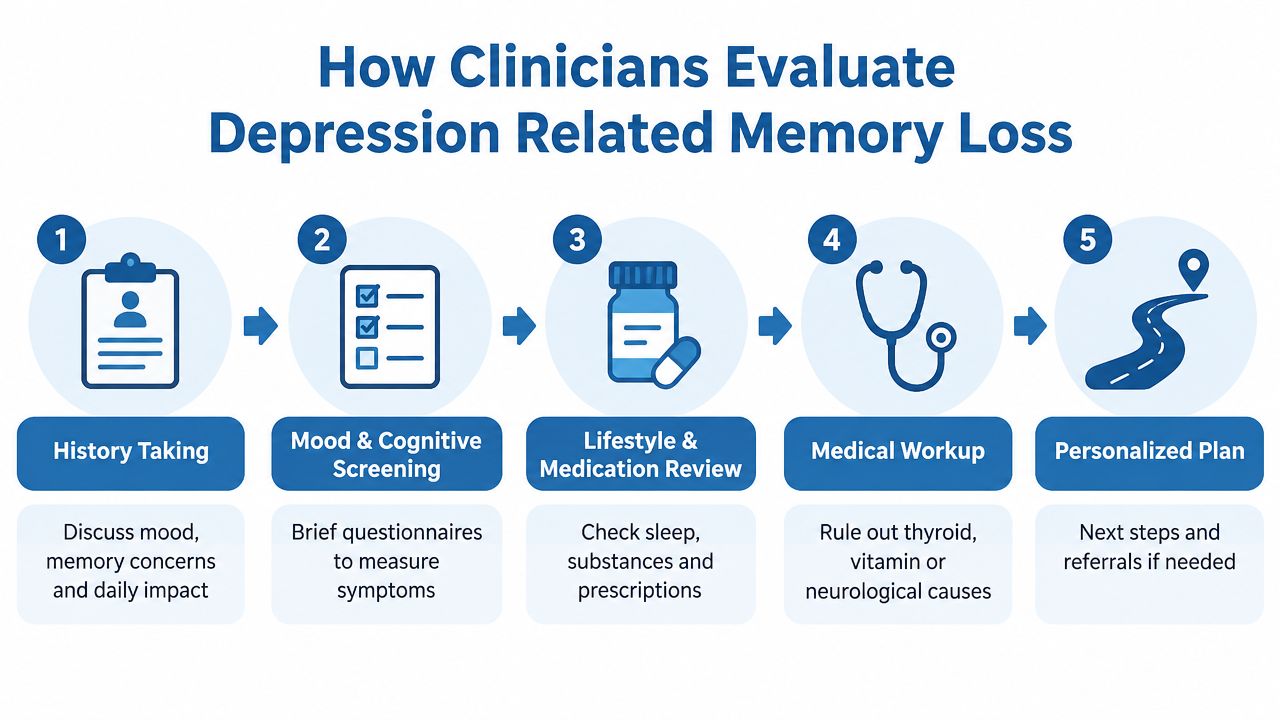
History taking links the complaint to everyday function. A clinician may ask about missed appointments, repeated questions, unpaid bills, losing your place while cooking, or needing help with familiar responsibilities. These examples show whether the main difficulty involves attention and encoding, recall, planning, or several skills together.
Mood and cognitive screening can include questionnaires about depression, anxiety, sleep, and attention. Brief office tasks may assess orientation, concentration, immediate learning, delayed recall, language, and executive skills. The results provide a starting point, while the full history explains what the score means.
Medication and lifestyle review can identify factors that interfere with attention. Sedating prescriptions, alcohol, cannabis, stimulant use, disrupted sleep, pain, and medical illness may all contribute. Bring medication names, doses, timing, and recent changes, and do not stop a prescription without medical guidance.
Medical workup depends on the history and examination. Laboratory testing or referral may be appropriate when thyroid, vitamin, neurological, hormonal, sleep-related, or other medical explanations require review.
A personalized plan follows the pattern, duration, severity, and effect on daily life. Clinicians also track whether cognitive symptoms improve as depression improves. Research has described moderate difficulties involving executive function, memory, and attention, with some memory problems continuing after remission (NCBI Bookshelf clinical review). Ongoing symptoms call for follow-up so the assessment can be refined.
Prepare useful information
Bring a symptom timeline, medication list, sleep notes, substance-use information, relevant medical history, and concrete examples from home or work. If possible, ask someone who knows you well what changes they noticed and when those changes began.
Useful questions include:
What could be affecting my attention and memory?
Do my symptoms fit depression, ADHD, anxiety, sleep disruption, medication effects, or another condition?
What should we monitor as treatment begins?
When would cognitive testing or a medical referral be appropriate?
You are not being graded on memory during the appointment. The clinician is identifying a pattern that can guide safe, targeted care.
Evidence Based Treatments and Everyday Strategies to Improve Memory
Improving memory usually means improving the conditions that support memory. Treatment can target depression, sleep, anxiety, trauma, medication effects, and daily structure at the same time. The aim isn't to force your brain to perform through exhaustion. It's to reduce the interference that blocks attention and encoding.
Build a coordinated plan
Therapy can help reduce rumination, avoidance, hopeless predictions, and behavioral withdrawal. CBT may address thought patterns and activity cycles. DBT can provide skills for emotional regulation and distress tolerance. Trauma-focused approaches may be appropriate when trauma symptoms contribute to hypervigilance, sleep disruption, or concentration problems.
Medication management may be indicated for some people. A psychiatrist can review benefits, side effects, sedation, activation, interactions, and the relationship between mood improvement and cognitive change. Precision cognitive rehabilitation is also receiving attention because depression can affect multiple memory types, and different people may need different cognitive targets (2022 clinical review of depression-related memory profiles).
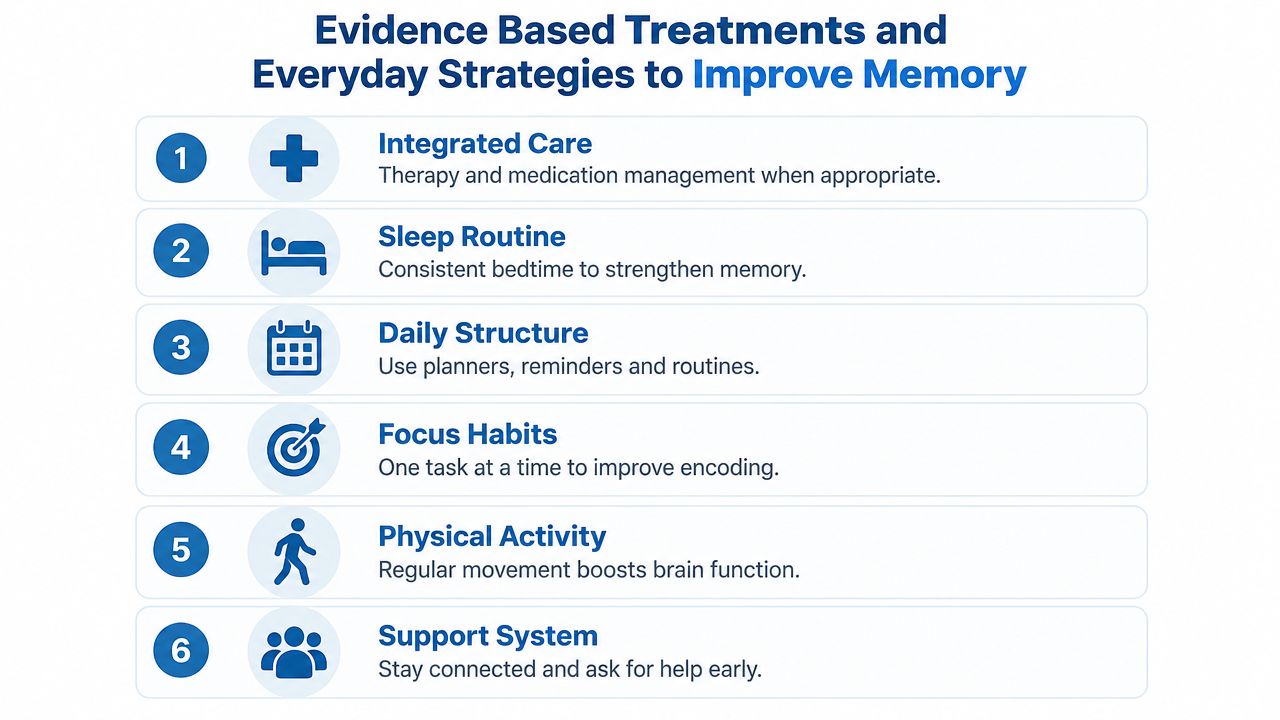
Practical supports work best when they reduce the demand on working memory:
Externalize appointments: Use one calendar, phone reminders, and written checklists instead of relying on recall.
Single-task deliberately: Put the phone away, name the task aloud, and finish one small step before switching.
Use spaced retrieval: Review important information after increasing intervals rather than cramming it once.
Create consistent locations: Keep keys, medication, and paperwork in designated places.
Add movement gradually: Choose manageable physical activity, such as a walk, stretching, or another routine you can repeat.
Protect sleep timing: Keep a consistent wind-down routine and discuss persistent insomnia clinically.
Stay connected: Ask a trusted person to help you track appointments or notice changes you may miss.
A behavioral plan often starts smaller than people expect. Behavioral activation for depression can help translate values into concrete actions, such as showering, opening the curtains, walking to the mailbox, or replying to one message.
A calming sensory routine may also help some people associate a familiar cue with relaxation. If you're exploring that option, this guide to how to use mood scents offers general ideas. Scent routines should complement, not replace, psychiatric or medical care, particularly if you have allergies, asthma, headaches, or medication concerns.
Working-memory performance may not improve all at once. Simple recognition can return before complex multitasking feels comfortable. Consistency gives clinicians and patients a clearer way to judge whether attention, processing speed, mood, and recall are changing together.
When to Seek Help and How Refresh Psychiatry Supports You in Florida
Schedule an evaluation when forgetfulness repeatedly interferes with work, school, finances, medication use, driving, relationships, or basic routines. Seek prompt medical attention for confusion, rapid decline, new safety problems, or disorientation. If depression includes thoughts of self-harm or suicide, seek immediate crisis support or emergency care rather than waiting for a routine appointment.
Depression-related memory symptoms deserve assessment because they can be treatable, while other causes may require different medical or neurological evaluation. People also sometimes avoid discussing alcohol, cannabis, stimulants, sedatives, or medication changes. Honest information helps clinicians make safer decisions.
For readers in Florida, Refresh Psychiatry & Therapy provides telemedicine-only psychiatric and therapy care through HIPAA-compliant video visits on a device. Care can include psychiatric evaluation, medication management, and individual therapy, with coordinated follow-up for depression, anxiety, ADHD, insomnia, trauma-related conditions, and related concerns. People who are also worried about substance use may find educational material on adults with depression and addiction helpful as they consider support.
Insurance coverage can depend on your plan and benefits. Refresh Psychiatry reports accepting Aetna, UnitedHealthcare and UHC, Cigna, Blue Cross Blue Shield, Humana, Tricare, UMR, and Oscar insurance plans. Confirm eligibility and benefits before scheduling.
This blog is for informational purposes only and does not constitute medical advice. Please consult a qualified mental health professional for personalized guidance.
If depression memory loss is making work, relationships, or daily routines harder, Refresh Psychiatry & Therapy offers Florida telepsychiatry evaluations, medication management, and coordinated therapy to assess both mood and cognitive symptoms. Contact us or call Refresh Psychiatry at (954) 603-4081 to schedule your evaluation. We accept Aetna, United Healthcare/ UHC, Cigna, Blue Cross Blue Shield, Humana, Tricare, UMR, and Oscar insurance plans.
Comments