
🛌 End Stage Screen Addiction What It Really Feels Like

You can be lying in bed with your phone in your hand, knowing you're exhausted, knowing you need sleep, and still keep scrolling because stopping feels harder than continuing. The next morning, you wake up flat, foggy, and irritated, then reach for the screen again because it's the fastest way to avoid that empty feeling. That loop can look like laziness from the outside, but clinically it often looks more like problematic screen use mixed with depression, sleep disruption, and a nervous system that's stuck on autopilot.
The phrase End Stage Screen Addiction isn't a formal diagnosis, but it can be a useful way to describe severe impairment. In mental health care, the important question isn't how dramatic the label sounds, it's whether the pattern is causing real loss of control, withdrawal from life, and worsening mood. That's the lens that helps people get the right help without shame.
If your screen time feels less like entertainment and more like escape, this article on feeling sad for no reason may help you separate low mood from something deeper.
When Screen Use Starts to Feel Like Depression
A teenager can stay in a dark room, game until 2 a.m., skip dinner, snap at family, and still insist they are “fine” because they are technically getting through the day. A working adult can answer emails, sit through meetings, and use every break to scroll, not because it feels good, but because silence feels harder to tolerate. In both cases, the screen starts working like emotional numbness.
The day-to-day pattern matters more than the label.
Severe screen use often shows up as withdrawal from people, a low tolerance for quiet, and the sense that ordinary life takes too much effort. Depression can look similar, especially when someone has lost interest, energy, or hope. That overlap is why people get confused, and why the first step is to look at functioning, not just the device.
A person may say they are “just tired,” yet the pattern tells a fuller story. They stop taking walks, forget meals, delay chores, and get irritated when anyone interrupts the feed, the game, or the messages. That is not a character flaw. It often means the brain has learned to reach for screens whenever discomfort shows up.
If screen use has become the fastest way to avoid sadness, boredom, shame, or loneliness, treat it as a mental health signal, not a personality flaw.
The feeling can be hard to name. A lonely child under a tree and an adult surrounded by notifications can both end up in the same place, cut off from people while still looking occupied. Screen use can create a private bubble that feels safer than the world, yet leaves the person more isolated inside it.
That is one reason severe use and depression can look so similar from the inside.
If emotional numbness is part of your experience, the emotional numbness guide can help you understand why “I don't feel much” is often a symptom, not a character trait. If you are trying to separate low mood from something deeper, this article on feeling sad for no reason may also help.
What End Stage Screen Addiction Really Means
A person can look "fine" from the outside and still be struggling in a serious way. They answer texts, show up to work, and keep scrolling, yet their life is narrowing. Clinicians pay attention to that pattern because severe screen use is defined less by a clock and more by impaired control, screens taking priority over other parts of life, and use continuing even when it causes harm. That approach matches the World Health Organization's ICD-11 framework for gaming disorder, which recognizes the condition when loss of control and functional decline are present. WHO gaming disorder FAQ
Hours count less than impairment
A teenager who plays for a long time is not automatically impaired. Another person may spend fewer hours online and still be missing meals, skipping sleep, or snapping at family because they cannot step away. The number matters only when it starts changing behavior, relationships, and daily responsibilities.
That is why clinicians focus on function first. Can the person stop when they need to? Are they falling behind at school, work, or home? Do they keep trying to cut back and fail? Those are the questions that matter more than a raw screen total.
The same logic appears in Internet Gaming Disorder criteria used in DSM-5-TR, where diagnosis depends on a pattern of symptoms, distress, and real-world impairment rather than casual overuse alone. DSM-5-TR Internet Gaming Disorder criteria
The label can sound harsh, which is part of why families get confused. What many people call “end stage screen addiction” is better understood as severe problematic use that may overlap with depression, anxiety, or both. The screen is often not the whole problem. It can become the place a person goes when sadness, loneliness, shame, or exhaustion feels too heavy to hold directly.
The public also gets mixed messages because estimates vary so much. A WHO-associated report from 2015 summarized global internet addiction estimates of 1.5% to 8.2%, while noting that different tools and thresholds make comparisons difficult. WHO-associated 2015 report
A practical way to understand it is simple, screen use has become a coping tool that starts running the person's day. That is when the problem is no longer about being “online too much.” It is about life shrinking around the screen, while the person loses freedom, connection, and follow-through.
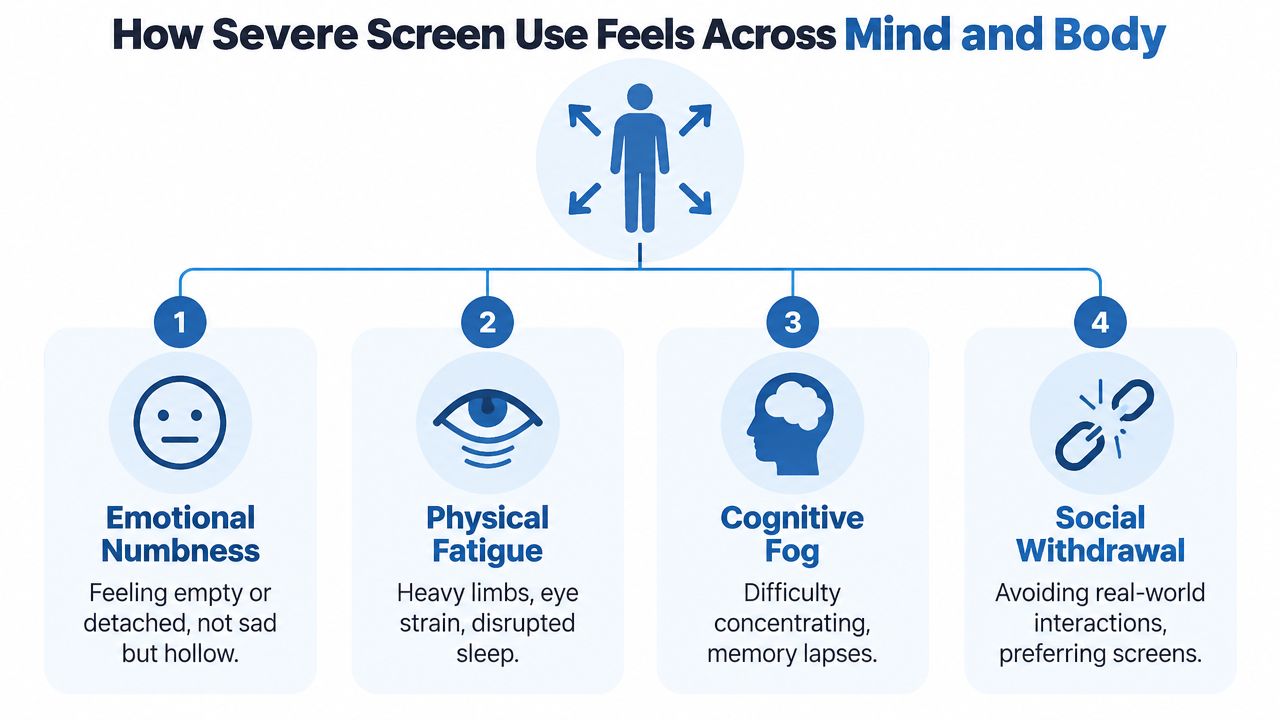
How Severe Screen Use Feels Across Mind and Body
A person may say, “I do not feel like myself,” long before they can explain why. Severe screen use often shows up that way. It can spill into mood, attention, sleep, and relationships, and the picture may resemble depression, anxiety, burnout, or ADHD depending on which symptoms are strongest.
Emotional, cognitive, physical, and behavioral layers
Emotionally, people may feel numb, irritable, or restless. Some do feel sad, but many describe a flat, detached state, as if life is happening at a distance. That emptiness can push them toward stronger stimulation, which keeps the cycle going. If emotional blunting sounds familiar, this clear explanation of feeling emotionally numb can help separate the feeling itself from the behavior that may be feeding it.
Cognitively, the pattern often looks like fog, poor focus, and constant attention drift. Someone opens a phone to check one message, then keeps hopping between apps because the brain keeps reaching for novelty. Research on disordered screen use has linked it with measurable neuropsychological impairment, especially in attention and executive functioning, the mental systems that help a person steer, inhibit, and switch tasks. Systematic review and meta-analysis on neuropsychological impairment
Behaviorally, the person may skip meals, ignore chores, avoid calls, and choose the screen over face-to-face contact. Families usually notice this part first. The change is not only that the phone is present, it is that the phone becomes the default place to go when life feels demanding.
A person usually does not need more shame at this point. They need a clearer read on what they are avoiding and why.
Physically, the cycle often includes fatigue, eye strain, and disrupted sleep. Screen-heavy routines can also make ordinary workday discomfort feel worse, especially for people who already struggle to focus on a monitor for long stretches. A practical resource like the occupational progressive lenses guide can help readers understand one small part of that strain, while keeping the bigger behavioral pattern in view.
Heavy use versus a clinical problem
A person can feel down after an argument and still function. They can scroll more than usual, binge a few shows, or stay online late and still not meet the bar for a disorder. The line gets crossed when the pattern keeps returning, is hard to interrupt, and starts interfering with daily life.
Transient sadness and heavy use | Clinically significant depression or problematic use |
|---|---|
Linked to a clear event or stressful period | Persists, spreads across settings, and affects daily life |
Breaks or limits still help | Breaks do not hold for long |
The person can usually pull back | Craving, withdrawal, conflict, and relapse keep returning |
Function stays mostly intact | School, work, sleep, or relationships start to suffer |
This is why hours alone can mislead families. A person may spend a lot of time on screens and still be relatively functional, while another person with less visible use may be spiraling because the screen has become a way to escape sadness, numbness, or pressure. Clinicians look at pattern, severity, and impact, and they also screen for depression, anxiety, and other conditions that can sit underneath the screen use.
Is It Sadness Heavy Use or Something More Serious
A good self-check starts with a few plain questions. Can you stop when you mean to stop. Do you get edgy, panicky, or angry when separated from your phone. Have you hidden how much you use, lied about it, or kept going even after it caused conflict. Those questions matter more than a stopwatch.
What separates a habit from a disorder
Duration matters, but it is not enough. Control matters more. So does craving, withdrawal, repeated failed attempts to cut back, and whether the behavior is crowding out sleep, relationships, school, work, or parenting.
The DSM-5-TR framework for Internet Gaming Disorder is useful here because it names the symptoms clinicians watch for, preoccupation, withdrawal, tolerance, unsuccessful attempts to control use, loss of interest in other activities, continued use despite problems, deception, escape from negative mood, and jeopardizing relationships or opportunities. If several of those sound familiar, the issue is no longer “too much screen time,” it may be a disorder pattern. Clinicians also look for overlap with depression, because low mood can sit underneath the screen use and make it look like a habit when it is doing more than that. If that sounds familiar, learn how high-functioning depression can mask distress.
There is also a reason families get stuck arguing about hours. A 2026 narrative review that brought together systematic reviews and meta-analyses found that general digital media use has mixed effects depending on content, motives, context, and individual traits, while problematic use is consistently tied to adverse outcomes. A separate review also advised moving beyond duration to screen type, timing, content, and individual vulnerability. 2026 narrative and systematic review
Red flags that deserve prompt evaluation
Deception: hiding use, deleting history, or lying about time online.
Relapse: repeated promises to cut back that do not hold.
Escape: using screens mainly to numb negative mood.
Conflict: ongoing fights with family, partners, or teachers about use.
Opportunity loss: skipping responsibilities, sleep, or important tasks.
If this pattern sits alongside hopelessness, low energy, or social withdrawal, depression may be part of the picture too. Problematic phone, social media, and gaming use has also been linked with later depressive, attention, sleep, and behavioral problems, while emotional and behavioral problems can push screen use higher in return. Prospective and meta-analytic findings
The clearest takeaway is simple. If the screen keeps winning over the rest of life, it is time for an evaluation, not more self-blame.
Why Severe Use Is So Hard to Stop
A person can want to stop and still feel pulled back to the phone. That is often the clearest sign that the problem is not simple willpower. The brain learns quickly when a device repeatedly relieves boredom, stress, loneliness, or shame, and that relief can start to run the show.
Cue, reward, and self-regulation
Problematic smartphone use is increasingly understood as a behavioral addiction with distinct neurobiological correlates. Studies point to heightened sensitivity to device-related cues, altered reward processing, and weaker executive control, along with frontostriatal and frontolimbic circuit abnormalities, the networks that help the brain notice what matters, anticipate reward, and regulate impulses. Neurological correlates of problematic smartphone use
That shows up before a person has time to think. A notification, a quiet moment, or a flash of discomfort can trigger checking almost automatically, like a smoke alarm that goes off too easily. Shame-based advice usually misses this part, because the urge may arrive first and reflection comes later.
Sleep and attention make the loop worse
Screens also interfere with sleep, and poor sleep makes the loop stronger. A large NIH review reported that sleep loss is common in children and adolescents, that screens are often present in bedrooms, and that many adolescents use screens in the hour before bedtime. NIH review on digital media and sleep A 2024 longitudinal study of adolescents found that daytime screen time, evening screen time after lights off, and nighttime screen time before lights off each predicted later poorer sleep quality and more insomnia severity. 2024 longitudinal sleep study
The pattern is easy to understand once sleep is part of the picture. A tired brain reaches for quick relief, and the phone is always available. Then the person sleeps worse, feels foggier, and checks more often. It can feel like trying to walk through mud while carrying a magnet.
Family structure matters too, especially with younger patients. A practical resource is this guide on managing device usage in children, which can help parents set limits without turning every boundary into a battle.
The other reason severe use is so hard to stop is comorbidity. Depression, ADHD traits, anxiety, social stress, and sleep disturbance can all push screen use higher, and the screen can then worsen those same problems. When low mood is part of the picture, the phone may act less like a hobby and more like a temporary anesthetic. That is why evaluation should screen for depression and other overlapping conditions, not just count hours.
Evidence Based Ways to Feel Better and Regain Control
A person can feel stuck in the same loop, reach for the phone for relief, then feel worse afterward. Treatment works best when it interrupts that loop from more than one angle, so the brain has room to recover flexibility.
Psychotherapy is often the right place to start, especially when screen use is tied to mood, stress, trauma, or avoidance. CBT can help identify triggers, unhelpful thoughts, and habit loops. DBT can be useful when urges surge during emotional overload, because it teaches distress tolerance and impulse control. Trauma-focused care matters when screens are being used to dull old pain rather than just fill time.
Medication may also help when depression, anxiety, ADHD, or sleep problems are part of the picture. The goal is not to treat screen use in isolation. The goal is to treat the symptoms pushing it forward, so checking behavior becomes easier to manage.
A practical plan usually includes a few concrete changes:
Stimulus control: remove the apps that pull you into automatic checking.
Notification reduction: silence non-essential alerts.
Response delay: pause before opening a device when the urge hits.
Sleep protection: keep the phone out of the bed area.
Structured offline time: schedule something specific, like a walk, gym session, cooking, or a phone-free dinner.
Use Screen Time parental controls to block the most tempting apps when willpower is running low.
Clinical insight: if the screen is helping regulate emotion, treat emotion regulation directly. Do not just count minutes.
The behavioral activation approach for depression can be especially helpful when low mood and avoidance keep feeding each other. It gives the day a structure before motivation returns, which is often how momentum starts.
A helpful shift is to stop asking only, “How many hours did I use?” Ask, “What was I feeling right before I reached for it, and what was I trying not to feel?” That question often points to boredom, loneliness, anxiety, grief, or a depressive crash.
A structured care visit can also help sort out what is driving the pattern. If screen use is overlapping with depression or attention problems, telemedicine can make evaluation easier to access without adding another barrier. Refresh Psychiatry & Therapy offers telemedicine psychiatry in Florida for adults, children, and adolescents, with medication management and therapy in one coordinated model.
If you are trying to help a child or teen, calm and consistent boundaries usually work better than repeated threats. Stability is boring, and that is part of why it helps.
Getting Compassionate Help in Florida With Refresh Psychiatry
If screen use is starting to affect your mood, sleep, school performance, work, or relationships, waiting for a crisis is not necessary. A psychiatric evaluation can help sort out whether depression, anxiety, ADHD, trauma, insomnia, or more than one of these is driving the pattern. The first step is understanding, not blame.
Refresh Psychiatry & Therapy provides HIPAA-compliant telepsychiatry throughout Florida for adults, children, and adolescents, with medication management and individual therapy in one coordinated care model. The practice accepts Aetna, United Healthcare/ UHC, Cigna, Blue Cross Blue Shield, Humana, Tricare, UMR, and Oscar insurance plans. Aetna UnitedHealthcare and UHC Cigna Blue Cross Blue Shield Humana Tricare UMR Oscar
Telepsychiatry can make care easier to start, especially when leaving home, arranging transportation, or fitting appointments into a crowded day feels like one more obstacle. If you want to understand the format better, see Refresh Psychiatry's telemedicine psychiatry information. If you have already tried to cut back on your own and keep getting pulled back in, that pattern deserves professional attention.
Contact us or call Refresh Psychiatry at (954) 603-4081 to schedule your evaluation. This blog is for informational purposes only and does not constitute medical advice. Please consult a qualified mental health professional for personalized guidance.
If you are ready to speak with a clinician about compulsive screen use, depression, sleep, or focus problems, visit Refresh Psychiatry & Therapy and schedule a Florida telepsychiatry evaluation. You will get a compassionate, evidence-based assessment that looks at the whole picture, not just the number of hours on a device.
Comments