
Why You Feel Off This Week: The Hidden Mental Health Impact of Daylight Saving Time

If you've been feeling unusually tired, irritable, or just not like yourself this week, you're not imagining it. Daylight Saving Time (DST) isn't just about adjusting your clocks — it can significantly disrupt your mental health, sleep patterns, and overall well-being.
Your Brain on Daylight Saving Time
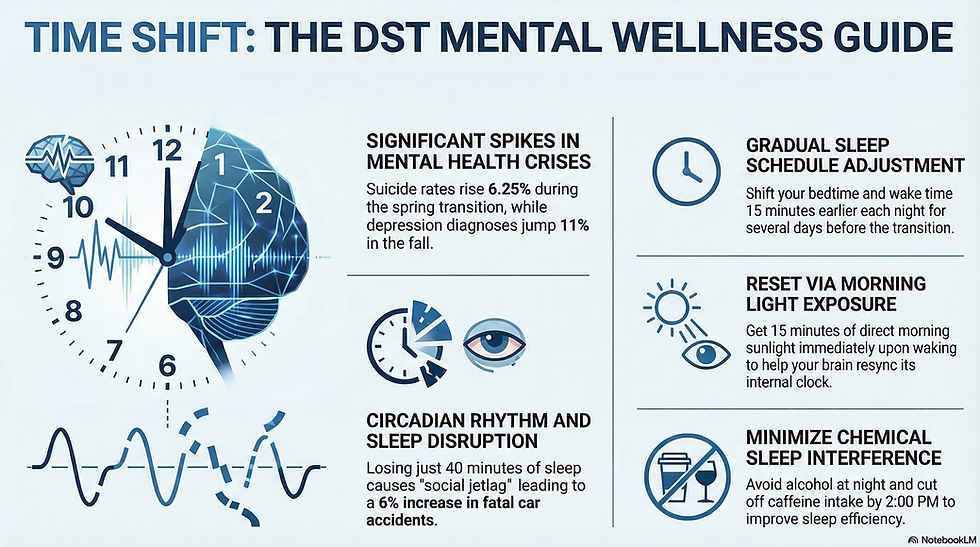
That one-hour shift may seem minor, but your circadian rhythm — the internal clock that regulates sleep, mood, appetite, and energy — is incredibly sensitive to changes in light exposure and sleep timing. When DST pushes clocks forward in the spring, your body is essentially dealing with a mini jet lag.
Research shows it can take your body anywhere from a few days to two full weeks to fully adjust. During that window, you may experience:
Difficulty falling or staying asleep
Increased anxiety or mood swings
Brain fog and trouble concentrating
Fatigue even after a full night's rest
Increased irritability or emotional sensitivity
Why It Hits Harder If You Already Manage a Mental Health Condition
For people living with depression, anxiety, ADHD, or bipolar disorder, the effects of DST can be amplified. Sleep disruption is one of the most well-documented triggers for mood episodes, increased anxiety symptoms, and difficulty with focus and executive function.
If your medication regimen is timed around sleep-wake cycles — as many psychiatric medications are — even a one-hour shift can temporarily alter how you feel on your current treatment plan.

5 Evidence-Based Tips to Reset Your Rhythm
Get morning sunlight. Exposure to natural light within 30 minutes of waking helps reset your circadian clock faster than anything else. Aim for 10–15 minutes outside — even on cloudy days.
Shift your bedtime gradually. Rather than forcing an abrupt change, move your bedtime 15 minutes earlier each night over the course of a few days.
Limit screens before bed. Blue light from phones and laptops suppresses melatonin production. Try to power down devices at least 60 minutes before sleep.
Be mindful of caffeine timing. It's tempting to reach for extra coffee when you're tired, but caffeine after noon can make it even harder to fall asleep that night.
Give yourself grace. Feeling off after a time change is a normal biological response. Be patient with yourself and adjust expectations for the first week.
When to Reach Out for Support
If you notice that the time change has triggered more than just a few groggy mornings — if your sleep hasn't bounced back after two weeks, your mood feels persistently low, or your anxiety has intensified — it may be time to talk to a mental health professional.
At Refresh Psychiatry and Therapy, we specialize in helping patients across Florida, Massachusetts, and Texas navigate these kinds of challenges with compassionate, evidence-based psychiatric care. Whether you need a medication adjustment or just want to talk through what you're experiencing, our team is here for you.
Feeling off doesn't mean something is wrong with you. Sometimes your brain just needs a little time — and the right support — to catch up.
Ready to Feel Like Yourself Again?
Schedule a telehealth appointment with Refresh Psychiatry today. We accept Aetna, United, Cigna, Humana, Avmed, UMR, and Oscar. Call us at (954) 603-4081 or visit refreshpsychiatry.com to book online.