
The Science of Snug: Why Cozymaxxing Is the Science-Backed Stress Antidote We Need Right Now
- Justin Nepa, DO, FAPA

- Mar 29
- 6 min read
Updated: May 20
Modern life has become a relentless landscape of sensory chaos. Between the infinite scroll of the attention economy, mounting economic uncertainty, and a “hustle culture” that refuses to hit pause, our collective nervous systems are frayed. As a psychiatrist, I see the downstream effects of this hyperarousal every day — anxiety, insomnia, emotional exhaustion, and a pervasive sense of never being able to truly rest.
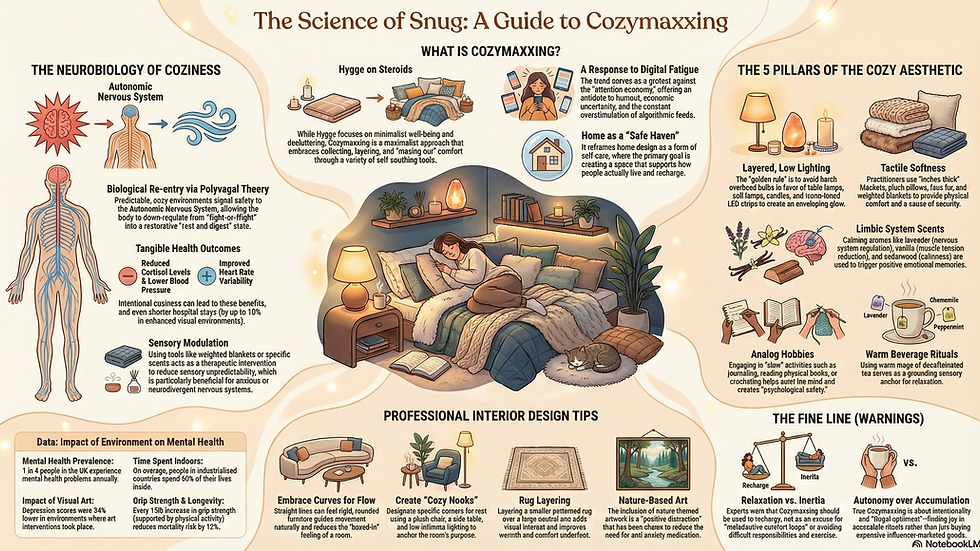
In response, a powerful cultural shift is emerging that reframes home design as a critical form of emotional self-defense. Known as “cozymaxxing,” this viral movement — which has already surpassed 400,000 hits on YouTube — moves beyond mere aesthetics. It is an intentional, science-backed reclaiming of the home as a sanctuary for nervous system repair.
1. It’s “Hygge on Steroids” — The Maximalist Shift
While the Danish concept of hygge introduced the world to the value of a warm atmosphere, cozymaxxing represents a significant evolution of that philosophy. The primary distinction lies in the rejection of minimalism. Hygge often emphasizes decluttering and sparse, simplified environments. Cozymaxxing, conversely, embraces a “maximalist bent” that prioritizes collecting and layering.
“Cozymaxxing is not to be confused with the Danish concept of hygge... [It] has a more maximalist bent that embraces collecting and layering rather than Hygge, which focuses on decluttering and simplifying. Consider cozymaxxing ‘hygge on steroids.’” — Boxwood Marketing
This shift toward “intentional softness” and “functional hoarding” feels more supportive than minimalist aesthetics for many people navigating chronic stress. It is about creating an absolute haven filled with what some call “hobby hoarding” — surrounding yourself with piles of books, colored pens, plush textures, and meaningful objects.
For many, a polished showroom feels cold and expectant, whereas a cozy-maxxed space feels like what I describe to patients as an “environmental antipsychotic” — a space that grants permission to simply exist without performing productivity. From a psychiatric perspective, this is not indulgence. It is burnout prevention.

2. The Biology of Softness: Why Your Brain Needs a Weighted Blanket
The appeal of cozymaxxing is grounded in Stephen Porges’ Polyvagal Theory. Our autonomic nervous system (ANS) is constantly scanning the environment for cues of safety — a process called neuroception. When we curate a space with predictable lighting, warmth, and soft textures, we signal to the ANS to down-regulate from a “fight-or-flight” state into a ventral vagal state — the zone of rest, digest, and social engagement.
In simpler terms: your nervous system reads your environment before your conscious mind does. A cluttered desk under fluorescent lights tells your body “stay alert.” A warm room with layered blankets and amber lighting tells your body “you are safe.”
The ADHD Paradox: When “Less Is More” Backfires
Here is a fascinating insight for anyone managing ADHD: while conventional design advice suggests that “less is more” for calm, emerging research suggests that for hyperaroused or ADHD brains, a quiet, empty room can actually amplify internal “background noise” and racing thoughts.
In these cases, the “visual noise” of a maximalist, cozy-maxxed room — surrounding yourself with varied textures and meaningful objects — acts as a grounding anchor, providing the sensory input necessary to quiet the mind. This is the same principle behind why fidget tools, textured objects, and ambient noise machines help with ADHD self-regulation.
“Your body is exhausted, not broken. And your apartment might be the only place left to exhale.” — Therapist Daniel Dashnaw
Dashnaw emphasizes that this is not just about individual comfort — it is about relational health. By practicing “familiarity as foreplay,” couples can use shared sensory rhythms — reading side-by-side, establishing “no-talk wind-down zones” — to co-regulate and build intimacy at a pace the nervous system can actually handle.

3. The “No Overhead Lights” Rule: Your Sensory Modulation Toolkit
True cozymaxxing requires a multi-sensory approach to removing environmental triggers. To “max out” your sanctuary, here is an expert-backed toolkit organized by sense:
Lighting: Forbid harsh overhead bulbs. Use “layered lighting” with salt lamps, paper lanterns, and candles to create an amber, gauzy glow. Red-spectrum light is preferred — research shows it helps increase melatonin production rather than suppressing it like blue-white LEDs.
Texture & Deep Pressure: Move beyond a single throw. Embrace rug layering to soften the “coldness” of hard floors. Use plush blankets or weighted blankets to provide deep-pressure touch — a technique shown to reduce anxiety and improve sleep quality.
The “No Straight Lines” Rule: Interior designers and environmental psychologists suggest prioritizing curved furniture and rounded edges (sofas, arched mirrors) over rigid, straight lines. Research indicates that curved contours are perceived as more pleasant and less threatening.
Scent Menu: Engage the limbic system — your brain’s emotion center — with specific aromas. Use bergamot to melt away tension, palo santo or sandalwood for grounding, and lavender to promote better sleep. Aromatherapy has measurable effects on cortisol reduction and mood improvement.
Soundscapes: Replace silence — or worse, the notification pings of your phone — with nature sounds, lo-fi ambience, or binaural beats to provide a predictable auditory background.
4. A Quiet Rebellion Against the Attention Economy
Cozymaxxing is more than a design trend — it is a form of “frugal optimism.” As economic uncertainty and the cost-of-living crisis make aspirational luxury feel distant, people are finding joy in accessible, small-scale rituals. Making coffee at home, lingering over a book, or wrapping yourself in a blanket while rain hits the window — these are quiet protests against a digital culture that demands we stay endlessly productive.
This rebellion is particularly resonant for marginalized communities. By leaning into what activist Mia Mingus calls “Access Intimacy,” cozymaxxing acknowledges that for queer, disabled, and neurodivergent individuals, comfort is not an optional luxury — it is the foundational ground upon which all other functioning rests.
It is a movement that chooses “lingering” over “scrolling,” creating a space where the rhythm of the social media feed cannot reach. In my clinical work at Refresh Psychiatry, I often encourage patients experiencing revenge bedtime procrastination or chronic overstimulation to audit their home environment as part of their treatment plan.
5. The Shadow Side: Restoration vs. Avoidance
As with any wellness practice, there is a risk of the “cozy bubble” becoming a “maladaptive comfort loop.” As a psychiatrist, I want to be transparent about this. We must distinguish between resting to recharge and withdrawing to avoid the difficult work of life.
If your cozy space fosters lethargy rather than restoration — if you are consistently declining invitations, missing deadlines, or using your blanket fort as a barrier against the world rather than a launchpad back into it — it may be acting as an “emotional moat.” That is when it is time to talk to a professional.
Furthermore, we must be wary of the “Commodification of Safety.” As influencers begin to market $300 “comfort boxes” and curated Amazon storefronts, the original trauma-informed impulse of the trend risks being flattened into a “marketable vibe.” True cozymaxxing is about the practice of co-regulation and sensory awareness, not just the purchase of more stuff.
The most powerful version of cozymaxxing is free: it is the decision to turn off the overhead light, sit in quiet warmth, and give your nervous system permission to do nothing for a while.

Reclaiming the Speed of the Nervous System
Cozymaxxing is a structural reclaiming of inner peace in a hyperaroused world. It is a recognition that our environments have a profound, measurable impact on our mental health. By intentionally curating spaces that prioritize curves over corners and softness over spectacle, we are building personal sanctuaries where rest is a right, not a reward.
I can tell you that some of the most effective “interventions” I prescribe have nothing to do with medication. Sometimes, the prescription is: go home, turn off the overhead light, wrap yourself in something soft, and let your body remember what safety feels like.
This is “love, reorganized at the speed of the nervous system.” In a feed designed to keep you endlessly scrolling, are you brave enough to finally slow down — and just blanket?
Disclaimer: This blog is for informational purposes only and does not constitute medical advice. Please consult a qualified mental health professional for personalized guidance. If you are in crisis, please call the 988 Suicide & Crisis Lifeline (call or text 988).
Comments