
🛌 Revenge Bedtime Procrastination: Causes and Fixes

You're tired enough to fall asleep, but you're still holding your phone. The house is finally quiet, nobody needs anything, and going to bed feels less like relief than giving up the only part of the day that belongs to you.
That tension is at the heart of revenge bedtime procrastination. Understanding what you're trying to get from those late hours can be more useful than another reminder to put your phone away.
What Revenge Bedtime Procrastination Really Means
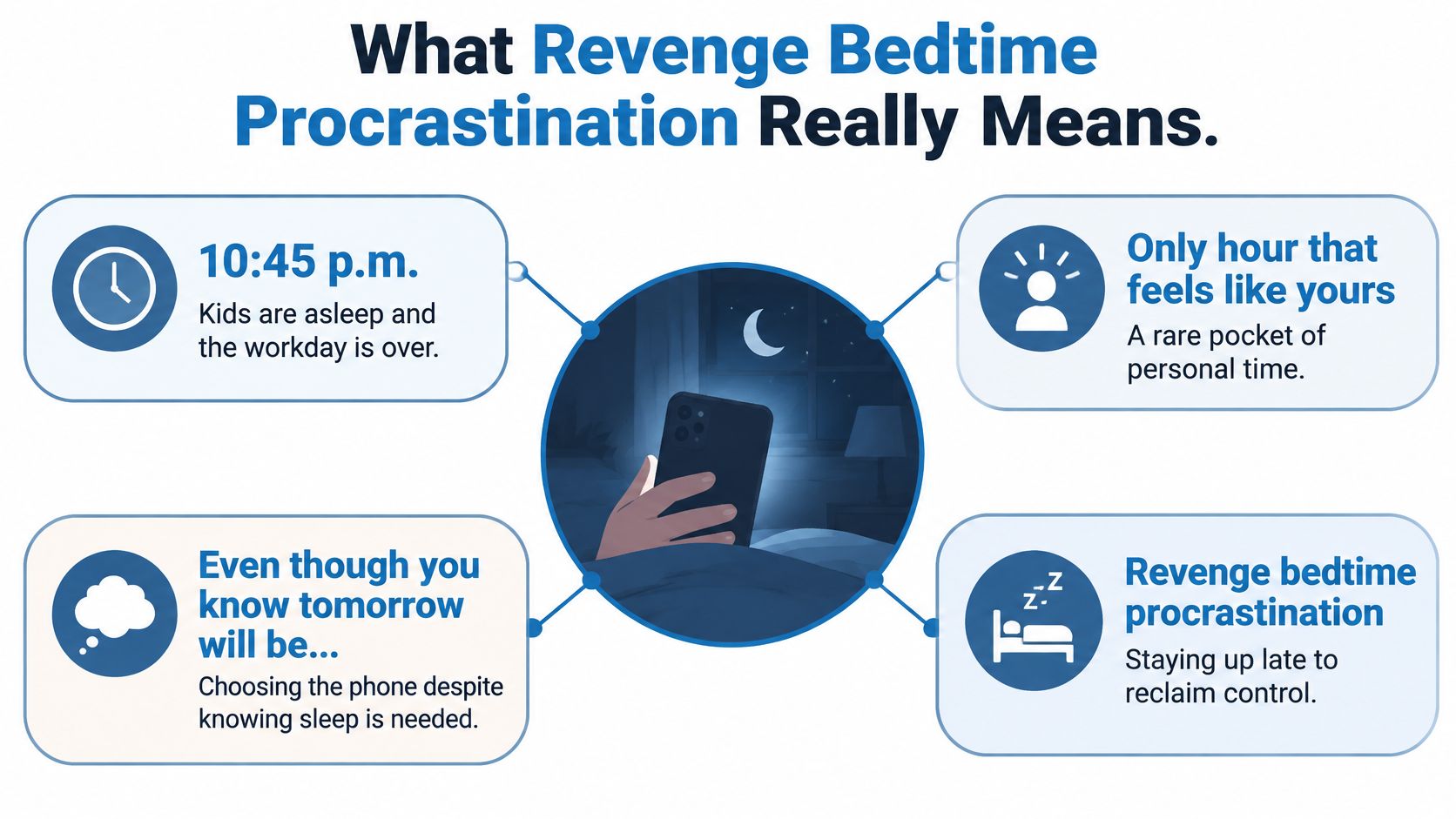
Say it's 10:45 p.m. The kids are asleep, the workday is over, and you finally settle onto the couch. You open your phone for a little downtime, even though you know tomorrow will be harder if you keep scrolling.
Revenge bedtime procrastination means intentionally delaying sleep despite expecting negative consequences, without an external obligation keeping you awake. The “revenge” usually means reclaiming leisure, choice, or emotional recovery after a demanding day.
It's like borrowing from tomorrow's sleep account to buy an evening of freedom. In this example, the bill arrives with your 6:30 a.m. alarm.
The illustration below captures that conflict between needing sleep and wanting time that feels like yours.
A behavior, not a diagnosis
Researchers formally introduced bedtime procrastination as a self-regulation problem in a 2014 study, whose participants averaged 2.8 on its bedtime-procrastination scale, while nearly 30% reported six hours or less of weeknight sleep, according to the original bedtime-procrastination paper. Those results describe that study's participants, not a diagnostic cutoff for an individual reader.
The informal “revenge” label adds a possible motivation. You might resist bedtime because sleep seems to end your freedom, not because you misunderstand the value of rest.
Wanting personal time isn't the problem. The question is whether getting it this way repeatedly costs you sleep you need.
How common is it?
A peer-reviewed review of bedtime procrastination reports that more than 50% of the general population postpones bedtime at least two nights per week, and describes associations with shorter sleep, poorer sleep quality, and daytime fatigue.
That isn't the same as scoring highly on a questionnaire. A systematic review found estimates of high bedtime procrastination ranging from 16% to 50.9%, depending on the measurement cutoff.
These percentages answer different questions. Frequent delay, a high questionnaire score, and a clinical sleep disorder aren't interchangeable.
Start with a more personal question: What does the late hour give me that the daytime does not? Your answer might be quiet, entertainment, privacy, relief from worry, or the chance to make a choice without negotiating with anyone.
How It Differs From Insomnia and Delayed Sleep Phase
Pattern | Is the Delay Voluntary? | Main Driver | Key Test | First Move |
|---|---|---|---|---|
Revenge bedtime procrastination | Yes, despite expected harm | Autonomy deficit, stress, self-regulation | Intended bedtime is earlier than actual lights-out, without an external barrier | Protected leisure block and shutdown cue |
Insomnia | No, sleep is wanted but doesn't come | Conditioned arousal, worry, sleep effort | Trouble falling or staying asleep at least 3 nights a week for 3 months despite adequate opportunity | CBT-I and clinical evaluation |
Delayed sleep phase disorder | Partly, but biological timing isn't simply a choice | Circadian timing shifted late | For example, falling asleep around 2 a.m. or later when unconstrained and struggling to wake on schedule | Clinician-guided light timing and a fixed schedule |
Ordinary late sleep | Usually no | Shifts, caregiving, classes, or other external demands | The external schedule explains the late bedtime, rather than a reward activity | Adjust the schedule where possible |
Revenge bedtime procrastination compared with related sleep patterns
Read the table as a starting point, not a diagnostic checklist. Clock time alone doesn't tell you why someone is awake.
With procrastination, the useful distinction is between when you planned to stop and when you stopped. You intended to begin your routine, but kept watching, gaming, or browsing instead.
Wanting sleep versus postponing it
Insomnia involves difficulty sleeping when you have the opportunity and want to sleep. Someone may put the phone away, turn out the light, and then remain awake with worry or frustration.
Don't wait until you meet a duration threshold before asking for help if you're struggling. The explanation of why you can't sleep even though you're tired can help you describe the difference between exhaustion, sleepiness, and nighttime alertness.
A delayed sleep phase involves a later biological sleep schedule. Someone may sleep comfortably on their preferred late schedule but struggle when school or work requires an earlier bedtime and wake time; the example in the table isn't a universal cutoff.
Practical distinction: Ask whether you're postponing the attempt to sleep, attempting sleep without success, or trying to sleep before your body is ready.
More than one pattern can apply
A late chronotype alone isn't a disorder. Clinical concern depends on distress, impairment, and whether someone can meet necessary daily responsibilities.
You can also have a late chronotype and procrastinate beyond your own preferred bedtime. Or you can delay bedtime, then experience insomnia once you finally try to sleep.
External constraints deserve recognition, too. A parent tending to a sick child isn't voluntarily sacrificing sleep for entertainment. That person needs practical support and sleep opportunity, not a lecture about discipline.
Causes and Risk Factors That Keep the Pattern Going
In a study of 420 university students, higher self-regulation was associated with less revenge bedtime procrastination, with a statistically significant but modest correlation of r = −0.196. The researchers used the Short Self-Regulation Questionnaire and Revenge Bedtime Procrastination Scale, rather than just asking whether students stayed up late.
That finding supports taking self-regulation seriously, but it doesn't establish that poor self-control causes the behavior. Managing emotions, switching activities, and allocating personal time can all matter.
When your day feels overcontrolled
After spending the day responding to supervisors, children, assignments, or caregiving needs, you may experience bedtime as another demand. Continuing an enjoyable activity can become a way to say that you still get to decide something.
The following patterns are possibilities to assess, not diagnoses you can infer from scrolling.
Driver | How It Drives the Delay | Typical Sign | Where to Focus |
|---|---|---|---|
Stress and overload | Late hours become the only recovery window | More phone use after demanding days | Daytime workload and a protected evening break |
Autonomy deprivation | Choosing bedtime feels like the only control left | Resentment about routines or bedtime reminders | Personal time earlier in the evening |
Work or school schedules | Long days squeeze out leisure | Late bedtimes alongside early required waking | Boundaries around work or study end times |
ADHD | Switching tasks and resisting immediate rewards can be difficult | Losing track of time, screen hyperfocus, unfinished tasks | External timers, shutdown cues, treatment evaluation |
Depression | Avoidance and low energy can push activities later | Low mood and flat daytime energy | Mood assessment and behavioral activation |
Anxiety | Checking, planning, or rumination delays disengagement | Worry continues after the phone is put away | Earlier worry scheduling and anxiety treatment |
Bipolar-spectrum symptoms | Elevated energy may accompany reduced need for sleep | Short nights without expected tiredness, increased activity | Prompt psychiatric evaluation |
Common drivers of revenge bedtime procrastination
Match support to the driver
Chronotype belongs in the assessment even when it isn't the main explanation. Someone who naturally becomes sleepy later may need a different schedule strategy from someone who feels sleepy but resists stopping entertainment.
For workload-related difficulties, the discussion of insomnia and burnout offers context for examining demands rather than treating bedtime as an isolated failure.
If you're exploring stress products, REVETIX on choosing stress support provides a supplement-focused perspective. That commercial resource isn't evidence that supplements treat bedtime procrastination; discuss ingredients and medication interactions with a clinician or pharmacist.
The same visible behavior can serve different purposes. A timer may help someone lose less time gaming, but it won't resolve untreated depression, an impossible caregiving schedule, or an emerging mood episode.
Warning Signs That Point to a Bigger Problem
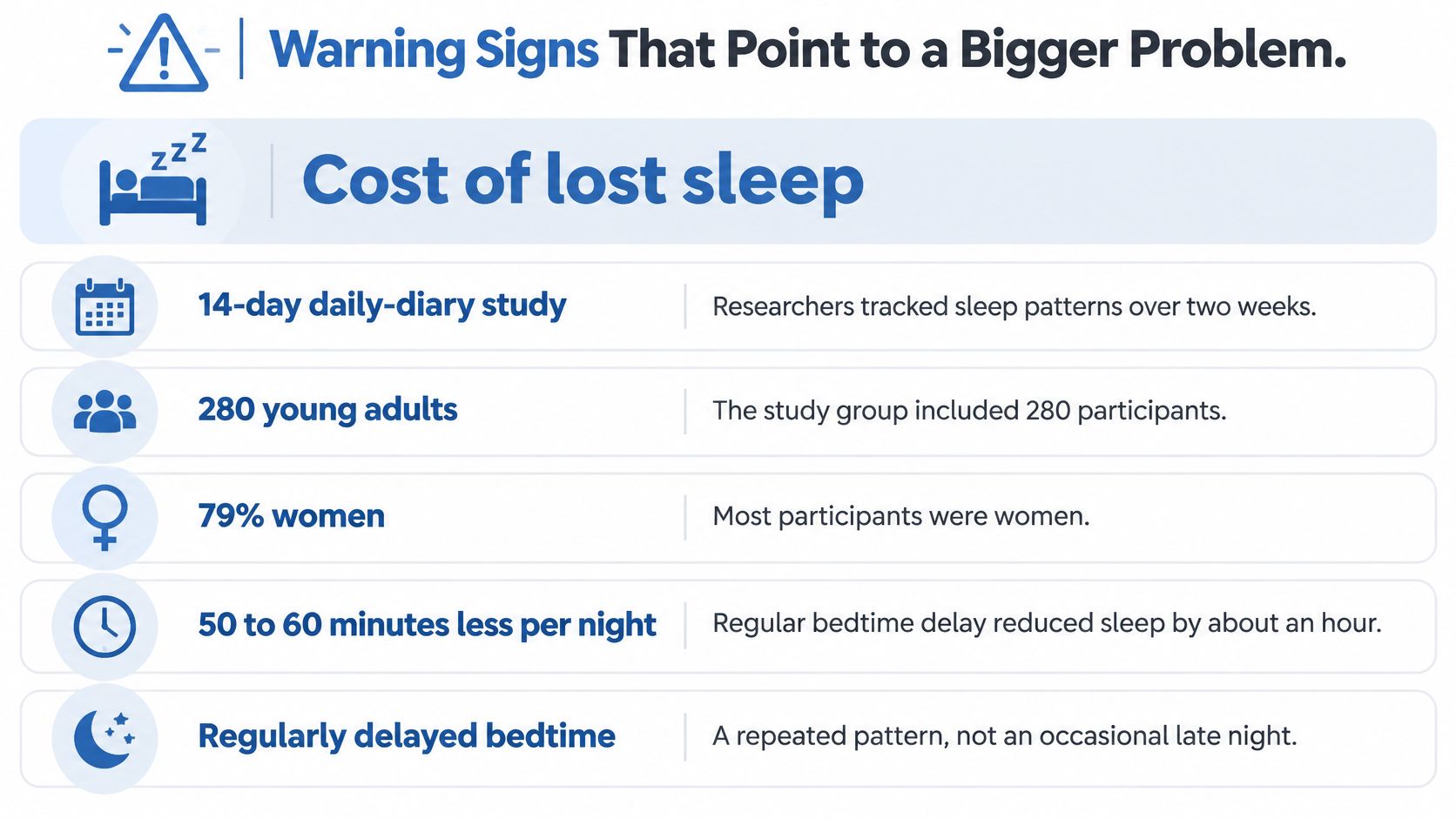
In a 14-day daily-diary study of 280 young adults, 79% of whom were women00171-7/pdf), regular bedtime procrastinators slept approximately 50 to 60 minutes less per night, were about twice as likely to report daytime sleepiness, and reported more negative mood. The study's reported sleep-loss comparison illustrates how repeated delays can matter beyond the evening itself.
The visual below summarizes the study group and the observed sleep difference.
These associations don't prove that bedtime procrastination alone causes psychiatric symptoms. They do support taking persistent delay seriously when you're struggling during the day.
Signs to bring to an evaluation
Daytime impairment: You're making mistakes, missing classes, struggling to parent, or becoming unsafe behind the wheel.
Sustained sleep loss: Severe restriction continues for several weeks rather than an occasional difficult night.
Unsuccessful sleep attempts: You can't sleep despite having adequate time and a suitable opportunity.
Unusual mood or energy: Racing thoughts, heightened or markedly irritable mood, impulsivity, or feeling little need for sleep warrants prompt assessment.
Trauma-related arousal: Nightmares, hypervigilance, or fear of falling asleep makes nighttime difficult.
Substance reliance: You're using alcohol, cannabis, or sleep aids to make yourself sleep.
Suicidal thinking: Seek immediate support through 988 in the United States or emergency services. Don't wait for a routine appointment if you're in danger.
What clinicians look for
A psychiatric evaluation typically includes a structured conversation about your sleep schedule, mood history, medications, substance use, and daily functioning. A clinician may screen for ADHD, anxiety, depression, trauma-related conditions, and bipolar-spectrum symptoms.
The treatment plan follows the findings. It may include CBT-I, dialectical behavior therapy skills for emotion regulation, or medication management when clinically indicated, rather than automatically prescribing a sleep medication.
You can also use this video as an additional discussion resource.
For Florida residents, statewide telepsychiatry through a secure video visit can make that initial conversation easier to arrange. You don't need to decide whether the problem is behavioral, psychiatric, or circadian before seeking help.
CBT-I Techniques and Sleep Hygiene Basics Worth Using
Technique | What It Does | How to Start | Caution |
|---|---|---|---|
Stimulus control | Rebuilds the bed as a cue for sleep rather than scrolling or worry | Reserve bed for sleep; when persistently awake, do something quiet in dim light and return when sleepy | Improvement isn't immediate; allow time to practice |
Fixed wake time | Supports a consistent body-clock anchor | Aim for the same wake time seven days a week | Late chronotypes may need gradual, clinician-guided adjustments |
Sleep window or restriction | Consolidates sleep by matching time in bed to estimated sleep | A clinician may begin with average sleep time and later extend the window by 15 to 30 minutes after sustained improvement | Avoid self-directed use with bipolar disorder or seizure risk |
Wind-down pacing | Prevents demanding tasks from running into bedtime | Try finishing the last demanding task about 90 minutes before target lights-out | Preserve leisure instead of replacing it with chores |
Light and caffeine timing | Supports daytime alertness and nighttime sleep readiness | A practical starting plan may include 10 to 30 minutes of morning daylight and avoiding caffeine within about eight hours of bed | Ask about caffeine if you take ADHD stimulant medication; light treatment needs individualized advice |
Screen and stimulation limits | Reduces stimulating input near bedtime | Charge the phone outside the bedroom; try ending intense gaming or streaming 30 to 60 minutes before the shutdown cue | Replace the activity with something satisfying earlier |
Cognitive restructuring | Challenges all-or-nothing beliefs about personal time | Write the thought, examine the evidence, and develop a balanced alternative | Practice with a trained therapist when thoughts remain difficult to shift |
CBT-I techniques and sleep hygiene basics for revenge bedtime procrastination
These are practical starting parameters, not universal prescriptions. Sleep hygiene supports sleep opportunity; it doesn't necessarily address why you resist using that opportunity. CBT-I targets thoughts and learned behaviors that interfere with sleep, particularly when insomnia is also present.
Choose a small starting set
Choose two or three approaches that fit your actual obstacle. If you stay on your phone in bed, begin with stimulus control and a charging location outside the bedroom; if evening tasks run late, prioritize wind-down pacing.
For an all-or-nothing belief that a day without personal time is wasted, write down what you missed and what you could protect tomorrow. A balanced alternative is that personal time matters, and staying awake isn't the only way to make room for it.
Safety first: Sleep restriction isn't a challenge to tolerate less sleep. It's a structured treatment that requires appropriate screening and monitoring.
Account for other sleep disruptors
The overview of natural approaches to insomnia treatment can help you discuss routines and relaxation strategies with a clinician.
If hot flashes or other menopause symptoms interrupt sleep, Lila's guide to sleep better during menopause offers symptom-specific context. Don't assume every disrupted night is procrastination when a physical symptom is waking you.
Sleep restriction and cognitive restructuring are best individualized with a trained therapist, especially when mood symptoms or persistent insomnia complicate the picture.
A Step-by-Step Evening Plan That Interrupts the Loop
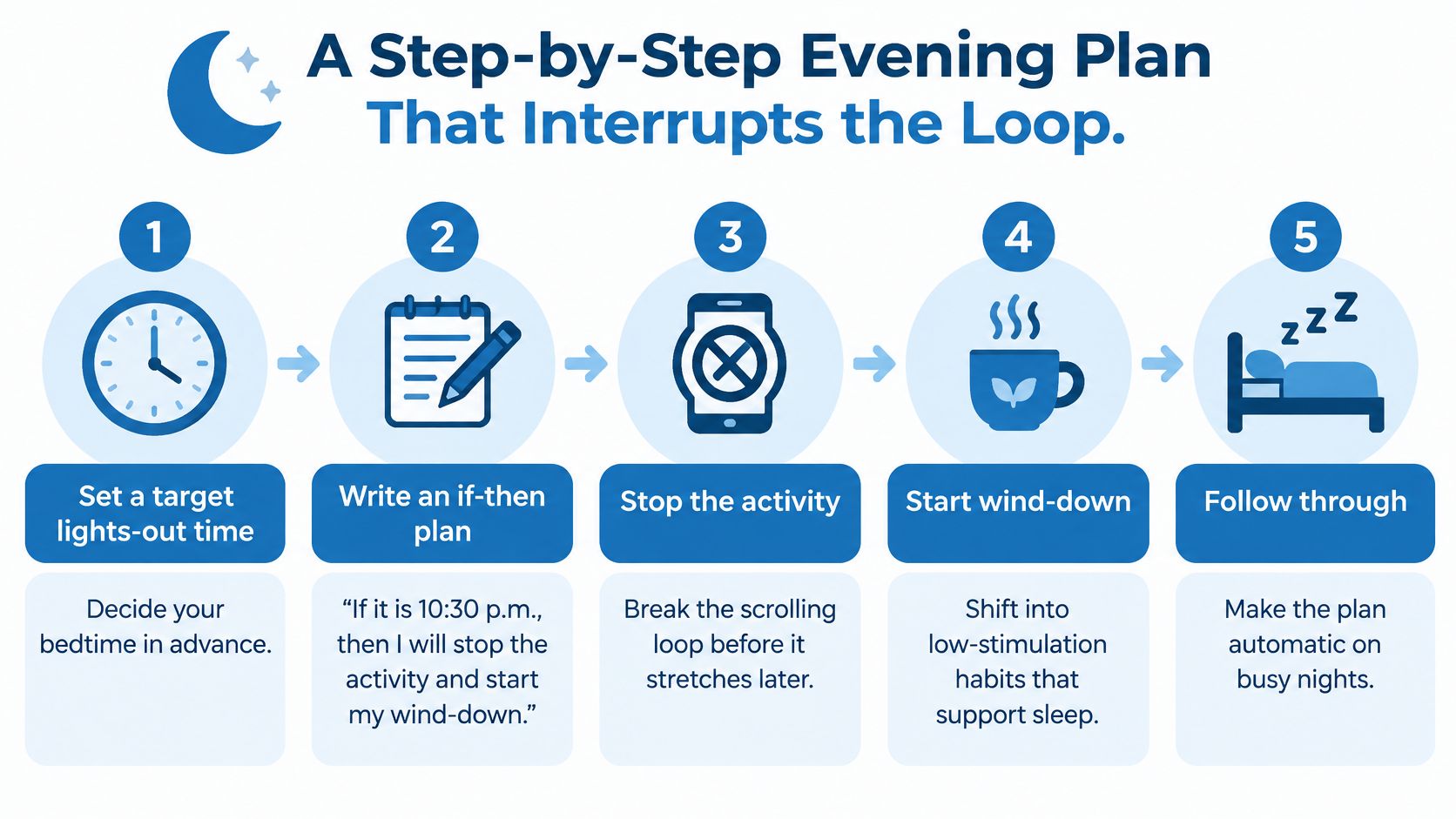
Make the plan easy enough to follow on a demanding evening, not just an unusually calm one. A paper on bedtime procrastination and self-regulation supports using concrete precommitment strategies that connect a cue with an action.
The visual below shows the basic transition from deciding on a bedtime to following through.
Make the transition concrete
Set a target lights-out time and an if-then plan. For example, if your shutdown cue is 10:30 p.m., decide in advance that you'll stop the activity, plug your phone into its charging station, and begin your routine. The first physical action matters more than a vague intention to sleep earlier.
Move the reward earlier. As an experiment, protect a 60-to-90-minute leisure block after dinner if your responsibilities allow it. Choose an activity you enjoy, not another self-improvement assignment; a shorter protected break is preferable to an unrealistic promise.
Label the urge without attacking yourself. Acknowledge that you're seeking recovery time, then decide how to meet that need without extending the night indefinitely. A study of self-compassion and bedtime procrastination links self-compassion with less delay through emotional pathways, although that doesn't guarantee an individual result.
Use a brief transition. Try a five-minute breathing exercise, with slow, comfortable breaths rather than forced deep breathing, or write tomorrow's first task on paper. If comfortable, approximately six breaths per minute can provide a simple pacing exercise; stop if you feel dizzy or uncomfortable.
Agree on a boundary with other people. For example, stop nonurgent work messages after 9 p.m., or arrange a shared chores rule with your partner. A bedtime plan is harder to follow if everyone still expects you to remain available.
Track seven nights without grading yourself. Record intended bedtime, actual lights-out, estimated hours slept, and morning sleepiness. Add the activity or emotion that kept you up so you can distinguish entertainment spillover from worry or necessary responsibilities.
Adjust after one week. Move leisure earlier if it repeatedly runs past the cue. If worry takes over when you stop, add a short written worry list before the transition; the guidance on how to stop overthinking at night offers additional strategies to discuss with your therapist.
A realistic example
Consider a hypothetical hospital nurse finishing a 12-hour shift at 7:30 p.m. She usually scrolls until 1 a.m., partly because she hasn't had a moment to herself.
On evenings when her commute and responsibilities permit, she experiments with leisure from 8 to 9:30 p.m. and keeps a 10:30 p.m. shutdown cue. Over the next two weeks, her goal is to create more sleep opportunity, not prove she can follow a perfect schedule.
If the plan doesn't fit her actual evening, she changes the plan. The purpose is to protect both recovery and sleep, not turn bedtime into another test she can fail.
Book a Psychiatric Evaluation for Persistent Late Nights
Book an evaluation if a warning sign applies, or if the pattern continues after two or more weeks of trying the evening plan and a couple of suitable behavioral techniques. Treat that interval as a practical check-in, not a diagnostic threshold; seek help sooner for significant impairment or mood changes.
A psychiatric evaluation can clarify whether you need sleep-focused therapy, treatment for another condition, or support changing daily demands. Refresh's board-certified psychiatrists and licensed therapists evaluate adults, adolescents, and children, coordinating medication management with CBT, DBT, or trauma-focused therapy when appropriate.
HIPAA-compliant virtual visits are available throughout Florida on a compatible device. Patients considering ADHD treatment can review Florida telehealth and ADHD medication considerations before discussing their individual needs.
We accept Aetna, United Healthcare/ UHC, Cigna, Blue Cross Blue Shield, Humana, Tricare, UMR, and Oscar insurance plans. Confirm your specific benefits when scheduling.
Contact us or call Refresh Psychiatry at (954) 603-4081 to schedule your evaluation.
This blog is for informational purposes only and does not constitute medical advice. Please consult a qualified mental health professional for personalized guidance.
Refresh Psychiatry & Therapy offers coordinated psychiatric assessment and therapy through Florida telehealth visits to help identify what's keeping you up. Schedule an evaluation to build a plan that addresses your sleep, emotional needs, and daily responsibilities together.