
Buspirone vs Hydroxyzine: Anxiety Treatment Guide

Hydroxyzine usually begins working within 15 to 30 minutes, while buspirone typically takes 2 to 4 weeks of consistent daily dosing to develop its clinical effect. Neither medication is universally better, because hydroxyzine is mainly a rapid symptom-relief option and buspirone is designed for longer-term anxiety management.
You may be sitting in a Florida clinic or telepsychiatry appointment with a familiar problem: anxiety is interfering with sleep, work, driving, relationships, or your ability to relax, and your provider mentions either buspirone or hydroxyzine. The names sound as though they belong in the same category, but they don't function as interchangeable substitutes.
The most useful question isn't, “Which medication is stronger?” It's what job do you need the medication to perform? Hydroxyzine may fit an occasional surge of physical tension or nighttime restlessness. Buspirone may fit persistent generalized worry that requires a scheduled, longer-term approach. Your symptoms, daily responsibilities, other medications, cardiac history, age, and treatment goals all influence the decision.
Understanding When to Choose Each Medication
A patient may describe anxiety that appears before presentations, flights, medical procedures, or difficult conversations. Another may wake with worry, carry muscle tension throughout the day, and spend hours anticipating problems that haven't happened. Both patients may use the word “anxiety,” but their treatment needs aren't identical.
For the first patient, a prescriber may consider hydroxyzine because its effects are felt relatively quickly and its sedating properties can reduce the intensity of an acute episode. For the second, buspirone may make more sense because it is taken consistently and evaluated over time rather than used as a one-dose rescue medication.
That distinction also explains why a medication can appear ineffective when the timing is misunderstood. Taking buspirone only on the days you feel anxious doesn't match its usual role. Taking hydroxyzine before driving, working, or performing a task that requires alertness may create a different problem, because sedation can interfere with functioning.
Practical rule: Match the medication to the pattern of anxiety, not merely to the word “anxiety” on the problem list.
The treatment job matters more than the medication ranking
Hydroxyzine is often considered when the immediate priority is calming the body. A racing mind may occur alongside physical agitation, difficulty settling at night, or a short-lived anxiety spike. Its rapid onset can be useful in that setting, but the same effect may cause unwanted drowsiness during the day.
Buspirone is better understood as a scheduled treatment for ongoing anxiety, particularly generalized anxiety disorder. It requires patience and regular dosing. Someone seeking a medication for a single stressful event may be disappointed by buspirone, while someone seeking a sustainable daytime option may find hydroxyzine too sedating.
Patients often benefit from reviewing whether they need:
Immediate relief: Anxiety rises quickly and the episode is occasional or situational.
Steady baseline treatment: Worry is present across much of the day and continues over weeks.
Daytime alertness: Work, school, driving, parenting, or caregiving make sedation difficult.
Nighttime calming: Anxiety and physical restlessness are most disruptive in the evening.
A broader plan: Medication may need to be combined with psychotherapy, sleep support, and treatment of depression, trauma, panic, or another underlying condition.
If anxiety has begun affecting your daily life, the signs you may need medication for anxiety can help organize the concerns you bring to an evaluation. They can't determine which medication is appropriate, but they can help you describe the frequency, triggers, physical symptoms, and functional impact of your anxiety more clearly.
How Buspirone and Hydroxyzine Work Differently
Buspirone and hydroxyzine feel different because they act through different biological pathways. Buspirone works through serotonin receptor activity and is intended to build a therapeutic effect with consistent use. Hydroxyzine blocks histamine receptors in the central nervous system, producing a more noticeable calming and sedating effect soon after an oral dose.
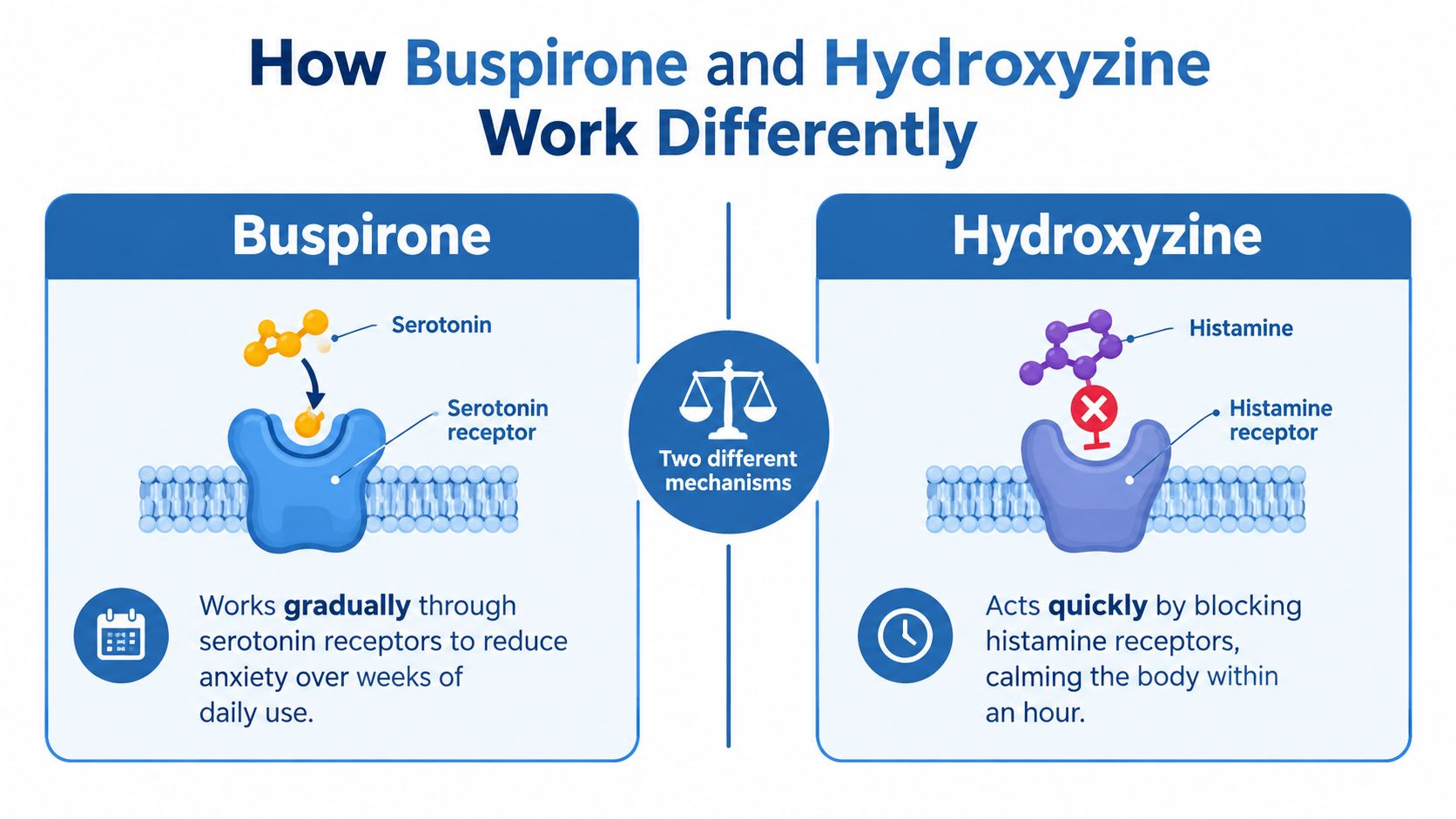
Two mechanisms, two timelines
Buspirone's delayed onset is central to its clinical use. Its FDA labeling describes an average elimination half-life of about 2 to 3 hours after single oral doses of 10 to 40 mg, which helps explain why it may be prescribed in divided doses rather than as a one-time rescue medication. The same labeling describes a recommended starting dose of 15 mg per day, divided into two doses, with increases of 5 mg per day every 2 to 3 days and a maximum of 60 mg per day. These figures come from the FDA buspirone prescribing information, and they aren't a dosing plan for an individual patient.
Hydroxyzine's FDA labeling states that clinical effects are usually noticed within 15 to 30 minutes after oral administration. The labeling also lists adult anxiety dosing of 50 to 100 mg four times daily, but a prescriber must determine whether that regimen is appropriate based on the individual, formulation, medical history, and other medicines. The FDA hydroxyzine labeling also identifies sedative uses, which reinforces why hydroxyzine is often viewed as a short-term symptomatic option.
Medication | Onset of Action | Duration of Effect | Half-Life |
|---|---|---|---|
Buspirone | Clinical effect generally develops over 2 to 4 weeks of consistent dosing, according to DrugBank's buspirone reference | Ongoing effect depends on regular scheduled dosing | About 2 to 3 hours after single oral doses of 10 to 40 mg, according to FDA labeling |
Hydroxyzine | Usually 15 to 30 minutes after oral administration, according to FDA labeling | Calming and sedating effects typically last about 4 to 6 hours, according to Drugs.com's hydroxyzine reference | Usually about 14 to 25 hours in adults, according to Drugs.com |
Hydroxyzine's subjective effect can feel shorter than the time the medication remains in the body. That matters if you feel groggy the next morning or notice sedation after repeated doses. For a broader discussion of its clinical role, see the hydroxyzine medication guide.
What the Research Shows About Efficacy
The strongest direct comparison comes from a 244-patient, 4-week multicentre double-blind trial conducted in France and the UK. Participants with generalized anxiety disorder received hydroxyzine, buspirone, or placebo after a one-week placebo run-in. The study used hydroxyzine at 12.5 mg in the morning and midday plus 25 mg in the evening, buspirone at 5 mg in the morning and midday plus 10 mg in the evening, or placebo. The trial is described in the head-to-head PubMed study.
On the primary Hamilton Anxiety Scale endpoint, hydroxyzine improved by 10.75 points, compared with 7.23 points for placebo. Only hydroxyzine separated significantly from placebo on that primary endpoint, although secondary measures showed that both active medications outperformed placebo. That is an important finding, but it doesn't establish that hydroxyzine is the universally superior medication.
What the comparison can and cannot prove
The controlled trial lasted four weeks, which favors a medication with a faster noticeable effect. Buspirone may need a longer period of consistent dosing before a patient can fairly judge its role in ongoing anxiety. A medication that hasn't produced immediate relief may still be poorly matched to an acute symptom, rather than ineffective for the condition it was intended to treat.
A Cochrane review found no superiority of hydroxyzine over buspirone in the single eligible head-to-head study. Across 163 participants, the odds ratio was 0.76, with a 95% confidence interval of 0.40 to 1.42. The review also found no meaningful difference in side effects, with an odds ratio of 1.07 and a 95% confidence interval of 0.57 to 2.02. These figures are reported in the Cochrane review of hydroxyzine for generalized anxiety disorder.
A later evidence summary noted a 28-day response comparison of 30 out of 71 patients, or 42%, for hydroxyzine, versus 26 out of 72, or 36%, for buspirone. Those results suggest broadly similar short-term outcomes, but the sample was limited and the evidence doesn't justify a simple winner-takes-all conclusion.
The practical meaning is straightforward. Hydroxyzine may show its value quickly, while buspirone needs a fair trial that respects its delayed timeline.
Why patient goals change the answer
A person who needs occasional relief before a predictable stressor may value speed more than long-term coverage. A person with persistent generalized worry may prioritize minimal sedation and a medication that can fit daytime responsibilities. Someone who has not tolerated other treatments may need to discuss a wider plan rather than treating this comparison as a complete anxiety strategy.
The Buspar reviews and anxiety treatment discussion can provide additional context, but online information can't determine whether a particular medication, dose, combination, or treatment duration is appropriate for you.
Dosing Patterns and Side Effect Considerations
Hydroxyzine may be felt soon after a dose, while buspirone is judged over a scheduled trial rather than a single episode. That difference shapes the daily trade-off. Hydroxyzine can calm acute anxiety but may cause sleepiness, slowed reactions, or mental fog. Buspirone generally fits daytime use more easily, although it requires consistent dosing and patience while benefits develop.
The most useful prescribing question is, “What side effect can I tolerate, and what side effect would disrupt my life?” Someone working an early shift or driving for work may need to avoid daytime sedation. Someone whose anxiety interferes with sleep may find evening drowsiness helpful, provided the medication is prescribed and used safely. These medications often serve different jobs in an anxiety plan rather than competing for the same role.
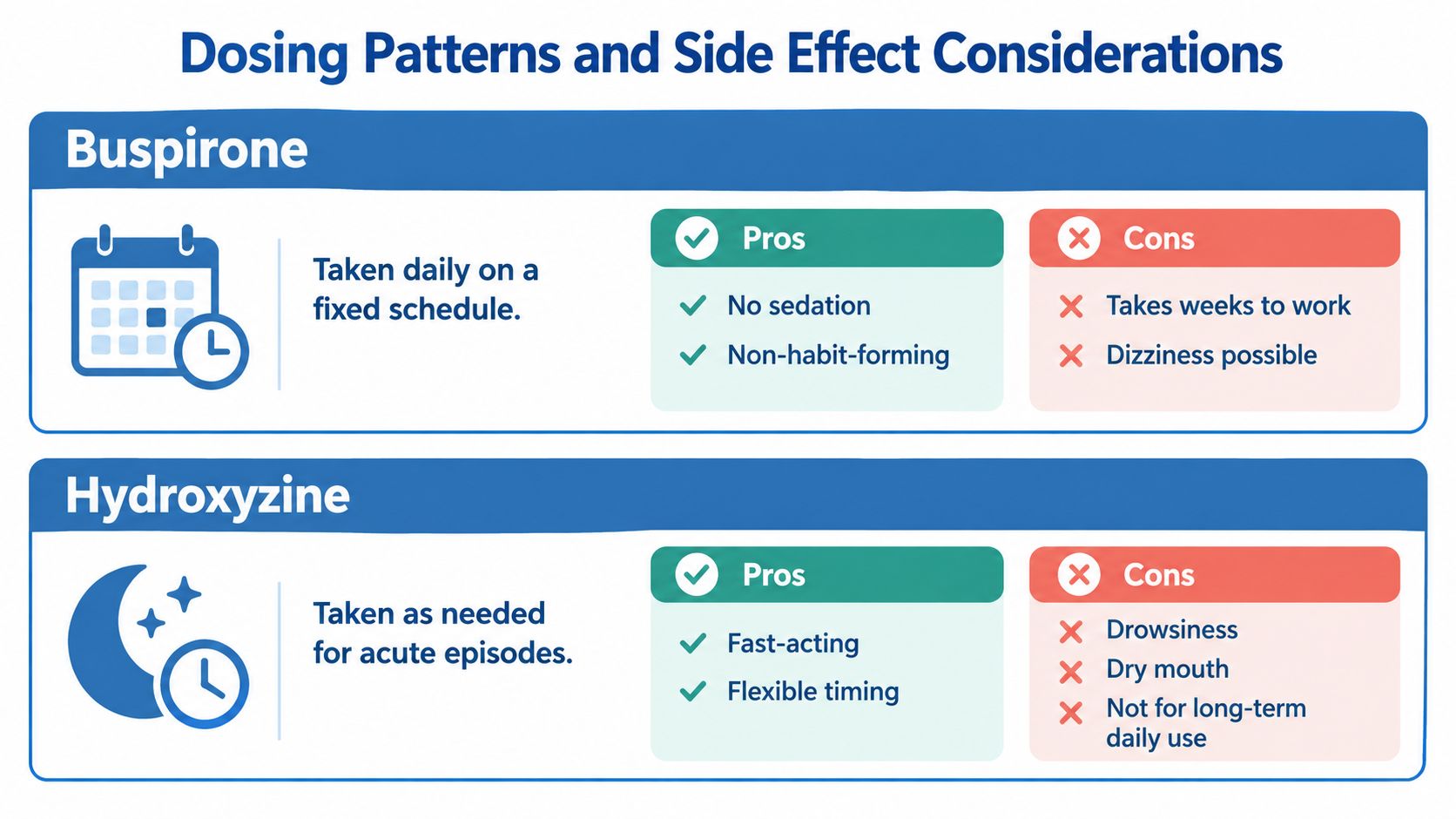
Comparing common tolerability concerns
Hydroxyzine's main limitation is sedation. Dry mouth and other anticholinergic effects can also affect comfort, concentration, and daily functioning. Buspirone is commonly associated with dizziness, nausea, headache, and nervousness. The clinical comparison of buspirone and hydroxyzine characterizes buspirone as minimally sedating in the evidence reviewed.
Medication | Common Side Effects | Serious Concerns | Special Populations |
|---|---|---|---|
Buspirone | Dizziness, nausea, headache, and nervousness | Review interactions and medical history with the prescriber, particularly when changing from recent sedative treatment | May suit patients who need daytime alertness, but its effectiveness may be reduced after recent benzodiazepine exposure |
Hydroxyzine | Sedation, drowsiness, and anticholinergic effects such as dry mouth | QTc concerns and cumulative sedation require attention | Older adults may be more vulnerable to cognitive and balance effects; cardiac history requires careful review |
Older adults require particular caution with hydroxyzine because sedation, anticholinergic burden, and QTc concerns can alter the risk calculation. Tell the prescriber about heart disease, fainting, or medications that affect cardiac rhythm before starting treatment.
Pregnancy and breastfeeding call for an individualized review. The prescriber should consider anxiety severity, alternative treatments, pregnancy stage, other medications, and the risks of untreated symptoms before recommending either drug or a combination. Do not start, stop, or combine these medications based only on an online comparison.
Dosing consistency changes the outcome
Buspirone is usually increased gradually and taken at consistent times. Missing doses, repeatedly changing the schedule, or using it only during a panic-like episode can make its effect difficult to assess. A buspirone dosing guide for anxiety can help you prepare questions, but your prescription instructions take priority.
Hydroxyzine may be used around acute symptoms or at a scheduled time, depending on the treatment plan. A fast onset does not make it appropriate before driving, alcohol use, operating equipment, or demanding work. Ask how long drowsiness may last, what level of sedation to expect, and whether repeated use fits your treatment plan.
Choosing the Right Option for Your Situation
A useful decision starts with your anxiety pattern, not with a medication preference formed from a social media post. Write down when symptoms occur, how long they last, what they prevent you from doing, and whether your priority is immediate relief or a lower baseline of worry over time.

Start with the symptom pattern
Choose the conversation about hydroxyzine first if your anxiety arrives in short, recognizable episodes and rapid calming is the main goal. Examples may include situational distress, evening agitation, or a predictable event that causes acute symptoms. The key follow-up question is whether sedation would be acceptable at that time.
Discuss buspirone as a scheduled option if worry is persistent, difficult to control, and present across ordinary days. It may be a better fit when you need to remain alert for work, school, driving, or caregiving and can commit to regular dosing while waiting for a gradual effect.
Neither pattern makes the choice automatic. Anxiety may reflect panic disorder, generalized anxiety disorder, trauma, depression, insomnia, obsessive symptoms, substance use, a medical condition, or a combination of these. Treatment should address the underlying presentation rather than suppressing whichever symptom is most uncomfortable that day.
Account for age, pregnancy, and prior treatment
For an older adult, the sedation and anticholinergic burden of hydroxyzine may weigh heavily against it. For a pregnant patient, the decision requires direct discussion with the obstetric and mental health clinicians involved. For a child or adolescent, age, developmental stage, diagnosis, school functioning, and caregiver observations all matter. Don't use an adult medication plan as a template for a younger patient.
Recent benzodiazepine exposure also deserves an explicit conversation. Buspirone may be less effective after recent benzodiazepine use, so the treatment timeline and transition plan should be clear. A patient who has been taking a sedating medication regularly shouldn't make an abrupt change without prescriber guidance.
Ask whether one medication is being used as part of a larger plan
Some patients need a daily foundation for anxiety plus a limited option for occasional spikes. Combining medications can be considered in some circumstances, but it requires review of sedation, interactions, cardiac risk, substance use, pregnancy status, and the full medication list. Never combine buspirone and hydroxyzine on your own because they work through different mechanisms.
Bring these questions to your appointment:
What diagnosis or symptom pattern are we treating?
Is the goal immediate relief, long-term reduction in worry, or both?
How will sedation affect my work, driving, sleep, or caregiving?
How long should I take buspirone before judging its effect?
What side effects require a call to the office?
What should I do if I miss a dose?
Are therapy, CBT, DBT, sleep treatment, or another medication part of the plan?
Monitoring Progress and Planning Next Steps
Medication decisions become clearer when you track the outcomes that matter in your actual life. Note the intensity and timing of anxiety, sleep quality, concentration, physical symptoms, panic-like episodes, missed responsibilities, and side effects. For buspirone, consistency and adequate time are essential to a fair assessment. For hydroxyzine, record whether relief is useful without creating unacceptable daytime impairment.
Contact your prescriber if sedation affects driving or safety, dizziness persists, anxiety worsens, or side effects make you want to stop treatment. Seek urgent help for severe or rapidly escalating symptoms, thoughts of self-harm, fainting, or other emergency concerns.
Telepsychiatry can make follow-up practical for Florida patients who need medication monitoring without repeated travel. Refresh Psychiatry & Therapy provides psychiatric evaluations, medication management, and therapy through Florida telepsychiatry, with care that may include CBT, DBT, trauma-focused, or other evidence-based approaches. The psychiatry appointment guide explains what you can expect when preparing for an evaluation.
This blog is for informational purposes only and does not constitute medical advice. Please consult a qualified mental health professional for personalized guidance.
Refresh Psychiatry & Therapy offers Florida telepsychiatry, psychiatric evaluations, medication management, and therapy to help match anxiety treatment with your symptoms, schedule, and health history. We accept Aetna, United Healthcare/UHC, Cigna, Blue Cross Blue Shield, Humana, Tricare, UMR, and Oscar insurance plans. Visit Refresh Psychiatry & Therapy or call Refresh Psychiatry at (954) 603-4081 to schedule your evaluation.