
💊 Trazodone for Sleep Dose Explained

You're exhausted, but your mind is still active. You take trazodone hoping to sleep through the night, then wake up groggy and wonder whether the dose was too high, too low, or the wrong treatment for your insomnia. That uncertainty is common, especially because trazodone's official antidepressant dosing can look dramatically different from the amount clinicians often use for sleep.
The practical question isn't just, “What is the trazodone for sleep dose?” It's whether the dose improves sleep continuity and next-day function without leaving you overly sedated, dizzy, or unsafe. Trazodone can be useful for some patients, but it's an off-label sleep option with meaningful limitations, and dose changes should be guided by a qualified prescriber.
Understanding the Trazodone for Sleep Dose
A patient may take a small bedtime dose, sleep more heavily, and still wake feeling unrefreshed. Another may need only a modest dose to reduce repeated awakenings without significant morning impairment. These outcomes show why trazodone dosing for insomnia requires more than matching a prescription to a number on the label.
Trazodone was developed and approved as an antidepressant, not as a dedicated insomnia medication. The FDA trazodone label describes an initial antidepressant dose of 150 mg per day in divided doses, increases of 50 mg per day every 3 to 4 days, and outpatient maximums generally not exceeding 400 mg per day. Those figures describe historical antidepressant treatment. They are not routine targets for sleep.
For insomnia, clinicians generally use a substantially lower bedtime range. The clinical overview of trazodone describes doses around 25 to 100 mg at bedtime, with 50 mg often used as a practical starting point. The appropriate dose depends on sleep onset, nighttime awakenings, morning alertness, other medications, and the patient's risk of dizziness or falls.
Why antidepressant dosing is different
At lower doses, the immediate aim is usually sedation and improved sleep continuity, rather than treatment of major depressive disorder with antidepressant-range exposure. A larger dose does not automatically create more restorative sleep. It can instead increase morning drowsiness, orthostatic dizziness, or other adverse effects before providing additional benefit.
The systematic review and meta-analysis is more useful for understanding how insomnia studies assessed trazodone than for identifying one universally correct dose. Its findings point toward outcomes such as total sleep time and wakefulness after sleep onset, rather than a simple rule that increasing the dose consistently improves sleep. In practice, a prescriber should assess whether the patient is sleeping more continuously and functioning better the next day, not only whether the medication causes strong sedation.
A prescriber may recommend immediate-release trazodone at bedtime, with timing adjusted to how quickly drowsiness begins and whether impairment persists in the morning. Do not raise the dose after one poor night, and do not treat the antidepressant maximum as a self-directed sleep limit. If the duration of sedation is unclear, review how long trazodone lasts with your clinician before changing the dose.
What the Clinical Evidence Says About Efficacy
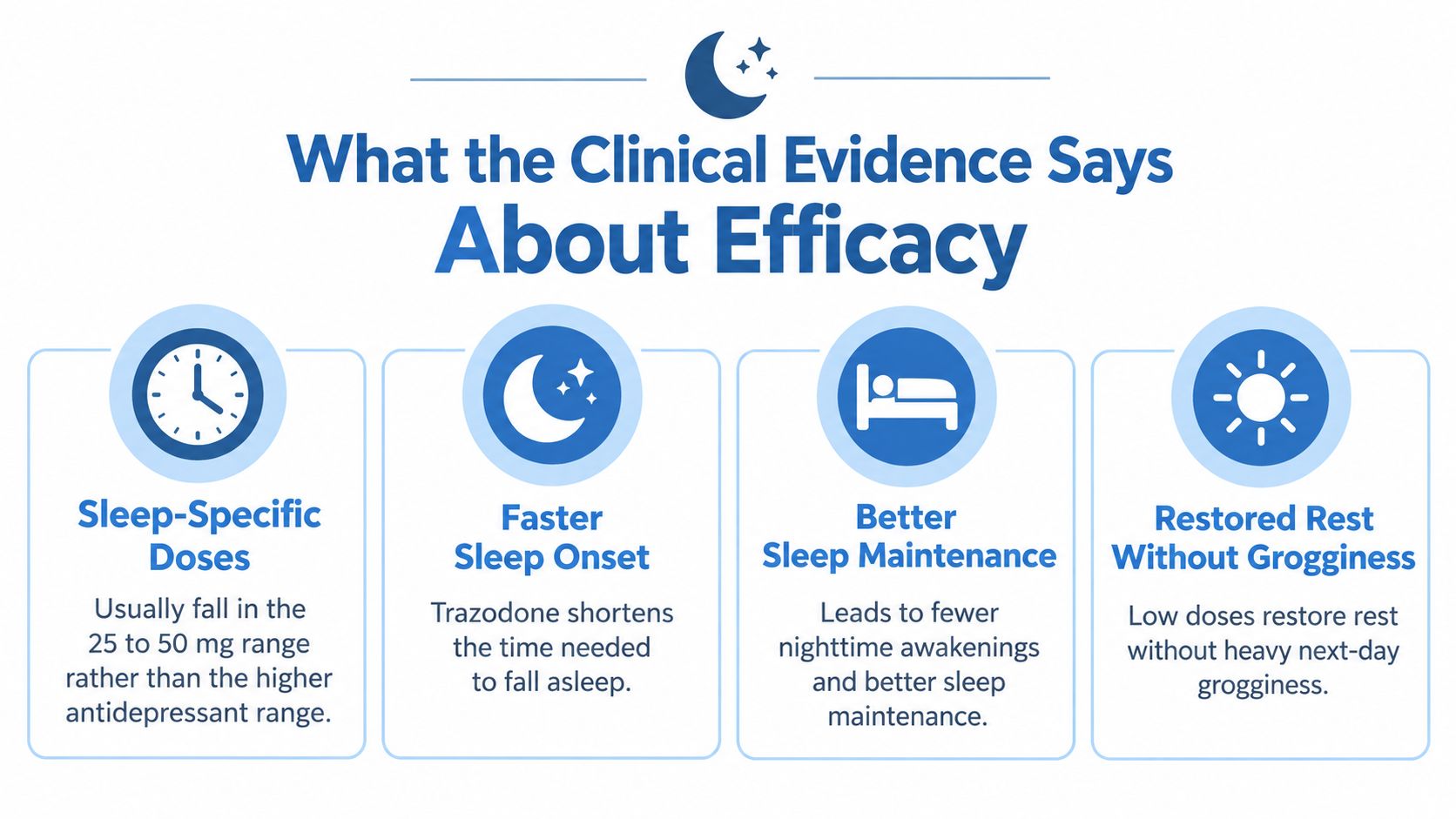
A patient may fall asleep quickly after taking trazodone and still wake feeling unrefreshed. That experience captures the central limitation of this medication: feeling sedated and obtaining restorative sleep are different outcomes. Clinical benefit should be judged by sleep onset, nighttime awakenings, total sleep time, and next-day functioning, not by drowsiness alone.
What low-dose trazodone is doing
Low-dose prescribing reflects a different clinical goal from the historical use of trazodone for depression. At bedtime doses, sedation is associated mainly with activity at 5-HT2A serotonin receptors and alpha-1 adrenergic receptors. A patient can therefore feel a strong sedative effect at a dose far below the antidepressant range, without receiving the broader treatment intended for major depressive disorder.
The available evidence suggests that trazodone may help some patients maintain sleep, with possible improvements in total sleep time and wakefulness after sleep onset. That profile may fit someone who falls asleep readily but wakes repeatedly. It does not show that increasing the dose will continue improving sleep, and it does not address every cause of insomnia.
The published evidence review should be interpreted as evidence of variable study methods and outcomes, rather than as a dosing formula. In clinical practice, the useful question is whether sleep is more continuous and daytime function is better. A patient who is unconscious for several hours but groggy, dizzy, or cognitively slowed the next morning may be experiencing sedation without a satisfactory sleep benefit.
Clinical perspective: The right dose is the lowest dose that provides a meaningful sleep benefit without impairing the following day.
Why the evidence remains mixed
Patients and clinicians can reach different conclusions because they may be measuring different results. A patient may value fewer awakenings, while a study may emphasize sleep efficiency or total sleep time. Someone else may sleep longer but describe the sleep as heavy and unrefreshing. The 2026 meta-analysis and evidence discussion reports improvements across several sleep measures, while also placing the size and clinical meaning of those improvements in context.
The response can also change over time. A prescribing review from the University of British Columbia describes benefits that may diminish within about two weeks for some patients and supports reassessing continued use rather than automatically raising the dose. The prescribing review from the University of British Columbia also supports tapering toward the lowest effective dose when longer-term treatment is being considered.
Before changing the dose, review how long the sedation lasts and whether impairment carries into the morning. Discuss how long trazodone lasts with the prescribing clinician instead of responding to one poor night by taking more.
Insomnia may also occur with depression, anxiety, trauma symptoms, pain, sleep apnea, restless legs, or irregular schedules. Depression and insomnia can reinforce each other, so treating the sleep symptom alone may leave the source of nighttime arousal active.
Immediate Release Versus Extended Release Formulations
The formulation on your prescription matters. Immediate-release and extended-release trazodone shouldn't be treated as interchangeable products, even when the medication name looks similar on the bottle. The formulation, tablet strength, instructions, and intended treatment target should all match the plan made with your prescriber.
For sleep-onset complaints, clinicians commonly consider the formulation and timing that best fit the patient's pattern. A patient who struggles mainly to fall asleep may need a different strategy from someone who falls asleep quickly but wakes repeatedly. Extended-release products may be selected for different clinical objectives, and a formulation that doesn't match the treatment plan can contribute to unwanted sedation or an ineffective bedtime routine.
Compare the prescription before changing the schedule
Read the exact wording on the bottle. Look for terms such as immediate release, extended release, or any instruction not to split or crush the tablet. If the label is unclear, ask the pharmacist to confirm the formulation before taking it differently from the written instructions.
Formulation | Onset Profile | Primary Clinical Use | Suitability for Sleep Onset |
|---|---|---|---|
Immediate release | Prescriber-directed bedtime use | Often considered when a clinician is targeting nighttime symptoms | May be suitable when the treatment plan focuses on falling asleep |
Extended release | Designed for a different release pattern | May be selected for broader or sustained medication coverage | May not match a sleep-onset plan unless specifically prescribed |
This table is a practical comparison, not a dosing instruction. The correct choice depends on the product dispensed, your other medications, medical history, and the sleep problem being treated. Don't crush, split, substitute, or move an extended-release product to bedtime without confirmation.
Before your next dose: Confirm the formulation, tablet strength, timing, and whether the prescriber expects you to take it with food or under other specific conditions.
Navigating Side Effects and Safety Precautions
A common experience goes like this: a patient starts with a low bedtime dose, falls asleep more easily, and feels encouraged. The next morning, standing up produces a wave of dizziness, or the patient feels slowed down while driving to work. That response isn't proof that trazodone is dangerous for everyone, but it is clinically important information that may require a timing change, a lower dose, a medication review, or a different treatment.
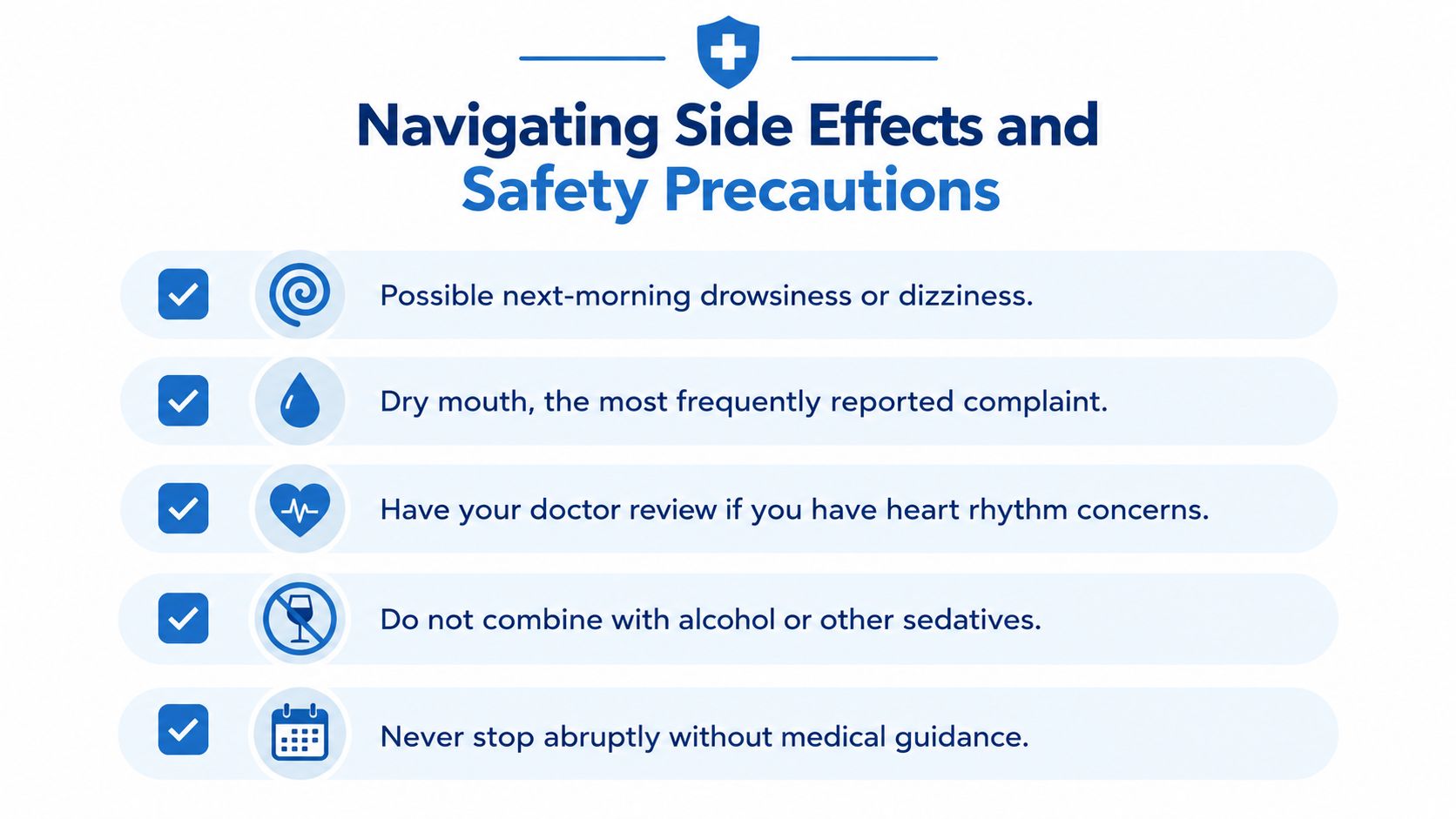
The most practical early concerns are drowsiness, dizziness, dry mouth, headache, and orthostatic hypotension, which means blood pressure can drop when you stand. A chronic-insomnia pharmacotherapy review also lists memory impairment and rare priapism among important risks. The chronic-insomnia medication review describes bedtime use around 50 to 100 mg about one hour before bed in some clinical contexts, but that doesn't make the same range appropriate for every patient.
How to respond during the first days
Take the medication only as prescribed and allow enough time for its sedating effects to be understood before driving, working at heights, or performing tasks that require quick reactions. Rise slowly from bed, especially if you wake during the night. If dizziness is significant, recurrent, or accompanied by fainting, contact the prescriber promptly.
A clinician may start low and assess the response before considering any increase. The relevant question isn't whether you can tolerate being heavily sedated. It's whether you sleep better and function safely the next day.
Risks that need direct attention
Morning impairment: Grogginess, slowed thinking, or poor coordination can make driving and work unsafe. Report persistent next-day effects rather than increasing or stopping the medication independently.
Postural dizziness: Move from lying to sitting, then standing, and hold onto a stable surface if needed. Ongoing dizziness deserves a medication and blood-pressure review.
Alcohol and sedatives: Don't combine trazodone with alcohol or other sedating substances unless a clinician has specifically reviewed the combination. The effects can compound and increase impairment.
Heart-related concerns: Tell your prescriber about heart rhythm problems, fainting, cardiovascular disease, or medications that affect cardiac conduction.
Priapism: A prolonged or painful erection is rare but urgent. It requires immediate medical attention rather than waiting for the medication to wear off.
Serotonergic combinations: Provide a complete list of prescription drugs, over-the-counter products, and supplements. Trazodone is contraindicated within 2 weeks of MAOI use, according to the chronic-insomnia pharmacotherapy review linked above.
Never stop a regular medication abruptly without medical guidance. A prescriber can determine whether tapering is appropriate, especially after ongoing use or when trazodone is combined with other psychiatric medications. For a broader review of medication reactions, see psychiatric medication side effects.
Special Considerations for Vulnerable Populations
A trazodone dose that leaves one adult sleepy may cause prolonged impairment in another. Age, blood pressure, heart rhythm, liver and kidney function, pregnancy status, psychiatric history, and concurrent medications all affect whether sedation is tolerable and whether sleep is actually restorative.
Older adults may be more sensitive to trazodone because age-related changes in drug handling can prolong its effects. A lower starting approach may be appropriate, with careful review of medication combinations and morning function. Ask about balance, memory, confusion, and nighttime bathroom trips. A patient may report sleeping longer while a family member notices new unsteadiness or slowed thinking. Those observations can change the risk-benefit assessment.
Pregnancy and breastfeeding call for an individualized discussion before trazodone is started, continued, or stopped. The decision depends on insomnia severity, psychiatric symptoms, pregnancy stage, available clinical information, and other treatment options. An online dose comparison cannot account for those factors.
Children and adolescents need assessment of the symptom driving the sleep complaint. Anxiety, depression, trauma, ADHD, bipolar-spectrum symptoms, substance use, and medical conditions can all present with disturbed sleep. Children and adolescents should receive trazodone only with psychiatric oversight and monitoring for mood or behavioral changes.
Cardiovascular disease, fainting history, and multiple medications also warrant a prescriber's review before treatment. Sedating drugs, antidepressants, blood-pressure medicines, and other centrally acting medications may alter tolerability or impairment. Liver or kidney problems can further affect medication processing. Pharmacogenomic testing may be considered in selected psychiatric medication decisions. A GeneSight test discussion can provide background, but testing does not replace a clinical evaluation.
Online forums cannot assess a complete medication list, medical history, or life stage. Those details determine whether a trazodone for sleep dose is reasonable, excessive, or inappropriate.
Next Steps for Long-Term Insomnia Management
If trazodone makes you sleepy but you still wake unrefreshed, the next step is not automatically a higher dose. Low-dose trazodone is commonly prescribed off-label for sleep, while its historical antidepressant dosing served a different therapeutic goal. Feeling sedated can shorten time to sleep without restoring consistent, restorative sleep. Discuss that distinction with the prescriber rather than judging treatment by sleepiness alone.
Cognitive behavioral therapy for insomnia, or CBT-I, should be considered early, particularly when insomnia has become persistent. It uses stimulus control, sleep scheduling, relaxation training, and cognitive restructuring to reduce time awake in bed and weaken the learned connection between bed and alertness. A therapist or qualified clinician can help apply these techniques to the person's actual sleep schedule.
Before starting or changing trazodone, ask the prescriber what outcome will define success, how next-day alertness will be monitored, and when the medication's benefit will be reassessed. Clarify whether the plan is a short-term bridge, treatment of an active mood or anxiety condition, or an ongoing off-label sleep strategy. Set a review date before refills continue, and discuss tapering rather than stopping abruptly or allowing automatic refills to determine the duration of treatment.
A practical plan can then proceed in stages: address behavioral treatment, review the response and daytime function, adjust or discontinue trazodone when its benefit does not justify its burden, and investigate another sleep disorder or untreated contributor when recovery remains poor. Patients may also review natural ways to approach insomnia treatment, while remembering that natural products can still cause side effects or interact with medication.
Refresh Psychiatry & Therapy provides telepsychiatry and coordinated mental health care in Florida, including psychiatric medication management and therapy relevant to insomnia. This blog is for informational purposes only and does not constitute medical advice. Consult a qualified mental health professional for individualized guidance.