
🧠 Depression Care Is Coming Home: Why the FDA’s Newest Approval Is a Living Room Revolution
- Justin Nepa, DO, FAPA

- Apr 1
- 7 min read
By Justin Nepa, DO, FAPA | Board-Certified Psychiatrist | Refresh Psychiatry and Therapy

Depression is a global crisis on an almost unfathomable scale, affecting nearly 300 million people worldwide and 21 million adults in the United States alone. For those living within the “dark cloud,” the path to recovery is often a grueling marathon of trial and error. Traditional antidepressants can be lifesavers, but they frequently come with a heavy side-effect tax — weight gain, sexual dysfunction, and emotional blunting — that leads over half of all patients to eventually abandon their treatment.
This “trial-and-error fatigue” has left millions searching for a third way between pills that don’t quite fit and clinical procedures that feel out of reach.
In December 2025, the landscape of mental health care shifted with the FDA’s landmark approval of the Flow FL-100 headset. Developed by Swedish innovator Flow Neuroscience, this wireless device is the first-of-its-kind at-home brain stimulation therapy cleared for the treatment of moderate to severe major depressive disorder (MDD). By moving clinical-grade neurotechnology from the hospital to the living room, the FL-100 represents a pivotal step toward making advanced psychiatric care as accessible as a daily wellness routine.
This technology arrives at a critical moment. Over 169 million Americans live in designated mental health professional shortage areas. The rise of “prescription tech” and the shift toward home-based care is the industry’s response to this scarcity. This approval signals a new era where we no longer just treat the symptoms of depression through systemic chemistry but address the brain’s “emotional thermostat” directly and non-invasively — right from the comfort of home.

It’s Not Just for “Last Resort” Cases
Historically, brain stimulation has been treated as a medical sledgehammer, reserved for the most desperate, treatment-resistant cases where multiple medications have failed. Procedures like Electroconvulsive Therapy (ECT) or Transcranial Magnetic Stimulation (TMS) often require weeks of in-office sessions and can cost tens of thousands of dollars.
The FL-100 shatters this paradigm by moving brain stimulation from the “end of the line” to a first-line option. It is specifically indicated for adults with moderate to severe depression who are not considered treatment-resistant. This is a massive win for accessibility — patients can now choose this as a standalone treatment (monotherapy) or use it alongside existing medication and therapy.
If traditional treatments are the sledgehammer, the FL-100 is the tuning fork — a gentle way to harmonize brain activity before a patient reaches a point of clinical crisis.
The Power of the “Gentle Zap”: How tDCS Works
The technology inside the headset is known as Transcranial Direct Current Stimulation (tDCS). While it sounds intense, the current used is remarkably low — between 0.5 and 2 milliamperes. For context, that is roughly 400 times weaker than the current used in ECT. Instead of inducing a seizure to “reset” the brain, tDCS uses a gentle current to subtly modulate the dorsolateral prefrontal cortex (DLPFC) — the area of the brain responsible for mood regulation that often stays “dimmed” during depression.
tDCS vs. ECT: Understanding the Difference
Current strength: tDCS uses 0.5–2 mA; ECT uses approximately 800 mA
Delivery method: tDCS targets the DLPFC via two scalp electrodes; ECT delivers current to the entire brain
Anesthesia: tDCS requires no anesthesia (non-invasive, at-home); ECT requires general anesthesia and muscle relaxants
Setting: tDCS is used at home guided by a companion app; ECT requires a hospital or outpatient surgical center
Cost: tDCS device costs $500–$800; a full ECT course costs $25,000+
“The FL-100 works by delivering a gentle, comfortable electrical signal to the forehead to restore healthy brain activity and reduce symptoms,” explains Dr. Kultar Garcha, Chief Medical Officer at Flow Neuroscience.

Remission Rates That Rival Traditional Antidepressants
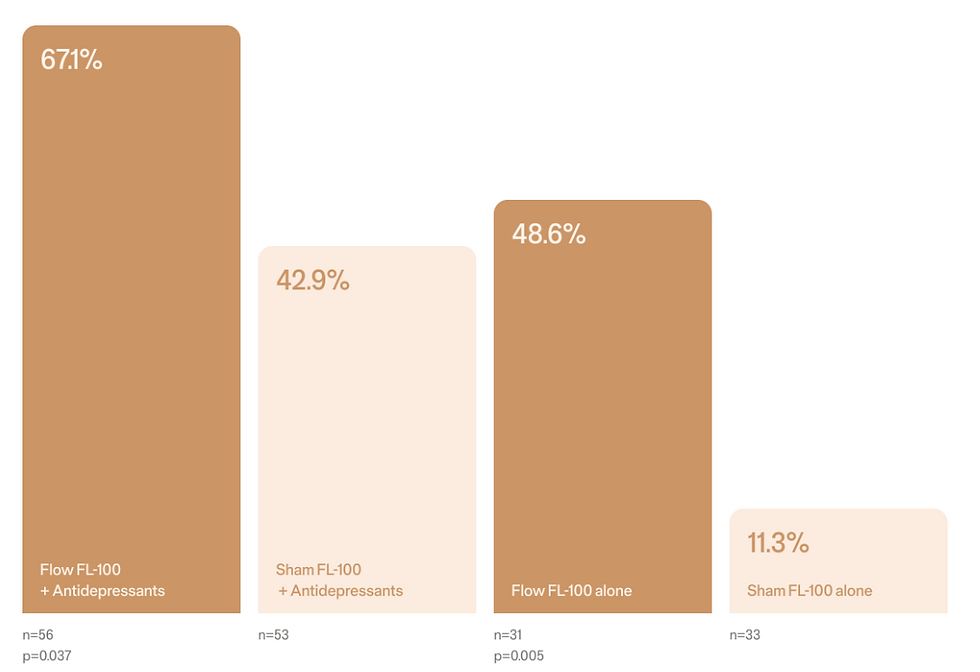
The data supporting this approval comes from the Nature Medicine Empower study, a large-scale, double-blind randomized controlled trial. While some scales — like the MADRS — showed a 58% remission rate after 10 weeks, the FDA’s primary endpoint used the HDRS-17 scale, which reported:
44.9% remission rate in the active treatment group
21.8% remission rate in the sham (placebo) group
Even at the more conservative 44.9% figure, the results represent a major clinical victory. It is important to distinguish between “feeling better” (response) and clinical remission. Remission is the gold standard — it means the absence of disease, typically defined as a Hamilton score of 7 or less.
Given that roughly 30% of patients do not respond to traditional antidepressants, achieving full clinical remission without oral medication represents a significant expansion of the treatment ceiling. For the millions who have cycled through SSRIs and SNRIs without lasting relief, this is not an incremental improvement — it is a fundamentally different pathway to getting better.
A Solution for the Side-Effect Struggle
The primary reason patients abandon SSRIs is their systemic nature. A pill travels through the bloodstream and affects the entire body, leading to weight gain, sexual dysfunction, fatigue, and emotional blunting. These are not trivial complaints — they are quality-of-life issues that directly undermine treatment adherence.
Because the FL-100 targets the brain externally, it bypasses the metabolic and hormonal systems entirely. This localized approach leads to significantly higher patient adherence — though it is not without its own minor, transient effects:
Temporary skin redness or irritation at the electrode site
A mild tingling sensation (described as “wind on a fresh graze”)
Occasional minor headaches
A critical safety note: Clinical data shows that the only instances of first-degree skin burns occurred when users reused electrode pads or allowed them to dry out. Proper pad maintenance is the key to keeping the “gentle zap” gentle.
For patients who have felt trapped between medications that help their mood but harm their body and going untreated, the FL-100 offers a meaningful third option.
The “Digital Pharmacist” in Your Pocket
The FL-100 is not a passive wearable. It is a prescription tech system controlled via the Flow Neuroscience companion app, which acts as a digital pharmacist managing a rigorous 12-week course:
Weeks 1–3 (acute phase): Five 30-minute sessions per week
Weeks 4–12 (maintenance phase): Two to three sessions per week
Crucially, the app bridges the gap between home use and clinical safety. It includes a robust suicide risk management protocol, where users complete the MADRS-s self-report questionnaire weekly. This allows for remote clinician monitoring through a dedicated platform — so while the treatment happens on your couch, you are never truly navigating the recovery process alone.
This model mirrors the approach we use at Refresh Psychiatry’s telepsychiatry practice: clinical-grade care, delivered remotely, with real human oversight at every step.
Cost, Access, and Your Next Steps
The Flow FL-100 is scheduled for a U.S. launch in Q2 of 2026. Here is what we know about access:
Expected cost: $500–$800 out of pocket
Compared to TMS: A full course of clinic-based TMS typically costs $6,000–$25,000
Insurance: Coverage is still being established, but because the device is a prescription-only medical tool, it is expected to be eligible for HSA and FSA funds
Prescription required: You will need a clinician to prescribe the device — a psychiatric evaluation is the starting point
What This Means for Depression Treatment Going Forward
The FL-100 approval does not replace existing treatments. It expands the toolkit. Depression is not one disease — it is a spectrum, and different patients respond to different interventions. The future of depression care increasingly looks like a personalized combination:
Medication management for patients who respond well to SSRIs, SNRIs, or newer agents
Therapy (CBT, DBT, trauma-informed approaches) to address thought patterns and behavioral loops
Neuromodulation like tDCS for patients who want a non-pharmacological option or need an adjunct to their current regimen
Pharmacogenomic testing to reduce the trial-and-error process and match patients to the right medication faster
At Refresh Psychiatry, we stay on the leading edge of psychiatric innovation because our patients deserve every available option — not just the ones that have existed for 30 years. As devices like the FL-100 become available, we will integrate them into comprehensive, individualized treatment plans.

Frequently Asked Questions
What is the Flow FL-100 and how does it work?
The Flow FL-100 is an FDA-cleared wireless headset that uses transcranial direct current stimulation (tDCS) to treat moderate to severe major depressive disorder at home. It delivers a low electrical current through two scalp electrodes to the dorsolateral prefrontal cortex — the brain region responsible for mood regulation.
What are the remission rates?
The FDA’s primary endpoint showed a 44.9% remission rate in the active group versus 21.8% in the sham group. The MADRS scale showed rates as high as 58%.
How much does the Flow FL-100 cost?
Expected $500–$800 when it launches in Q2 2026. HSA and FSA eligibility is expected.
Is the Flow FL-100 safe?
The FL-100 uses a current approximately 400 times weaker than ECT and requires no anesthesia. Side effects are mild and transient: temporary skin redness, tingling during sessions, and occasional headaches.
Can I use it with my current antidepressant?
Yes. The FL-100 is cleared as both a standalone treatment and as an adjunct to existing medication and therapy. Always consult your psychiatrist before making changes to your treatment plan.
Do I need a prescription?
Yes. The FL-100 is a prescription-only medical device. A psychiatric evaluation is the first step to determine if it is appropriate for your situation.
Take the Next Step
Whether you are considering the FL-100, revisiting your current medication plan, or seeking a comprehensive psychiatric evaluation for the first time — the most important step is the first one.
Ready to explore your options? Contact us or call Refresh Psychiatry at (954) 603-4081 to schedule your evaluation.
We accept Aetna, United Healthcare, Cigna, Blue Cross Blue Shield, UMR, Oscar, and TriCare insurance plans.
This blog is for informational purposes only and does not constitute medical advice. The Flow FL-100 is a prescription medical device — consult a qualified mental health professional to determine if it is appropriate for your individual needs. For a personalized evaluation, book an appointment with Refresh Psychiatry.
Using Transcranial Magnetic Stimulation therapy, the clinic focuses on non-invasive treatment that targets OCD treatment brain circuits involved in mood regulation.