
🧠 PTSD After Car Accident: Symptoms, Timeline and Treatment

🧠 PTSD After Car Accident: Symptoms, Timeline and Treatment
You walked away from the crash, answered the officer's questions, and told your family you were fine. A few weeks later a brake squeal tightens your chest, you take the long way home, and sleep falls apart. Feeling steady in the first hours does not close the question of PTSD after a car accident. The useful move is a checkpoint, not a guess: log what changed, then decide whether to keep watching or book an evaluation.
Which Symptoms Point to PTSD After a Crash
PTSD after a car accident is a trauma-related condition in which crash memories keep triggering fear, avoidance, and a body stuck on alert, well past the shock of the first days. It is more than being frightened or upset once. Under DSM-5 criteria explained by the VA, the pattern has to show up across four symptom domains, last more than one month, and cause real distress or impairment.
The exposure check before you count symptoms
The first criterion is the event itself. Qualifying exposure means actual or threatened death, serious injury, or sexual violence, to you or to someone you witnessed. A low-speed bump with no such threat does not meet that first criterion, even if you feel rattled. Distress can still deserve care. It just is not this diagnosis.
Count symptoms as a set, not as isolated bad days. The VA's CAPS-5 structure asks for at least one intrusion symptom, one avoidance symptom, two negative cognition or mood symptoms, and two arousal or reactivity symptoms, plus duration and impairment.
Symptom cluster | Examples after a car accident | Symptoms required |
|---|---|---|
Intrusion | Nightmares, flashbacks, distress at brake squeals or headlights | At least 1 |
Avoidance | Skipping driving, highways, the crash route, or riding as a passenger | At least 1 |
Negative thoughts and mood | Self-blame, feeling permanently unsafe, numbness, detachment | At least 2 |
Arousal and reactivity | Startle, hypervigilance, irritability, sleep problems, poor concentration | At least 2 |
Duration and impairment | Symptoms last longer than 1 month and interfere with daily life | All required |
A one-week flinch versus a six-week shutdown
Say you flinch at a horn for a week, then you drive your usual route and sleep returns. That is a normal alarm system settling. Contrast that with six weeks of refusing the wheel, waking most nights, blaming yourself for the whole crash, and snapping at people at work. Those pieces belong together. Separate symptoms do not make the diagnosis. The cluster, the clock, and the hit to work, school, driving, or relationships do.
Practical rule: Write each symptom on one line and note the first day it showed up. If you cannot fill the minimum in every cluster, or nothing has lasted past a month, keep logging rather than labeling yourself.
If fear, numbness, or anger is already spilling into daily life, a short guide to a PTSD meltdown can help you name what is happening in the moment. When the crash also affects work, medical bills, or a claim, legal help for PTSD after crashes from Nares Law Group LLC is a separate track from clinical care, and it should not replace an evaluation.
Tonight, mark your own rows against the table and write how many days each symptom has lasted. That note is what you bring to a clinician, or what you review again at the next checkpoint.
How PTSD Symptoms Change Over Weeks and Years
Feeling fine in the first days can be real and still incomplete. Adrenaline, paperwork, and caring for other people can mute alarm signals until the first solo commute, an insurance call, or a similar intersection brings the crash back. Treat each checkpoint as a decision: keep monitoring at home, or book a clinical evaluation now.
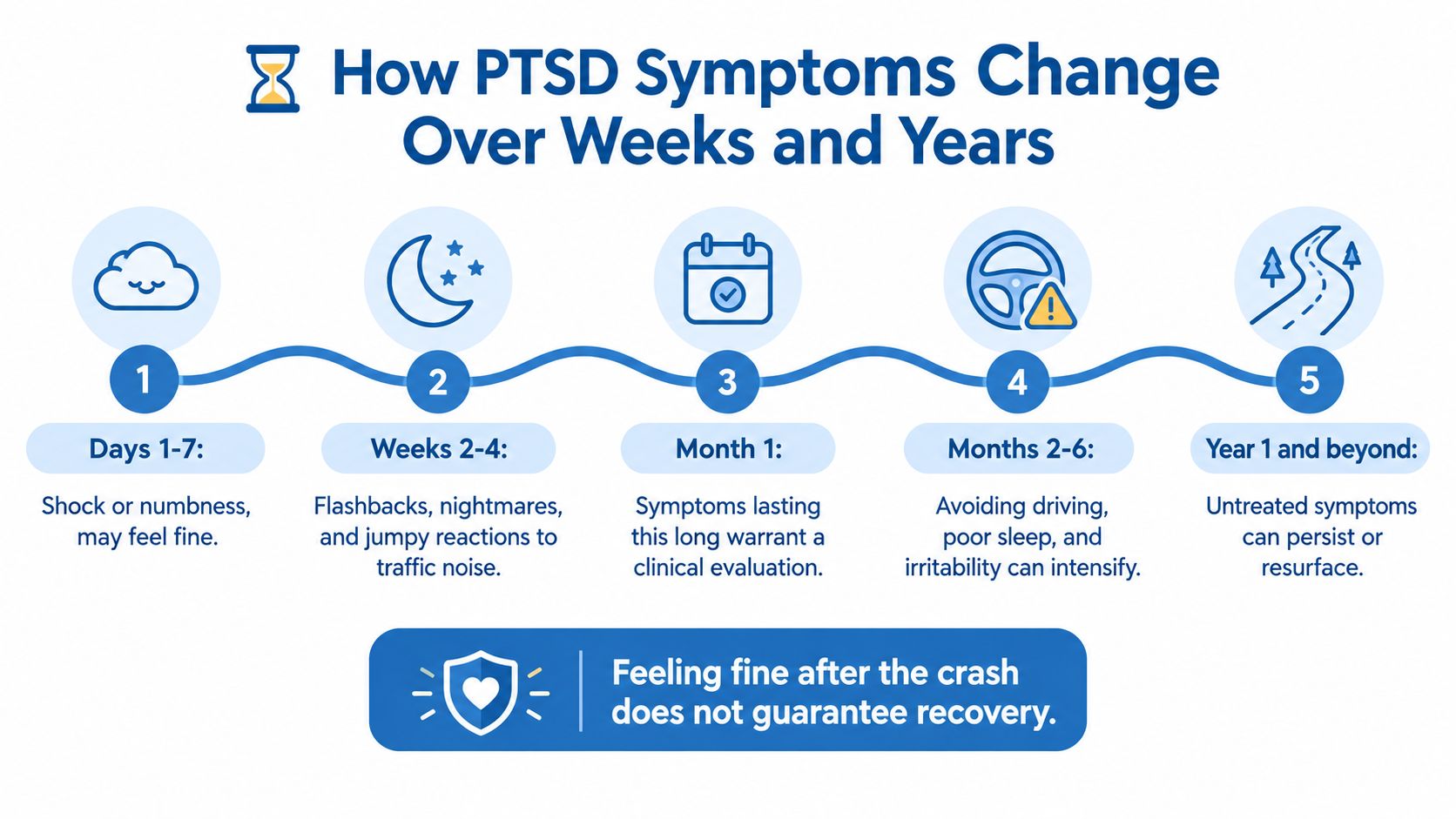
Walk the checkpoints in order
A timeline is a tool, not a verdict.
Time since crash | What research shows | What to do |
|---|---|---|
First 2 weeks | Shock, poor sleep, and jumpiness are common and often fade | Keep a simple daily symptom log |
Month 1 | Symptoms that continue past the early window matter more than a rough first week | Book an evaluation if symptoms persist or impair daily life |
Month 3 | Symptoms can begin, ease, or reappear after the first calm period | Repeat your symptom check and flag any worsening |
Months 6 to 12 | Some injured survivors are still symptomatic around six and twelve months | Start trauma-focused treatment if symptoms still block work, school, relationships, or driving |
Up to 3 years | A subset remains symptomatic for years, and quiet periods can be followed by flare-ups | Continue care and reassess at least yearly |
In the first two weeks, poor sleep and jumpiness are common and often fade. Log driving avoidance, sleep, and startle each day in three words. If those lines are still full after the early window, that is the signal to book an evaluation rather than wait for a perfect week.
Symptoms often begin in the first stretch after trauma, but later onset is possible, and diagnosis looks for persistence plus interference with daily life. At month three, repeat the same three-line log. New avoidance after you felt “over it” still counts.
What the longer follow-up actually means
Follow-up studies of injured crash survivors show a pattern readers can use without memorizing percentages: symptoms drop off for many people, while a meaningful group remains symptomatic months later. The exact figure shifts with injury severity, prior mental health, and how the study defines PTSD, but the clinical lesson stays stable. Time alone does not finish the job for everyone.
Road traffic injury is a global health issue tracked by the World Health Organization, which is why screening belongs in ordinary clinics, not only in specialty centers. If your log is quieter but still shows nightmares, avoidance, guilt, irritability, or a body that braces at every brake light, the useful question is not “Was I bad enough?” It is “Is daily life still smaller than before the crash?”
Feeling fine on day two does not guarantee recovery. The log at each window is the decision tool.
If symptoms still block work, school, relationships, or safe transportation at six or twelve months, start trauma-focused care rather than another season of white-knuckle driving. If you are already in care, reassess at least yearly, because symptoms can quiet and then return when a similar intersection or a new claim letter shows up.
What parents can watch for
Children often cannot say “I feel traumatized.” Watch for regression, separation anxiety, irritability, stomachaches or headaches, sleep problems, school avoidance, crash play, or fear of the car seat. Pediatric practice treats developmentally appropriate screening after a serious accident as standard, and PTSD is generally not diagnosed until symptoms persist for at least one month. A quiet child is not automatically fine. Compare home, school, sleep, and the ride to school, and book a child evaluation if daily life is shrinking.
Who Is Most Likely to Develop PTSD After a Crash
A 2025 systematic review and meta-analysis of 82 studies put pooled PTSD prevalence at 20.3% among road-traffic-accident survivors, with a 95% confidence interval of 18.1%–22.8%, as reported in Health Promotion Perspectives via PMC. That works out to roughly one in five survivors. Common enough to take seriously, far from a certainty.
The same analysis shows how much the yardstick matters. Self-report questionnaires produced a pooled rate of 22.8%, while clinician-administered assessments produced 18.7%. Timing shifts the estimate as well: prevalence peaked at 29.4% about one month after the accident and settled to 18.8% by three months. Early estimates also move depending on which diagnostic criteria a study applies, so two honest reviews can report different numbers for similar crash survivors. That spread is one reason a structured clinical interview tells you more than any single headline figure.
Hospitalization is the clearest clinical split in that review. About 31% of people hospitalized after a crash met PTSD criteria during the first 1–6 months, compared with about 20% of emergency-department patients. Visible injury raises risk. It does not own the diagnosis.
Why these factors raise risk
Injury severity and a hospital stay: A longer recovery keeps the body in threat mode and stacks medical reminders on top of the memory.
Persistent pain: Pain interrupts sleep and makes every car ride feel like another injury waiting to happen.
Peritraumatic dissociation: Feeling unreal, foggy, or outside your body during the crash is linked with memories that do not file away cleanly.
Prior trauma or a mental-health history: An older alarm system is easier to restart, even after a smaller collision.
Loss of driving independence: Losing the ability to get to work or school turns fear into daily disability.
Low social support: Nobody to debrief with leaves avoidance unchallenged.
Claim or money stress: Repeated retelling for insurers can keep the crash in the present tense.
A dent-sized crash does not rule PTSD out, and a totaled car does not guarantee it. Your mix of these factors matters more than the repair estimate, so mark whichever ones fit you. If your list is short and daily life is intact, tracking symptoms at home is a reasonable start. If several factors apply, or symptoms are already disrupting sleep, work, or driving, that is the stronger argument for booking a clinical evaluation now rather than waiting to see.
How Clinicians Tell PTSD From Look-Alike Conditions
A crash can leave several problems at once. Headache, low mood, a racing heart, and dread of the highway can share an afternoon and still come from different conditions. Diagnosis rests on timing, pattern, and what the symptoms are attached to.
Clinicians usually combine a structured interview with a short self-report scale. The CAPS-5 is the reference interview for PTSD. The PCL-5 is a questionnaire people can repeat so everyone can see whether scores are falling, stuck, or climbing. Neither form replaces the story of your week. Together they stop a single bad night from being treated as a full disorder, and they stop a quiet month of avoidance from being missed.
Condition | Key clue | How it differs from PTSD |
|---|---|---|
Acute stress disorder | Trauma symptoms lasting 3 days to 1 month after the crash | Becomes a PTSD question only if symptoms persist past one month |
Concussion or mild brain injury | Headaches, dizziness, memory and concentration problems, light sensitivity | Often improves as the brain recovers; symptoms overlap with PTSD |
Chronic pain | Constant pain, poor sleep, guarding movement | Pain can maintain arousal and avoidance but is not a fear-based memory response |
Depression | Low mood, loss of interest, hopelessness across all areas of life | Less tied to crash reminders; the two frequently co-occur |
Panic disorder | Unexpected panic attacks and fear of the attacks themselves | Panic can arrive without any crash cue |
Medication or substance effects | Sedatives, alcohol, or stimulants changing sleep, mood, or alertness | Symptoms may shift once the substance changes |
What a thorough visit actually records
Bring dates, not adjectives. A practical evaluation documents onset and duration, driving avoidance, work or school effects, sleep, pain, dissociation, suicidal thoughts, and alcohol or drug use. As the VA/DoD psychotherapy guideline frames it, symptoms in the first month do not by themselves establish PTSD, while persistent, clinically significant symptoms beyond that point warrant diagnostic assessment and a treatment plan.
Early group debriefing aimed at "getting it all out" is not a prevention treatment. Clinicians should watch risk and offer targeted care when impairment shows up, not a one-time retelling for everyone in the waiting room.
If you are comparing a single crash with years of stacked trauma, the difference between complex PTSD and PTSD changes how the history is taken. For Florida patients who cannot come in person, that same VA/DoD guidance supports secure video when the therapy has been validated for teleconferencing or in-person care is unavailable.
Before you book, list which row in the table fits you best and whether symptoms are tied to crash cues. That one-page contrast is the most useful thing you can hand a clinician.
Evidence-Based Treatments and How Long They Take
Established PTSD is treated in structured, repeated sessions, not in a single conversation and not with an automatic prescription the week of the crash. Length follows severity, other conditions, safety, day-to-day impairment, response, and the protocol your clinician picks.
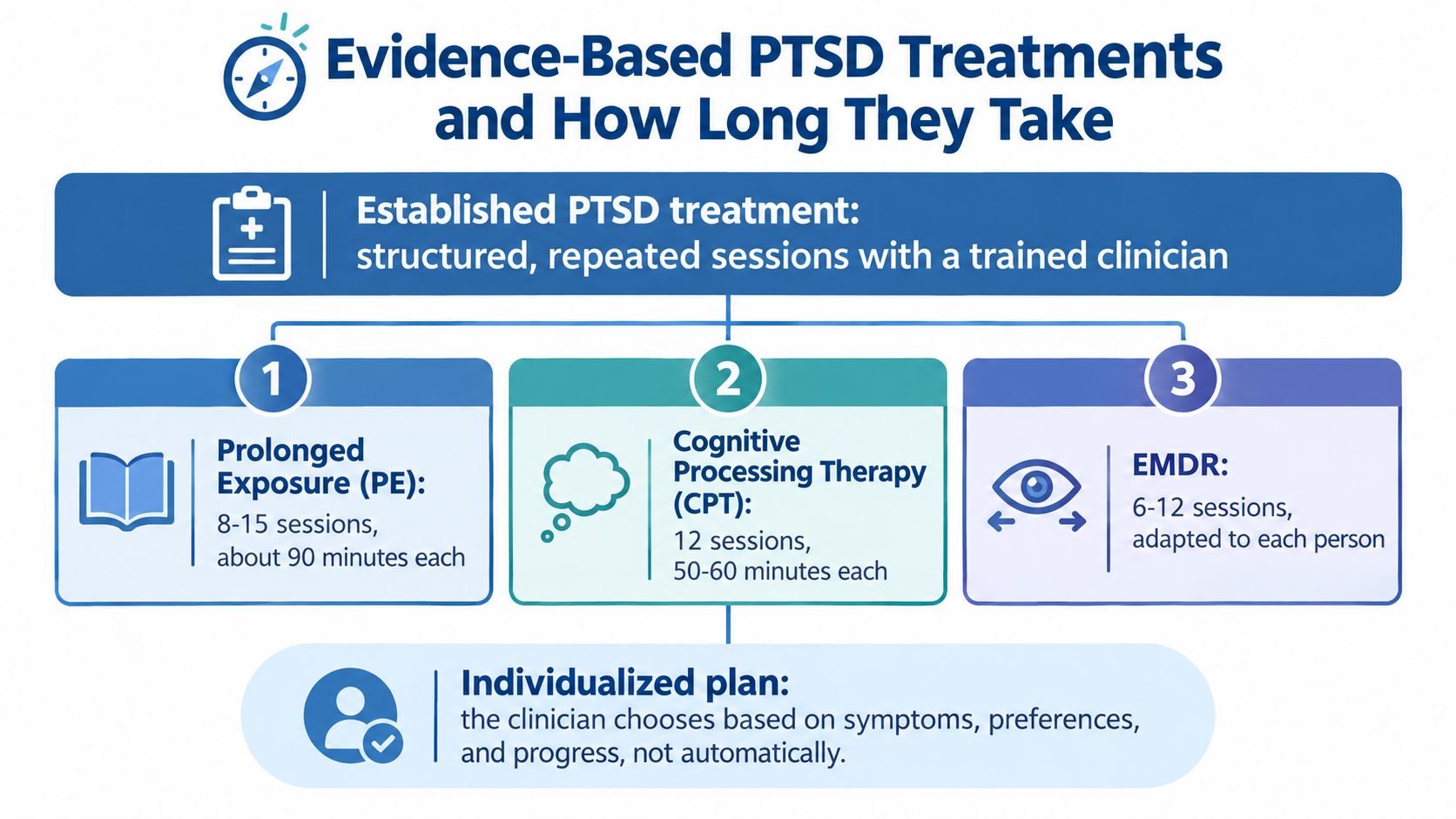
The American Psychological Association PTSD guideline is the source for the session ranges below. Those ranges are studied courses, not a promise that you will need the maximum.
Treatment | Guideline status | Typical sessions | Typical duration |
|---|---|---|---|
Cognitive processing therapy (CPT) | Strongly recommended (APA) | 4 to 24 | About 6 to 18 weeks |
Prolonged exposure (PE) | Recommended in VA/DoD guidance | Manualized repeated sessions | Set by the chosen protocol and your response |
Trauma-focused CBT | Strongly recommended (APA) | 8 to 29 | About 5 to 17 weeks |
EMDR | Conditionally recommended (APA) | 2 to 24 | About 1 to 26 weeks |
Medication (e.g., sertraline, paroxetine) | Guideline-supported option; both are FDA-approved for PTSD | Ongoing, reviewed regularly | Often several months, reassessed over time |
What each option is actually doing
Cognitive processing therapy argues with the sentence the crash wrote, such as "it was all my fault" or "roads are permanently unsafe." You examine the evidence, then practice a more accurate belief while you still live in the everyday world.
Prolonged exposure asks you to revisit the memory in a planned way and to approach safe cues you have been dodging, including short drives. Fear drops because the cue shows up without a new crash, not because someone tells you to relax.
Trauma-focused CBT pairs that gradual approach with skills for thoughts and body arousal. The APA lists it as strongly recommended, commonly 8 to 29 sessions, weekly to three times weekly, over about 5 to 17 weeks.
EMDR has you hold the distressing memory while you follow bilateral stimulation, often eye movements. The APA lists it as conditionally recommended, with protocols from 2 to 24 sessions over about 1 to 26 weeks. CPT, strongly recommended, has been studied from 4 to 24 sessions over about 6 to 18 weeks, usually weekly or every other week.
Medication such as sertraline or paroxetine can be reasonable when therapy is declined, unavailable, or not enough, or when depression, insomnia, or severe arousal need direct attention. At Refresh Psychiatry, psychiatrists closely monitor progress and adjust medications as necessary rather than leaving a starting dose untouched for months.
Nightmares deserve their own plan. Evidence-based options for trauma nightmares can sit alongside the trauma therapy instead of being treated as a sleep problem only.
Ask which protocol is on the table, how many sessions that manual uses, and what "better" will look like on your driving and sleep log by week six.
Coping Strategies That Help Between Sessions
After a rear-end collision, Jordan stopped driving, skipped the highway, and started sleeping on the living-room couch because the bedroom felt too far from the door. Avoidance felt like safety. It also kept the fear rehearsed. Coping skills lower the load between sessions. They do not replace trauma-focused treatment when the pattern is already established.

A weeknight routine you can actually run
Practice graded driving. Start as a passenger in daylight on a familiar street. Next, take a ten-minute drive with someone you trust. Only then approach the crash route. Skipping steps teaches your brain that the only safe plan is total avoidance.
Fix the sleep window. Same bedtime and wake time, including weekends, and no caffeine after noon. A drifting schedule makes hyperarousal look like a personality change.
Ground during a flashback. Name five things you see, four you can touch, three you hear, two you smell, and one you taste. Our short guide to grounding techniques walks through that sequence so you are not inventing it mid-panic.
Cut repeat exposure that is not therapy. Crash videos, news clips, and telling the insurance story five times a night keep the memory hot without the structure of a session.
Tell one person the specific help you need. "Sit with me for the first mile" is more useful than "I'm fine."
Do not use alcohol or sedatives as a sleep switch. They break up sleep and hide symptoms you and your clinician need to see.
Keep one social or work routine that does not depend on driving far. Isolation is its own risk factor.
If you want a plain-language companion while you set that routine, you can take first steps toward emotional healing alongside clinical care, not instead of it.
If the log is flat or worse after two weeks of this routine, self-help has done its job by showing you that you need a clinician. It has not failed you.
Bring the routine and the log to your next visit so the plan matches what you already tried.
When to Seek Help and How to Book Your Evaluation
Feeling fine for the first week or two does not settle the question. Book a clinical evaluation if symptoms are still shaping your days past the first month, if driving, work, school, or sleep is impaired, or if the log is getting worse instead of smaller. For urgent psychiatric support outside an emergency, contact the clinic and you will be connected with a mental health professional. If you are thinking about harming yourself, call or text 988, or call 911.
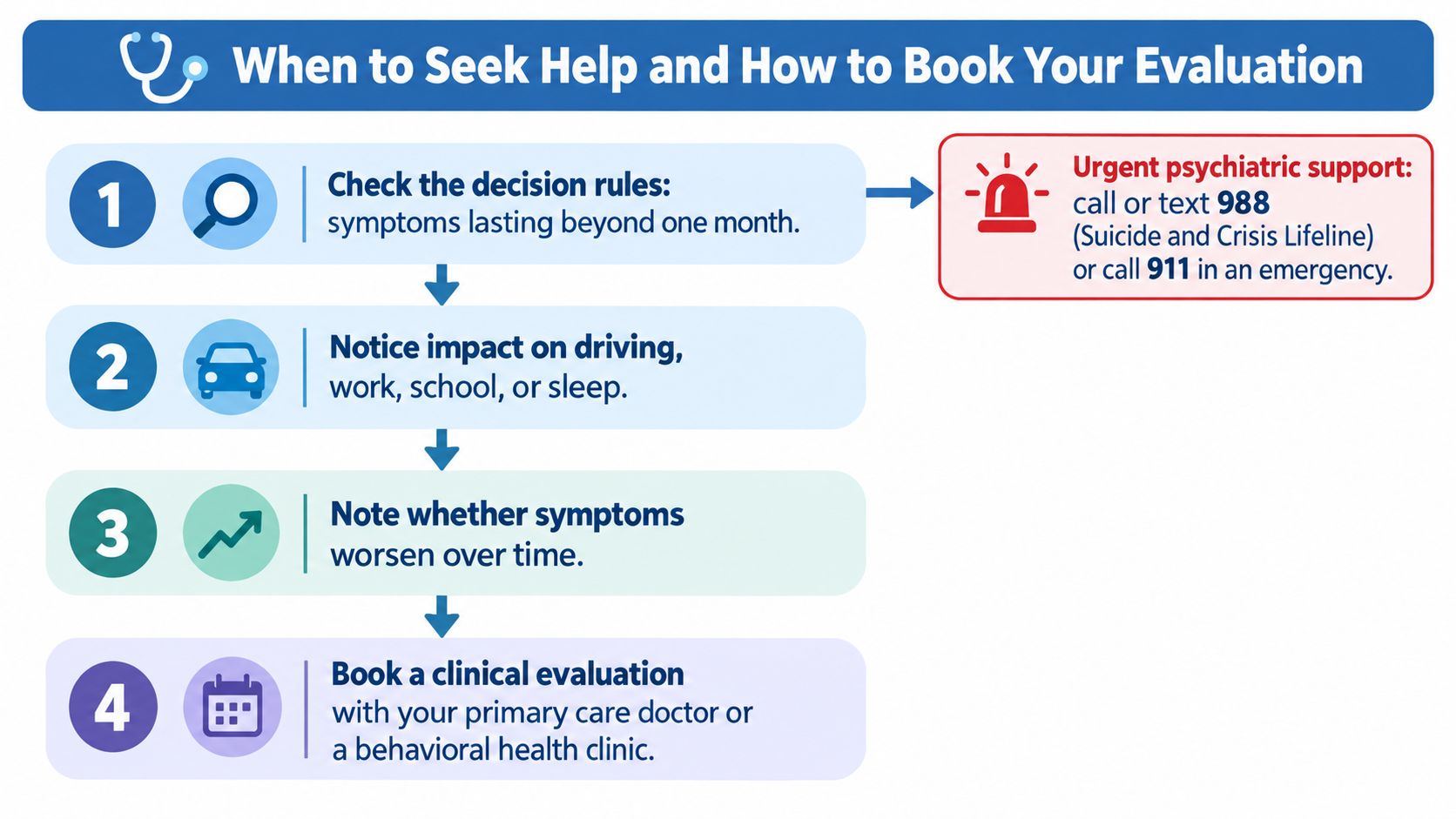
Match your situation to a starting point:
Mild jumpiness that is shrinking. Keep the daily log and recheck at the next time window.
Avoidance or broken sleep that is not shrinking. Book an evaluation this week.
You cannot drive, work, or stay in school. Book now, and say so when you schedule so the visit is not a general check-in.
Thoughts of suicide or of harming someone. Use 988 or 911 before any routine appointment.
The 2023 VA/DoD guideline, summarized by the National Center for PTSD, recommends individual trauma-focused psychotherapy over medication when both are feasible, because core symptoms tend to improve more, and the gains tend to last longer, than with medication alone. Medication still fits when therapy is unavailable, declined, or not enough, or when depression, anxiety, insomnia, or severe arousal need it. A video visit is appropriate when a trained clinician delivers it securely and the protocol suits video care. The plan should also cover pain, sleep, driving confidence, and avoidance, because those keep disability going after other symptoms ease.
How a Refresh Psychiatry evaluation runs
Call (954) 603-4081 or use online scheduling.
Complete the symptom and history questions before the visit so the appointment time goes to your story, not paperwork.
Join a video evaluation built around a structured clinical interview. You will need a video chat app on your phone, tablet, or computer. If you want to know what that first visit includes, read what a psychiatric evaluation covers.
Leave with a personal plan. Psychiatrists here build plans that can include medication management, and therapy can run in the same coordinated setting rather than in two offices that never talk.
We provide statewide telepsychiatry on a HIPAA-compliant video platform for adults and for children and teens. We accept Aetna, United Healthcare/UHC, Cigna, Blue Cross Blue Shield, Humana, Tricare, UMR, and Oscar. Confirm your current network status when you schedule, because plan details change.
Pick the starting point that matches your log, then call or book before the next commute becomes another week of avoidance.
Refresh Psychiatry & Therapy offers Florida telepsychiatry evaluations, trauma-focused therapy, and medication management for PTSD after a car accident, coordinated in one setting rather than split across offices. If your symptom log is still full, Contact us or call Refresh Psychiatry at (954) 603-4081 to schedule your evaluation. We accept Aetna, United Healthcare/UHC, Cigna, Blue Cross Blue Shield, Humana, Tricare, UMR, and Oscar. This blog is for informational purposes only and does not constitute medical advice. Please consult a qualified mental health professional for personalized guidance.