
🧠 Processed Food and Depression: What Research Shows

People eating at least 9 servings of ultra-processed food daily were 50% more likely to develop depression than people eating no more than 4 servings daily, according to a 2024 Harvard Health summary of ultra-processed foods and depression risk. That number sounds alarming until you know what the studies measured.
They didn't measure one snack, one soda, or one bad week. They measured an overall dietary pattern over months and years. That's an important distinction for processed food and depression, because it changes the conversation from shame about a single meal to a practical question. What food pattern is realistic to shift, even on a low-energy day?
Diet belongs alongside care, not in place of it. Food changes won't replace a psychiatric evaluation, therapy, or medication when medication's indicated.
What Counts as Processed Food in Everyday Eating
Depression research in this area measures ultra-processed food (UPF), a specific category, rather than every food that's been cooked, frozen, canned, or sealed in a package.
Patients often hear "processed" and assume frozen vegetables, canned beans, or plain yogurt have to go. They don't.
Processing sits on a spectrum. At one end, a meal built from whole ingredients: wash, chop, cook. At the other, an industrial line that breaks foods down, rebuilds them with additives, and engineers shelf life, uniform flavor, and a texture you can't reproduce in a home kitchen.
The Ingredient-List Test
The practical check is what the ingredient list contains.
If the ingredient list reads like a chemistry set, with items you wouldn't keep in your own kitchen, it's likely ultra-processed.
Emulsifiers, modified starch, flavor enhancers, colorants, and hydrogenated oils point toward the ultra-processed end. A short list of ingredients you'd recognize from your own pantry points the other way. For a broader look at how diet fits into mental health, our explainer on the connection between your brain and nutrition covers it in plain language.
The NOVA classification sorts foods into four groups by degree of processing. It asks how many industrial steps, additives, and non-kitchen ingredients a food contains.
Group | What It Includes | Everyday Examples | Role in Depression Studies |
|---|---|---|---|
1. Unprocessed or minimally processed | Whole foods, with at most cleaning, drying, freezing or pasteurizing | Fresh fruit, plain oats, eggs, frozen vegetables, plain milk | Reference point for lower intake |
2. Culinary ingredients | Substances extracted or refined for cooking | Olive oil, butter, sugar, salt | Used in cooking; not the main exposure |
3. Processed foods | Simple preparation adding salt, sugar or oil | Canned beans, canned fish, cheese, fresh bread | Not the main exposure measured |
4. Ultra-processed foods | Industrial formulations with additives and little whole food | Soft drinks, packaged snacks, instant noodles, processed meats, ready meals | Main exposure in depression studies |
Group 4 is the exposure the research tracks. Frozen vegetables and canned beans are not the problem the studies are pointing at, and they're some of the most useful foods to keep on hand when energy is low. A can of beans heated with olive oil takes minutes and sits in Group 3. That kind of distinction matters more than any single snack.
What Major Studies Found About Depression Risk
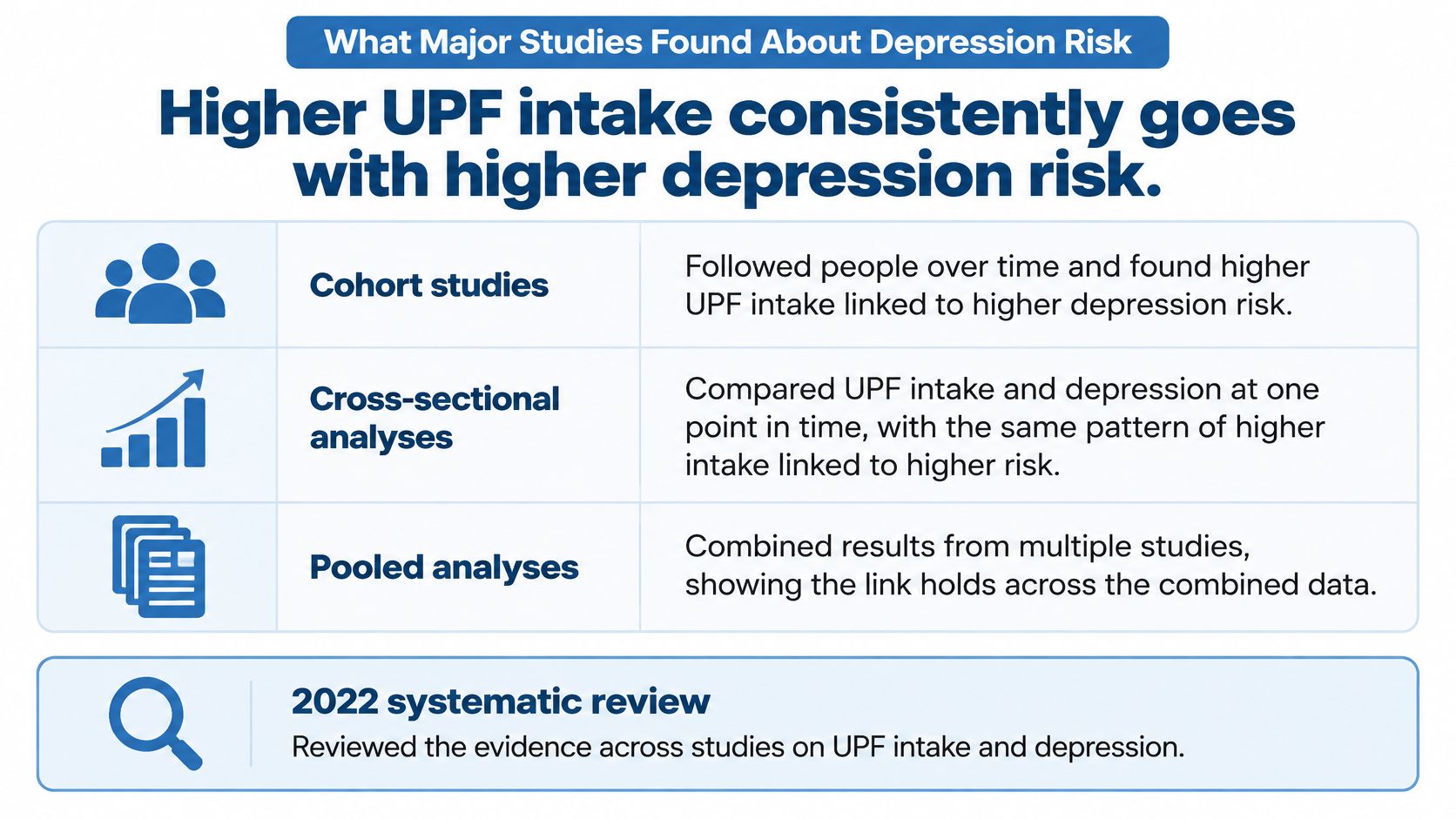
A 2022 systematic review and meta-analysis of UPF and depression pooled 17 observational studies and 385,541 participants. In cross-sectional analyses, higher UPF intake was linked to 44% higher odds of depressive symptoms (OR 1.44; 95% CI 1.14-1.82), and to increased odds for combined anxiety and depressive symptoms (OR 1.53; 95% CI 1.43-1.63).
The image below summarizes that pattern across study types.
A dose-response meta-analysis of UPF intake and depression combined 26 studies, 260,385 participants, and 12 countries. High intake was associated with 28% higher depression risk (RR 1.28; 95% CI 1.19-1.38) compared with lower intake.
The Whitehall II cohort study on UPF and recurrent depressive symptoms followed participants for up to 13 years. The highest-intake quintile averaged 33% of daily food intake by weight from UPF, compared with 18.1% in the four lower quintiles, and had 31% higher odds of recurrent depressive symptoms (OR 1.31; 95% CI 1.04-1.64) after adjustment.
One point I make when patients see numbers like these: every study above measured an overall dietary pattern, the share of daily intake coming from UPF. No single food drives the result. The data tracks the total load, which is why the practical target is shifting that share, and even modest steps down in UPF share tracked with lower risk in the dose-response data.
Study | Design and Size | Intake Compared | Key Result |
|---|---|---|---|
Systematic review (2022) | 17 studies, 385,541 participants; 15 cross-sectional, 2 prospective | Highest vs lowest UPF intake | 44% higher odds of depressive symptoms (OR 1.44; 95% CI 1.14-1.82) |
Same review, prospective subgroup | 2 prospective studies | Higher vs lower UPF intake | 22% higher risk of developing depression (HR 1.22; 95% CI 1.16-1.28) |
Dose-response meta-analysis | 26 studies, 260,385 participants, 12 countries | High vs low UPF intake | 28% higher risk (RR 1.28; 95% CI 1.19-1.38) |
Dose-response meta-analysis, continuous | Same pooled data | Each 10-percentage-point rise in UPF share of daily calories | 11% higher risk (RR 1.11; 95% CI 1.01-1.17) |
Dose-response meta-analysis, food-frequency questionnaires | Subgroup using diet questionnaires | High vs low UPF intake | 31% higher risk (RR 1.31; 95% CI 1.21-1.41) |
Whitehall II cohort | Prospective, up to 13 years | Top quintile (UPF 33% of food weight) vs lower quintiles (18.1%) | 31% higher odds of recurrent depressive symptoms (OR 1.31; 95% CI 1.04-1.64) |
What a Ratio Means in Plain Language
A relative risk of 1.28 means the higher-intake group carried 28% more relative risk than the comparison group. That figure describes a proportional difference between groups, and absolute risk is a separate question. It depends on how common depression already is in the population studied, so the same relative difference can translate into a modest number of added cases in one group and a larger number in another.
Why Prospective Studies Carry More Weight
Cross-sectional studies take a snapshot. They measure diet and symptoms at the same time, so they can't show which came first.
Prospective studies follow people forward. That design is stronger for timing, because diet is recorded before depression develops. Readers comparing dietary approaches can see how a different pattern is discussed in our article on a ketogenic diet for depression. Any eating pattern works alongside treatment, and no diet replaces clinical care.
How Processed Food Could Affect Mood
A low mood rarely traces back to one meal. When patients ask me why diet matters, I point to systems: blood sugar, gut bacteria, inflammation, and the nutrients that never make it onto the plate.
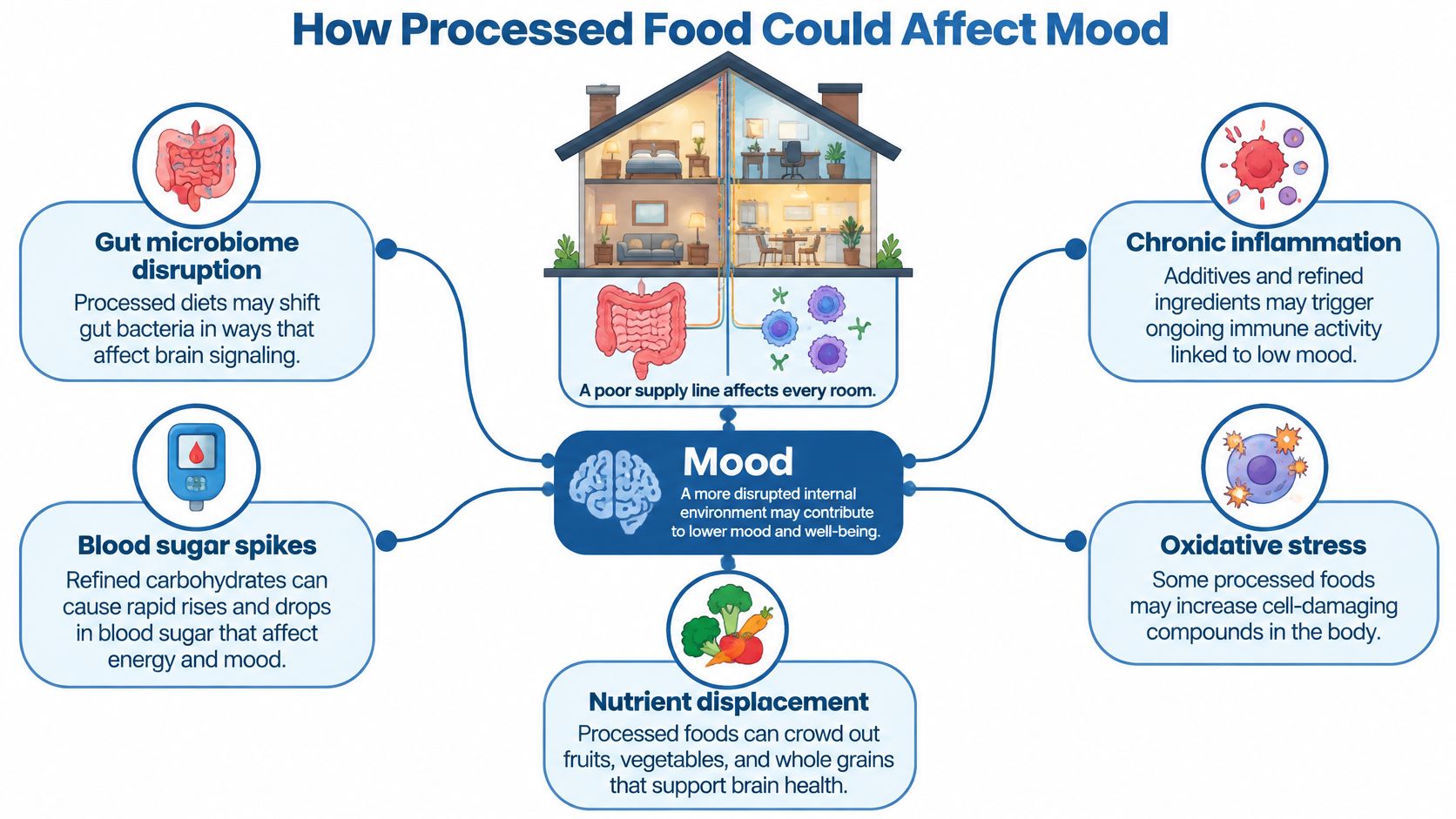
No single pathway explains processed food and depression. The routes below are proposed mechanisms with varying levels of evidence, and they likely interact rather than act alone.
The map below shows how those routes connect.
Five Proposed Routes
Blood-sugar swings come first for many patients. Refined carbohydrates and sugary drinks digest quickly. A sharp rise and drop can bring fatigue, irritability, and cravings, and those swings land harder when sleep and appetite are already disrupted.
The gut microbiome and gut barrier may shift next. Low fiber intake, additives, and sweeteners may alter microbial balance. Gut bacteria signal the brain through immune, nerve, and metabolic channels, so a change in the gut can register in mood.
Inflammation has the strongest support among these pathways. A review of dietary inflammatory potential and depression reported a meta-analysis of seven longitudinal studies and 77,420 participants that found higher dietary inflammatory potential was associated with 31% greater risk of developing depression over follow-up of five to 13 years. That review also discusses oxidative stress, the microbiota-gut-brain axis, epigenetic changes, and neuroplasticity as related hypotheses.
The video below walks through the gut and inflammation routes visually.
Nutrient displacement is the quieter problem. When ultra-processed products fill most of the cart, fish, legumes, vegetables, and whole grains get crowded out. Less room on the plate means less omega-3 fat, folate, magnesium, B vitamins, and fiber, even when total calories look adequate.
Oxidative stress and neurotransmitter regulation remain less established. They are plausible parts of the picture, especially alongside inflammation and metabolic strain, but the evidence is thinner and neither one justifies blaming a single ingredient.
One more point matters here. These mechanisms describe dietary patterns averaged over weeks and months. A single snack on a hard night does not carry the same weight as what the grocery cart looks like week after week.
Movement touches several of these same systems, which is why we discuss exercise and depression as a companion habit. Eating differently works best as one part of a care plan, and the sections ahead cover how far the evidence reaches.
Reading the Evidence Without Overstating It
These studies are observational. They show association, not proof that processed food causes depression.
That's not a technical footnote. It's the central limit, and it should shape how you act on the findings.
The Arrow Can Run Both Ways
Reverse causation is a real concern. Early depressive symptoms can lower energy, increase cravings, and make convenience food the easiest option, so depression may drive UPF intake as well as follow it.
Confounders shape both diet and mood. Income and food access, education, smoking, sleep, physical activity, existing illness, and overall diet quality can all influence food choices and mental health at the same time. Good studies adjust for many of these factors, but adjustment can't remove every difference.
Diet is a modifiable risk factor, not a standalone treatment.
Measurement Is Imperfect
Food-frequency questionnaires depend on memory. People forget snacks, misjudge portions, and describe a typical week that may not match a difficult week.
That helps explain why estimates vary by method. A meta-analysis indexed on PubMed on UPF dose and depression found that every 10-percentage-point increase in UPF share of daily calories was associated with 11% higher depression risk (RR 1.11; 95% CI 1.01-1.17), while the food-frequency questionnaire subgroup showed RR 1.31 (95% CI 1.21-1.41). UPF definitions also vary across countries, which adds noise when studies are pooled.
That dose-response pattern matters. It points to a gradient, not a single threshold where food suddenly becomes harmful. Small shifts in overall share are the relevant unit, not dietary perfection.
The same PubMed-indexed analysis found an association with depression but not a statistically significant association with anxiety. A non-significant result doesn't prove the link is specific to depression. The accurate statement is narrower: evidence is strongest for depressive symptoms.
Three Myths Worth Dropping
Processed food causes depression: The evidence doesn't prove causation.
Every processed item harms mood: The research focuses on ultra-processed patterns, not canned beans or frozen vegetables.
Cutting junk food alone cures depression: Food can support care, but it doesn't replace evaluation, therapy, or medication management when needed.
Swapping Processed Staples and Keeping It Going
Change the item you eat most often first. A full pantry overhaul rarely survives the first hard week.
That one-item-at-a-time rule works because frequency matters more than intensity. A daily soda changed to water shifts your overall pattern more than a perfect grocery list abandoned by Thursday. Building the shift into a daily routine for mental health also helps it hold when motivation dips.
Swaps That Lower the Ultra-Processed Share
Most swaps below add protein, fiber, or both, so the replacement is satisfying enough to repeat. The drink swap works differently: it removes a large source of added sugar without asking you to eat anything new.
Processed Item | Swap | Why It Helps |
|---|---|---|
Sweetened soft drinks | Water, sparkling water with fruit, unsweetened tea | Removes a large source of added sugar and empty calories |
Packaged chips and crackers | Apple or orange with a handful of nuts, or plain yogurt | Adds fiber, protein and fat for steadier energy |
Processed deli meats and hot dogs | Eggs, canned fish in water, beans or home-roasted chicken | Replaces additives and sodium with protein and omega-3 options |
Sugary breakfast cereal | Plain oats with berries and nuts | Higher fiber and a slower blood-sugar rise |
Instant noodles or frozen ready meals | Rice or quinoa bowl with frozen vegetables and eggs or lentils | Brings vegetables, protein and fiber into one meal |
White sandwich bread and flavored yogurt | Whole-grain bread and plain yogurt with fruit | Keeps the habit while reducing refined flour and added sugar |
Fast-food or fried takeaway | Home-cooked fish, bean or vegetable dish | Lowers the ultra-processed share and sodium of the week |
Budget matters, and cost is not a barrier to starting. Canned fish in water, frozen vegetables, plain oats, eggs, and beans are inexpensive staples in most Florida grocery stores. Frozen produce also removes the pressure to cook everything before it spoils.
A perfect label on every product is not worth chasing. Reading every package costs time and energy you may not have on a low week. Three quick checks cover most of what matters.
Added sugar near the top: Ingredients are listed by weight, so sugar in the first few items means it is a major part of the food.
Sodium near the top: Ready meals and processed meats often carry much of the day's sodium in one serving.
Light or diet claims: Treat these as still processed unless the ingredient list is short and familiar.
Repeated swaps build a pattern, and overall pattern is what the studies measure. Dietary perfection is not required to lower your UPF share.
A System for Low-Energy Days
Cooking from scratch can feel unrealistic on a depressed day. Low energy is a symptom, and the plan has to work around it.
Build the plan for your lowest-energy day, not your best one.
Three default meals: Pick three meals you can repeat without thinking, such as oats with berries, eggs with frozen vegetables, or beans and rice with salsa.
Bridge foods on hand: Keep canned beans, frozen vegetables, eggs, plain yogurt, oats, and rotisserie chicken ready so a meal takes minutes, not a recipe.
Regular meal times: Eating at roughly regular times reduces long gaps that trigger crash-driven cravings later.
A good-enough rule: A cooked egg and frozen vegetables count as a meal. So do yogurt, fruit, and nuts.
One list, one shop: Shop once with a written list, and use grocery delivery during low weeks if getting to the store is the barrier.
A short log: Track mood, sleep, and appetite for two to four weeks and bring it to appointments. Patterns are easier to discuss with notes than from memory.
One warning belongs here. Tell your clinician promptly if eating stops or cycles of restriction and binge eating appear. Restrictive rules can worsen both mood and eating symptoms, so the goal is steadier, more flexible eating.
Small, repeatable swaps are the trade-off that holds up. They ask less on hard days, work alongside therapy and medication management, and still move the overall pattern the research is concerned about.
Confirm Your Next Step With a Psychiatric Evaluation
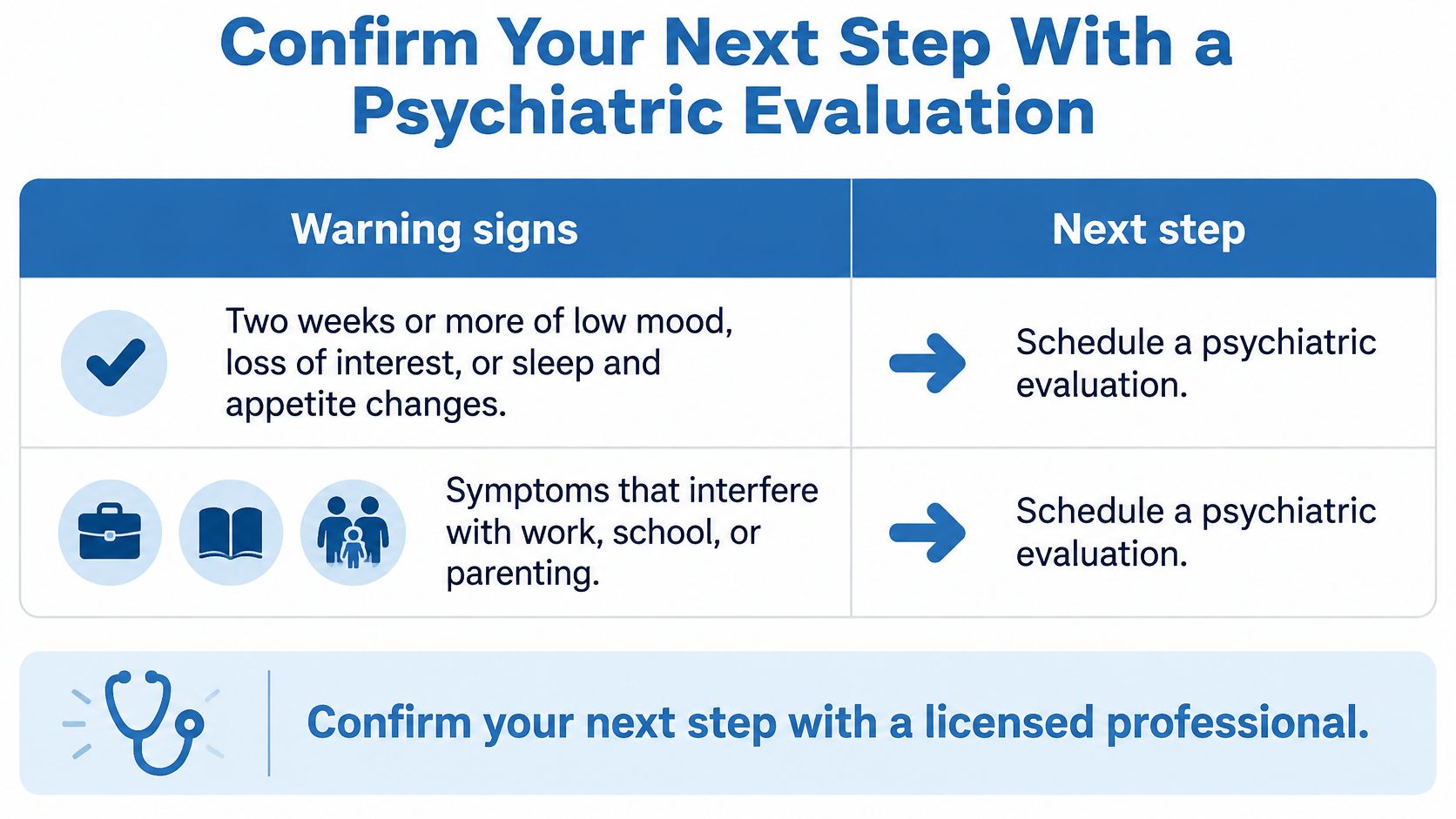
Diet is worth discussing, but timing matters more. The situations below help you decide whether to track symptoms, book soon, or get immediate help.
Situation | Recommended Action |
|---|---|
Low mood, loss of interest, or sleep and appetite changes lasting two weeks or more | Schedule a psychiatric evaluation |
Symptoms interfering with work, school, parenting or relationships | Book an evaluation soon rather than waiting |
Thoughts of self-harm or suicide | Call or text 988 now, or go to the nearest emergency room |
On antidepressants and wanting to change or stop a dose | Talk to your prescriber first; deprescribing needs a tapering plan |
Mild, short-lived low mood after a diet change | Track mood, sleep and appetite for two to four weeks and discuss at your next visit |
What Integrated Care Looks Like
A thorough assessment comes first. If you are unsure what that involves, our guide to what happens during a psychiatric evaluation walks through the process step by step.
At Refresh Psychiatry, patients can get medication management and therapy in one practice, with the whole care team coordinated. Cognitive behavioral therapy is one approach our clinicians use to treat depression, anxiety, and related concerns. Diet, sleep, and activity are part of that conversation, working alongside treatment rather than replacing it.
Medication is not always recommended. Our psychiatrists assess each patient before deciding on an approach, and the choice to use medication is collaborative. When reducing or stopping a dose makes sense, deprescribing happens gradually under professional guidance, with a personalized tapering plan.
Telepsychiatry through our Davie, Florida practice makes follow-up easier. Video sessions connect you with a mental health expert from home, and prescriptions are sent electronically, so no paper prescription is needed.
If low mood, poor sleep, or appetite changes are making food decisions harder, schedule an evaluation with Refresh Psychiatry & Therapy. We can assess your symptoms, review daily habits like diet and sleep, and build a treatment plan that fits your energy and your life.
This blog is for informational purposes only and does not constitute medical advice. Please consult a qualified mental health professional for personalized guidance.