
3am Anxiety: What It Is and How to Cope

🛌 3am Anxiety: What It Is and How to Cope
You fall asleep without much trouble, then your eyes open in the dark. Your heart is pounding, your body feels alert, and your mind immediately searches for danger: a difficult conversation, an unfinished task, a health concern, or tomorrow's responsibilities. The more you try to force sleep, the farther away it seems.
This pattern isn't a personal failure or poor sleep habits. 3am anxiety can reflect nocturnal panic, sleep maintenance insomnia, an anxiety disorder, or the interaction between circadian biology and a sensitized stress system. The right response depends on which pattern is occurring.
Waking at 3am With Anxiety
A patient might describe it this way: “I was fine when I went to bed. Then I woke up suddenly, my chest was tight, and I felt certain something was wrong.” By morning, the immediate fear may have faded, but the exhaustion remains. After several nights, bedtime itself can become threatening because the person expects another abrupt awakening.

Clinically, waking in panic during sleep is a recognized phenomenon called nocturnal panic. A major review of sleep and anxiety disorders reports that up to 18% of all panic attacks occur during sleep (review of sleep and anxiety disorders). Nocturnal panic differs from a nightmare or an awakening caused by an outside disturbance. The person may wake with a racing heart, breathlessness, trembling, fear, or a sense of impending catastrophe, often without a remembered dream.
That distinction matters because the treatment pathway changes. A person who wakes worried about work may need assessment for generalized anxiety and insomnia. Someone who wakes abruptly with intense physical panic may need evaluation for panic disorder. Repeated distress can also occur alongside trauma-related hyperarousal, depression, medication effects, hormonal transitions, or sleep disorders.
What the pattern can mean
The clock time alone doesn't establish a diagnosis. The useful details include what happens in the body, what thoughts appear first, how often the awakening occurs, and whether symptoms also happen during the day.
Nocturnal panic: sudden fear with strong physical symptoms and no obvious external trigger.
Sleep maintenance insomnia: repeated difficulty returning to sleep after awakening.
Anxiety-related rumination: a quieter awakening followed by escalating worry and mental problem-solving.
Nightmare-related distress: waking from a vivid dream with remembered content and lingering fear.
Hormonal changes can also complicate sleep and anxiety. People navigating perimenopause may find it helpful to review practical guidance on restful nights during perimenopause, while still discussing persistent panic or insomnia with a qualified clinician.
If you're unsure whether an episode is anxiety or panic, this explanation of anxiety versus a panic attack can help you organize what you're experiencing. It shouldn't replace an evaluation, particularly when symptoms are new, severe, or accompanied by concerning physical signs.
The Biology Behind Nighttime Panic
Waking at 3am can reflect several interacting systems, not one isolated cause. Cortisol, a primary stress hormone, is usually lowest near midnight. It starts rising roughly two to three hours after sleep onset and continues increasing toward morning (circadian cortisol and sleep).
That normal rise can make a brief shift toward wakefulness feel unusually intense. For someone with panic vulnerability or chronic hyperarousal, a faster heartbeat may be interpreted as a medical emergency, while muscle tension can seem like proof that something is wrong. The mind then builds a frightening explanation around sensations that began in the body.
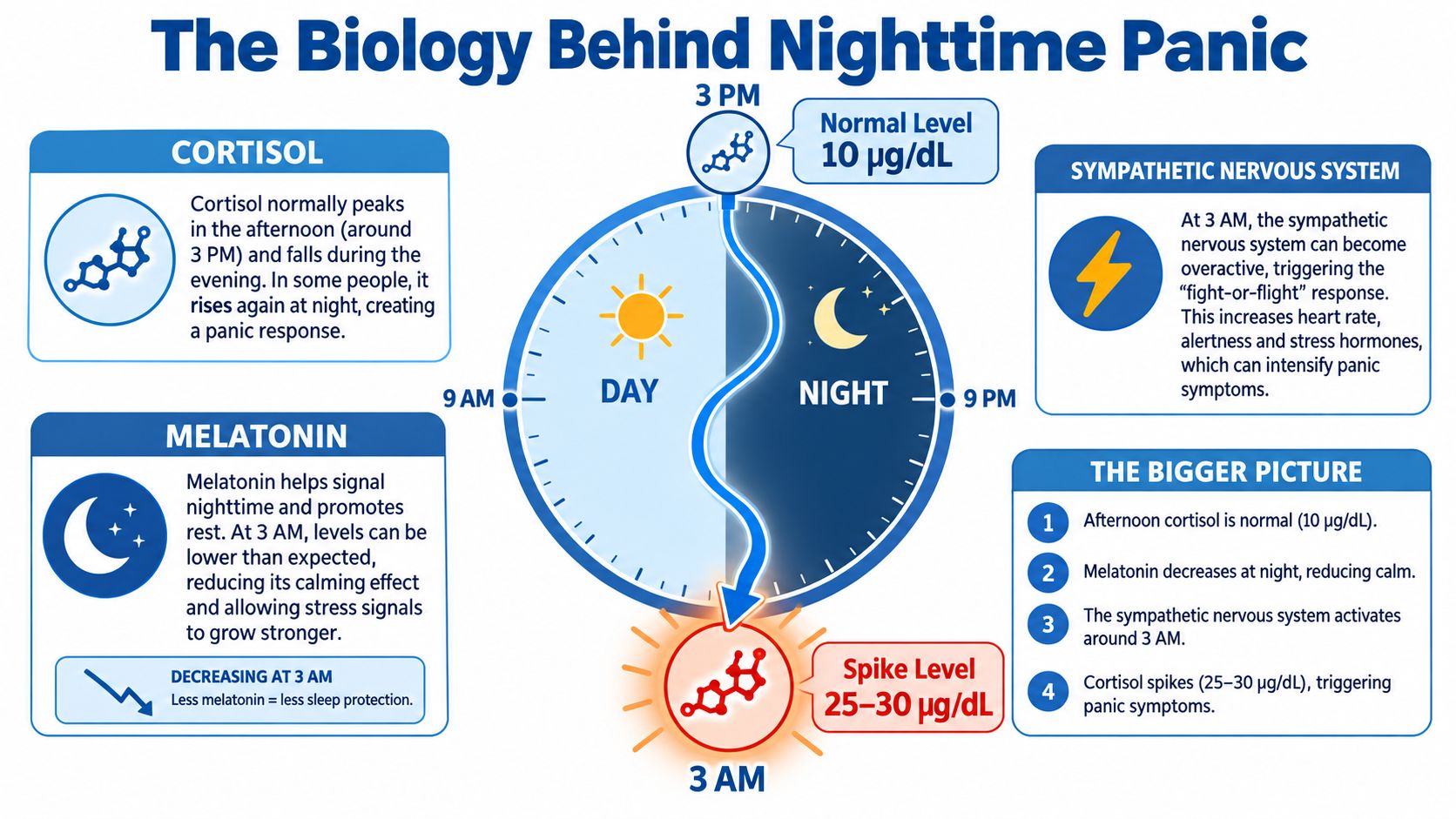
The hypothalamic-pituitary-adrenal axis, or HPA axis, coordinates part of the stress response. A nighttime awakening can produce a temporary cortisol increase, followed by temporary suppression. This fluctuation does not make every awakening pathological, but it explains why physical activation may appear before a conscious worry.
Anxiety and insomnia frequently overlap. A review reports insomnia symptoms in roughly 70–80% of people with anxiety, while approximately three-quarters of participants with anxiety disorder report sleep disturbances (review of insomnia and anxiety). The relationship runs in both directions. Anxiety disrupts sleep, and disrupted sleep lowers the threshold for threat detection and emotional reactivity.
Clinical perspective: The body can initiate the alarm before the mind identifies a subject for worry.
Sleep fragmentation can sustain that cycle. NIH-hosted research describes a feedback loop in which excessive HPA-axis activation promotes fragmented sleep, while fragmented sleep raises cortisol levels (HPA-axis activation and sleep fragmentation). This helps explain why the pattern can continue after the original stressor has eased.
The experience reflects circadian timing, panic sensitivity, conditioned arousal, anxious interpretation, and sleep loss working together. Self-help may reduce arousal during an isolated episode, but recurring nighttime panic or insomnia-anxiety overlap often requires individualized clinical assessment rather than reassurance alone.
The embedded video below walks through the panic response in two minutes. It provides background on the physiology, while recurring nocturnal panic still warrants an individualized evaluation.
Immediate Steps When Anxiety Strikes at Night
At 3am, don't try to solve your entire life. The immediate objective is to lower arousal and stop teaching your brain that nighttime bed rest means danger.
Start by naming what is happening without arguing with it: “My body is having an anxiety response. I don't have to make a decision right now.” This wording separates the experience of fear from the conclusion that danger is present. It also reduces the pressure to prove that every worry is impossible.
Reduce physical activation
Use a slow exhalation-focused breathing pattern. Breathe in gently, then make the out-breath longer and softer. If counting helps, use a comfortable rhythm rather than forcing a specific technique or holding your breath until you feel strained.
Grounding shifts attention from internal threat monitoring to immediate sensory information. Notice the pressure of the mattress, the temperature of the room, and a few neutral sounds. A practical guide to cognitive grounding for pressure offers additional ways to redirect attention without debating every anxious thought.
Stop feeding the spiral
Don't check the clock repeatedly, read work messages, or search symptoms online. Each activity gives the brain a new reason to remain alert and can turn a brief awakening into a long period of cognitive engagement.
If your thoughts are racing, write a short note in dim light: “Review this tomorrow.” Add only enough detail to reassure yourself that the concern won't be lost. Then return to a neutral activity, such as reading a familiar, unexciting book.
If you're awake and increasingly frustrated, leave the bed for a quiet activity until sleepiness returns. The purpose isn't to punish yourself or start the day. It's to weaken the association between your bed and anxious wakefulness. More ideas appear in these grounding techniques, but severe or recurring episodes require more than an emergency routine.
Seek urgent help if nighttime anxiety includes thoughts of self-harm, an inability to stay safe, severe chest pain, fainting, or serious breathing difficulty. Anxiety can produce intense physical symptoms, but new or dangerous symptoms should receive appropriate medical attention.
Sleep Hygiene and CBT Strategies for Lasting Relief
A calming technique may settle one episode without changing the pattern behind repeated awakenings. Lasting improvement usually requires consistent sleep behavior, targeted anxiety treatment, and a response plan that does not reinforce fear of being awake.
Rebuild the sleep association
Stimulus control is a core CBT-I method. Keep a consistent wake time, reserve the bed mainly for sleep, and leave it when you feel alert and frustrated. Return only when sleepiness returns. This can make the next morning harder after a poor night, but remaining in bed while monitoring anxiety can strengthen the bed-wakefulness association.
Keep the bedroom dark, quiet, and comfortable, while recognizing that environmental changes alone will not treat nocturnal panic or an insomnia-anxiety overlap. Avoid repeated clock checks and stimulating phone content. Behavioral retraining matters more than creating a perfect sleep setting.
Move worry out of the night
Schedule a 15-minute worry period during the day, preferably well before bedtime. Write each concern, label it as solvable or hypothetical, and assign one next action to solvable problems. For example: “I may miss tomorrow's deadline” becomes “Open the project file at 9 a.m. and list the remaining tasks.” If no useful action exists, record that conclusion and postpone further analysis until the next scheduled period.
At 3 a.m., remind yourself that the concern has a designated time. This is a practiced boundary, not an attempt to prove that the worry is irrational. A brief wind-down routine may include gentle stretching, paper reading, or paced breathing. Keep it simple enough to repeat. If missing one step creates more anxiety, the routine has become another performance test.
Strategy | What it changes | Common trade-off |
|---|---|---|
Consistent wake time | Strengthens the sleep-wake rhythm | It can feel difficult after a poor night |
Stimulus control | Weakens the bed-anxiety association | It requires leaving bed when you would rather stay put |
Worry scheduling | Moves problem-solving into daytime | Concerns may feel more urgent at first |
CBT-informed thought work | Tests catastrophic interpretations | It takes practice and may fail during intense panic |
Environmental adjustments | Removes avoidable stimulation | It does not treat panic disorder by itself |
Behavioral work is often more useful than trying to argue with every anxious thought in bed. Understanding cognitive behavioral therapy explains why changing behavior and thought patterns together matters. Persistent rumination may also benefit from this guide to how to stop overthinking at night. If awakenings remain frequent, impair daytime functioning, or include intense physical panic, self-help may not address the underlying condition and professional assessment is appropriate.
Treatment Options for Chronic 3am Anxiety
Self-help has a role, but it has limits. If awakenings continue, cause daytime impairment, or produce intense physical panic, professional evaluation can determine whether the central problem is panic disorder, generalized anxiety, insomnia, depression, trauma-related symptoms, medication effects, or another medical or sleep condition.
Therapy is often the most direct way to change the learned cycle. CBT-I targets sleep behaviors and conditioned wakefulness. CBT for anxiety examines catastrophic predictions and avoidance. DBT can strengthen distress-tolerance and emotion-regulation skills, while psychodynamic therapy may help when nighttime symptoms connect with recurring relational or emotional conflicts. Trauma-focused approaches may be appropriate when awakenings include hypervigilance or trauma memories.
Medication management can be useful when anxiety or panic is severe, persistent, or preventing engagement in therapy. The choice depends on symptoms, medical history, current medications, substance use, sleep pattern, and side-effect risk. A medication that causes sedation may not address the underlying panic, and a medication that helps daytime anxiety may require careful monitoring for sleep-related effects. Medication should be prescribed and reviewed by a qualified clinician rather than selected from online lists of sleep aids.
Studies report higher cortisol secretion at bedtime and during the first half of the night in people with insomnia, with overnight hyperarousal connected to sleep-wake transitions and nighttime cortisol dynamics (overnight cortisol and insomnia). That supports treatment aimed at the whole sleep-wake pattern, not just sedation at bedtime.
Choosing coordinated care
Therapy and medication aren't competing philosophies. Some patients need structured CBT-I; others need panic-focused psychotherapy, medication adjustments, or both. Pharmacogenomic analysis may offer additional information in selected medication decisions, but it doesn't replace clinical judgment or guarantee a particular outcome.
Telepsychiatry can make follow-up more practical, especially when nighttime symptoms make travel and rigid scheduling difficult. Refresh Psychiatry & Therapy provides psychiatric evaluation, medication management, and therapy options for anxiety, insomnia, panic, trauma, and related conditions. Its common anxiety medications resource may help patients prepare questions, but a clinician should determine whether medication is appropriate.
Getting Help Through Florida Telepsychiatry
Persistent 3am anxiety deserves an evaluation when it repeatedly disrupts sleep, affects daytime functioning, or creates fear of going to bed. A clinician can review the episode's physical symptoms, mood, trauma history, medications, substances, medical conditions, and sleep habits. That assessment is more useful than treating every early-morning awakening as the same problem.
For Florida residents, telepsychiatry can remove practical barriers while preserving continuity of care. HIPAA-compliant virtual visits allow appointments from home, and follow-up can focus on whether symptoms, sleep, side effects, and coping strategies are changing over time. Refresh Psychiatry & Therapy offers care for anxiety, depression, PTSD, insomnia, and related psychiatric conditions through medication management and individual therapy.
Insurance coverage can also influence whether treatment is sustainable. Refresh Psychiatry & Therapy accepts Aetna, United Healthcare or UHC, Cigna, Blue Cross Blue Shield, Humana, Tricare, UMR, and Oscar insurance plans. Coverage and benefits can change, so confirm current eligibility and services directly with the practice and your insurer.
The practice's telemedicine psychiatry information explains how virtual psychiatric care works. If you're waking with panic, don't wait for the pattern to become entrenched before asking for help. A focused evaluation can identify the most likely driver and create a plan that addresses both anxiety and sleep.
This blog is for informational purposes only and does not constitute medical advice. Please consult a qualified mental health professional for personalized guidance.
Refresh Psychiatry & Therapy offers psychiatric evaluations, medication management, and evidence-based therapy for anxiety, panic, insomnia, and related conditions through Florida telepsychiatry. Visit Refresh Psychiatry & Therapy or call Refresh Psychiatry at (954) 603-4081 to schedule your evaluation. We accept Aetna, United Healthcare/UHC, Cigna, Blue Cross Blue Shield, Humana, Tricare, UMR, and Oscar insurance plans.