
Adderall vs Strattera: Key Differences for ADHD Care in 2026

A parent may sit across from a psychiatrist with a newly diagnosed teenager, looking at two unfamiliar names on a treatment plan. An adult who has spent years missing deadlines, losing essentials, or fighting mental clutter may face the same decision: Adderall or Strattera?
The choice is not merely “stronger stimulant versus gentler non-stimulant.” It involves symptom severity, medical history, anxiety, substance-use history, daily schedule, family needs, insurance requirements, and whether the local pharmacy can keep the medication in stock. Both medications are used to treat ADHD in children 6 years and older through adulthood, but they create very different treatment experiences.
Consideration | Adderall | Strattera |
|---|---|---|
Medication type | Amphetamine-based stimulant | Atomoxetine, a non-stimulant |
Main action | Increases dopamine and norepinephrine activity | Selectively blocks norepinephrine reuptake |
Onset | Usually within hours | Usually 1–4 weeks for clinical effects to emerge, as described in this provincial ADHD medication summary |
Controlled status | Schedule II controlled substance | Not a controlled substance |
Typical clinical advantage | Faster, stronger average short-term symptom reduction | Steady non-stimulant treatment without stimulant abuse and diversion concerns |
Common reason to consider it | Need for rapid symptom control and strong response | Substance-use history, stimulant intolerance, access problems, or preference for a non-controlled medication |
Key safety issue | Appetite, sleep, cardiovascular, anxiety, and misuse concerns | Suicidal ideation warning in children and adolescents, plus other medication-specific risks |
Why Choosing Between Adderall and Strattera Is More Complex Than It Looks
A college student with exams approaching may want reliable attention quickly. A parent may worry that a stimulant will worsen a teenager's appetite, sleep, anxiety, or impulsivity. An adult in recovery may prioritize a medication that doesn't carry controlled-substance status, even if it takes longer to work.
Those priorities can point in different directions. Adderall often has the clearer advantage when rapid and substantial symptom relief is the main goal. Strattera may be the better fit when continuity, non-stimulant treatment, or substance-use risk matters more.
The pharmacy itself can become part of the clinical decision. A patient may respond well to Adderall but spend every month calling pharmacies, changing strengths, or interrupting treatment because the prescribed product isn't available. A medication that works on paper but can't be obtained consistently won't provide dependable symptom control.
Both medications are approved for ADHD in pediatric patients and adults. Strattera, whose generic name is atomoxetine, received FDA approval in 2002 as the first non-stimulant ADHD treatment for children, adolescents, and adults, according to the FDA prescribing information.
The practical question isn't only which medication works better in a trial. It's which treatment this patient can take safely, consistently, and long enough to benefit.
A thoughtful comparison needs to address how the drugs work, how quickly they act, what the evidence shows, which side effects matter, and how shortages and insurance affect continuity. The right answer may be Adderall, Strattera, another medication, or no medication until the diagnostic picture is clearer.
How Adderall and Strattera Work Inside the Brain
Adderall contains mixed amphetamine salts. As an amphetamine-based stimulant, it increases the activity and availability of dopamine and norepinephrine, neurotransmitters involved in attention, motivation, impulse control, and executive function. In practical terms, it helps strengthen signaling in brain networks that support planning and sustained mental effort.
Adderall is a Schedule II controlled substance. That status doesn't mean it shouldn't be prescribed. It does mean the prescriber and patient must take storage, refills, monitoring, diversion, and misuse risk seriously.
Strattera works differently. Atomoxetine is a selective norepinephrine reuptake inhibitor, not a stimulant. It raises norepinephrine activity in relevant brain circuits without producing the same stimulant effect or reward-pathway dopamine surge associated with amphetamine medications. The FDA label for Strattera identifies it as an ADHD treatment for pediatric patients 6 years and older and adults.
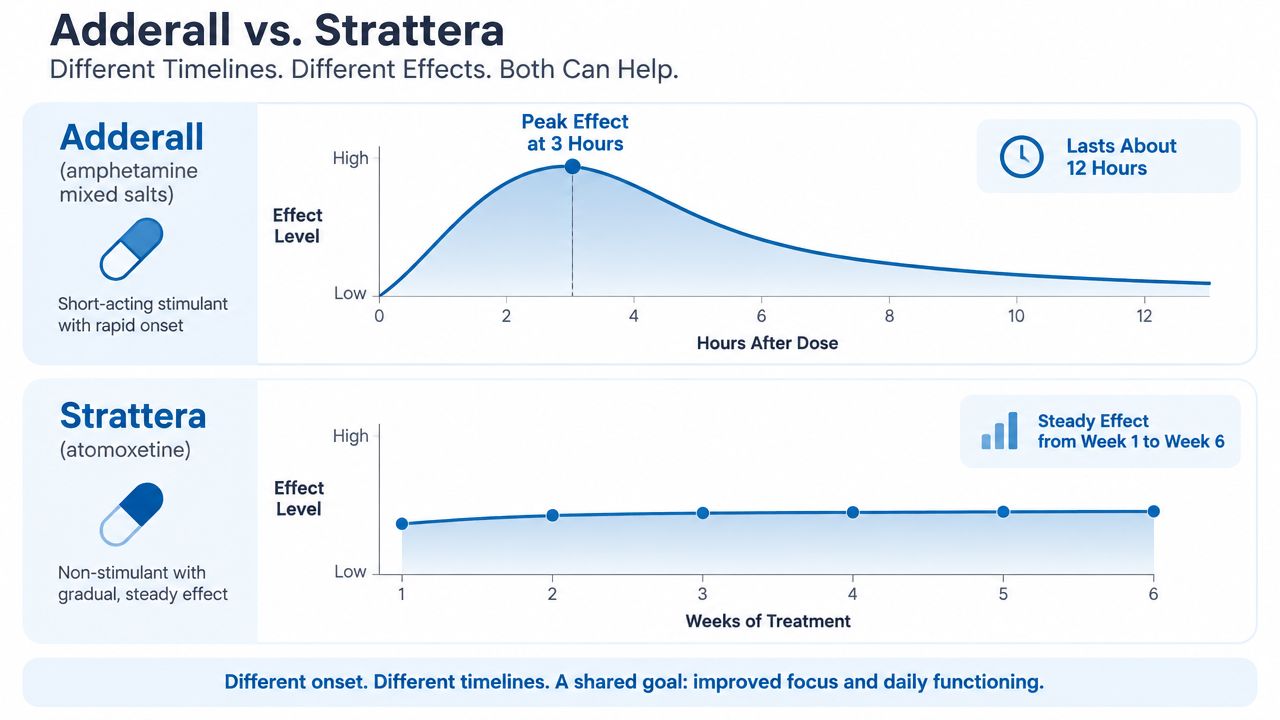
A simple analogy helps. Adderall turns up the volume on several attention-related systems quickly. Strattera fine-tunes a specific norepinephrine channel over time. That difference helps explain why Adderall can feel noticeable on the first day, while Strattera usually requires patience and consistent dosing.
The mechanism also shapes prescribing logistics. Adderall's controlled status creates additional requirements around prescriptions and dispensing. Strattera doesn't carry the same federal scheduling restrictions, which can make it more practical for some patients who worry about misuse, diversion, travel, or recurring pharmacy problems.
Patients who want a clearer explanation of stimulant effects may also benefit from understanding why stimulants help ADHD. The important point is that neither mechanism automatically makes one medication universally superior. Mechanism predicts certain trade-offs, but the patient's response determines whether those trade-offs are acceptable.
Onset Speed and Duration, A Day-by-Day Reality Check
A student who needs better concentration for an examination in two weeks faces a different decision from an adult seeking stable coverage across work, parenting, and evening responsibilities.
Amphetamine-based stimulants such as Adderall generally begin working within hours. Atomoxetine typically takes 1–4 weeks before clinical effects emerge, according to the British Columbia medication handout. That timeline affects how a clinician evaluates treatment. With Adderall, the prescriber can often learn relatively quickly whether a dose and formulation are moving in the right direction. With Strattera, stopping too early can mistake a slow onset for treatment failure.
Adderall's duration depends on the formulation. Immediate-release medication may require more than one dose across the day, while an extended-release formulation is designed for broader daytime coverage. Some patients appreciate the flexibility of immediate-release dosing, while others find multiple doses inconvenient or stigmatizing.
What a typical day can feel like
A child taking immediate-release Adderall may have useful classroom coverage but experience a noticeable change as the dose wears off. An adult using an extended-release formulation may get smoother workday support but still struggle with late-afternoon tasks. Sleep, appetite, rebound irritability, and the timing of responsibilities all matter.
Strattera is generally taken consistently rather than used as an occasional “focus” medication. That can simplify adherence and avoid a midday dose at school or work. It also means patients shouldn't expect a dramatic first-day transformation. The medication needs time to build a therapeutic effect.
A useful conversation with a prescriber includes more than “How long does it last?” Ask which hours need coverage, whether weekends matter, whether evening symptoms affect family life, and how quickly the clinician expects to adjust the plan. The practical timing differences are discussed further in how long Adderall lasts, but duration should always be balanced against sleep, appetite, mood, and functioning.
Effectiveness, What the Evidence Actually Shows
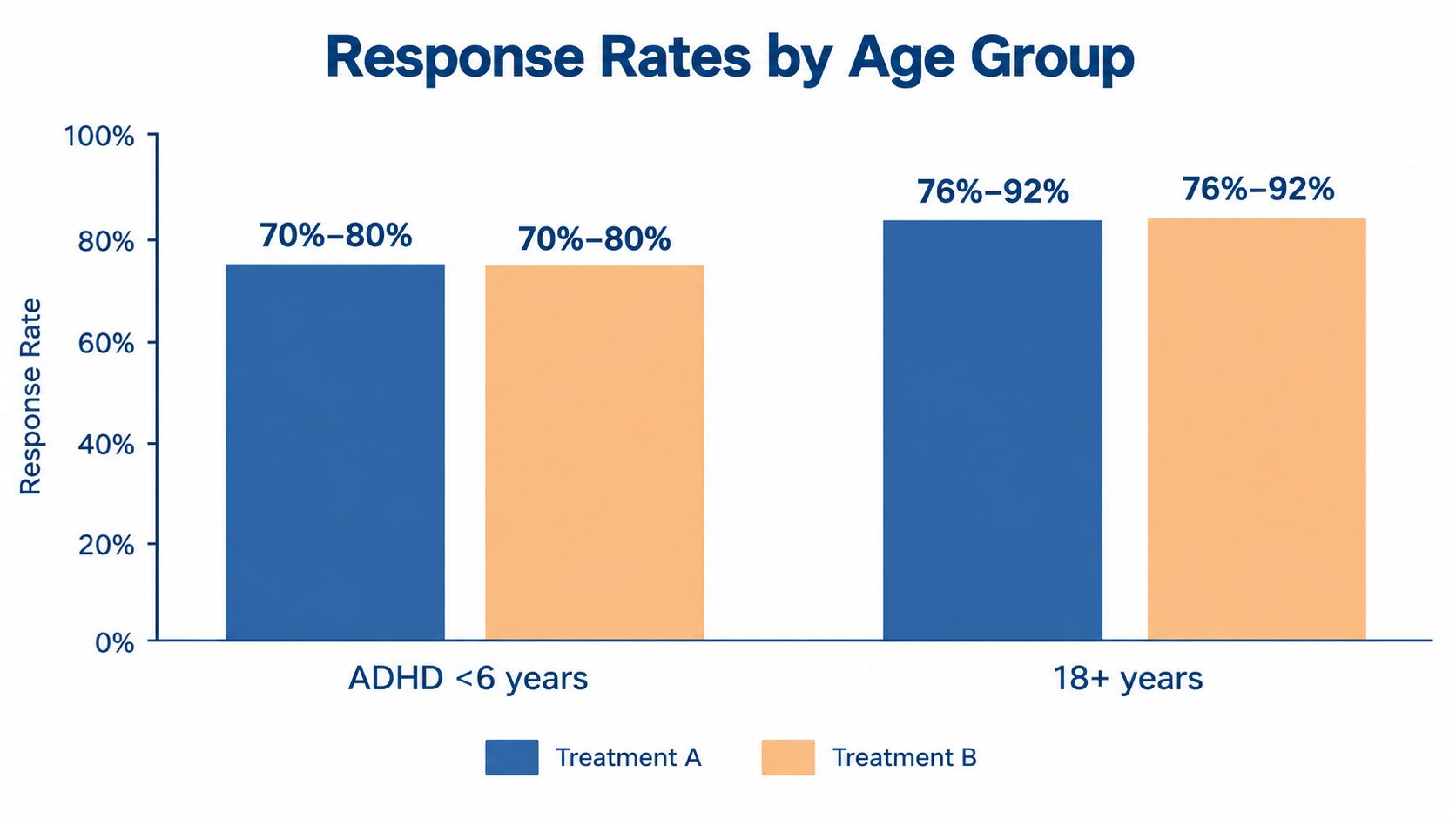
The evidence doesn't support pretending Adderall and Strattera have identical average effects. In a major network meta-analysis, clinician-rated improvement occurred in 72% of patients taking amphetamines, 43% taking atomoxetine, and 25% taking placebo, as reported in the comparative ADHD evidence review.
The same evidence base found a larger average effect in adults for amphetamines, with a standardized mean difference of approximately -0.79 compared with -0.45 for atomoxetine. That represents a roughly 75% larger average effect size for amphetamines in that dataset. These findings explain why stimulants are often considered first when a patient has no major contraindication and wants the strongest probability of rapid symptom reduction.
That advantage is meaningful, but it isn't the same as a guarantee. Some patients don't tolerate stimulant effects, don't want a controlled medication, or can't obtain it consistently. A lower average effect in comparative research doesn't make atomoxetine clinically irrelevant.
Where Strattera earns its place
Strattera has evidence for sustained benefit beyond the initial treatment period. In Eli Lilly's 18-month maintenance trial involving about 600 children aged 6 to 15, relapse occurred in 2.5% of children taking Strattera compared with 12.2% receiving placebo, according to the maintenance-trial report.
Longer-term pooled data involving 3,928 children and adolescents found that 44.4% achieved at least 40% improvement with atomoxetine compared with 21.4% receiving placebo, in the same evidence summary. The result shows meaningful efficacy, even though head-to-head comparisons generally favor amphetamine stimulants for average short-term symptom reduction.
My clinical interpretation is straightforward. If the priority is maximum short-term symptom suppression, and the patient can tolerate and obtain a stimulant, Adderall often has the edge. If the priority is long-term continuity, avoidance of controlled substances, or a treatment that fits a complicated risk profile, Strattera can be a legitimate first-line conversation rather than a consolation prize. Patients interested in broader non-stimulant options can review non-stimulant ADHD medication choices.
Side Effects, Safety Signals, and Who Should Avoid Each Medication
Medication selection becomes more useful when side effects are treated as decision criteria rather than a long warning list. The relevant question is not “Which drug has no side effects?” Neither does. The relevant question is which risks are most manageable for this person.
Patient or concern | Why Adderall may be difficult | Why Strattera may be difficult | Clinical focus |
|---|---|---|---|
Appetite and weight | Appetite suppression can interfere with nutrition | Decreased appetite and nausea may occur, especially early | Track eating, weight, and growth in children |
Sleep | Stimulation can worsen insomnia or cause late-day difficulty settling | Fatigue can occur, though the timing may differ | Match dosing and monitor sleep quality |
Anxiety | May intensify activation or physical anxiety in some patients | May be preferable for some, but mood and activation still require monitoring | Stabilize significant anxiety and reassess symptoms |
Cardiovascular concerns | Heart rate and blood pressure may rise | Cardiovascular monitoring is still appropriate | Review personal and family cardiac history |
Substance-use history | Controlled status creates misuse and diversion concerns | Non-controlled status is a practical advantage | Discuss recovery, cravings, and medication storage |
Children and adolescents | Growth, appetite, sleep, and behavior need follow-up | FDA warning requires close monitoring for suicidal ideation | Involve caregivers in observation and communication |
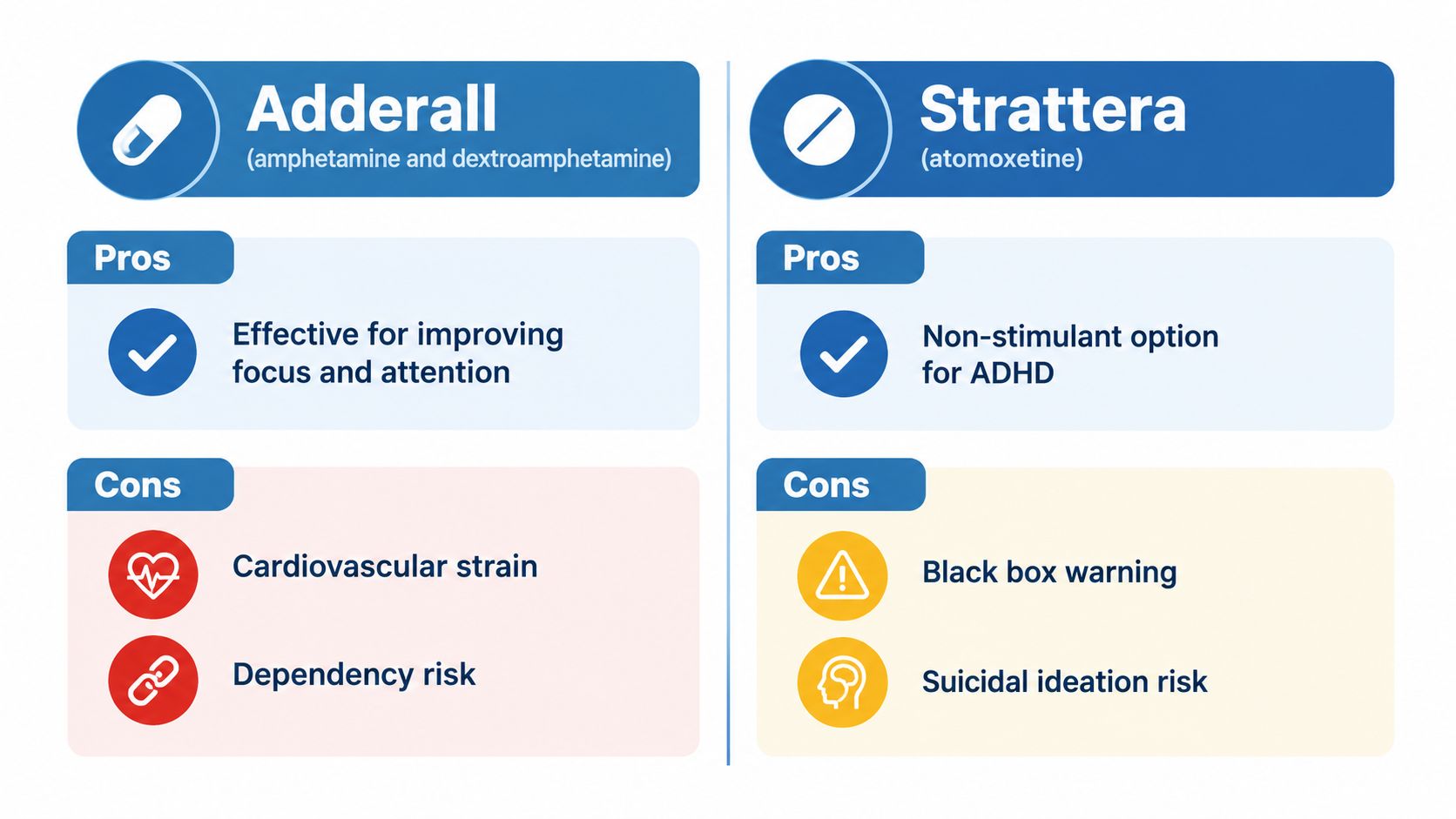
The FDA label for Strattera carries a black-box warning because atomoxetine increased the risk of suicidal ideation in short-term studies of children and adolescents with ADHD. Anyone starting it should be monitored for suicidality, worsening mood, agitation, and unusual behavior changes, as detailed in the FDA safety labeling.
Matching risk to the person
Adderall deserves particular caution when a patient has significant cardiovascular risk, uncontrolled anxiety, severe insomnia, or a personal history that raises concern about misuse or diversion. A family history can also change the screening conversation. These factors don't automatically rule out a stimulant, but they should be addressed before prescribing.
Strattera may be attractive for a patient in recovery, a patient who doesn't want a controlled medication, or a patient whose stimulant-related appetite and sleep effects have been difficult. It can still cause nausea, appetite changes, fatigue, mood changes, and cardiovascular effects. It also has medication-specific restrictions, including the need to avoid use with MAOIs, and rare serious liver injury requires clinical attention if concerning symptoms appear.
A broader overview of stimulant versus non-stimulant ADHD medications can help families prepare for that individualized discussion.
Real-World Access, Shortages, Insurance, and What Most Comparisons Miss
A medication's clinical effectiveness matters only if the patient can obtain it and take it consistently. The Adderall stimulant shortage has remained active into 2026, with reporting describing amphetamine mixed salts as affected by manufacturing and supply-chain constraints rather than prescribing behavior alone, as discussed in this current shortage report.
That changes the Adderall versus Strattera calculation. A patient may respond well to Adderall but lose coverage when a pharmacy can't fill the prescription. Repeated substitutions, unavailable strengths, and treatment interruptions can create anxiety and make it harder to tell whether the medication itself is working.
Strattera isn't a therapeutic equivalent to Adderall, and it shouldn't be presented as a simple replacement. It is a non-stimulant option with a slower onset and a different response profile. Still, its non-controlled status can make continuity more realistic for patients who are repeatedly unable to maintain stimulant access.
Insurance and prior authorization
Insurance coverage adds another layer. Generic Adderall products may be affordable when available, while generic atomoxetine can offer a practical non-stimulant alternative. Some insurance plans may require prior authorization for Strattera or prefer documentation showing stimulant intolerance, contraindication, or inadequate response.
A telepsychiatry evaluation can help organize that documentation and clarify which medication options are covered. Refresh Psychiatry accepts Aetna, UnitedHealthcare and UHC, Cigna, Blue Cross Blue Shield, Humana, Tricare, UMR, and Oscar insurance plans. Coverage varies by plan, so patients should verify benefits, medication tiers, and prior-authorization rules directly with their insurer.
Patients who are sorting through coverage rights may also find this guide to behavioral health parity explained useful. Insurance access isn't separate from psychiatric care. If cost or authorization barriers prevent a patient from continuing treatment, those barriers become part of the treatment plan.
How to Choose and What to Ask Your Prescriber
Start with the factor that could change the risk-benefit balance most. A history of substance use or recovery often makes Strattera an especially important option to discuss because it isn't a controlled stimulant. Uncontrolled anxiety, significant insomnia, cardiovascular concerns, or repeated stimulant side effects also warrant a careful conversation before choosing Adderall.
Speed matters too. If a patient needs symptom relief for an immediate academic or occupational demand, Adderall's faster onset may fit the situation better. If the patient values steady daily treatment and can wait through a gradual trial, Strattera may be more practical. If stimulant access has been unreliable, ask about non-stimulant treatment before another month of pharmacy calls.
Questions that improve the appointment
Bring specific questions instead of asking only which medication is “stronger.”
Treatment fit: How do you decide between a stimulant and non-stimulant for someone with my medical and psychiatric history?
Success markers: Which symptoms should improve first, and how will we know the medication is working?
Monitoring: How will we track appetite, sleep, blood pressure, heart rate, mood, and functioning?
Timing: How long should I trial this medication before deciding it isn't effective?
Stopping safely: What should I expect if I need to stop or switch medications?
Access: What happens if my pharmacy can't fill the prescription?
Coverage: Does my insurance require prior authorization for either option?
A complete ADHD evaluation should also consider anxiety, depression, trauma, sleep disorders, bipolar symptoms, substance use, medical conditions, and medication interactions. For patients seeking specialized evaluation and medication management, a Florida ADHD psychiatrist can help connect the diagnosis to a safe treatment plan.
Refresh Psychiatry & Therapy provides psychiatric evaluation and medication management through HIPAA-compliant telepsychiatry for Florida patients, including care involving stimulant and non-stimulant ADHD options. The practice can also help patients discuss monitoring, follow-up, and insurance documentation with a qualified clinician.
This blog is for informational purposes only and does not constitute medical advice. Please consult a qualified mental health professional for personalized guidance.
Contact us or call Refresh Psychiatry at (954) 603-4081 to schedule your evaluation. We accept Aetna, United Healthcare and UHC, Cigna, Blue Cross Blue Shield, Humana, Tricare, UMR, and Oscar insurance plans. Visit Refresh Psychiatry & Therapy to discuss whether Adderall, Strattera, or another ADHD treatment fits your symptoms, medical history, and access needs.