
🧠 Interview Anxiety Relief: A Practical Guide for Florida

Twenty minutes before a video interview, a capable candidate can sit frozen in front of a laptop, watching the blinking cursor in the meeting window while sweat cools on their palms. Their heart races, breathing turns shallow, their mouth goes dry, and a familiar answer about their experience suddenly disappears. The mind fills the silence with predictions: I'll embarrass myself. They'll notice I'm nervous. I'll lose the opportunity.
That response is common, but interview anxiety becomes clinically important when it interferes with thinking, speaking, preparation, or career decisions. A U.S. survey cited by Anxiety.org reported that 92% of adults were anxious about job interviews, while 17% identified general anxiety as their most common fear. The same reporting describes sweaty palms, a racing heart, nausea, and headaches.
The practical mistake is treating every anxious candidate as if they have the same problem. Anxiety may be concentrated in the body, the thought process, social interaction, self-presentation, or a particular question. Once you identify the mechanism, you can choose an intervention that has a reasonable chance of helping instead of repeating advice that merely feels productive.
What Interview Anxiety Actually Feels Like
An anxious candidate can arrive early, reread a résumé, and still feel unready. The body may react before the interviewer appears: a racing heart, tight chest, shallow breathing, trembling hands, dry mouth, nausea, or the sensation that the room has narrowed around the screen. Once the interview starts, tunnel vision may make the full question difficult to absorb.
The mind can add another layer of distress. You may know your work history thoroughly yet struggle to retrieve it under pressure. A neutral facial expression can look like rejection, prompting you to rush through pauses or overexplain. Afterward, one imperfect answer may replay until it feels like evidence that the entire interview failed.
At higher intensity, anxiety reduces working memory, speech fluency, eye contact, and flexible problem-solving. Mild activation can sharpen attention, while overactivation interferes with the skills an interview requires. Research on job-interview anxiety separates mental worry from visible physiological reactions, including shaking, perspiration, dry mouth, and stomach sickness (the validated interview anxiety scale).
Practical rule: The question isn't whether you feel nervous. Ask whether anxiety is preventing you from showing skills you actually possess.
Track the pattern before choosing a solution. The anxiety symptom checklist can help identify whether symptoms are mainly physical, cognitive, behavioral, or social. Candidates preparing for senior roles may also use executive interview preparation tips to strengthen communication and preparation while clinical treatment addresses the anxiety itself.
Specificity makes treatment more useful. “Calm down” gives you no clear target. “My hands shake when a panel asks me to defend a decision” identifies the trigger, the response, and the skill that needs practice. That information can guide therapy, rehearsal, and practical interview adjustments.
The Five Faces of Interview Anxiety
Interview anxiety isn't one uniform experience. Research involving actual job applicants described distinct dimensions involving appearance, behavioral, communication, performance, and social anxiety, and found that these dimensions can affect men and women differently (Rotman research on applicant anxiety).
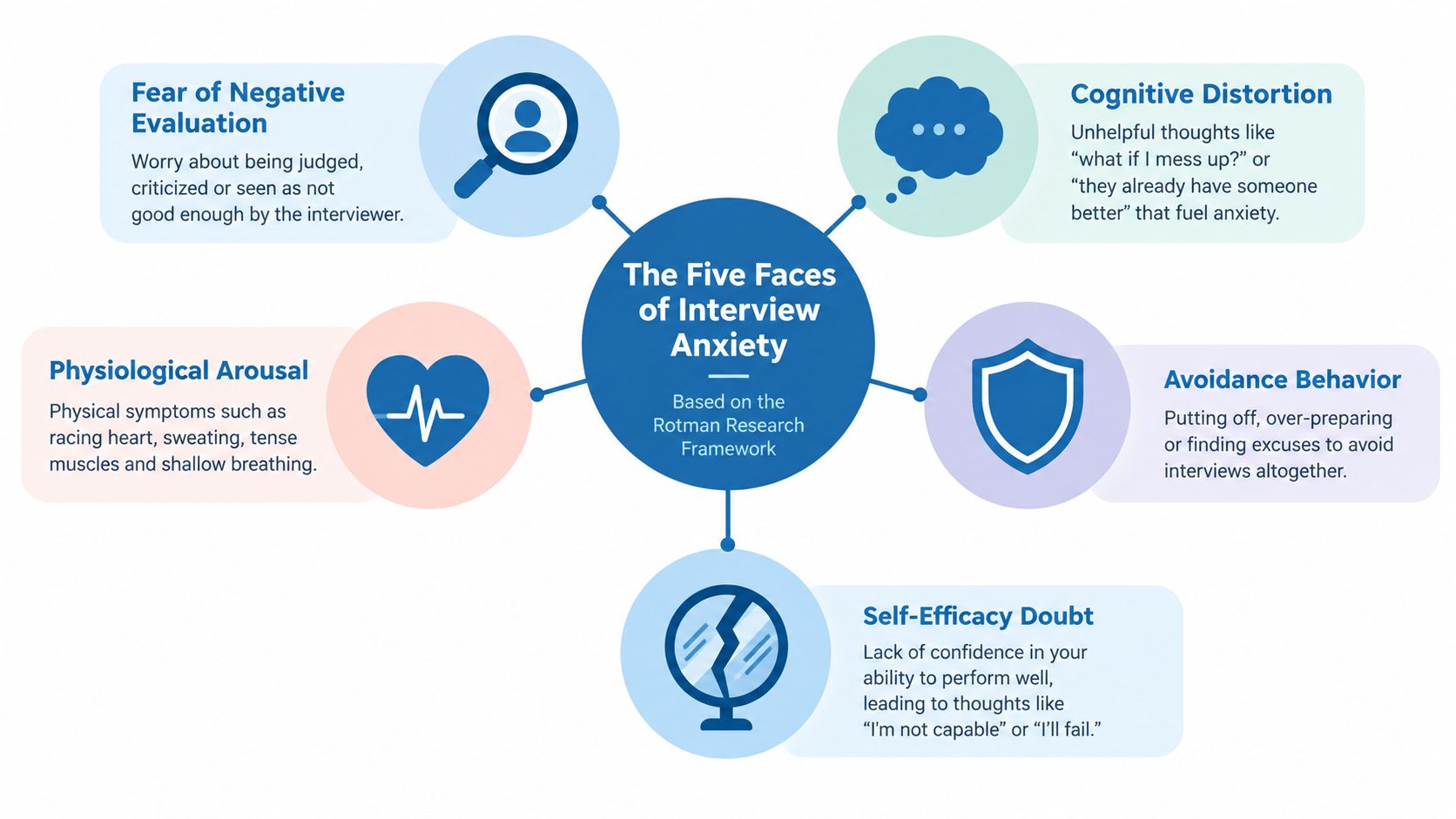
Appearance anxiety
This is fear of being judged through your appearance, age, clothing, accent, disability, background, or perceived social status. A candidate may spend more mental energy monitoring how they look than answering the question. Camera-based interviews can intensify this because the candidate sees their own image while speaking.
Behavioral anxiety
Behavioral anxiety concerns the interviewer's conduct and the candidate's visible reaction to it. A serious expression, interrupted answer, or panelist who takes notes may feel threatening. The candidate might fidget, lose eye contact, apologize repeatedly, or read ordinary professional behavior as hostility.
Communication anxiety
Communication anxiety appears in the exchange itself. You may worry about finding the right words, misunderstanding a question, speaking with an accent, or sounding less intelligent than you are. Someone with this pattern may know the answer but deliver it in fragments because self-monitoring consumes attention.
Performance anxiety
Performance anxiety centers on tasks, presentations, technical questions, tests, or demonstrations. An engineer may fear live coding. A clinician may fear explaining a complex judgment. A manager may worry that one request for an example will expose a gap in leadership experience.
Social anxiety
Social anxiety becomes strongest when the interview involves multiple employees, informal conversation, group judgment, or a workplace tour. The candidate may handle one interviewer well but shut down when three people join the call.
Generic breathing advice can reduce arousal, but it doesn't address every face. Performance anxiety often needs graded rehearsal. Social anxiety often needs planned exposure. Communication anxiety may respond to practice with pauses and concise answer structures. The Rotman findings also suggest that a universal “calm down and practice” message can miss meaningful differences in both anxiety and coping.
Cognitive Versus Behavioral Anxiety and Why It Matters
The McCarthy and Goffin interview anxiety scale separates anxiety into cognitive anxiety and behavioral anxiety. The categories overlap, but they suggest different starting points for treatment and practice.
Dimension | Cognitive Anxiety | Behavioral Anxiety |
|---|---|---|
Main experience | Worry, rumination, self-doubt, and predictions of failure | Visible arousal already described above, with attention on the maintenance loop |
Interview example | “My answer was too vague, and now they think I'm incompetent.” | A follow-up question triggers a stronger urge to escape or rush |
Typical maintenance loop | Threat thoughts increase self-monitoring, which makes recall harder | Sensations feel dangerous, so fear increases arousal and avoidance |
Useful starting tools | Write the prediction, check the evidence, and prepare a two-part answer structure | Practice one grounding cue while answering a mildly uncomfortable question |
Cognitive anxiety can persist even after careful preparation. You rehearse a clear answer, then the interviewer asks for more detail and harsh commentary takes over: You should have said that better. They know you're bluffing. The difficulty lies partly in the attention consumed by worry and self-evaluation. That attention is no longer available for listening, recalling examples, or organizing a response.
Behavioral anxiety is easier for an interviewer to notice, and it can affect how competence is judged. A report from the University of Guelph described poorer job-interview performance among anxious people, with stronger effects for men than for women. It identified nervous tics, difficulty speaking, and trouble generating answers as behaviors that may shape an interviewer's assessment. The practical implication is clear: reducing visible avoidance can matter alongside changing anxious thoughts.
Match the tool to the mechanism
For cognitive anxiety, write down the feared prediction and test it against available evidence. Replace “I'll fail if I pause” with a more accurate statement: “A short pause gives me time to answer clearly, and one imperfect response does not define my qualifications.” Then rehearse that statement while answering a question, rather than reading it as a reassurance exercise.
For behavioral anxiety, test techniques before interview day. Practice paced breathing, grounding, and speaking while mildly activated. DBT skills for emotional regulation provide a broader framework for tolerating distress without allowing the urge to escape to control your behavior.
Most candidates experience both loops. A physical alarm can trigger catastrophic thinking, while catastrophic thinking can intensify the alarm. Effective treatment addresses the two processes together, choosing cognitive work for threat predictions and behavioral practice for avoidance and arousal.
The Five Questions That Spike Anxiety the Most
A 2026 report identified five questions associated with the largest anxiety spikes: “Tell me about yourself,” “What is your greatest weakness?,” “Why are you leaving your current job?,” “Where do you see yourself in five years?,” and “Tell me about a time you failed” (the 2026 GlobeNewswire report). It also reported that anxiety can rise even in highly prepared candidates.
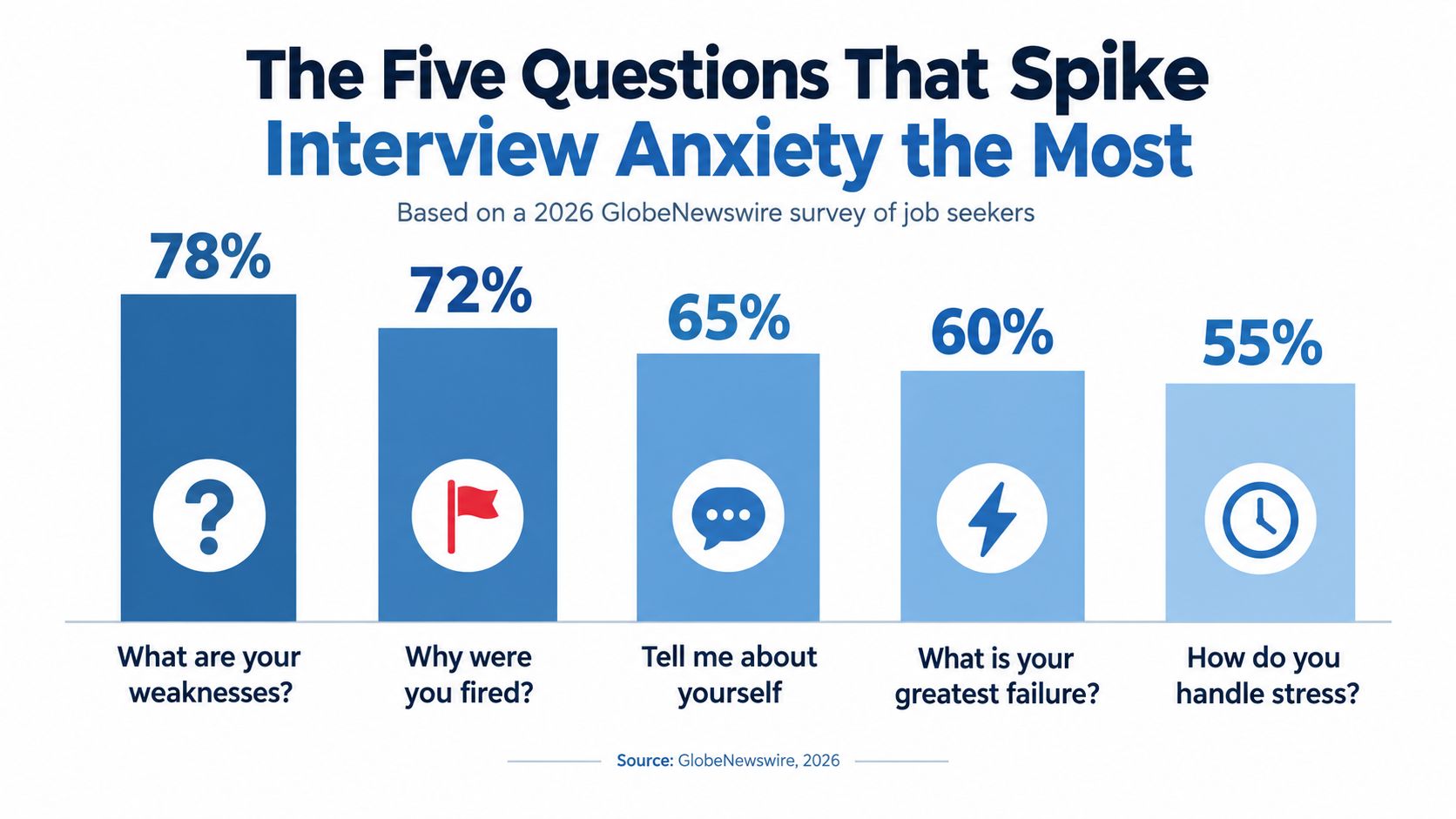
Each prompt creates a different threat. “Tell me about yourself” is open-ended, so the candidate must choose a starting point and decide what matters. “What is your greatest weakness?” creates perceived exposure. “Why are you leaving?” can feel like a reputation test, particularly after conflict, burnout, or termination. “Where do you see yourself in five years?” demands a confident narrative about an uncertain future. “Tell me about a time you failed” requires autobiographical recall while you're managing shame and trying to sound reflective.
The right response isn't memorizing a polished paragraph. Build a short structure, then practice adapting it. A concise professional summary works for the first question. A weakness answer should identify a real development area and the system you use to manage it. A departure explanation should stay factual and forward-looking. A failure story benefits from a clear situation, action, result, and lesson.
Candidates who need help shaping a weakness response may find Interview Pilot interview preparation useful as a preparation resource. The key clinical insight is that awareness lowers surprise. When you know which question activates shame, uncertainty, or reputation threat, you can rehearse the emotional response as well as the words.
CBT and DBT Techniques You Can Use Before and During the Interview
Techniques work best when they're tied to a specific moment. A breathing exercise won't rewrite a belief that one mistake makes you unemployable, and a thought record won't instantly stop a racing heart. Use cognitive behavioral therapy, or CBT, for the interpretation of the interview, and dialectical behavior therapy, or DBT, for staying effective while difficult emotions are present.
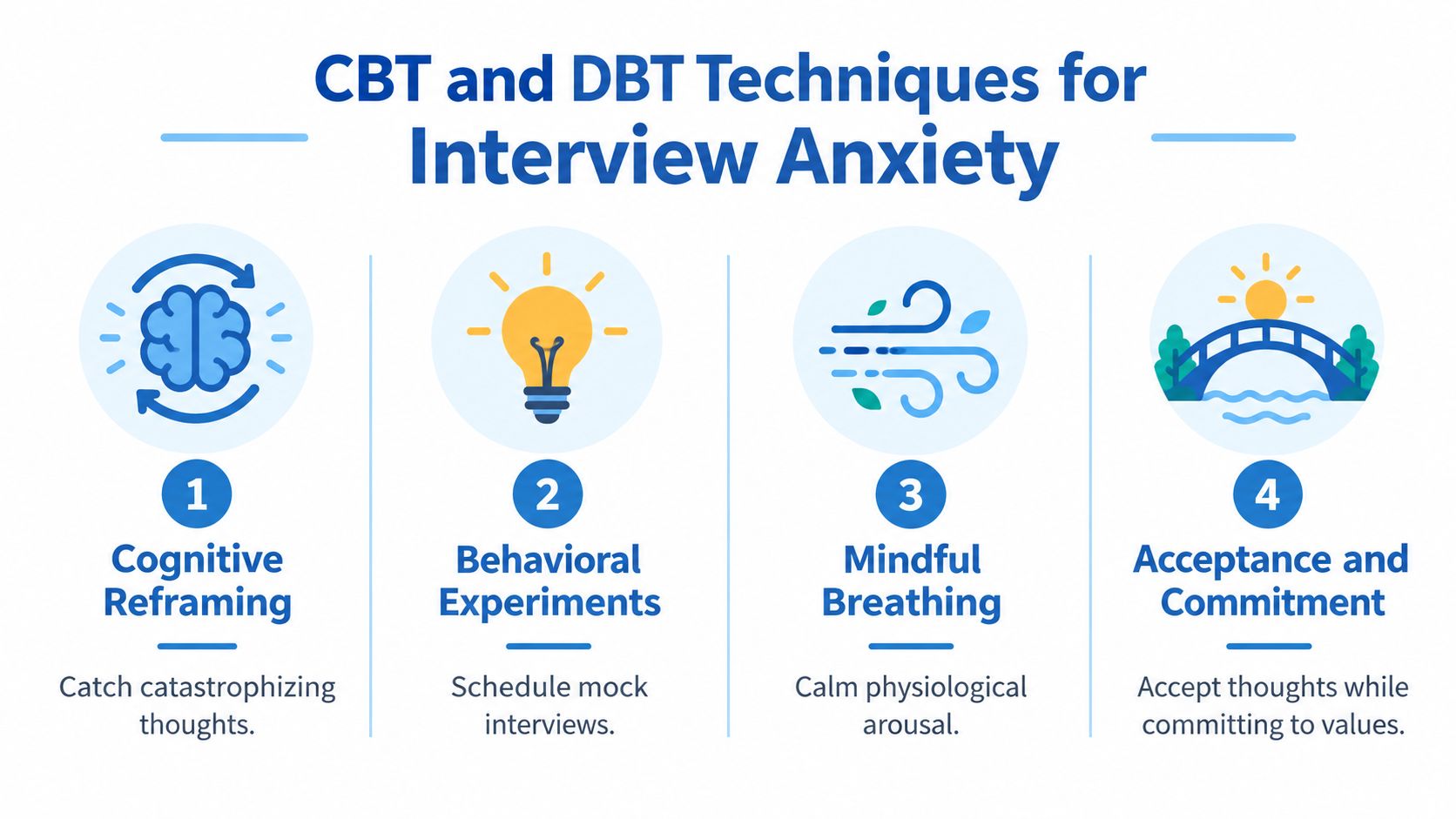
Cognitive reframing
Write the anxious prediction exactly as it appears: “If I pause, they'll assume I'm unqualified.” Then examine the evidence for and against it. A more balanced replacement might be: “I can pause, organize my answer, and return to the question. Interviewers evaluate the full conversation, not one second of silence.”
Reframing doesn't mean forcing optimism. It means replacing an absolute prediction with a statement that is accurate enough to guide behavior.
Behavioral experiments
Turn the fear into a test. If you predict that your voice will sound unacceptable when you're nervous, record an answer after a brisk walk and review it later. If you predict that a pause will ruin the interaction, deliberately pause before answering a practice question and observe what happens.
Move from lower-pressure practice to more demanding situations. The experiment should challenge the prediction without overwhelming you.
Opposite action
Anxiety often urges withdrawal, silence, excessive reassurance-seeking, or cancellation. DBT opposite action means choosing behavior that fits your values rather than the escape urge. Keep your appointment, answer the follow-up, ask for clarification, or remain engaged after an imperfect response.
This isn't pretending to feel calm. You can feel anxious and still act like someone who wants the opportunity.
Grounding during a spike
If panic rises mid-interview, place both feet on the floor and identify what you can see, hear, and physically feel. The grounding techniques guide offers a way to practice returning attention to the present rather than debating every anxious thought.
Use the following sequence:
Notice: Name the experience privately, such as “My heart is racing, and I'm still safe.”
Anchor: Feel your feet, loosen your jaw, and lengthen the exhale without forcing a deep breath.
Orient: Look at the interviewer's question and repeat the central words in your head.
Respond: Take a brief pause and answer one part at a time.
This short video can serve as a visual introduction to regulating anxious arousal:
Practice these skills before the interview. Under pressure, people reach for what they've rehearsed, not necessarily what they understand intellectually.
Exposure Practice and Graduated Rehearsal That Actually Work
Exposure practice is repeated contact with a feared situation in a controlled order, moving from less threatening to more threatening experiences. The purpose isn't to force yourself into panic. It's to teach your nervous system that you can remain present, answer questions, and recover while anxiety rises and falls.
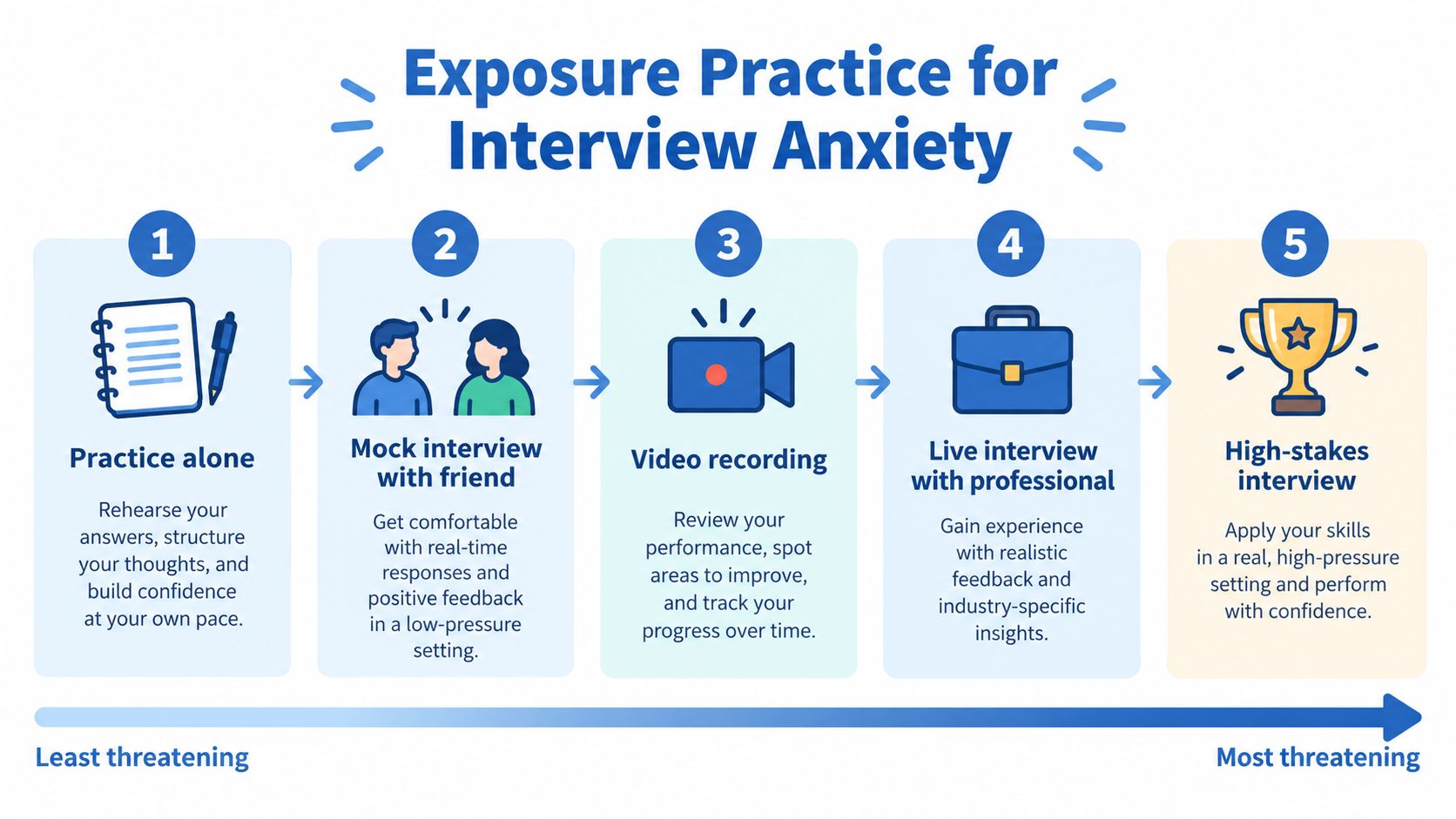
A workable hierarchy might look like this:
Practice alone: Speak answers aloud while using brief notes.
Meet a friend: Ask someone to interrupt gently and ask follow-up questions.
Record yourself: Watch the recording once for useful observations, not endless criticism.
Practice with a professional: Use a career adviser, therapist, or structured interview practice with AI to vary the prompts.
Choose a high-stakes interview: Apply the same skills to the role you most want.
Don't advance because the experience feels perfect. Advance when you can complete the task without relying on avoidance, excessive checking, or restarting every answer.
Positive imagery can support this process. A study published in the International Journal of Selection and Assessment found that positive imagery and field perspective taking decreased interview anxiety and increased interview self-efficacy, but did not change performance scores (the intervention study). That trade-off matters. Imagery may help you feel more capable, but it isn't a substitute for communication practice or treatment directed at persistent symptoms.
Practice insight: Rehearse recovery, not just success. Let yourself lose your place, pause, ask for the question again, and continue.
If your anxiety is strongly social, targeted guidance on coping with social anxiety can help you build exposure tasks that are challenging without becoming reckless.
When Anxiety Needs Professional Care and How Florida Telepsychiatry Helps
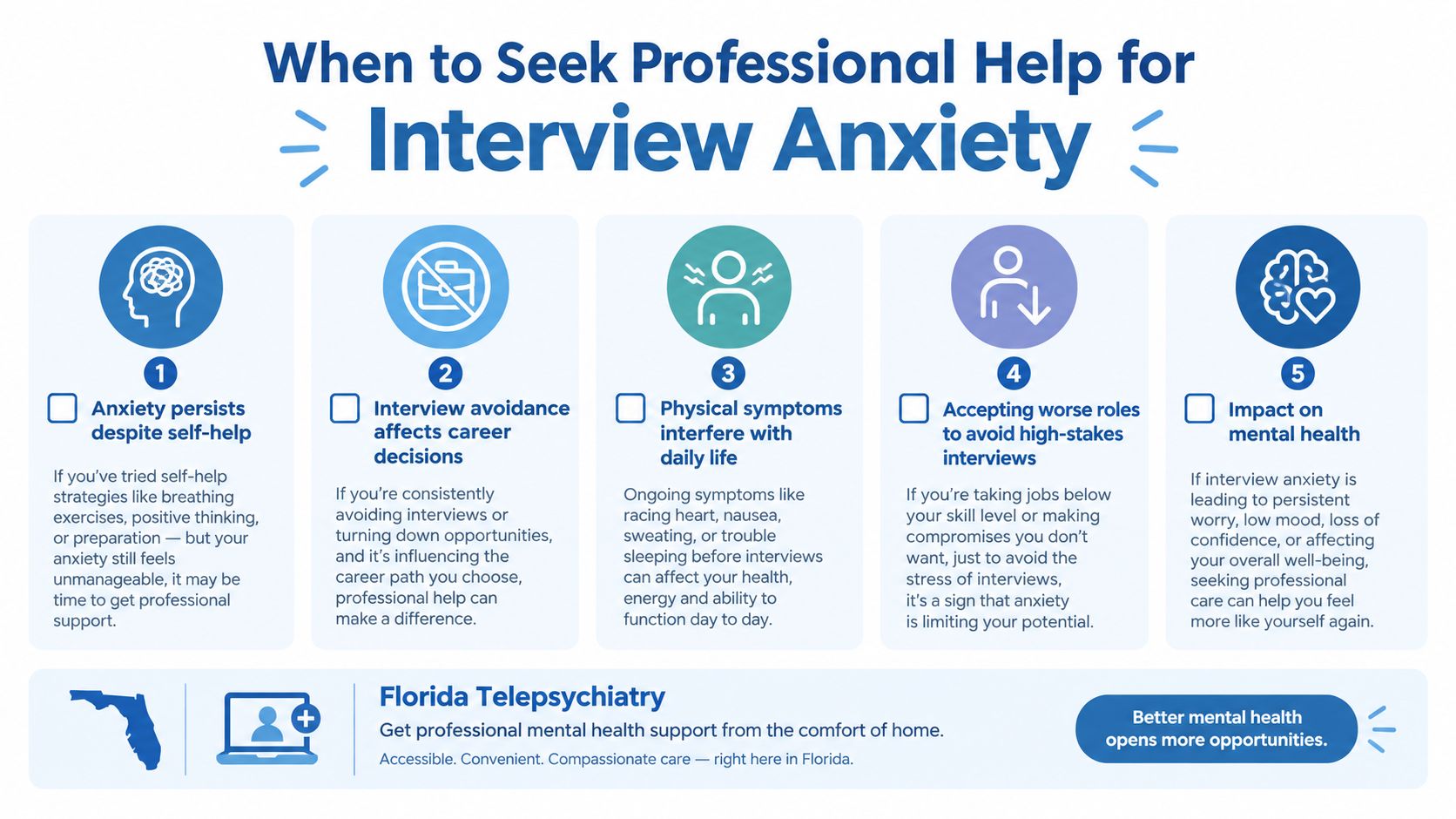
Self-help has a ceiling. If you keep declining interviews, change career plans to avoid evaluation, accept a less suitable role because it feels safer, lose sleep before every interview, or experience physical symptoms that continue despite practice, the problem deserves a clinical assessment.
Professional care also matters when interview anxiety extends beyond interviews. Persistent worry, panic symptoms, depressed mood, trauma reactions, attention problems, substance use, or sleep disruption can look similar on the surface but require different treatment plans. A psychiatric evaluation helps distinguish interview-specific anxiety from social anxiety disorder, panic disorder, generalized anxiety, depression, ADHD-related performance concerns, medication effects, or another condition.
What an evaluation can clarify
A psychiatrist will typically ask about the onset of symptoms, triggers, physical reactions, avoidance, sleep, mood, medical history, medications, substances, and previous treatment. The clinician may also ask how anxiety affects work, relationships, and ordinary tasks, not just the interview itself.
Treatment can include psychotherapy, medication, or both. CBT can target catastrophic predictions and avoidance. DBT skills can improve distress tolerance and emotional regulation. Depending on the broader clinical picture, a psychiatrist may discuss an SSRI or SNRI for persistent anxiety, while short-acting beta-blockers or benzodiazepines require careful individualized consideration because they aren't appropriate for everyone and carry different medical risks.
Medication should never be selected solely because a job interview is approaching. A board-certified psychiatrist can review diagnoses, interactions, contraindications, substance use, and the difference between reducing symptoms and masking a condition that needs broader care.
Why telepsychiatry helps Florida residents
Florida telepsychiatry removes practical barriers that often reinforce avoidance. You can attend from a private location without a commute or waiting room, schedule care around work, and receive follow-up through a HIPAA-compliant virtual visit. Electronic prescription handling may also reduce logistical friction when medication is part of the plan.
Telemedicine psychiatry in Florida can be a useful pathway for residents who need evaluation or ongoing treatment but find traditional appointments difficult to manage. Refresh Psychiatry & Therapy provides statewide telepsychiatry and combines medication management with therapy approaches such as CBT and DBT.
Seeking care isn't an admission that you're weak or incapable. It means the symptoms have become costly enough to deserve more than white-knuckling.
Your Next Steps With Refresh Psychiatry in Florida
Start with a practical account of what happens before the first appointment. Schedule through the practice's online portal or by phone, then complete intake paperwork describing your anxiety history, physical symptoms, avoidance patterns, sleep, medications, and interview-specific triggers. Specific examples help the clinician see whether the problem is narrow or part of a wider anxiety pattern.
During the initial telepsychiatry evaluation, expect a clinical interview and symptom review, followed by a discussion of treatment options. The plan may include therapy, medication management, or coordinated care, depending on your history and goals. Follow-up timing is individualized and should settle into a rhythm you can maintain alongside work and job searching.
Insurance questions are worth asking before the visit. Refresh Psychiatry & Therapy accepts Aetna, United Healthcare or UHC, Cigna, Blue Cross Blue Shield, Humana, Tricare, UMR, and Oscar insurance plans. Confirm benefits, copays, deductibles, telehealth coverage, and any self-pay arrangements with the billing team before scheduling.
Interview anxiety is highly treatable, and your candidacy rarely depends on one performance. The first appointment may be the hardest one to book, but it's usually easier to get through once you stop treating anxiety as a private test of character and start treating it as a health concern.
This blog is for informational purposes only and does not constitute medical advice. Please consult a qualified mental health professional for personalized guidance.
If interview anxiety is keeping you from opportunities or disrupting your daily life, Refresh Psychiatry & Therapy offers Florida telepsychiatry evaluations, therapy, and medication management for anxiety-related concerns. Contact us or call Refresh Psychiatry at (954) 603-4081 to schedule your evaluation.