
🧠 Manic Depression vs BPD: How to Tell Them Apart

A 2016 meta-analysis found that 21.6% of people with bipolar disorder also met criteria for borderline personality disorder, while 18.5% of people with BPD also met criteria for bipolar disorder (peer-reviewed review). That overlap explains why “manic depression vs BPD” isn't a simple comparison of mood swings. The decisive question is usually how long the change lasts, what starts it, and whether the shift behaves like an episode or a reaction.
I treat both conditions regularly, and the same mistake appears repeatedly: a patient describes intense anger, impulsive behavior, self-harm, or unstable relationships, and everyone focuses on the emotional intensity rather than the clock. Bipolar disorder and BPD can coexist, but they aren't interchangeable diagnoses. A careful evaluation can identify the pattern and prevent treatment from becoming a sequence of guesses.
Why This Comparison Matters
The overlap is clinically meaningful, not an academic footnote. The same 2016 literature found that comorbidity was even higher in bipolar II samples, reaching about 37.7% (peer-reviewed review). Another review reported BPD in about 16.0% of people with bipolar disorder, including 10.7% in bipolar I and 22.9% in bipolar II (epidemiologic review). Bipolar II deserves particular attention because hypomania can be subtle, while emotional reactivity and impulsivity may dominate the clinical presentation.
Both conditions can involve depression, irritability, suicidal thinking, recurrent crises, impulsivity, and self-injury. In an emergency department or primary-care visit, clinicians often see the crisis rather than the months or years of history needed to classify it accurately. A person in acute distress may not be able to describe whether their sleep changed before the mood shift, whether energy remained high, or whether a relationship conflict set the entire episode in motion.
Practical rule: Don't diagnose the disorder from the most dramatic symptom. Diagnose the pattern surrounding it.
The consequences of getting the pattern wrong can accumulate. Antidepressant monotherapy may be a poor fit when bipolarity hasn't been assessed, while a delayed mood-stabilizer discussion can leave episodic illness untreated. Conversely, treating chronic interpersonal and emotion-regulation problems as if they were only a medication-responsive mood cycle can postpone psychotherapy that addresses the actual mechanism.
A useful assessment asks four questions:
Duration: How long did the change last from clear onset to clear return toward baseline?
Structure: Was there a recognizable episode, or is instability present across most settings and relationships?
Trigger: Did the shift follow rejection, conflict, or perceived abandonment, or did it arise without an identifiable interpersonal event?
Recovery: Did sleep, energy, judgment, and goal-directed activity normalize together?
The rest of this article uses those questions as a chairside reference. It draws on DSM-5-oriented diagnostic distinctions and the practical reasoning clinicians use when bipolar disorder and BPD overlap.
What Manic Depression and BPD Are
“Manic depression” is the older term for bipolar disorder, a condition defined by episodes of mood and energy change. Current diagnostic language distinguishes bipolar I, bipolar II, mania, hypomania, and depressive episodes rather than treating every severe mood shift as the same illness.
Bipolar disorder is a mood disorder organized around discrete episodes. Mania involves at least one week of persistently heightened, expansive, or irritable mood with increased energy or goal-directed activity, along with other manic symptoms. The duration can be shorter if hospitalization is required. Hypomania lasts at least four days and represents a clear change from baseline, without the marked impairment or psychosis associated with mania. Bipolar I includes mania. Bipolar II includes hypomania and major depressive episodes, with no history of mania. The criteria are summarized in this clinical review of bipolar episode criteria.
Depression may be the symptom that brings someone to treatment, while the bipolar evidence sits in the history. A careful interview looks for past periods of decreased need for sleep, unusually high or irritable mood, pressured speech, grandiosity, racing thoughts, and sustained goal-directed activity. Family history can add context, but it cannot replace a documented episode pattern.
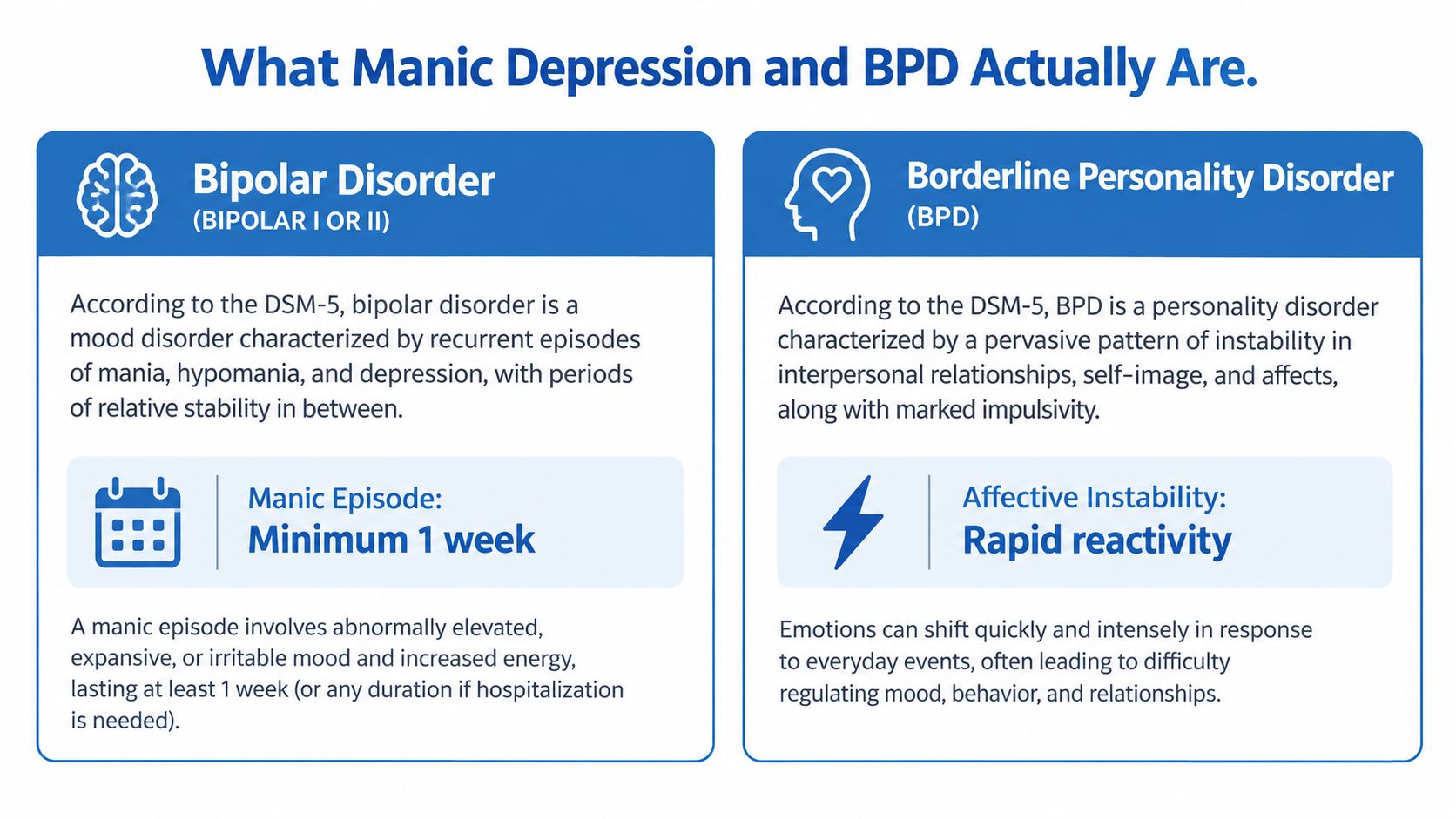
Borderline personality disorder, or BPD, is a personality disorder involving a pervasive pattern of instability in relationships, self-image, affect, and impulse control. DSM-5 diagnosis requires five of nine criteria, including possible frantic efforts to avoid abandonment, unstable relationships, identity disturbance, impulsivity, recurrent suicidal behavior or self-harm, affective instability, chronic emptiness, intense anger, and stress-related paranoia or dissociation.
The central distinction is the time course and structure of the problem. Bipolar disorder involves episodes that come and go. BPD involves a long-standing pattern affecting self-experience, relationships, conflict, and emotional pain across settings. A person with BPD may have calm periods, and a person with bipolar disorder may have persistent relationship difficulties, so one appointment rarely settles the diagnosis.
For a plain-language explanation of hypomania, see this guide to hypomanic symptoms. That distinction affects treatment planning: sustained episodes may prompt medication evaluation, while chronic reactivity and interpersonal patterns often require psychotherapy, and some patients need both. A clinician still must assess duration, impairment, development, substances, medical contributors, and safety.
Side by Side at the Chairside
At the chairside, time course is usually the most useful discriminator. Bipolar episodes generally persist for days to weeks, and sometimes longer, while BPD-related affective shifts are often brief, commonly minutes to hours, and linked to interpersonal stressors (clinical distinction).
Clinical Feature | Bipolar Disorder (Manic Depression) | Borderline Personality Disorder |
|---|---|---|
Duration | Discrete mood episodes lasting days to weeks or longer | Rapid shifts, often minutes to hours |
Trigger pattern | May arise without a clear interpersonal trigger; sleep disruption can be important | Often follows rejection, conflict, perceived abandonment, or criticism |
Energy | Sustained increase in energy and goal-directed activity during mania or hypomania | Bursts of activation are usually tied to emotional distress |
Sleep | Decreased need for sleep, often without next-day fatigue | Insomnia is more often driven by anxiety, anger, rumination, or distress |
Relationships | Difficulties may intensify during episodes and improve between them | Instability is chronic, with abandonment fears and idealization-devaluation patterns |
Baseline | Possible intervals of meaningful recovery | Emotional and interpersonal vulnerability often persists across settings |
A manic or hypomanic state isn't “feeling very emotional.” The person may sleep far less and still feel rested, speak faster, start multiple projects, pursue unrealistic plans, spend impulsively, or show unusually expansive confidence. The increased energy has a sustained, organized quality, even when judgment is impaired.
BPD reactivity can be equally intense but usually has a different sequence. A delayed text, argument, perceived rejection, or sudden change in closeness may produce panic, rage, shame, dissociation, or self-harm urges. The emotion can shift quickly when the interpersonal situation changes, although the consequences may last much longer.
The question isn't only “How high did your mood get?” Ask, “When did it start, what maintained it, and what ended it?”
Sleep deserves careful questioning. “I slept three hours” isn't enough to establish decreased need for sleep. In mania, the person may sleep less and feel energized. In BPD, the person may sleep less because they were distressed, frightened, or ruminating, then feel exhausted the next day.
A mood chart should record the onset, offset, trigger, sleep, energy, behavior, and recovery of each change. A symptom checklist can tell a clinician that impulsivity occurred. A timeline can show whether impulsivity appeared during a sustained episode, followed a conflict, or occurred as a chronic trait. For a more detailed look at interpersonal precipitants, review this resource on BPD triggers.
Where the Two Conditions Confuse Each Other
Structured assessments can separate bipolar disorder and BPD more effectively when they include hypomanic and manic features. One classification study reported 81% to 84% accuracy using personality-measure items alone, 88% after refining study variables, and 92% to 95% when hypomanic or manic features were added (classification study). Those figures don't mean a diagnosis can be automated. They show why a structured interview that asks about polarity, sleep, energy, and episode boundaries is more informative than a rapid impression.
Four common diagnostic traps
BPD mistaken for rapid-cycling bipolar disorder. A person may experience several severe mood changes in one day. If the clinician counts each reaction as a bipolar episode, the diagnosis may miss the interpersonal sequence and chronic pattern.
Bipolar II hypomania mistaken for BPD impulsivity. Hypomania can appear as productivity, confidence, sociability, reduced sleep, or irritability rather than obvious euphoria. If no one asks whether the person needed less sleep and maintained unusually high energy, the episode can be overlooked.
Mixed features obscuring the clock. Irritability, agitation, racing thoughts, hopelessness, and impulsivity can occur together. The clinician must determine whether these symptoms formed part of a sustained mood episode rather than assuming that anger alone indicates BPD.
Substance use hiding baseline functioning. Alcohol and other substances can trigger, mimic, or intensify mood symptoms. The assessment needs a substance timeline, including what was used, when it was used, and whether the symptoms persisted during periods without use.
Turn distress into a usable record
For each significant shift, write four entries:
Misdiagnosis Pattern | Why It Happens | Journal Entry to Capture |
|---|---|---|
Rapid mood changes labeled as bipolar episodes | The intensity is visible, but the interpersonal trigger is missed | Record the event immediately before the shift and how quickly the emotion changed |
Hypomania labeled as impulsivity | Reduced sleep and increased energy aren't explored | Note sleep duration, fatigue level, speech speed, projects, spending, and confidence |
Irritability labeled as BPD | Mixed mood symptoms can look relational or behavioral | Record sadness, hopelessness, agitation, racing thoughts, and energy together |
Substance effects mistaken for baseline illness | Intoxication, withdrawal, and sleep loss distort the picture | Record substance use, timing, sleep, and symptoms on substance-free days |
Dissociation may complicate both the history and the patient's sense of continuity. A clinician can use a resource such as what dissociation can look like to help clarify experiences without treating dissociation as proof of either diagnosis.
Treatment Paths for Each Diagnosis
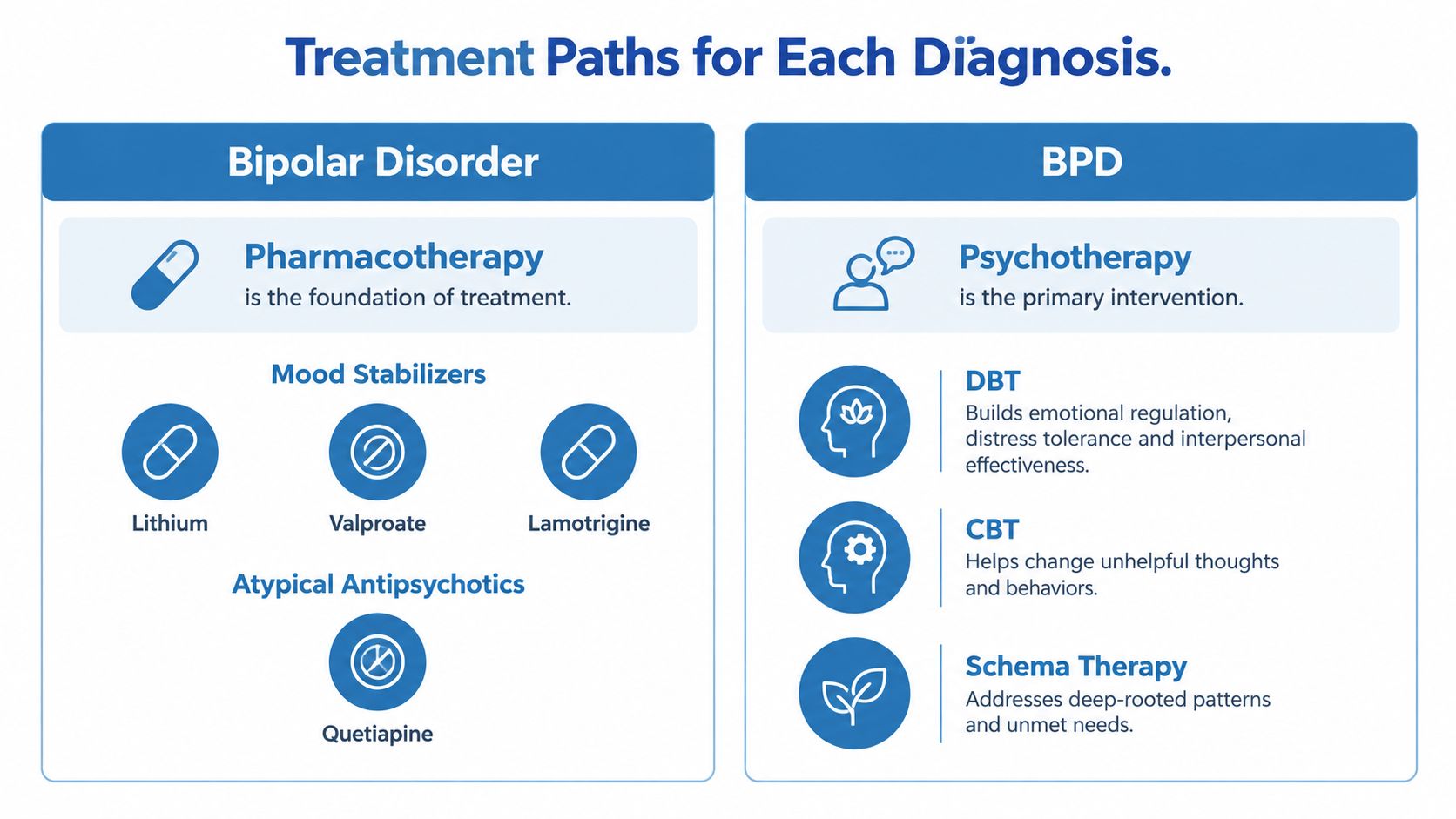
Treatment follows the mechanism. Bipolar disorder generally begins with pharmacotherapy, while BPD treatment is primarily psychotherapy-based. The difference matters because medication can reduce mood episodes, but it can't by itself teach the relationship and emotion-regulation skills central to BPD. Conversely, psychotherapy can support bipolar relapse prevention, but it shouldn't substitute for appropriate mood stabilization when clear mania or hypomania is present.
For bipolar disorder, commonly used medication categories include mood stabilizers such as lithium, valproate, and lamotrigine, along with atypical antipsychotics such as quetiapine, lurasidone, and lumateperone. Selection depends on the current phase, prior response, side-effect risks, medical history, pregnancy considerations, substance use, and the need to target mania, depression, or maintenance. Therapy remains valuable for adherence, sleep regularity, relapse prevention, family communication, and recognizing early warning signs.
BPD requires a different center of gravity. Dialectical behavior therapy, or DBT, targets distress tolerance, emotion regulation, mindfulness, interpersonal effectiveness, and crisis behaviors. Mentalization-based therapy, schema therapy, and other structured approaches may also be appropriate. Medication can be considered for specific symptoms or co-occurring conditions, but medication alone doesn't change the enduring interpersonal and behavioral patterns that define BPD.
DBT often combines individual therapy with skills-group participation, coaching or skills practice, and clinician consultation. The exact schedule depends on the program. A realistic plan includes repeated practice between sessions, because knowing a skill intellectually isn't the same as using it during abandonment panic, rage, or suicidal distress.
Treatment trade-off: Medication can lower biological mood volatility, but it won't replace behavioral rehearsal. DBT can improve regulation and relationships, but it won't treat a sustained manic episode by itself.
When both conditions are present, sequencing and coordination become essential. The psychiatrist generally needs to address active bipolar mood instability first, while the therapist begins or strengthens DBT work as soon as the patient can participate safely. Mixed states, impulsivity, access to medication, substance use, and suicidal thinking require direct communication among the treatment team.
Medication changes shouldn't happen abruptly or without the prescribing clinician. For an overview of commonly discussed options, see this mood stabilizers medication list. The right choice depends on an individualized evaluation rather than the diagnosis name alone.
This short educational video can supplement, but not replace, clinical care:
Crisis Planning and Safety Considerations
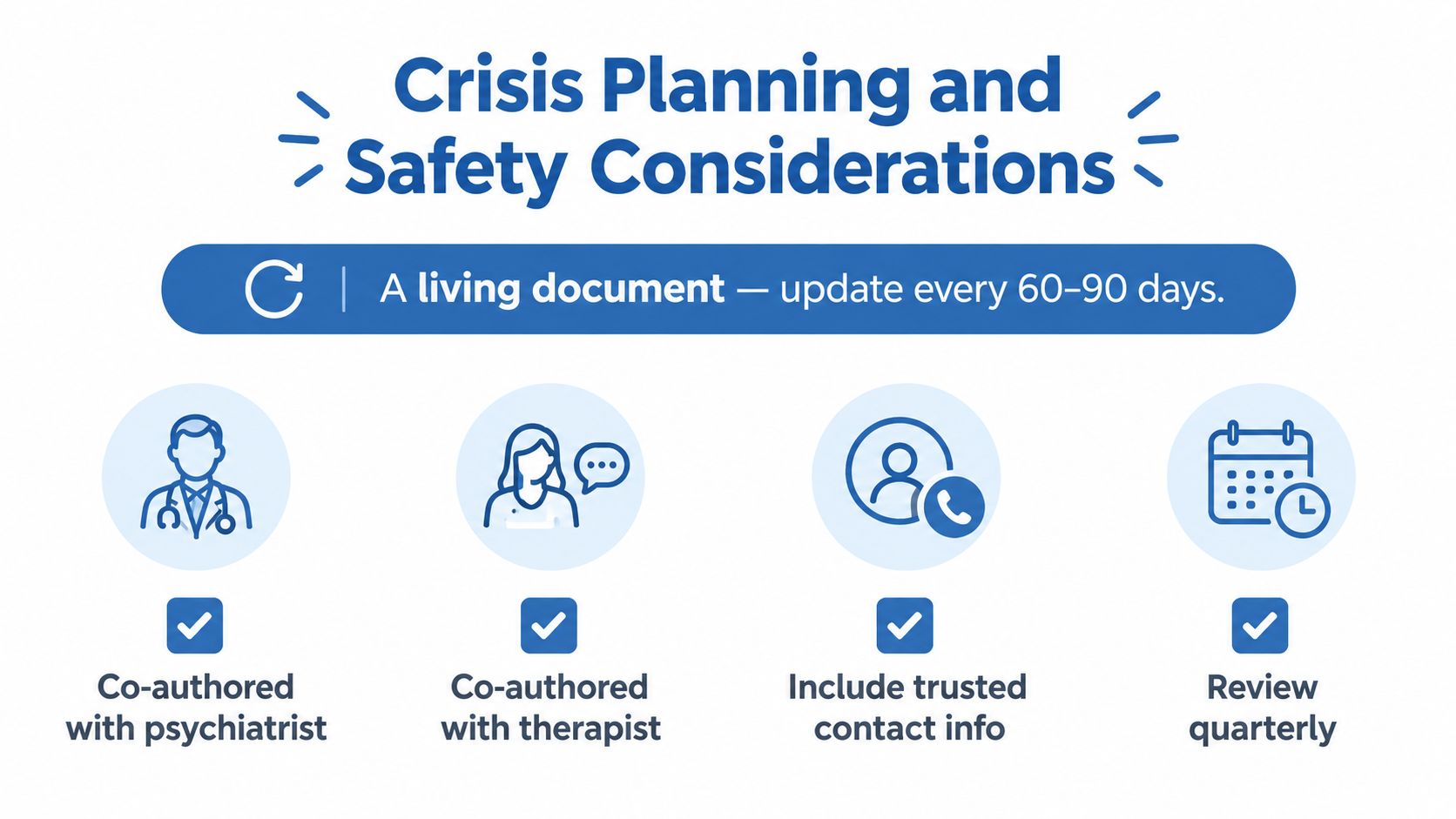
A safety plan shouldn't be written only after someone has attempted suicide or arrived in an emergency department. It works better as a living document, created with the psychiatrist, therapist, and a trusted contact, then reviewed regularly as medications, relationships, housing, access to means, and warning signs change.
A practical plan has three layers:
Reduce access to lethal means: Remove firearms from the home when risk rises, store medications securely, and ask the prescriber or pharmacy whether limited quantities or split fills are appropriate.
Use shared warning-sign language: Replace “I'm having a bad day” with a phrase everyone understands, such as “I haven't slept, I'm thinking about overdosing, and I need someone to stay with me.”
Preassign crisis routes: List the treating clinician, local mobile crisis resources, the nearest emergency department, and 988. Call emergency services when there is immediate danger or someone can't stay safe.
Both bipolar disorder and BPD can involve serious suicide risk, but the risk may present differently. Bipolar disorder has been described as carrying the highest completed-suicide rate among psychiatric diagnoses, while BPD is associated with frequent suicide attempts. These are reasons for active monitoring, not reasons for shame or fatalism.
A person can tell a partner, “I'm having thoughts of hurting myself. I don't need you to solve this, but I do need you to stay with me while we contact my clinician.” To a therapist, say, “The thoughts are stronger than usual, I have access to medication, and I don't trust myself alone tonight.” Direct language gives others information they can act on.
For broader emergency-preparedness thinking, this lone worker emergency alert story illustrates why a reliable escalation pathway matters when a person is isolated or unable to respond normally. If danger is immediate, call 911 or go to the nearest emergency department. In the United States, call or text 988 for the Suicide & Crisis Lifeline.
What to Expect From a Psychiatric Evaluation
A psychiatric evaluation is the highest-yield step when the question is bipolar disorder versus BPD. The clinician isn't just checking whether you have mood swings. They're reconstructing the relationship between time, sleep, energy, triggers, behavior, family history, substances, trauma, medical conditions, and safety.
The intake commonly includes a detailed interview lasting 60 to 90 minutes, covering current symptoms, previous mood episodes, family history of mood and substance-use disorders, developmental experiences, trauma, medications, and hospitalizations. Standardized tools may include the Structured Clinical Interview for DSM-5, or SCID-5, the Mood Disorder Questionnaire, or MDQ, and mood-specific or BPD-specific rating scales. Screening tools organize the interview, but they don't make the final diagnosis.
Evaluation Component | What Is Assessed |
|---|---|
Clinical interview | Current symptoms, prior episodes, impairment, relationships, trauma, and safety |
Episode timeline | Onset, offset, sleep, energy, triggers, behavior, and return to baseline |
Family history | Bipolar disorder, depression, suicide, substance-use disorders, and related conditions |
Structured measures | Possible bipolar-spectrum symptoms and BPD features |
Medical review | Thyroid, metabolic, medication, and substance-related contributors |
Treatment history | Previous medications, therapy, benefits, adverse effects, and adherence |
Collaborative feedback | Working diagnosis, uncertainty, treatment priorities, and follow-up plan |
Medical testing may include TSH, CBC, CMP, vitamin D, B12, and a urine drug screen when clinically appropriate. These tests can help identify thyroid, metabolic, nutritional, medication-related, or substance-induced contributors, but laboratory results don't establish BPD or bipolar disorder.
Bring a written timeline rather than relying on memory under pressure. Include sleep logs, medication bottles or an accurate medication list, prior records, hospitalization dates, and observations from someone who knows your baseline. Note whether heightened periods involved decreased need for sleep or just insomnia with fatigue.
Telepsychiatry can provide the same diagnostic depth through a secure, HIPAA-compliant video appointment. A Florida clinician will still ask about relationships, triggers, past intense emotional states, dissociation, substance use, and suicidal thinking, then review a working formulation and next steps with you rather than presenting a label without explanation.
Finding the Right Care in Florida
Choose a clinician who routinely evaluates and treats both bipolar disorder and BPD. Dual experience matters because bipolar II, trauma symptoms, substance use, dissociation, and genuine comorbidity can blur the presentation. The practical discriminator is often the time course: sustained episodes with a decreased need for sleep point clinicians toward bipolar illness, while rapid, trigger-linked shifts may suggest BPD. That distinction affects whether medication, psychotherapy, or both should lead treatment.
Florida patients can check credentials through the Florida Medical Association, Psychology Today's clinician directory, or the American Psychiatric Association's Find a Psychiatrist tool. Before booking, use a step-by-step guide to finding the right psychiatrist, then ask:
Diagnostic scope: Does the psychiatrist assess bipolar-spectrum conditions and personality disorders?
Therapy coordination: Does the practice provide DBT or coordinate with a DBT therapist?
Follow-up access: What happens if sleep drops, impulsivity escalates, or suicidal thoughts increase?
Insurance: Is the clinician in-network with your specific plan?
Format: Are secure telepsychiatry visits available throughout Florida?
Medication management alone rarely addresses BPD, while therapy without attention to active bipolar symptoms can leave mood episodes undertreated. An integrated practice such as Refresh Psychiatry & Therapy offers psychiatric evaluations, medication management, and individual therapy, including CBT, DBT, psychodynamic, and trauma-focused approaches through Florida telepsychiatry.

Before the appointment, gather your symptom timeline, medication history, prior records, sleep observations, and safety-planning questions. Confirm current insurance coverage directly with the practice or insurer, since plan details can change.