
ADHD and Anxiety: How to Cope with Both

You've missed another deadline, but the problem doesn't feel like simple distraction. You sit down to work, then worry about getting it wrong, lose sleep replaying what you haven't finished, and struggle to start the next day. When ADHD and anxiety overlap, the same difficulty focusing can come from different causes, or several at once. Sorting out what's driving it helps guide treatment that addresses the whole picture.
When Focus Problems Are Not Just ADHD
A college student arrives for an ADHD evaluation after years of missed deadlines. They describe losing track of assignments and underestimating how long tasks take. But they also lie awake worrying about failing, feel restless before class, and put off opening their laptop because the work feels overwhelming. Those details matter: difficulty concentrating can reflect ADHD, anxiety, sleep disruption, or a combination.
The clinical question isn't just whether someone has trouble focusing. It's what happens just before focus breaks down. Does the person lose track of a task even when they feel calm? Does worry about making a mistake pull their attention away? Do they avoid a task because they can't organize the steps, because they fear the outcome, or both?
That distinction affects care. If anxiety is driving avoidance, an ADHD-only plan may not address the fear keeping someone stuck. If ADHD-related disorganization is creating missed deadlines, treating anxiety alone may leave the recurring source of stress in place. And if a medication change causes insomnia or physical activation, a clinician needs to consider those effects rather than automatically treating them as proof of a separate anxiety flare.
For a closer look at possible causes, see this guide to what can lead to poor concentration. A useful evaluation connects attention problems to the person's history, settings, sleep, and daily functioning, rather than relying on one symptom or an online checklist.
The aim isn't to decide which diagnosis “wins.” It's to understand which symptoms are primary, which may be reactions to repeated difficulty, and what is making life hardest right now.
How Often ADHD and Anxiety Actually Overlap
ADHD and anxiety often occur together, but the reported rate depends on who researchers study and how they define each condition. That variation doesn't make the evidence meaningless. It means that an estimate from a general-population sample may not match one from a psychiatric clinic, where people are more likely to seek care for significant distress.
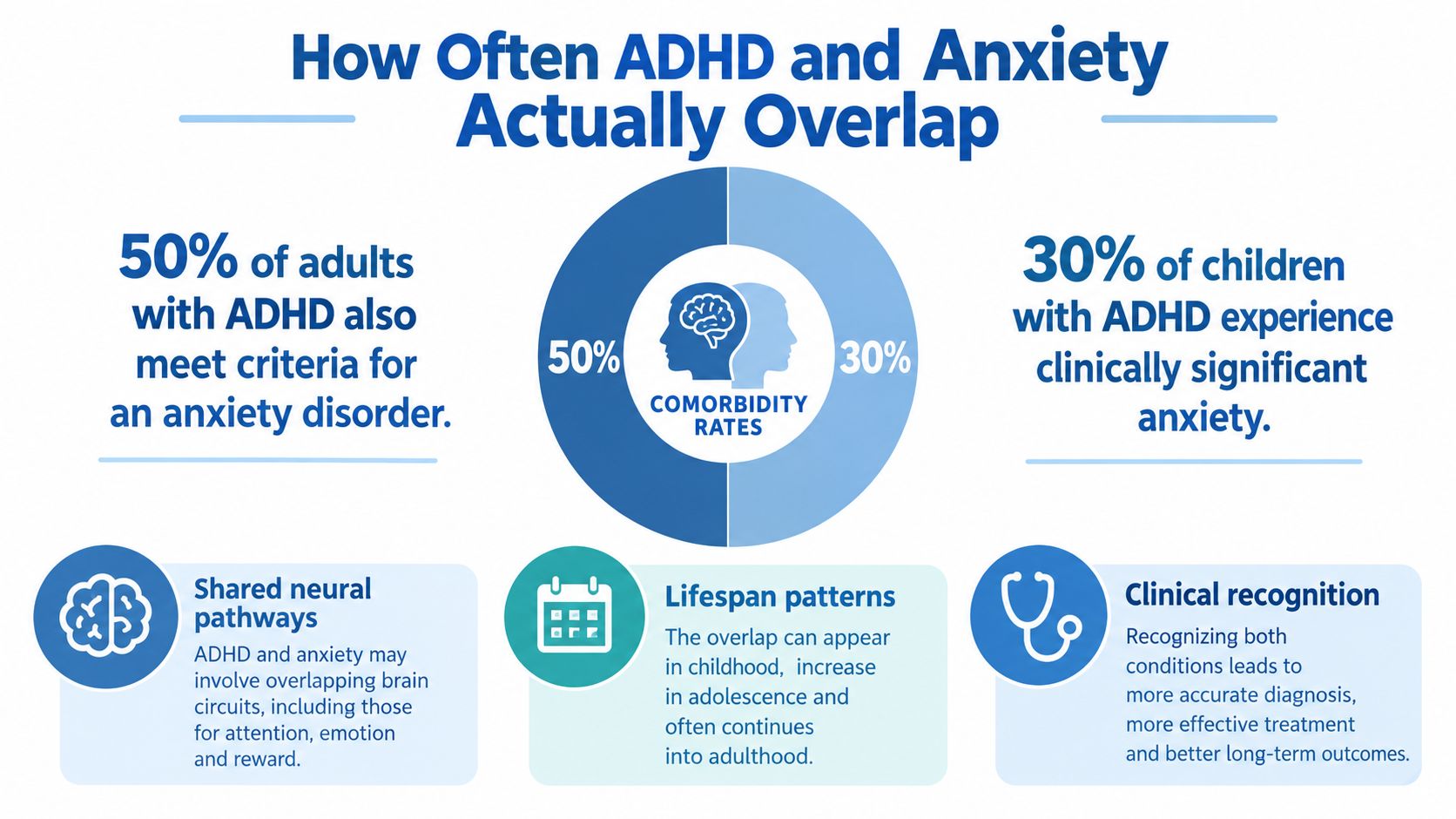
In a study of 353 adults with ADHD, 56% met criteria for at least one anxiety disorder. An earlier analysis estimated that 47% of adults with ADHD had an anxiety disorder in the previous 12 months. A systematic review found estimates ranging from 4.3% to 47.1% in general-population samples and 3.9% to 84% in clinical samples. These findings come from different populations and methods, so no single figure describes every adult with ADHD. The adult review helps explain why screening matters even when prevalence estimates vary.
Children show a similar need for careful assessment. The CDC reports that nearly 4 in 10 children with ADHD have anxiety, and that nearly 78% have at least one co-occurring condition. In visits to health centers for young people with diagnosed anxiety, an ADHD diagnosis was also documented in 18.7% of visits. These are visit records, not an estimate of how many individual children will develop both conditions, and they don't show that one causes the other. CDC data on ADHD and co-occurring conditions underscore why clinicians should consider both.
The practical lesson is straightforward: when evaluating ADHD, screen for anxiety, and when evaluating anxiety, ask about attention and development. A clinician may also distinguish current symptoms from past episodes, since a history of anxiety and anxiety happening now can inform care in different ways. Screening is a starting point, not a diagnosis.
Overlapping vs Distinct Symptoms
Restlessness, procrastination, poor concentration, sleep disruption, and avoidance can appear in both ADHD and anxiety. Looking at the pattern around a symptom is often more informative than counting symptoms alone.
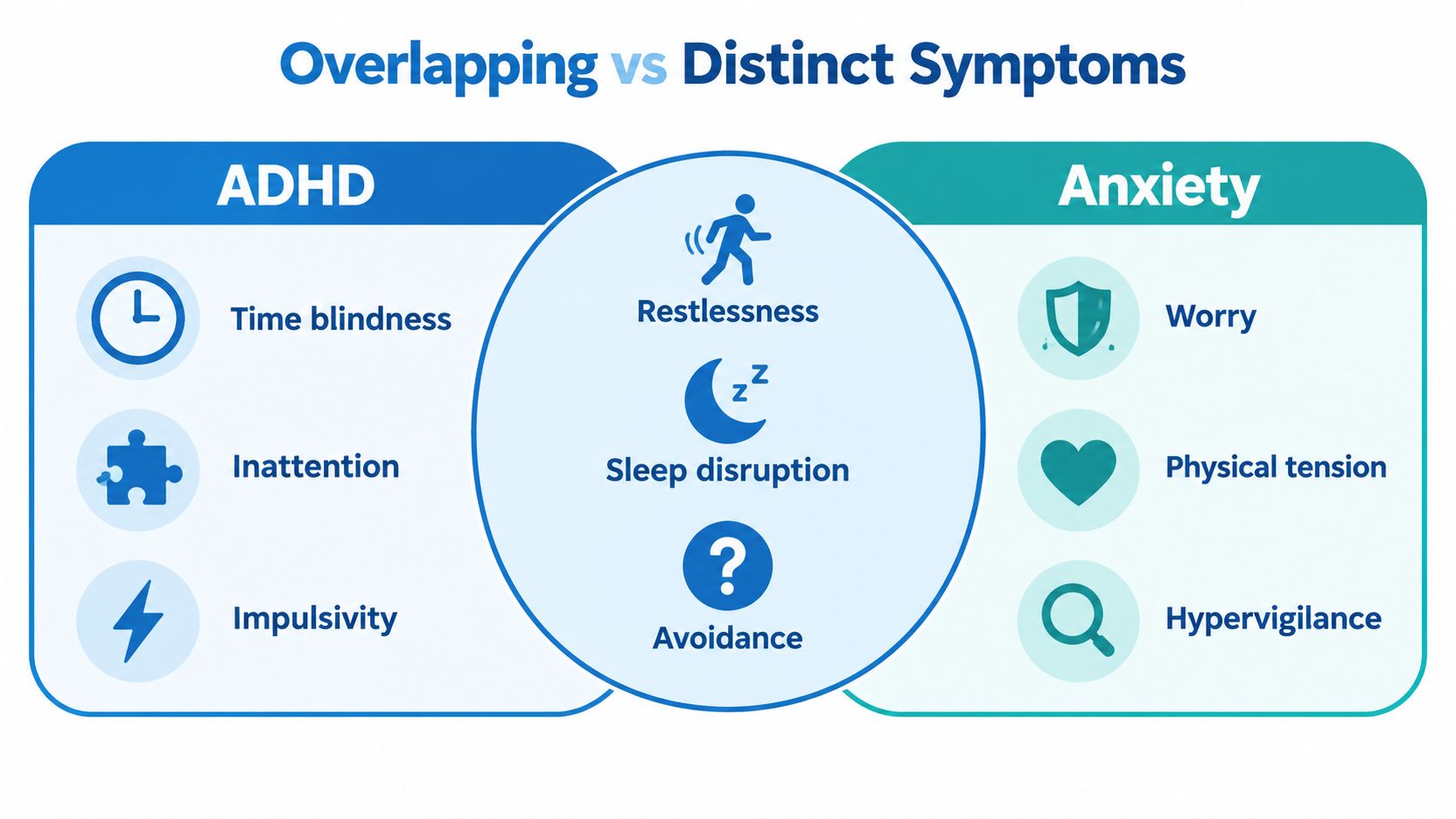
Consider two people who haven't started a major assignment. One keeps postponing it because they expect to fail, worries about being judged, and feels a wave of fear whenever they open the document. That pattern points toward anxiety-driven avoidance. The other wants to begin but can't sequence the steps, misjudges the time required, and gets pulled into unrelated tasks even when they don't feel especially worried. That may suggest executive-function difficulties associated with ADHD. Someone can also experience both patterns.
Social difficulties can be hard to interpret from the outside, too. A person with social anxiety may avoid a gathering because they fear embarrassment or scrutiny. Someone with ADHD may lose the thread of a conversation or interrupt, then feel distressed about how others responded. Rejection sensitivity can complicate either picture, so a clinician needs to ask what the person fears and what tends to happen in the moment.
Symptom | More typical of ADHD | More typical of anxiety | Overlap warning sign |
|---|---|---|---|
Starting tasks | Trouble organizing steps or sustaining effort | Fear of failure, judgment, or a bad outcome | Avoidance comes with both disorganization and worry |
Attention shifts | Distractibility, losing track, or misjudging time | Attention pulled toward threat-focused worry | The person can't focus and also feels persistently on edge |
Restlessness | Fidgeting or difficulty staying with an activity | Tension or feeling unable to relax | Restlessness worsens with worry or poor sleep |
Social hesitation | Missing conversational cues or impulsive interruptions | Fear of scrutiny or embarrassment | Past social difficulty fuels anticipation and avoidance |
These patterns can guide a conversation, but they can't establish a diagnosis. The National Institute of Mental Health's ADHD overview notes that overlapping conditions can make diagnosis and treatment more difficult. Concentration trouble alone doesn't identify its cause.
Why Diagnosis Is Hard at Every Age
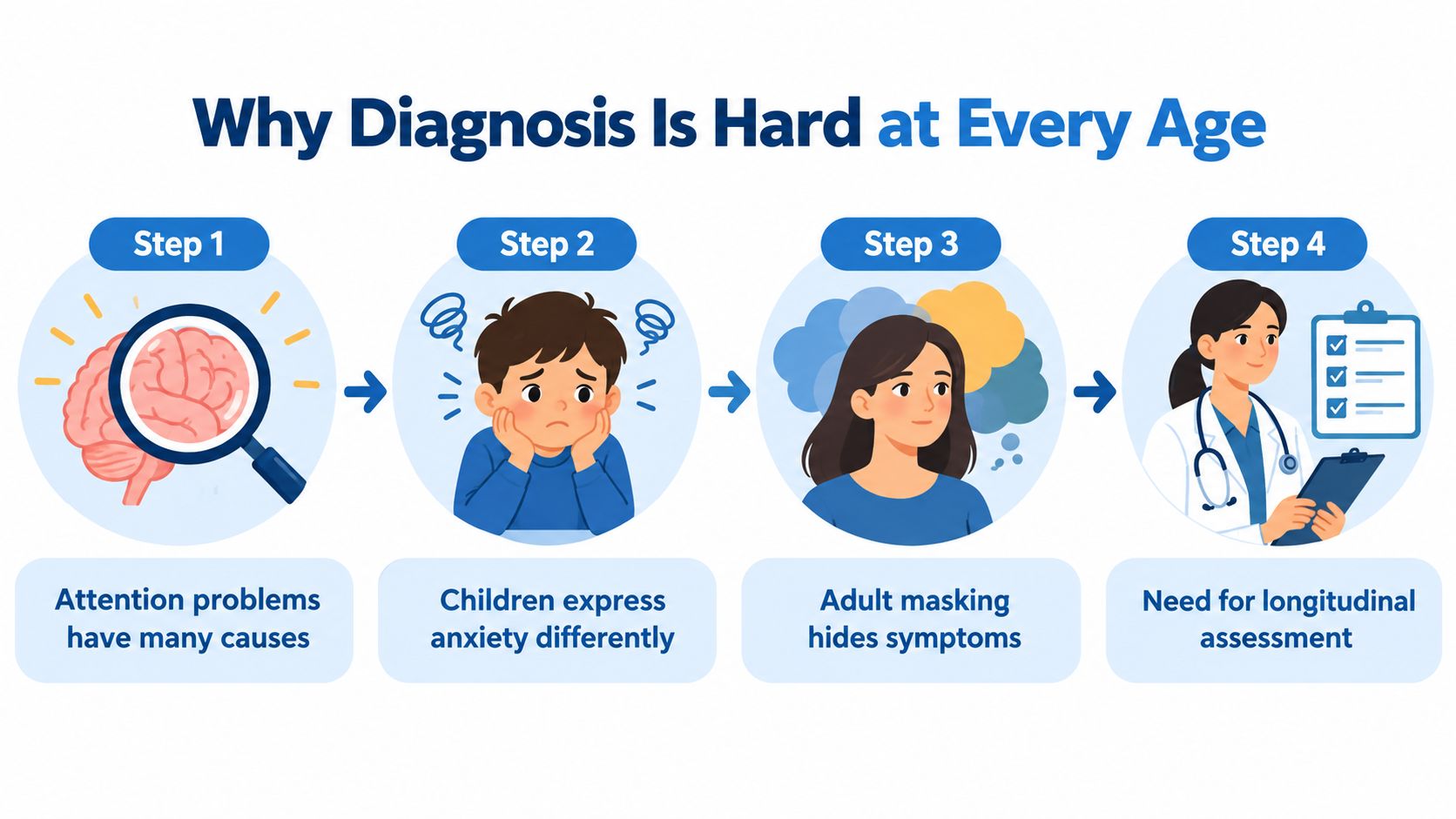
A sound evaluation looks beyond the symptoms someone has today. It asks when they began, where they appear, what makes them worse, and how they affect everyday life.
Reconstruct the timeline
A clinician may ask about childhood school experiences, current work or academic demands, relationships, sleep, and previous treatment. They'll consider whether attention problems showed up across settings and whether anxiety came before or after repeated difficulties. Parents, partners, report cards, or other records can sometimes add useful context, with the patient's permission.
Children may express anxiety through irritability, avoidance, physical complaints, or difficulty separating from caregivers rather than describing worry clearly. Adolescents can conceal difficulties by overpreparing or relying on intense last-minute effort. Adults may have developed routines that helped them compensate, while still experiencing significant stress and impairment.
For parents trying to understand how ADHD can be framed in an educational context, this overview of the UK ADHD legal definition for parents offers a useful point of comparison. Legal definitions and clinical diagnosis serve different purposes, so one shouldn't substitute for the other.
Check more than one explanation
Poor concentration may relate to anxiety, ADHD, sleep problems, another health concern, or multiple factors. A clinician should also ask about medication and substance effects, including whether changes in sleep or physical activation coincide with treatment adjustments. A rushed assessment that treats every attention complaint as ADHD, or every restless symptom as anxiety, can miss that context.
Women and girls may describe their struggles in ways that are overlooked or attributed to anxiety. This discussion of ADHD signs in women that can be mistaken for anxiety may help readers prepare questions for an evaluation.
In Florida, telepsychiatry can make psychiatric assessment more accessible, but the format doesn't replace a careful clinical process. Ask how the clinician will review developmental history, functioning across settings, anxiety symptoms, sleep, and treatment goals. A high-quality evaluation should leave room for uncertainty and follow-up, not force a quick either-or answer.
Evidence-Based Treatment That Treats Both
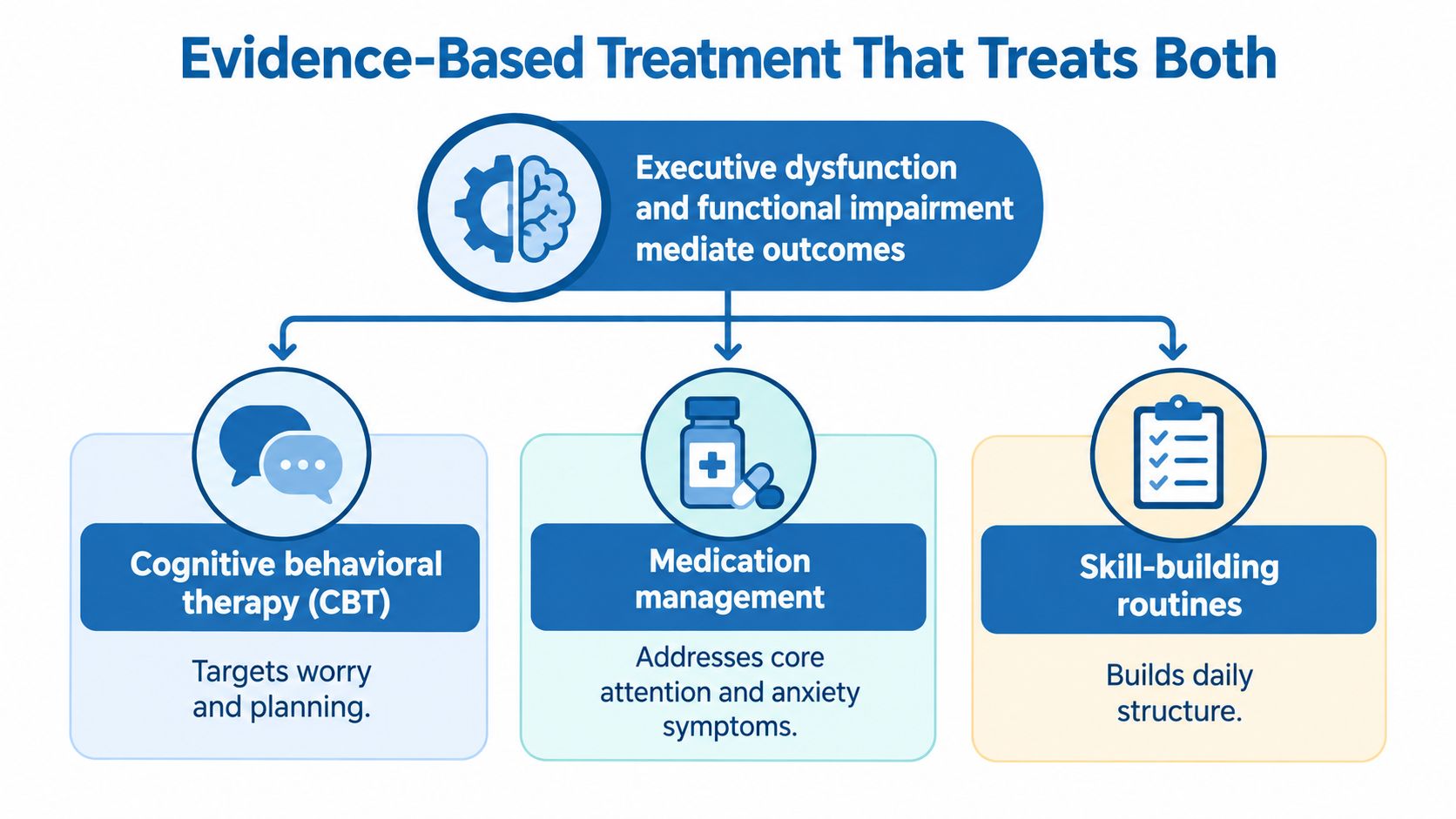
Treatment should address the pattern affecting a person's life, not follow a fixed rule that ADHD or anxiety must always come first. A clinical study in adolescents found that executive dysfunction and functional impairment helped mediate the ADHD–anxiety relationship. In practical terms, ongoing difficulty managing tasks and daily responsibilities can contribute to anxiety, while anxiety can further disrupt attention and follow-through.
Match the plan to the main source of impairment
For ADHD, clinicians may consider stimulant medication or atomoxetine, taking into account symptoms, health history, preferences, and prior response. A clinical practice review identifies methylphenidate or atomoxetine as first-line options for comorbid ADHD and anxiety, with cognitive behavioral therapy (CBT) useful for remaining anxiety. If anxiety remains severe or significantly impairs functioning, a clinician may consider an SSRI as part of an individualized plan. The clinical review discusses these options and the role of therapy.
Medication has trade-offs. A stimulant may help someone focus, but it can also contribute to jitteriness or insomnia in some people. Atomoxetine may be considered when stimulants aren't tolerated or haven't helped enough, but medication choice and response are individual. Anxiety medication doesn't address every ADHD-related difficulty, and ADHD medication doesn't necessarily resolve avoidance or panic.
CBT can help a person examine catastrophic predictions, practice facing avoided situations, and build realistic ways to plan. Other therapy approaches may fit a person's needs and history. Skill-building matters as well: reminders, task breakdown, and predictable routines can reduce the daily failures that feed stress.
The clinician and patient can prioritize the most severe, unstable, or impairing symptoms, then adjust the sequence as the response becomes clearer. Track ADHD and anxiety separately, including functioning, sleep, worry, and side effects. The point isn't to demand that one condition disappear before addressing the other; it's to make changes carefully and see what improves.
A short video can also help introduce the topic of ADHD and anxiety:
Practical Coping Strategies for Daily Life
Daily strategies work best when they address the reason someone is getting stuck. A reminder won't resolve fear of judgment, and reassurance alone won't organize a task with too many steps. Pair the tool to the barrier.

Make tasks easier to hold in mind
Put appointments and deadlines in one calendar rather than relying on memory. Break a project into visible actions, such as opening the assignment, finding the required materials, and drafting one section. A body double, someone working alongside you, can help provide structure without taking over the task.
Use a visual reminder where the action happens, like placing a medication checklist beside the toothbrush. A repeatable morning routine can reduce the number of small decisions that compete for attention.
Reduce avoidance without demanding instant confidence
When fear keeps you from starting, set a small approach step: open the email, write a rough first sentence, or attend part of a social event with a plan for leaving if needed. The aim is to practice moving toward the situation, not to wait until all anxiety disappears. If avoidance is entrenched, a therapist can help shape gradual exposure and behavioral activation to fit the person's needs.
For additional ideas that complement professional care, this overview of natural ways to manage anxiety offers a practical resource. These strategies aren't a substitute for assessment when anxiety or attention problems are disrupting daily life.
Protect sleep and lower physical arousal
Keep a consistent wake time when possible, get daylight after waking, and notice whether late caffeine or medication timing interferes with sleep. A brief paced-breathing practice or short walk may help settle physical tension. Keep the plan modest enough to repeat, and discuss persistent insomnia or medication-related changes with a clinician.
If overwhelm makes even small tasks feel unmanageable, this guide to coping with ADHD-related overwhelm can help you think through where to begin. Pick one strategy, try it consistently, and adjust based on what gets in the way.
Will ADHD Medication Make Anxiety Worse
Stimulants don't automatically worsen anxiety, and anxiety doesn't always need to be fully treated before a clinician considers ADHD care. The response is individual. For some people, treating ADHD-related difficulties reduces the missed deadlines and disorganization that have been feeding performance worries. For others, a medication can bring on or intensify symptoms that need attention.
Jitteriness, sleep disruption, appetite changes, or a faster-feeling heartbeat can be hard to distinguish from anxiety. The timing offers clues: did the symptom start after a dose change, appear as the medication takes effect, or show up alongside reduced sleep? A clinician can review the pattern rather than assume the cause.
Practical rule: Track what changes, when it changes, and how it affects your day before making medication adjustments on your own.
During a medication trial, note sleep, physical sensations, worry, and the timing of doses. Tell your prescriber about caffeine or other substances that may affect how you feel. Dose, timing, and formulation can matter, so the plan may involve an adjustment or a different medication rather than abandoning ADHD treatment outright. Gradual, individualized changes make it easier to understand what's helping and what isn't.
Reach out to your prescriber promptly if anxiety becomes sharply worse, sleep deteriorates, or new physical symptoms concern you. Seek urgent help for a crisis or symptoms that feel dangerous. Don't stop, increase, or combine prescribed medication without clinical guidance.
If you're concerned about the relationship between Adderall and anxiety, this guide to Adderall and anxiety may help you prepare focused questions for your prescriber. Use it to support a clinical conversation, not as a basis for changing treatment independently.
How Integrated Care in Florida Actually Works
When attention difficulties and anxiety overlap, care is easier to manage when assessment, medication decisions, and therapy can inform one another. A psychiatrist can evaluate symptoms and discuss medication, while a therapist can work on worry, avoidance, planning, and coping skills. With coordination, each provider can consider whether a change in daily functioning reflects progress, a new stressor, or a treatment concern.
In Florida, telepsychiatry lets patients meet with clinicians remotely, while a telemedicine-only practice can provide care without in-person visits. Ask whether the service is available where you live, how follow-ups work, and who to contact between appointments. This overview of telehealth psychiatry explains what remote psychiatric care can involve.
Refresh Psychiatry & Therapy provides psychiatric evaluations, medication management, and therapy for ADHD and anxiety, including coordinated care through approaches such as CBT, DBT, psychodynamic therapy, and trauma-focused therapy. The practice offers telepsychiatry for Florida residents and accepts Aetna, United Healthcare/UHC, Cigna, Blue Cross Blue Shield, Humana, Tricare, UMR, and Oscar insurance plans. Confirm your specific coverage and benefits directly with the practice and your insurer.
If attention problems, worry, or both are affecting school, work, sleep, or relationships, an evaluation can help clarify what support makes sense. You don't need to decide on your own which condition is "causing" everything before asking for help.
This blog is for informational purposes only and doesn't constitute medical advice. Please consult a qualified mental health professional for personalized guidance.
Refresh Psychiatry & Therapy offers psychiatric evaluations, medication management, and therapy to help Florida residents understand and address overlapping ADHD and anxiety symptoms. Contact Refresh Psychiatry & Therapy or call Refresh Psychiatry at (954) 603-4081 to schedule your evaluation.