
Vaping and Mental Health: What the Evidence Actually Shows

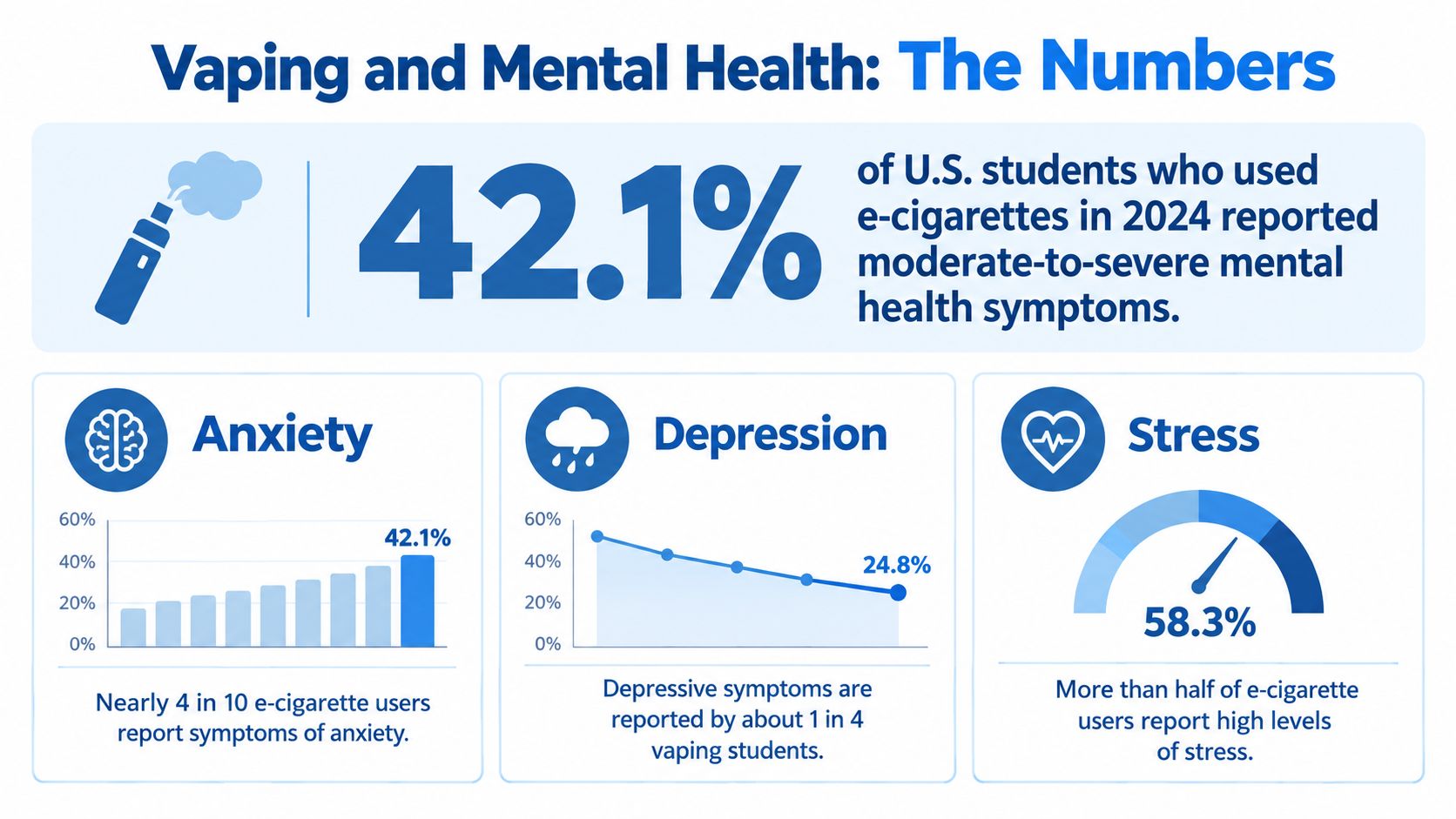
42.1% of U.S. students who currently used e-cigarettes in 2024 reported moderate-to-severe depression and anxiety symptoms, compared with 21.0% of non-users, approximately twice the prevalence, according to the CDC's nationally representative student analysis. That's a striking relationship, but it doesn't prove that vaping caused those symptoms.
For a worried parent, college student, or adult patient, the useful question isn't whether vaping is bad. It's what someone is trying to manage by vaping, what happens between uses, and whether an underlying psychiatric condition also needs treatment. A careful conversation about vaping and mental health should address all three without blaming the patient or overlooking dependence.
What the Mental Health Numbers Around Vaping Actually Show
The student findings above describe a cross-sectional association, meaning researchers examined vaping and symptoms within the same survey rather than establishing which came first. They measured reported symptoms, not a psychiatric diagnosis determined through an individual evaluation.
The same CDC analysis found that 5.9% of students reported current e-cigarette use, and 74.6% of current users were high school students. Those figures make vaping relevant to adolescent behavioral-health screening, particularly when families notice changes in mood, sleep, concentration, or school functioning.
The infographic summarizes the headline findings. Its anxiety, depression, and stress imagery shouldn't be interpreted as separate measured rates or documented trends.
Association Isn't the Same as Cause
Several explanations can coexist. Someone may start vaping because they're anxious or depressed; nicotine dependence may then add withdrawal-related distress; and circumstances such as trauma, social stress, or other substance use may contribute to both.
The issue extends beyond the United States. A WHO European Region page prepared for World No Tobacco Day 2027 lists average e-cigarette use among adolescents aged 13–15 at 14.3%. Because that page is future-dated, its figure shouldn't be presented as a current surveillance estimate or directly compared with the U.S. survey.
Clinical takeaway: Vaping is a reason to ask more questions, not a shortcut to diagnosing depression, anxiety, or addiction.
Why the Interpretation Matters
Overstating causation can lead a family to assume that removing a vape will resolve every symptom. Dismissing the association can lead a clinician to treat anxiety while never asking about nicotine exposure.
Neither approach adequately addresses the patient's experience. Useful screening asks about symptoms before vaping began, changes during abstinence, the substance being inhaled, and the effect on daily life.
The practical conclusion is straightforward: take both the distress and the vaping seriously. A patient doesn't need to prove which came first before receiving help.
How Nicotine and THC Actually Affect the Brain
Nicotine acts on nicotinic acetylcholine receptors, brain signaling sites involved in learning and reward. With repeated exposure, a person can develop a learned connection between a cue, a craving, and using the device.
The National Academies' evidence review found substantial evidence that e-cigarette use produces dependence symptoms. It also identified nicotine concentration, formulation, device power, and aerosolization method as factors that alter dependence risk; average dependence risk and severity may be lower than with combustible cigarettes, but lower doesn't mean absent.
This illustration offers a visual pause from the mechanics of dependence.

Why Relief Can Be Misleading
Think of a thermostat that someone keeps nudging away from its usual setting. That analogy isn't a literal description of brain chemistry, but it helps explain why feeling better immediately after vaping doesn't establish that vaping improves overall mental health.
The CDC's explanation of e-cigarette health effects notes that students most commonly report current use because they feel anxious, stressed, or depressed. Nicotine may offer temporary relief or stimulation, while dependence and withdrawal can contribute to irritability, anxiety, low mood, poor concentration, and cravings.
A person may therefore feel calmer after vaping partly because they've relieved discomfort associated with needing nicotine. That relief can be real without being a sustainable treatment for an anxiety disorder.
For background on these signaling systems, the practice's explanation of dopamine versus serotonin provides additional context. Neither chemical alone explains someone's mood or establishes a diagnosis.
Why the Device and Substance Matter
Counting puffs isn't enough to estimate nicotine exposure. A clinical inventory should include:
Product details: The device, liquid, labeled nicotine concentration, and formulation.
Automatic use: Whether the person reaches for the vape without consciously deciding.
Context: Studying, driving, socializing, waking, or responding to distress.
Other substances: Cannabis cartridges, unidentified products, or mixed use.
THC vaping needs a separate discussion, not an assumption that it behaves like nicotine. The evidence provided on adolescent cannabis vaping remains limited, so precise claims about cartridge-specific psychiatric risks aren't justified.
The safest clinical approach is to document the actual product and the timing of symptoms, then assess both substance-related effects and underlying illness.
Nicotine Vaping Versus THC Vaping in Mental Health Risk
A patient saying they vape hasn't yet identified what they use. Nicotine liquids, cannabis cartridges, and mixed-product use require different questions, even when the devices look similar.
A study of youth and young adults examining product-use patterns found that current users, regardless of the number of products used, were more likely to report clinically raised anxiety and depression symptoms and suicidal ideation. That association supports broad assessment, but it doesn't establish that every product has the same effects.
Nicotine vs THC Vaping and Mental Health
Domain | Nicotine Vaping | THC Vaping |
|---|---|---|
Anxiety | Ask whether distress occurs between uses and improves after nicotine. | Ask whether anxiety follows use, periods without use, or another trigger; don't assume cannabis is calming. |
Mood and depression | Consider dependence alongside symptoms that may have preceded vaping. | Establish the mood timeline and product-use pattern rather than attributing depression to THC alone. |
Sleep | Assess nighttime use and sleep changes during reduction. | Ask whether use is intended to help sleep and whether sleep actually improves. |
ADHD and attention | Distinguish longstanding attention problems from use-related fluctuations. | Ask about concentration during and outside periods of use; don't diagnose ADHD from current difficulties alone. |
Psychotic symptoms | Assess new symptoms independently rather than assuming vaping explains them. | New paranoia, hallucinations, or disorganization require prompt assessment, regardless of the presumed product. |
Dependence | Review cravings, automatic use, and difficulty stopping. | Assess loss of control and functional consequences separately from nicotine dependence. |
The THC column is deliberately framed around assessment rather than definitive predictions. Limited cannabis-vaping evidence is an evidence gap, not proof of safety, and findings about nicotine shouldn't be transferred automatically to cannabis.
Ask About the Cartridge, Not Just the Habit
Bring packaging or a photograph of the label when possible. Tell the clinician whether products are shared, obtained outside regulated channels, or have uncertain contents; a label alone doesn't resolve every question about exposure.
What are you actually inhaling, how often, and has the dose changed?
That question is a practical conversation starter, not a diagnostic test. It can uncover a switch in products that a parent or prescriber otherwise wouldn't know about.
The practice's discussion of cannabis and mental health research offers further reading. During an evaluation, the priority remains the individual's symptoms, safety, functioning, and pattern of use.
Clinical Signs Worth Watching at Every Age
Consider a hypothetical teenager, not a reported patient case, whose parents notice falling grades, less contact with friends, and a vape in a jacket pocket. They're understandably concerned, but those observations don't establish whether the main problem is dependence, depression, social anxiety, ADHD, or several overlapping difficulties.
The illustration captures the concern many families bring to that first conversation.

A clinician would build a timeline rather than immediately assign a cause. Did inattention exist before vaping, did social avoidance precede the school decline, and does irritability appear mainly when the device isn't available?
A 2025 study of young adults' vaping motives found that higher stress, anxiety, and depression were associated with reporting vaping to reduce tension or relax. That supports taking self-medication seriously without treating the person's explanation as proof that vaping is helping.
Patterns Families Can Document
Adolescents: Note changes in friendships, attendance, appetite, sleep schedule, secrecy, and whether nicotine and cannabis products appear together.
College students: Ask about using substances during academic stress, combining products with alcohol, and anxiety that breaks through previously stable functioning.
Adults: Record a return to nicotine, increasing use during work stress, and persistent sleep or concentration problems.
Across ages: Track whether symptoms follow use, craving, abstinence, or stressful events unrelated to vaping.
These are reasons for assessment, not a checklist that confirms a disorder. Families can also review signs of depression in college students when withdrawal from activities or declining functioning extends beyond vaping.
For families supporting someone in Georgia, Georgia DUI Schools provides Georgia-specific help for substance abuse. It can supplement a discussion about warning signs, but it doesn't replace psychiatric evaluation or emergency care.
Keep Safety in the Conversation
Ask directly about suicidal thoughts, cannabis use, sleep disruption, and other substances. If someone reports suicidal intent, cannot stay safe, or develops new hallucinations or severe confusion, seek immediate emergency assessment rather than waiting for a routine appointment.
The embedded video provides another format for engaging with the topic.
Practical Steps to Reduce Harm and Quit
A workable quitting plan addresses both nicotine use and the situations that keep prompting it. Readiness matters, but waiting for perfect motivation isn't necessary to start gathering information.
The National Institute on Drug Abuse's vaping guidance explains that nicotine withdrawal can begin within hours after stopping and may include cravings, depression, anxiety, difficulty focusing, and sleep problems. That's a reason to plan support, particularly when psychiatric symptoms are already active, not a reason to continue vaping indefinitely.
Start With Observation and a Plan
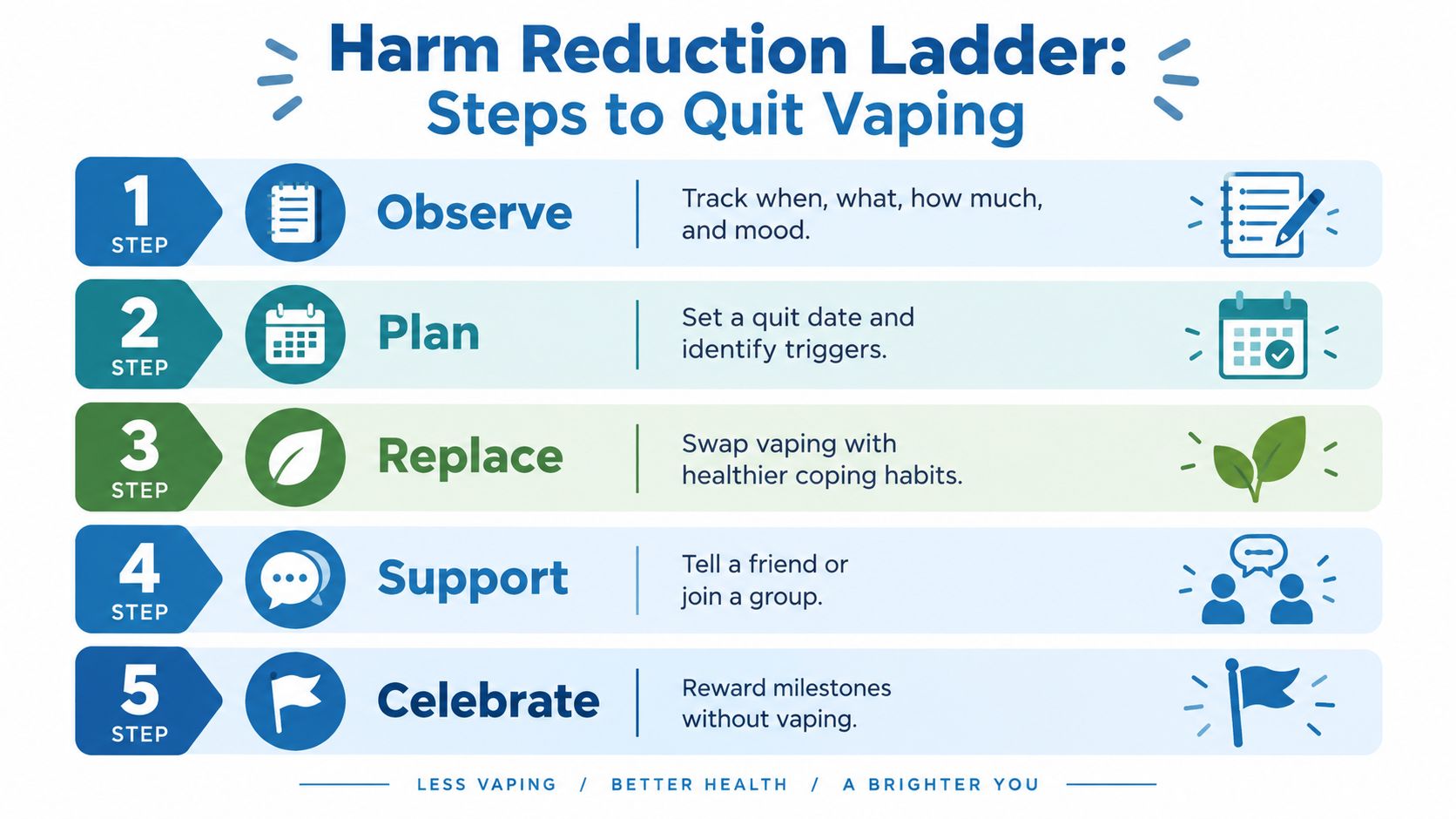
Record the pattern: Write down the product, approximate use, situation, and mood beforehand. Include occasions when use felt automatic.
Choose a behavioral target: Separate vaping from a specific routine, such as studying or driving, rather than trying to change everything simultaneously.
Prepare substitutes: Sugar-free gum, cold water, a brief walk, or contacting a supportive person can provide an alternative response to a cue.
Arrange support: Tell someone what you're attempting and decide whom you'll contact if symptoms worsen.
The ladder below offers a visual reminder of these practical steps.
Match Treatment to the Person
Discuss tapering and nicotine-replacement products such as patches, gum, or lozenges with a clinician or pharmacist. Age, medical history, psychiatric symptoms, and current exposure should inform the plan; don't assume a product or dose appropriate for someone else is right for you.
Lower labeled nicotine strength doesn't automatically demonstrate lower total exposure if the pattern of use changes. Likewise, a zero-nicotine device may preserve the behavioral ritual rather than resolve it.
If you want to compare zero nicotine vape options, Pink Smoke Shop's commercial overview can help identify product categories. It shouldn't be treated as independent medical evidence, proof of safety, or a recommended cessation treatment.
Avoid a false trade-off: You don't have to choose between addressing nicotine dependence and treating anxiety, depression, or ADHD.
Medication questions belong in the same coordinated discussion. The explanation of how Wellbutrin works provides background, not a recommendation to start or change medication.
Repeated unsuccessful attempts, escalating use, panic, or worsening mood warrant professional help. Partial reduction can be a planning step, but don't promise yourself a specific improvement or recovery deadline.
What Integrated Psychiatric Care Looks Like in Florida
An integrated evaluation doesn't start by deciding that vaping explains everything. It asks which symptoms reflect an underlying disorder, which may relate to substance use, and what needs attention first.
A 2021 systematic review of adolescent and young adult research found that most included studies reported positive associations between e-cigarette use and depression, with additional associations involving suicidality, stress, ADHD, impulsivity, and conduct problems. Much of the evidence was cross-sectional, reinforcing the need for assessment rather than a simple causal conclusion.
This illustration reflects the collaborative conversation an evaluation should support.

What the Evaluation Should Establish
A structured interview, supplemented when appropriate by validated screening questionnaires, can examine anxiety, depression, ADHD, trauma, sleep, and substance use. Screeners help organize information; they don't replace clinical judgment.
Useful preparation includes:
A symptom timeline: What began before vaping, what changed afterward, and what happens during reduction.
A treatment inventory: Medications, supplements, therapy, previous diagnoses, and prior quit attempts.
A product inventory: Nicotine devices, cannabis products, frequency, and uncertainty about contents.
A safety review: Suicidality, agitation, major sleep changes, mood elevation, and available support.
For patients with bipolar disorder, PTSD, ADHD, anxiety, or depression, clinicians should monitor sleep, concentration, agitation, mood elevation, and safety as use changes. An underlying condition still deserves treatment even when nicotine contributes to the presentation.
Coordinated Care Without Separate Silos
Medication management and individual therapy should share a coherent plan. CBT can address anxious thinking and behavioral avoidance; DBT skills can support emotional regulation; trauma-focused or psychodynamic work may fit other needs after assessment.
Florida patients can seek support through primary care, addiction services, or psychiatric care. Telepsychiatry offers a way to attend evaluations and follow-up without traveling, although urgent or medically unstable presentations may require local, in-person care.
The practice described here is telemedicine only, with HIPAA-compliant video visits across Florida using a compatible device. Its services include psychiatric evaluations, medication management, individual therapy, pharmacogenomic analysis, and deprescribing when appropriate; these aren't all necessary for every patient.
Virtual care doesn't guarantee an immediate appointment or substitute for emergency services. Ask about availability, follow-up arrangements, and what to do if symptoms worsen between visits.
Ready to Talk to a Psychiatrist in Florida
Asking for help is a clinical decision, not a confession. You don't need to know whether nicotine dependence, cannabis use, anxiety, depression, ADHD, or trauma is the main issue before scheduling an evaluation.
Bring your product information, medication list, and a short account of what has changed. Parents can describe observable concerns without assuming motives, while students and adults can explain what vaping seems to do for them and what makes stopping difficult.
Prepare for the First Visit
The guide to what happens at a psychiatry appointment can help you understand the evaluation process. When scheduling, ask about appointment availability, your specific insurance network, and potential out-of-pocket costs.
Accepted insurance plans include Aetna, UnitedHealthcare/UHC, Cigna, Blue Cross Blue Shield, Humana, Tricare, UMR, Oscar, AvMed, and Blue Cross Blue Shield/Florida Blue; self-pay is also available. Confirm benefits for your particular plan before the visit, since an insurer's name alone doesn't establish individual coverage.
Individual insurer blog links aren't included because verified addresses for those posts aren't available. The scheduling team can direct you to the appropriate coverage information rather than relying on an unverified page.
You can seek an evaluation while you're still uncertain about quitting. Honest information is more useful than presenting a perfect plan.
This blog is for informational purposes only and does not constitute medical advice. Please consult a qualified mental health professional for personalized guidance.
Refresh Psychiatry & Therapy offers Florida telepsychiatry evaluations, medication management, and individual therapy that can assess vaping alongside mood, anxiety, attention, and trauma concerns. Visit Refresh Psychiatry & Therapy to explore care and scheduling options. Contact us or call Refresh Psychiatry at (954) 603-4081 to schedule your evaluation.