
🧠 Moral OCD: What It Feels Like and What Helps

Why does a person who cares about doing the right thing keep asking, again and again, whether they're secretly bad? That question sits at the center of moral OCD, a form of obsessive-compulsive disorder often called scrupulosity when the fear focuses on morality, religion, or ethics. The pain usually isn't about one bad action, it's about the terror that a thought, mistake, or uncertain memory proves something rotten about the self.
What Moral OCD Actually Feels Like
Moral OCD usually starts with a doubt that feels morally loaded. A person may think, “What if I lied without noticing?” or “What if I hurt someone and missed it?” The thought doesn't fade like an ordinary worry. It sticks, feels urgent, and demands certainty.
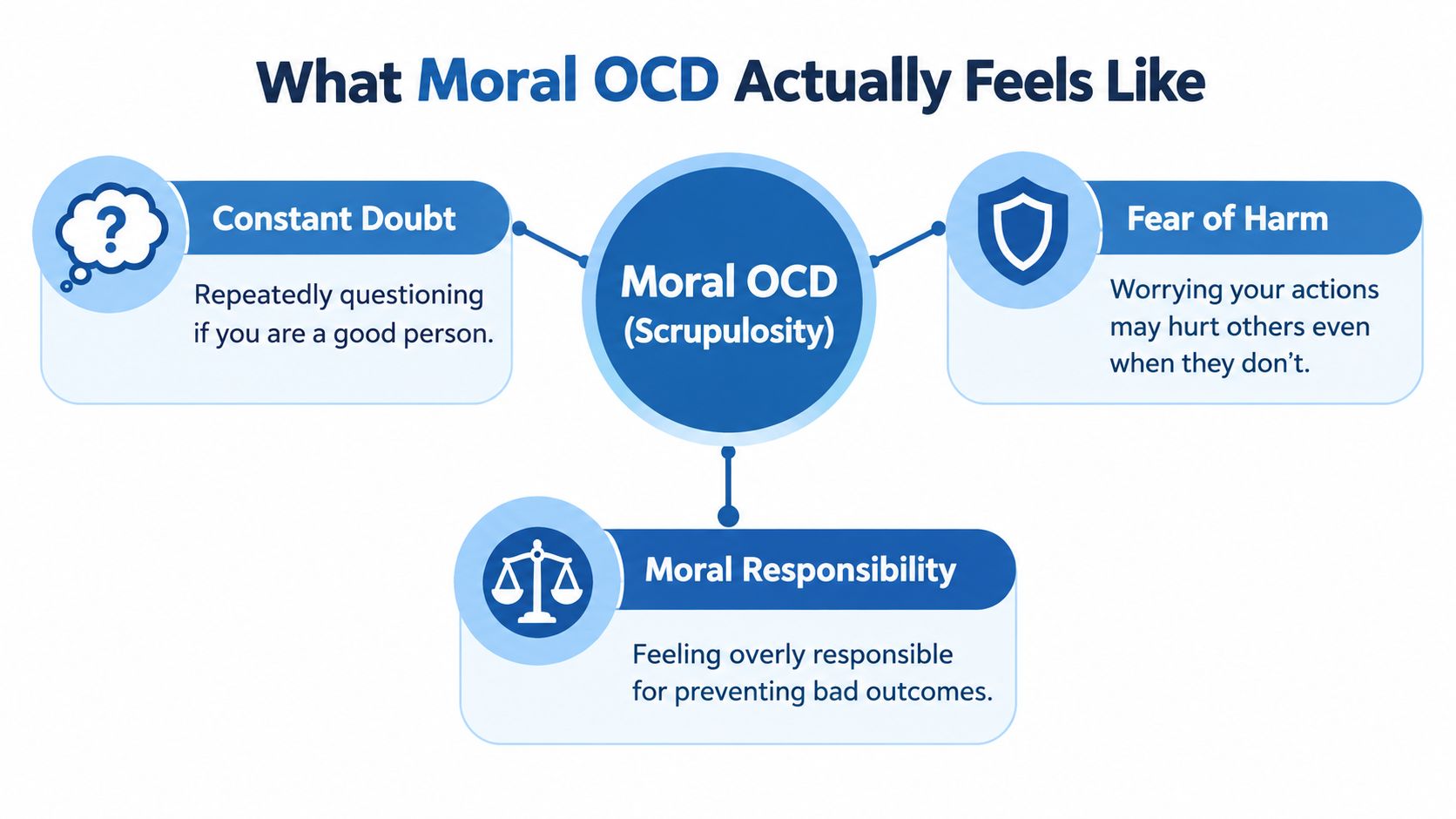
The pattern is simple but exhausting. Intrusive moral fears show up, then the mind tries to neutralize them with checking, reviewing, confessing, or reassurance seeking. That cycle is what turns a passing worry into a disorder. A pediatric clinical review reports that scrupulosity symptoms may appear in roughly 5% to 33% of people with OCD, and an earlier study by Foa and colleagues found that nearly 6% of OCD patients reported scrupulosity as their primary obsessional symptom, with religious beliefs ranking as the fifth most common OCD theme (clinical review and historical context).
Secular and religious forms can look different on the surface
Some people fear being dishonest, selfish, harmful, or secretly immoral. Others fear sin, blasphemy, or offending God. The content changes, but the mechanism is the same. The mind treats a moral doubt like a problem that must be solved right now.
A useful way to think about it is this, ordinary conscience asks, “What's the right thing to do next?” Moral OCD asks, “Can I prove beyond doubt that I am a good person?” That second question never really ends.
Practical rule: If the thought keeps returning after you've already checked, apologized, or reflected, you're probably dealing with OCD logic, not healthy conscience.
The concept of scrupulosity has a long history, and the modern clinical framing preserves that old pattern while placing it inside OCD (historical overview). For a broader overview of OCD presentations, you can also review types of OCD.
Common Intrusive Thoughts and Compulsions
Moral OCD doesn't always announce itself with dramatic fears. Often, it shows up in ordinary situations that suddenly feel charged with moral meaning. A comment, a memory, a decision at work, or a small social misstep can trigger hours of self-interrogation.
What the thoughts sound like
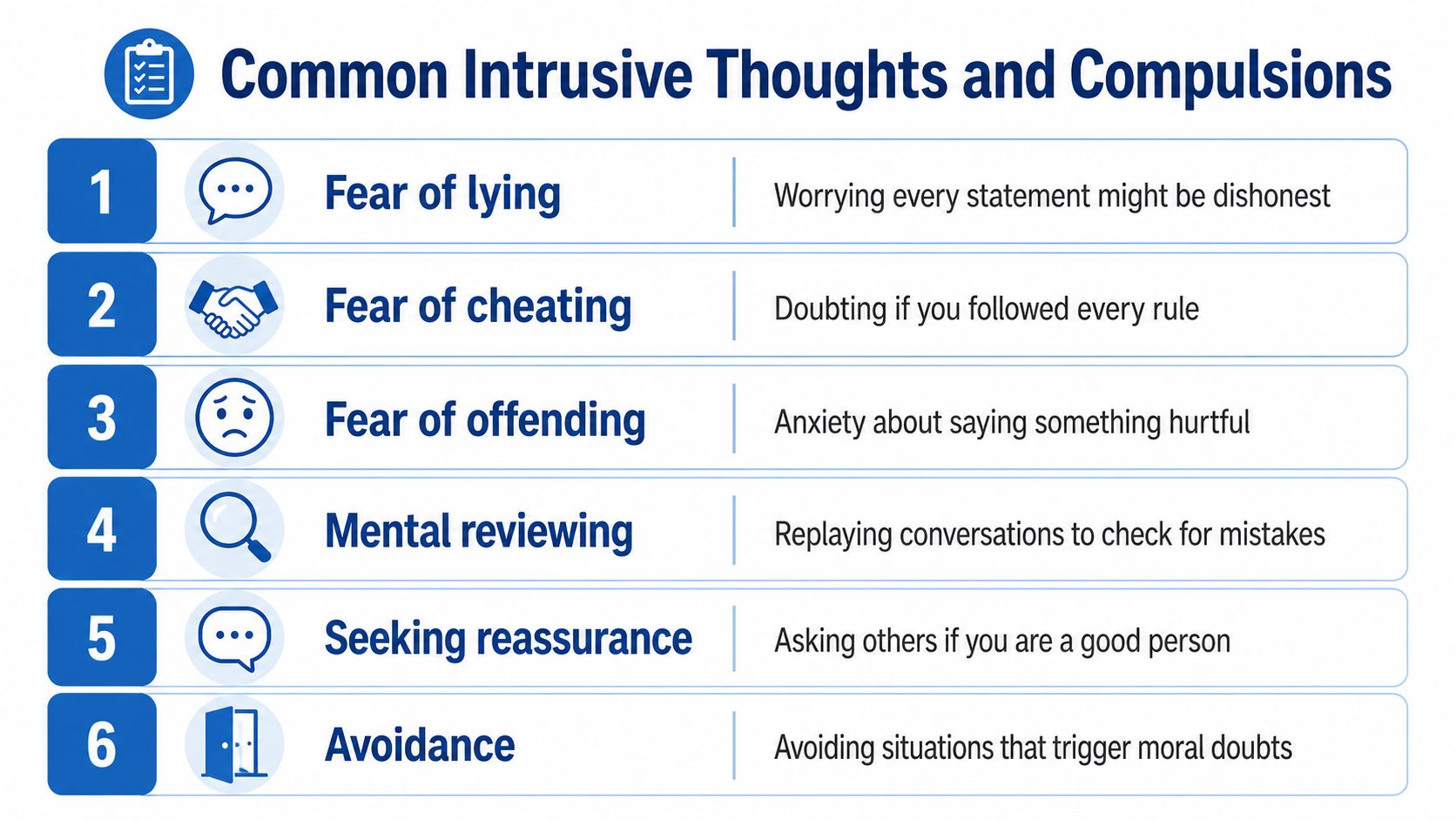
The secular version may sound like, “Was I rude?” “Did I exaggerate?” “Am I the kind of person who could hurt someone?” The religious version may sound like, “Did I offend God?” “Was that thought sinful?” “What if I meant something evil?” Both versions create the same pressure, to get rid of uncertainty before moving on.
The compulsions can be visible or completely hidden. People may confess repeatedly, ask trusted people to judge their intent, research moral rules, avoid situations that could trigger doubt, or mentally replay conversations to see whether they were unfair. That is why moral OCD is easy to miss, especially when the rituals happen inside the mind.
The rituals are often the problem
Mental reviewing is one of the most overlooked compulsions. Someone may spend ten minutes re-reading a text, then another hour replaying the same exchange internally, then end up no closer to peace. The mind tells them that more analysis will bring clarity, but it usually just deepens doubt.
You can see why this gets confusing. A person with strong values might think they're just being careful. In reality, the behavior has become repetitive, rigid, and distress-driven. If you want a broader screening lens for that pattern, do I have OCD can help people recognize the difference between ordinary concern and a compulsive cycle.
Sometimes the clearest sign isn't what you fear. It's how much time you spend trying not to fear it.
The important point is not whether the concern is religious or secular. It's whether the thought triggers a loop of neutralizing behavior that never really settles the question.
Why Normal Guilt and Moral OCD Are Not the Same
Healthy guilt points to a specific action. Moral OCD targets identity. That difference matters, because one responds to proportionate repair, while the other demands impossible proof that you're not secretly bad.
Ordinary guilt usually says, “I should apologize,” or “I need to change that behavior.” Moral OCD says, “What if this proves I'm the kind of person who would do something awful?” That shift from behavior to identity is where the disorder gets sticky. The fear is often less about wrongdoing itself and more about discovering a flawed self.
The cognitive engine behind the loop
Three patterns tend to drive the cycle. Inflated responsibility says, “If something bad could happen, it's my job to prevent it.” Intolerance of uncertainty says, “I can't live with not knowing for sure.” Thought-action fusion treats a thought as morally meaningful in the same way as an act. A recent comparison found these cognitive patterns were stronger in people with scrupulosity than in people with contamination-focused OCD (comparison of cognitive patterns).
Feature | Healthy Moral Reflection | Moral OCD |
|---|---|---|
Trigger | A real action, choice, or conflict | A doubt that may or may not match reality |
Response | Proportionate repair, then moving on | Repeating checks, reviews, confessions, or reassurance |
Relationship to uncertainty | Tolerates some uncertainty | Demands absolute certainty |
Effect on identity | Leaves self-worth intact | Makes the person question who they are |
End point | Action is enough | The question keeps returning |
A particularly useful model here is the fear of self. In this view, the intrusive thought isn't terrifying because it exists. It's terrifying because the person fears it reveals their true identity. That's why a small doubt can feel so destabilizing.
If you're trying to separate moral OCD from ordinary guilt or anxiety, OCD vs anxiety is a helpful place to start. The distinction is not whether you care. It's whether care has turned into a demand for certainty that never ends.
The Reassurance Trap Nobody Warns You About
Reassurance can feel kind and logical, but in moral OCD it often becomes part of the ritual. A person asks a friend, clergy member, therapist, search engine, or AI, “Am I a good person?” The answer may calm them briefly, then the doubt returns in a slightly different form.
That's because reassurance usually works like a temporary sedative for the obsession. It lowers distress in the short term, which teaches the brain to seek it again next time. The behavior feels responsible, but it keeps the disorder alive. A published comparison linked stronger reassurance-seeking with more severe OCD symptoms and guilt, which fits the lived experience of people who keep returning for a moral verdict (reassurance and guilt in OCD).
When reflection becomes compulsion
A good question is, “Am I trying to act on my values, or am I trying to obtain a perfect moral guarantee?” If you're asking for a verdict over and over, you're probably no longer doing reflection. You're doing checking.
That's why reassurance is such a central trap. It can come from a helpful place, but the effect is the same whether it comes from family, clergy, a clinician, or a search bar. The person gets a moment of relief and then learns to doubt their own judgment again.
For readers looking for a focused discussion of that pattern, OCD and reassurance addresses how reassurance functions inside the cycle.
Practical boundary: Values-based action ends with a decision. Compulsive moral checking keeps asking for proof after the decision is already made.
The goal is not to stop caring. The goal is to stop converting care into endless self-surveillance. Moral OCD often masquerades as responsibility, but the repetition is what gives it away.
Evidence-Based Treatments That Actually Work
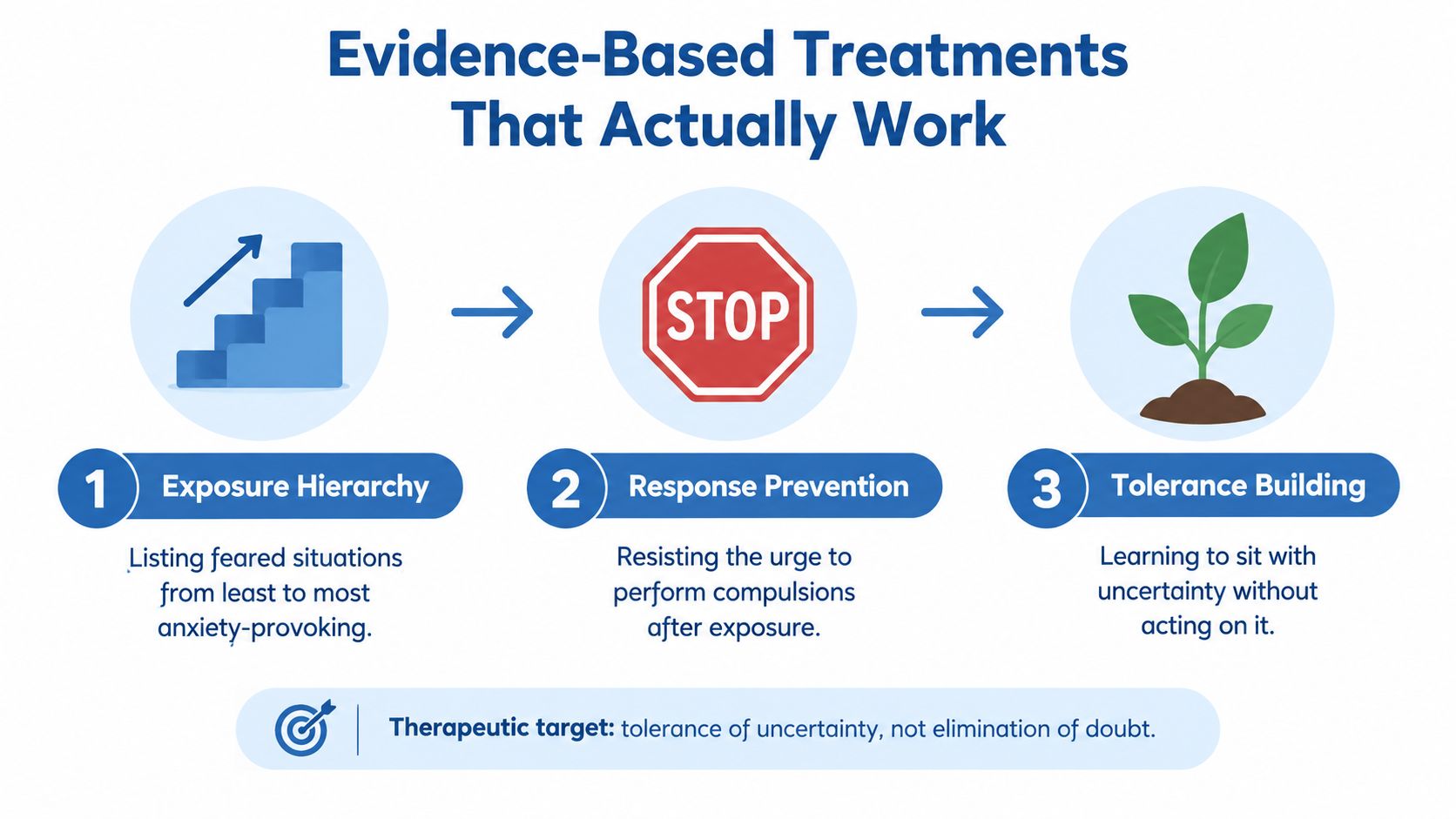
The core treatment for moral OCD is exposure and response prevention, or ERP, usually delivered within cognitive behavioral therapy. ERP asks the person to face uncertainty on purpose, then refrain from the ritual that would normally neutralize the discomfort. The National Institute of Mental Health identifies CBT and ERP as evidence-based psychotherapy options for OCD and notes that psychotherapy can help adults and children alike (NIMH OCD treatment overview).
What ERP looks like in real life
A therapist and patient build an exposure hierarchy, which is a list of feared situations ordered from easier to harder. A mild exposure might be letting a small moral doubt sit without checking it. A harder one might involve resisting the urge to confess or ask for reassurance after a conversation.
The response prevention part is just as important. The person does not review, research, confess, or ask others to judge their intent. The point is not to prove the feared conclusion false. The point is to learn that uncertainty can be tolerated without rituals.
The International OCD Foundation describes ERP as the gold-standard treatment for scrupulosity and emphasizes that the hierarchy should be individualized and clinically appropriate (scrupulosity and ERP). A pediatric review also notes that ERP should be used with the same seriousness and intensity as it is for other forms of OCD (pediatric scrupulosity review).
Where medication fits
Medication can be part of a coordinated plan, especially when symptoms are stuck or severe. In some cases, psychotherapy and medication are used together. NIMH notes that OCD may be treated with psychotherapy, medication, or a combination of both, and that ERP can reduce compulsive behaviors even in people who don't respond well to medication (NIMH OCD treatment overview).
A values-sensitive clinician also keeps the treatment process grounded. For religiously focused scrupulosity, therapy should not argue with the person's faith. It should separate faith practice from OCD-driven repetition, which is a different clinical task. In that context, one option for Florida patients is Refresh Psychiatry & Therapy, where OCD care can be coordinated through telepsychiatry with therapy and medication management.
Self-Help and Daily Coping Strategies
Self-help won't replace treatment when moral OCD is entrenched, but it can reduce the amount of fuel you give the cycle each day. The most useful skill is learning to tolerate not knowing. If the mind demands a perfect answer, practice responding with a smaller one, such as, “I can't know that with complete certainty, and I can still choose my next action.”
Four practical habits
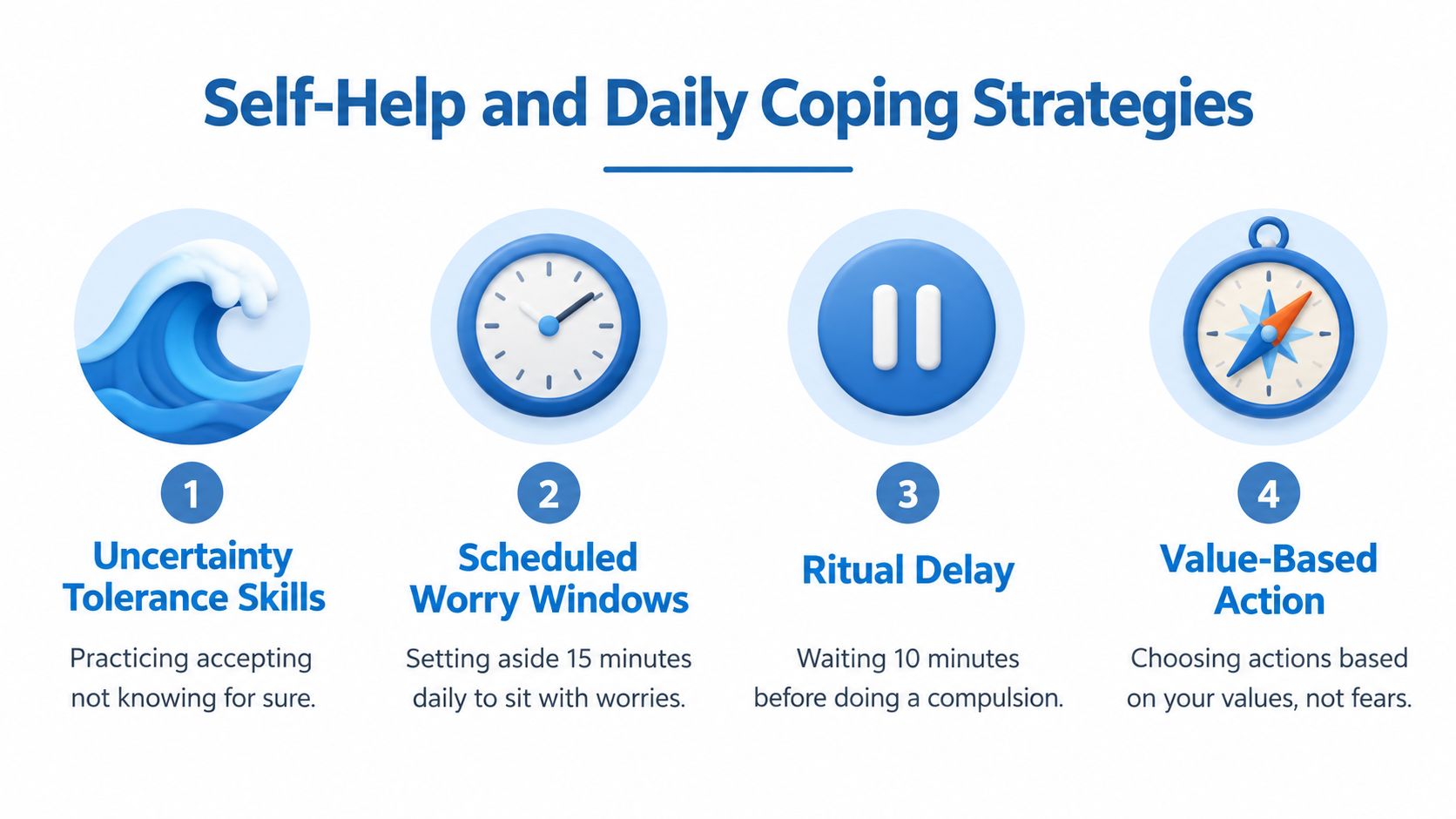
Uncertainty tolerance skills: Practice letting the question remain unanswered for a while instead of resolving it immediately.
Scheduled worry windows: Set aside a short daily period to sit with the worry, then move on when the time ends.
Ritual delay: Wait before checking, confessing, or asking for reassurance. Delaying weakens urgency.
Value-based action: Choose what to do based on your values, not the fear that demands certainty.
Tracking can help, but track the right things. Count how often you checked, confessed, avoided, or asked for reassurance, not how calm you felt in the moment. Calm can be misleading. Reduction in rituals is the more meaningful sign of progress.
If bedtime is when the loop gets loud, a practical guide on ease anxiety before bedtime can be useful alongside OCD-specific work. Just avoid using podcasts, apps, or AI as reassurance sources, because “just one more answer” can become another ritual.
When to Seek Professional Care and How to Start
If moral doubts keep returning, take more than an hour a day, or interfere with work, school, relationships, or sleep, it's time for a professional evaluation. A thorough assessment should look at obsessions, compulsions, avoidance, distress, and functioning, not just the headline fear. The DSM-5-style framework also makes clear that symptoms do not need to exceed exactly one hour a day to matter clinically, because distress and impairment count too (DSM and OCD classification).
Telepsychiatry can work well for Florida residents who want coordinated care without traveling to an office. It's especially useful when symptoms make in-person appointments hard to manage consistently. For readers who want to compare how clinicians structure OCD support, Vancouver Counselling Clinic OCD therapists offers another example of how specialized OCD care is discussed online.
A few common questions
How long do symptoms need to last before getting help? You don't need to wait for a certain duration. If the cycle is persistent or disruptive, get evaluated.
Can children have moral OCD? Yes. Pediatric scrupulosity is recognized in clinical literature, and children can show the same doubt, confession, and reassurance patterns.
How is OCD different from depression-related guilt? Depression often brings global self-blame. OCD adds a compulsive urge to check, analyze, or seek certainty.
Refresh Psychiatry & Therapy offers psychiatric evaluations, medication management, and therapy for OCD through HIPAA-compliant telepsychiatry in Florida, with care customized to the person's symptoms rather than a template. Contact us or call Refresh Psychiatry at (954) 603-4081 to schedule your evaluation. We accept Aetna, United Healthcare/ UHC, Cigna, Blue Cross Blue Shield, Humana, Tricare, UMR, and Oscar insurance plans. This blog is for informational purposes only and does not constitute medical advice. Please consult a qualified mental health professional for personalized guidance.
If moral OCD is making you question your character instead of just your choices, you don't have to sort it out alone. Refresh Psychiatry & Therapy provides OCD-focused evaluation, therapy, and medication management for people who need clear, compassionate care. If you're ready to stop treating every doubt like a moral emergency, schedule a visit and start with a proper assessment.