
Exercise and Depression: What the Evidence Actually Shows

Exercise can reduce depressive symptoms without being the right first step for every person who's depressed. Randomized trials support its use, but they don't support telling an exhausted patient to try harder. The evidence on exercise and depression is more useful when movement is treated as a behavioral intervention: choose an appropriate activity, prescribe a manageable dose, identify barriers, and monitor what happens.
If you're skeptical because you've walked, stretched, or joined a gym without feeling better, that doesn't mean you failed. A useful treatment plan should account for your symptoms, physical health, preferences, and need for support, rather than making recovery another test of willpower.
What the Latest Research Actually Shows
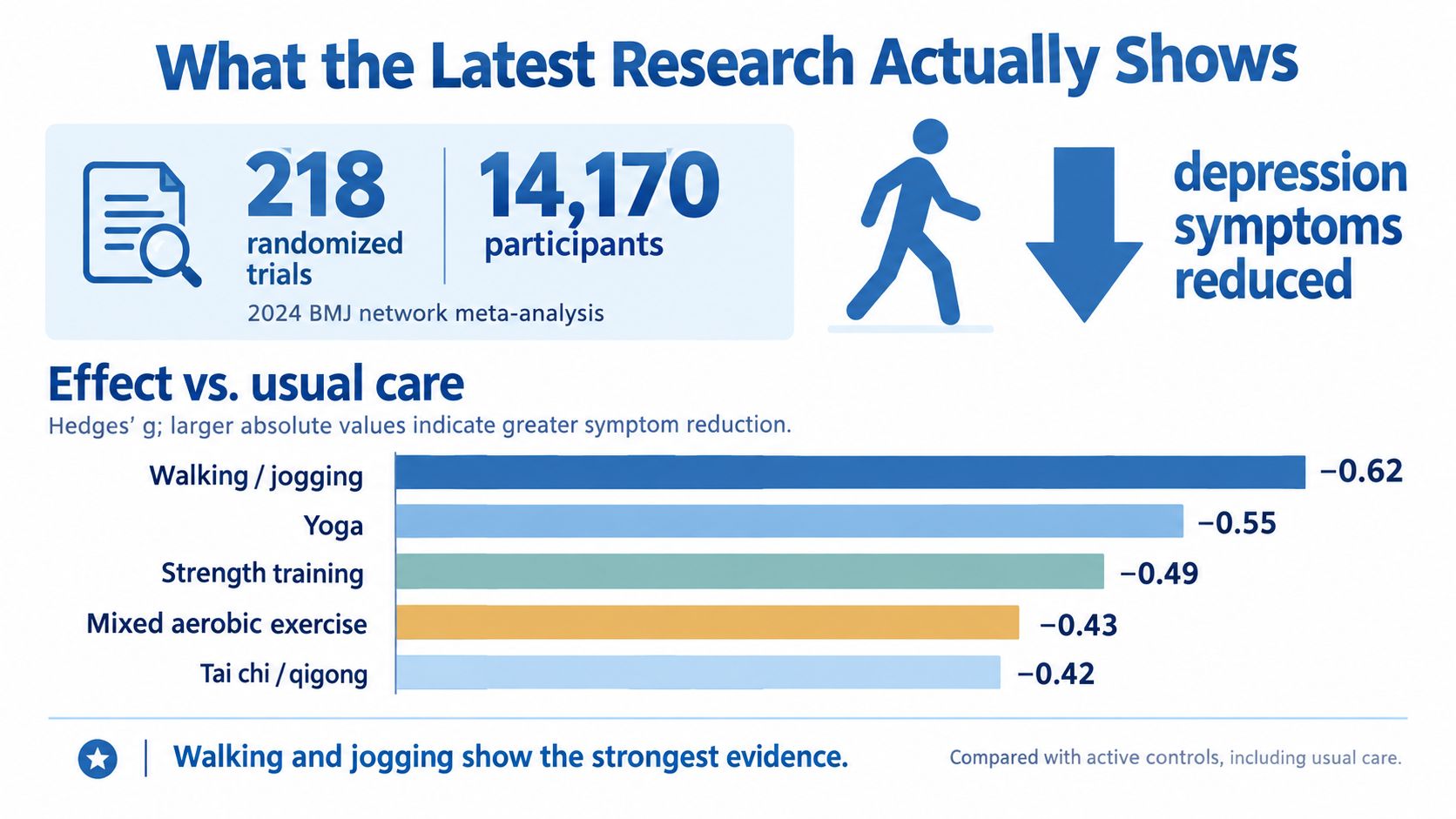
Exercise produces a meaningful average reduction in depressive symptoms, including against active comparison treatments. A 2024 BMJ systematic review and network meta-analysis pooled 218 randomized controlled trials involving 14,170 participants; walking or jogging produced a moderate benefit against active controls, with Hedges' g = −0.62 and a 95% credible interval of −0.80 to −0.45.
That's stronger evidence than a comparison with people receiving nothing. Active controls included usual care or placebo, so participants had credible alternatives rather than waiting for treatment. Still, an average benefit doesn't tell us whether a particular person will improve enough to return to work, enjoy relationships, or feel safe.
The infographic summarizes the scale of the evidence and the direction of the findings.
Understanding Effect Sizes Without Overselling Them
An effect size describes the difference between groups on symptom measures. It isn't a percentage improvement, a probability of recovery, or a guarantee that walking will relieve your depression. The negative sign in the walking estimate indicates lower symptom scores, not a harmful effect.
Exercise Modality Effect Sizes Against Active Controls
Modality | Typical Effect | Population |
|---|---|---|
Walking or jogging | Moderate symptom reduction | Participants included in depression exercise trials |
Yoga | Among the more effective modalities | Trial populations with depressive symptoms |
Strength training | Among the more effective modalities | Trial populations with depressive symptoms |
Mixed aerobic exercise | A possible option, without a numerical estimate presented here | Participants in exercise interventions |
The same review placed yoga and strength training among the more effective approaches and found that benefits generally increased with prescribed intensity. That finding matters, but it doesn't justify starting every patient with vigorous workouts.
What a Clinical Prescription Adds
A useful recommendation specifies modality, intensity, frequency, and duration, then checks symptoms and participation. “Get more exercise” leaves the patient to solve every practical problem while already feeling depleted.
Clinical perspective: A treatment can have good evidence and still be poorly matched to the person receiving it.
The appropriate conclusion is neither that exercise cures depression nor that it's merely general wellness advice. It deserves a place among structured treatment options, with realistic expectations and follow-up.
How Exercise May Change the Brain and Mood
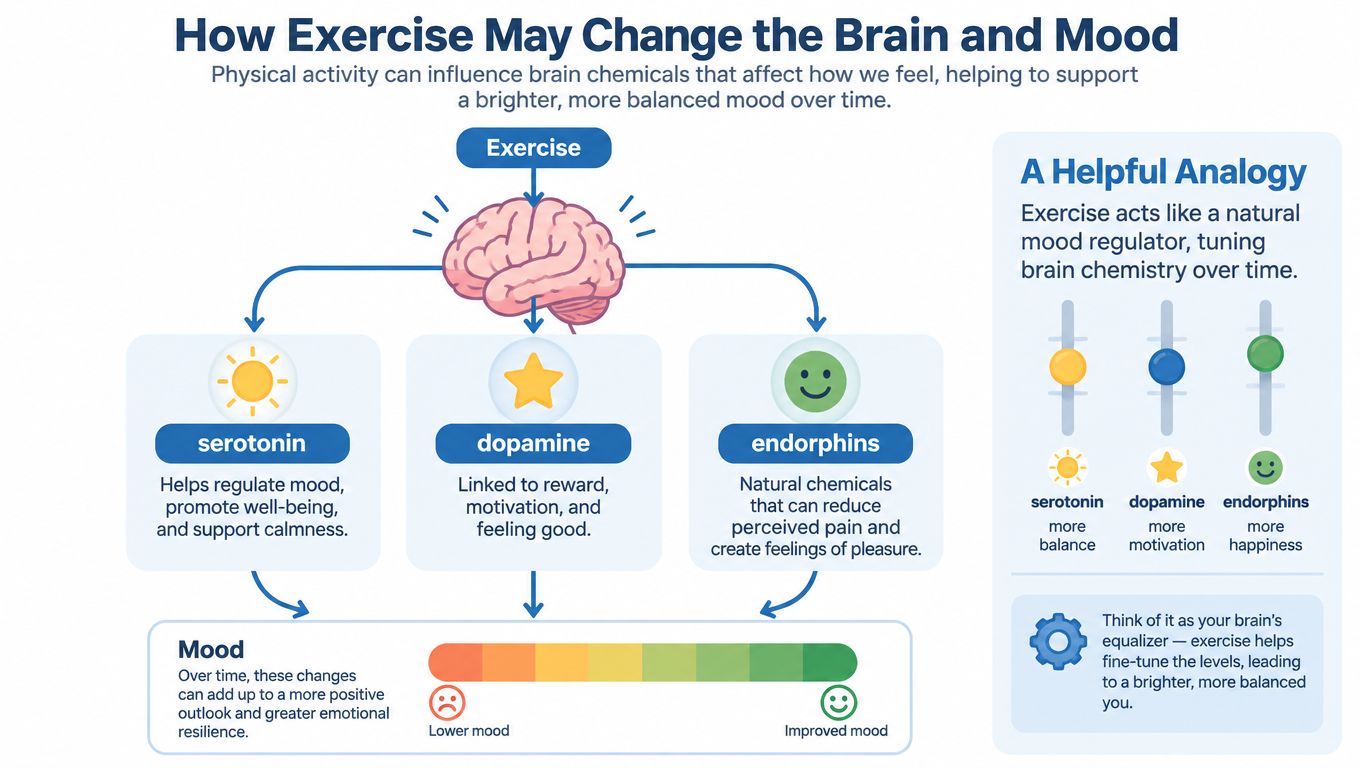
There probably isn't a single biological switch that explains why movement helps. Candidate mechanisms include changes involving serotonin, dopamine, norepinephrine, and endorphins, alongside processes related to sleep, stress, and inflammation. These are plausible contributors, not a complete explanation of an individual patient's response.
Think of mood regulation as a mixing board rather than a light switch. Movement might influence several channels at once, but turning one dial doesn't necessarily resolve the whole problem. Depression also involves a person's circumstances, thought patterns, medical health, and ability to function.
The diagram illustrates proposed pathways, not a proven chemical sequence or a promise of benefit.
Brain Chemistry Is Only Part of the Explanation
Neuroplasticity refers to the brain's capacity to adapt. Brain-derived neurotrophic factor, often shortened to BDNF, is discussed as a candidate contributor to that process. Neither term means that a workout automatically repairs depression, and the clinical outcome evidence doesn't establish which mechanism accounts for improvement.
Likewise, changes in sleep or inflammation may contribute without being the primary explanation for everyone. It's more accurate to describe overlapping possibilities than to claim exercise corrects a specific chemical deficiency. For background on commonly discussed neurotransmitters, the explanation of dopamine versus serotonin can help clarify the terminology.
Behavioral Changes Can Matter Too
A movement plan can also create opportunities that depression has crowded out:
Mastery: Completing a manageable activity offers a concrete experience of doing something difficult.
Routine: A planned walk can provide an anchor when days have become unstructured.
Attention: Following a route, rhythm, or sequence may offer a temporary break from rumination.
Connection: An activity with someone else can include social contact without requiring a long conversation.
These are reasons to consider an activity's setting, not just its physical demands. If music and shared movement sound more approachable than a gym, you can browse dance programs for mental health through Danza Academy of Social Dance. Treat that as an activity resource, not evidence that dance alone treats major depressive disorder.
You don't need to feel euphoric afterward for movement to be worth evaluating. More useful questions include whether you're functioning better, sleeping differently, or finding it easier to rejoin daily life.
Walking, Weights, Yoga, and Mixed Workouts Compared
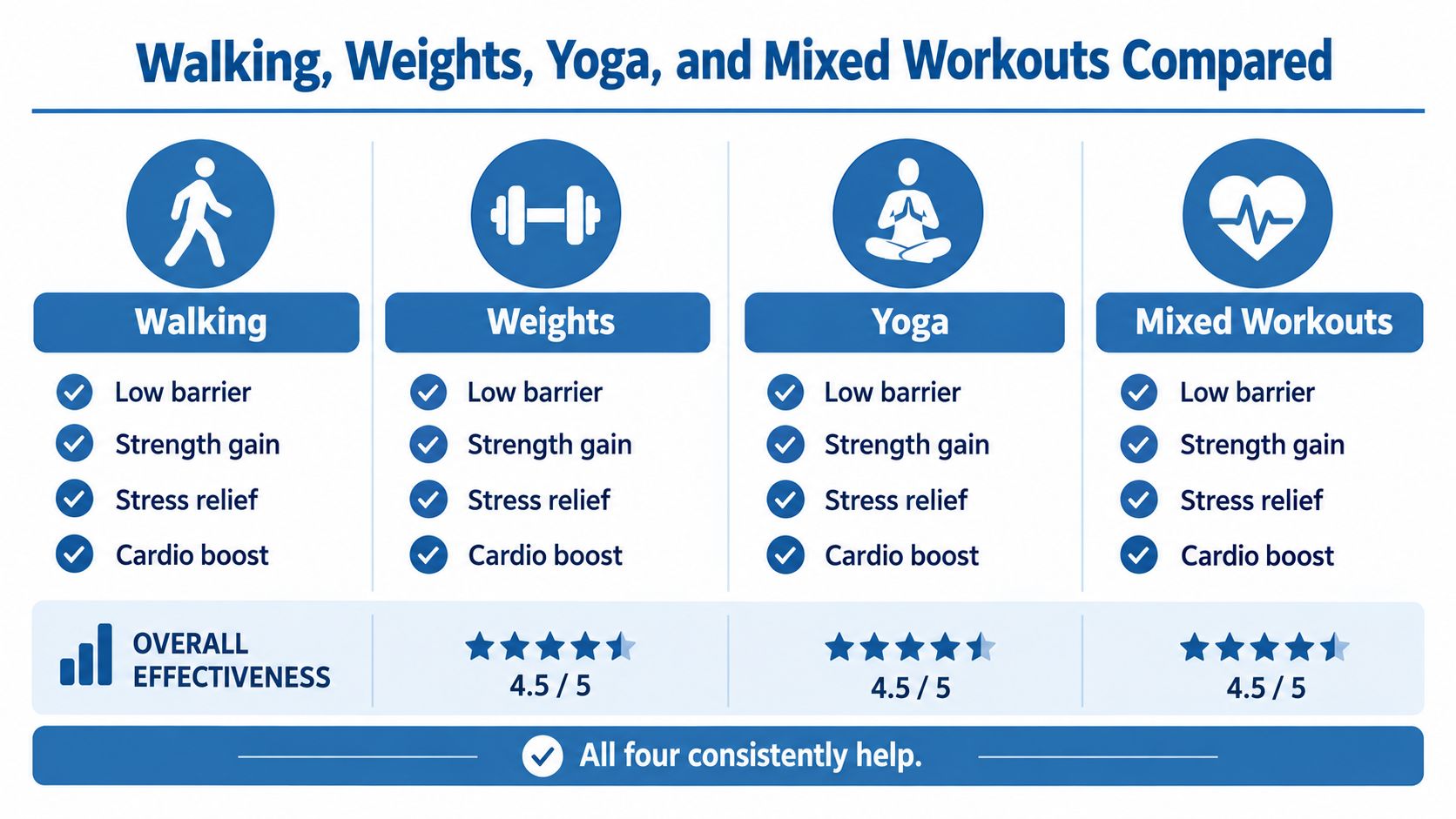
The most useful activity isn't necessarily the one that looks most impressive. It's the one whose demands fit your body and whose setting you can tolerate. Walking, weights, yoga, and mixed workouts offer different trade-offs, even when each has a place in depression care.
This comparison is a starting point for choosing an activity, not proof that all options work equally well for every patient.
Match the Activity to the Barrier
Activity | Practical advantage | Trade-off to consider |
|---|---|---|
Walking or jogging | Flexible route and pace, without a gym membership | Weather, pain, neighborhood access, or discomfort exercising outside |
Strength training | Adaptable exercises with clear progression | Technique, equipment, loading, and possible need for instruction |
Yoga | Can be adapted to different settings and abilities | Some positions, classes, or body-focused practices may feel uncomfortable |
Mixed aerobic workouts | Variety across cycling, walking, and other activities | Too many choices can make planning harder |
Resistance exercise has evidence beyond aerobic training. A summary of resistance-exercise research in BMJ reports a meta-analysis of 33 clinical trials involving 1,877 participants, with a moderate standardized mean effect of 0.66, a 95% confidence interval of 0.48–0.83, and P < .001.
That supports offering strength work when walking or jogging is unacceptable. It doesn't mean a person should lift heavy weights immediately or ignore medical limitations. Loading should be individualized, with attention to technique and recovery.
Choose for Fit, Not Prestige
Walking may suit someone who wants the fewest logistical decisions. Strength training may suit someone who prefers a defined task over continuous aerobic activity. Yoga may appeal to someone seeking a slower format, while mixed workouts may help someone who dislikes repetition.
None of those preferences is a diagnosis, and none should override safety. A person with painful joints might need an adapted program; someone uncomfortable in group settings might begin privately rather than forcing attendance at a class.
The embedded video is an additional viewing resource, not a substitute for individualized exercise instruction.
Don't compare effect sizes from separate analyses as though they're a head-to-head contest. Different participants, measures, and comparison conditions can change the estimates. Choose a workable option, then assess your own response.
How Much Movement Is Actually Enough to Start
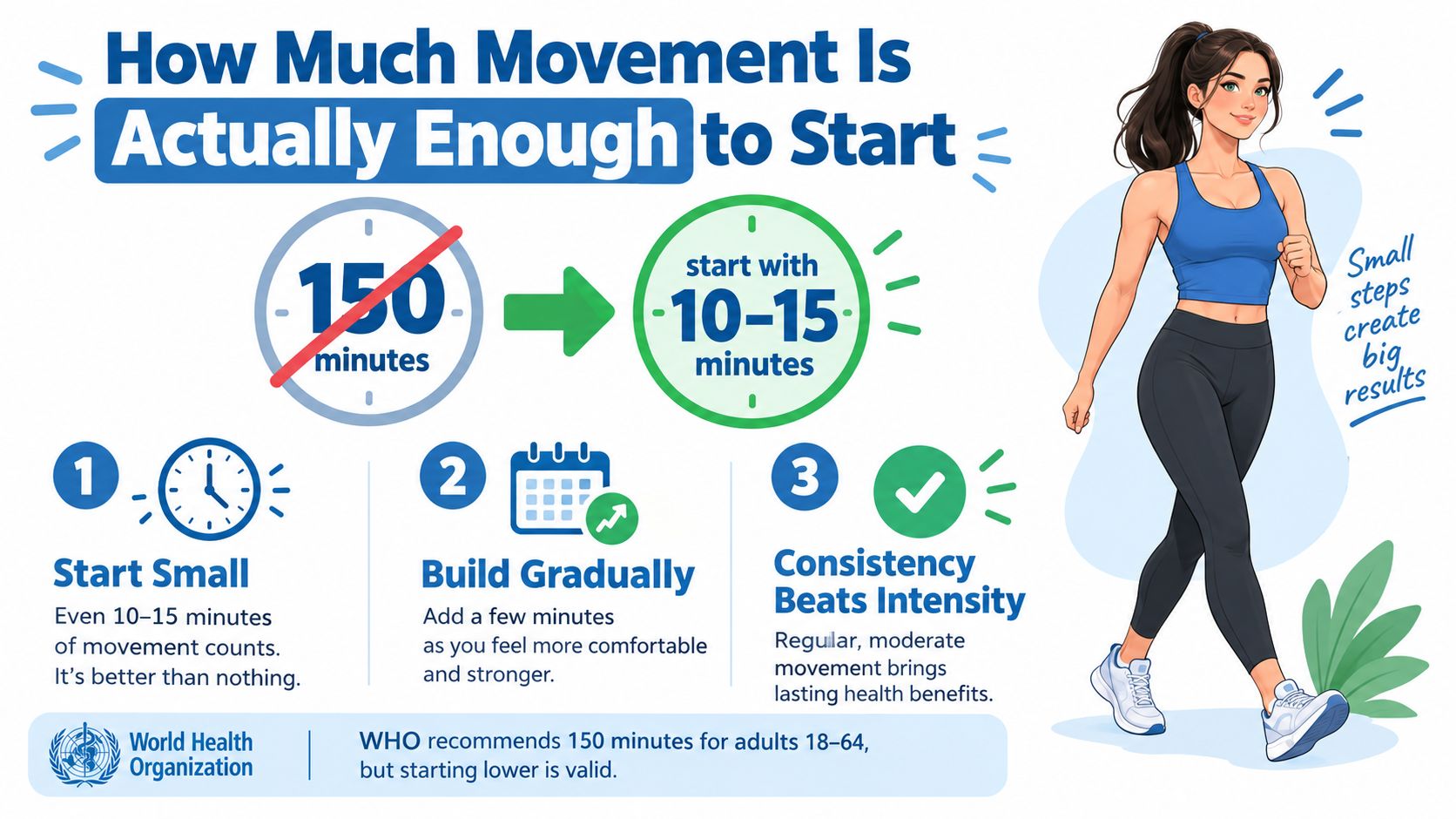
A public-health target is not an entry requirement for depression treatment. The WHO guidance document for adults ages 18–64 recommends at least 150 minutes of moderate-intensity aerobic activity weekly, 75 minutes of vigorous activity, or an equivalent combination; that document also specifies bouts lasting at least 10 minutes.
Those figures provide a framework, not a reason to postpone all movement until you can meet them. If depression, chronic pain, disability, or medication-related tiredness makes conventional workouts unrealistic, the starting question should be what you can safely repeat.
The graphic's suggested starting duration is an example, not a WHO-established minimum dose for treating depression.
Start Below the Target When Necessary
A 2025 systematic review of aerobic exercise in chronic illness and comorbid depression found clinically meaningful improvement at approximately 405 MET-minutes weekly, below the commonly cited 450 MET-minutes benchmark, and reported −0.01 depressive-symptom units per additional 10 MET-minutes weekly.
MET-minutes combine activity intensity and time. You don't need to calculate them yourself to begin; the practical implication is that benefits can occur below conventional targets in the population studied. It's not a universal minimum prescription.
Choose a tolerable starting point: Consider a short walk, brief cycling, or medically appropriate chair-based activity.
Split the effort: Several small sessions may be more manageable than one conventional workout.
Progress according to recovery: Increase demands only when the current routine fits your energy and medical status.
More Isn't Automatically Better
The chronic-illness evidence also describes nonlinear or U-shaped dose-response patterns, with benefits peaking at moderate volumes and declining at higher doses. That differs from the intensity finding discussed earlier: intensity and total volume aren't interchangeable.
Progress means finding a sustainable dose, not proving you can tolerate exhaustion.
If fatigue is the main obstacle, understanding whether depression can make you tired can help you prepare for a clinical discussion. Don't assume every episode of tiredness is psychological or something to push through.
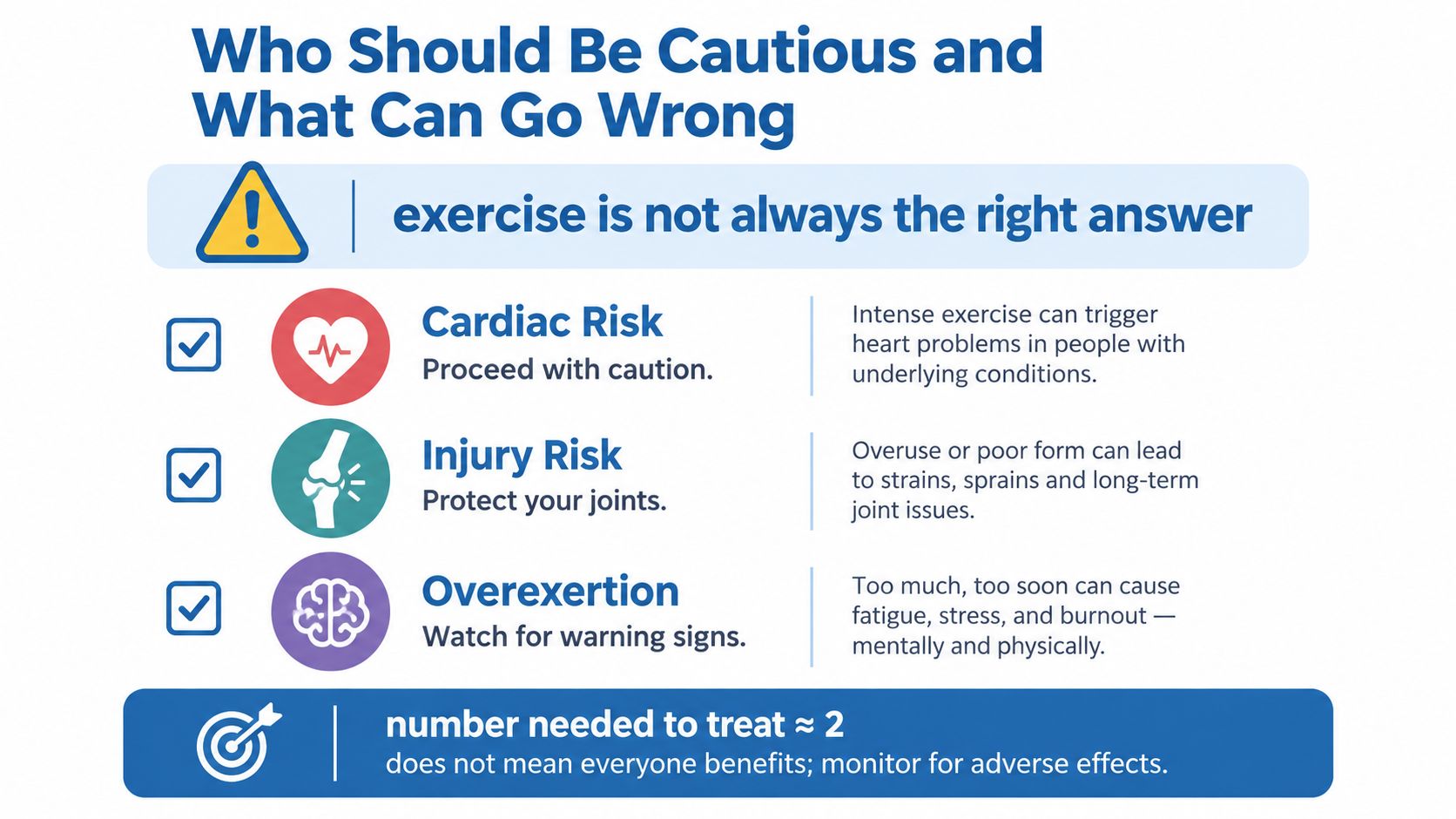
Who Should Be Cautious and What Can Go Wrong
An impressive average treatment effect doesn't make exercise universally appropriate. A meta-analysis in the British Journal of Sports Medicine included 41 studies and 2,264 participants, reporting a standardized mean difference of −0.946, with a 95% confidence interval of −1.18 to −0.71, and an estimated number needed to treat of approximately 2, with a 95% confidence interval of 1.68–2.59.
That estimate describes an additional favorable outcome compared with the comparison condition under studied circumstances. It doesn't mean every other patient is guaranteed to recover. Programs, participants, supervision, and adherence differed substantially.
The warnings below are reasons to tailor or reassess a plan, not reasons to fear all movement.
Identify Barriers Before Calling Them Nonadherence
Pain, obesity, disability, cardiometabolic disease, ADHD, anxiety, trauma, disrupted sleep, and medication side effects can all complicate participation. These call for different adaptations, not the same motivational speech.
A review of exercise and depression in PLOS ONE identifies adherence as a major challenge. When getting started or staying involved is difficult, discuss supervised support rather than repeatedly attempting a plan that isn't working.
Physical concerns: Ask for medical guidance when pain or a medical condition limits activity; stop and seek assessment for concerning symptoms such as chest pain or fainting.
Psychological discomfort: Change the setting or activity if crowded classes, body-focused exercises, or performance pressure intensify distress.
Possible mood activation: Unusually high energy, reduced need for sleep, impulsivity, or compulsive exercise warrants psychiatric review rather than encouragement to increase training.
Know When Endurance Advice Doesn't Apply
For someone medically cleared whose difficulty is ordinary walking endurance, Caddie Wheel's guide on how to walk longer without fatigue offers an activity-planning resource. It isn't an assessment of unexplained exhaustion or a treatment for depression.
Safety boundary: More energy is not always recovery, especially when it comes with less need for sleep or loss of control.
If exercise becomes punishment, displaces sleep, or continues despite injury, the goal should shift from increasing participation to restoring safety and control.
How Movement Fits With Therapy and Medication
Exercise and psychiatric treatment don't have to compete. A BMJ analysis of exercise interventions for depression found benefits when exercise was combined with established treatments, including cognitive behavioral therapy. That supports integration, not automatically replacing care that's already helping.
The remission findings are encouraging but need context. A review of randomized exercise trials describes a trial of 156 adults with major depressive disorder, with remission rates of 60.4% for exercise, 65.5% for sertraline, and 68.8% for combined treatment; a separate 16-week comparison reported remission in 45% with supervised exercise, 40% with home-based exercise, 47% with medication, and 31% with placebo.
These results don't establish that any home workout is equivalent to medication. They describe particular treatment conditions, and the combined-treatment result doesn't prove that combination care is always superior for every patient.
Give Each Treatment a Clear Job
Component | Place in an individualized plan |
|---|---|
Movement | A scheduled behavioral intervention with participation and symptom monitoring |
CBT | Work on thought patterns and behaviors, including barriers to engaging in daily life |
DBT | Skills for emotion regulation and distress tolerance when clinically appropriate |
Medication | Treatment when indicated by symptoms, history, preferences, and clinical assessment |
The exercise evidence cited here specifically supports combination with CBT. It shouldn't be stretched into a claim that exercise plus DBT has the same research findings. A clinician may still coordinate movement with DBT as part of a broader plan.
Match Care to Severity and History
For some people with mild depression, structured exercise may be a possible first-line option after assessment. Moderate-to-severe symptoms, substantial functional impairment, or suicidal thoughts require more than a self-directed fitness plan.
Don't stop or reduce psychiatric medication because you've started exercising. Discuss changes with the prescribing clinician, including whether fatigue, sleep disruption, or other side effects are making participation difficult.
Longstanding symptoms also deserve a treatment review rather than another lifestyle checklist. Guidance on persistent depressive disorder treatment can help frame that conversation. The question is which combination addresses your actual needs, not which treatment seems most natural.
A Practical Starting Plan You Can Actually Follow
If you're reading this from bed, don't begin by designing a complete fitness routine. Choose an action that requires little preparation and fits your current abilities. An indoor walk, a familiar adapted movement, or getting ready for an agreed activity can be a more workable beginning than committing to a demanding class.
A minimum viable routine is the smallest version of your plan that you can realistically repeat. It's an adherence strategy, not a claim that any tiny amount of movement is sufficient treatment for major depression.
Make the First Attempt Easier
Choose the setting before the workout: Decide whether home, a quiet outdoor route, or a supervised setting feels most manageable.
Attach movement to an existing cue: Try after breakfast or another familiar part of your day, rather than relying on a sudden burst of motivation.
Prepare only what you need: Put comfortable shoes or equipment where you'll use them. Avoid turning preparation into a shopping project.
Allow a smaller version: If the planned activity is too much, adapt it rather than abandoning the entire routine.
This approach overlaps with behavioral activation for depression, which uses planned actions rather than waiting for motivation to arrive. The point is to make participation possible, not to deny how hard depression can make it.
Track What Happened, Not What You Intended
Use a paper note, phone calendar, or simple checklist. Record the activity, whether you completed it, and how mood, sleep, energy, and pain changed. Also note unusually driven behavior or reduced need for sleep.
A weekly check-in can help you distinguish a workable plan from an aspirational one. Missed sessions are useful information: was the obstacle fatigue, transportation, anxiety, pain, forgetfulness, or a dose that was too demanding?
Practical rule: Change the obstacle before increasing the demand.
Ask about supervision when repeated attempts stall or when you're uncertain about safe movement. If symptoms worsen, functioning declines, or you're not improving after several weeks, seek a treatment review rather than indefinitely increasing exercise. Today's task can be choosing a safe activity and arranging the support needed to attempt it.
When to Reach Out for Professional Support
You do not need to wait for exercise to fail before seeking care. Trouble getting out of bed, ongoing hopelessness, difficulty functioning, or uncertainty about your diagnosis are reasons to request an evaluation. Exercise may support treatment, but it should not delay assessment when depression is affecting daily life.
If you have suicidal thoughts, exercise is not a substitute for urgent assessment. If you might act on those thoughts or cannot stay safe, seek emergency help now and involve someone who can stay with you.
Prepare for a Useful Conversation
Before an appointment, note your symptoms, sleep, medication effects, physical limitations, and past attempts at movement. The guide on how to talk to a doctor about depression can help you describe what has been difficult.
If safety and treatment needs are addressed, but following a routine remains hard, Strive Workout Log's guide to stay consistent with workouts offers planning ideas. A workout log can support follow-through, but it cannot determine the level of psychiatric care you need.
We accept Aetna, United Healthcare/UHC, Cigna, Blue Cross Blue Shield, Humana, Tricare, UMR, and Oscar insurance plans. HIPAA-compliant telepsychiatry is available across Florida.
This blog is for informational purposes only and does not constitute medical advice. Consult a qualified mental health professional for guidance suited to your needs.
Refresh Psychiatry & Therapy offers psychiatric evaluations, medication management, and therapy through Florida telepsychiatry, including help deciding how movement fits into depression care. To schedule an evaluation, call Refresh Psychiatry at (954) 603-4081.