
🎭 ADHD Masking: The Hidden Cost of Fitting In

You can look polished all day and still feel like you're holding your life together with reminders, over-preparation, and sheer willpower. The meeting starts on time, the kids get to school, the email gets sent, and nobody sees the mental sprint it took to make that happen. ADHD masking is the name for that hidden labor, and for many adults, it explains why success can feel so expensive.
A 2026 SFU study found that 91.6% of 202 adults with ADHD reported masking, hiding, suppressing, or compensating for ADHD traits in at least some social situations, making it close to universal in that sample, especially in work, public spaces, and personal relationships SFU study summary. In practical terms, that means a lot of adults are not “fine” in the way they appear. They're running a constant internal performance that often goes unnamed until burnout, anxiety, or a late diagnosis forces the issue.
If you've ever built your life around appearing composed while privately feeling exhausted, the guide for busy professionals with ADHD can be a helpful companion for the executive-function side of that struggle. For a broader look at how overwhelm and masked symptoms overlap, see this overview of ADHD overwhelm.
The Invisible Full Time Job of Hiding ADHD
She gets the children out the door, answers a few emails, and makes it to the office on time. Coworkers call her organized. Her family calls her dependable. By the end of the day, though, she's drained, irritable, and embarrassed that it took three alarms, a written checklist, and a last-minute burst of panic to keep the day from unraveling.
That gap between what others see and what the person feels is where ADHD masking lives. It often looks like competence from the outside, but inside it can feel like a second job, one that never clocks out. A related resource on ADHD symptoms in women is useful here, because women are often praised for coping well long before anyone asks what coping is costing them.
The behavior is common across settings. In the SFU sample, masking showed up especially in school or work for 83% of participants, and 57% reported masking within the family SFU study summary. That pattern matters because it tells us this isn't a rare quirk. It's a widespread survival strategy.
Practical rule: if someone looks “high functioning” only because every day requires intense self-monitoring, they may not be thriving, they may be compensating.
The hardest part is that the person often internalizes the performance as proof they don't really have ADHD, or that they should just work harder. That self-blame can keep the mask in place for years. The mask works socially, but it also delays care.
What ADHD Masking Is and What It Is Not
Think of masking as acting like a translator who never gets to stop translating. A thought appears, then gets edited for tone, timing, volume, body language, and likely fallout before anyone else ever hears it. That translation takes energy, and over time it can make ordinary life feel strangely performative.
The British Journal of Psychiatry defines ADHD camouflaging as strategic modification of behavior intended to reduce the visibility of neurodevelopmental differences, including suppressing hyperactivity, restraining impulsivity, and using perfectionistic strategies to appear competent and controlled British Journal of Psychiatry. A qualitative adult ADHD thesis describes the same pattern as impression management, a coping strategy people use to camouflage symptoms or conceal functional impairments adult ADHD thesis. Those descriptions are different in style, but they point to the same clinical reality.
What It Is
Masking is a set of compensatory strategies. It can be conscious, automatic, or somewhere in between. A person may rehearse conversations, over-prepare for simple tasks, force stillness, or copy the social pace of the room just to avoid standing out.
It's also effortful. A recent review describes masking behaviors as compensatory strategies used to conceal or offset ADHD-related traits in order to meet social or task demands, and notes that this can increase psychological burden and lead to avoidance of interpersonal interaction 2024 empirical review. That's a key clinical clue. If social contact itself becomes more draining because every interaction requires choreography, masking is probably part of the picture.
What It Is Not
Masking is not lying in the ordinary moral sense. It isn't a person deciding to trick others for advantage. It's usually a survival response to criticism, rejection, disorganization, or repeated failure.
It's also not the same as basic politeness or normal self-control. Everyone adjusts their behavior sometimes. Masking becomes clinically important when the adjustment is constant, exhausting, and tied to hiding impairment rather than just showing good manners. A resource on eye contact can help distinguish a social skill from the broader effort to look composed when attention is slipping internally.
Common Masking Behaviors You Might Recognize
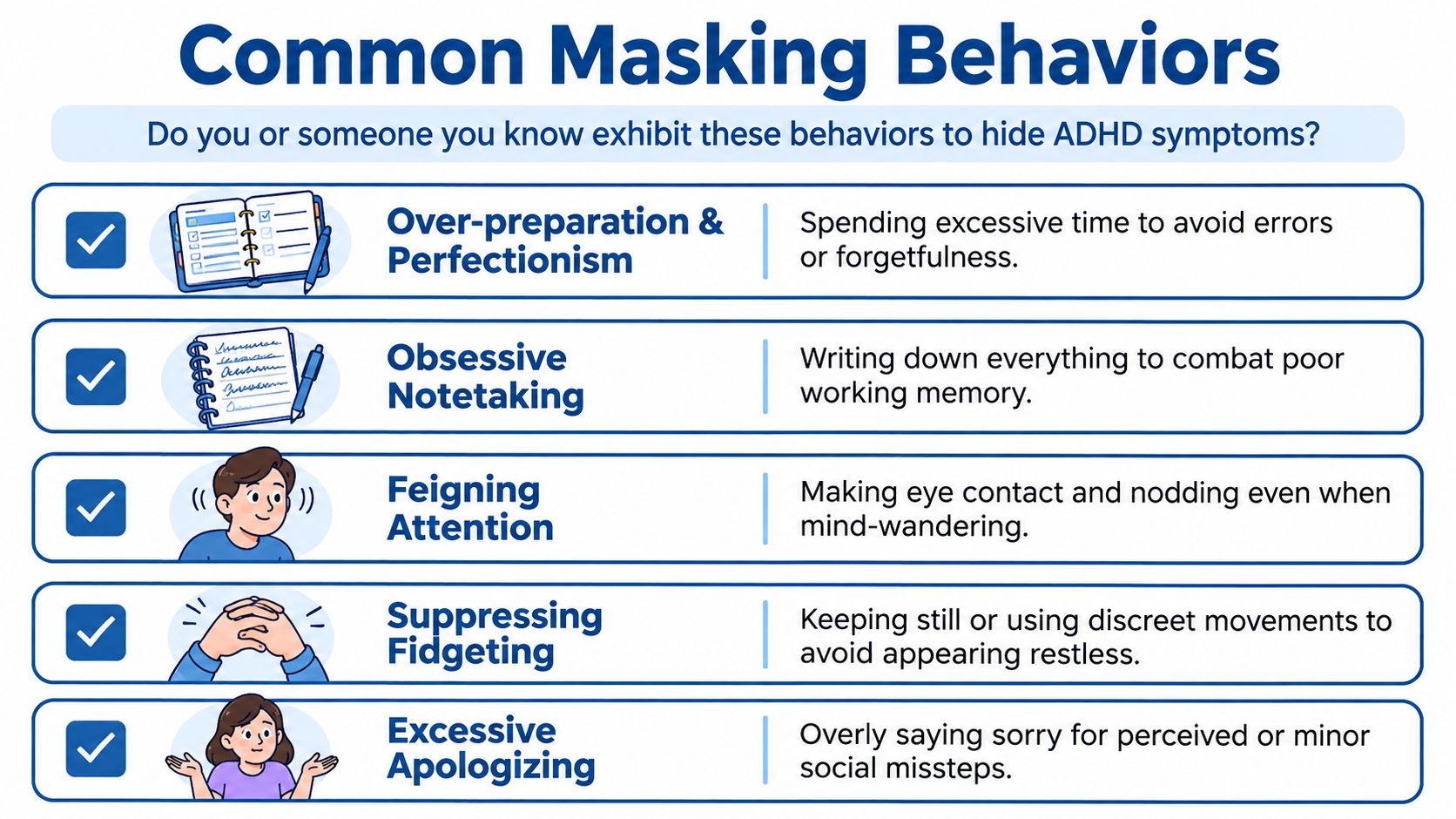
At work, masking often looks admirable from a distance. The person has color-coded systems, five backup calendars, and a habit of staying late so nobody notices how much triage is happening behind the scenes. At school, it can look like a student who never misses an assignment, but only because every paper starts with frantic over-preparation and ends with exhaustion.
A clinician would recognize several recurring patterns. The Cambridge definition of camouflaging includes suppressing hyperactivity, restraining impulsivity, and using perfectionistic strategies to appear competent and controlled British Journal of Psychiatry. In daily life, that can look like a person who never interrupts, never leaves a visible trace of chaos, and never lets anyone see how much effort ordinary tasks require.
A few common examples stand out:
Over-preparation and perfectionism: spending far too long on emails, projects, or household tasks because any error feels dangerous.
Obsessive note-taking: writing down every detail to compensate for weak working memory.
Feigning attention: nodding, maintaining eye contact, or mirroring others while mentally drifting.
Suppressing fidgeting: forcing stillness, clasping hands, or using tiny hidden movements to avoid looking restless.
Excessive apologizing: saying sorry for minor delays, interruptions, or ordinary human slips.
Girls and women often get praised for being thoughtful, organized, or mature, when those traits may partly reflect relentless self-monitoring. In adults, masking can also look like rigid routines, over-reliance on alarms, or doing everything early because time blindness makes last-minute work feel unsafe. For a related clinical angle, see this resource on ADHD eye contact, since eye contact is often one small piece of a much larger concealment pattern.
Some people don't look “hyperactive.” They look exhausted from acting calm.
The 2026 SFU study helps show how broad this can be, since 91.6% of adults in that sample reported some masking in social settings SFU study summary. When a behavior is that common, the clinical question isn't whether it exists. It's what it's costing.
The High Price of Hiding ADHD Symptoms

Masking usually starts as an attempt to avoid shame. Over time, it can become its own source of shame because the person feels they “should” be able to keep up forever. That cycle is one reason many adults with ADHD don't seek help until they're already burned out.
A recent review notes that masking behaviors can increase psychological burden and lead to avoidance of interpersonal interaction 2024 empirical review. That fits what patients often describe clinically. They become more isolated not because they dislike people, but because social performance has gotten too expensive.
The most common downstream effects are not subtle. People develop chronic anxiety about being found out, feel emotionally flattened from constant self-surveillance, and begin to organize their identity around performance instead of spontaneity. A resource on emotional blunting can be useful when someone says they feel less like themselves, because that language often appears alongside long-term masking.
The pressure can also delay diagnosis. If a person is organized at work but collapsing at home, many checklists miss the problem because they only capture the polished version. Late-diagnosed adults, especially women, often describe success at school or work despite significant internal strain, and masking can hide the full severity of ADHD until demands increase in college, parenting, or remote work settings University College Dublin paper.
The end result is often a double bind. The person succeeds just enough to look okay, but not enough to feel okay. That mismatch is one of the clearest signs that the underlying problem is being hidden, not solved.
Recognizing Masked ADHD A Clinician's Perspective
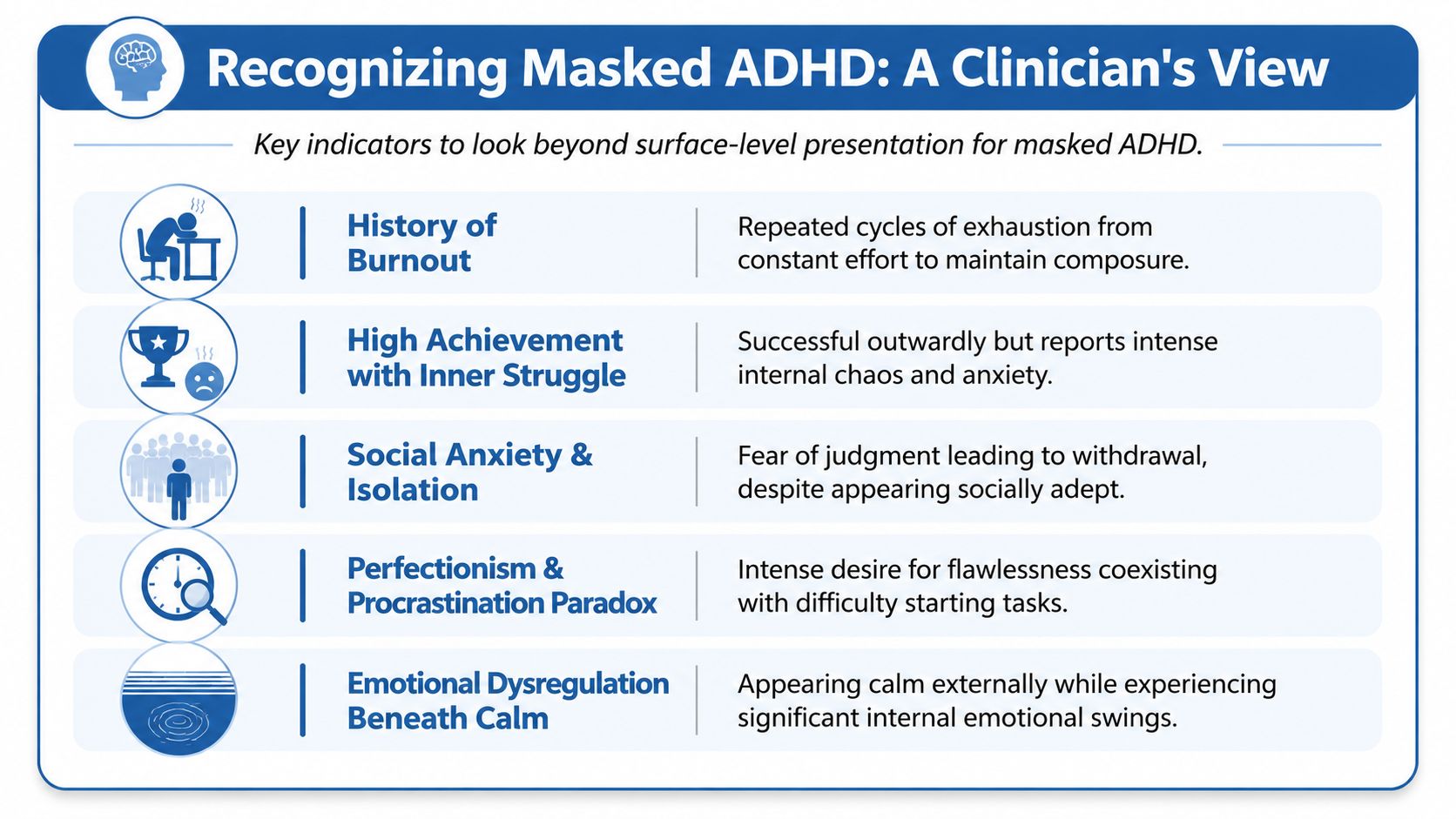
A patient who appears composed in the office can still be spending extraordinary effort to hold it together. Masking can obscure standard symptom-based assessment because the clinician sees intact outward functioning while the patient is using suppression, rehearsal, and compensation internally clinical review. That is why the interview has to go beyond “Are you distracted?” and “Do you miss deadlines?”
Questions That Reveal Cost
Ask what it takes to keep life on track. Ask how much anxiety sits underneath the appearance of control. Ask what happens on the days when routines break, because many masked patients can function only while the structure is intact.
A few red flags deserve attention:
History of burnout: repeated crashes after periods of intense effort.
High achievement with inner struggle: outward success paired with chronic overwhelm.
Social anxiety and isolation: fear of judgment leading to withdrawal.
Perfectionism with procrastination: wanting flawless work but struggling to start.
Calm exterior, turbulent interior: seeming composed while feeling emotionally flooded.
A telehealth psychiatrist resource can be useful for patients who need a setting that feels less performative, because some people disclose more fully when the pressure of an in-person performance is lower.
What To Look For Across Contexts
Cross-context history matters more than a snapshot. Someone may be meticulous at the office and chaotic at home, or highly verbal in one setting and shut down in another. That pattern is important because masking often works in one environment while breaking down in another.
Clinical rule: if the story changes drastically by setting, ask what each setting is costing the patient, not just what it is producing.
Open-ended questions uncover more than checklists when masking is present. A patient may not report “symptoms” in the abstract, but they can usually describe the rituals, backups, and recovery time that keep them afloat. Those details often tell the truth faster than a rating scale does.
The Path to Unmasking and Authentic Living
Unmasking isn't about dropping every coping skill overnight. It's about replacing compulsory performance with conscious choice. That shift matters because the goal is not to become less responsible, it's to stop using exhaustion as the price of appearing normal.
Treatment usually works best when it addresses both the brain and the behavior. Medication can reduce the underlying symptom load, which lowers the need to overcompensate every hour of the day. Therapy, especially CBT and DBT, can help people challenge shame, rebuild self-trust, and learn coping strategies that don't depend on perfection.
Environmental support matters just as much. If a workplace, classroom, or home routine assumes everyone can track time, switch tasks, and tolerate interruption the same way, an ADHD brain is forced to spend more energy on concealment. Accommodations, clearer structure, and realistic expectations reduce the need to perform competence.
The practical win is not “never mask again.” It's to mask less, notice sooner when coping is becoming strain, and build a life that doesn't require constant acting. That is especially important for adults who have spent years being praised for resilience while privately losing energy to the act of looking fine.
How Refresh Psychiatry Can Help You Find Your Way
Masked ADHD often needs a careful evaluation, not a quick checklist. Late-diagnosed adults, especially women, may appear successful while carrying a heavy internal load, and expert guidance recommends looking beyond surface coping with open-ended interviews when masking may be obscuring symptoms University College Dublin paper. A thoughtful assessment can separate resilience from overcompensation, and that distinction changes treatment.
If you've been functioning on effort alone, you don't need to keep proving that it's hard. You need a clinical plan that takes the hidden cost seriously and helps you build steadier support around it. Refresh Psychiatry & Therapy can help you take that next step with evaluation, medication management, and therapy that respects the profound complexity of masked ADHD.
Contact us or call Refresh Psychiatry at (954) 603-4081 to schedule your evaluation. We accept Aetna, United Healthcare/ UHC, Cigna, Blue Cross Blue Shield, Humana, Tricare, UMR, and Oscar insurance plans. This blog is for informational purposes only and does not constitute medical advice. Please consult a qualified mental health professional for personalized guidance.