
🧠 Test for ADHD Adults: What the Visit Covers

You keep a running list in your head and still leave without the one thing you needed. At work you catch the big idea and miss the small date. At home you start talking before the other person finishes, then replay it later. For years someone else absorbed the cost. A partner reminded you. A manager cleaned up the edges. A loose college deadline left room for a midnight sprint.
Then the slack disappears. A promotion adds meetings you can't bluff through. A child needs you on time. Coursework no longer bends around a burst of focus. Burnout makes the old shortcuts feel thin. That's usually when someone searches for a test for ADHD adults and hopes a score will settle a lifetime of friction.
A quiz can name a pattern. It can't tell you whether that pattern is ADHD, poor sleep, anxiety, or more than one problem at once. The visit that follows has a different job.
Why Adults Look for a Test for ADHD Adults
A Florida adult may book an ADHD assessment after a new role brings missed deadlines into sharper focus, or family life leaves less room for forgotten tasks. The difficulties often began years earlier. What changes is how much they interfere.
A first evaluation in adulthood is common. Childhood report cards or a parent's account can help establish early patterns, but adults may not have access to either. In telepsychiatry, a clinician can review the person's own memories, school and work history, and accounts from others who know them. Missing records or an unavailable parent informant do not, by themselves, end the assessment.
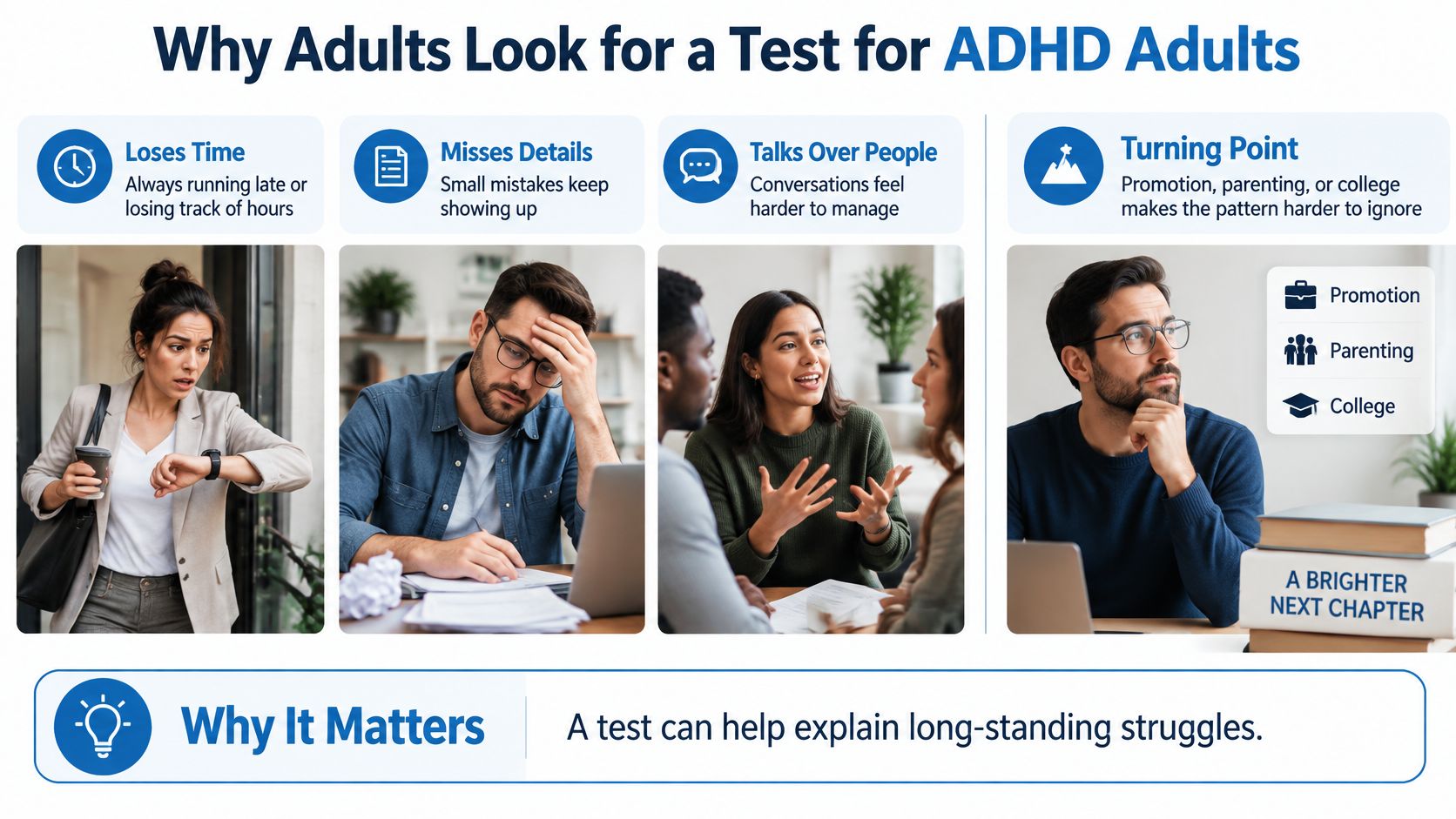
What the turning point usually looks like
The concern often comes from familiar problems becoming harder to manage:
Time slips away. A short task takes the afternoon, or meetings begin before the person is ready.
Small errors recur. A form is missing a line, an attachment goes unsent, or a bill is paid late.
Conversation moves too fast. Someone interrupts, then feels embarrassed or worn out.
A diagnosis made at 35 does not mean symptoms began at 35. The clinician needs to understand whether current difficulties have a longer history and how they affect daily life. That history may include signs of executive dysfunction, such as difficulty planning and following through, even when a person understands what needs to be done.
What an Adult ADHD Evaluation Actually Measures
An online quiz is one snapshot. A computerized attention score is one task on one day. Neither is an adult ADHD evaluation. The visit is a structured clinical assessment, and the clinician's job is to synthesize history, not to read a lab value.
The National Institute of Mental Health sets a plain standard. Symptoms must have begun before age 12, lasted at least 6 months, shown up in at least two settings such as home and work, and caused real impairment in social, school, or job life. For adults and adolescents older than 16, at least five symptoms of inattention and/or hyperactivity-impulsivity are required. Younger children need six.
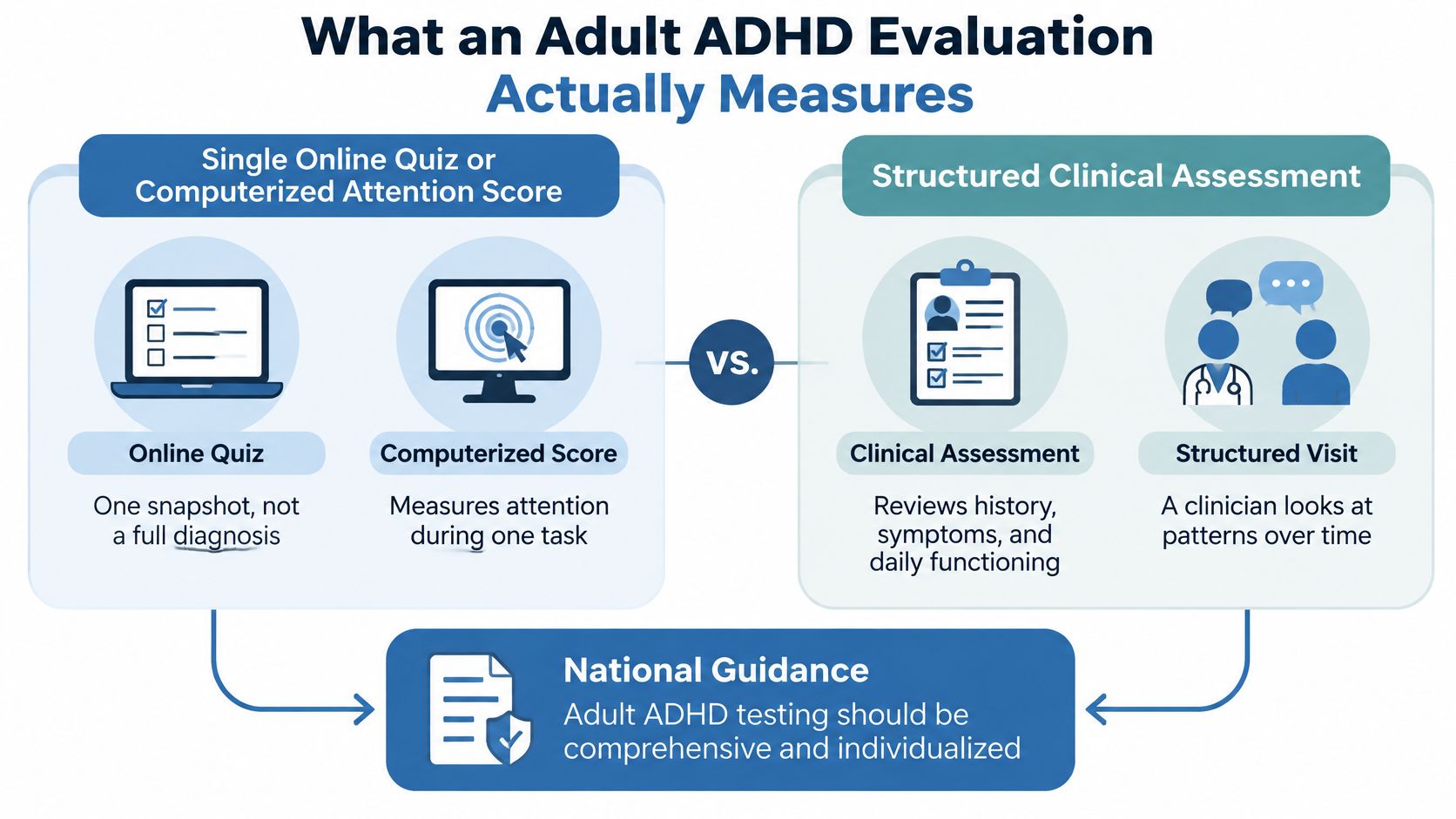
The history that actually carries the diagnosis
A credible interview reviews current behavior, childhood behavior, school or job history, medical and mental-health history, and other explanations. Rating scales can support that conversation. Psychological testing may look at working memory, planning, decision-making, or reasoning when those skills are in question. Neither replaces the interview.
The CDC makes the limit explicit in that same NIMH-aligned guidance. No single test establishes ADHD, because sleep disorders, anxiety, depression, and learning disabilities can look similar. If you want a sense of how therapy fits beside that medical review, you can explore therapy for ADHD as skills work, not as a substitute for diagnosis.
A short video walk-through of adult symptoms can help you notice what to bring up, but it is still not the assessment.
Practical rule: A credible assessment has to establish childhood onset, persistence, impairment across settings, and a differential. Today's concentration complaint is only the starting complaint.
How DSM-5 Criteria Shape the Adult Interview
A missed deadline can reflect ADHD, sleep loss, anxiety, or a temporary crisis. The clinician uses DSM-5 criteria to ask whether symptoms form a persistent pattern that interferes with life, rather than relying on a symptom count alone. Adults generally need at least five symptoms in one or both symptom groups, lasting at least six months, with impairment in more than one setting. CHADD's professional overview summarizes these criteria.
The questions behind the numbers
The interview explores how symptoms have affected daily life over time. A clinician may ask whether the pattern began earlier in life, where it appears now, and what consequences it has had. For example, repeated missed deadlines at work alongside unpaid bills at home may point to impairment across settings. Difficulties limited to one unusually stressful job call for a closer look at other explanations.
A symptom count without meaningful impairment does not establish ADHD. The clinician also considers whether the pattern fits the person's history, rather than a recent period of stress or change.
Three adult presentations
DSM-5 describes predominantly inattentive, predominantly hyperactive-impulsive, and combined presentations. These labels reflect which symptom group is more prominent; they do not describe a person's character or ability.
Inattention may show up as unfinished tasks, lost time, or repeatedly rereading emails. Hyperactivity in adults can be less visible than childhood fidgeting. A person may feel internally restless, interrupt others, or act impulsively with spending or driving. Adults who recognize that pattern can read more about hyperactive ADHD in adulthood.
In Florida telepsychiatry, the clinician can ask about these patterns directly and gather relevant collateral information with the patient's permission. Missing childhood records or an unavailable parent informant can limit corroboration, but do not automatically prevent an assessment. Other sources, such as the patient's recollections, school history, or observations from someone who knows them now, may help build the clinical picture.
A demanding week alone does not establish ADHD. The interview looks for a longstanding pattern and its effects across different parts of life.
Screening Tools That Help but Do Not Diagnose
An adult in Florida can complete an ADHD questionnaire before a telepsychiatry visit, but the score is only one piece of the evaluation. The Adult ADHD Self-Report Scale (ASRS) helps identify symptoms and establish a baseline. In one validation study, the ASRS had a sensitivity of 0.84 and specificity of 0.66 at the first assessment. Its positive predictive value was 0.26, meaning a positive result often occurred in people who did not have ADHD in that study's sample. A clinician interprets the answers alongside the interview and other available information.
What the short forms add
The six-question WHO Adult ADHD Self-Report Scale Screener is another screening tool, not a stand-alone diagnosis. In a U.S. health-plan sample of 668 subscribers, its four-category scoring version showed strong agreement with clinician diagnoses based on DSM-IV adult criteria. Agreement varied across measures of consistency and retesting, which is one reason a single score cannot settle the question.
A separate college-student reliability study found that ASRS scores tracked DSM inattentive symptoms more closely than hyperactive-impulsive symptoms. Some students also changed screening category when retested. A questionnaire captures how a person answers at a particular time; clinical context helps explain what those answers mean.
CAARS and other adult-normed scales can describe current symptom burden and help track change during treatment. Their limits matter: answers can be affected by memory, expectations, or symptoms shared with other conditions. A positive screen should prompt a clinical evaluation, not medication on its own. For terminology, see this guide to ADD versus ADHD symptoms.
In a Florida telepsychiatry assessment, missing childhood records or a parent informant does not make a questionnaire diagnostic or end the evaluation. The clinician can review available records, ask about remembered childhood examples, and consider input from another person who knows the patient, if available. The strength of the conclusion depends on the full evidence, not on any single form.
What Common Adult ADHD Screens Can and Cannot Do
Tool | Best use | Reported performance | Main limit |
|---|---|---|---|
ASRS | Case-finding and a baseline symptom count | Sensitivity 0.84, specificity 0.66, and positive predictive value 0.26 in one validation study | A positive result does not confirm ADHD |
Six-question WHO ASRS screener | Brief screening before a full interview | Strong agreement with clinician diagnoses in a 668-person health-plan sample | Agreement on a screen is not a diagnosis |
College retest of ASRS | Showing how responses can vary over time | Scores tracked inattentive symptoms more closely than hyperactive-impulsive symptoms; some students changed category on retest | One sitting may not reflect a stable pattern |
CAARS and similar adult scales | Describing current symptoms and tracking change | Adult-normed; performance depends on the specific form | Self-report scales cannot diagnose ADHD alone |
Look-Alike Conditions and Neuropsych Testing
A Florida adult may report missed deadlines and restless evenings while also sleeping poorly, managing trauma, or starting a medication that affects concentration. An ADHD evaluation considers anxiety, depression, bipolar-spectrum symptoms, trauma, sleep disorders, substance use, medication effects, and medical conditions because each can affect attention and activity.
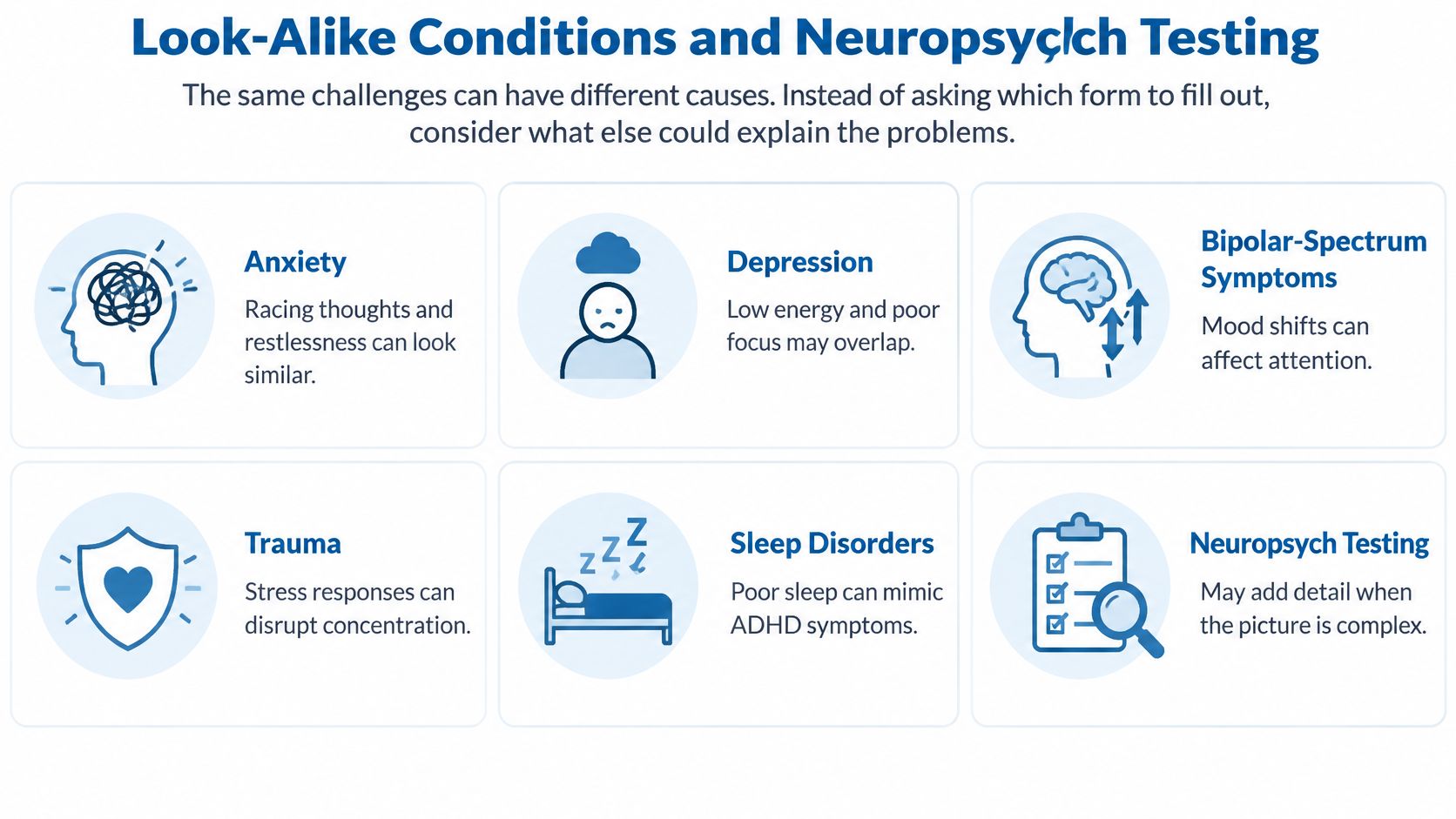
You can have ADHD and still need something else first
ADHD can coexist with another condition. A clinician may recommend treating insomnia, depression, or a bipolar-spectrum illness first or alongside ADHD, depending on symptoms and safety. Treating one condition alone can leave the other untreated. The overlap between ADHD and anxiety is one reason an evaluation should assess both rather than assume one explains everything.
Sleep history matters, too. Short sleep, snoring, and waking unrefreshed can impair focus. If a sleep study has identified apnea, include the next steps after sleep apnea diagnosis in the care discussion before attributing concentration problems only to a psychiatric condition.
When cognitive testing earns its place
A detailed clinical history is central to the assessment. School records, a partner's observations, family reports, or employment history can add context when available. Childhood documents or a parent informant may be missing, including for adults assessed by telepsychiatry in Florida. The clinician can still examine developmental history and current functioning through the interview and other available information.
Neuropsychological testing can help when the history leaves important questions unresolved, when there is concern about the validity of reported symptoms, or when co-occurring conditions make the picture difficult to interpret. It is an add-on, not a routine requirement or a stand-alone ADHD diagnosis. Cognitive test results need to be interpreted alongside the clinical history.
Sleep loss, a medication change, trauma reminders, or a mood episode can all affect concentration on a given day. Mention these factors during the evaluation.
How to Prepare for a Telepsychiatry Assessment
A Florida adult with long-standing trouble meeting deadlines may have years of work and home examples, but no report cards and no parent available to ask. A video visit can still support a careful evaluation. The clinician reviews symptoms, development, daily functioning, mental state, and available information from others. An online questionnaire alone cannot establish a diagnosis. Refresh Psychiatry & Therapy provides HIPAA-compliant telepsychiatry for adults throughout Florida, with intake history collected before the appointment. The practice operates by telemedicine only.
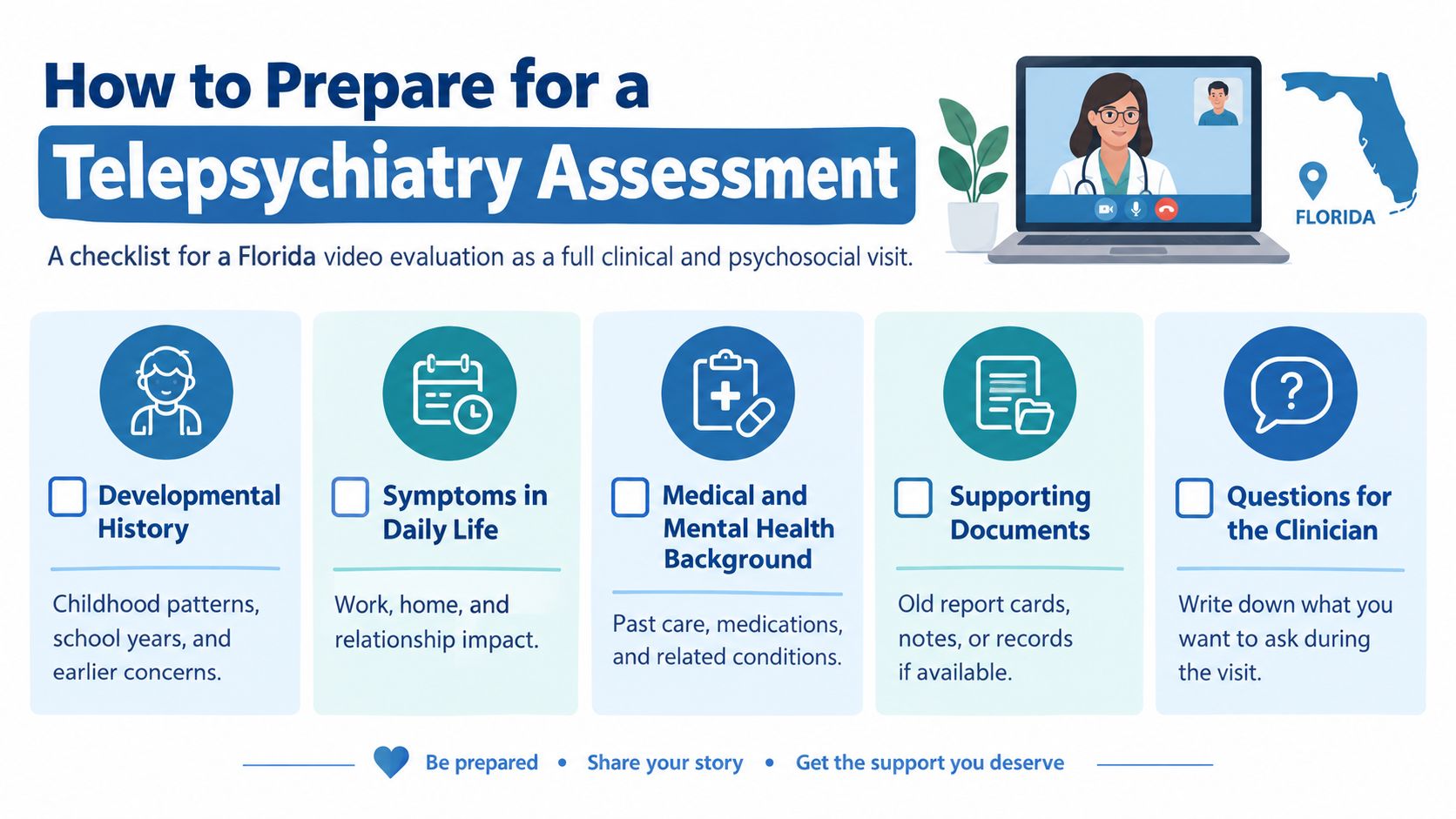
What to gather before you log on
Bring details that show how the problem affects daily life.
Medical list. Current medicines and doses, plus anything you stopped because it made you feel flat or wired.
Care notes. Prior therapy or psychiatry summaries, including records under labels such as anxiety or depression.
Examples from two settings. Describe specific difficulties at work and at home, rather than relying on one poor performance review.
Compensatory routines. Note alarms, body doubling, all-nighters, or a partner who tracks the bills.
A complete archive is not required. Report-card comments, a partner's observations, missed appointments, and the systems you rely on to stay organized can all add context. For details on setting up remote care, see this overview of telemedicine psychiatry.
When the childhood file is empty
Strong grades, missing report cards, or an unavailable parent do not automatically rule out an evaluation. A supportive classroom, high effort, or mostly inattentive symptoms may have made early difficulties less visible. The clinician still needs to assess whether symptoms began in childhood and should explain any uncertainty in the available history.
A screening result is one piece of information, not a verdict. If a parent cannot provide history, work patterns, relationship experiences, and observations from someone who knows you well may help. The assessment should state what the evidence supports and where the record remains limited.
Next Steps After an Adult ADHD Evaluation
A Florida adult may finish a telepsychiatry evaluation with ADHD confirmed, another explanation identified, or a more complex picture that includes both. The clinician should explain what the evidence supports and what remains uncertain. Treatment should follow that assessment, not a standard template.
How the result becomes a plan
Medication may help some adults, while others benefit from starting with therapy, skills-based support, or treatment for sleep or mood concerns. These approaches can also be combined. If key parts of the history remain unclear, the clinician may recommend follow-up or seek additional information before making a diagnosis.
A useful treatment discussion covers expected benefits, possible risks, and how progress will be reviewed. Measures might include missed deadlines, sleep, mood, daily functioning, and medication side effects. The plan can change as the clinician and patient see what helps.
Refresh Psychiatry & Therapy schedules adult ADHD evaluations for people across Florida. Contact the practice or call (954) 603-4081. Accepted plans include Aetna, United Healthcare/UHC, Cigna, Blue Cross Blue Shield, Humana, Tricare, UMR, and Oscar. Self-pay may also be available; costs depend on coverage and visit type.
This article is for informational purposes only and does not constitute medical advice. Consult a qualified mental health professional for guidance specific to your situation.
Refresh Psychiatry & Therapy provides HIPAA-compliant telepsychiatry for adults across Florida, including structured ADHD evaluations that consider history, impairment, and conditions with overlapping symptoms. Childhood records or a parent informant may be unavailable. A clinician can still assess the broader history and explain the limits of the evidence. Visit Refresh Psychiatry & Therapy to schedule an evaluation.