
🧠 ADHD and Gut Health: Evidence and Care

You're halfway through a Florida workday, the task list is still open, and your stomach has felt off since breakfast. The stimulant flattened your appetite, lunch never happened, and a late snack left you foggy in the middle of an email. You can't tell whether the rough day is ADHD, short sleep, skipped meals, or a gut that has been uncomfortable for months.
When Focus Problems and Stomach Symptoms Travel Together
Maya, a college student in South Florida, loses the thread in lectures and spends some evenings managing constipation and a dull ache in her upper stomach. The timing varies: sometimes the discomfort comes first, sometimes the focus problems do. She wonders whether one is causing the other.
Digestive symptoms such as constipation, dyspepsia, irritable bowel symptoms, appetite changes, and difficulty staying with a meal are reported alongside ADHD. The overlap matters because discomfort can affect daily functioning and may complicate medication routines. It does not establish that gut problems cause ADHD.
A large population study found higher odds of functional gastrointestinal disorders among people with ADHD than among matched controls. The study reported increased odds of dyspepsia, chronic constipation, and IBS, without a comparable increase in organic diseases such as inflammatory bowel disease or celiac disease (population study of ADHD and functional gut disorders).
What that comparison can and can't say
The findings show an association, not a cause. Sleep disruption, stress, eating patterns, medication effects, and overlapping behavioral or autonomic factors may contribute to symptoms. Functional symptoms can be distressing, but they are different from diseases involving inflammation or tissue damage.
For a clinical visit, note what changes your sleep, appetite, work or school day, and ability to take medication as prescribed. A plain-language resource on IBS awareness and gut health may help you describe bowel patterns.
Mention digestive symptoms at an ADHD visit when they affect sleep, school, work, appetite, or medication use.
Bring a short record of:
Sleep: nights interrupted by pain, urgency, or late meals.
Meals: skipped meals, grazing, or low appetite during a stimulant's active hours.
Bowels: constipation, upper-stomach discomfort, or IBS-type symptoms, including how often they occur.
Anxiety: whether worry coincides with changes in focus or gut symptoms. A clinician can assess ADHD and anxiety together.
A coordinated assessment can help identify what needs treatment. Avoid assuming that every stomach symptom is a medication side effect, or that gut symptoms explain ADHD.
How the Gut and Brain Stay in Conversation
Think of ADHD and gut health as traffic between two cities. The brain and the intestine send messages both ways. Nerves, immune messages, and chemical notes from microbes are the lanes. A jam in one lane can slow mood, appetite, or attention without proving that lane built the diagnosis.
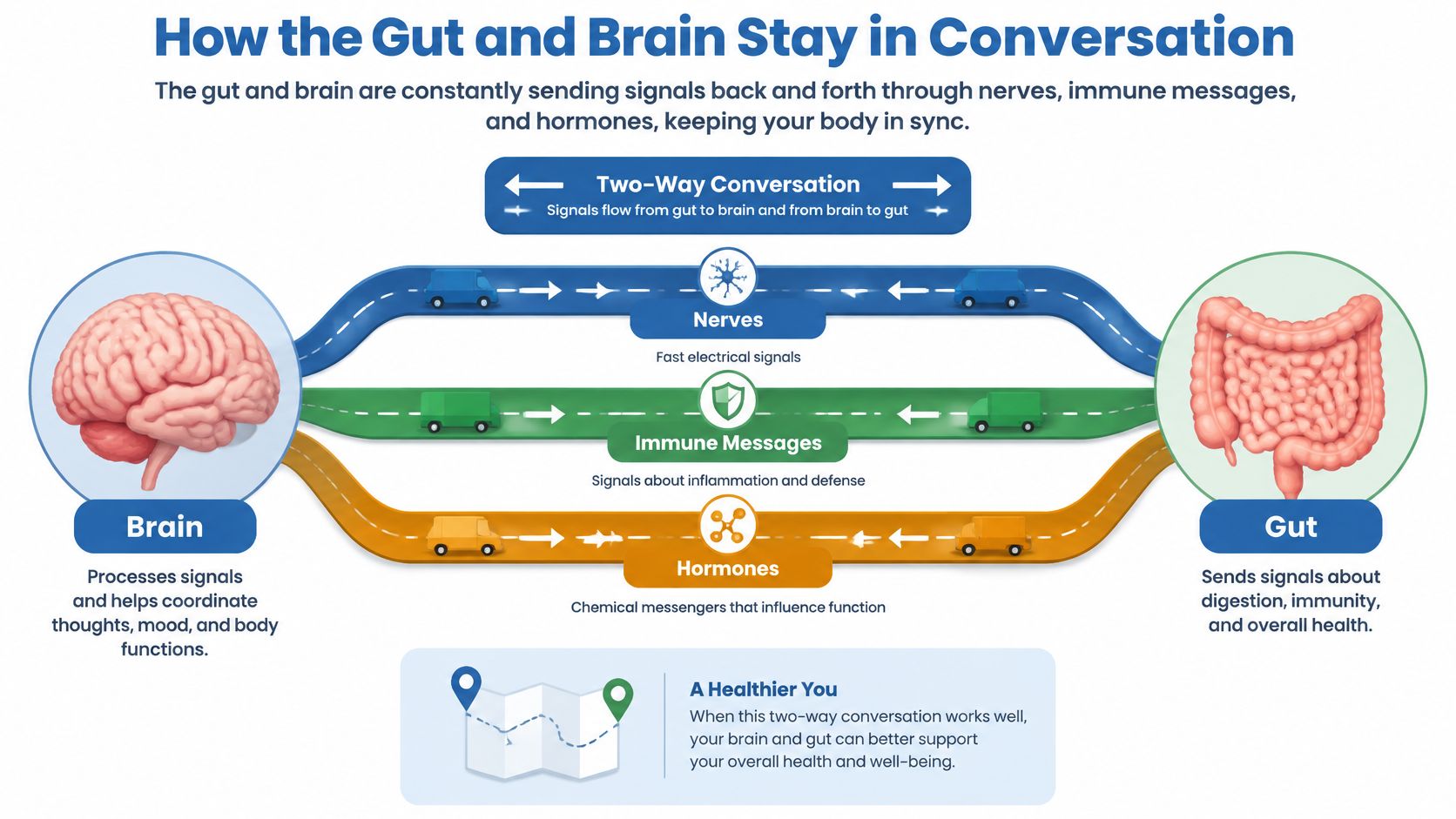
Three lanes, not a bacteria list
Nerves are the fast lane. The vagus nerve carries rapid signals about stretch, fullness, and threat. A tense day can change motility. A bloated afternoon can make concentration harder.
Immune messages move more slowly. The gut lining talks to immune cells all day. Stress, poor sleep, and irregular meals can shift that tone. You feel it as discomfort, low energy, or a shorter fuse, not as a lab value you can diagnose yourself from.
Microbial metabolites are the chemical notes. When microbes ferment fiber, they produce short-chain fatty acids. Those compounds help the barrier and immune signaling. They are interesting biology. They are not a prescription for ADHD.
Sleep loss, stress, skipped meals, and stimulant-related appetite changes can alter that traffic. Any of those can change what you eat and how your bowels behave. None of them, by itself, proves a single lane causes ADHD.
Practical rule: A gut finding can matter for daily functioning even when it isn't the cause of ADHD.
A clinician asks about bowels, diet, and sleep because those lanes change energy, medication timing, and whether you can stay with a plan. You don't need a microbiome lecture to answer. You need a recent week of meals, stools, and nights.
Marketed products such as vegan gut-brain support from Yuve sit beside this science as nutrition marketing. Treat them as optional products to discuss, not as proof that a capsule retunes attention.
A short clinical explainer makes the two-way traffic easier to picture before you sort headlines from data.
In one or two sentences: the gut and brain keep a two-way conversation through nerves, immune signals, and fiber-related metabolites, so bowel habits belong in an ADHD visit even when they don't explain the diagnosis.
What ADHD and Gut Health Studies Actually Found
Headlines often promise a unique ADHD microbiome. The studies underneath don't support a signature you could diagnose from a stool kit.
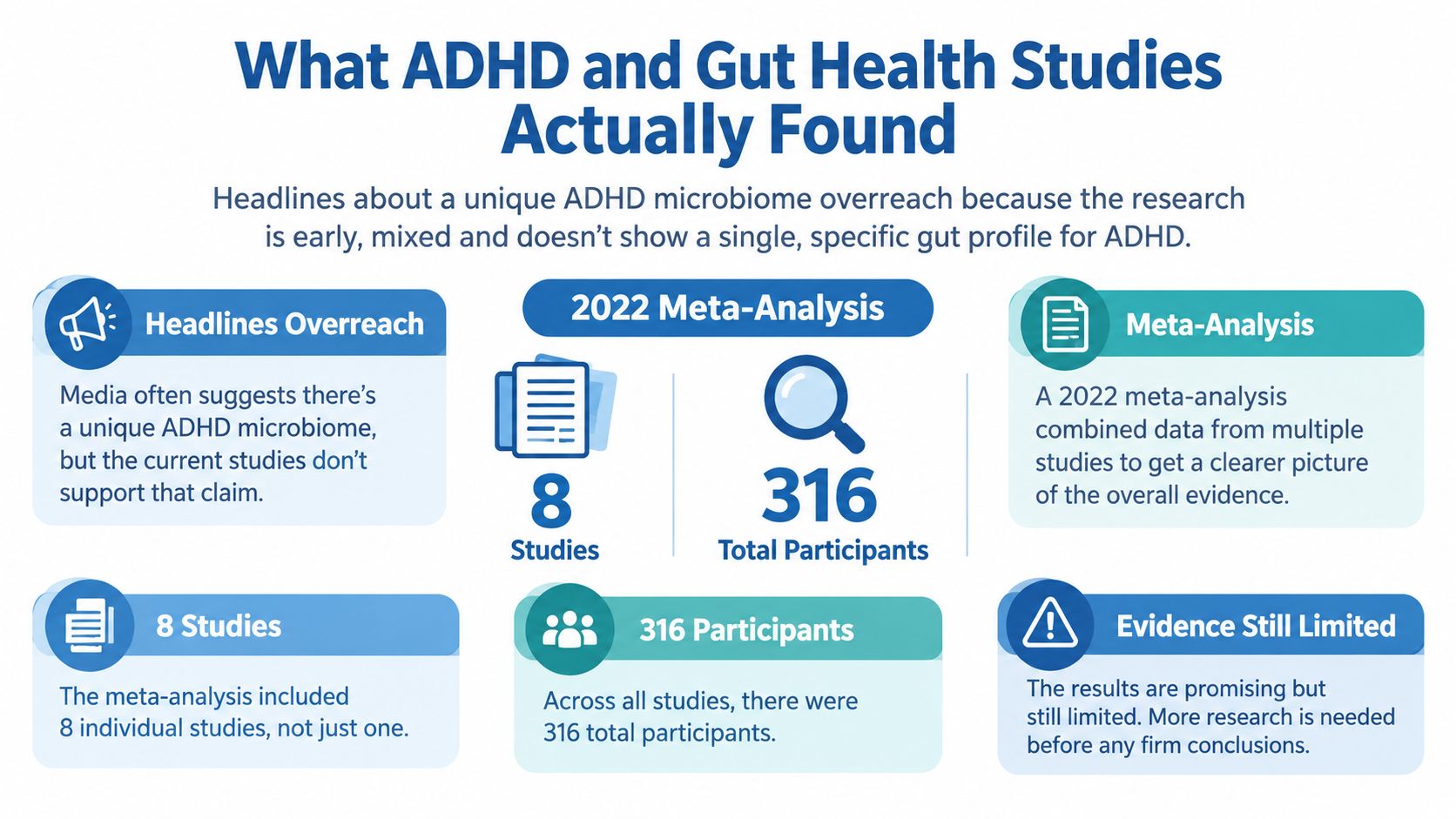
The diversity result that faded
A 2022 meta-analysis pooled 8 studies, 316 children with ADHD, and 359 neurotypical controls. ADHD participants showed higher Shannon diversity at first (SMD 0.97, 95% CI 0.13–1.82, p = 0.02). That link disappeared on sensitivity analysis because between-study heterogeneity was extreme (I² = 96%). The genus finding that stayed significant was increased Blautia (SMD 0.34, 95% CI 0.06–0.63, p = 0.02, I² = 0%), according to this meta-analysis of the pediatric ADHD microbiome.
Alpha diversity is how many species are present and how evenly they are spread. Beta diversity asks whether the overall community looks different between groups. A higher Shannon number is not a diagnosis. A single genus that survives one analysis still isn't a treatment target.
Why the pictures don't match
Patterns shift with age, diet, geography, medication exposure, sequencing methods, and study design. One lab's "ADHD microbiome" is another lab's noise.
Association: functional gut symptoms are more common, as the population data already showed.
Fragile signal: the Shannon difference didn't hold once heterogeneity was taken seriously.
Not a target: more Blautia doesn't tell you what to eat, which probiotic to buy, or whether medication should change.
There is no stool test that diagnoses ADHD. Microbiome testing shouldn't replace a clinical evaluation, and changing Blautia isn't an evidence-based treatment. Observational differences also can't show that dysbiosis causes ADHD.
Use this as an evidence filter. If a claim needs one genus to explain attention, it has outrun the data.
Plausible Routes From Microbes to Attention
A child with ADHD may have constipation, poor sleep, and trouble concentrating on the same day. Those symptoms can interact, but current research has not shown that changing gut microbes treats core ADHD symptoms.
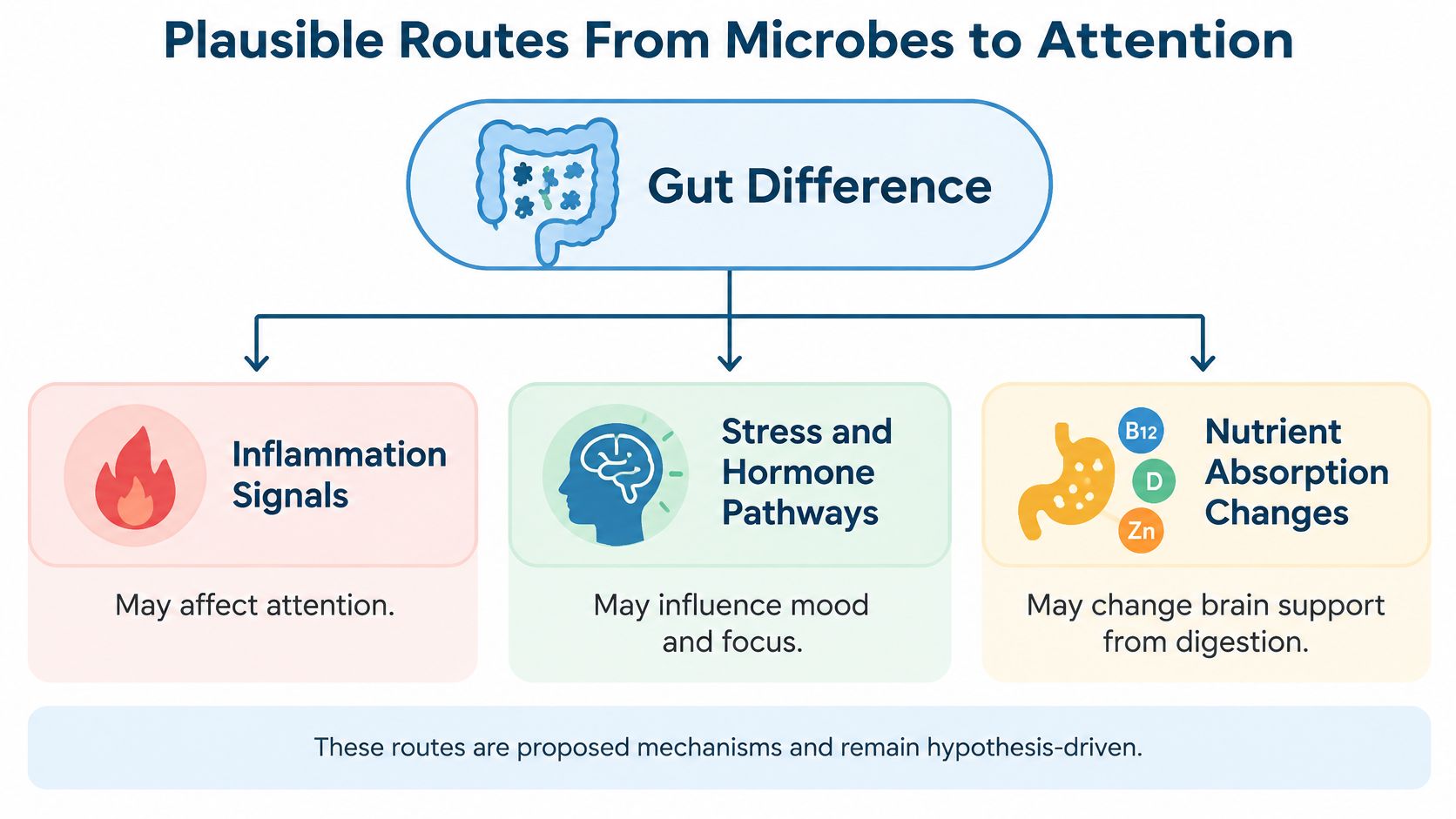
Researchers have proposed several biological routes between gut microbes and brain function. Microbial metabolites, including short-chain fatty acids, can affect the intestinal barrier and immune signaling. Those processes may influence physical comfort and, indirectly, how someone feels and functions. The steps from a specific microbe to a change in attention remain unproven.
Three routes researchers are examining
Barrier and immune signaling. Microbial products may influence the gut lining and immune activity. If a digestive condition causes pain or discomfort, addressing it may help with sleep, mood, or daily functioning. That is different from treating ADHD itself.
Butyrate-related activity. Some gut bacteria produce short-chain fatty acids such as butyrate. Researchers have suggested that differences in these bacteria could relate to gut-barrier function and inflammation. A stool result cannot establish that a person has increased intestinal permeability or identify a treatment.
Dopamine-related pathways. The gut and brain communicate through several routes, including chemical and nerve signaling. Researchers have proposed that microbes might influence dopamine-related processes, but this remains a research question, not a reason to target a particular bacterium with a supplement.
The 2022 review discussed associations involving Enterococcus, Bifidobacterium, Odoribacter, Faecalibacterium, and other groups, as summarized in this review of gut bacteria in ADHD. These findings do not establish that any one organism causes ADHD or should be increased or reduced.
Products marketed for focus may draw on these proposed pathways. You can browse Zenwise focus supplements, but a focus-related label does not show that a product improves ADHD symptoms.
Medication can affect appetite and meal timing, which may change how comfortable someone feels day to day. For a separate explanation of how stimulant medication helps ADHD, keep its established treatment effects distinct from gut-microbe hypotheses.
If you test a gut intervention for a specific symptom, track that symptom and any side effects. Agree on a review point with your clinician, and stop or reassess if there is no clear benefit or the intervention makes eating, digestion, or medication routines harder.
Food Habits That Help and Claims That Do Not
A breakfast you can repeat is more useful than a restrictive reset. Try oatmeal with berries and peanut butter, or eggs with fruit and whole-grain toast. Pair the meal with water, then notice whether it affects stomach comfort, appetite, or your medication routine.
Regular meals, fiber-containing foods, enough fluid, and appropriate care for constipation can support digestion and day-to-day functioning. They are not established treatments for core ADHD symptoms.
What the trials allow you to say
A 2025 systematic review found only three randomized controlled trials among 3,591 records. Probiotics and synbiotics showed possible benefits for gastrointestinal symptoms, inflammatory markers, and emotional dysregulation, but a reliable effect on core ADHD symptoms has not been established. A separate 2025 review of 13 trials and about 800 participants concluded that probiotic treatment alone should not replace standard ADHD care, as described in this review of microbiota modulation in ADHD.
Approach | Reasonable goal | Do not claim |
|---|---|---|
Fiber, fluids, and a steady meal pattern | More comfortable bowel habits and fewer meal-related energy dips | That breakfast structure treats core ADHD symptoms |
A probiotic discussed with a clinician | Possible improvement in gut comfort or emotional regulation for some people | That it reliably changes core ADHD symptoms or replaces medication and therapy |
Cutting gluten, dairy, or sugar for everyone | A targeted evaluation when symptoms suggest an intolerance or medical condition | A universal ADHD gut reset or cure through elimination |
If you test a change, track gastrointestinal comfort, sleep, appetite, emotional regulation, and an ADHD rating your clinician already uses. A brief diary can record the time, meal, bowel symptoms, and one note about focus. Give the change a defined trial period, then stop if it brings no meaningful benefit, costs too much, or makes it harder to get adequate nutrition.
Food supports brain function in ordinary ways. A broader explanation of how nutrition relates to the brain is more useful than a detox promise. Gut-focused care can support comfort and daily routines alongside ADHD treatment; it has not been shown to replace that treatment.
When Digestion Restrictive Eating or Medication Needs a Clinician
A person taking a stimulant may skip lunch because food feels unappealing, then face constipation, evening hunger, and poor sleep. That pattern can affect daily functioning, but it does not show that food caused ADHD or that a gut intervention will treat its symptoms.
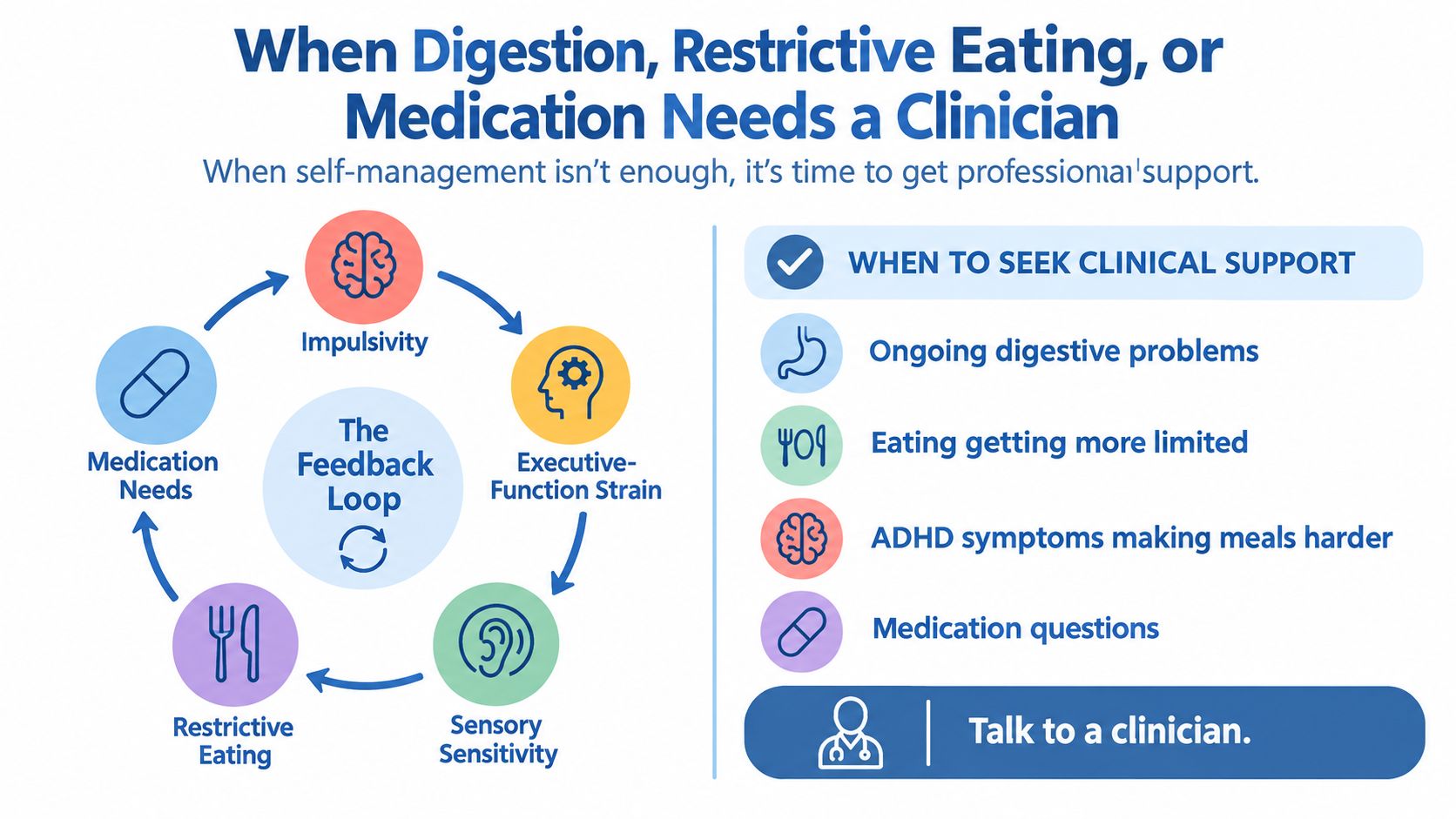
Why a generic reset is the wrong default
A 2025 clinical review found that probiotics reduced gastrointestinal symptoms in one analysis, while trial data showed no significant differences in dietary intake, sleep patterns, or eating and activity habits (2025 clinical review). That finding may support trying a probiotic for gut comfort with clinical guidance. It does not establish that probiotics treat ADHD symptoms or justify a broad gut protocol.
Seek medical evaluation for persistent pain, blood in stool, unexplained weight loss, anemia, severe constipation, or fear of eating. These symptoms need assessment rather than another dietary restriction.
Bring a short record: Note meals, bowel symptoms, sleep, appetite, and medication timing across a typical week.
Assess nutritional risk: A very limited diet, low fiber intake, or falling weight warrants review by a clinician or dietitian.
Describe sensory barriers: Strong texture or smell aversions can make eating difficult. If food choices have become extremely narrow or frightening, learn about ARFID in adults and discuss the pattern with a clinician.
Review medication effects: Appetite suppression may call for a medication review. Bleeding, anemia, or persistent pain needs medical evaluation.
Primary care and psychiatry can coordinate around the same symptoms and medication history. That keeps digestive problems from becoming an assumed explanation for ADHD.
A coordinated care team can address medication and therapy alongside eating concerns. Treatment may include CBT, DBT, psychodynamic, or trauma-focused therapy, with telepsychiatry available to patients across Florida. The goal is a plan based on the person's symptoms and needs, not a promise that a probiotic will change ADHD.
A Practical Next Step for ADHD and Gut Health
A workday can unravel when a stimulant suppresses lunch, constipation causes pain, and poor sleep makes attention harder the next morning. Track those effects as part of day-to-day functioning, while keeping ADHD diagnosis, medication decisions, and psychotherapy with qualified clinicians. Gut care can ease digestive or emotional strain, but evidence does not show that changing the microbiome treats core ADHD symptoms.
What to ask for in the evaluation
Bring a typical week of observations to the appointment. Include meals, bowel movements, sleep, appetite, and medication timing. Ask the clinician to review digestion, eating patterns, and all medicines, including stimulants and over-the-counter bowel remedies.
Be clear about the trade-offs. What did you hope a probiotic or diet would improve? Did it cause cost, stress, reduced food variety, or worse symptoms? Agree on one or two outcomes to track, such as pain, stool frequency, appetite, or sleep. If there is no meaningful benefit after an agreed trial, or eating becomes more restrictive, stop the intervention and discuss another approach.
Keep evidence-based ADHD care in place while digestive symptoms receive their own assessment. A consultation with an ADHD psychiatrist can help coordinate questions about attention, medication, and daily functioning.
For Florida telemedicine appointments, call (954) 603-4081. The practice accepts Aetna, United Healthcare/UHC, Cigna, Blue Cross Blue Shield, Humana, Tricare, UMR, and Oscar insurance plans.
This article is for informational purposes and is not medical advice. Consult a qualified mental health professional for guidance suited to your needs.