
💊 Antidepressant Myths Debunked with Facts

💊 Antidepressant Myths Debunked with Facts
You finally book a psychiatry appointment, then spend the night reading posts that say antidepressants are fake, addictive, personality-changing, impossible to stop, or pushed on anyone who feels sad. By morning, you're more anxious than before you started searching.
That kind of confusion is common. One friend says medication gave them their life back. Another says it numbed them. A headline says withdrawal is overblown. Another says it's ignored. Social media tends to flatten everything into extremes, and mental health treatment rarely works in extremes.
If you're in Florida and considering telepsychiatry, this uncertainty can feel even more personal because the decision often happens at home, between work messages, parenting duties, classes, and one more night of poor sleep. You're not just asking, “Are antidepressants good or bad?” You're usually asking something more practical: What will this feel like for me, what should I watch for, and when should I call my prescriber?
Antidepressant myths stick around because they often contain a grain of truth wrapped in an all-or-nothing conclusion.
Some antidepressants help many people and cause side effects for some. Stopping too fast can cause symptoms, but that doesn't mean everyone will have severe withdrawal. SSRIs can help depression, but that doesn't prove depression is just a serotonin shortage. Nuance matters here.
The good news is that we do have useful evidence. We can talk clearly about what antidepressants likely do in the brain, what the major treatment trials found, what early side effects often look like, and how to stop safely if a medication isn't right for you or it's time to come off.
Introduction Why Antidepressant Myths Persist Today
A patient might tell me, “I was ready to try medication until I saw videos saying antidepressants are basically sugar pills.” Another says, “I'm scared to start because I heard once you take them, you can never stop.” A parent may ask, “Will this change my teenager's personality?” These aren't irrational fears. They're what happen when people try to make a careful medical decision in a noisy information environment.
Part of the problem is that people often mix up different questions. “Do they work?” is one question. “How long do they take?” is another. “Can stopping them cause symptoms?” is another. Online, those separate issues get collapsed into one dramatic takeaway.
Why people get pulled into myths
Anecdotes are powerful because they feel concrete. If your cousin had a rough time on paroxetine, that story lands harder than a journal abstract. But one person's experience can't answer whether a medication class works overall, which side effects are common, or what a safer taper looks like.
There's also a trust problem. Some people grew up hearing the old “chemical imbalance” story and later learned it was too simplistic. That can leave them feeling misled, and then every claim about antidepressants starts to sound suspicious.
Key idea: Mistrust grows when medicine gets oversimplified. Better explanations usually reduce fear more than reassurance alone.
The decision points that matter most
Most patients don't need a generic myth list. They need help with decisions like these:
Starting: What should I expect in the first few weeks?
Monitoring: Which side effects are annoying but manageable, and which deserve a call?
Continuing: If I feel somewhat better, should I stay the course?
Stopping: How do I tell withdrawal from relapse?
Family questions: If my child or teen is prescribed an antidepressant, what should I be tracking at home?
That's the lens worth using. Antidepressant myths aren't just ideas to argue about. They shape real choices about whether someone starts treatment, sticks with it long enough to judge fairly, or stops in a way that creates avoidable misery.
How Antidepressants Actually Work in the Brain
Many people were taught a clean, catchy explanation: depression equals low serotonin, and antidepressants fix the shortage. It's understandable. It's also incomplete.
Antidepressants are better understood as brain-state modifiers, not as simple nutrient replacement. They influence signaling systems that affect mood, stress response, attention, sleep, and the brain's ability to adapt over time.
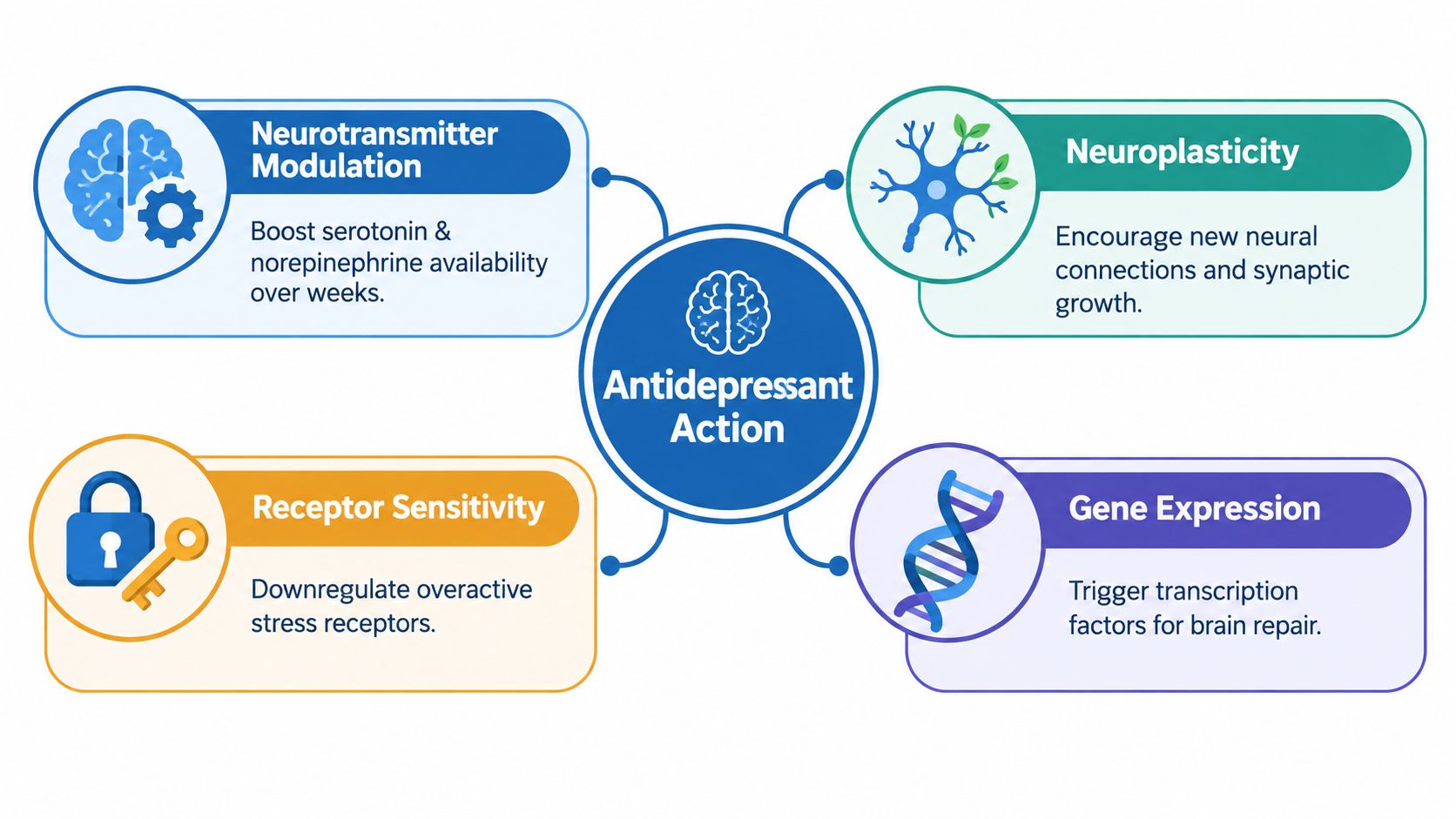
Think dimmer switch, not light switch
SSRIs and related medications don't usually create an instant emotional flip. A better analogy is a dimmer switch. They gradually change how certain brain circuits regulate emotional intensity, threat sensitivity, and recovery from stress.
In practical terms, that may mean:
crying less easily
getting stuck in worry loops less often
having enough energy to re-engage with daily tasks
feeling less overwhelmed by the same stressors
That doesn't mean the medication “manufactures happiness.” It may lower the volume on symptoms that were drowning out your usual personality.
Why the chemical imbalance story is too simple
A major review of the serotonin hypothesis found no consistent evidence that depression is caused by low serotonin and no clear evidence that SSRI potency tracks antidepressant efficacy, which means SSRI benefit doesn't prove a simple chemical-imbalance model (serotonin hypothesis review).
That's an important correction, but it doesn't mean antidepressants are fake. It means mechanism and cause aren't the same thing. Aspirin can help a headache without proving all headaches come from one single cause.
For a broader plain-language explanation of how brain messengers differ, this dopamine vs serotonin guide can help.
What else may be happening
Researchers also think antidepressants may influence neuroplasticity, which is the brain's ability to form and strengthen connections. That matters because depression often feels rigid. The same thoughts, the same hopeless predictions, the same inability to shift gears.
Other likely effects involve:
Stress circuitry: Some medications may reduce overactive stress signaling over time.
Receptor adaptation: The brain often adjusts gradually to repeated changes in neurotransmitter availability.
Behavioral opening: When symptoms ease even slightly, people often sleep better, move more, reconnect socially, and benefit more from therapy. Those changes can reinforce recovery.
The big takeaway is simple. Antidepressants don't prove depression is a one-chemical disease. They may help because they alter several systems involved in mood regulation, and each person's response can differ.
The Most Common Antidepressant Myths and What Evidence Shows
Let's tackle the myths patients ask about most often, but through the lens that matters in a clinic: what should this claim mean for your actual decision?
A large 2018 network meta-analysis looked at 522 randomized trials with 116,477 participants and found that all 21 commonly used antidepressants were more effective than placebo for acute major depression. Response odds ratios ranged from 1.37 for reboxetine to 2.13 for amitriptyline, and the review also found antidepressants were generally acceptable to patients, with acceptability odds ratios ranging from 0.64 to 0.83 across drugs (BMJ meta-analysis on antidepressant efficacy and acceptability).
That doesn't mean every antidepressant works for every person. It does mean the blanket claim that antidepressants are “just placebos” doesn't fit the trial record.
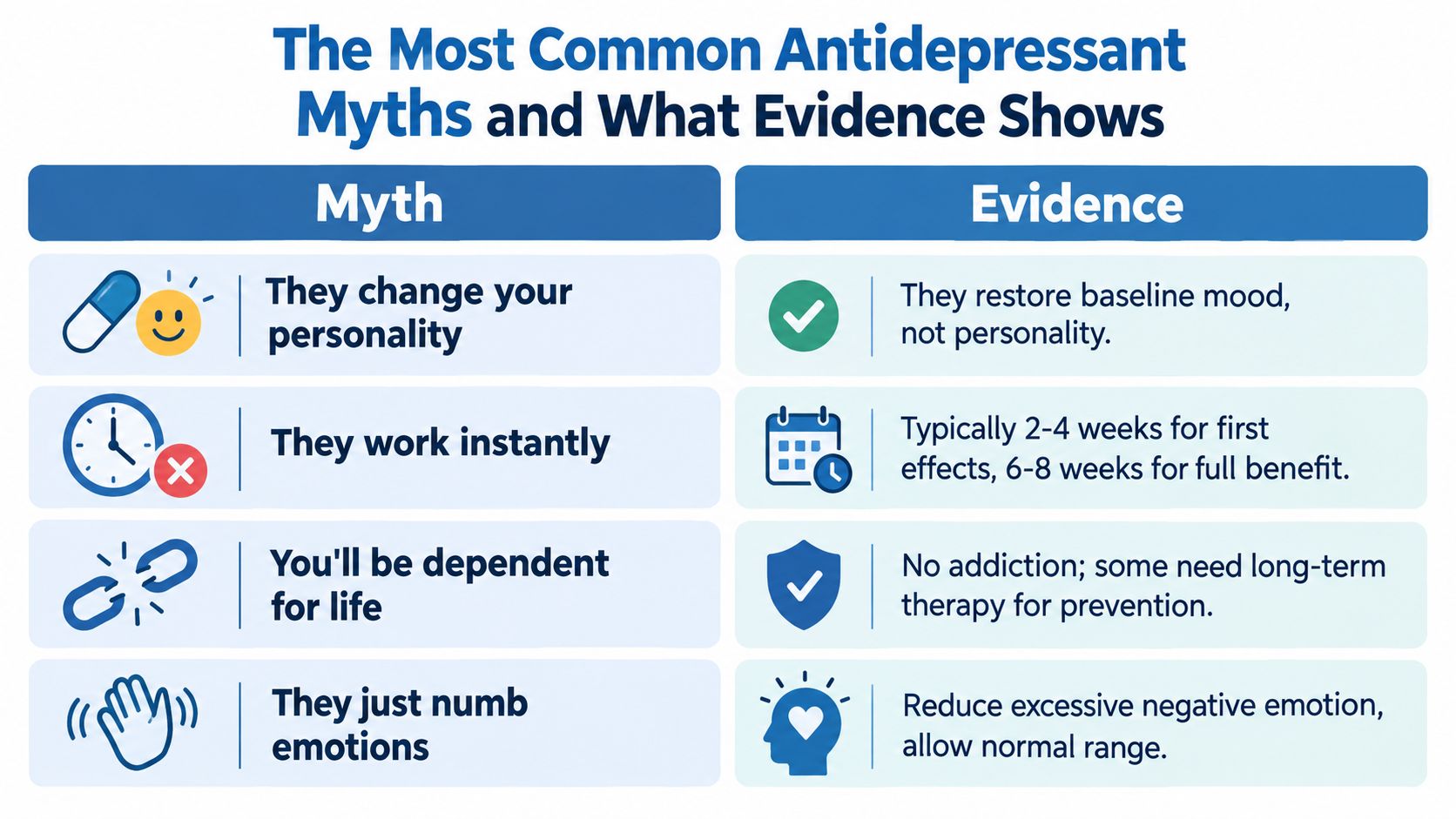
Antidepressant myths vs evidence at a glance
Common Myth | What Evidence Shows |
|---|---|
Antidepressants are no better than placebo | Large trial syntheses found antidepressants outperform placebo for acute major depression |
They work immediately | They don't act like pain medicine. Benefits usually build gradually |
They're addictive | They can cause discontinuation symptoms, but that's different from addiction |
They change your personality | Most patients describe symptom relief, not becoming a different person |
They're universally intolerable | Tolerability varies by medication and by person |
Myth 1 They're basically sugar pills
A related review of 122 placebo-controlled trials found a pooled responder-rate risk ratio of 1.42 for antidepressants versus placebo (historical review of antidepressant efficacy). The same review discussed concerns about biased reporting in some FDA trials, but later large meta-analyses that included unpublished data still found antidepressants superior to placebo.
That's the key nuance. The effect isn't magic, and it isn't huge for everyone. But it's also not placebo-only.
Here's a short video explanation many patients find helpful before a first appointment:
Myth 2 If they work, they should work right away
This myth causes a lot of premature quitting. Antidepressants don't usually give an immediate “I feel better” signal. Often the earliest changes are subtle, like sleeping a bit more consistently, crying less often, or feeling less physically agitated.
If nothing dramatic happens in the first several days, that doesn't mean the medication has failed. It often means your brain is still adapting.
Myth 3 They're addictive
Patients often use “addictive” to mean one of three different things: craving, needing higher and higher doses for a high, or feeling sick when stopping. Those are not the same. Antidepressants are not typically used for intoxication or reward in the way addictive drugs are, but some people can have real discontinuation symptoms if they stop abruptly.
That's why “not addictive” shouldn't be translated into “effortless to stop.” It's more accurate to say they may require a thoughtful taper.
Myth 4 They will make me less like myself
When antidepressants help, people don't describe becoming strangers to themselves. They describe getting access to themselves again. The concern becomes more relevant if a person feels emotionally flat, unusually detached, or dulled. That's not a reason to panic. It's a reason to report the change and reassess dose, diagnosis, timing, or medication choice.
What to Realistically Expect From Benefits Risks and Timelines
Patients often feel discouraged because they expect one big moment of improvement. More often, recovery arrives in small pieces. You answer texts sooner. You shower without arguing with yourself first. You don't dread the evening in the same way. Those shifts count.
The first month is usually about two things at once: watching for early side effects and looking for early signs of benefit, even if they're modest.
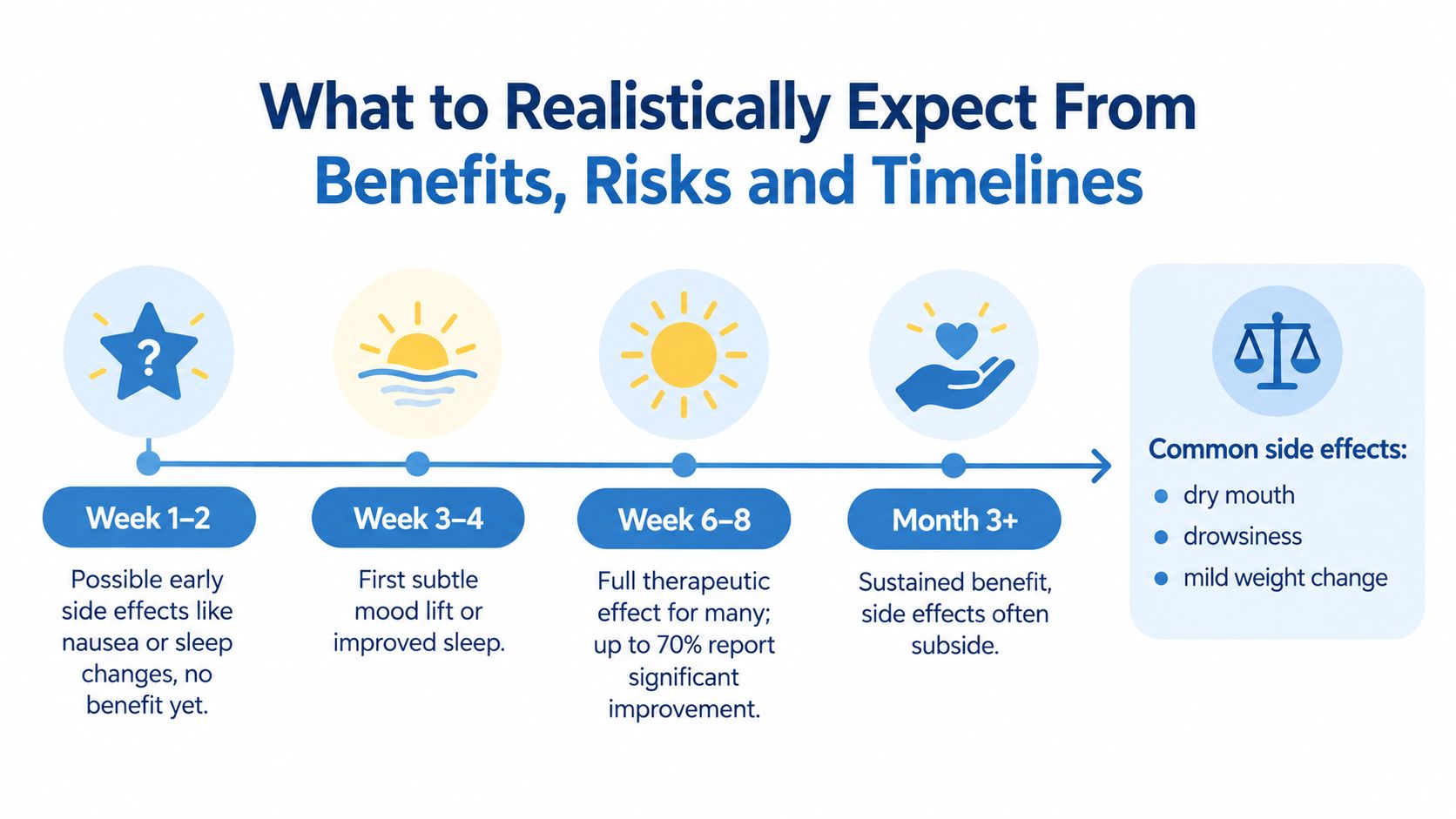
What the early weeks often feel like
Some people notice stomach upset, headache, sleep changes, or jitteriness before they notice emotional improvement. That sequencing can be frustrating because it creates the impression that the medication is “doing side effects but not doing the job.” In clinic, that's a very common conversation.
A practical way to think about it is this:
Early phase: Your body notices the medication before your mood fully does.
Middle phase: Symptoms may soften around the edges rather than disappearing.
Later phase: You and your prescriber judge whether the medication is helping enough, needs adjustment, or should be changed.
What improvement often looks like
Improvement doesn't always feel like happiness first. It may look more like:
Less friction: Routine tasks feel a little less impossible.
More range: You still get sad or anxious, but you're not pinned there.
Better recovery: Stress still hits, but you bounce back faster.
More participation: Therapy, exercise, work, and relationships become easier to engage with.
If you're wondering how long people generally stay on treatment once it starts helping, this guide on how long you should take antidepressants covers the bigger picture.
Practical rule: Don't judge an antidepressant only by how you feel on a single bad day. Look for trends across several weeks.
When to call your prescriber
Don't wait if something feels off. Reach out if:
Side effects feel hard to tolerate: especially if they're disrupting sleep, appetite, or daily functioning.
Your mood worsens: including increased hopelessness, agitation, or any safety concerns.
You stop taking it for several days: restarting isn't always as simple as picking up where you left off.
You feel emotionally blunted: not every “numb” feeling means the medication is wrong, but it deserves discussion.
A lot of antidepressant myths survive because people expect a straight line. In reality, treatment often involves adjustment. The goal isn't perfection on day ten. The goal is a thoughtful, monitored trial long enough to be fair, but not so long that a poor fit drags on unnecessarily.
Stopping Safely How to Recognize and Manage Discontinuation Symptoms
Stopping an antidepressant is its own clinical decision. It shouldn't be treated like tossing out an antibiotic bottle once you feel better.
An American Academy of Family Physicians evidence review reports that antidepressant discontinuation syndrome occurs in about 20% of patients after abrupt discontinuation of an antidepressant taken for at least six weeks, and describes symptoms such as flu-like symptoms, insomnia, nausea, imbalance, sensory disturbances, and hyperarousal (AAFP review of antidepressant discontinuation syndrome). A separate NIH review notes that symptoms usually begin within two to four days after cessation and usually last one to two weeks, and summarizes the FINISH mnemonic for that same symptom cluster (NIH review on recognition and management of discontinuation syndrome).
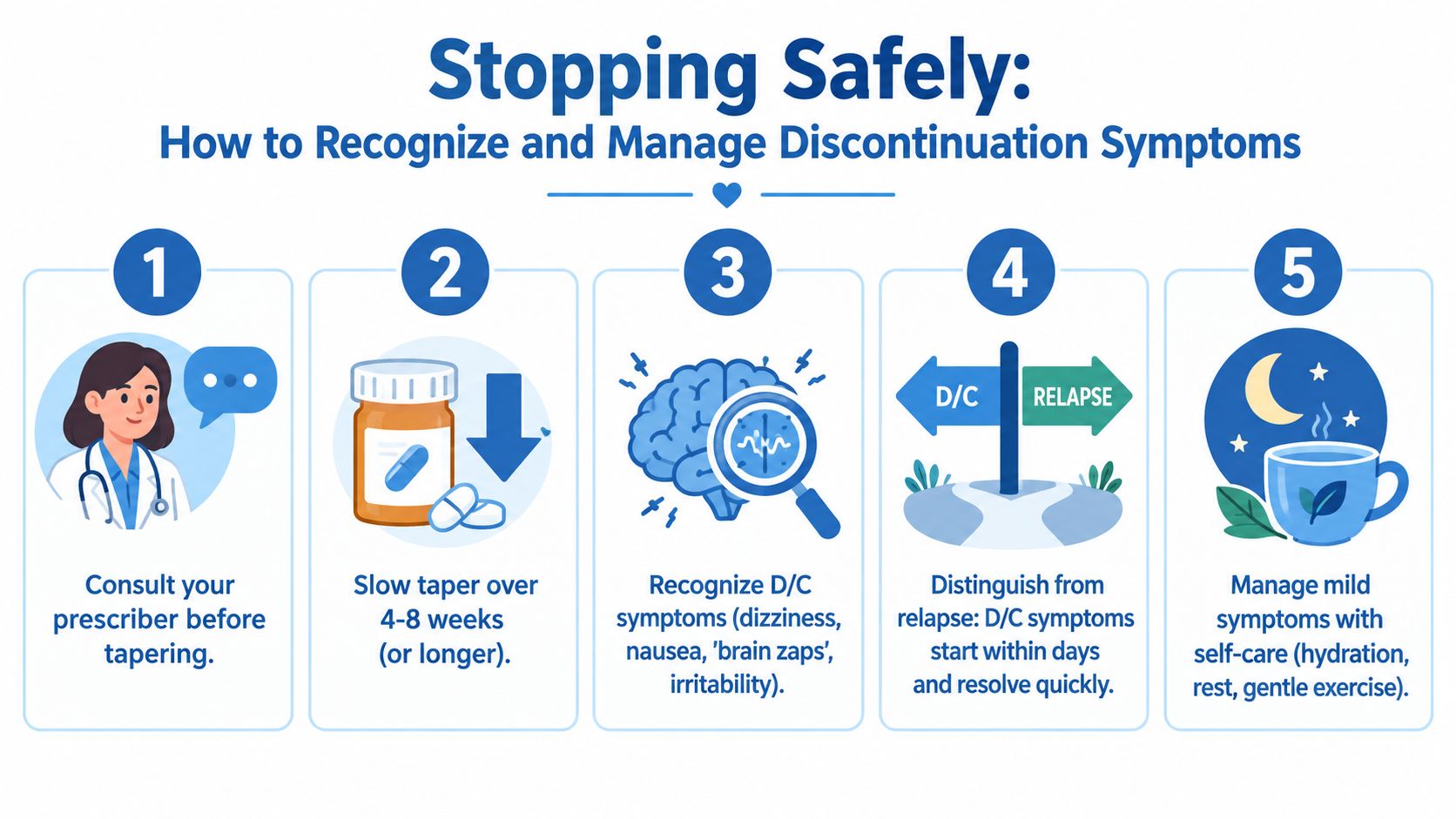
How to tell discontinuation from relapse
Many patients get confused. If you stop a medication and feel bad a few days later, it's easy to assume your depression has returned. Sometimes that's true. Sometimes it isn't.
Clues that suggest discontinuation symptoms include:
Fast timing: symptoms start within days of stopping or cutting down
Physical sensations: dizziness, nausea, imbalance, or “brain zaps”
Short pattern: symptoms often improve over a shorter window than a true depressive recurrence
Relapse tends to look more like the return of your original depressive pattern over time, rather than a sudden burst of unfamiliar physical symptoms.
What newer evidence adds
A 2024 systematic review and meta-analysis in The Lancet Psychiatry estimated that about one in six to seven patients, or roughly 15%, has pharmacologically caused antidepressant discontinuation symptoms after stopping antidepressants, found that dizziness was the most common symptom, and estimated that about one in 35 patients is likely to experience severe symptoms (Lancet Psychiatry meta-analysis on discontinuation symptoms00133-0/fulltext)).
That's a useful corrective to two opposite myths. One myth says withdrawal never happens. The other says severe withdrawal happens to everyone. Neither is accurate.
A separate 2024 meta-analysis found the average discontinuation burden was about one extra symptom at week 1, with a standardized mean difference of 0.31 and higher odds of symptoms like dizziness, nausea, vertigo, and nervousness, while the mean symptom count stayed below the threshold for clinically significant discontinuation syndrome in those studies (2024 systematic review and meta-analysis on antidepressant discontinuation).
What safe stopping usually requires
The right taper depends on the medication, dose, how long you've taken it, and what happened during past dose changes. That's why generic internet advice is risky.
Call before stopping: Don't make a sudden change because you had one rough day.
Track timing carefully: Write down when symptoms start after any dose reduction.
Know your pattern: If you want a deeper patient guide, this article on how long antidepressant discontinuation syndrome lasts explains common timelines in plain language.
Get urgent help if needed: Severe distress, suicidal thinking, or functional collapse deserves prompt professional attention.
If symptoms show up within days of stopping and include dizziness, nausea, imbalance, or sensory oddness, think discontinuation first and call your prescriber.
Special Considerations for Children Adolescents and Families
When the patient is a child or teenager, antidepressant myths don't just affect one person. They ripple through the family. One parent may worry medication will “label” their child. Another may worry refusing treatment means letting symptoms grow.
That's why youth treatment needs a more developmentally specific approach. A teen with depression isn't just a smaller adult. School stress, sleep schedule, social media exposure, bullying, family dynamics, identity development, and attention problems can all shape how symptoms show up and how treatment should be monitored.

What families should watch for
Parents often focus on one question: “Is the medicine working?” A better set of questions is broader.
Watch for changes in:
Daily functioning: getting out of bed, hygiene, school attendance, homework completion
Emotional expression: less tearfulness, less irritability, fewer shutdowns
Behavioral shifts: agitation, impulsivity, withdrawal from friends, conflict at home
Body rhythms: sleep, appetite, and energy
Family observation matters because kids and teens may not report changes clearly. Some minimize symptoms. Others struggle to put internal experiences into words.
Why communication matters so much
Good youth care usually works best when the psychiatrist, therapist, family, and sometimes school are aligned. That doesn't mean a child loses privacy. It means adults share enough information to notice meaningful patterns early.
A misconception survey from Al-Madinah found that misunderstandings remain common, including beliefs that depression resolves on its own, that antidepressants work immediately, and that they cause addiction (survey on misconceptions about antidepressants). Those beliefs can easily shape family decisions and adherence.
If your child or teen needs a specialty evaluation, this pediatric psychiatrist guide explains what that care involves and what questions to ask.
Next Steps Talking With Your Psychiatrist and Accessing Care in Florida
A good psychiatric evaluation isn't about being talked into medication. It's about getting a careful history, clarifying what symptoms you're having, reviewing prior treatment, discussing options, and making a plan for follow-up. Sometimes that plan includes an antidepressant. Sometimes it includes therapy first. Often it includes both.
For Florida patients using telepsychiatry, preparation helps. Bring a list of current medications, past psychiatric medications, side effects you've had before, family history if you know it, and your main questions. Ask directly: What benefits should I watch for? What side effects matter? When should I message or call? What would tapering look like if this isn't a fit?
At a practice like Refresh Psychiatry & Therapy, care may include medication management plus therapy approaches such as CBT, DBT, psychodynamic therapy, and trauma-focused work, which can be especially helpful when symptoms are tied to stress patterns, trauma, or relationship difficulties. If you're comparing providers, this guide on how to find a psychiatrist is a practical place to start.
Patients who want to read more about how mental health information is explained online may also find these Sight AI healthcare content insights useful for understanding why clear, trustworthy education matters so much in healthcare.
Contact us or call Refresh Psychiatry at (954) 603-4081 to schedule your evaluation. We accept Aetna, United Healthcare/ UHC, Cigna, Blue Cross Blue Shield, Humana, Tricare, UMR, and Oscar insurance plans.
This blog is for informational purposes only and does not constitute medical advice. Please consult a qualified mental health professional for personalized guidance.
If antidepressant myths have left you stuck between fear and indecision, a thoughtful evaluation can make the picture much clearer. Refresh Psychiatry & Therapy offers psychiatric evaluations, medication management, therapy, and telepsychiatry across Florida, with support for adults, children, adolescents, and families who want a careful plan for starting, monitoring, or safely tapering treatment.