
🌿 Persistent Depressive Disorder Treatment: A 2026 Guide

Some people live with depression for so long that it stops feeling like an illness and starts feeling like identity. They say, “I've always been this way,” or “I'm just a low-energy person.” By the time they seek care, they're often still functioning on paper, but everything takes too much effort.
That's the group I think about when I talk about persistent depressive disorder treatment. The treatment plan changes once low mood isn't a short episode but a long-standing pattern. If you've been carrying a dull, heavy baseline for years, the goal isn't only to feel better this month. It's to interrupt a condition that has had time to shape sleep, motivation, relationships, work habits, and self-expectations.
When Low Mood Lasts for Years
Maya is 41. She works, shows up for family, pays bills, and rarely misses deadlines. But for more than a decade she has felt flat, tired, self-critical, and vaguely hopeless. She doesn't call it depression. She calls it her personality.
That's common in persistent depressive disorder. People often arrive after years of coping, not because of one dramatic crisis, but because they're exhausted by living at partial capacity. Many have read about high-functioning depression and recognize themselves there before they ever use the word “depression.”
What qualifies as persistent depressive disorder
In DSM-5-TR, persistent depressive disorder is defined by a depressed mood lasting 2 years or longer, present for more days than not (American Psychiatric Association DSM-5-TR summary). The diagnosis also includes depressive symptoms that tend to travel with that chronic low mood, such as appetite change, sleep disturbance, fatigue, low self-esteem, poor concentration, and hopelessness.
The important clinical point is duration. The 2-year threshold is not a technicality. It tells me I'm not treating a brief downturn. I'm treating a pattern that may have become the patient's baseline.
Why chronicity gets missed
Population data make clear that chronic depressive illness is not rare. One DSM-5-TR based estimate places 12-month prevalence at about 0.5% for dysthymia and about 1.5% for chronic major depressive disorder (NCBI Bookshelf review). The same review notes that chronic forms of depression are common enough to matter at a public-health level, while diagnosis and sustained specialty treatment remain under-recognized.
Many patients don't say, “I became depressed.” They say, “I've always felt this way.”
That difference changes the interview. I don't only ask when symptoms started. I ask what the person's mood has looked like across jobs, relationships, moves, and life stages. Chronic depression often hides inside continuity.
How Persistent Depressive Disorder Differs From Major Depression
A patient tells me, "I can remember distinct depressive episodes, but I also can't remember the last time I felt consistently well." That history points to a different treatment problem than a single major depressive episode, even if the symptom list looks similar on paper.
The 2-year threshold changes the plan because it changes the goal. With major depression, treatment often starts with getting the person out of an episode and then protecting recovery. With persistent depressive disorder, treatment usually starts with a lower baseline. The work is not only symptom reduction. It is helping someone identify what depression has absorbed into identity, routine, relationships, and expectations.
As noted earlier, diagnostic guidance defines persistent depressive disorder by chronic depressive symptoms lasting at least 2 years. NICE also separates chronic depressive symptoms from shorter depressive episodes in its treatment recommendations and supports planning for longer-course care rather than a brief acute intervention alone (NICE depression guideline recommendations).
That distinction matters in the room.
In major depressive disorder, patients can often describe a clearer contrast between "during the episode" and "my usual self." In persistent depressive disorder, that contrast is often blurred. Low motivation, pessimism, social withdrawal, and self-criticism may feel ordinary because they have been present for years. That makes under-recognition more common, and it also means treatment has to target longstanding patterns, not only current distress.
The evidence review in the NCBI Bookshelf chapter on dysthymic disorder also notes a harder course for chronic depression, including lower rates of full recovery and a tendency toward persistent functional impairment (NCBI Bookshelf review). Clinically, that is why I discuss maintenance earlier with these patients. If the depression has been continuous for years, a short trial of treatment with no follow-through is less likely to hold.
Comparison at the bedside
Feature | Persistent Depressive Disorder | Major Depressive Disorder |
|---|---|---|
Core time pattern | Chronic depressive symptoms lasting 2 years or longer | Discrete depressive episodes |
Baseline between worse periods | Baseline is often chronically low and hard to separate from illness | Baseline is often easier to identify |
What treatment must address | Symptoms plus entrenched habits, beliefs, and interpersonal patterns | Symptoms first, then recurrence prevention |
Early planning focus | Longer horizon, maintenance strategy, lower threshold to combine treatments | Acute episode treatment, then continuation care |
Common clinical trap | Patient and clinician may mistake chronic symptoms for personality or "just how life is" | Patient and clinician may underestimate future recurrence after recovery |
Clinical takeaway: Persistent depressive disorder is not just major depression that lasted longer. The 2-year duration threshold changes the entire treatment plan, including how aggressively to treat, how early to plan maintenance, and how much attention to give to chronic patterns that keep the illness in place.
Psychotherapy Options That Target Chronic Patterns
Psychotherapy for persistent depressive disorder works best when it targets what keeps the depression going, not just what the person feels on a bad day. In chronic depression, the maintaining factors are often avoidance, withdrawal, self-criticism, rumination, and interpersonal patterns that have been rehearsed for years.
CBT for beliefs that have hardened over time
NICE recommends CBT for chronic depressive symptoms and specifically points clinicians toward maintaining processes such as avoidance, rumination, and interpersonal difficulty (NICE depression guideline recommendations). That's a very practical roadmap.
Thought records: catching automatic beliefs like “nothing changes anyway”
Core belief work: identifying deeper themes such as defectiveness, failure, or unlovability
Behavioral experiments: testing assumptions in real life rather than arguing with them abstractly
This isn't quick reassurance. It's repeated work against beliefs that may have shaped the person's adult life.
Behavioral activation for low energy and shutdown
For many people with chronic depression, elaborate insight isn't the first missing ingredient. Movement is. Behavioral activation helps patients act before motivation arrives, not after. A good treatment plan includes scheduled activity, tracking of mastery and pleasure, and honest review of what avoidance is costing.
If you want a patient-friendly overview of how that process works, this guide on behavioral activation for depression is a useful starting point.
Interpersonal work and the social side of chronic depression
Some patients stay depressed partly because every important relationship has adapted to the depression. They cancel, withdraw, avoid conflict, or assume they're a burden. Interpersonal therapy can help when role disputes, grief, loneliness, or long-standing disconnection are central.
Finding a therapist who understands chronic depressive patterns matters. If you're searching by region, a directory such as GEO for therapists can help you identify clinicians and compare fit.
Therapy for persistent depressive disorder shouldn't feel vague. It should name the patterns that keep the depression in place and give you something concrete to practice between sessions.
Medication Choices and What the Evidence Shows
A common scenario in clinic is a patient who has felt low, tired, and self-critical for so long that any medication decision starts to feel loaded. They do not just want symptom relief. They want to know whether treatment can change a depression that has been present for years. That 2-year threshold matters here. In persistent depressive disorder, I plan medication with a longer horizon from the start, because the goal is not only an acute lift in mood but a treatment the patient can stay with long enough to improve daily functioning.
Medication has a real role in persistent depressive disorder, but the pattern of benefit is often gradual. Early dramatic relief can happen, but it is not the expectation I set. A better frame is steady improvement in sleep, energy, concentration, irritability, and capacity to engage with life.
What the comparative evidence supports
Practice guidelines support antidepressants for chronic depression, including SSRIs and other standard antidepressant options, while also recognizing that no single medication clearly fits every patient with persistent depressive disorder (VA/DoD major depressive disorder guideline). That is the key evidence-based point. Medication works for many patients with long-duration depression, but choice should be driven by symptom pattern, side effect burden, prior response, and what the patient can realistically continue.
The duration of illness changes the prescribing strategy. In a brief depressive episode, a patient may accept more side effects if relief comes quickly. In persistent depressive disorder, tolerability carries more weight because treatment often needs enough time and enough consistency to shift a years-long baseline.
Practical class-by-class trade-offs
Class | Example Medications | What often makes them a reasonable choice in PDD | Key tolerability concern |
|---|---|---|---|
SSRI | sertraline, fluoxetine | Often a first choice when anxiety, rumination, or irritability are prominent, and when safety in overdose matters | sexual side effects, GI upset, activation |
SNRI | venlafaxine, duloxetine | Useful when low energy, pain, or concentration problems are part of the picture | blood pressure concerns, discontinuation symptoms |
TCA | imipramine | Sometimes considered when prior first-line trials failed and the patient can manage a higher side effect burden | anticholinergic burden, sedation, overdose toxicity |
Other agents | bupropion, mirtazapine | Helpful when the main problem is fatigue and sexual side effects, or insomnia and low appetite | insomnia or anxiety with bupropion, sedation or appetite increase with mirtazapine |
Two prescribing mistakes are common in chronic depression. One is switching too quickly before a fair trial has answered anything useful. The other is staying on a poorly tolerated medication for months out of inertia.
Matching the medication to the person
The best medication choice depends on what the depression looks like day to day. A patient with chronic insomnia, early morning waking, and weight loss may reasonably prioritize sleep and appetite effects. A patient with sexual side effects on a prior SSRI, marked fatigue, and cognitive slowing may want a different profile. Someone with panic symptoms or obsessive rumination may accept trade-offs that another patient would reject.
Newer options also come up in consultation, especially from patients who have already tried standard antidepressants. For a practical review of one of those choices, see this article on Auvelity for depression.
I recommend setting a clear target before starting. Track mood, yes, but also track whether the person is getting out of bed more reliably, attending work or school more consistently, withdrawing less, and recovering some range of feeling. In persistent depressive disorder, those functional gains often show the treatment is working before the patient says they feel fully well.
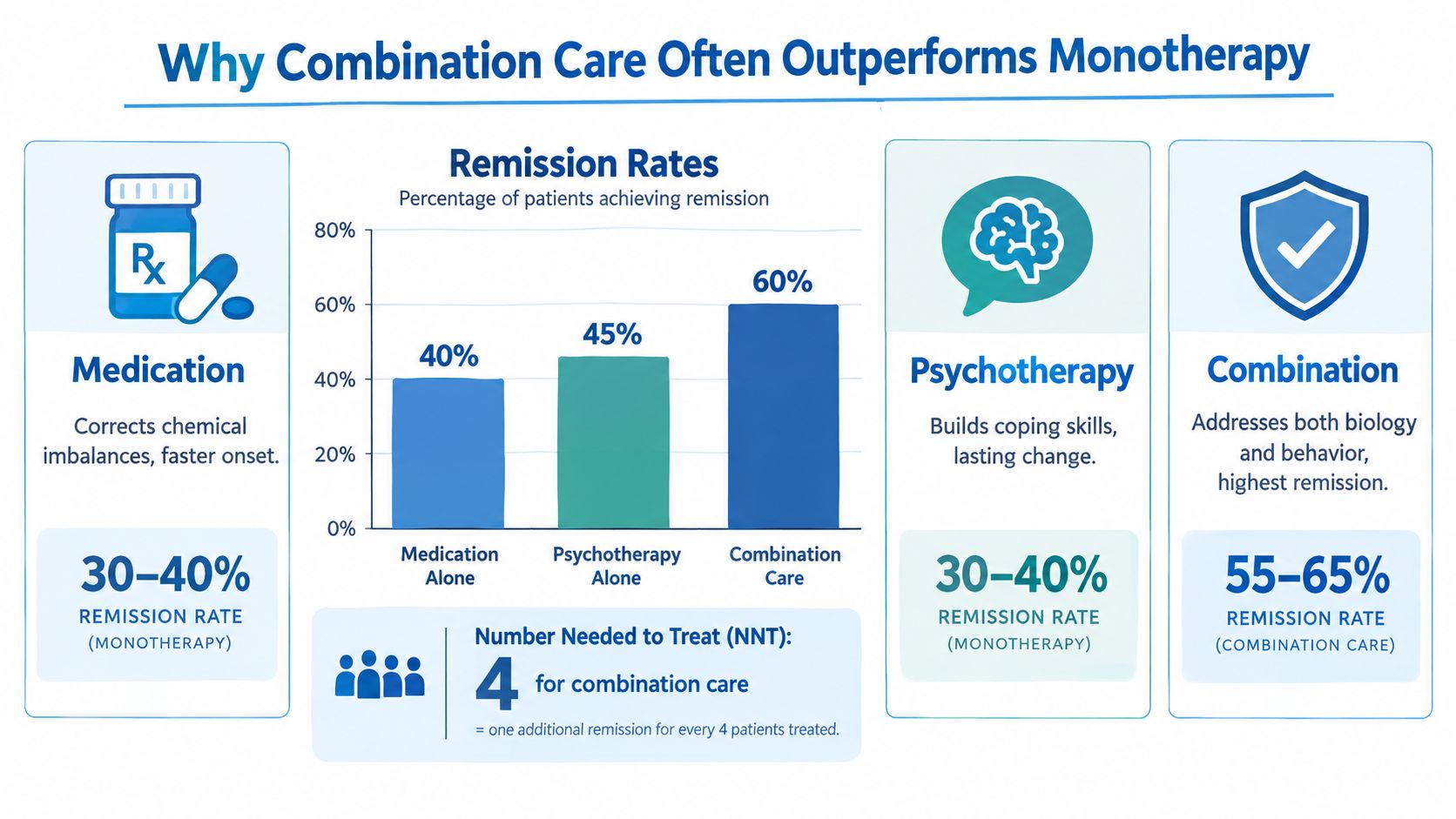
Why Combination Care Often Outperforms Monotherapy
A common chronic-depression pattern looks like this: medication lifts sleep, appetite, or energy enough to make the day less heavy, but the person still lives inside the same withdrawal, self-criticism, and low-expectation routines that built up over years. The reverse also happens. Therapy improves insight and daily structure, but the patient remains too slowed down, numb, or fatigued to use those gains consistently.
That is why the 2-year threshold changes treatment planning. In persistent depressive disorder, I am less interested in picking a single “best” treatment and more interested in whether the plan covers both symptom biology and entrenched depressive patterns. Chronic depression usually has both.
The guideline support is strong enough to matter in practice. The VA/DoD guideline recommends combining pharmacotherapy with evidence-based psychotherapy for persistent depressive symptoms lasting more than two years, and an AAFP summary of the depression guideline also notes better remission outcomes when CBT is added to medication in persistent depression.
When one treatment is enough and when it isn't
Monotherapy still has a place. Therapy alone can be a reasonable starting point when symptoms are milder, functioning is mostly intact, and the patient is motivated to attend regularly and practice skills between sessions. Medication alone can also be reasonable when access to therapy is limited, prior medication response was clear, or the person is too depleted to participate well in psychotherapy at the start.
The trade-off is straightforward. A single treatment is simpler, cheaper, and easier to stick with. It is also more likely to leave one part of chronic depression untreated.
If symptoms have been present for years, if there is a history of repeated partial response, or if daily functioning has narrowed around the illness, I usually recommend combination care early. In those cases, the goal is not only to reduce depressive symptoms but to interrupt a long-standing style of living that has adapted to depression. That often takes both medication and psychotherapy working at the same time.
Patients also ask whether “combination care” can include more than one medication. Sometimes it can, but that decision depends on what happened in the first trial, what side effects showed up, and whether there is a clear reason to augment rather than switch. For readers trying to understand one common antidepressant pairing, this overview of Wellbutrin and Lexapro used together covers the practical questions well.
A brief overview can also help if you're trying to understand the rationale before a visit:
Managing Partial Response and Treatment-Resistant Cases
One of the most frustrating experiences in chronic depression is “better, but not well.” That middle zone needs a plan, not endless waiting.
First decide whether the first trial was adequate
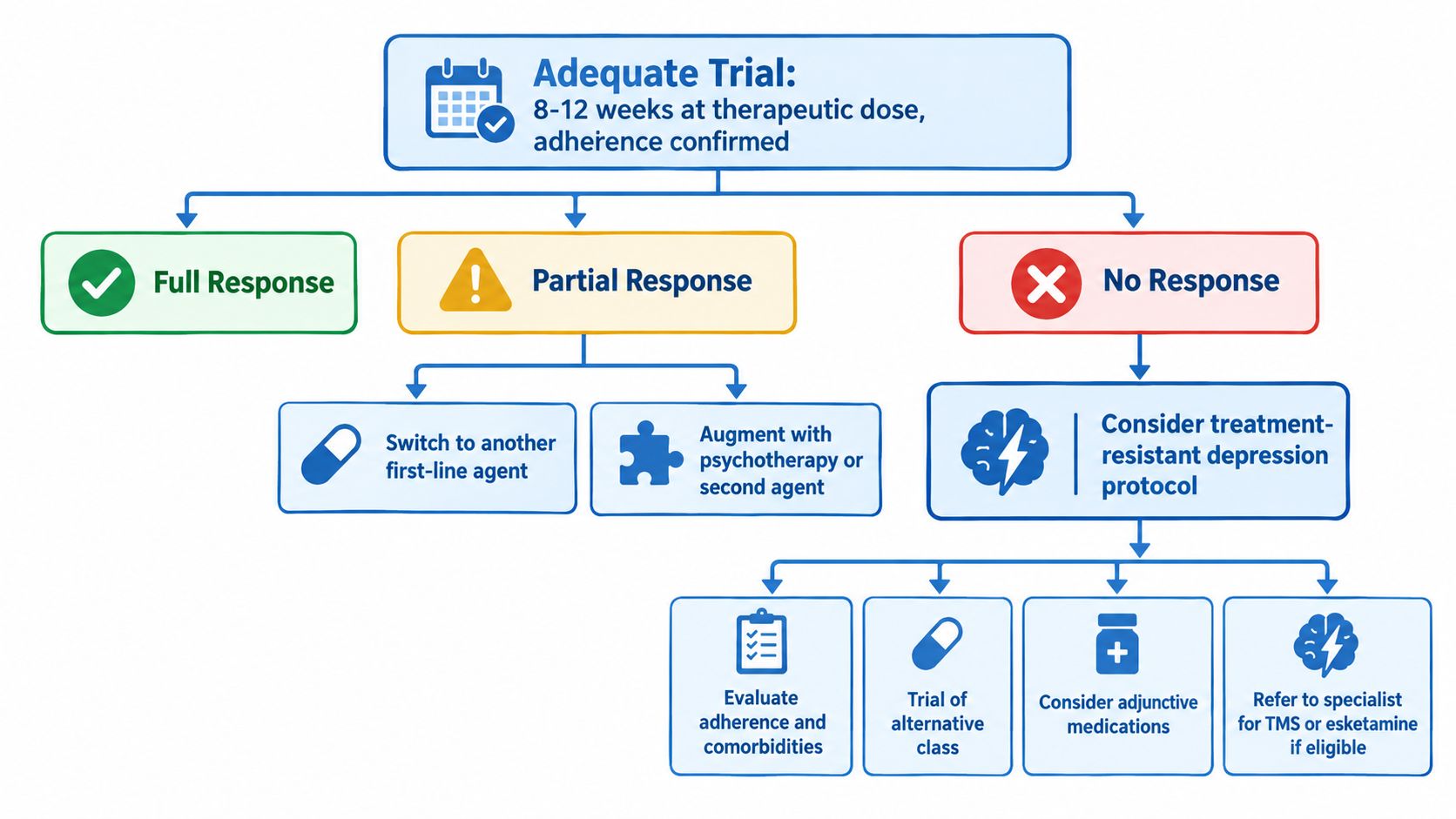
An adequate antidepressant trial generally means 8 to 12 weeks at a therapeutic dose with adherence confirmed. If a patient stopped after a few inconsistent weeks because of nausea, sedation, or fear, that's not failure. That's an interrupted trial.
Once the trial is adequate, I sort the next move by pattern:
Full response: continue the effective treatment and shift attention toward maintenance.
Partial response: optimize the current strategy before abandoning it.
No meaningful response: reassess diagnosis, adherence, substance use, medical contributors, and whether a switch makes more sense than augmentation.
This decision tree is useful for visual learners:
What partial response should trigger
If the patient has some benefit, I usually consider one of three paths:
Dose optimization when the medication is helping and side effects are manageable.
Augmentation with another evidence-based treatment, often psychotherapy if medication has improved enough energy to engage.
Switching medications if benefit is thin, side effects are costly, or the symptom pattern points elsewhere.
A practical patient guide like what to do when antidepressants stop working can help frame these conversations before a follow-up visit.
Don't judge a treatment only by whether it changed mood. Judge whether it restored range, initiative, and daily function.
Maintenance matters more in chronic depression
Once remission occurs, stopping too early is one of the most common mistakes. A 2023 CANMAT guideline summary states that antidepressant treatment should continue for a minimum of 6 to 12 months after symptomatic remission, and for 2 years or more in patients at higher risk of recurrence (CANMAT 2023 summary). That's especially relevant in persistent depressive disorder, where the condition's entire structure argues for longer-term relapse prevention.
For refractory cases, referral for interventions such as TMS or ECT may be appropriate, depending on severity, access, comorbidities, and safety concerns.
Finding the Right Provider and Using Telepsychiatry
For Florida patients, choosing a clinician for persistent depressive disorder isn't just about finding someone who prescribes antidepressants. You want someone who can tell the difference between chronic low-grade depression, recurrent major depression, bipolar-spectrum illness, anxiety overlays, trauma-related symptoms, and personality patterns that may complicate treatment.
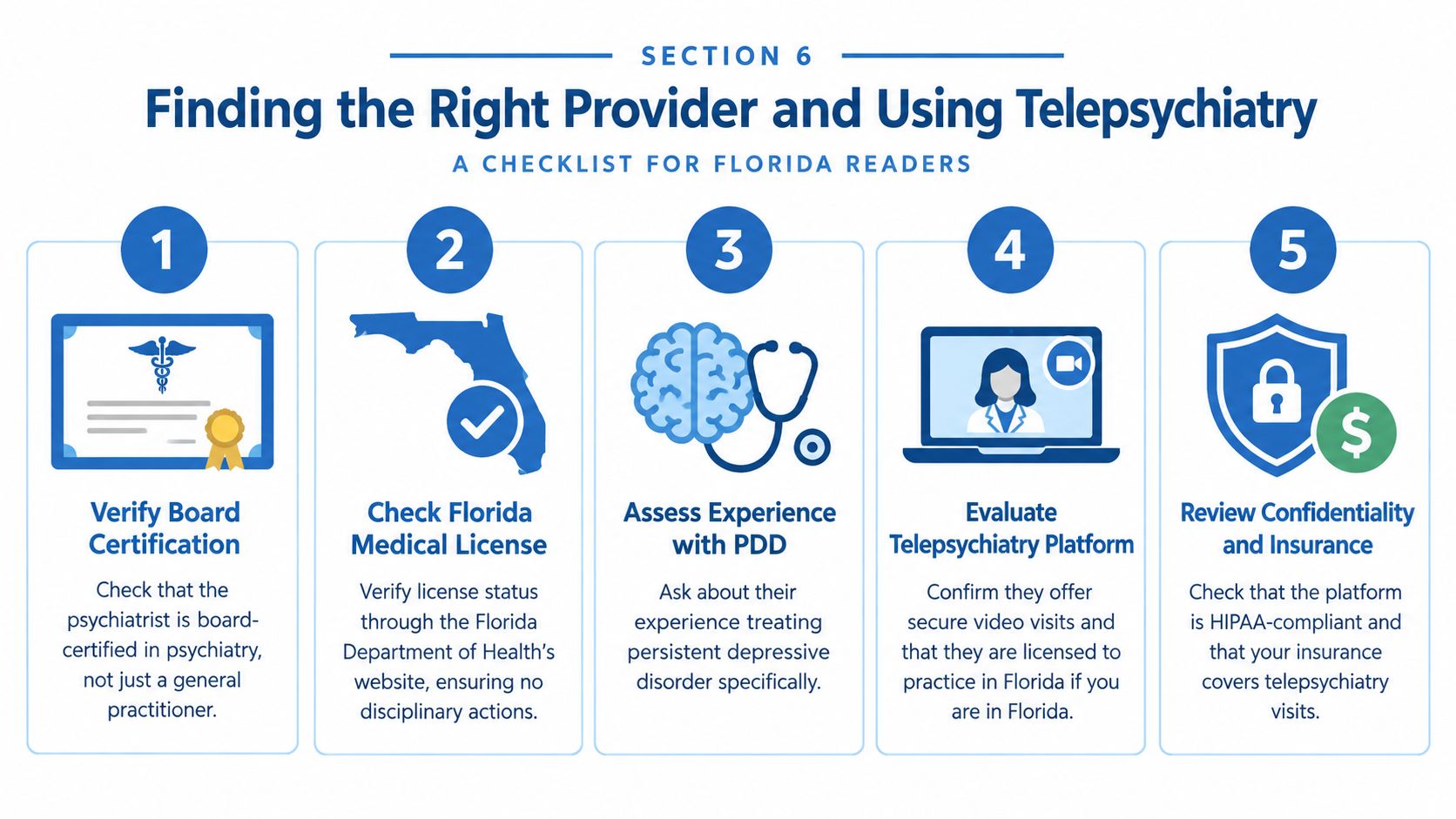
What to verify before the first visit
Start with the basics:
Board certification: confirm the clinician is trained in psychiatry, not offering general medication management.
Florida licensure: verify the clinician is licensed to practice where you are located during the visit.
Experience with chronic depression: ask directly whether they treat persistent depressive disorder and whether they use both medication and psychotherapy referrals when needed.
This checklist captures the essentials:
What a good evaluation should include
A useful first consultation should include a chronicity-focused history, prior medication trials, therapy history, sleep pattern, substance use review, medical screening, and a written treatment plan. If the visit feels like a rapid refill with no effort to map the course of illness, that's a problem.
Telepsychiatry can work very well for persistent depressive disorder when the patient is medically stable, reliable with follow-up, and using care for medication management, maintenance therapy, or behavioral activation coaching. If you want a plain-language overview of privacy and platform questions to ask, the CloudOrbis Inc. telehealth guide is a helpful primer on telehealth compliance concepts.
Questions worth asking on the first call
When I advise patients how to screen a clinic, I suggest something simple:
“I've had low mood for years, not just a recent episode. How do you evaluate chronic depression, and what does follow-up usually look like if the first treatment only partially helps?”
That one question tells you a lot. A solid clinic will answer with process, not vague reassurance. In Florida, telepsychiatry is especially useful because it broadens access across the state, but you still need clear answers about insurance coverage, refill policies, after-hours contact, and whether the provider can continue care if you travel out of state.
One Florida option in this space is Refresh Psychiatry & Therapy, which offers telepsychiatry across the state and integrates psychiatric evaluation with therapy-based care planning.
Long-Term Self-Management and Next Steps
A common pattern in persistent depressive disorder is this: someone starts treatment, feels a modest lift, then assumes that is as good as it gets because low mood has been present for years. That assumption can stall recovery. With chronic depression, the two-year duration matters because treatment is not only about reducing symptoms in the short term. It is also about changing routines, expectations, and interpersonal patterns that have had a long time to harden.
Self-management matters here because maintenance is part of treatment, not an optional add-on after treatment is "done."
Four habits that support maintenance
The framework I usually recommend has four parts:
Keep sleep and wake times steady: regular timing often matters more than getting a perfect night of sleep. Morning light exposure can help stabilize circadian rhythm, which is often off in chronic depression.
Use behavior before motivation shows up: behavioral activation works best when action is scheduled in advance. Track what you did, not only how you felt.
Watch for gradual backsliding: chronic depression often returns. Repeating a symptom scale such as the PHQ-9, along with a written plan for what to do if scores rise, gives you an earlier warning.
Protect social structure: put contact with other people on the calendar. Persistent depressive disorder tends to shrink life slowly, and isolation makes that contraction worse.
Maintenance treatment should be active and specific. For persistent depressive disorder, I want patients to think in phases: getting initial improvement, holding the gains, and then deciding how to reduce the risk of slipping back into a long-standing baseline of low energy, pessimism, and limited functioning. That is different from treating a brief depressive episode and then waiting to see what happens.
A maintenance rhythm often includes regular follow-up, even when things are going well. Visits can become less frequent once symptoms are stable, but they should still cover a few concrete points: whether the medication still helps, whether side effects are limiting daily life, whether therapy skills are being used, and whether work, relationships, or self-care are narrowing again.
A more useful marker of progress in chronic depression isn't only feeling less sad. It is having more emotional range, better follow-through, and less of life organized around the illness.
Call sooner if there are warning signs. Suicidal thinking, a sharp drop in function, new agitation after starting or changing medication, or a clear return of hopelessness should not wait for the next routine appointment.
If you are ready to act, make the next step practical. Book an evaluation and bring a concise timeline: past medications, side effects, prior therapy, periods when symptoms were worse, and periods when they were less intense. In chronic depression, that long-view history is often more informative than describing one difficult week.
Contact us or call Refresh Psychiatry at (954) 603-4081 to schedule your evaluation. We accept Aetna, United Healthcare/ UHC, Cigna, Blue Cross Blue Shield, Humana, Tricare, UMR, and Oscar insurance plans.
This blog is for informational purposes only and does not constitute medical advice. Please consult a qualified mental health professional for personalized guidance.
Refresh Psychiatry & Therapy provides psychiatric evaluations, medication management, and therapy-informed treatment planning for chronic depression, including the kind of long-duration symptom patterns discussed here. If you're looking for structured, Florida-based telepsychiatric care for persistent depressive disorder, visit Refresh Psychiatry & Therapy to learn more or schedule a consultation.