
Seasonal Affective Disorder Treatment: What Works

Bright light therapy, CBT for SAD, and FDA-approved medication like bupropion XL are all evidence-based first-line treatments for seasonal affective disorder treatment. Light therapy is typically 10,000 lux for 30 minutes each morning, CBT and light therapy perform similarly right after treatment, and bupropion XL is the medication with the clearest evidence for prevention when started in the fall.
If you're reading this as the days get shorter, you may already know the pattern. You wake up tired even after enough sleep. Work feels heavier. Social plans start to sound like effort. By late afternoon, the dim light outside seems to match the way you feel inside.
That doesn't always mean seasonal affective disorder. But when depression returns in a repeating seasonal pattern, it helps to stop treating it like a personality flaw or a lack of motivation. It is treatable. The question isn't just what seasonal affective disorder treatment exists. It's which treatment fits your symptoms, schedule, goals, and tolerance for daily routines.
Recognizing Seasonal Depression Before It Takes Hold
For many people, seasonal depression doesn't arrive dramatically. It creeps in. Fall starts normally, then mornings get harder, energy drops, appetite changes, and concentration slips. Patients often tell me they didn't realize how much they had slowed down until they looked back at the past few weeks.

A key feature of seasonal affective disorder is timing. The low mood doesn't happen randomly across the year. It tends to show up during a particular season and then ease when the season changes. Many think of winter-pattern depression, but seasonal mood shifts can happen in other patterns too. If you've ever wondered whether summer symptoms can also follow a seasonal pattern, this discussion of summertime sadness is worth reading.
What patients usually notice first
The first signs are often practical, not dramatic:
Morning slowdown: Getting out of bed takes more effort, even when nothing obvious is wrong.
Loss of drive: Tasks that were manageable in warmer months start to feel mentally expensive.
Social retreat: You cancel more plans, text less, and prefer isolation.
Mood flattening: Some people feel sad. Others feel numb, irritable, or emotionally blunted.
Sleep and appetite shifts: Changes in either direction matter, especially when they repeat each year.
Seasonal depression often looks ordinary at first. That's why people delay treatment.
Why early recognition matters
Early recognition changes the treatment conversation. If you catch symptoms near the start of the pattern, you have more room to choose a strategy instead of reacting only after you're already deep in an episode. That matters because the three main evidence-based paths work differently.
One works best when used with daily consistency and often helps quickly. Another may be more durable over time. A third can be useful when your goal is prevention before symptoms start. Matching the treatment to the pattern is where good care becomes much more effective than trial and error.
How Light Therapy Works and What the Evidence Shows
A common winter treatment decision starts like this: you want something that can help soon, you would rather avoid medication if possible, and you need to know whether the routine is realistic before you spend money on a light box. That is the right question to ask. Light therapy can work well for seasonal depression, but it works best for patients who can reliably use it early in the day.
Bright light therapy became a central evidence-based treatment for seasonal affective disorder after the first formal description of SAD in 1984 by Rosenthal and colleagues. Later reviews describe it as a first-line therapy. A clinical review of its history and protocol notes that standard morning treatment is typically 10,000 lux for 30 minutes daily, or lower intensities for longer sessions, which is why the method is prescribed in a fairly specific way rather than used casually (clinical review on the history and protocol of light therapy).
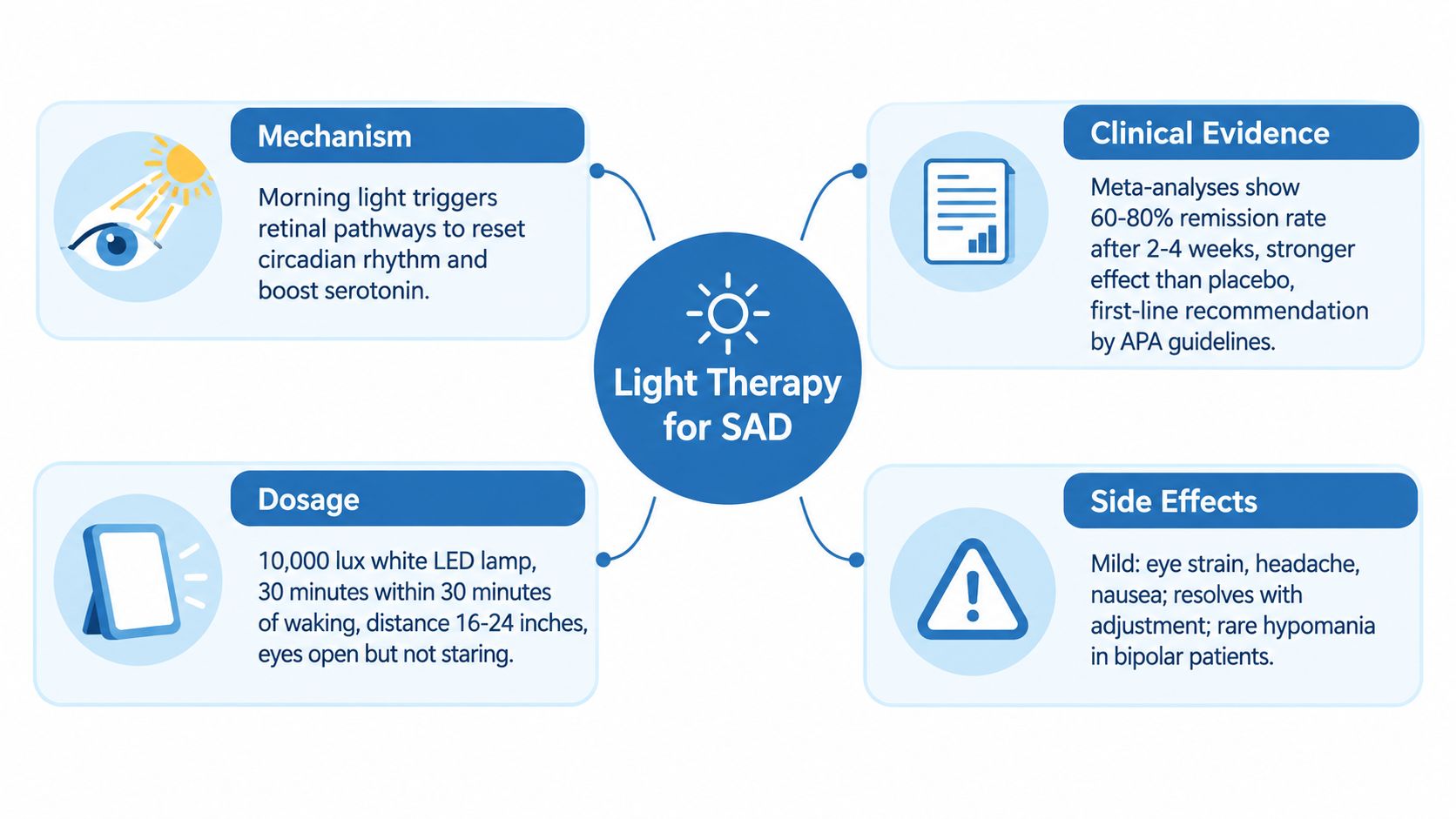
Light therapy gives the brain's circadian system a stronger morning signal
Seasonal depression is not only about feeling sad in darker months. In many patients, sleep timing, alertness, appetite, and energy shift with reduced morning light. Light therapy aims to correct that pattern by giving the brain a brighter signal shortly after waking, at the time of day when light has the strongest effect on circadian timing.
Reviews of clinical use describe a standard setup of 10,000 lux for about 30 minutes in the morning or 2,500 lux for 1 to 2 hours, with the lamp placed roughly 12 to 24 inches from the face, eyes open but not staring directly at the device. Those same reviews report that morning use is more effective than evening use because the timing fits the underlying circadian problem more closely, and some patients notice improvement within the first week (evidence review on dosing, timing, and response).
That speed is one reason light therapy often becomes the first treatment patients consider when symptoms are already active.
What the evidence supports, and what it does not
Light therapy has controlled evidence behind it. A major review reports that two meta-analyses covering eight randomized blinded controlled studies with 703 total participants found bright light therapy effective versus control conditions. The same review notes that international guidelines place it as a first-line treatment because of its relatively low side-effect burden, while also showing that response is stronger in milder cases than in more severe seasonal depression (review of efficacy, prevalence, and guideline support).
That distinction matters in practice. If someone has clear winter depression but is still functioning, light therapy is often a strong first choice. If symptoms are severe, long-standing, or mixed with significant anxiety, oversleeping, or marked impairment, light therapy may still help, but I would be more likely to discuss combining it with CBT-SAD or medication rather than treating it as a complete answer.
The trade-off patients often miss: daily adherence
Light therapy usually helps while you keep using it. If you stop, symptoms can return. That is the trade-off of the tool. Daily morning adherence is part of the treatment.
Treatment matching starts to matter. A patient who likes routine, wakes at a predictable time, and wants a non-drug option may do very well with a light box. A patient with an erratic schedule, frequent travel, shift work, or repeated trouble sticking with morning habits may be better served by CBT-SAD, medication, or a combination plan.
If your seasonal symptoms worsen around clock changes or shortened daylight transitions, this article on the hidden mental health impact of daylight saving time adds useful context for why timing can matter so much.
Comparing Light Therapy, CBT, and Medication Options
Patients often want one winner. In practice, there usually isn't one universal best treatment. There is a best fit for the problem in front of you.
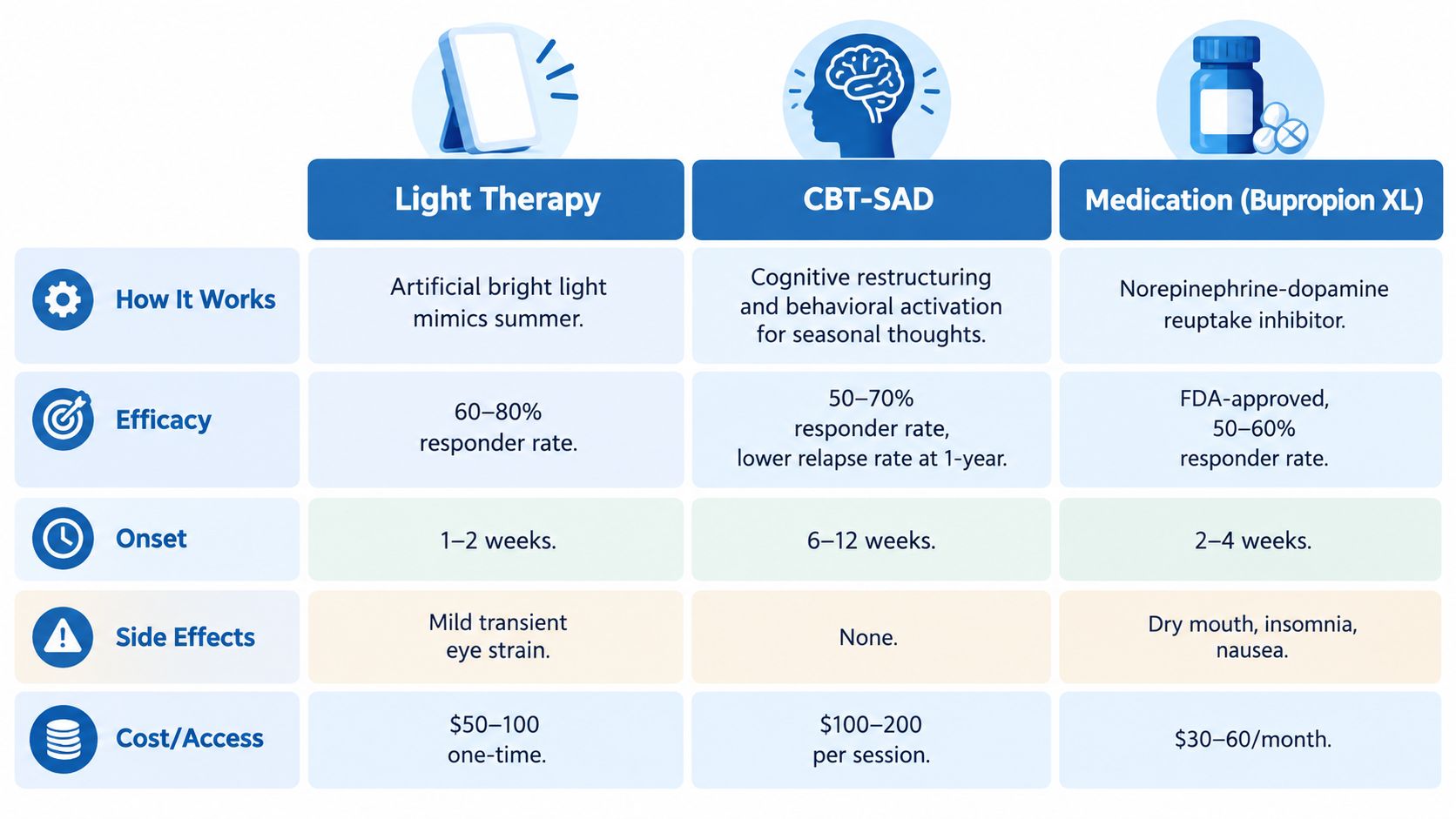
Side-by-side comparison
Treatment | Best fit | Main strength | Main limitation |
|---|---|---|---|
Light therapy | Active winter symptoms, preference to avoid medication | Often helps quickly and has a concrete routine | Requires consistent daily morning use |
CBT-SAD | People who want skills that last beyond the season | Stronger durability over follow-up | Takes engagement and regular therapy work |
Bupropion XL | People with recurrent seasonal episodes who want prevention | Best-supported medication for preventing recurrence | Requires prescribing review and isn't right for everyone |
Light therapy when speed matters
If someone is already in an active seasonal slump and wants a treatment that is structured, non-drug, and often felt early, light therapy usually rises to the top. It asks for consistency, but not much interpretation. You use it, in the morning, at the right distance, on a regular schedule.
That straightforwardness matters. Some patients do very well with a routine they can start at home without waiting for weekly sessions to build momentum.
CBT-SAD when durability matters more
CBT for SAD answers a different problem. It isn't only trying to lift symptoms during one season. It also helps people challenge seasonal beliefs, reduce avoidance, and build behaviors that hold up when winter returns.
A 2025 systematic review and meta-analysis found that CBT was more effective than light therapy at 1 to 2 years follow-up for reducing depressive symptoms. That same evidence base also supports an important nuance: there was no meaningful difference immediately after treatment between CBT and light therapy, while older comparative data found six weeks of group CBT matched 10,000 lux morning light in acute efficacy (systematic review and meta-analysis on CBT-SAD).
Many treatment pages oversimplify. Saying both work is true, but incomplete. CBT may be the better choice when a person says, "I don't want to depend on a light box every winter if there's a way to reduce relapse over time."
For patients who benefit from action before motivation returns, behavioral activation for depression often overlaps well with the CBT-SAD approach.
If your question is "What helps me feel better soon?" light therapy often makes sense. If your question is "What helps me next winter too?" CBT deserves serious consideration.
Medication when recurrence is the pattern
Medication enters the picture in two different ways. One is treatment of an active depressive episode. The other is prevention of a known seasonal recurrence.
For prevention, the medication with the clearest evidence is extended-release bupropion. A review of prevention data reports that starting bupropion 300 mg once daily in the fall can reduce recurrence of seasonal symptoms, with a number needed to treat of 5 in high-risk adults with a history of SAD and 8 in lower-risk adults (AAFP review of prevention evidence).
That makes bupropion XL especially relevant for people who can predict the pattern well and want to interrupt it before it takes hold.
Starting Light Therapy Correctly at Home
A light box is simple to use. It is not casual to use. Small setup mistakes can turn a good treatment into an ineffective one.
The setup that matters
Major clinical guidance describes the standard dose as a light box delivering 10,000 lux, used for 30 minutes per day in the morning. Lower-intensity setups may require longer exposure, such as 2,500 lux for 1 to 2 hours (Mayo Clinic guidance on light box dosing).
The mechanics matter too. The light should be used every day at roughly the same time, with your eyes open and the light angled toward you rather than stared into directly. Staring isn't necessary and may increase side effects (AAFP guidance on timing and positioning).
A practical home routine
Do best with a routine like this:
Use it soon after waking. Morning timing supports the circadian effect you want.
Sit at the recommended distance. Follow the device instructions so you receive the intended intensity.
Keep your eyes open, but don't stare at the lamp. Read, eat breakfast, or work.
Stick with daily use. Skipping around makes it harder to judge whether it's helping.
Track the first week carefully. Changes in energy, alertness, or morning mood often show up before everything else improves.
If you want a practical device-focused walkthrough, this guide to choosing a seasonal depression lamp can help you think through what features matter.
What to expect and when to ask for help
Early side effects can include eye strain, headache, or feeling overstimulated. Those problems don't always mean light therapy is wrong for you. Sometimes the fix is adjusting timing, distance, or session length under clinical guidance.
Start with the right protocol, not random exposure to a bright lamp in the evening.
People with bipolar disorder, significant eye disease, or unusual sensitivity to light should be more careful and should generally avoid self-directing treatment without medical input. If seasonal symptoms include marked agitation, reduced need for sleep, or anything that suggests mood elevation instead of depression, get assessed before using bright light treatment on your own.
When Medication Makes Sense for SAD
Medication isn't mandatory for seasonal affective disorder treatment. It becomes more appealing when depression is moderate to severe, when daily light therapy isn't realistic, when relapse is predictable, or when a person wants a prevention strategy rather than reacting after symptoms begin.
Treatment versus prevention
This distinction matters. Some antidepressants are used to treat an active depressive episode once symptoms are already present. Bupropion XL is different because it has a specific role in prevention.
The FDA labeling states that extended-release bupropion is indicated for preventing seasonal major depressive episodes in patients with SAD. The label recommends starting it in the autumn before symptoms begin, continuing through winter, and tapering in early spring. For 300 mg/day, the dose should be reduced to 150 mg/day before discontinuation (FDA prescribing information for bupropion XL).
That pattern makes sense for people who can practically set their calendar by their symptoms.
Who tends to benefit most
Medication becomes a strong option when one or more of these are true:
Your episodes are predictable: You feel well now, but every fall brings the same decline.
Your symptoms are heavy enough to impair work or parenting: At that point, prevention or added symptom control matters more.
You won't reliably use a light box: A treatment only works if you can stick with it.
You want combination care: Medication can pair with psychotherapy or light exposure when one approach alone isn't enough.
What medication doesn't do well
Medication isn't the best answer for every question. If your main goal is skill-building that may reduce recurrence over future winters, psychotherapy still deserves a central place. If your main problem is insomnia, don't assume an antidepressant or light box alone will organize your sleep.
The evidence base also doesn't support common supplement shortcuts. High-quality summaries note that vitamin D alone is not an effective SAD treatment, and the National Center for Complementary and Integrative Health states there is very little evidence for other supplements such as melatonin or St. John's wort, with small studies showing unclear or inconsistent results (NCCIH summary on SAD and complementary approaches).
If you're already taking antidepressants or considering starting one for a recurring seasonal pattern, this overview on how long you should take antidepressants can help frame the timing discussion.
Building a Personalized Treatment Plan with Professional Support
The most effective seasonal affective disorder treatment plan is rarely the most complicated one. It's the one you can sustain when daylight is shortest, motivation is lowest, and your normal routines are under pressure.

How clinicians match treatment to the person
A good evaluation usually focuses on a handful of practical decisions:
How severe are the symptoms right now? Mild and early symptoms may fit one path. More impairing depression may require a broader plan.
Is the goal relief or prevention? Those are related, but not identical.
What can the person realistically do every day? A perfect plan on paper fails if it doesn't fit the person's morning schedule or home life.
Has this happened repeatedly? Predictable recurrence changes the medication conversation.
Are sleep problems central? Some people need direct attention to insomnia rather than assuming mood treatment will fix everything else.
Combination treatment is often the most honest answer
Patients sometimes worry that needing more than one treatment means their condition is more serious. It doesn't. It often means the treatment plan is being crafted thoughtfully.
A common real-world pattern is using light therapy for symptom relief while doing CBT-SAD for recurrence prevention. Another is starting preventive medication before the usual onset, then using therapy to reduce avoidance and social withdrawal once winter begins. In some cases, lifestyle structure matters too. Gentle outdoor routines, even when they aren't a standalone treatment, can support mood and stress regulation. For patients looking for low-pressure ways to stay engaged with daylight and movement, these cortisol-lowering gardening activities can be a useful addition to a broader plan.
The right plan is not the most intensive plan. It's the plan you'll actually keep using in December and January.
Where telepsychiatry fits
Professional support matters most when you're deciding between options rather than just reading about them. A psychiatrist or therapist can help sort out whether you're dealing with seasonal depression, another form of major depression, bipolar spectrum symptoms, a sleep disorder, or several overlapping issues.
For Florida patients who want coordinated care remotely, Refresh Psychiatry & Therapy offers telepsychiatric evaluation, medication management, and therapy, which allows light therapy guidance, psychotherapy, and medication planning to be discussed in one treatment setting.
Contact us or call Refresh Psychiatry at (954) 603-4081 to schedule your evaluation. We accept Aetna, United Healthcare/ UHC, Cigna, Blue Cross Blue Shield, Humana, Tricare, UMR, and Oscar insurance plans.
This blog is for informational purposes only and does not constitute medical advice. Please consult a qualified mental health professional for personalized guidance.
If seasonal depression keeps returning, Refresh Psychiatry & Therapy offers psychiatric evaluations, medication management, and therapy through a telemedicine-only model for patients across Florida. If you're trying to decide between light therapy, CBT, medication, or a combination, we can help you build a plan that fits your symptoms, schedule, and prevention goals.