
🧠 Bipolar Depression vs Major Depression: Key Differences

If two people walk in with the same two-week low, why would one leave on an antidepressant alone and the other leave on a mood stabilizer? The usual answer, "because one depression is worse," is the wrong split. In bipolar depression vs major depression, the current low can be identical. What changes the label, and the medicine, is the lifetime pattern of energy, sleep, and mood.
How Bipolar Depression Differs from Major Depression
The same exhausted, joyless stretch can carry two diagnoses. Major depressive disorder (MDD) is defined by depressive episodes without documented mania or hypomania. Bipolar disorder involves depressive episodes that alternate with manic or hypomanic symptoms. Someone who arrives only during a low can look like they have MDD even when the broader life story is bipolar.
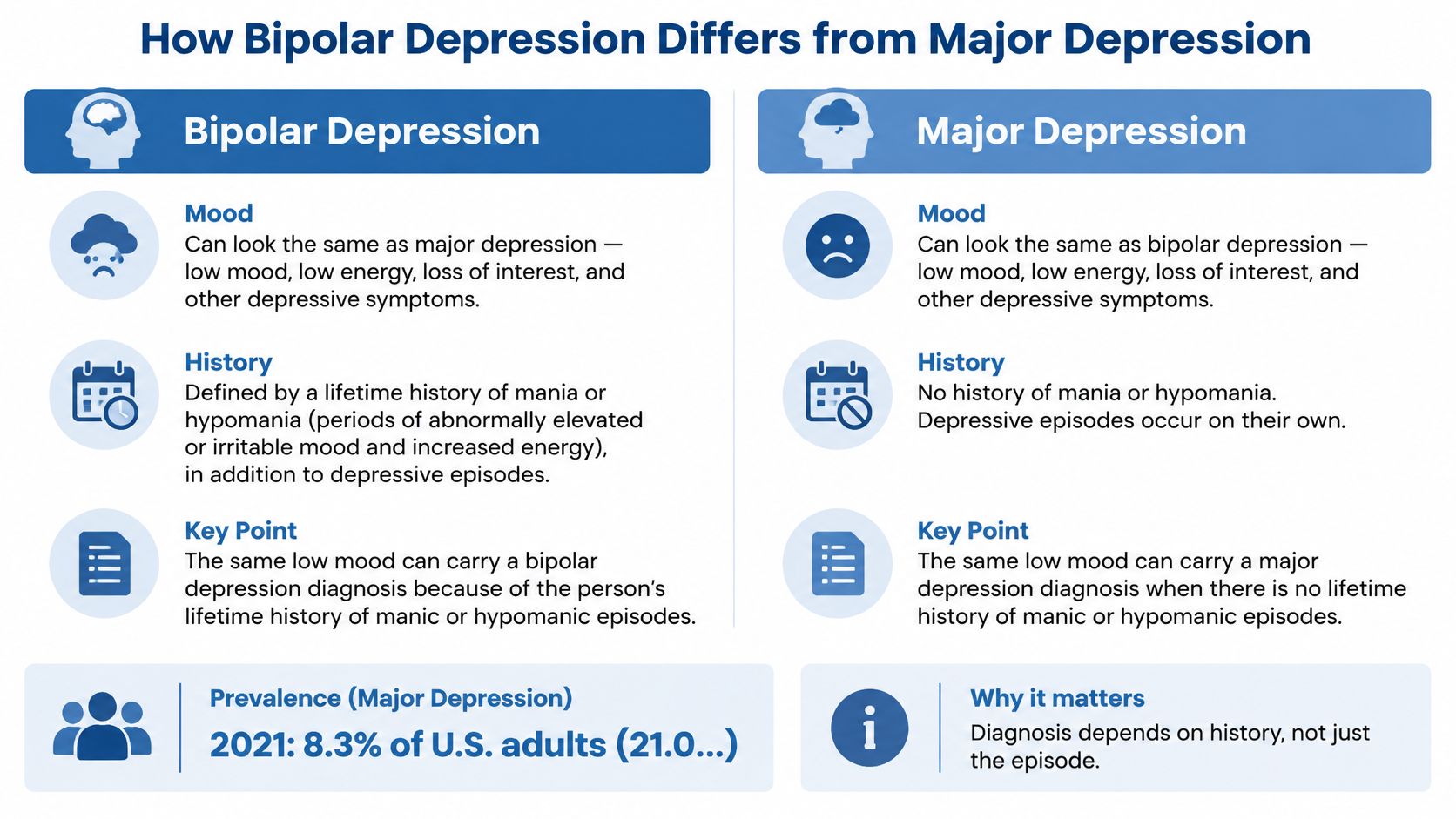
How common each illness is doesn't sort them. In 2021, approximately 21.0 million U.S. adults experienced at least one major depressive episode, representing 8.3% of adults, while the National Institute of Mental Health estimates that 2.8% of U.S. adults had bipolar disorder during the preceding year and 4.4% experienced it during their lifetime. Bipolar disorder also carried a heavy burden: 82.9% of affected people were classified as having serious impairment. A more common illness is not the default label for every low.
The Shared Threshold And The Separating Rule
Both conditions can meet the same major depressive episode bar. That means at least five symptoms over the same two-week period, including depressed mood or loss of interest, with clinically significant distress or impairment. Appetite, sleep, energy, concentration, guilt, and thoughts of death can match on a checklist.
Bipolar disorder adds a second requirement: a lifetime manic or hypomanic episode. Mania is a distinct period of heightened or irritable mood with a clear increase in activity or energy, lasting a week, or any length if the person needs hospital care. Hypomania is a similar, observable shift lasting at least four consecutive days, without that same degree of breakdown. Clinicians weigh severity, duration, frequency, family history, and age at onset together. They don't score today's mood in isolation.
A nationally representative U.S. study of more than 43,000 adults found the first mood episode at an average age of 21.2 years for bipolar I disorder and 20.5 years for bipolar II disorder, compared with 30.4 years for major depressive disorder, a gap of roughly 9 to 10 years (epidemiologic comparison in Bipolar Disorders).
Feature | Major Depressive Disorder | Bipolar Depression |
|---|---|---|
Core diagnostic requirement | Major depressive episode with no lifetime mania or hypomania | Major depressive episode plus at least one lifetime manic or hypomanic episode |
Average age at first mood episode | 30.4 years | 21.2 years (bipolar I); 20.5 years (bipolar II) |
Episode pattern | Depressive episodes only | Depressive episodes alternating with manic, hypomanic, or mixed episodes |
Energy and sleep outside depression | Fatigue and insomnia during lows | Periods of decreased need for sleep and high energy |
Psychotic or catatonic features | Possible in severe episodes; not diagnostic on its own | Should raise bipolar screening priority |
Typical first-line medication | Antidepressant monotherapy | Mood stabilizer or antipsychotic; antidepressant monotherapy generally avoided in bipolar I |
Family history | Depression in relatives | Bipolar disorder in relatives raises screening priority |
Say a 34-year-old describes two months of low mood, oversleeping, and guilt. On those symptoms alone, the picture fits MDD. Asked about earlier years, she recalls a week at 27 on about three hours of sleep, feeling sharp rather than tired, and writing a new business plan each day. Her current symptoms match MDD. Her history changes the diagnosis, and with it the first medicine on the table.
Why The First Label Is Often MDD
People usually ask for help while depressed, so the high-energy stretches never reach the chart. Published estimates indicate that approximately 20.8% to 61.5% of people with bipolar disorder may initially be misdiagnosed with MDD, and in one clinical sample 14.5% of patients first diagnosed with MDD were later diagnosed with bipolar disorder (clinical review of bipolar misdiagnosis). Build a dated lifetime timeline before the label is treated as final. Earlier onset, frequent episodes, atypical symptoms, psychosis, a bipolar family history, and activation after an antidepressant all raise the priority of that timeline.
Bipolar disorder requires a history of mania or hypomania, not a different set of depressive symptoms.
Red-Flag Clues and How to Screen for Bipolar Signs
Which details from a person's past low moods point toward a closer look at bipolar disorder? A clue is a reason to ask more, not a diagnosis. The VA/DoD bipolar pocket card lists several prompts for further assessment, including past mania or hypomania, agitation after starting an antidepressant, extended high energy with little sleep, and repeated depressive episodes.
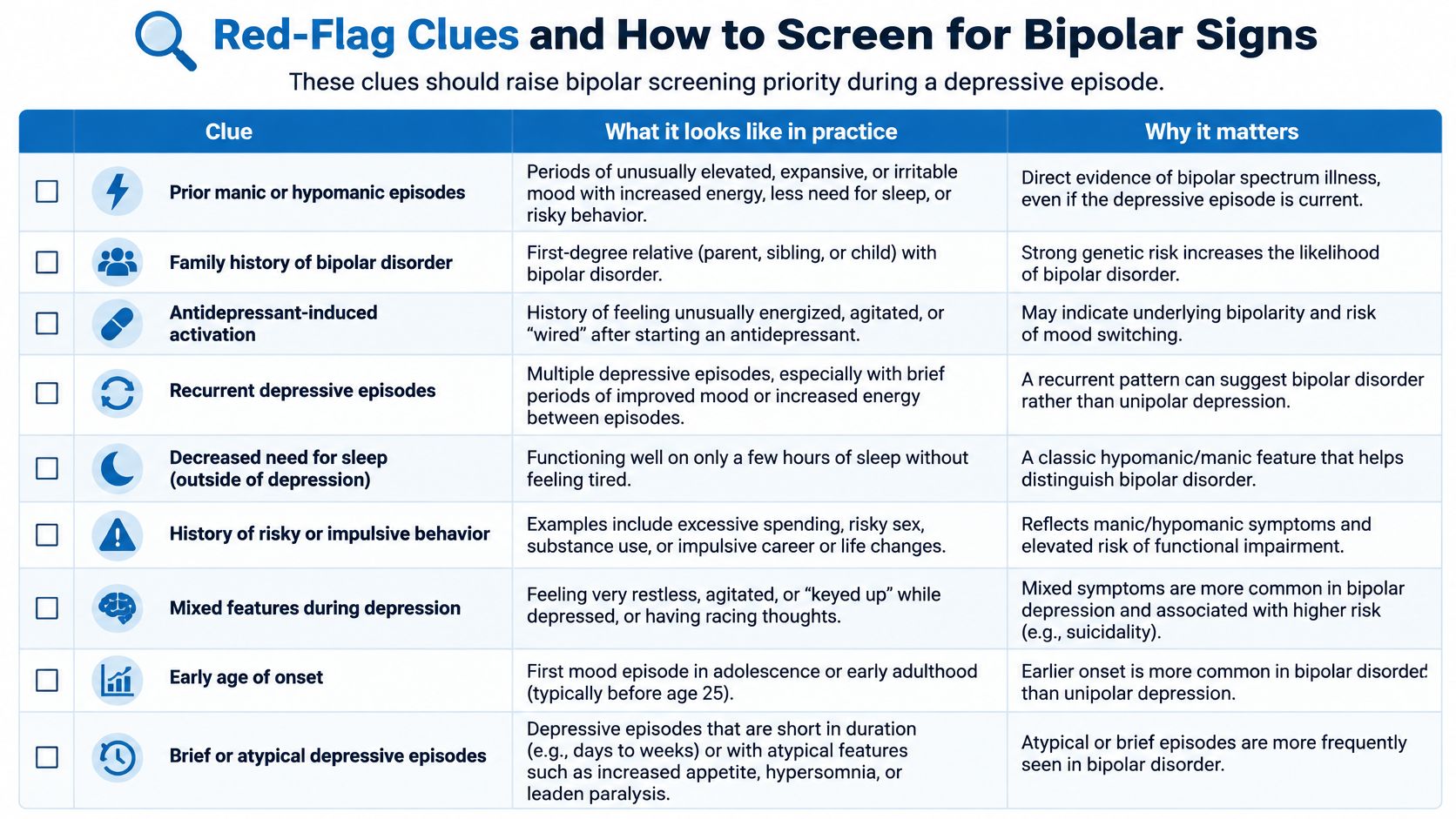
Clue | What It Often Looks Like | Why It Matters |
|---|---|---|
Depression beginning at age 25 or younger | Early first episode with recurring lows | Earlier onset can prompt closer assessment |
Five or more previous depressive episodes | Frequent recurrence across years | Recurrence warrants a closer look at the lifetime pattern |
Irritability or agitation after starting an antidepressant | Restlessness, racing thoughts, or unusual irritability after a new prescription | A marked change after starting medication calls for assessment of possible mood elevation |
Extended high energy with little sleep | Several days on three to four hours of sleep without fatigue | Feeling rested on little sleep can be a sign of mania or hypomania |
Atypical or leaden features | Heavy limbs, slowed speech, and movement during lows | These features can help guide a fuller assessment |
Psychotic or catatonic features | Delusions or immobility during low periods | These symptoms warrant prompt clinical assessment, including a review of mood history |
Family history of bipolar disorder | Relatives with mood episodes or hospitalizations | This history can raise the priority of asking about mood elevation |
Hypomania the patient doesn't recognize | Patient reports only productivity; relatives notice a change | Collateral history can help establish whether behavior changed from the person's usual baseline |
Match any clue to a dated period and ask what sleep, speech, spending, and work were like then. Decreased need for sleep means feeling rested despite sleeping less. Insomnia usually leaves a person tired the next day. Common hypomanic symptoms can be mistaken for a productive spell, so the key question is whether energy, sleep, and behavior changed together.
What A Questionnaire Can And Cannot Do
A questionnaire can organize questions about past mood changes, but it cannot establish a diagnosis. The VA/DoD bipolar quick reference describes using validated screening tools in specialty mental health care when symptoms raise suspicion. Three commonly used tools approach the questions differently:
Mood Disorder Questionnaire: asks about past manic symptoms, whether they occurred together, and whether they caused problems.
Hypomania Checklist: asks about experiences during possible hypomanic periods, which a person may not think to mention.
Bipolar Spectrum Diagnostic Scale: uses a narrative format to ask about less obvious mood patterns.
A screen can miss bipolar signs or flag experiences that do not amount to bipolar disorder. Clinicians therefore interpret answers alongside the person's history, symptoms, and functioning, rather than using a score alone to settle the diagnosis. When a person may not recognize a change in their own behavior, a relative's account can help fill in the timeline.
Real Cases Where The Answer Changes
Four ordinary visits show how the same low leads to different next steps. The chart below lays the turning point next to the action that follows.
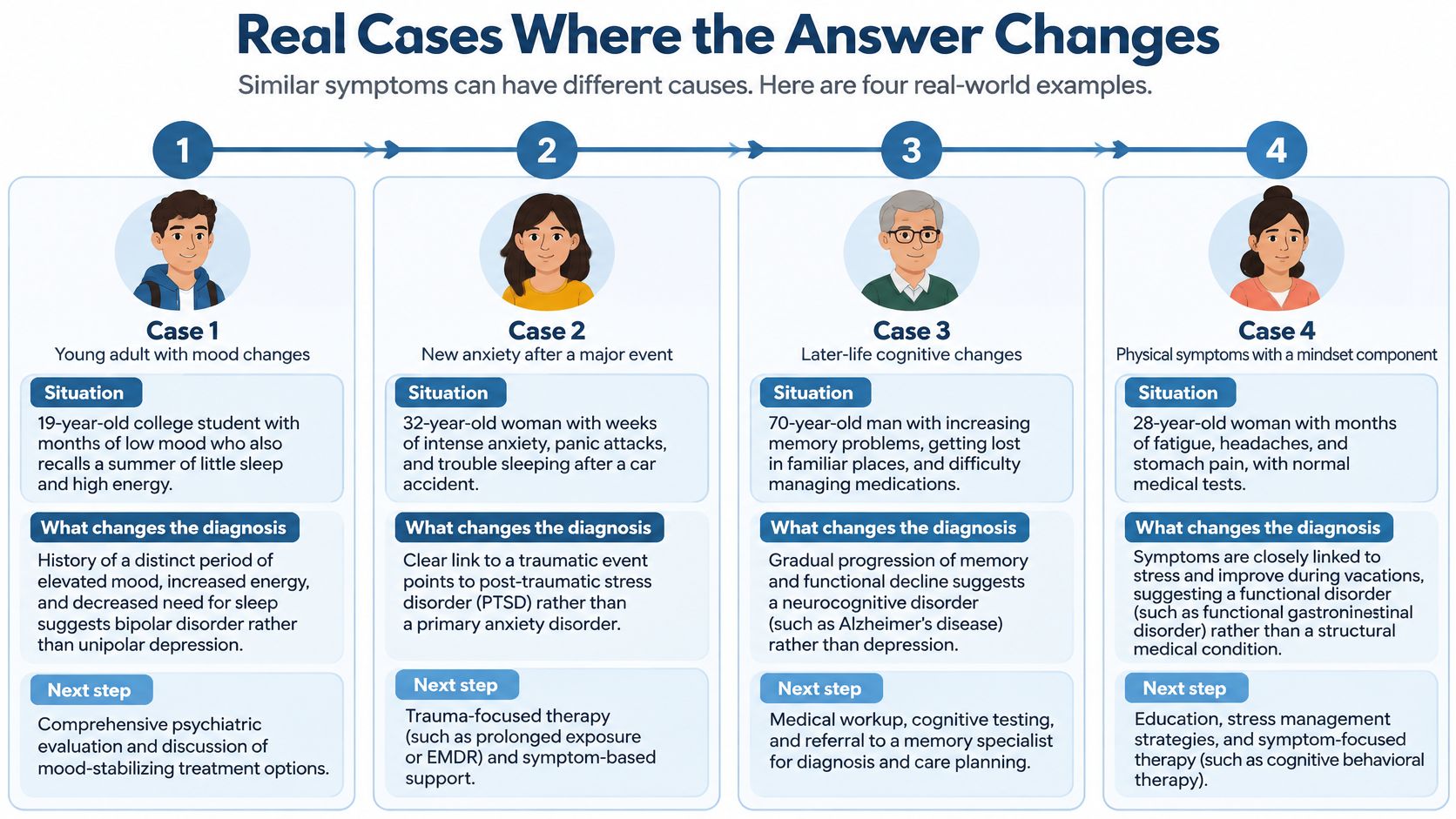
A 19-year-old college student has spent months withdrawn, missing class, and sleeping through alarms. In the same interview she mentions a summer of little sleep, nonstop group chats, and bursts of energy she called "finally feeling like myself." The summer, not the current low, is what points toward bipolar II screening. The next step is a structured history of that season's sleep, spending, and speech before any new antidepressant is started. Comparing that pattern with manic depression versus BPD also keeps a personality pattern from being mistaken for an episode.
A 45-year-old has had five depressive episodes and no real lift from two adequate antidepressant trials. There is no dramatic story of staying up all week. Recurrence plus failed monotherapy is enough to justify a full lifetime review, including quieter stretches of irritability, late-night projects, and family hospitalizations.
A parent says a 15-year-old became irritable, impulsive, and sleepless within days of starting an antidepressant for a low mood. In teens, irritability and activation can be the leading signs, not grandiosity. The prescriber should reassess before increasing the dose. Earlier onset is itself a bipolar clue. Child and adolescent psychiatry evaluates kids and teens for depression, anxiety, and ADHD, so those look-alikes get ruled in or out rather than folded into one mood label.
A short walk-through of how clinicians separate these histories is here.
A telehealth patient remembers only the lows. Their spouse, on the call with consent, describes weeks of overspending and late-night projects the patient had filed as catching up at work. The case changes once collateral history is gathered. Family observations belong in the evaluation, not in a side conversation after the prescription is already written.
Medication Choices and Their Risks by Presentation
The right medication depends partly on a person's lifetime mood history, not only on how low they feel today. In major depressive disorder (MDD), antidepressant monotherapy is a standard evidence-based option. In bipolar depression, especially bipolar I, antidepressant monotherapy is generally discouraged because it may contribute to mania, hypomania, or rapid cycling, while evidence of benefit is limited (CANMAT, ISBD, and NICE treatment comparison).
Presentation | Antidepressant Approach | Monitoring Priority |
|---|---|---|
Recurrent major depression with no history of mania | Standard evidence-based antidepressant monotherapy | Mood, response, and side effects |
Confirmed bipolar I depression | Monotherapy generally avoided; mood stabilizer or antipsychotic pathway | Sleep need, activation, irritability, and speech rate |
Bipolar II depression | Adjunctive antidepressant may be considered with close monitoring | Early hypomanic signs and episode switching |
Prior antidepressant-induced mania | Avoid or use cautiously; stop if early manic symptoms appear | Activation and rapid cycling |
Mixed features or recent rapid cycling | Use caution; reassess the diagnosis before any dose increase | Mixed symptoms and agitation |
Worsening after starting medication | Diagnostic reassessment rather than automatic dose escalation | Prompt contact with the prescriber; no self-discontinuation |
Past antidepressant-induced mania, mixed features, or recent rapid cycling call for caution with antidepressants. If early manic symptoms emerge, guidance recommends stopping the antidepressant; NICE also advises considering discontinuation and offering an antipsychotic if mania or hypomania develops during monotherapy. When the pattern suggests switching rather than an incomplete response, increasing the dose may be the wrong move.
Bipolar II Is Not Bipolar I With A Softer Name
A 2025 review of antidepressant use in bipolar depression describes evidence that antidepressants may help some people with bipolar depression, particularly when a serotonin-reuptake inhibitor or bupropion is used at a moderate dose for a limited time alongside a mood stabilizer or certain atypical antipsychotics. For carefully selected people with bipolar II depression, a clinician may consider this adjunctive approach. Antidepressant monotherapy is generally avoided in bipolar I. The decision depends on the person's history of activation, mixed symptoms, rapid cycling, current treatment, and ability to attend follow-up.
Medication is not always recommended. Refresh Psychiatry's psychiatrists conduct thorough assessments and make treatment decisions collaboratively. When medication is part of care, psychotherapy can be coordinated with medication management so the care team works from the same plan. A mood stabilizer is a different class of medicine from an antidepressant, which helps explain why Depakote is not an antidepressant. Learn more about mood stabilizers versus antidepressants.
Follow-up should track more than mood scores. Changes in sleep need, activation, irritability, impulsivity, speech rate, and episode pattern can show whether treatment is helping or whether the diagnosis needs another look. Evidence for antipsychotic treatment in depression includes findings from a 2024 systematic review and meta-analysis of nine randomized trials evaluating cariprazine for unipolar or bipolar depression. A 2024 meta-analysis of lumateperone reported a standardized mean difference of −0.36 versus placebo for bipolar depression across seven trials. These findings support considering antipsychotics in some cases; the person's diagnosis, history, and monitoring needs still guide the choice.
Practical rule: If agitation worsens, sleep need drops, or racing thoughts appear after starting a medication, contact the prescriber promptly. Do not stop the medication on your own.
Suicide Risk, Comorbidity and Long-Term Course
Bipolar depression carries its own safety concerns, and a past suicide attempt is one reason to screen for bipolar illness rather than treat every recurrent low as ordinary MDD. Ask directly, at every visit, including item 9 of the PHQ-9: thoughts that you would be better off dead, or of hurting yourself. Families can use the same plain question.
Do three things the same day if the answer is yes. Ask about past attempts and current intent. Check access to firearms and to stockpiled medication, and store both out of reach. Write a safety plan with named emergency contacts, not a verbal promise to "call someone." In the United States, call or text 988 for the Suicide and Crisis Lifeline. Call 911 if danger is immediate.
"Are you thinking about killing yourself?" is a kinder question than silence. People answer it when someone actually asks.
Anxiety disorders, substance use, and personality patterns often travel with bipolar depression, and alcohol or stimulants can mimic a high or deepen a low. A medication and substance review belongs in the same visit as the mood timeline. Sorting bipolar 1 versus bipolar 2 symptoms also changes how tightly you watch for switching, because the two subtypes don't carry the same risk with an antidepressant.
A Label From Today Can Shift Later
Bipolar illness tends to recur, stack up more depressive episodes, and wear on quality of life more than a single depressive spell does. A diagnosis made at the first low shouldn't be frozen. A 2024 Johns Hopkins Medicine cohort study found that 4.2% of patients initially diagnosed with major depressive disorder transitioned to bipolar disorder within one year, rising to 11.4% within ten years. Review the diagnosis at later visits, especially after activation, a new high-energy stretch, or another depressive episode.
Keep a simple mood log: date, sleep hours, energy, irritability, spending, and any medicine change. Bring it to every appointment. A page of dates outperforms a reconstructed memory from the middle of a low.
Book a Full Evaluation Before Changing Medication
A mood timeline makes an evaluation more useful. Before changing medication, gather details that can help a clinician distinguish a single depressive episode from a longer pattern of mood shifts.
Write a lifetime mood timeline. Mark lows, highs, and steady periods by month and year. Include postpartum stretches and college semesters if relevant.
List every medication and supplement. Note when each was started and whether activation, insomnia, or irritability followed an antidepressant.
Record alcohol and other substance use. Include energy drinks and cannabis, which can be easy to overlook.
Consider inviting a relative or close friend, with your consent. Ask what they noticed about changes in your sleep, speech, or spending, rather than asking them to assign a diagnosis.
A psychiatric evaluation and what it covers can help you understand what to expect. In a telepsychiatry visit, a clinician can review your timeline, screening results, and medication history. Refresh Psychiatry & Therapy offers private, HIPAA-compliant telepsychiatry visits on any device.
To schedule, use the online scheduling option at Refresh Psychiatry & Therapy. The practice is in-network with Aetna, UnitedHealthcare, Cigna, Blue Cross Blue Shield, Humana, Tricare, UMR, and Oscar for telemedicine psychiatric visits. If you are in immediate danger, call 911. For crisis support, call or text 988.
This blog is for informational purposes only and does not constitute medical advice. Consult a qualified mental health professional for personalized guidance.