
Centanafadine for ADHD: What Patients Should Know

Centanafadine is an investigational nonstimulant for ADHD, and Otsuka submitted a U.S. New Drug Application on November 25, 2025, for children, adolescents, and adults. It is not an FDA-approved prescription a clinician can write today.
Advice to ask your psychiatrist to switch you to centanafadine gets ahead of the evidence and the regulatory process. An application, a positive trial, and an approval are different milestones. For patients, that distinction determines whether a medicine is available, not just whether it sounds promising.
What Centanafadine Is in 2026
💊 Centanafadine for ADHD: What Patients Should Know
Centanafadine is being developed as a sustained-release, nonstimulant treatment for ADHD. Its development program includes adults and younger patients, but published trial results aren't prescribing instructions.
Otsuka's application announcement states that the company submitted a U.S. New Drug Application covering children, adolescents, and adults on November 25, 2025. Submission is not approval, and that announcement doesn't establish an approval date.
Why approval headlines can mislead
Say your current ADHD medicine helps you finish work, but you struggle to eat lunch and fall asleep. You find a headline describing a new alternative and assume your psychiatrist can send it to the pharmacy.
That's the point where you need to check what happened. A manufacturer can announce successful trials and submit an application without having an approved product that a pharmacy can routinely dispense.
A positive trial means a treatment met a defined research endpoint.
An application asks regulators to evaluate the evidence.
Approval and labeling establish the authorized uses, dosing instructions, and warnings.
The practical starting point is understanding the nonstimulant ADHD medications already available, rather than assuming every investigational option is ready for use.
Who's following its development
Adults frustrated by stimulant side effects may be interested. Parents may want another option when a child's medication doesn't provide enough benefit, and people with anxiety may hope a different mechanism will feel less activating.
Those are reasonable questions, but they require separate answers. A medicine's mechanism doesn't tell us its real-world benefit, and an ADHD symptom score doesn't tell us whether anxiety improved.
Don't start, stop, or switch medication because of a centanafadine headline. Any future prescribing decision would need an approved label, a full medical history, and an individualized assessment.
How Centanafadine Acts on Three Signals
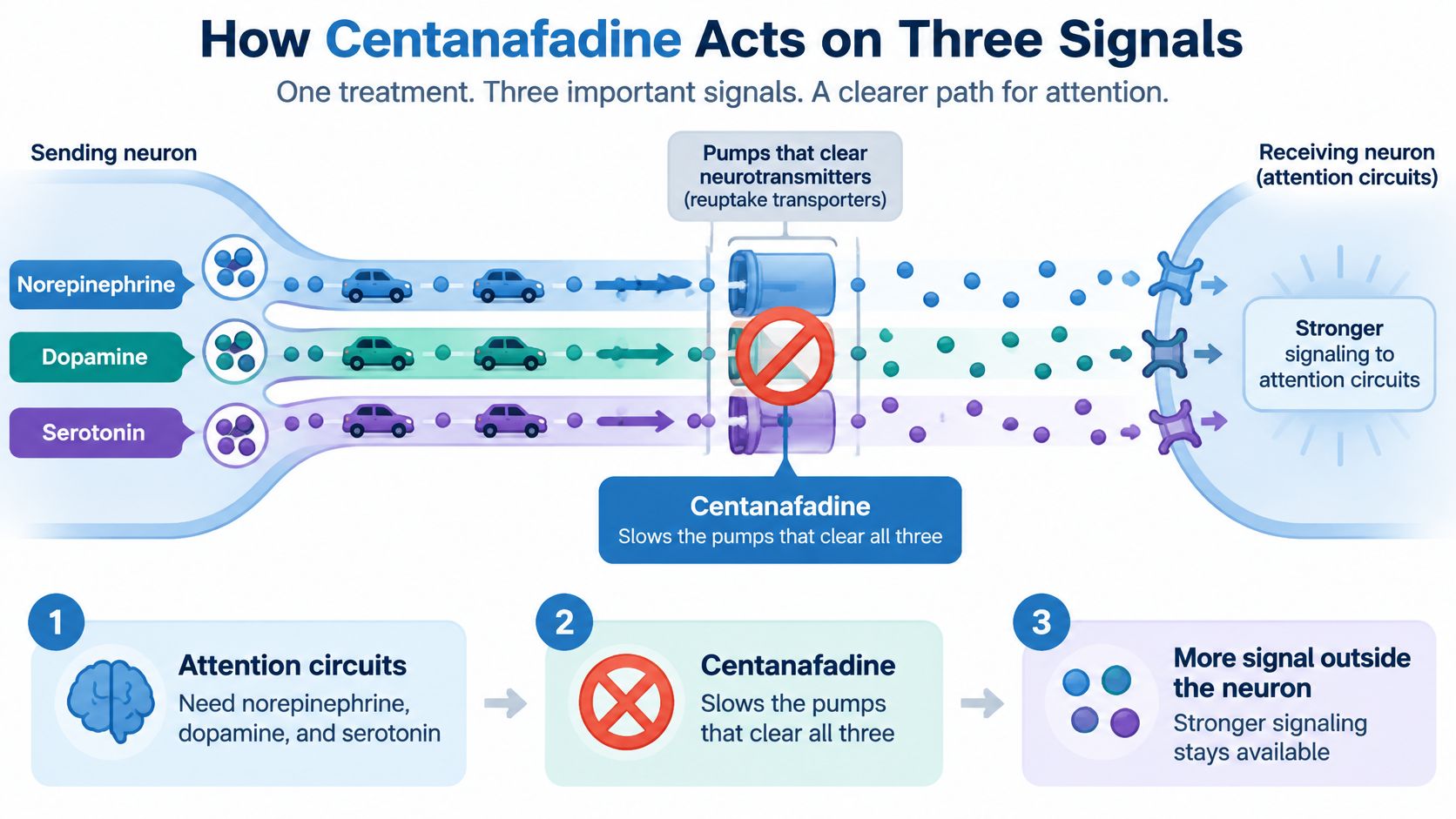
Think of communication between nerve cells as traffic moving through an intersection. Chemical signals carry messages, while transporter proteins act like pumps that clear those signals from the space outside the cells.
Centanafadine slows the pumps for norepinephrine, dopamine, and serotonin. Their names are the norepinephrine transporter (NET), dopamine transporter (DAT), and serotonin transporter (SERT). Slower clearance allows more of each signal to remain available outside the neuron.
This illustration shows the basic idea, not a guarantee of symptom improvement.
Three targets don't mean equal strength
The laboratory measurements aren't balanced: a medicinal chemistry review reports inhibitory concentrations of approximately 6 nM at NET, 38 nM at DAT, and 83 nM at SERT. Lower values indicate greater potency, giving an approximate relationship of 1:6:14, with the strongest activity at norepinephrine transporters.
The proposed effects include increased norepinephrine and dopamine in the prefrontal cortex, which supports working memory and impulse control, and increased dopamine in the striatum, as described in this pharmacology overview.
This helps explain the drug's design. It doesn't prove centanafadine works better than a stimulant, treats more conditions, or produces fewer side effects. Understanding why stimulants help ADHD also makes clear why different medication classes can affect overlapping signaling systems.
What happens after a dose
The same medicinal chemistry review reports an oral peak at approximately 5 hours, steady state by approximately day 2, and modest accumulation of 1.2–1.3-fold. It reports an elimination half-life of approximately 5.2 hours, apparent clearance of approximately 410 mL/min, and recovery of approximately 88% in urine versus 7% in feces.
These are measurements of exposure and elimination, not a timetable for when someone will feel focused. Steady state doesn't mean full clinical benefit. Likewise, a blood concentration peak doesn't necessarily identify the moment of greatest symptom improvement.
Practical implication: A relatively short elimination half-life and a sustained-release formulation answer different questions. Release controls how medicine enters the body; elimination describes how the body removes it. Missed doses, dosing schedules, and kidney function therefore need clinical attention.
Blocking several monoamine transporters also creates interaction concerns. An MAOI overlap is particularly dangerous, not a combination to experiment with.
What the Phase 3 ADHD Trials Found
The clearest way to read the results is as a dose question. Higher pediatric doses carried the positive findings; lower doses did not stand on their own.
Group | Study snapshot | Dose | Main 6-week result | What it means |
|---|---|---|---|---|
Adults | 200 mg daily | About 3.12 points better than placebo | ||
Adults | Same adult program | 400 mg daily | AISRS drop 9.73 versus placebo 6.98 | About 2.75 points better; no added numerical advantage over 200 mg |
Adults versus methylphenidate ER | Published assessment, separate from the primary placebo trials | Compared regimens | Reported a statistically significant AISRS difference | Treat it as a comparative signal with limits, not direct head-to-head randomization |
Adolescents 13–17 | 328.8 mg | ADHD-RS-5 change −18.50 versus placebo −14.15, p=0.0006 | High dose met the primary endpoint | |
Adolescents 13–17 | Same trial | 164.4 mg | Did not meet the primary endpoint | Low dose didn't demonstrate benefit on its own |
Adolescents combined | Both active doses | p=0.0099 | High-dose result supported the positive combined analysis | |
Children 6–12 | NCT05428033 | High dose | Met the primary endpoint | High dose demonstrated benefit |
Children 6–12 | Same trial | Low dose alone | Did not reach statistical significance | Same dose-dependent pattern as teens |
Children combined | High and low averaged | Both active doses | Positive overall analysis | The averaged result masks the weaker low-dose finding |
Centanafadine Phase 3 results by age and dose.
Adults showed benefit without a higher-dose advantage
The adult program was substantial, not an early exploratory experiment. The published assessment reports assignment of 301 participants to the lower-dose regimen, 303 to the higher-dose regimen, and 302 to placebo, with a safety population of 876.
Participants received treatment after a run-in period. The reported adult rating-scale reductions favored centanafadine over placebo, and Clinical Global Impressions–Severity scores improved in the same direction.
The higher adult dose still failed to produce a larger numerical symptom improvement than 200 mg in the results summarized above. That pattern argues against assuming dose escalation automatically buys more benefit, while leaving open why an individual patient might need adjustment.
The separate methylphenidate assessment found a statistically significant rating-scale difference. It should stay in context: a comparative assessment can suggest a difference without proving one medicine fits every adult better.
Lower pediatric doses missed their endpoints
The adolescent publication reports 155 participants assigned to each active-dose group and 149 to placebo. Of those enrolled, 451 received a dose and 371 completed the study.
A useful analogy is averaging two test scores. Pairing a strong score with a weak one can produce an acceptable average, even when one score would fail by itself. A combined-dose analysis works similarly: averaging active groups can look positive while the lower dose misses its own endpoint.
Both pediatric studies showed that distinction. The higher-dose groups demonstrated statistically significant benefit, while the lower-dose groups didn't independently establish it. That finding helps set expectations, and it still leaves the real-world question of which dose a particular child would eventually need to a clinician.
What rating-scale improvement means
AISRS and ADHD-RS-5 scores organize symptom changes into measurable totals. They don't directly answer whether someone completed homework independently, stopped missing appointments, or maintained attention through a work meeting.
A statistically significant result supports a treatment effect under study conditions. It doesn't promise that every patient will notice enough improvement to justify treatment. The Phase 3 ADHD findings also leave anxiety outcomes unaddressed here, so relief of worry, tension, or coexisting anxiety remains a separate clinical question.
For now, a practical conversation is narrow and useful: which symptoms matter most, what functional change would count as success, what dose was studied, and which side effects would make the benefit feel smaller.
Side Effects from Short and Year-Long Studies
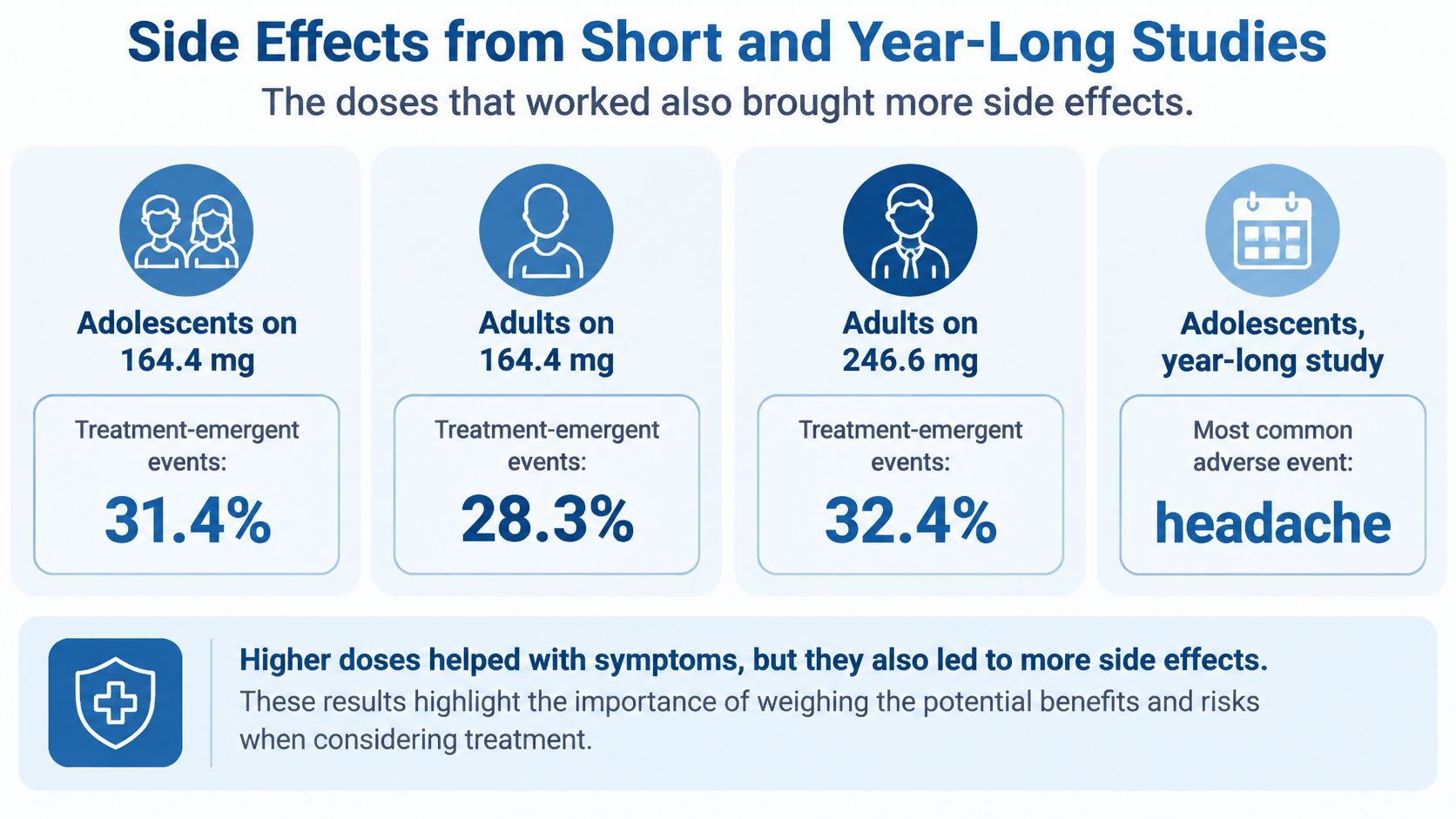
A nonstimulant label does not erase side effects. Centanafadine is still investigational, so the practical question is narrower than a headline: which effects appeared often enough in trials to matter if a clinician later has an approved label to work from.
Population | Exposure | Event rate | Often named effects or interpretation |
|---|---|---|---|
Adolescents, lower dose | Randomized trial | Above placebo and below the higher-dose group | Dose-related pattern; individual experiences differ |
Adolescents, higher dose | Same trial | Highest of the three adolescent groups | Benefit and tolerability rose together |
Adolescents, placebo | Same trial | Lowest of the three groups | Background rate for comparison |
Children across studies | Pooled pediatric reports | Not a single clean rate | Higher rates were generally observed at higher doses |
Adults, short-term studies | Phase 3 reporting | Not pooled into one clean rate | Decreased appetite and headache were commonly named |
Adults, 52 weeks | 61.4% (401 participants) | No placebo group, so causation isn't established for every event |
Rates are not interchangeable across age groups, doses and study lengths. A short randomized trial works like a controlled race with a finish line and comparison lane; a year-long open-label study works more like keeping a diary while everyone drives the same car, so more gets recorded and less can be blamed cleanly on the medicine.
What the longer study can establish
The adult year-long study is useful for persistence and late-appearing problems, but it cannot isolate drug causality the way a placebo arm can. Severe treatment-emergent events were uncommon in that cohort, and participants still discontinued over time, so the completion count should shape how strongly readers interpret every recorded event.
Treatment-emergent means the event occurred during treatment. Severe describes intensity; it is not automatically the regulatory category called serious. A year of observation gives headaches, infections, life stressors, and unrelated illnesses more chances to enter the record.
Sleep and anxiety findings need careful interpretation
A review of the adult development program names decreased appetite and headache, with insomnia, nausea, dry mouth and diarrhea also reported. The same review describes a 2025 matching-adjusted indirect comparison with methylphenidate showing risk differences of −9.46 percentage points for insomnia and −4.68 for initial insomnia.
Indirect is not head-to-head. Statistical matching across separate trials can suggest a direction, but it cannot reproduce random assignment to centanafadine versus methylphenidate in the same study. Anxiety is the bigger gap: the available reporting does not give patients a clean anxiety signal, so anyone with panic symptoms, trauma-related hyperarousal or severe baseline anxiety should treat “helped my focus” as different from “settled my anxiety.”
For context on a prescribed nonstimulant families already ask about, our guide to Qelbree side effects is useful, while centanafadine still needs its own approved labeling before its profile can be translated into routine care.
Track tolerability: Appetite, weight, sleep onset, headache and blood pressure deserve attention.
Track function: Record whether schoolwork, appointments or job tasks improve.
Report urgent symptoms: Chest pain, fainting, severe agitation or possible serotonin toxicity require urgent medical assessment, not self-diagnosis.
Centanafadine Next to Familiar ADHD Medicines
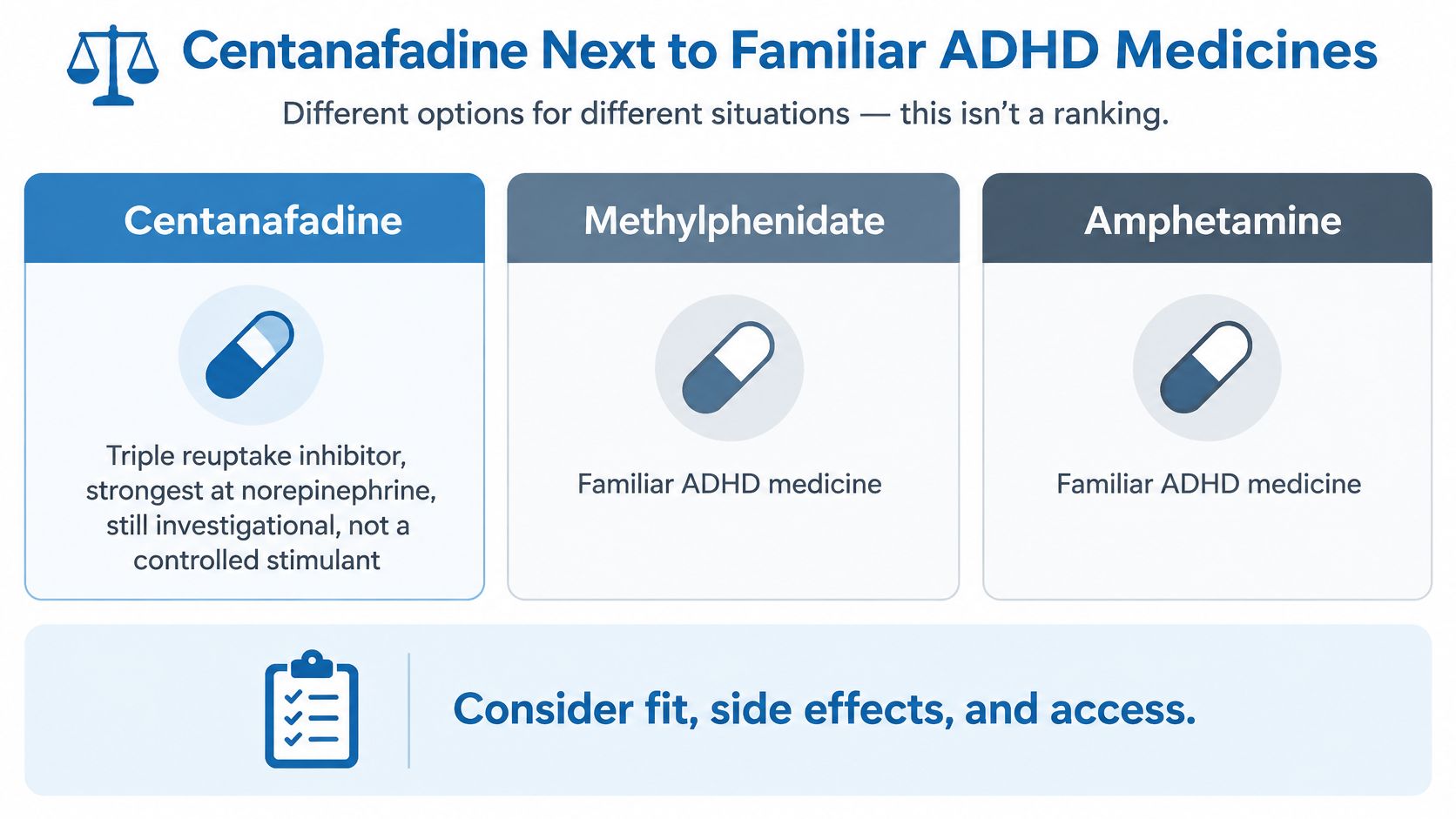
The useful comparison is fit for a particular patient, not a ranking from newest to oldest. An investigational mechanism doesn't establish superiority over medicines clinicians already know how to prescribe and monitor.
This comparison graphic introduces the treatment categories.
Compare the clinical decisions
Medicine | How it acts | US status for ADHD | Controlled substance | Practical difference |
|---|---|---|---|---|
Centanafadine | NET, DAT, and SERT inhibitor, strongest at NET | Investigational | No approved product classification to use for prescribing | Cannot be routinely prescribed without approval and labeling |
Methylphenidate ER | Dopamine and norepinephrine reuptake stimulant | Approved | Yes | Effects can occur on the day taken; sleep and misuse concerns need attention |
Amphetamine products | Stimulant releasing and reuptake effects | Approved | Yes | Appetite, sleep, cardiovascular history, and diversion require a plan |
Atomoxetine | Selective norepinephrine reuptake inhibitor | Approved nonstimulant | No | Benefit develops over time; liver-injury and suicidal-thought warnings matter |
Viloxazine ER | Norepinephrine-modulating nonstimulant | Approved for pediatric patients and adults | No | Adult approval shouldn't be overlooked when comparing options |
Bupropion | Norepinephrine and dopamine reuptake inhibitor | Not FDA-approved for ADHD; sometimes used off label | No | Depression may affect selection; seizure risk matters |
Viloxazine ER isn't limited to pediatric treatment. Any comparison that describes it as unavailable under adult ADHD labeling needs correction. Likewise, describing centanafadine as nonstimulant shouldn't be treated as a guarantee of its eventual controlled-substance classification.
Nonstimulant doesn't mean mild, risk-free, or automatically better for anxiety.
For someone whose stimulant works well and is tolerated, novelty alone isn't a reason to switch. For someone with persistent appetite or sleep problems, a medication review may identify an approved alternative without waiting for another product.
A substance-use history requires individualized assessment rather than an automatic rule. The clinician needs to understand the substance involved, current stability, treatment history, and how medication would be stored and monitored.
Choose the problem to solve first
A comparison of Adderall and Strattera illustrates how different treatment approaches can serve different needs. The conversation should include daily demands, previous trials, coexisting conditions, and what the patient considers an unacceptable side effect.
This video provides another format for considering ADHD treatment choices.
The available centanafadine evidence doesn't establish randomized head-to-head superiority against atomoxetine, viloxazine, or amphetamines. An indirect sleep comparison can't fill that gap.
Nor should serotonin activity be interpreted as proof of antidepressant benefit. Centanafadine isn't an established depression treatment, and ADHD rating-scale gains don't demonstrate improvement in depression.
The better question is specific: are we trying to improve focus, preserve appetite, protect sleep, reduce misuse risk, or address another diagnosis? Different answers can lead to different treatment choices.
Who Might Be a Candidate and What to Ask
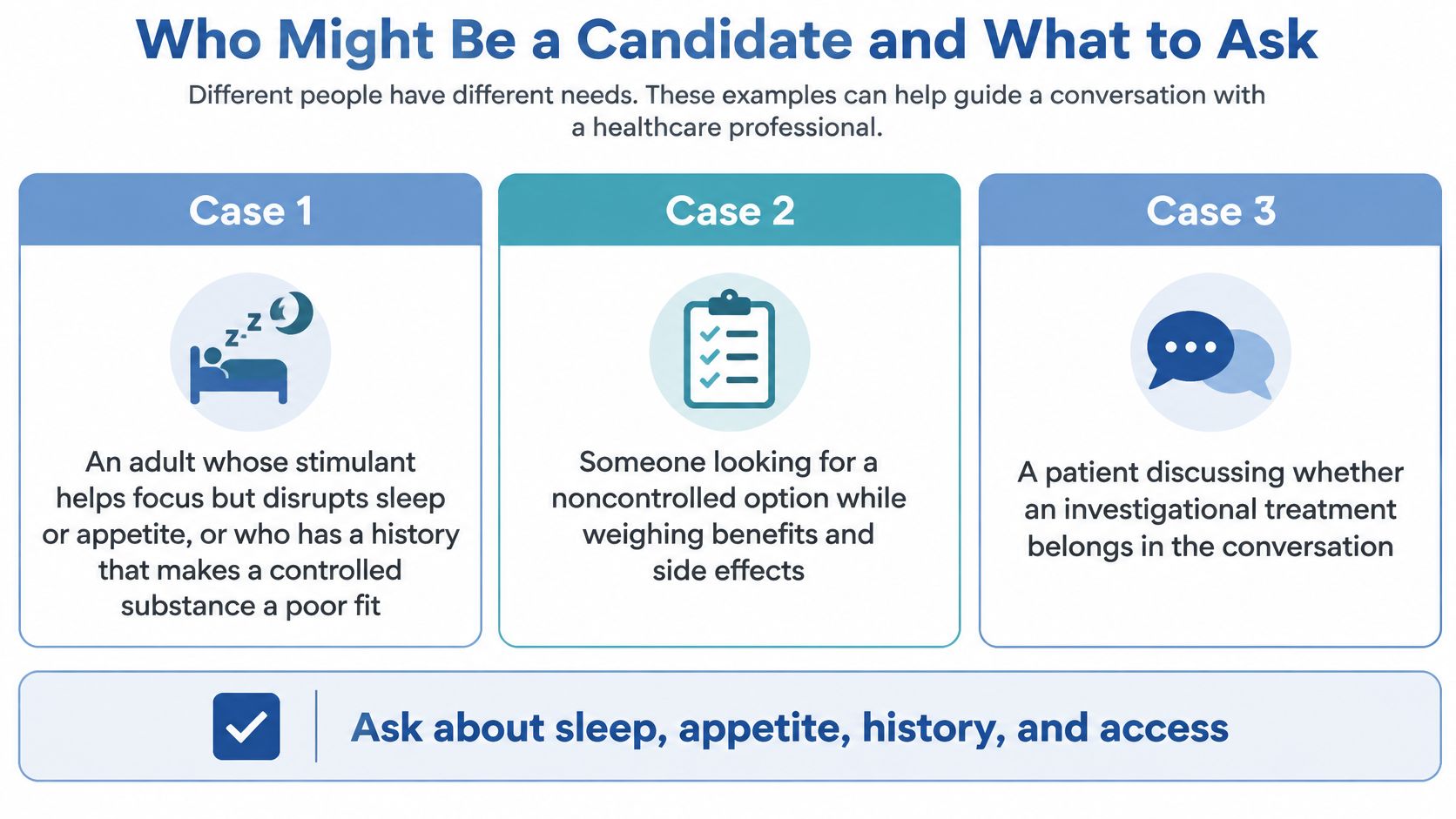
Nobody can receive a routine centanafadine prescription based on a promising patient profile alone. These scenarios identify useful conversations, not eligibility guarantees.
An adult with benefit and burdens
Your stimulant helps you organize work, but eating and sleeping have become difficult. Bring a record of the benefits alongside the problems, including when they happen relative to medication.
The first task is to review the current regimen and available alternatives. A future treatment should solve a defined problem, not merely replace a medicine because its name is newer.
A parent considering future options
A parent may reasonably want an alternative after a child has had an incomplete response. The pediatric dose findings mean that cautious dosing and demonstrated efficacy aren't automatically the same thing.
Any future use would require clinician-directed titration and monitoring. Parents would need to weigh possible benefit against the possibility that a tolerated dose isn't effective, or an effective dose isn't tolerated.
These consultation scenarios can help organize that discussion.
An adult hoping to treat ADHD and anxiety together
Enthusiasm requires the clearest limit. The public listing for study 405-201-00180 identifies 315 participants with ADHD and comorbid anxiety and trial dates spanning March 2025 to April 2026, but it doesn't report comparative anxiety, functional, or tolerability outcomes.
Enrollment isn't an outcome. The listing doesn't tell patients whether anxiety improved, stayed unchanged, or worsened.
Centanafadine therefore shouldn't be presented as an established anxiety treatment. Psychotherapy may still be necessary, and treating anxiety first can be appropriate when anxiety is the main source of impairment.
Medication history is a safety requirement
The reviewed monoamine interaction precautions prohibit concurrent MAOI use or starting centanafadine within 14 days of discontinuing an MAOI because of hypertensive crisis and serotonin syndrome risks. This isn't a washout schedule to manage yourself.
Disclose other serotonergic medicines, blood-pressure treatments, supplements, and kidney disease. A prescriber needs the complete list, including medications taken only occasionally.
Bring these questions to an evaluation:
Diagnosis: Is ADHD the best explanation for my difficulties?
Current choices: Which approved option fits my history first?
Future decisions: What would an approval change?
Stopping criteria: Which adverse effects would make us reconsider treatment?
Coexisting symptoms: How will we track anxiety and sleep separately from attention?
Schedule an ADHD Evaluation in Florida
Centanafadine is still investigational, so care starts with what is available now. An evaluation works like a map: it shows where symptoms interfere before anyone chooses the treatment route. That matters because trial benefit appears dose-dependent, anxiety outcomes are still missing, and headlines can make a future option sound closer than it is.
At Refresh Psychiatry & Therapy, ADHD assessment uses evidence-based tools and a full review of history, symptoms, and impairment to diagnose ADHD. A personalized plan may include therapy, medication management, and coping strategies. The aim is a plan that helps this month, while still leaving room to reconsider centanafadine if approval and prescribing guidance later make it relevant.
Prepare for a useful evaluation
Come with concrete examples of impairment: missed deadlines, unfinished chores, losing track mid-conversation, trouble starting tasks, or bills that pile up despite intention. Note when the pattern began, which settings trigger it, and what already helps or backfires. If prior treatments were tried, describe the dose, benefit, side effects, and reason for stopping in plain terms.
Our guide to adult ADHD testing explains the assessment process. To see how clinicians organize history, symptoms, and clinical impressions, the annotated assessment notes from PatientNotes offer a useful documentation example rather than a self-diagnostic checklist.
Bring one observable goal. “Finish work assignments before deadline” is easier to measure than “focus better,” and it gives treatment a target.
Coordinate care around your circumstances
Justin Nepa, DO, FAPA, an adult and addictions psychiatrist, co-founded Refresh Psychiatry and Therapy and serves as its Medical Director. The practice is telemedicine-only, with HIPAA-compliant video visits for patients physically located in Florida.
A visit can review cardiovascular history, blood pressure information, previous medication response, therapy needs, sleep, mood, and anxiety. That broader picture keeps attention problems from being treated in isolation. It also creates a baseline, which is what a clinician would need if centanafadine ever becomes an option worth comparing against approved medicines.
The immediate goal is a workable plan for current symptoms. Refresh Psychiatry & Therapy is in-network with major insurers such as Aetna, Blue Cross Blue Shield/Florida Blue, Tricare, UnitedHealthcare/UMR, Cigna, Humana, AvMed, and Oscar Health, and self-pay is available. Use the contact form on the Refresh Psychiatry & Therapy website to schedule your evaluation.
This blog is for informational purposes only and does not constitute medical advice. Please consult a qualified mental health professional for personalized guidance.