
🧠 Body Doubling ADHD: A Practical Guide That Works

You know the feeling. The laptop is open, the document is blank, and the cursor keeps blinking like it's daring you to begin. You might clean your desk, refill your water, check one notification, and still not touch the thing you meant to do, until someone sits nearby or joins you on camera and suddenly your brain can move.
That pattern is common in body doubling ADHD work. The point isn't that another person lectures you, coaches you, or micromanages you. The point is that a quiet, visible presence can make the first step feel less impossible, which is why body doubling has spread through ADHD communities and is now showing up in clinical conversations too. If you want a broader look at strategies for executive dysfunction, that can be a useful companion read, and if you're also trying to build steadier routines, mindfulness and wellbeing can help you pair structure with self-regulation.
The Moment You Can Finally Open the Document
A patient once described it to me exactly this way, “I can write the email if someone else is in the room. If I'm alone, I'll stare at it for an hour.” That's the core experience body doubling tries to address. The task doesn't become easy, but it becomes startable.
Why the struggle is real
This is not a character flaw, and it isn't proof that you're lazy. Task initiation is an executive-function problem, which means the brain has trouble converting intention into action when the task feels boring, ambiguous, emotionally loaded, or just too open-ended. Body doubling lowers the activation barrier by adding another human into the environment without demanding conversation or teaching.
The idea has moved from internet folklore into the clinic partly because it's cheap, accessible, and easy to test in real life. It can be in-person, virtual, synchronous, or app-based. It can help with studying, chores, organizing, writing, or the kind of paperwork that grows teeth.
Practical rule: use body doubling when the problem is getting started, not when the problem is lack of knowledge. If you know what to do but can't begin, this tool may help.
What you should expect from this guide
You'll get a plain explanation of what body doubling is, what the research shows, which formats have the least friction, and how to run a session that doesn't turn into a hangout. You'll also see where the tool falls short, because body doubling can support action, but it doesn't replace assessment, therapy, or medication management when those are needed.
For readers who want a clinician-oriented overview of ADHD care, Refresh Psychiatry's ADHD information is a practical place to start. The same principle applies here, helpful supports are most useful when they're matched to the problem, not the most popular label.
What Body Doubling Actually Is
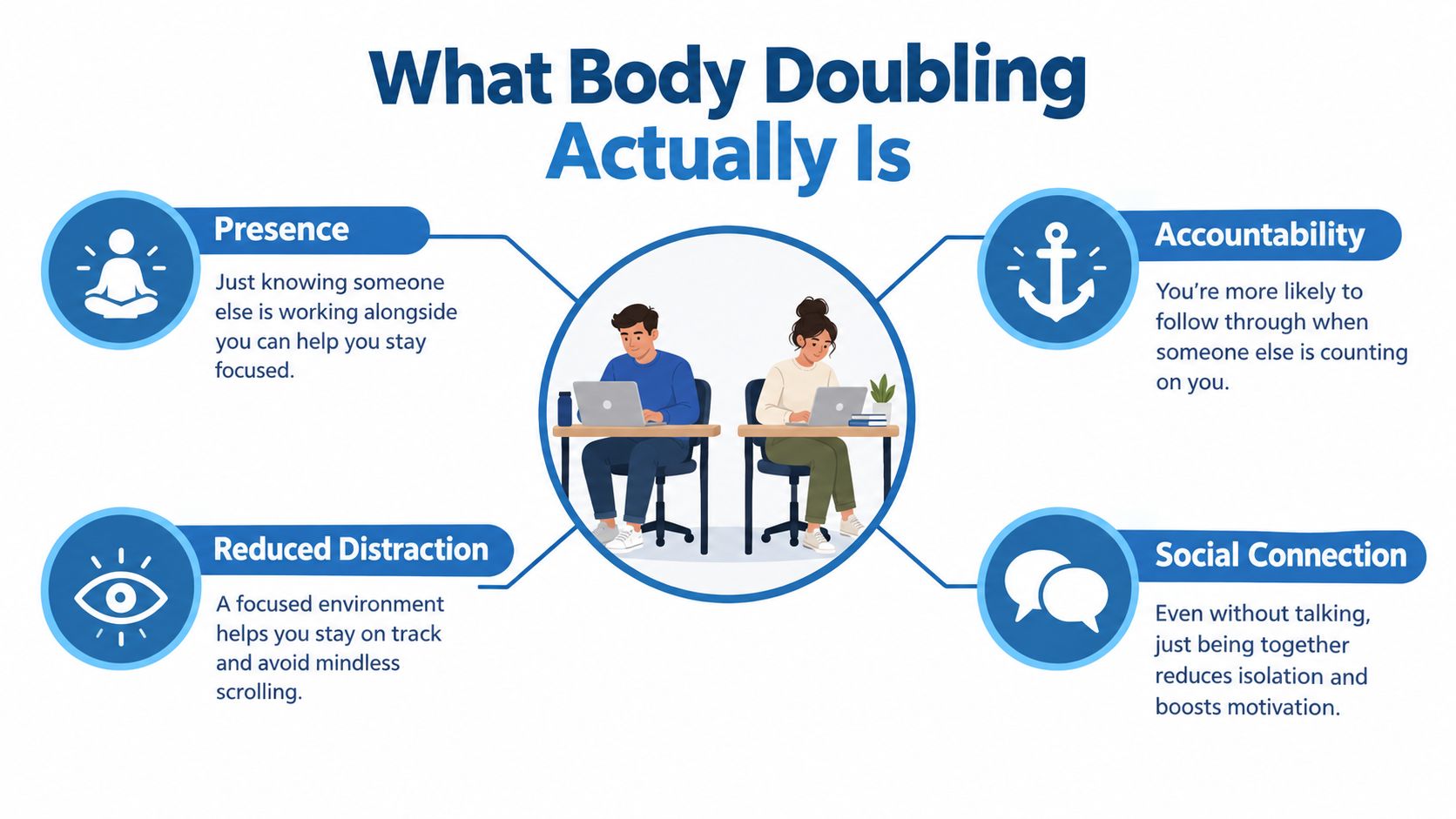
Body doubling is simple on the surface. You work on your own task while another person is present, physically or virtually, doing their own thing. They don't have to coach you. They don't have to talk. They just have to be there in a way your brain can register.
The four mechanisms people usually feel
The best way to understand it is to think of a running partner. Some people sprint better when somebody else is running beside them, not because that person pushes them, but because the presence changes the tempo and commitment. Body doubling may work in a similar way through social facilitation, external accountability, reduced anxiety about starting, and the structure created by a scheduled block.
That said, those mechanisms remain theoretical. The available literature describes them as plausible explanations, not settled facts. In other words, body doubling may help because another person makes the task feel more real, more bounded, and less lonely, but researchers have not proven which ingredient matters most.
It is not the same as coaching or tutoring
An accountability partner might check in before and after a task. A tutor explains the content. A coach helps you plan, troubleshoot, and reflect. A body double shares space while you work. That difference matters, because ADHD users often call all of these things “body doubling” even when the function is completely different.
Support | Who drives the task | Who talks | Best for |
|---|---|---|---|
Body doubling | You | Usually no one during work time | Starting, staying with, and finishing a task |
Accountability partner | You, with check-ins | Briefly before or after | Follow-through and deadlines |
Tutor | The tutor | A lot | Learning new material |
Coach | Shared, guided by the coach | Often yes | Planning, patterns, habits |
The cleanest mental model is this, body doubling is quiet copresence for execution, not instruction for skill-building. That's why it can feel surprisingly powerful for an avoided task and still be the wrong tool for a problem that needs diagnosis, treatment, or a different kind of support.
What the Research Actually Shows
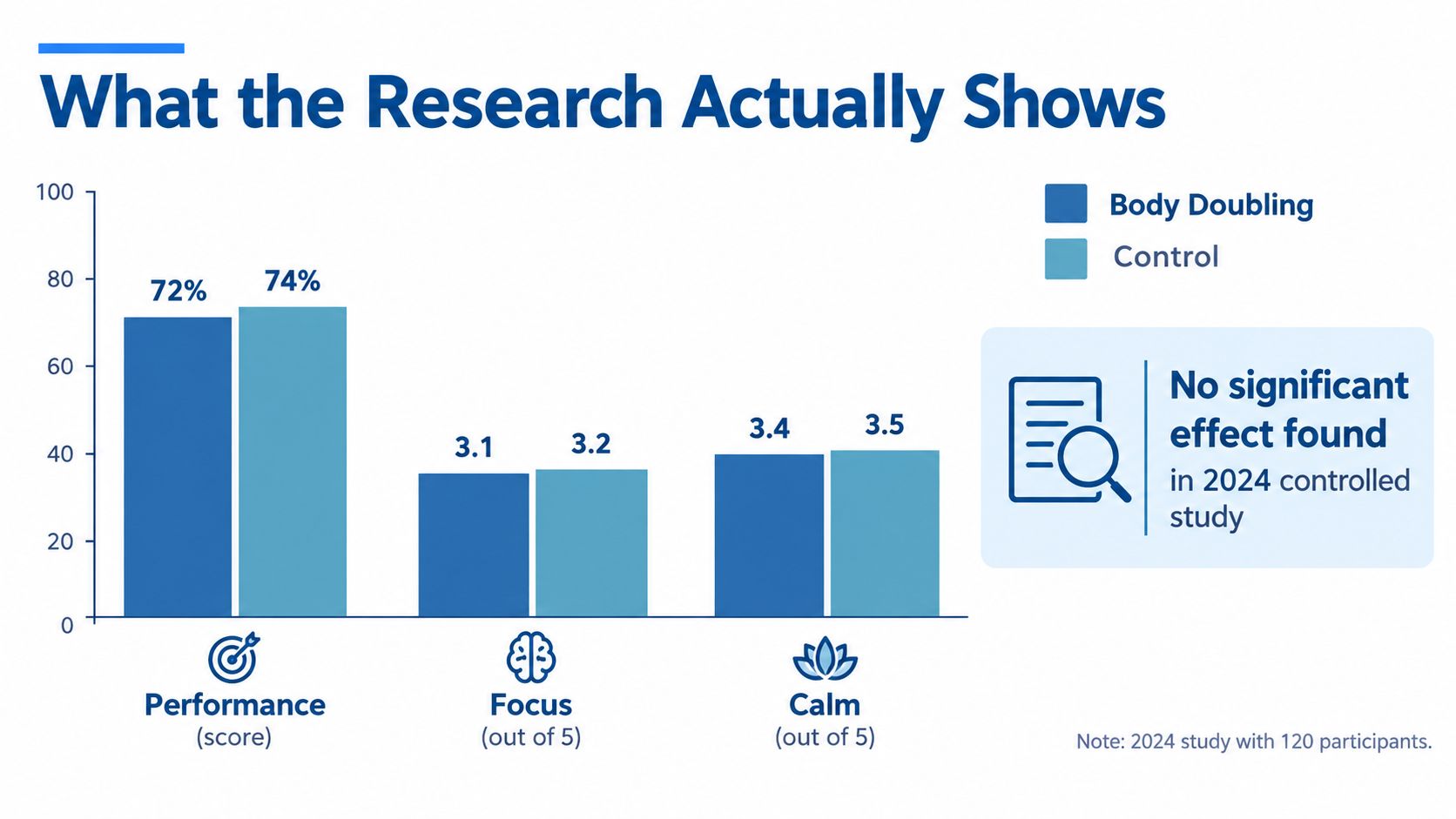
The research base is still early, and it's important not to dress that up as certainty. A controlled 2024 study found no significant overall effect on performance, focus, or calm. That matters because it tells us body doubling is not a universal switch you can flip and expect the same result every time.
Why a negative study doesn't close the door
The task in that study was a standardized exam-like setting, and that may not be the purpose of body doubling. Many patients use it for something more specific, getting through a task they've been avoiding, especially when the task feels personal, vague, or emotionally loaded. A reading-comprehension exam is not the same psychological problem as opening tax forms or starting a neglected report.
A separate virtual-reality study with 12 participants reported faster completion and higher perceived accuracy and sustained attention when participants worked with a human or AI body double compared with no double. That is encouraging, but the sample was very small, the task was simulated, and there were no clinical outcome measures. It supports further study, not a treatment claim.
What the student survey adds
A survey of approximately 1,600 college students across seven campuses during the 2022 to 2023 academic year found that about 10% of respondents had ADHD, and accountability was the main reason students with ADHD gave for studying or working with someone else. Reported performance gains were modest, which fits the practical clinical picture, body doubling may help you start, but it isn't a magic boost for every outcome.
The strongest interpretation is modest and useful. Body doubling looks like a plausible accountability and initiation aid, not a proven productivity cure.
If you want a tool that helps organize the workflow around attention rather than promising impossible transformation, task management built for your brain is a useful lens. For a broader set of ADHD resources, Refresh Psychiatry's resources page can also help you compare supports without treating any single one as enough on its own.
Comparing In-Person, Virtual, Coworking, and App Doubles
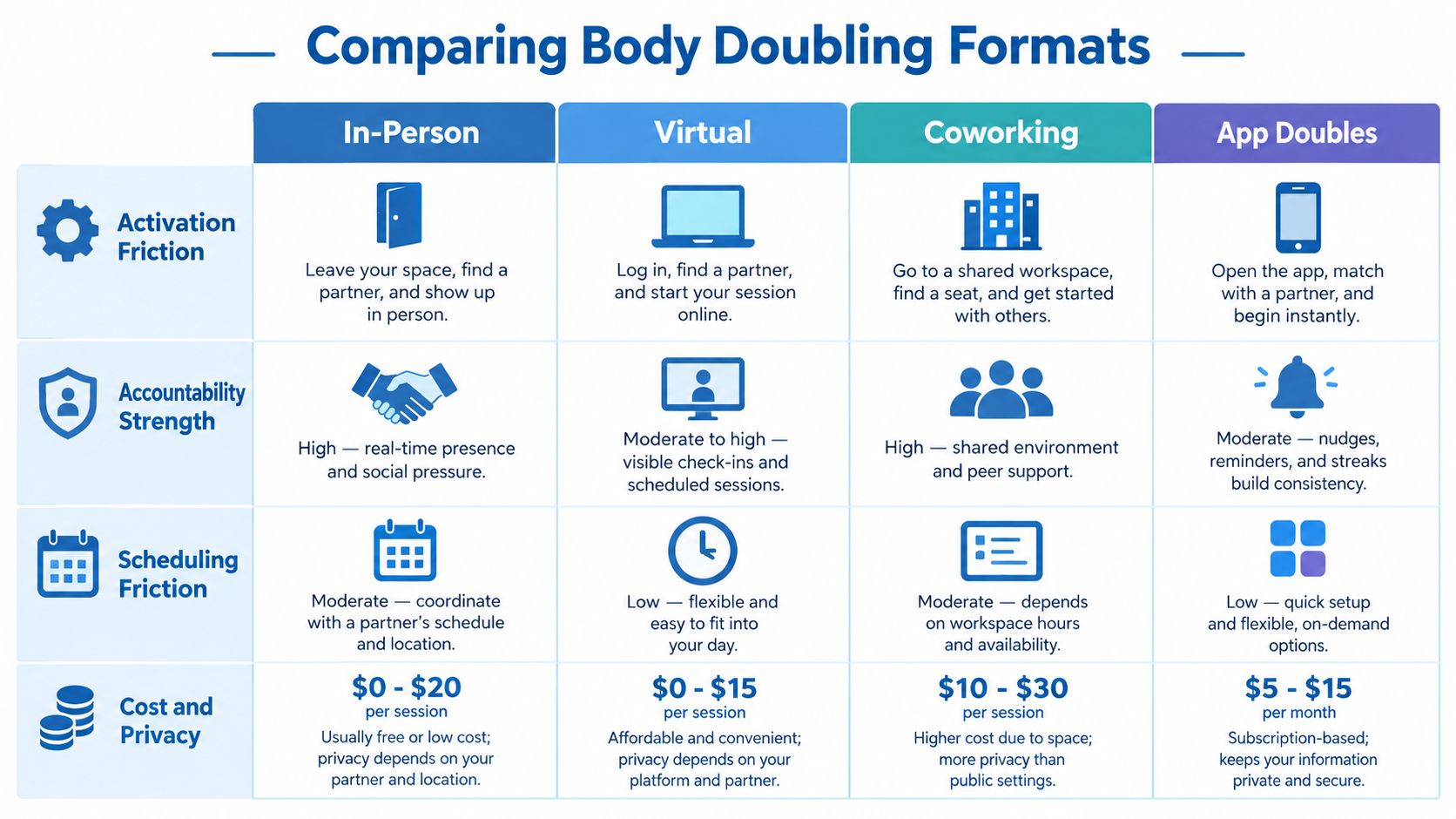
Choose the format that solves your real friction point. If getting started is hard because you feel isolated, one format may help. If the issue is privacy, distraction, or scheduling, a different format will fit better.
The trade-offs are not subtle
In-person doubling usually offers the strongest sense of presence and accountability. It also has the highest scheduling friction, because you have to be in the same place at the same time. For some people, that's worth it. For others, the logistics erase the benefit.
Virtual doubling is usually the easiest entry point. A video call can lower activation friction without requiring a commute or a shared physical space. The trade-off is that accountability is softer, and some people find the screen itself distracting if the arrangement isn't clearly structured.
Coworking sessions add a community feel, which can be motivating. They can also introduce social comparison, noise, and pressure, especially for people whose ADHD comes with anxiety or rejection sensitivity. If you find yourself performing instead of working, the format is probably too socially loaded.
App-based or AI doubles remove the need for another person to be available, which makes them convenient. They also reduce the social element that many people find helpful, and privacy becomes a more serious question because the experience is mediated through software.
The CDC reported that approximately 15.5 million U.S. adults, or 6.0%, about 1 in 16, had a current ADHD diagnosis in 2023, and worldwide adult ADHD symptom prevalence sits at approximately 2% to 5% (CDC summary). Those numbers help explain why low-cost supports like a scheduled coworking session, video presence, or an accountability partner get so much interest.
For people exploring virtual peer formats, Refresh Psychiatry's virtual support groups can be one option alongside informal or app-based setups. The right choice is the one that reduces friction without creating a new problem.
How to Run a Session That Actually Works
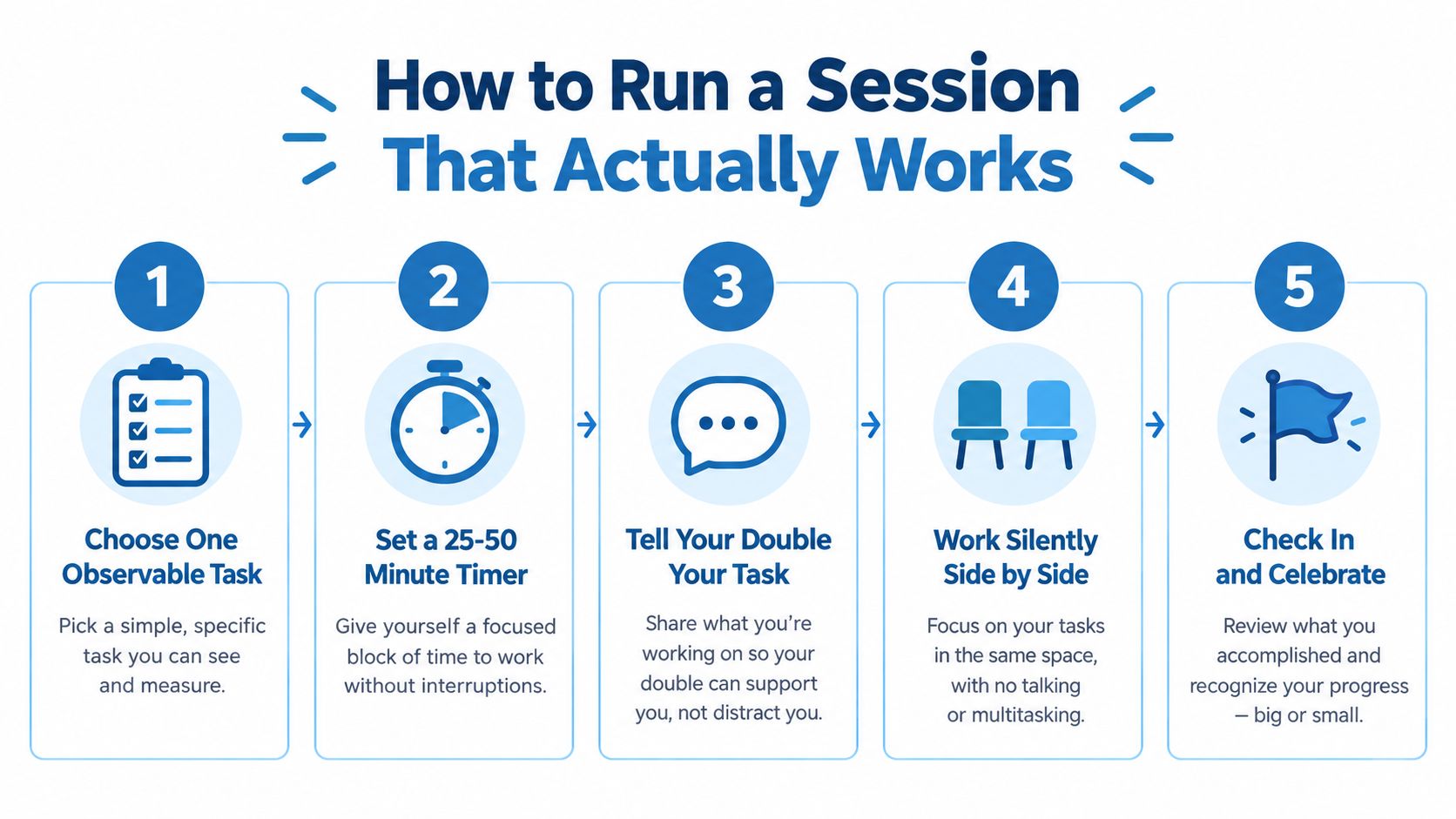
The best sessions are boring in a good way. They are short, specific, and quiet. If you want body doubling to help more often, stop treating it like a vibe and start treating it like a repeatable protocol.
A session that's too loose will drift
Start by naming one observable task. “Work on taxes” is too vague. “Upload three receipts” or “Draft the first paragraph” gives the brain a finish line it can see. That clarity matters because ADHD often improves when the task is concrete enough to recognize completion.
Set a 25- to 50-minute timer with a real stop time. Open-ended sessions tend to blur into socializing, avoidance, or passive scrolling. A timer makes the commitment finite, which lowers resistance before the session even begins.
Keep the conversation off during work intervals. If you talk the whole time, you may feel supported, but you often lose the activation state that makes the task possible in the first place. A brief check-in at the beginning and end is enough for many people.
Clinical rule of thumb: choose a partner whose presence is neutral, not exciting. If they're likely to chat, teach, flirt, compare, or check on your feelings, they're not really a body double.
A brain-computer-interface study comparing unmedicated ADHD participants, medicated ADHD participants, and neurotypical participants found no significant effect of body doubling on performance, self-reported focus, calm, or completion time during a reading-comprehension exam (CCSC poster). That's another reminder that standardized tasks may not capture everyday use cases, which is why the session design matters so much.
Use simple measures, not vibes
Try two to four sessions and compare initiation latency, completion time, and finished output. If the partner makes you more anxious, more performative, or more avoidant, modify the format or stop using it. If you need extra structure, focus timer for ADHD students can pair well with the session design, because the timer gives shape to the work block.
Refresh Psychiatry's therapy services can be a fit when body doubling is useful but not enough. Adjunctive tools and professional treatment often meet in practice.
Adapting Body Doubling for Kids, Students, and Caregivers
Body doubling can be adjusted for age, task, and setting. For children, begin with a manageable work period, reduce the number of competing distractions, and make restarting tomorrow feel predictable. The aim is steady progress and a workable routine.
For younger kids, keep it short and visible
A 10- to 20-minute block may suit a child better than a long work sprint. Choose a defined place, such as the kitchen table or a desk. The adult or sibling should sit nearby and complete a quiet task of their own, rather than monitoring every movement. Watching an adult begin and stay with a task gives a child a model to copy.
For example, during a 15-minute kitchen-table block, a parent might sort paperwork while the child reads two pages or completes a small set of problems. At the end, ask what was finished and identify the next small step. Keep correction brief unless safety or a clear instruction requires intervention.
Students need a setup that matches the task. A library may help when quiet presence supports concentration and the social environment feels manageable. A dorm room can work when the assignment is specific and distracting devices are put out of reach. Virtual sessions may suit students who find public comparison or crowded study spaces distracting.
Accountability helps more than company for its own sake. If a student needs help with anxiety, planning, or a grading problem, tutoring or coaching is a better fit than body doubling.
The purpose of the partner changes with age. A caregiver can provide structure for a child, while a student may prefer a peer who agrees on a start time and stays mostly quiet. In either case, set the task before the session, choose a clear stopping point, and avoid turning the block into a performance review. The survey summary describes accountability as a reason students use shared work, but the practical question is whether this arrangement improves starting and follow-through for that individual.
What parents can say to schools
Ask schools to provide parallel work rather than present body doubling as special treatment. A child might work near a calm peer or an adult during writing, independent reading, or homework start-up. Explain the request in terms of task initiation, sustained participation, and fewer distractions.
At home, a parent's visible routine can reinforce the same pattern. Sit down, begin your own quiet task, and let the child work beside you without constant prompts. If the child remains unable to start, becomes increasingly distressed, or needs more support than this arrangement provides, discuss the pattern with a qualified clinician or school professional.
Common Misconceptions and When to Stop
A lot of people give body doubling too much credit, then quit when it fails to do something it was never meant to do. It's a support, not a treatment. It can help with initiation and follow-through, but it doesn't diagnose ADHD, fix sleep disruption, or resolve emotional dysregulation.
Four misconceptions that cause trouble
First, more people does not automatically mean more focus. A group coworking room can help one person and distract another. If you feel pulled into conversation, comparison, or masking, the setup is working against you.
Second, any presence is not enough. A partner who comments, judges, or keeps breaking the quiet can increase avoidance. The point is low-interaction copresence, not social stimulation.
Third, body doubling does not work for everyone with ADHD. Task type matters, environment matters, and the relationship with the other person matters. The same person may do great with a virtual stranger for paperwork and poorly with a friend for household chores.
Fourth, if you need body doubling to start every task, that can be a signal that the underlying problem is bigger than task initiation alone. In that case, the tool isn't failing, it's just insufficient.
Stop or modify the format if you notice rising stress before sessions, more avoidance when a session is scheduled, or dependence on the other person in a way that's making you smaller instead of more capable. Those are signs to adjust the plan and consider a fuller evaluation.
When to Seek Professional Help and How to Reach Refresh
If body doubling helps you start but you still struggle with time blindness, emotional reactivity, sleep problems, procrastination that keeps spreading, or difficulty across school, work, and home, it is time for a professional assessment. Body doubling can support executive function, but it should not carry the whole load.
Refresh Psychiatry & Therapy is a Florida-based practice offering HIPAA-compliant telepsychiatry statewide for adults, children, and adolescents. The practice combines medication management with evidence-based therapy, including CBT, DBT, psychodynamic therapy, and trauma-focused care. It is staffed by board-certified psychiatrists and licensed therapists, and in-network plans include Aetna, United Healthcare/UHC, Cigna, Blue Cross Blue Shield, Humana, Tricare, UMR, Oscar, and others including AvMed and Florida Blue, with self-pay available.
If you want a direct next step, call (954) 603-4081 to schedule an evaluation. You can also review the practice at Refresh Psychiatry & Therapy, then decide whether body doubling should remain a standalone aid or become part of a broader care plan.