
🧠 Executive Dysfunction Explained and What to Do Next

You know the pattern already. The emails sit unopened, the project keeps getting postponed, the calendar fills with reminders you don't trust yourself to follow, and Sunday night turns into another reset that doesn't stick. That gap between knowing what needs to happen and getting it done is often what people mean when they say executive dysfunction.
Clinically, it's a description of impaired goal-directed behavior, not a single diagnosis. It shows up when the brain can understand the task, but can't reliably start, sequence, monitor, or finish it. If you want a plain-language primer alongside a clinical one, what is executive function disorder is a useful starting point, but the key question is why the gap exists and what helps.

When Knowing What to Do Is Not Enough
The most frustrating part is that the problem rarely looks dramatic from the outside. You can be intelligent, articulate, and fully aware of the consequences, yet still miss deadlines, lose track of steps, or spend an hour trying to begin a task that should've taken five minutes.
That's why executive dysfunction is so often mistaken for laziness, avoidance, or poor attitude. It's not that the person doesn't care. It's that the system for turning intention into action isn't holding together when the task requires sustained self-direction, switching, or self-monitoring.
A better way to name the experience
The term has a long clinical history. The modern scientific roots trace back to Alexander Luria and later work by Tim Shallice and Donald Norman, who helped explain why routine habits fail when a situation demands deliberate control, plus Muriel Lezak's practical framing of goal formation, planning, carrying out plans, and effective performance psychiatric history review.
Practical rule: if someone can explain the plan but can't reliably launch it, the issue is often control, not comprehension.
That distinction matters because it changes the conversation from “Why can't you just do it?” to “What's interfering with follow-through?” It also helps explain why the same surface problem can appear in ADHD, brain injury, mood disorders, dementia, and frontal-lobe disease. The label is descriptive, but the cause is not always the same.
The Core Building Blocks of Executive Function
Think of the executive system as an air traffic controller, not a pilot. It doesn't do the flying itself, it keeps multiple signals organized so the right action happens at the right time, and it keeps distractions off the runway.
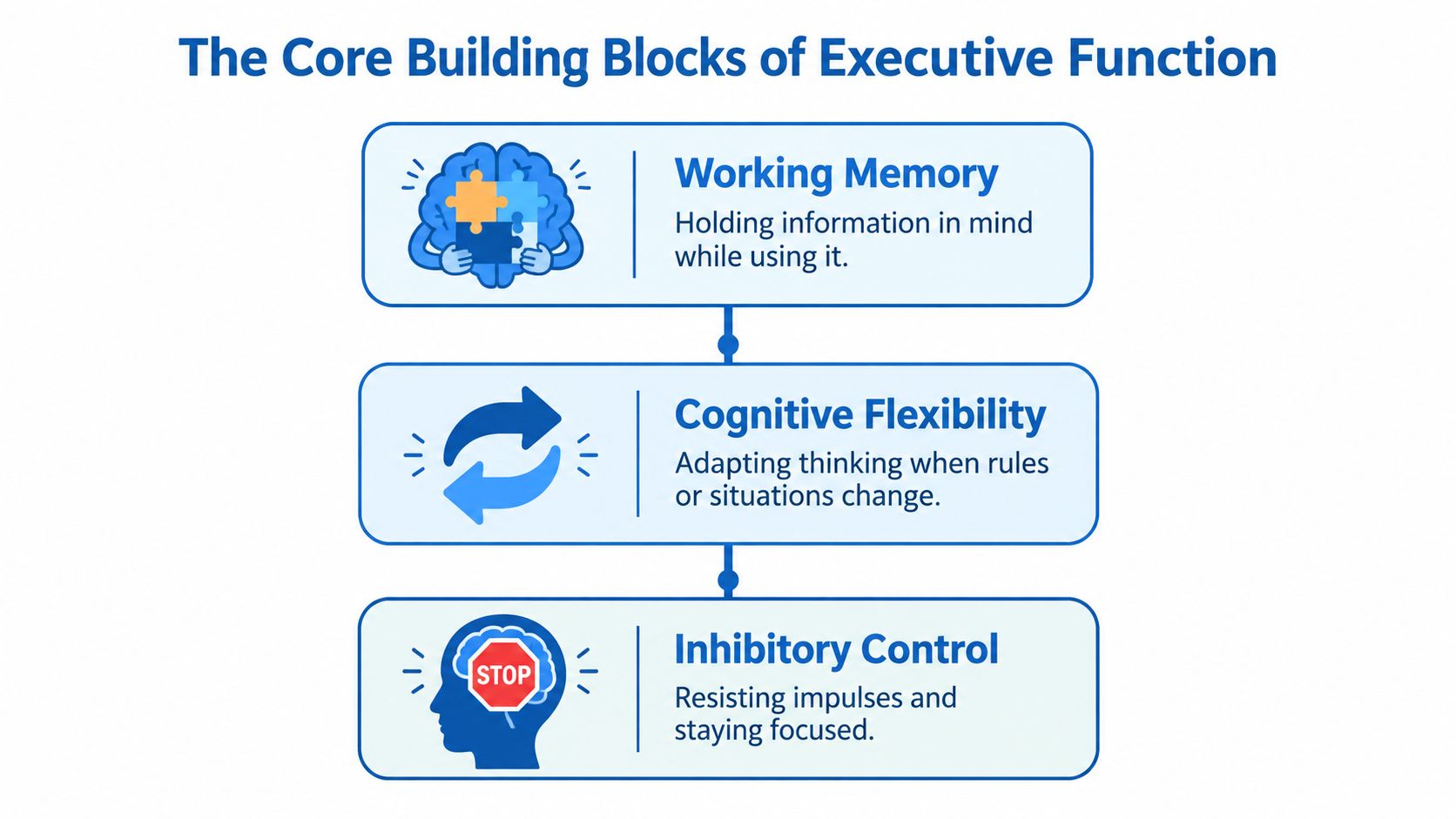
The most widely used framework breaks executive function into three core pieces, inhibition, working memory, and cognitive flexibility executive function framework. Inhibition helps you block a distraction or impulse. Working memory helps you keep relevant information active while you use it. Cognitive flexibility helps you shift when a rule changes, a plan fails, or a better option appears.
From core skills to daily life
Those three pieces show up in broader domains that patients notice. Planning is the ability to map a goal into steps. Task initiation is starting without a long internal argument. Organization is keeping materials, priorities, and time in usable order. Self-monitoring is catching errors before they snowball. Emotional regulation matters too, because a flooded nervous system can shut down the whole system.
A person may know exactly what needs doing and still miss the first step, forget the second step, or abandon the third step when frustration spikes. That's why executive dysfunction often feels like a gap between insight and execution.
Refresh Psychiatry's ADHD care is one place where these domains are assessed in the context of real-life impairment, not just symptom labels.
If a checklist helps only while it's in front of you, the checklist is doing the control work your brain can't reliably hold alone.
What Causes Executive Dysfunction and Why It Crosses Diagnoses
The same complaint can come from very different places. A student who can't start papers, a parent who loses track of appointments, and an adult who can't finish chores may all describe the same frustration, but the driver could be ADHD, depression, anxiety, PTSD, sleep loss, medication effects, traumatic brain injury, dementia, acute stress, or another neurological condition.
That's why symptom lists are useful only up to a point. They tell you what is happening, but not why. Clinically, the same frontostriatal and frontocortical systems are involved across these problems, so the surface behavior can look similar even when the underlying treatment plan should be different prefrontal cortex review.
Driver | Typical Pattern | What Improves With Treatment |
|---|---|---|
ADHD | Chronic inconsistency with initiation, follow-through, time management, and inhibition | Medication, skills support, structure, accommodations |
Mood or anxiety disorders | Focus collapses when mood, worry, or arousal is high | Treating the mood or anxiety condition, plus coping strategies |
Sleep problems | Slowed thinking, poor attention, low frustration tolerance | Sleep stabilization and related medical care |
Trauma-related conditions | Scattered attention, reactivity, shutdown, avoidance | Trauma-informed therapy and stabilization |
Neurological illness or injury | New or worsening planning, monitoring, or organization problems | Medical and rehabilitation-based evaluation |
The clinical mistake is to stop at the checklist. The better question is what changed, when it started, and whether the symptoms track with sleep, stress, medication timing, or environment. A person who functions better with outside structure may be dealing with executive load; a person who stays impaired even with support needs a deeper evaluation.
How Executive Dysfunction Shows Up Across Ages
A child may look oppositional when the underlying issue is transition difficulty. Homework comes home unfinished, the backpack is full of random papers, and a small change in routine turns into tears or anger. In adolescents, the same control problem often becomes missed deadlines, late-night cramming, and a pattern of saying “I'll do it later” until the pressure is unbearable.
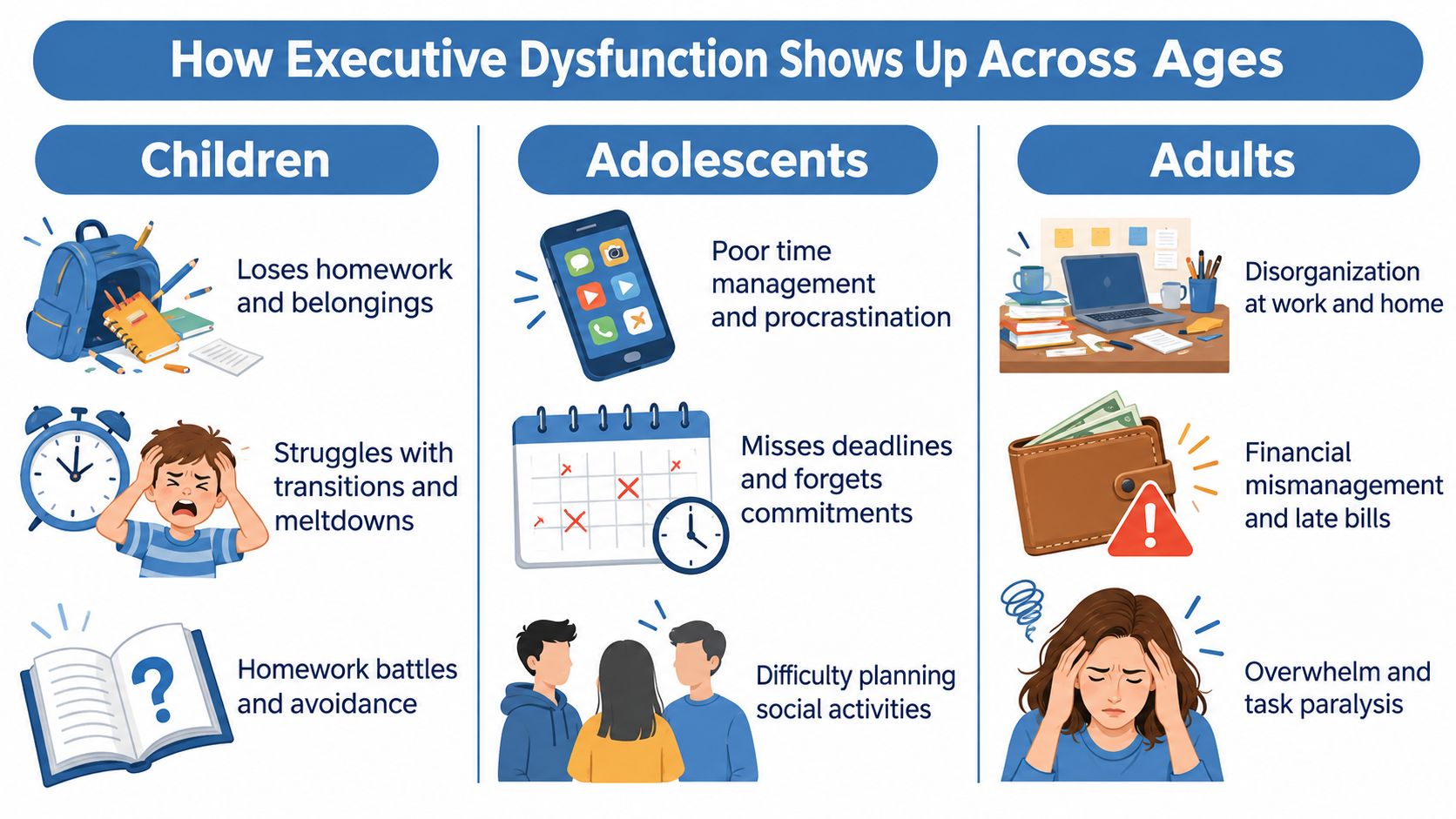
Adults usually feel it in the consequences. Bills get paid late, email piles up, errands turn into avoidance, and home repairs stay half-finished. The National Institute of Mental Health notes that adult ADHD involves difficulty in at least two life areas, such as home, school, or work, and that inattentive symptoms often persist while hyperactivity and impulsivity are more likely to decline NIMH ADHD guide.
Ordinary distractibility versus impairment
Everyone procrastinates sometimes. Clinically significant impairment is different because it repeats, it crosses settings, and it causes real disruption. The question is not whether someone ever forgets things, it's whether the pattern consistently interferes with school, work, relationships, or home life.
For families looking for age-specific support, child and adolescent psychiatry services can help sort out whether the issue is developmental, environmental, or part of a broader executive-control problem.
What a Real Clinical Assessment Looks Like
A good evaluation starts with a timeline, not a label. I want to know when the problem began, what was happening around that time, where it shows up, and what makes it better or worse. I also ask about sleep, mood, trauma, substance use, medical history, and medication timing, because any one of those can mimic or amplify executive dysfunction.

What to expect in a telepsychiatry visit
A first telepsychiatry evaluation usually runs as a structured conversation on a secure video platform. The clinician is listening for patterns, whether symptoms are chronic or new, whether they cluster around stress or sleep loss, whether there's impairment in more than one domain, and whether another condition better explains the picture. If you want a general overview of the process, how executive dysfunction is evaluated is a helpful example of how assessment often moves from symptoms to functional impact.
Refresh Psychiatry's psychiatric evaluation is one way to start that process in Florida without needing an in-person visit first. A good evaluation separates ADHD from a mood disorder, a sleep disorder, medication effects, or a neurological issue instead of treating all concentration problems as the same thing.
Evidence-Based Treatments and What to Expect
Treatment works best when it matches the driver. In youth ADHD trials, a systematic review found 136 studies involving 11,443 participants, with pharmacological approaches showing the strongest overall support and psychological and digital interventions also showing favorable, replicable outcomes, even though study methods varied systematic review. That doesn't mean every patient needs medication, but it does mean we shouldn't pretend lifestyle tips alone are enough for many people.
Medication, therapy, and support
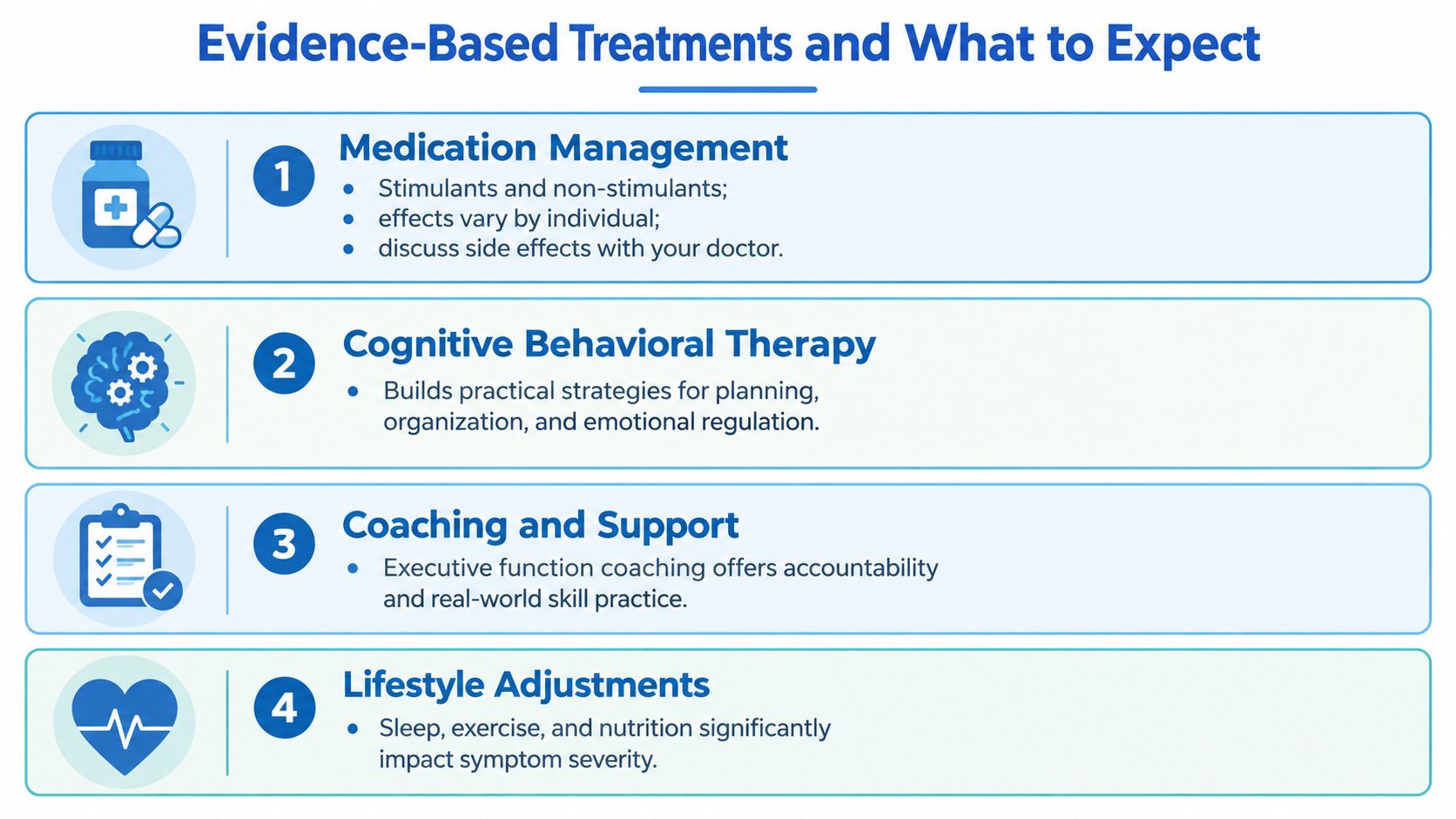
Medication can help reduce the friction that keeps someone from starting, shifting, or finishing tasks. In practice, that often opens the door for skills to work better. Medication management matters because it isn't just about symptom reduction, it's about whether a person can carry out daily responsibilities more reliably.
CBT and skills-based therapy are different from open-ended talk therapy. They focus on planning systems, follow-through, and emotion regulation in real situations. Coaching, parent support, and workplace accommodations can also reduce the burden on working memory and self-monitoring.
One important boundary: computerized cognitive training should not be sold as a stand-alone fix. A 2023 meta-analysis found no evidence supporting computerized cognitive training in its current forms as a standalone treatment for core ADHD symptoms meta-analysis. Better test scores also don't automatically mean better daily functioning, so the outcome that matters is whether appointments are kept, work gets finished, and the household runs more smoothly.
Daily Life Strategies That Actually Help
The most useful strategy is to externalize control. Don't ask the brain to hold what the environment can hold instead. Put the next action where you can see it, set prompts that fire by time rather than memory, and make the room less able to distract you in the first place.
Visible next actions: Write “open laptop and send the invoice” instead of “work on finances.”
Time-based prompts: Use recurring alarms for transitions, not just deadlines.
Body-doubling: Work beside another person, even in silence, so starting feels less isolated.
Checklists: Use a short list for repeat tasks like medications, leaving the house, or closing up work.
Immediate feedback: Mark the task done right away so progress is concrete.
Environmental design: Keep the phone out of reach, or turn off nonessential notifications while working.
These tools work because they reduce the amount of internal control needed at the moment of action. If performance improves when structure is added, that points toward executive load. If things still fall apart despite structure, the problem deserves a professional assessment, not more self-blame.
For people who want practical support with attention, routines, and behavior change, mindfulness and wellbeing support can be one useful piece of a broader plan.
When and How to Get Help in Florida
A patient who is missing deadlines at work, forgetting school pickups, or repeatedly losing track of household tasks should document the pattern before the appointment. Write down the onset, where the problem shows up, the practical consequences, sleep patterns, substance use, mood changes, medication timing, and what helps or worsens it. Bring examples from work, school, home, or parenting, because function matters more than vague frustration.
If you're in Florida and want a psychiatric evaluation, Refresh Psychiatry & Therapy offers telepsychiatry and medication management for adults, children, and adolescents, along with therapy when indicated. If family support is part of the picture, some people also compare psychiatric care with local resources like find autism treatment centers in Florida to understand the full range of help available.
We accept Aetna, UnitedHealthcare/UHC, Cigna, Blue Cross Blue Shield, Humana, Tricare, UMR, and Oscar insurance plans. Coverage details can change, so check the practice's current insurance information before booking and use the contact page to confirm what applies to you.
This blog is for informational purposes only and does not constitute medical advice. Please consult a qualified mental health professional for personalized guidance.
Contact us or call Refresh Psychiatry at (954) 603-4081 to schedule your evaluation. For additional coverage details, review the individual insurance pages linked from the practice site and reach out directly through the contact page. The first appointment is often the hardest part, but effective treatment exists, and the next step is straightforward.