
When to Stay on Antidepressants: A Practical Guide

🛌 When to Stay on Antidepressants: A Practical Guide
What should you do when you feel well, but the medication that helped you get there is still sitting on the counter?
Many people assume the answer is obvious. If symptoms have improved, stopping can seem like the natural next step. Others hear that depression can return and conclude they must stay on an antidepressant indefinitely. Both conclusions are too simple.
A patient might describe the same moment this way: “I'm sleeping again, functioning at work, and enjoying time with my family. Do I still need the prescription?” The clinically useful answer depends on what recovery means in that person's history, how stable the improvement is, what happened during previous attempts to stop, and what risks or side effects matter most now.
If you're still trying to understand the difference between ordinary sadness, depression, anxiety, and recurrence, a resource on depression and anxiety care can provide helpful background. You can also review common misunderstandings in this guide to antidepressant myths.
The Question Almost Every Patient Asks
A patient often arrives at this decision after a quiet improvement rather than a dramatic event. The panic has eased, the heavy mornings are less frequent, and family members say they seem more like themselves. Then the next refill appears on the calendar, turning medication from a routine into a question.
Feeling better is important, but it doesn't answer the whole question. A medication may have reduced symptoms while the person's vulnerability to another episode remains. That doesn't mean the person is permanently ill, and it doesn't mean treatment must continue forever. It means the timing of a change deserves the same care as the original treatment decision.
The useful question isn't “Can I stop now?” It's “What would make stopping reasonable and safe for me?”
A prescriber usually looks at several pieces together: whether the person has had one depressive episode or several, whether symptoms have fully resolved, how severe the earlier illness was, whether stopping previously led to deterioration, and whether current side effects are affecting quality of life. Preferences matter too. So do pregnancy considerations, other medical conditions, access to therapy, work demands, and the consequences of becoming unwell again.
The rest of this guide focuses on four practical issues: how long continuation usually lasts, which relapse-risk markers favor longer treatment, what research shows about stopping, and how a monitored taper works. For people receiving care through Florida telepsychiatry, follow-up isn't an afterthought. It can be scheduled around dose changes, symptom tracking, therapy, and a clear plan for urgent help.
The answer to “when to stay on antidepressants” is rarely “always” or “exactly six months.” It's a structured review with a prescriber, based on risk, benefit, stability, and the person's informed choice.
What Continuation, Maintenance, and Tapering Actually Mean
Clinicians use three terms to describe different points in antidepressant treatment. Understanding them prevents a common mistake: treating time on medication as the only factor that determines whether stopping is appropriate.
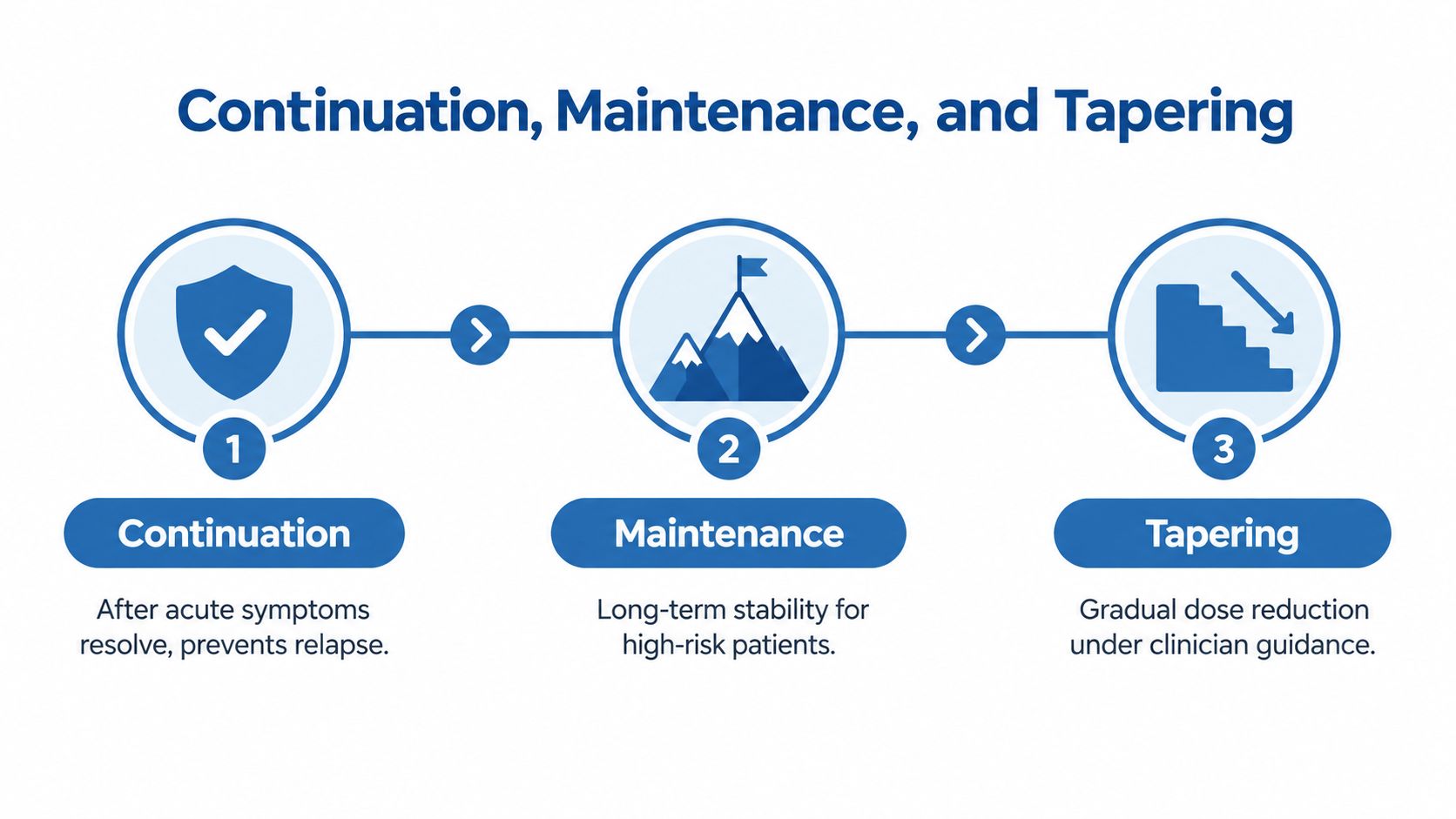
Continuation protects recent recovery
Continuation begins after acute symptoms improve or remit. The purpose is to protect the recovery from the same episode, because symptom relief doesn't necessarily mean relapse vulnerability has disappeared.
For adults with moderate-to-severe depression who benefited from initial treatment, the World Health Organization's guidance on antidepressant duration supports considering treatment for at least six months after remission. The timing begins after remission, not on the day medication starts. NICE similarly advises that treatment may need to continue for at least six months after symptoms remit, with ongoing medication reviewed at least every six months.
WHO also reports consistent evidence that continuation lowers relapse or recurrence risk across follow-up points from three through twelve months, and its guidance says medication generally shouldn't be stopped before nine to twelve months after recovery for adults who benefited from initial treatment. These recommendations can appear different because clinical guidance uses different ways to describe recovery and continuation. Your prescriber should clarify which milestone applies to your situation.
Maintenance addresses future episodes
Maintenance treatment looks beyond the episode that just improved. It becomes more relevant when someone has recurrent depression, persistent symptoms, severe previous illness, or substantial consequences when symptoms return.
For people at significant risk, NICE advises discussing treatment for at least two years, often maintaining the dose that produced remission unless adverse effects or another clinical reason supports a reduction. That doesn't mean every higher-risk patient must remain on medication indefinitely. It means the cost of relapse may justify a longer period of protection, with regular review.
Tapering is a treatment decision
Tapering is a planned reduction in dose. It isn't the same as skipping pills randomly or stopping when a refill runs out. A taper allows the prescriber and patient to observe whether symptoms reflect withdrawal, returning depression, or both.
A practical discussion of treatment timelines can be found in this guide to how long antidepressants should be taken. The central principle is simple: duration depends on treatment phase and relapse risk, not merely on how long the medication has been prescribed.
Risk Factors That Push You Toward Longer Treatment
Once remission has occurred, the decision becomes more individualized. A person with one episode, complete recovery, and no previous difficulty stopping may have a different risk profile from someone with multiple episodes and residual symptoms.
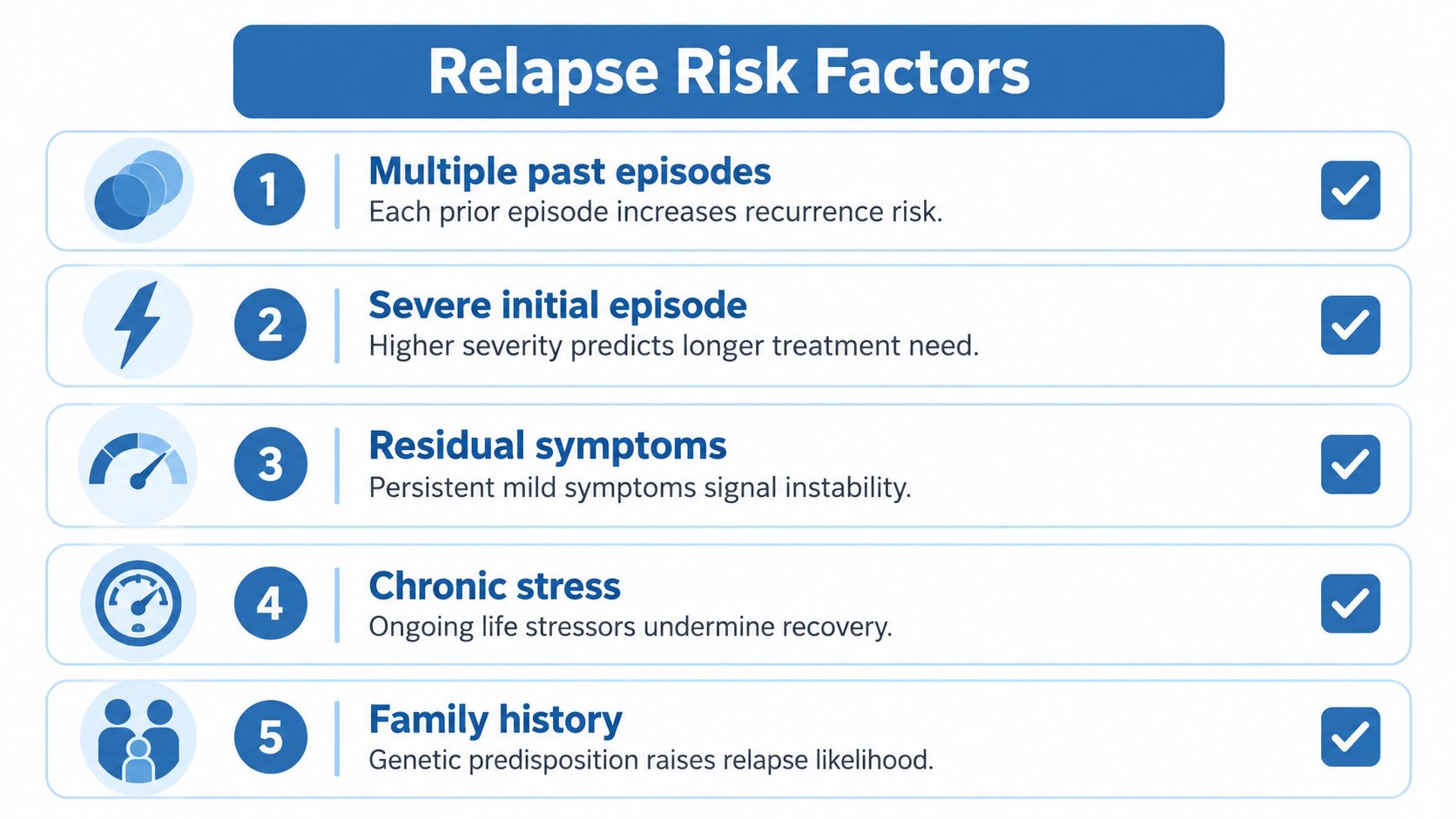
NICE identifies several features that push clinicians toward longer relapse-prevention treatment. Use them as conversation prompts, not as a self-diagnosis tool.
The questions that change the risk discussion
How many episodes have you had? Multiple previous episodes generally make recurrence more concerning than a single, fully resolved episode.
How recent was the last episode? An episode within the previous two years is one factor NICE identifies when considering extended treatment.
Are any symptoms still present? Ongoing sleep disruption, low motivation, anxiety, rumination, or reduced pleasure may indicate incomplete recovery rather than stable remission.
How severe or prolonged was the illness? Severe functional impairment or a long-lasting prior episode can raise the consequences of relapse.
What pressures remain? Ongoing physical-health problems, relationship difficulties, financial stress, or other psychosocial strain may make recovery more fragile.
What happens when you cope with distress? Avoidance and rumination can maintain symptoms and increase vulnerability, especially when they replace active coping or treatment support.
A person doesn't need to check every box to benefit from a longer conversation. One factor may be highly important in one person's life and less important in another. For example, a previous relapse shortly after stopping may carry more practical weight than the total number of years someone has taken medication.
NICE recommends balancing relapse prevention against adverse effects, including sexual dysfunction and increased bleeding risk. Sexual side effects deserve direct discussion rather than being treated as an embarrassing footnote. Readers looking for broader vaginal wellness insights from Momotaro may also find it easier to identify questions to raise with a prescriber.
Relapse-Risk Factors and What They Suggest | ||
|---|---|---|
Risk Factor | What It Looks Like | Tends to Favor |
Multiple episodes | Depression has returned more than once | Longer continuation or maintenance review |
Recent episode | A depressive episode occurred within the previous two years | Caution before stopping |
Residual symptoms | Improvement is incomplete or unstable | Further treatment and symptom monitoring |
Severe impairment | Work, relationships, self-care, or safety were significantly affected | Stronger relapse-prevention planning |
Ongoing stress or maladaptive coping | Medical problems, psychosocial strain, avoidance, or rumination remain active | Therapy, support, and possible longer medication treatment |
For people with chronic or recurring symptoms, a clinician may also discuss persistent depressive disorder treatment. The most defensible decision is usually the one that openly compares medication benefits, side effects, relapse consequences, and the person's priorities.
What the Evidence Shows About Stopping
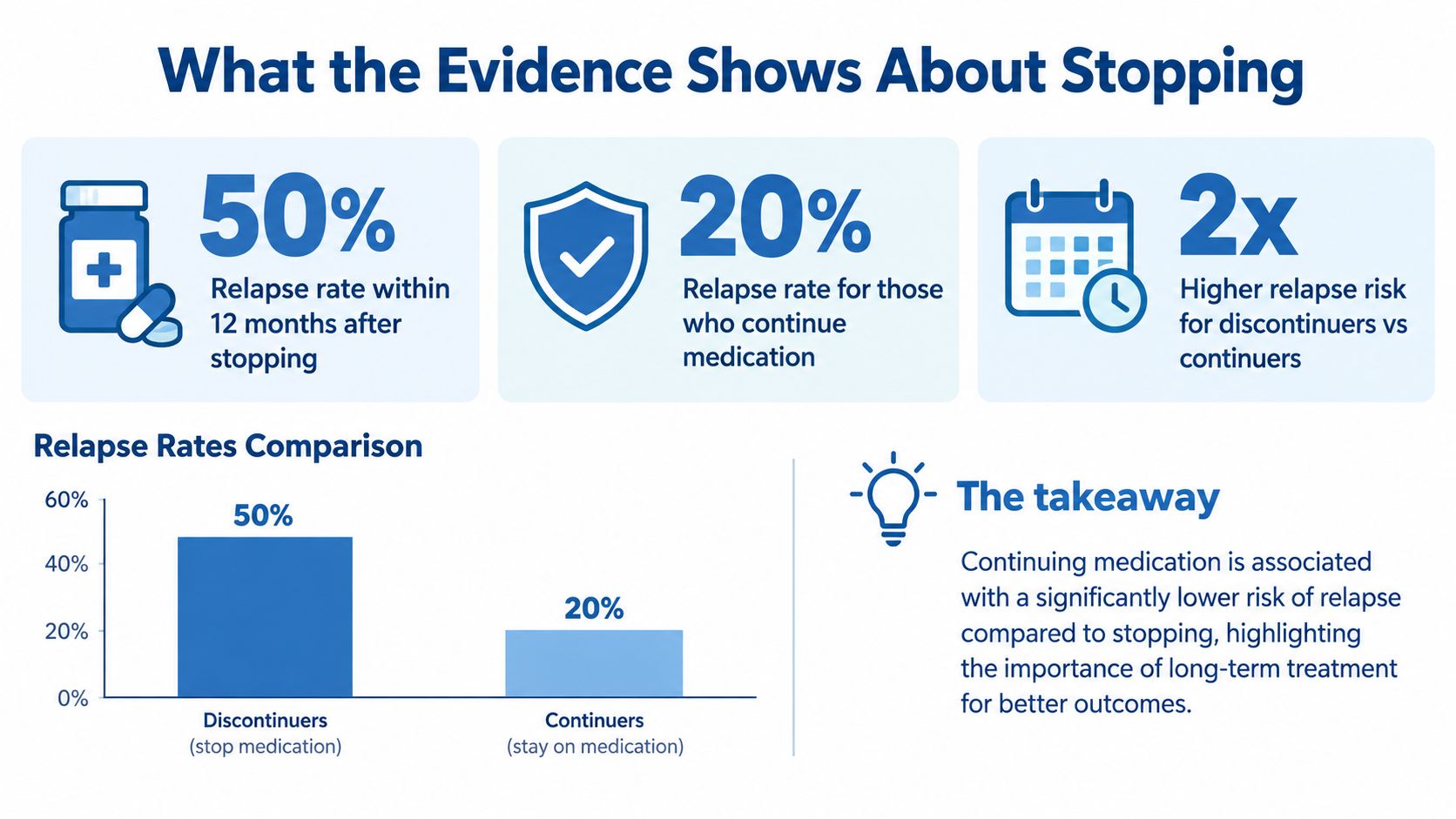
Could stopping an antidepressant raise relapse risk even after you feel well? A 2021 randomized trial published in the New England Journal of Medicine examined that question in adults taking citalopram, fluoxetine, sertraline, or mirtazapine through general practices in the United Kingdom. Participants either continued their medication or tapered it before switching to a matching placebo.
At 52 weeks, depression relapse occurred in 92 of 238 people who continued treatment, or 39%, compared with 135 of 240 people who discontinued, or 56%. The estimated hazard of relapse was approximately twice as high after discontinuation, with a hazard ratio of 2.06 and a 95% confidence interval of 1.56 to 2.70. The difference was statistically significant at P<0.001, according to the New England Journal of Medicine trial record.
The results do not mean that everyone should remain on an antidepressant indefinitely. In this study, continuing treatment was associated with about a 17-percentage-point lower absolute relapse rate over one year. The same data also show that discontinuation does not lead to relapse: 44% of participants who discontinued did not relapse within the study period.
That is a population-level finding, not a personal forecast. Individual risk can differ with episode history, residual symptoms, medication response, side effects, current stress, therapy, and the way tapering is carried out. The study also compared planned discontinuation with continued treatment, so it should not be used to justify stopping abruptly.
Stopping is best treated as a clinical intervention, much like changing another part of a treatment plan. It needs a reason for stopping, a taper schedule, symptom monitoring, a response plan for withdrawal symptoms, and clear instructions if depression returns.
A planned discontinuation asks, “How will we detect trouble early?” It does not assume trouble is inevitable, and it does not pretend risk is zero.
The findings support longer treatment when relapse could be especially dangerous or disruptive. They also support a carefully monitored taper when a person is stable, understands the trade-offs, and has reliable follow-up.
Planning a Safe Taper With Your Prescriber
If the decision is to stop, the safest approach is usually gradual and supervised. Abrupt cessation can cause withdrawal symptoms and can make it difficult to tell whether a person is experiencing discontinuation effects, returning depression, or both.
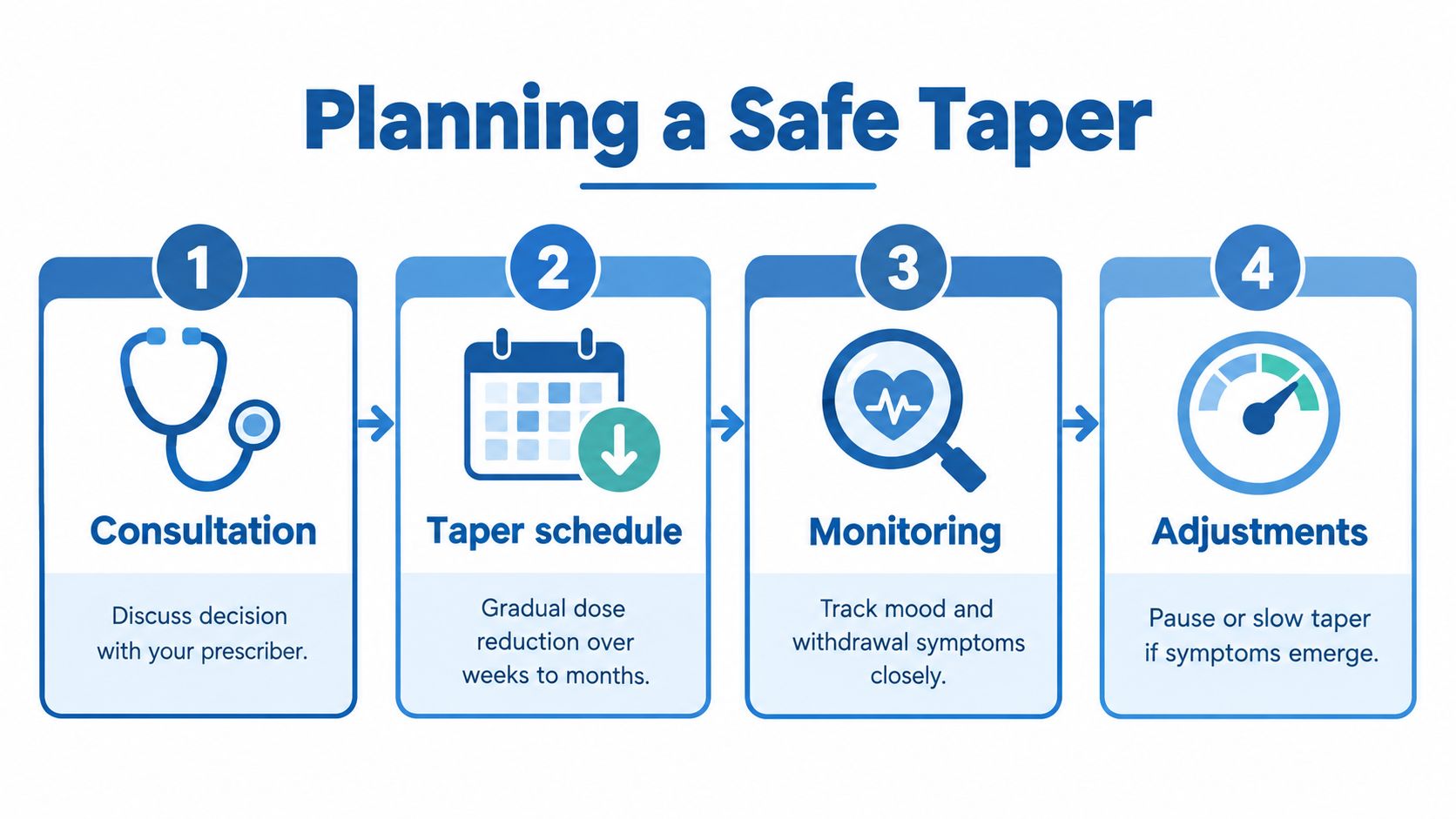
Build the taper around the individual
The Royal College of Psychiatrists advises that antidepressants generally be tapered rather than stopped suddenly. Tapering commonly takes weeks or months, and people who have taken medication for many months or years may need a slower, flexible plan. Even when withdrawal seems mild or absent, tapering should usually last at least four weeks, according to the Royal College of Psychiatrists' antidepressant guidance.
A sensible default is to change one dose step at a time, then allow roughly two to four weeks to assess the new dose. If significant symptoms appear, the prescriber may pause the taper or return to the last well-tolerated dose. Some people need very small final reductions, potentially reaching approximately 2% of the original dose before stopping, with the next reduction delayed for at least four weeks so emerging symptoms can be assessed.
These are planning principles, not a personal prescription. The medication, formulation, dose, treatment duration, previous withdrawal experience, and medical context all affect the schedule. A focused discussion of one commonly used medication appears in this resource on deprescribing Lexapro.
Distinguish withdrawal from recurrence
Withdrawal can begin within days and sometimes after a missed dose. Symptoms may include dizziness, unusual sensory sensations, nausea, sleep disruption, irritability, anxiety, or flu-like feelings. Relapse more often resembles the person's original depressive pattern, such as steadily worsening low mood, loss of interest, hopelessness, or declining function, although the two can overlap.
Keep a brief record of dose changes, sleep, mood, anxiety, physical symptoms, energy, and daily functioning. That record gives the prescriber something more useful than “I feel strange,” and it helps identify whether symptoms appeared soon after a reduction or are developing as a broader return of depression.
Add psychological relapse prevention
Medication isn't the only tool available during discontinuation. For people with recurrent depression, NICE discusses relapse-prevention psychological therapies such as group cognitive behavioral therapy or mindfulness-based cognitive therapy. Therapy can help address rumination, avoidance, sleep habits, emotional regulation, and early-warning signs while medication is reduced.
Bring these questions to your appointment:
What is my relapse risk? Ask which features of your history favor continuation.
What taper pace fits me? Discuss dose steps, waiting periods, and the smallest available reductions.
How will we track symptoms? Agree on what to record and when to contact the clinic.
What happens if symptoms return? Clarify whether to pause, reverse a reduction, restart treatment, or consider therapy support.
Which warning signs require urgent help? Make the safety plan specific before the first dose change.
How Telepsychiatry Follow-Up Actually Works
A Florida telepsychiatry taper should feel like a scheduled process, not a patient disappearing after the last prescription. At the initial review, the clinician can examine the medication's benefits, side effects, target symptoms, episode history, current stressors, and reasons for wanting to stop.
During dose changes, follow-up may be arranged at roughly two-to-four-week intervals, allowing the prescriber to assess withdrawal symptoms and mood before making another change. For people continuing maintenance treatment, planned reviews at three, six, and twelve months can create points to reconsider benefit, side effects, adherence, and relapse risk.

The practical advantage of HIPAA-compliant virtual care is that a follow-up can happen without a long drive or a separate travel day. A patient can discuss sleep, appetite, work performance, anxiety, medication effects, and taper progress from a private location, provided the visit is conducted appropriately.
A structured plan also includes a documented safety pathway. That means knowing how to contact the clinic urgently, what symptoms require same-day attention, and where to seek emergency help if suicidal thoughts or marked deterioration develop.
Medication management can be coordinated with individual therapy, including CBT, DBT, psychodynamic, or trauma-focused approaches. For Florida patients comparing care options, telemedicine psychiatry can help explain how virtual psychiatric visits fit into an ongoing treatment relationship.
Refresh Psychiatry & Therapy offers psychiatric evaluation, medication management, therapy coordination, and deprescribing discussions through telepsychiatry. The practice accepts several major insurance plans, including Aetna, UnitedHealthcare, Cigna, Blue Cross Blue Shield, Humana, Tricare, UMR, and Oscar, although coverage should be confirmed before scheduling.
When to Stop Trying to Decide Alone
The decision to continue or stop becomes unsafe when it is driven mainly by shame, pressure, or a desire to prove something. Staying on medication isn't a character flaw, and stopping as soon as you feel better isn't automatically a sign of strength. Both choices deserve clinical reasoning.
Contact your prescriber promptly if suicidal thoughts return, sleep or appetite changes markedly, agitation appears or worsens, your response to treatment suddenly fades, or severe withdrawal symptoms develop during a planned taper. A rapid change in functioning, inability to care for yourself, or concern from people close to you also deserves attention.
Treat warning signs as information
A return of depression can begin subtly. You might stop answering messages, withdraw from activities, lose concentration, or begin waking early with dread. Withdrawal can also be distressing and physically intense. The important step is not to label yourself correctly without help, but to report the timing, symptoms, dose, and functional impact clearly.
Don't wait for certainty before contacting your prescriber. Early information gives the treatment team more options.
Shared decision-making means the clinician explains likely benefits, adverse effects, alternatives, and uncertainty. The patient explains what matters most, including sexual side effects, pregnancy or medical context, fear of relapse, previous withdrawal, treatment preferences, and access to therapy.
The question “when to stay on antidepressants” should never be settled at two in the morning with a half-read internet post and an empty prescription bottle. It should be revisited with enough time to review the history, make a plan, and arrange support if the decision changes.
A Short Recap Before Your Next Appointment
Remember four points:
After remission, major guidance commonly supports continuing an antidepressant for at least six months, with the precise timeline reviewed with your prescriber.
Higher-risk patients may need treatment for at least two years or a relapse-prevention therapy plan.
Taper gradually, usually with dose steps over weeks or months, rather than stopping abruptly.
Contact your prescriber quickly if suicidal thoughts, marked sleep or appetite changes, agitation, severe withdrawal, or significant deterioration appears.
Write down your episode history, current symptoms, side effects, previous taper experiences, and preferred alternatives before the appointment. Contact us or call Refresh Psychiatry at (954) 603-4081 to schedule your evaluation. We accept Aetna, United Healthcare/UHC, Cigna, Blue Cross Blue Shield, Humana, Tricare, UMR, and Oscar insurance plans. This blog is for informational purposes only and does not constitute medical advice. Please consult a qualified mental health professional for personalized guidance.
Refresh Psychiatry & Therapy provides Florida telepsychiatry, psychiatric evaluations, medication management, therapy coordination, and individualized deprescribing support when appropriate. Visit Refresh Psychiatry & Therapy to request an evaluation and discuss whether continuing, adjusting, or tapering your antidepressant fits your clinical history and goals.