
🛌 Daily Routine for Mental Health: How to Build One

You wake up to your phone, scroll through bad news and unread messages before your feet hit the floor, skip breakfast, answer whatever shouts loudest at work, and fall into bed replaying everything you didn't finish. Nothing terrible happened. The day still feels unmanageable. That's the gap a daily routine for mental health is meant to close, not with a perfect schedule, but with a few predictable points you don't have to renegotiate every morning.
Why a Daily Routine Helps Your Mental Health
Most patients I see who feel scattered aren't lacking discipline. They're making dozens of small decisions while already depleted. When to get up, whether to exercise, when to stop working, what to do when anxiety spikes at 10 p.m. Each open question costs energy you may not have.
A routine removes some of those questions in advance. You decide once that you'll get light after waking, walk after lunch, and stop checking email after dinner. On a low day, you follow the cue instead of waiting to feel motivated.
What a Routine Can and Cannot Do
Think of routine as scaffolding. It can stabilize sleep, meals, movement, and contact with other people, and it can create small completions that counter the sense that nothing is getting done. It can't treat moderate or severe depression, bipolar symptoms, trauma, or suicidal thoughts on its own.
That's not a reason to dismiss it. Scaffolding matters most when motivation is unreliable, which is exactly when depression and anxiety are active. A simple structure gives therapy and medication something to work with between sessions. Our overview of behavioral activation for depression explains that action first, mood change tracked afterward approach in more detail.
Predictable cues: The same trigger starts the same small behavior, so you spend less time deciding.
Visible completion: A checked box or logged walk is concrete evidence against an all or nothing story.
Fewer late decisions: Evening choices made earlier are easier to keep when you're tired.
A good routine is not the one you follow on your best week. It's the one that still bends on a bad Tuesday without breaking.
Build for that Tuesday. Every element below includes a smaller version, because a plan that only works when you feel well isn't a mental health plan. It's a fair weather preference.
Building Morning and Evening Anchors That Stick
Don't start by redesigning your whole day. Start with two anchors, a short sequence at the beginning and a short sequence at the end. Anchors work because they're attached to events that already happen, not to willpower or an ideal wake time you keep missing.
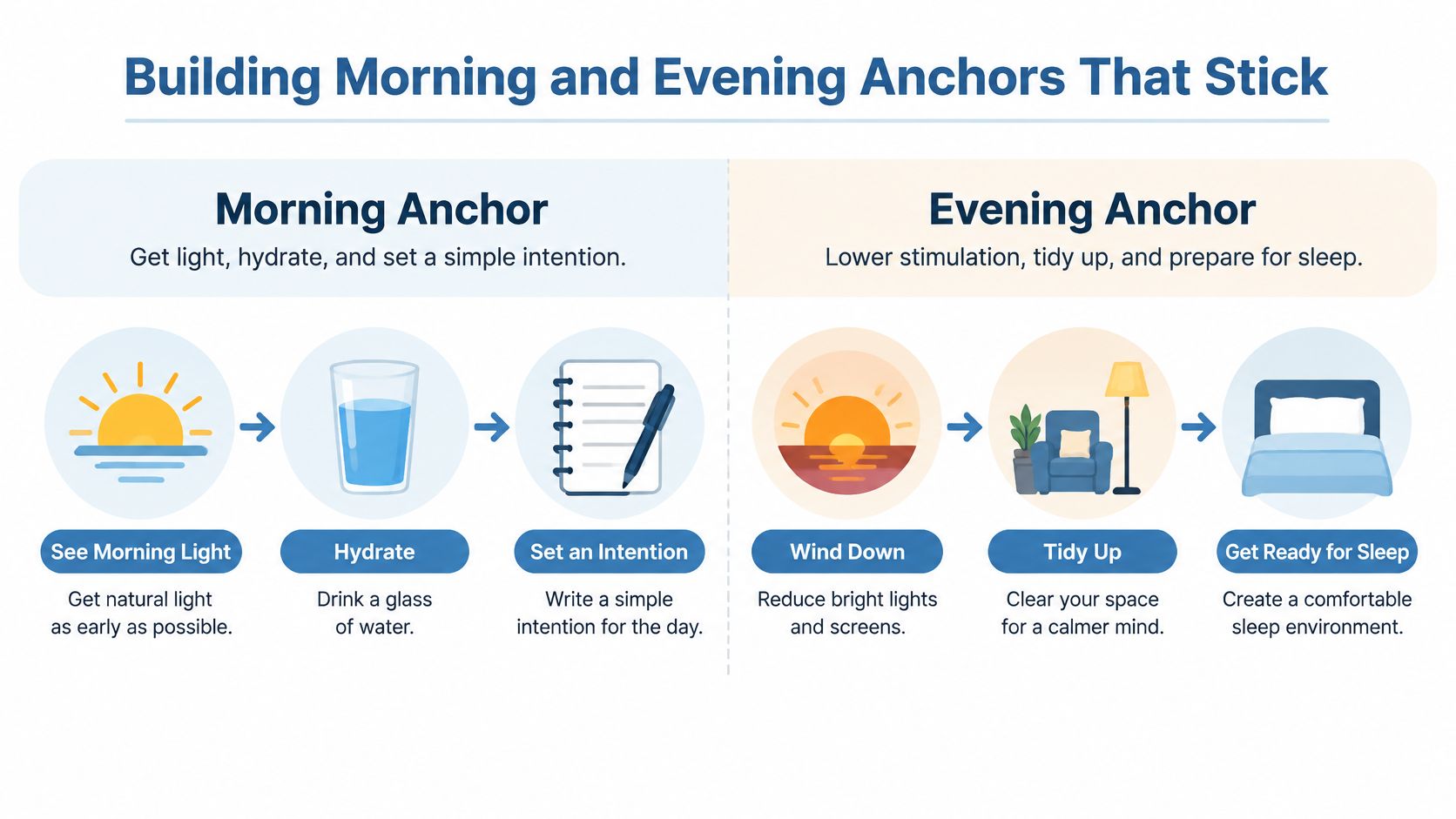
This visual lays out the basic flow for both ends of the day.
The Morning Anchor
Attach three small steps to something you already do, such as making coffee or brushing your teeth. Get light by opening blinds or stepping outside, drink water, and write down one priority for the day. One priority, not a full task list. A long list first thing often becomes a record of everything you'll feel behind on by noon.
Keep the full version under 15 minutes. If you work nights or care for a baby, anchor it to your main wake up, whatever time that is. The clock time matters less than the sequence happening in the same order most days.
This short video walks through setting up anchor habits step by step.
The Evening Anchor
Your evening anchor should close the day rather than extend it. Lower the lights, put work and news out of reach, tidy one small area, and set out anything tomorrow morning needs. You're giving your brain a repeated signal that input is stopping.
Full version: Dim lights, shower, lay out clothes, write tomorrow's first step, read something low stakes.
Two minute version: Plug your phone in outside the bedroom, brush your teeth, get into bed at your usual time.
Restart rule: If you miss an anchor, do the two minute version the next day. Don't double up to compensate.
That restart rule prevents the common collapse I hear about in sessions. Someone misses three days, decides the routine is ruined, and abandons steps that were helping. A missed day is data about capacity, not a verdict.
Scheduling Activities and Movement You Can Sustain
Anchors hold the ends of the day. The middle needs scheduled activity, because unstructured time is where rumination, avoidance, and endless scrolling expand. The clinical tool here is behavioral activation, which means scheduling specific activities and tracking mood as an outcome, rather than waiting to feel like doing them first.
Pick One Activity in Each Domain
Choose one predictable activity from each of three domains and keep each one between 5 and 15 minutes at first.
Routine or necessary: Pay one bill, start laundry, answer one email you've been avoiding.
Mastery: Practice a language app lesson, fix something small, complete one work task start to finish.
Pleasure: Sit outside with coffee, text a friend, listen to one song without multitasking.
Attach each activity to an existing cue, such as after breakfast or after a work break. Log the planned time, whether you completed it, your mood before and after, and what got in the way. Increase duration only after you're completing the small version consistently, and aim for a weekly completion rate around 70% to 80% rather than perfection, as described in the systematic review of behavioral activation in people with co occurring medical conditions, which also found only a small and statistically uncertain short term advantage over controls with very high variation between studies.
That mixed evidence is worth knowing. Behavioral activation is a tool to test and adjust, not a guaranteed fix. If a task fails repeatedly, make it smaller or move it. Don't keep scheduling the same vague goal, such as get organized, and collecting evidence that you can't follow through.
Build Movement Progressively
Start with a 10 minute moderate walk on most days. Moderate means your breathing is faster but you can still speak in short sentences. Add small increments after a week or two without symptom or injury escalation.
The target you're building toward is 150 to 300 minutes of moderate intensity aerobic activity per week, or 75 to 150 minutes of vigorous activity, plus muscle strengthening on at least 2 days. That sounds large, but divided across the week it's roughly 20 to 45 minutes on most days. Brisk walking, cycling, and swimming all count, and shorter bouts count too, so two 10 minute walks beat skipping movement because you couldn't do 30.
Track minutes, exertion, mood, and sleep. If exercise starts replacing sleep or meals, or a missed session triggers a complete stop, the plan is too rigid. Scale it back to the last level you sustained.
Sleep Hygiene and a Wind-Down Routine
It's 10:30 p.m. You're tired, but scrolling has pushed bedtime later again. A workable sleep routine gives the evening a clear stopping point, while leaving room for nights that don't go to plan.
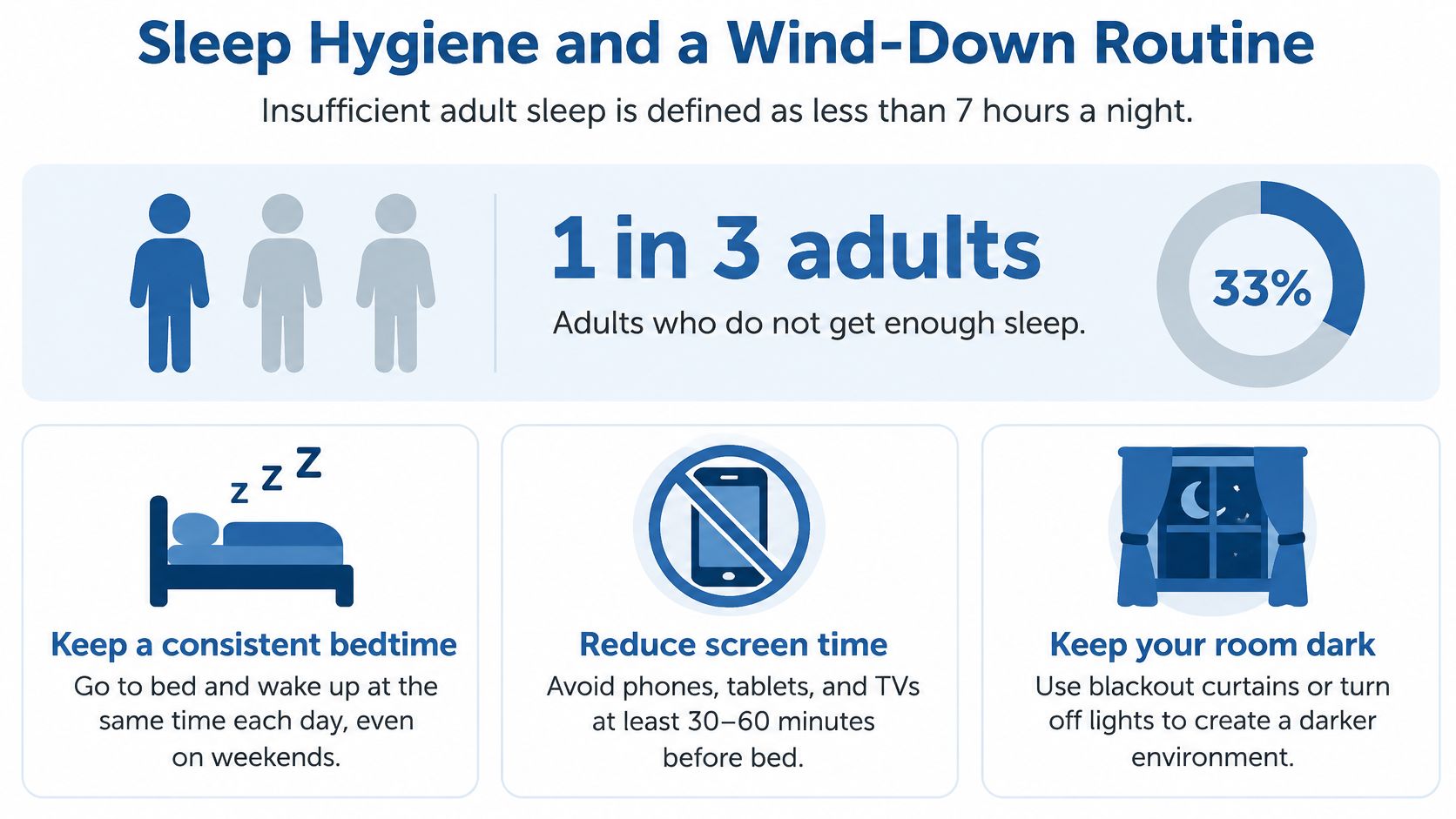
The CDC defines insufficient sleep for adults as fewer than 7 hours in a 24-hour period. Short sleep and mental distress are associated, though that link does not prove one causes the other. Anxiety and depression can also disrupt sleep, so changes in sleep and mood often affect each other.
Protect the Sleep Window First
Adults ages 18 to 60 should aim for at least 7 hours of sleep each night. Choose a wake time you can keep most days, then allow enough time in bed to meet that goal. A late weekend can make an early Monday harder, so keep the difference modest when you can.
Start with one or two changes that address your main obstacle:
Dim the lights: Lower light and stimulation as bedtime approaches.
Park your phone: Charge it outside the bedroom if scrolling keeps you awake.
Repeat a short sequence: For example, wash up, brush your teeth, read, then turn out the light.
On a difficult night, keep the smallest version: dim the lights, put the phone away, and do one calming step before bed. If you miss a night, restart with the next evening's routine rather than trying to make up for it by going to bed unusually early. Trackers can help you notice patterns, but their estimates are not a diagnosis. If you compare sleep tools, Navilo Health versus Sleep Cycle offers a way to review features; stop tracking if scores increase bedtime anxiety.
Persistent insomnia, a major change in sleep, or severe daytime impairment calls for professional assessment, particularly alongside depression, trauma symptoms, possible mania, or medication changes. Read about natural approaches to insomnia and when to seek treatment for guidance on where self-help may not be enough.
Grounding, CBT and DBT Micro-Practices for Hard Moments
A routine plans for ordinary days. You also need a short list for the moment anxiety spikes in a meeting, a wave of low mood hits at night, or an urge to avoid everything takes over. These micro practices take one to five minutes, and they work better if you rehearse them when you're calm.
Grounding When Your Body Is Activated
Grounding brings attention back to present sensory input when your mind is racing ahead or shutting down. Name five things you can see, four you can touch, three you can hear, two you can smell, and one you can taste. Say them out loud if you can, since speaking slows the exercise down.
Cold water on your face or holding something cold can also interrupt escalating arousal for some people. Paced breathing helps others, especially a longer exhale than inhale. Test these during calm moments first, because a technique that annoys you when you're settled won't rescue you mid panic.
Our detailed walkthrough of grounding techniques for anxiety and overwhelm gives variations you can rotate through until you find one that fits.
CBT and DBT Skills in Small Doses
A CBT style thought check is a written pause, not positive thinking. Write the thought, the evidence for and against it, and a more accurate version you'd offer a friend. Keep it to three lines or you'll stop doing it.
For DBT style skills, two translate well into a daily routine.
Opposite action: When low mood urges withdrawal and the situation is safe, do the small opposite, such as stepping outside or sending the text.
Self soothe with a sense: Music, a warm shower, or a familiar scent, chosen in advance and used deliberately for a few minutes.
STOP before reacting: Stop, take a breath, observe what you feel, then proceed with one chosen step.
Slot one practice into each anchor. Breathing after your morning coffee and a thought check during your evening wind down turns abstract skills into habits you can find under pressure.
Rehearsal rule: A coping skill you've only read about is information. A coping skill you've practiced 20 calm times is something you can actually reach for.
Sample Routines for Anxiety, Depression and ADHD
The same building blocks shift depending on what's driving your symptoms. Anxiety usually needs less uncertainty late in the day. Depression needs activation scheduled before motivation arrives. ADHD needs external structure, visible cues, and shorter gaps between intention and action.
How the Emphasis Changes
Condition | Morning Anchor | Midday Activity | Evening Wind-Down |
|---|---|---|---|
Anxiety | Light, water, one written priority, no news check | Scheduled worry time, walk after lunch, one mastery task | Screens off early, thought check, same bedtime sequence |
Depression | Fixed wake time, hygiene first win, get dressed | Behavioral activation across routine, mastery, and pleasure | Low light, lay out tomorrow's clothes, one pleasure activity |
ADHD | Alarm across room, medication by toothbrush if prescribed, visual checklist | Timed work blocks, movement breaks, one task visible at a time | Capture loose tasks on paper, pack bag by the door, phone outside bedroom |
For ADHD specifically, shrink the distance between cue and action. Shoes by the door beat a plan to exercise later. Our strategies for ADHD time management cover external reminders and time blocking in practical detail.
The Minimum Viable Version
Barriers are real, not excuses. In global wellness data, cost was cited by 53% of respondents as a barrier to healthier choices, while lack of time affected 26% and low motivation 25%. A routine that requires a gym membership, an hour of free time, and high motivation fails on all three.
So define your floor in advance. One sleep anchor, one brief movement or outdoor break, one nourishing meal, and one human contact. That's a complete bad day routine, and completing it counts.
For Florida adults juggling shift work, caregiving, school, or chronic illness, that floor matters more than an elaborate morning protocol. Walk to the mailbox instead of a full workout. Sit on the porch for light instead of a sunrise routine. You're preserving the pattern at a size your current capacity allows, which makes restarting the full version far easier.
Tracking Progress and Knowing When to Get Help
Tracking turns a routine from a self judgment exercise into an experiment. Once a week, spend a few minutes reviewing what you scheduled, what you completed, how you slept, how your mood moved, and what blocked you. Bring that record to therapy or a medication appointment, because it's more useful than a general sense that the week was bad.
A Simple Weekly Review
Calculate completion as completed activities divided by scheduled activities. If the number is low, your first move is shrinking tasks or scheduling fewer of them, not trying harder at the same size. Repeatedly failed tasks usually have a fixable cause, such as the wrong time of day, a vague definition, or no clear starting cue.
Keep what's repeatable: Activities you completed even on hard days are your core routine.
Revise what keeps failing: Make it smaller, move it earlier, or attach it to a stronger cue.
Drop what adds guilt without benefit: A habit that only produces shame isn't supporting your mental health.
Watch sleep and mood alongside completion. If you're doing more but sleeping less and feeling worse, the routine is costing more than it's returning.
Where Routine Fits With Treatment
A daily routine for mental health supports treatment. It doesn't replace an evaluation, psychotherapy, or medication management when those are indicated. Therapy gives you skills and a place to work through patterns, medication can lower symptom intensity enough that routine becomes possible, and routine stabilizes the days between appointments.
Get professional help promptly if symptoms are worsening despite consistent routine changes, if you can't function at work, school, or home, if sleep disruption is severe or persistent, or if you have thoughts of harming yourself. Our guidance on when to see a psychiatrist can help you sort routine support from care that shouldn't wait.
Refresh Psychiatry is a telemedicine only practice offering HIPAA compliant telehealth across Florida, with integrated medication management alongside CBT, DBT, and trauma focused therapy. Contact us or call Refresh Psychiatry at (954) 603-4081 to schedule your evaluation. We accept Aetna, United Healthcare/UHC, Cigna, Blue Cross Blue Shield, Humana, Tricare, UMR, and Oscar insurance plans. This blog is for informational purposes only and does not constitute medical advice. Please consult a qualified mental health professional for personalized guidance.
If your routine keeps collapsing because anxiety, depression, ADHD, or insomnia won't settle, Refresh Psychiatry & Therapy offers coordinated psychiatric evaluation, medication management, and evidence based therapy by telehealth anywhere in Florida. Contact us or call (954) 603-4081 to schedule your evaluation and build a plan that's sized for your actual life, including the hard days.