
💔 Depression After a Breakup: When to Get Help

You're awake in your Florida apartment, rereading messages you already know by heart. Tomorrow's workday is getting closer, but sleep isn't. You miss your former partner, you barely touched dinner, and you're wondering whether this is heartbreak or something that needs medical attention.
Depression after a breakup deserves attention without an automatic diagnosis. You don't have to minimize the loss, and you don't have to assume that feeling terrible means you have major depression. The most useful clues are how your symptoms affect daily life, whether they're easing, and whether you feel safe.
Why a Breakup Can Feel Like Depression
The difficult part may not be the breakup conversation itself. It may be coming home afterward and realizing there's no familiar person to text about your day. Even ordinary decisions, like what to cook or whether to keep weekend plans, can feel different.
You might get through a meeting, then cry in the parking lot. Later, you might catch yourself enjoying something and feel guilty for that moment of relief. These examples aren't a diagnosis. They describe the uncertainty that can make a hard week feel frightening.
The Loss Is Bigger Than the Last Conversation
A relationship's ending can mean losing companionship, shared routines, and the future you expected. Our guide to understanding grief and finding a path through loss offers language for thinking about that experience without treating grief as a personal failure.
If you need words rather than advice right now, you might reflect on heartbreak through tender quotes from Soulknit. Reflective writing can be a companion to your feelings, not a test of whether you're recovering correctly or a substitute for assessment.
Think of acute heartbreak as a storm. A mood that persistently changes your ability to work, eat, connect, and feel interest deserves attention as a broader change in the climate.
You Don't Have to Name It Perfectly
It's understandable to want a clear answer immediately. But the word heartbreak doesn't tell a clinician how you're sleeping, and the word depressed doesn't establish a diagnosis by itself.
A more useful starting point is a plain description: what feels different, what you can't manage, and whether anything is improving. Research on relationship dissolution supports taking breakup-related distress seriously while distinguishing it from a depressive disorder through severity, duration, and functional impact.
You deserve support even if you don't yet know which description fits.
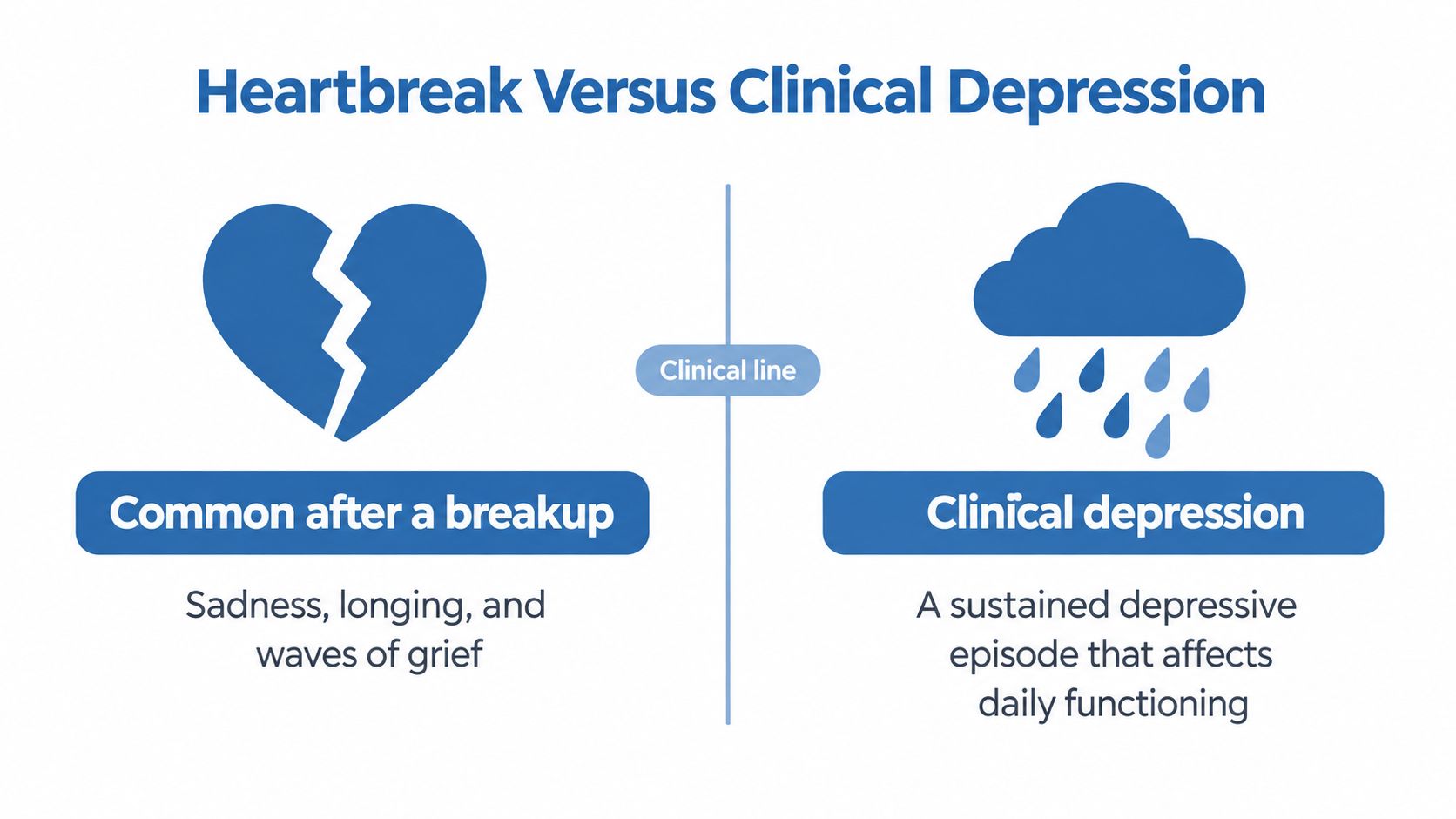
Heartbreak Versus Clinical Depression
Grief and depression can overlap. Sadness, longing, and emotional waves can follow a relationship's ending. A depressive episode involves a more sustained pattern of low mood or loss of interest, accompanied by changes that interfere with everyday functioning.
For example, missing your ex during dinner is different from finding that food, friendships, work, and familiar interests all feel persistently empty. That contrast is useful, but it isn't a home diagnostic test. A clinician considers the whole pattern rather than deciding from whether you cried or briefly laughed.
What the Research Can Tell Us
In a Canadian longitudinal analysis, among married adults without recent depressive symptoms, a new depressive episode occurred in 12% of those separated, divorced, or single at follow-up, compared with 3% who remained partnered, approximately a fourfold difference; unadjusted odds were about sixfold for men and 3.5-fold for women relative to their partnered counterparts (population-based findings discussed in this research).
That association matters, but it doesn't prove the breakup alone caused every later episode. Financial strain, earlier vulnerabilities, and other circumstances still need consideration during an individual evaluation.
In an experimental sample, 26.8% of recently separated participants reported mild-to-severe depressive symptoms; separate neuroimaging findings involving 69 recently separated participants linked greater symptom severity with less flexible coordination across brain networks (research on breakup-related depressive symptoms and brain activity). These findings don't make a brain scan a diagnostic tool for heartbreak. They show why distress shouldn't be dismissed because it followed a relationship loss.
Focus on Function, Not Just Tears
Our discussion of random crying spells provides another way to describe an experience that can feel confusing. Crying alone doesn't answer whether someone has depression.
Practical rule: Persistent loss of pleasure, impaired concentration, disrupted sleep or appetite, or declining daily function deserves clinical assessment.
For readers whose faith shapes how they understand suffering, Christian mental health guidance from HolyJot may be a useful reflective resource. Spiritual support and clinical evaluation don't have to be competing choices, and neither faith nor relationship status determines whether symptoms deserve care.
How Breakup Depression Symptoms Change Over Time
“How long will I feel this way?” is a reasonable question. The difficulty is that research can describe a group's average recovery without predicting your particular course.
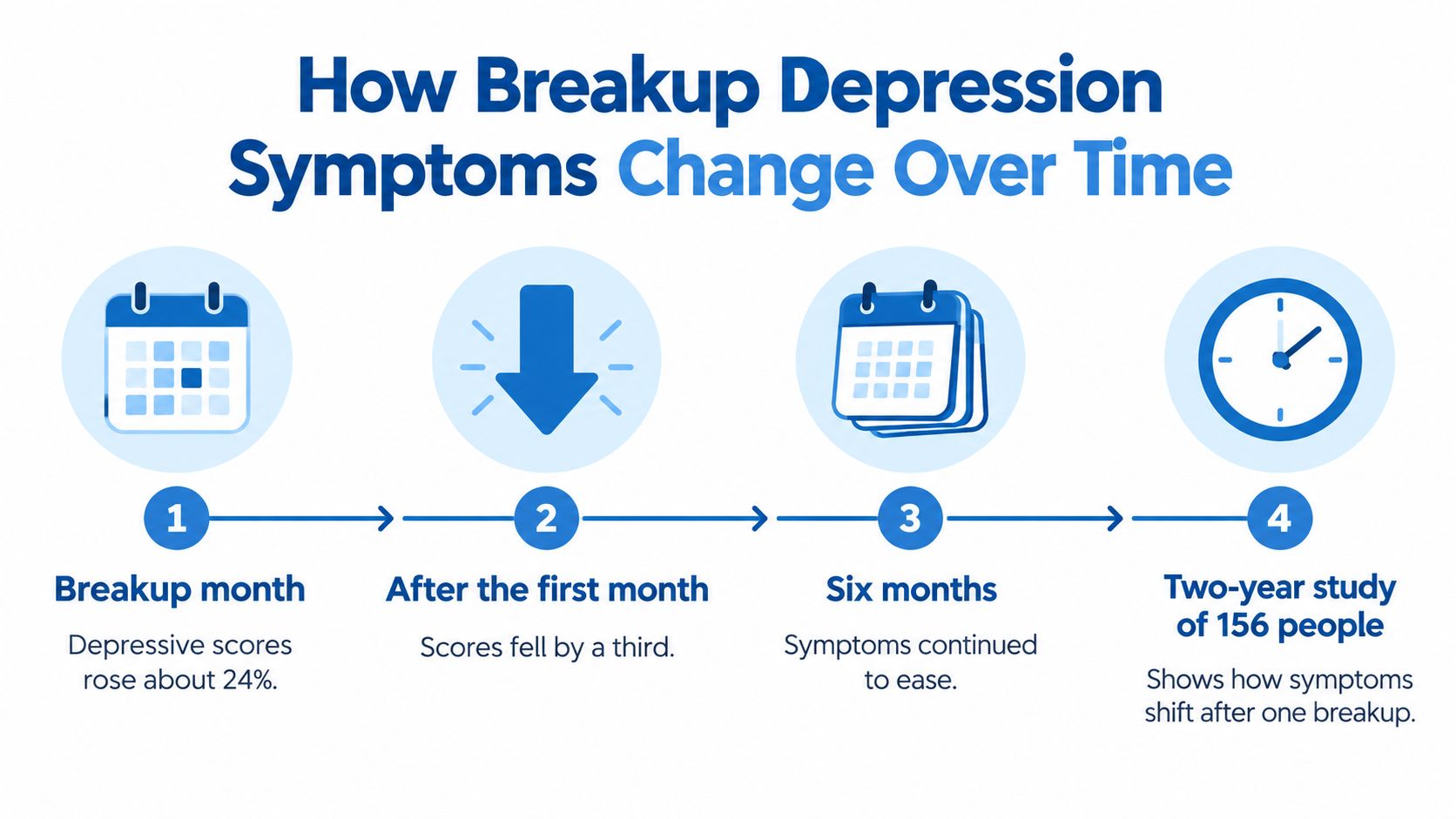
In a two-year study of 156 people who reported a breakup, depressive symptom scores increased by approximately 24% during the breakup month, declined by a similar amount the following month, and returned to pre-breakup levels on average within approximately three months (longitudinal study of breakup-related symptom changes).
An Average Is Not a Deadline
That pattern offers reassurance: an intense initial reaction doesn't necessarily become lasting depression. But returning to an earlier symptom score isn't the same as never missing someone again. Emotional meaning and clinical symptom severity aren't interchangeable.
An average also combines people with very different experiences. Someone who gradually resumes eating and working may share a breakup date with someone whose functioning keeps deteriorating. Neither person should use the group average as a verdict.
The visual below presents a timeline concept. For the numerical findings, use the study description above: the evidence cited here describes a similar-sized decline the following month and average recovery near the earlier baseline, not a separate verified six-month milestone.
Watch the Direction and the Disruption
Rather than repeatedly checking the calendar, notice the direction of your symptoms. You don't need to be completely comfortable to be improving, and an occasional difficult evening doesn't erase meaningful progress.
These markers are more useful than a promised recovery date:
Symptoms aren't easing. Your mood stays equally low or becomes worse rather than allowing more manageable periods.
Responsibilities are slipping. You can't reliably work, study, parent, or handle essential daily tasks.
Sleep or eating changes are severe. The disruption is affecting your ability to care for yourself.
Safety becomes uncertain. Thoughts of suicide or self-harm require urgent attention, not continued tracking.
Previous depression, substance use, and the pressures surrounding young adulthood or college life are also important assessment context. The relationship may be part of the story without being the entire explanation.
You don't have to wait until the average recovery period has passed to ask for help. A clinician can evaluate symptoms while you're still unsure whether you're grieving, depressed, or experiencing both.
Four Recovery Paths After a Relationship Ends
People who end relationships at the same time don't necessarily recover together. In a 30-week study of 87 women, researchers identified four trajectories: resilience, fast recovery, slow recovery, and chronic distress (longitudinal research on different recovery patterns).
The illustration offers a visual way to think about those different courses.

Different Courses, Not Different Character
These are illustrative examples, not descriptions of individual study participants:
Resilience might look like genuine sadness alongside relatively steady functioning. The person misses the relationship but can still engage with work and other people.
Fast recovery could involve a difficult initial period followed by a noticeable return of interest and routine.
Slow recovery may mean progress that's real but uneven, with more time spent struggling before daily life feels manageable.
Chronic distress might look like ongoing impairment, with little relief and a life that remains narrowed around the loss.
These labels aren't grades. Resilience doesn't mean the relationship mattered less, and persistent distress doesn't mean someone is choosing not to recover.
When Thinking Becomes Replaying
The researchers associated higher rumination and neuroticism with slower or more persistent symptoms. They also linked impaired cognitive flexibility, the ability to shift perspectives or approaches, particularly with chronic distress.
Rumination is repetitive negative thinking rather than useful problem-solving. As an example, reviewing a conversation to understand a practical misunderstanding is different from repeatedly asking yourself why you weren't enough, without reaching any new understanding.
The video offers an additional format for reflecting on breakup-related distress.
A study limited to women doesn't establish how everyone will recover. Still, the different trajectories help explain why a reassuring average can miss someone who needs more support.
Persistent distress deserves attention rather than an instruction to be more patient. Repeatedly revisiting messages, profiles, and relationship explanations is also a concrete pattern you can discuss with a clinician, without blaming yourself for having the urge.
Coping Steps That Reduce Rumination and Checking
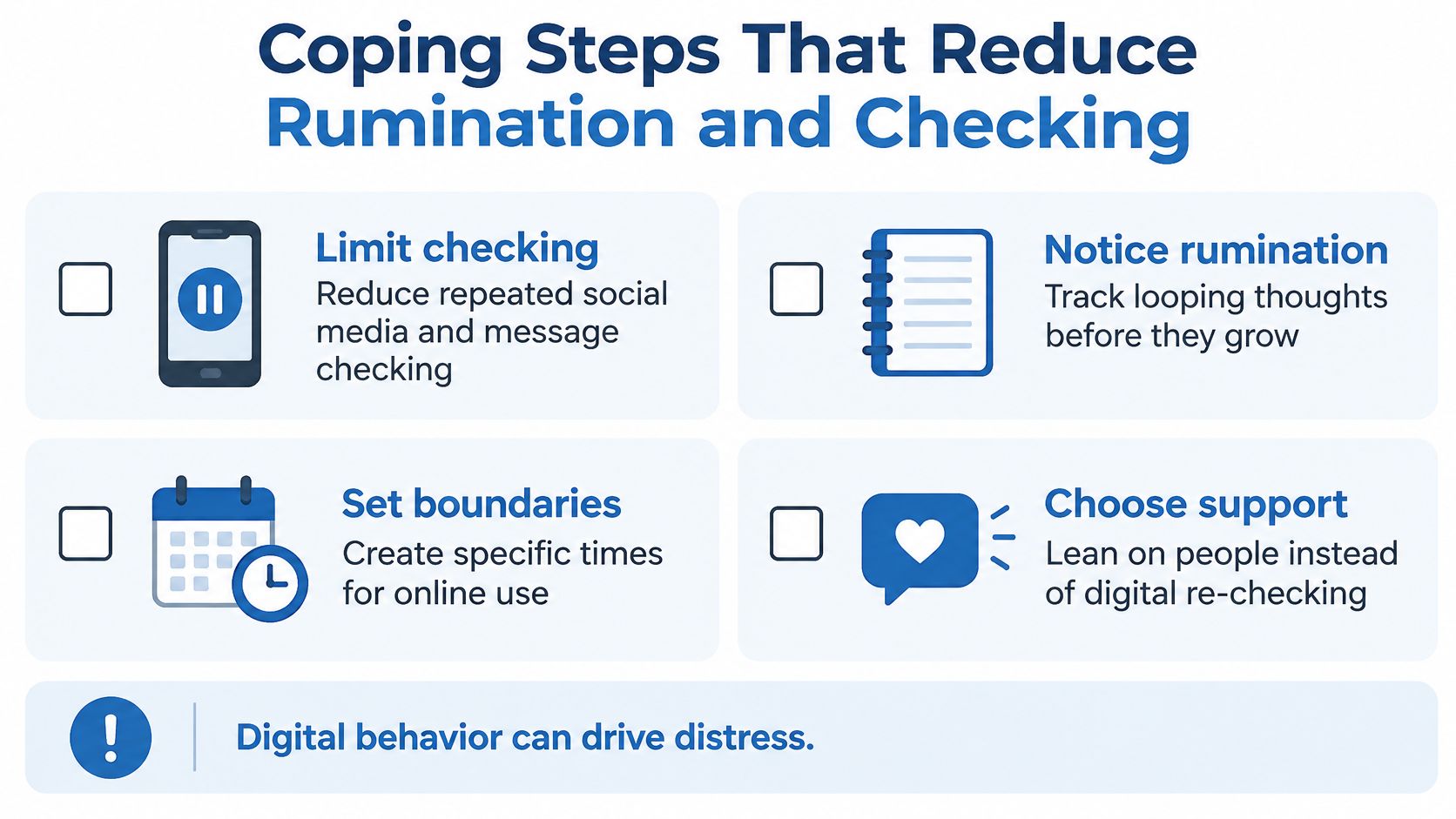
Opening your ex's profile may feel like gathering information. But if you leave feeling worse and return again soon afterward, it's worth treating the checking itself as something to change.
In a 2025 study of 256 people whose relationships had ended within the previous year, approximately 38% experienced breakup distress sometimes or more often, with distinct digital-behavior profiles; separate evidence involving 438 mostly young adults associated ongoing contact with greater anxiety and depression and autonomy-supportive breakup communication with better mood and vitality (research on post-breakup digital behavior and contact).
These associations don't prove that every contact causes harm. They support asking what a particular pattern of contact does to your mood and functioning.
Make Boundaries Fit Your Actual Life
Choose a boundary you can maintain. Shared parenting, work, finances, safety concerns, and cultural expectations may make complete silence unrealistic. Necessary communication can stay focused on logistics rather than becoming an ongoing review of the relationship.
Try practical adjustments:
Reduce prompts. Mute notifications or updates that repeatedly pull your attention back to the relationship.
Plan necessary checks. Use a chosen check-in time for shared responsibilities rather than compulsively refreshing messages.
Separate logistics from reassurance. A parenting update needs a response. An urge to ask whether your ex misses you may need support from someone else.
Protect safety. If contact feels threatening or coercive, prioritize a professional safety plan rather than experimenting with boundaries alone.
Replace Checking With Something Concrete
Behavioral activation means taking manageable steps toward daily activity even when motivation is low. Start with a regular sleep routine and a daily anchor, such as preparing breakfast or walking with a friend. The aim isn't to stay busy enough to avoid feeling anything.
For looping thoughts, our guide to working with negative thoughts offers a starting point. If you prefer reflective relationship reading, the Tarot Chats guide to relationship overthinking is an optional companion, not diagnostic guidance or a replacement for care.
The digital-behavior research also discusses emerging findings linking a new relationship with fewer intrusive thoughts. That doesn't establish that rebounding causes recovery or make dating a treatment.
Suicidal thoughts, inability to function, or severe sleep and appetite disruption mean self-help alone isn't enough.
Evidence-Based Care and How to Choose It
You don't need medication because a breakup hurts. You also shouldn't be denied treatment because someone thinks a breakup is an understandable reason to feel depressed.
The World Health Organization's depression guidance identifies psychological treatments as first-line options, including behavioral activation, cognitive behavioral therapy, interpersonal psychotherapy, and problem-solving therapy. For moderate-to-severe depression, structured psychological treatment or antidepressant medication may be considered; medication generally isn't needed for mild depression.
Match Care to the Problem
Different approaches address different difficulties. Cognitive behavioral therapy can target repetitive negative thinking and avoidance. Interpersonal psychotherapy can address a changed relationship role, while problem-solving therapy can help organize practical difficulties.
Which Level of Care Fits Breakup Depression
Situation | Usual first approach | What it targets |
|---|---|---|
Grief with manageable daily functioning and gradual improvement | Support, routine, and follow-up as needed | Adjustment to loss without assuming a disorder |
Persistent symptoms or impaired functioning | Clinical assessment and an individualized therapy plan | Withdrawal, rumination, avoidance, and disrupted routines |
Moderate-to-severe depression or more complex needs | A clinician-guided discussion of psychotherapy, medication, or combined care | Depressive symptoms, functioning, and ongoing monitoring |
This table is a discussion guide, not a way to prescribe your own treatment. A clinician considers previous episodes, medical conditions, suicide risk, preferences, and available support.
Give Treatment an Appropriate Review
Antidepressants may take approximately four to six weeks to produce their full effect, and effective treatment is commonly continued at the same dose for at least four to six months after improvement, according to WHO educational guidance on depression treatment.
Early side effects or partial improvement aren't automatic proof of failure, but they deserve discussion. Don't start, stop, or change medication without professional guidance. Psychotherapy and medication can be combined when clinically appropriate.
For Florida patients, Refresh Psychiatry offers telemedicine-only care through board-certified psychiatrists and licensed therapists, with HIPAA-compliant video visits statewide. Coordinated care may include medication management and CBT, DBT, psychodynamic, or trauma-focused therapy, depending on the assessment rather than a fixed template.
An evaluation can consider depression, bipolar-spectrum symptoms, trauma, and whether medication is appropriate without assuming the breakup explains everything. If you're uncertain how to begin, this guide to talking to a doctor about depression can help you prepare.
When to Seek Urgent Help in Florida
The central question is whether you're grieving a relationship or experiencing major depression, and how long it's safe to wait: persistent, worsening, or disabling symptoms matter more than a promised recovery date (research informing breakup recovery and assessment).
You don't need to settle the diagnosis before taking action. The next step depends first on safety, then on how much your symptoms interfere with life.
When Waiting Isn't Safe
Seek urgent local emergency or crisis support if you have suicidal thoughts. A suicide plan, intent to act, or inability to stay safe calls for emergency care now, not a routine appointment request.
If possible, tell a trusted person what's happening and ask them to stay with you while you access help. If you're in immediate danger, go to the nearest emergency department or contact local emergency services.
Other changes also need prompt professional attention:
Severe sleep or appetite collapse. You're struggling to meet basic physical needs.
Inability to manage essential responsibilities. Work, school, parenting, or basic self-care has become unmanageable.
Symptoms that remain stuck or worsen. Several weeks have passed without meaningful improvement, or you're deteriorating sooner.
These situations don't all require the same setting. A clinician can help determine the appropriate level of care, but immediate danger should never wait for an outpatient reply.
A Concrete Next Step for Non-Emergency Care
Telepsychiatry can provide an evaluation, but it isn't a replacement for emergency stabilization. Review which conditions may not be a good fit for telehealth psychiatry when considering whether an online appointment matches your current needs.
For an appointment, write down what changed after the breakup, whether you're improving, and what you can no longer manage. Include current medications, previous mental-health treatment, and changes in substance use. You don't need a polished explanation.
Visits are telemedicine only and available to patients in Florida. Accepted insurance plans include Aetna, United Healthcare/UHC, Cigna, Blue Cross Blue Shield, Humana, Tricare, UMR, and Oscar. Confirm your particular plan's coverage and visit costs when scheduling.
This blog is for informational purposes only and does not constitute medical advice. Please consult a qualified mental health professional for personalized guidance.
Refresh Psychiatry & Therapy offers Florida telemedicine evaluations, therapy, and medication management to help clarify whether post-breakup symptoms need clinical treatment. Contact us or call Refresh Psychiatry at (954) 603-4081 to schedule your evaluation.