
Depression in Women vs Men: Key Symptom Differences

Depression affected 6.2% of adult women compared with 4.1% of adult men worldwide in 2023, and the World Health Organization describes it as approximately 1.5 times more common in women. That difference is real, but it doesn't tell the whole clinical story, because depression in women vs men can look different enough for men to be missed and for treatment decisions to require closer attention.
Depression isn't just sadness divided by sex. Women may present with persistent low mood, tearfulness, appetite changes, and disrupted sleep, while men may arrive after months of irritability, substance misuse, reckless behavior, overwork, withdrawal, or anger. These patterns aren't rigid rules, and no symptom belongs exclusively to one sex. They are practical signals that should shape how clinicians ask questions, how families interpret behavior, and how quickly someone receives an evaluation.
Clinical question | Women may more often show or report | Men may more often show or report |
|---|---|---|
Core emotional symptoms | Depressed mood, tearfulness, hopelessness | Emotional numbness, irritability, frustration |
Physical symptoms | Appetite or weight change, sleep disturbance, fatigue | Sleep disruption, low energy, reduced motivation |
Behavioral clues | Withdrawal, self-criticism, reduced interest | Anger, risk-taking, poor impulse control |
Common complicating concerns | Anxiety and trauma-related distress | Alcohol or drug misuse and externalizing behavior |
Screening priority | Ask about mood, sleep, appetite, caregiving strain, and hormonal transitions | Ask directly about anger, substance use, reckless behavior, and emotional shutdown |
Why Depression Looks Different by Sex
The most important starting point is the global prevalence gap. In 2023, the WHO estimated depression among 5.2% of adults worldwide, including 6.2% of adult women and 4.1% of adult men. The organization also summarizes the broader epidemiology as depression being approximately 1.5 times more common among women than men. These figures come from the World Health Organization's depression fact sheet, a major global benchmark rather than a finding from one clinic or one country.
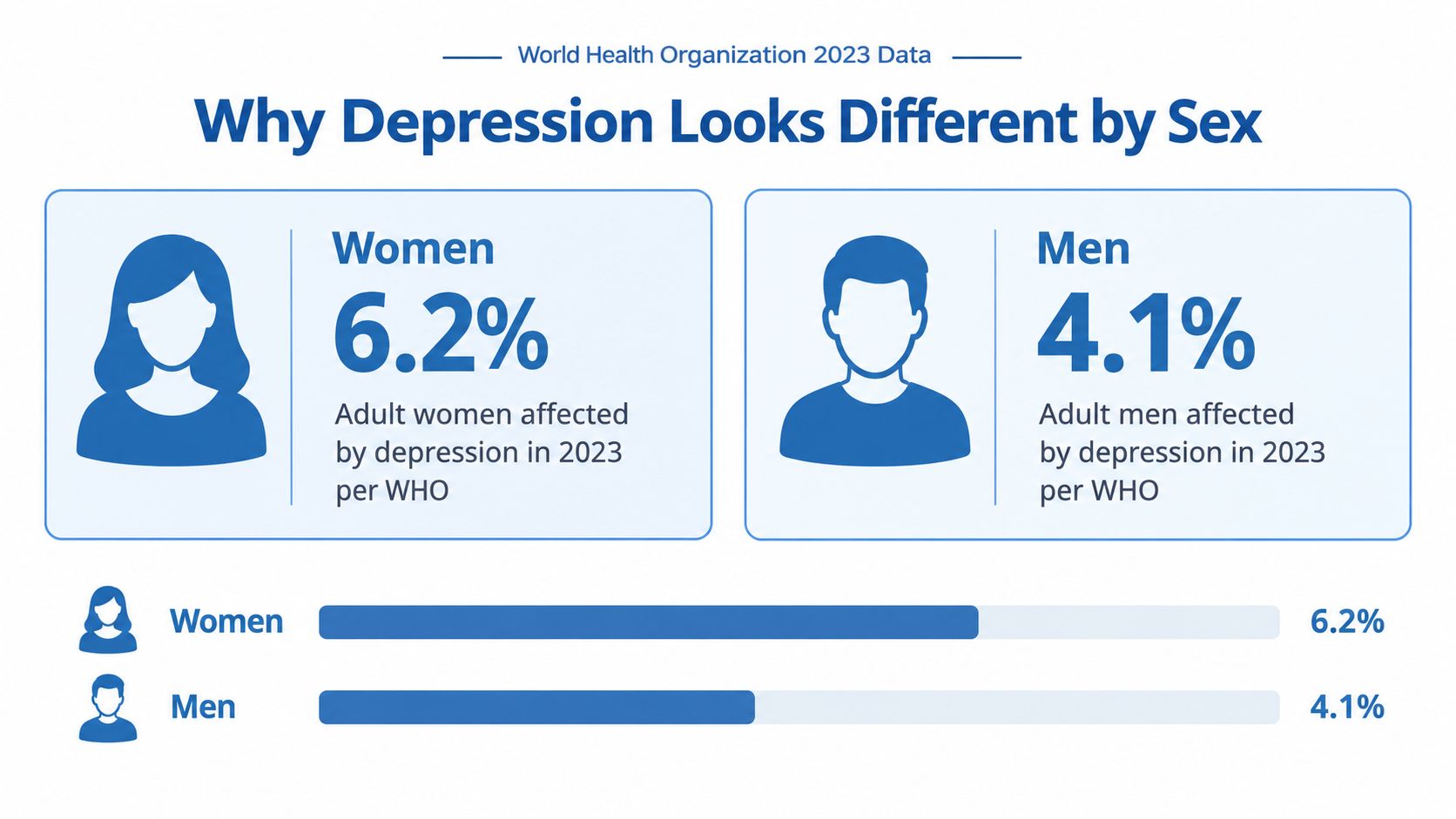
That gap matters because prevalence influences who gets screened, which symptoms clinicians expect, and where health systems place treatment resources. If screening focuses mainly on sadness and tearfulness, it may identify many women while missing men whose depression appears as anger, alcohol misuse, workaholism, or reckless decision-making. A diagnosis is not determined by a stereotype, but stereotypes can influence which questions get asked.
The difference also persists across the lifespan. The same WHO estimate places depression among adults ages 70 and older at 5.4%, showing that the condition doesn't vanish after midlife. Older adults of any sex may describe depression through pain, sleep problems, memory concerns, reduced appetite, or loss of independence rather than volunteering the word “depressed.”
Why the average doesn't diagnose an individual
Population data describe patterns, not destinies. A woman can present primarily with agitation and anger, and a man can experience classic sadness, guilt, and crying. The correct clinical response is to use the prevalence gap as a prompt for broader screening, not as a shortcut to diagnosis.
A careful assessment also separates depression from bipolar disorder, grief, trauma-related conditions, medication effects, thyroid disease, substance-induced symptoms, and medical illness. Neurotransmitter explanations, such as the simplified comparison of dopamine and serotonin, may help patients understand some treatment discussions, but no single chemical explanation accounts for the full difference between women and men.
How Depression Symptoms Differ Between Women and Men
Symptom-level evidence shows a meaningful presentation difference. Women tend to show greater intensity in depressed mood, appetite or weight change, and sleep disturbance, while men more often present with alcohol or drug misuse, risk-taking, and poor impulse control, according to a symptom-level meta-analysis indexed by PubMed.
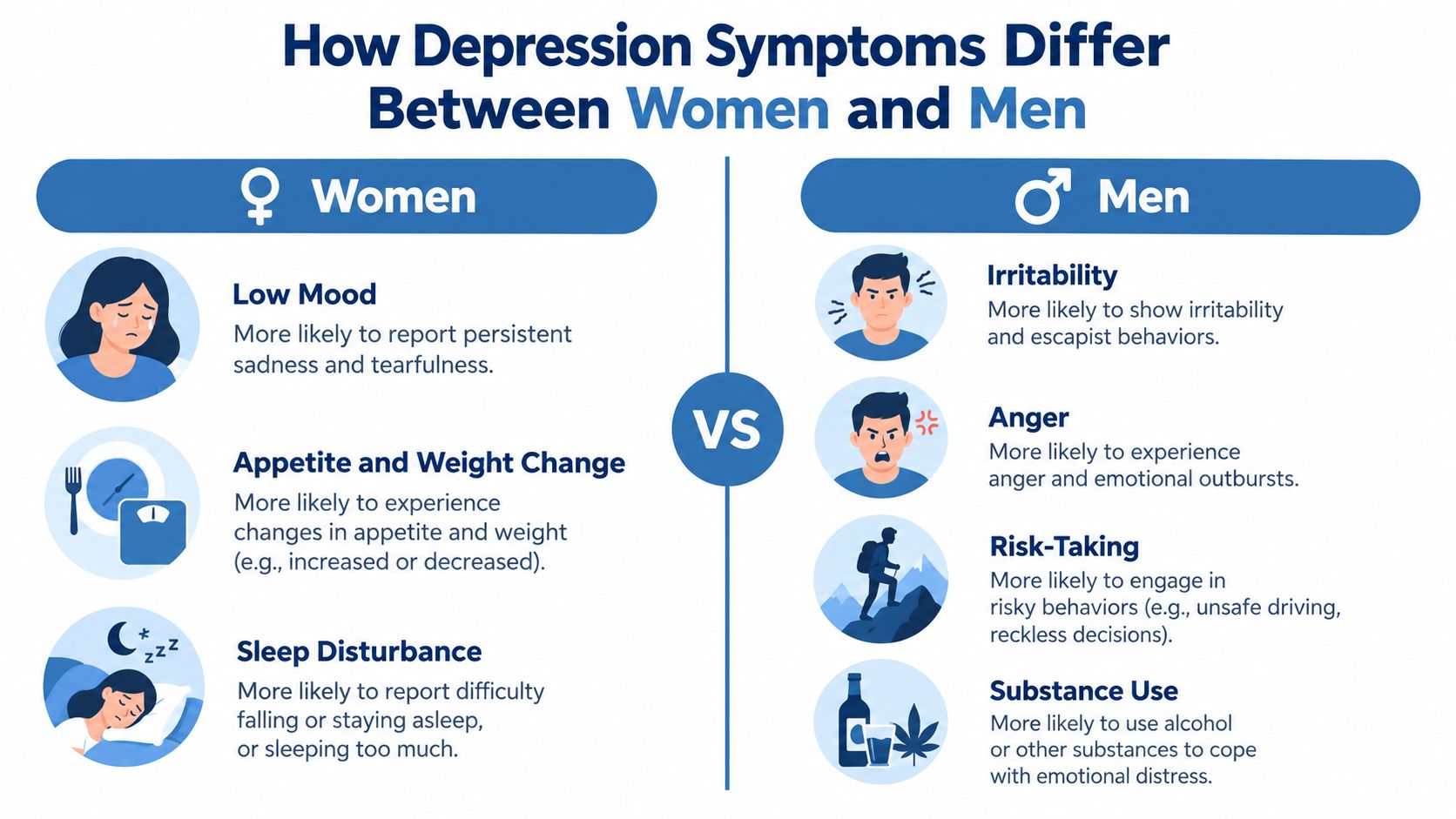
A woman may say, “I can't stop crying, I don't enjoy anything, and I barely sleep.” A man with the same underlying depressive illness may say he is working late every night, snapping at his partner, drinking more, and taking unnecessary risks. If the clinician asks only whether he feels sad, he may answer no and leave without appropriate care.
Presentation | Questions that uncover the problem |
|---|---|
Persistent sadness or hopelessness | “Have you felt emotionally heavy, empty, or hopeless most days?” |
Sleep and appetite change | “What has changed in your sleep, eating, weight, or energy?” |
Irritability and anger | “Are small frustrations leading to reactions that feel out of character?” |
Substance use | “Are alcohol, cannabis, stimulants, or other substances becoming your main way to calm down or escape?” |
Risk-taking | “Have you been driving faster, spending impulsively, fighting, or making decisions you later regret?” |
The behavior may be the symptom
Consider a man who isolates from friends, stays at work long after his responsibilities are finished, and becomes angry when his family asks what is wrong. His behavior might be labeled dedication, stubbornness, or a relationship problem. Those explanations may be partly true, but a clinician should also ask whether he has lost pleasure, feels like a failure, sleeps poorly, or uses alcohol to switch off his thoughts.
Anger alone doesn't establish depression. Neither does tearfulness. Symptoms must be persistent, impairing, and considered alongside safety, medical history, substance use, and other psychiatric conditions. Families can start the conversation by describing observable changes rather than accusing someone of having a disorder.
Practical rule: Ask about what a person is doing differently, not only what emotion they can name.
Women also need screening that goes beyond sadness. Appetite changes, insomnia, exhaustion, chronic worry, guilt, and reduced pleasure can become normalized during caregiving, parenthood, or major life transitions. A focused resource on the signs and symptoms of depression in men can help families recognize externalizing presentations that don't fit the familiar image of depression.
Biological and Psychosocial Risk Factors Behind the Gap
The difference in depression prevalence has several interacting causes. Biology may create periods of increased vulnerability, while social conditions shape stress exposure, symptom recognition, and access to care. These factors also affect whether depression appears as sadness, physical exhaustion, anxiety, irritability, or behavior that is misread as a personality problem.
Women experience reproductive transitions without a direct male equivalent, including puberty, pregnancy, postpartum changes, perimenopause, and menopause. Hormonal shifts do not make depression inevitable, and they should not replace a psychiatric evaluation. They do make timing clinically relevant. Ask when symptoms began, whether they follow reproductive changes, and whether thyroid disease or another medical condition could contribute. For a focused discussion, see this guide to perimenopause and depression.
Biology interacts with lived pressure
A patient may have biological vulnerability while also managing caregiving demands, financial strain, relationship conflict, inadequate sleep, or trauma. A treatment plan that addresses only one layer may provide incomplete relief. Medication can reduce depressive symptoms, while psychotherapy, practical support, restored sleep, safety planning, and treatment for trauma or anxiety may determine whether improvement continues.
Pregnancy, postpartum, and breastfeeding also require careful review of nonprescription products. “Natural” does not automatically mean safe, effective, or compatible with prescribed medication. A clinician can consider natural supplement guidance for moms alongside the patient's medical history, current treatment, and feeding status. Supplements should not replace evaluation or evidence-based depression care.
Men may face pressures that make emotional disclosure feel unsafe. Cultural expectations can reward self-reliance even as work, relationships, sleep, or physical health deteriorate. Distress may be expressed through alcohol or drug use, excessive work, aggression, compulsive exercise, or risk-taking. These behaviors can briefly dull emotional pain while worsening the conditions that sustain depression.
What the historical data can and can't tell us
The National Comorbidity Survey reported a lifetime prevalence of major depressive disorder of 21.3% in women compared with 12.7% in men, often summarized as roughly 2:1, in this Harvard-hosted depression chapter. The finding supported further research into hormones, stress, trauma, caregiving, and help-seeking.
These figures reflect diagnosed or reported illness, so recognition and access to care may influence the gap. They do not show that women are destined to become depressed or that men are protected. Risk assessment should account for both body-based transitions and social context, because each can change when symptoms emerge and how quickly care is needed.
Course, Comorbidities, and Suicide Risk by Sex
Depression in women vs men carries a difficult paradox. Women are diagnosed more often, yet men can face a more dangerous course when symptoms remain hidden, substance use is present, or help is delayed. Suicide risk must be assessed directly in every sex, and clinicians shouldn't infer safety from a calm appearance or a denial of sadness.
U.S. surveillance data illustrate the diagnosis gap. In a CDC data brief based on NHANES, 10.4% of women compared with 5.5% of men had had depression overall, and the difference persisted across the reported periods, with women at 10.4% in 2007–2008 and 9.3% in 2015–2016. These figures are reported in the CDC data brief on depression.
Why diagnosis and danger don't move together
Men may be less likely to disclose emotional symptoms, seek care early, or tolerate repeated conversations about vulnerability. When depression is paired with alcohol or drug misuse, impulsivity, access to lethal means, or sudden withdrawal, the clinical risk can rise quickly. Women more often present with co-occurring anxiety or eating-related concerns, which can create a different pattern of distress and impairment.
The important point is not to rank one sex as safer or sicker. Diagnosis frequency and suicide danger are different measurements. A person who has never received a depression diagnosis can still be at immediate risk.
The CDC also reports that depression prevalence was 16.0% among females and 10.1% among males overall, with the difference present in every age group except adults ages 20–39, where 19.0% versus 14.3% wasn't statistically significant, as detailed in its national depression prevalence brief. These differences reinforce the need for age-aware and sex-aware screening, not assumptions about individual patients.
Ask plainly about thoughts of death, self-harm, suicide, intent, preparation, access to lethal means, intoxication, and protective supports. If someone may act soon, has a plan, or can't stay safe, contact emergency services or go to the nearest emergency department. Don't leave the person alone while arranging urgent help.
Sleep also affects safety and functioning. Persistent insomnia can intensify mood symptoms and impair judgment, so evaluation should address both depression and sleep rather than treating depression and insomnia as unrelated problems.
Help-Seeking Patterns and Treatment Response Differences
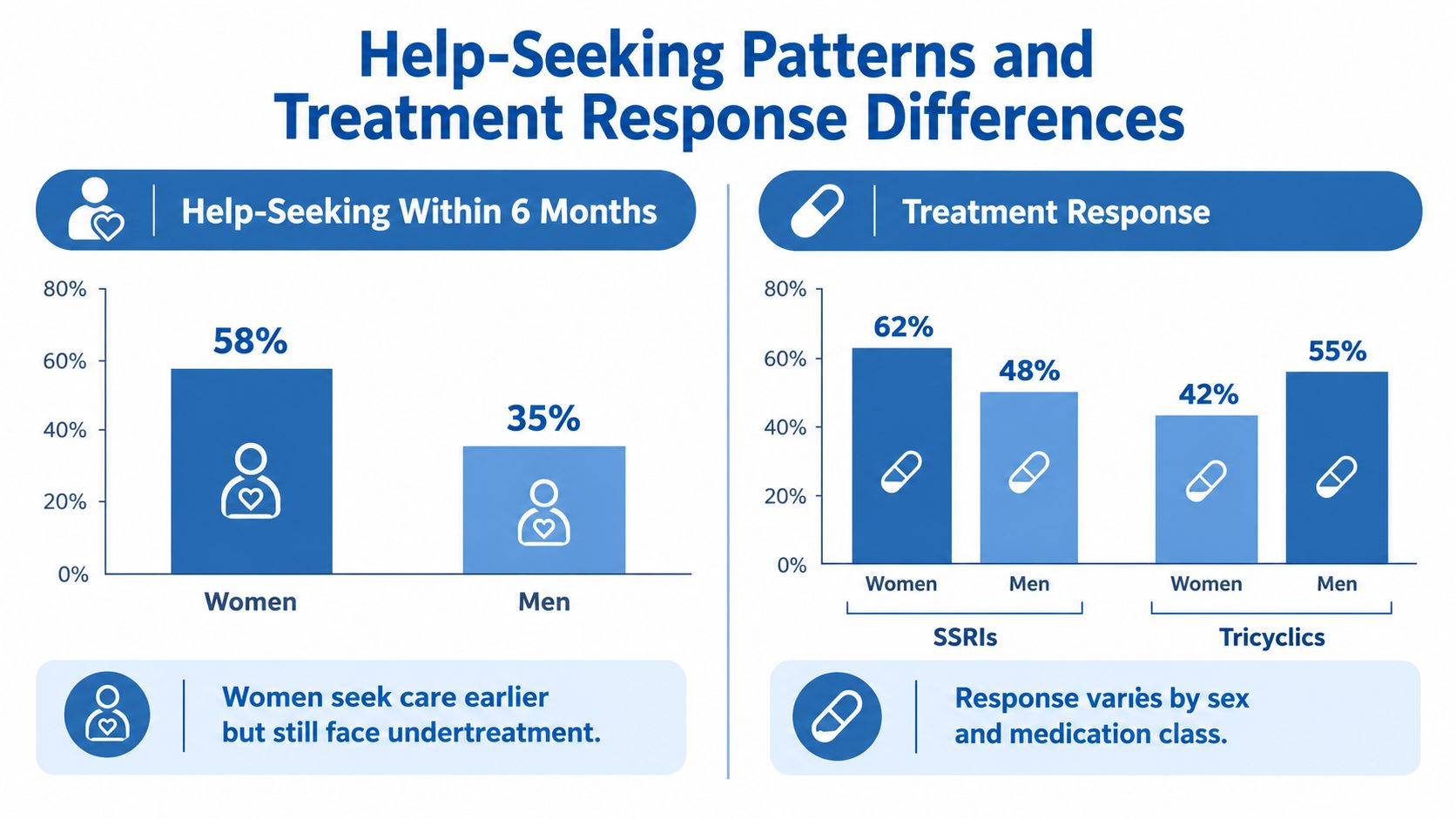
Women often enter mental health care sooner because their symptoms are more likely to match conventional screening questions or because they feel more permission to discuss emotional distress. That doesn't mean women always receive adequate care. Chronic symptoms can be minimized as stress, caregiving strain, hormonal change, or personality, and a prescription alone may leave trauma, anxiety, relationship strain, or sleep problems untreated.
Men frequently present later, after work, relationships, substance use, or physical health have deteriorated. The practical mistake is to wait for a man to describe sadness in familiar language. A clinician should ask about anger, avoidance, overwork, alcohol, impulsivity, loss of pleasure, and the gap between outward performance and private functioning.
Treatment response also doesn't support a universal “women respond better” conclusion. A recent systematic review and meta-analysis found a small-to-moderate effect favoring women for SSRIs, Hedges' g = -0.434, 95% CI -0.706 to -0.163, while it found no significant sex difference for SNRIs, g = 0.018, 95% CI -0.224 to 0.261, or placebo response, g = -0.045, 95% CI -0.154 to 0.063, in the published systematic review and meta-analysis.
What those findings change in practice
For a man starting an SSRI, I want a defined follow-up plan, symptom tracking, and a frank review of adherence, side effects, alcohol or drug use, sleep, bipolar symptoms, and medical contributors. A partial response isn't proof that the medication class is wrong, but it is a reason to reassess rather than repeatedly renew the same prescription without measurement.
For women, response still needs monitoring, especially when reproductive stage, pregnancy plans, postpartum status, medication interactions, sleep deprivation, or anxiety affect treatment. No sex-based trend should override the patient's actual response.
Psychotherapy efficacy doesn't appear meaningfully differentiated by sex in meta-analytic evidence. That makes therapy a core treatment option for both women and men, particularly when depression is maintained by avoidance, shame, trauma, interpersonal conflict, or substance-related coping. Medication and therapy aren't competing identities. The useful choice depends on severity, risk, preference, past response, comorbidity, access, and the patient's willingness to participate.
When to Seek Evaluation and How Telepsychiatry Helps
Seek a professional evaluation when low mood, emotional numbness, irritability, or loss of interest persists and begins to affect work, relationships, parenting, self-care, or sleep. Prompt assessment is especially important after a marked appetite or sleep change, increased substance use, escalating anger or risk-taking, inability to function, or thoughts of self-harm.
A psychiatric evaluation should do more than confirm depression. It should review symptom timing, severity, sleep, appetite, energy, concentration, trauma, substance use, medical conditions, current medications, family history, bipolar symptoms, reproductive or hormonal context when relevant, and immediate safety. The clinician should explain the working diagnosis and offer a treatment plan that can be adjusted when the first approach isn't effective or tolerable.
A practical evaluation pathway
Start with safety. Tell the clinician about suicidal thoughts, self-harm urges, domestic violence, intoxication, or access to lethal means. Safety concerns change the urgency and setting of care.
Describe behavior as well as feelings. “I'm angry, drinking more, and avoiding everyone” gives a clinician useful information even when sadness isn't the main complaint.
Bring the treatment history. Include previous antidepressants, therapy experiences, side effects, missed doses, supplements, and what helped or failed.
Agree on follow-up measures. Tracking sleep, appetite, energy, functioning, and mood helps distinguish a real response from day-to-day fluctuation.
Telepsychiatry can reduce practical barriers such as transportation, scheduling conflicts, and discomfort entering a clinic. It can also make follow-up easier when a patient is struggling to leave home. A clinician still needs to verify location, privacy, emergency contacts, and the appropriate local response plan for every virtual visit. The telemedicine psychiatry guide offers further context on how virtual psychiatric care works.
A clinical health-care setting study published in JAMA Psychiatry found an average ICD-10 current depressive episode prevalence of 12.5% among women versus 7.1% among men, showing that the sex gap appears in routine medical settings as well as population surveys, according to the JAMA Psychiatry study. In Florida, Refresh Psychiatry & Therapy provides psychiatric evaluation, medication management, and individual therapy through telepsychiatry, allowing clinicians to address depression alongside anxiety, trauma, insomnia, substance-related concerns, and other conditions when appropriate.
This blog is for informational purposes only and does not constitute medical advice. Please consult a qualified mental health professional for personalized guidance.
Refresh Psychiatry & Therapy offers virtual psychiatric evaluations, medication management, and coordinated individual therapy for depression, with care adapted to the person's symptoms, safety, medical history, and treatment response. Visit Refresh Psychiatry & Therapy or call Refresh Psychiatry at (954) 603-4081 to schedule your evaluation. We accept Aetna, United Healthcare/UHC, Cigna, Blue Cross Blue Shield, Humana, Tricare, UMR, and Oscar insurance plans.