
🛌 Is PTSD a Disability When It Limits Daily Life

PTSD isn't automatically a disability, but it can qualify as one when symptoms substantially limit daily functioning. The standard depends on whether you mean Social Security benefits, ADA workplace protections, or VA benefits.
You may be asking after missing work because of nightmares, avoiding a crowded office, losing concentration during meetings, or feeling constantly alert for danger. Perhaps you've received a PTSD diagnosis and still wonder whether the law recognizes what you're experiencing. Or you're a veteran trying to understand whether a service connection and diagnosis are enough for VA benefits.
The answer is yes in some circumstances and no in others. A diagnosis matters, but the practical effect of PTSD on work, relationships, concentration, self-care, and other daily activities matters just as much. Each system asks a different question, uses different evidence, and offers a different kind of protection.
This distinction can feel frustrating, especially when one person says, “PTSD is a disability,” while another says, “You have to prove you can't work.” Both statements may be accurate within different frameworks. Social Security examines whether a medically determinable impairment prevents substantial gainful activity for at least 12 months or is expected to result in death. The Americans with Disabilities Act, or ADA, focuses on substantial limits to major life activities and possible workplace accommodations. The VA evaluates service connection and the level of occupational and social impairment.
For Florida patients, a psychiatric evaluation can help clarify symptoms, treatment needs, and functional limitations. It can't guarantee a legal outcome, but it can create a clearer clinical record and guide appropriate care. Understanding the difference between PTSD and complex PTSD may also help you describe your symptoms more accurately.
Introduction Why So Many People Ask Is PTSD a Disability
A Florida worker wakes after a trauma-related nightmare and arrives late because leaving home feels unsafe. At work, a sudden sound triggers a flashback. The person spends the morning scanning the room, avoiding coworkers, and rereading the same email without understanding it. By afternoon, one question remains: is this a medical condition, a disability, a workplace issue, or all three?
PTSD affects people differently. Some continue working with treatment or accommodations. Others struggle with attendance, concentration, social interaction, or independent daily tasks. A diagnosis alone does not answer the disability question. Documented functional limits do.
A useful rule: Ask not only, “Do I have PTSD?” Ask, “What can I no longer do reliably, safely, or consistently because of PTSD?”
The three systems people often confuse are Social Security disability benefits, ADA workplace protections, and VA disability benefits. Social Security generally asks whether a condition prevents substantial gainful activity for at least 12 months or is expected to result in death. The ADA may protect an employee who can work with a reasonable accommodation. The VA considers service connection and the level of impairment when assigning a PTSD rating. These standards overlap in subject matter, but they are not interchangeable. A clinical record that supports one question may not answer the others.
The National Institute of Mental Health estimates that 3.6% of U.S. adults had PTSD in the past year and 6.8% had PTSD at some point in their lives (NIMH PTSD statistics). Those figures do not decide an individual claim. They do show why trauma-related disability questions arise across medical, workplace, and veterans' systems.
For Florida patients, Refresh Psychiatry & Therapy provides psychiatric evaluation and treatment through telepsychiatry. An evaluation cannot guarantee benefits, workplace protection, or a VA rating. It can clarify symptoms, treatment needs, and functional limits, while helping a patient identify which standard applies and what documentation to discuss next. Describing the difference between PTSD and complex PTSD may also make that clinical picture clearer.
Understanding PTSD and How It Can Limit Daily Functioning
A person may know they are safe at home, yet a car backfire, crowded room, or unexpected message can trigger the body's danger response. PTSD can make the brain's alarm system behave like an overly sensitive smoke detector. It reacts to reminders, sensations, places, thoughts, or sounds as though the original threat is happening again.
PTSD symptoms often connect in four groups:
Re-experiencing: Flashbacks, intrusive memories, distressing dreams, or intense reactions to reminders.
Avoidance: Staying away from people, places, conversations, activities, or responsibilities linked to the trauma.
Mood and behavior changes: Detachment, guilt, shame, irritability, loss of interest, distrust, or difficulty feeling positive emotions.
Heightened arousal: Poor sleep, being easily startled, anger, physical tension, racing thoughts, or trouble staying focused.
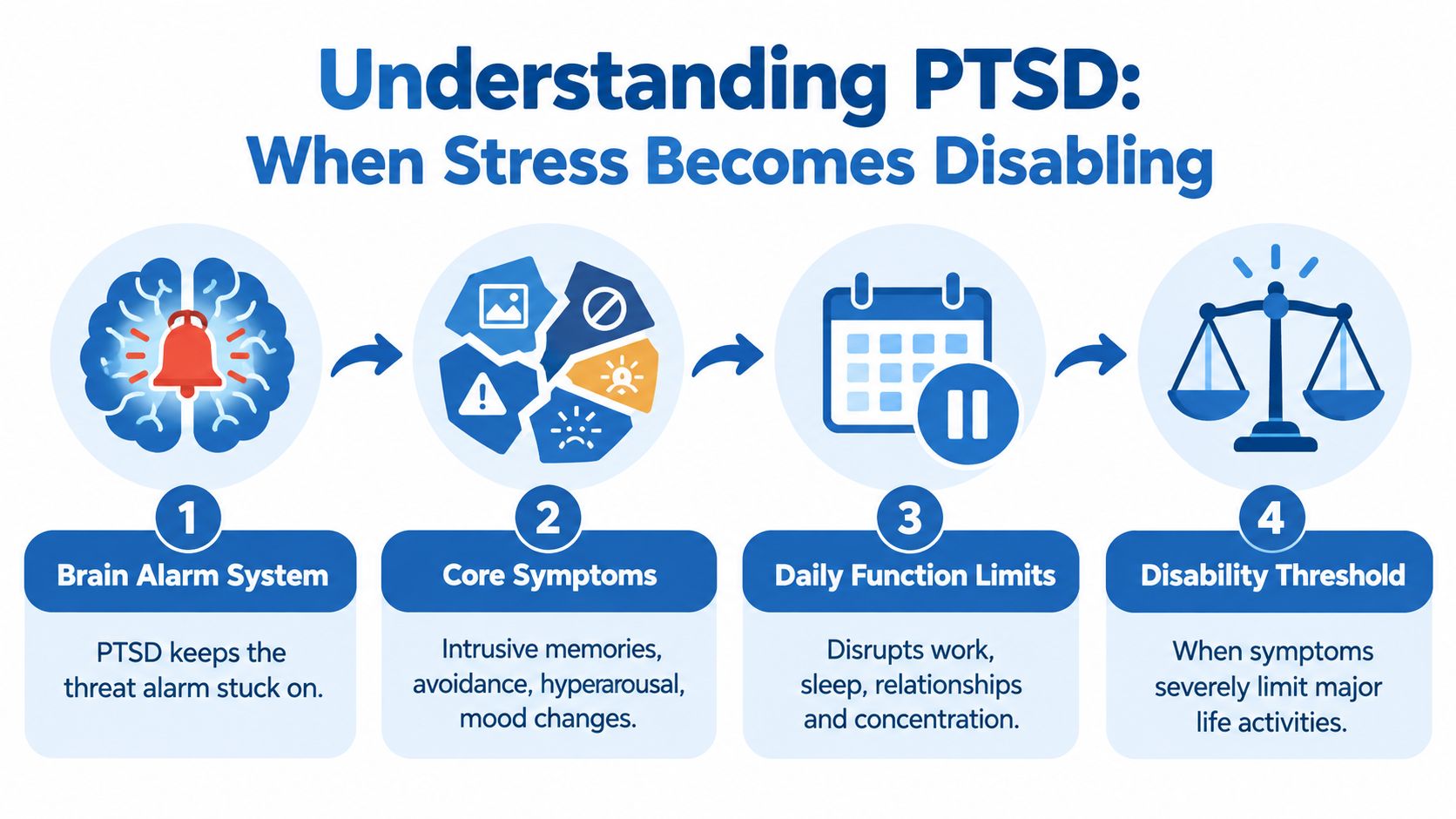
These symptoms matter in a disability claim when they disrupt repeated activities. Insomnia can cause exhaustion and slower thinking. Avoidance can interfere with work, school, medical appointments, or family events. Hyperarousal may make an ordinary workplace feel threatening, while an intrusive memory can interrupt a task without warning.
Clinical research connects PTSD with impaired functioning across several areas, including education and everyday responsibilities (clinical evidence on PTSD-related functional impairment). The practical question is how symptoms affect a person's actual reliability, concentration, relationships, self-care, and ability to adapt.
A diagnosis starts the evaluation. It does not, by itself, answer whether someone qualifies for SSDI or SSI, needs an ADA accommodation, or meets the VA standard for a service-connected rating. Each system asks a different question, so the same clinical record may need to explain symptoms in different ways.
If you often wonder why you don't feel safe for no reason, a qualified clinician can help identify triggers, treatment options, and functional patterns. For Florida patients using telepsychiatry, that evaluation can also organize information for the next conversation with Social Security, an employer, or the VA.
How Social Security Evaluates PTSD for Disability Benefits
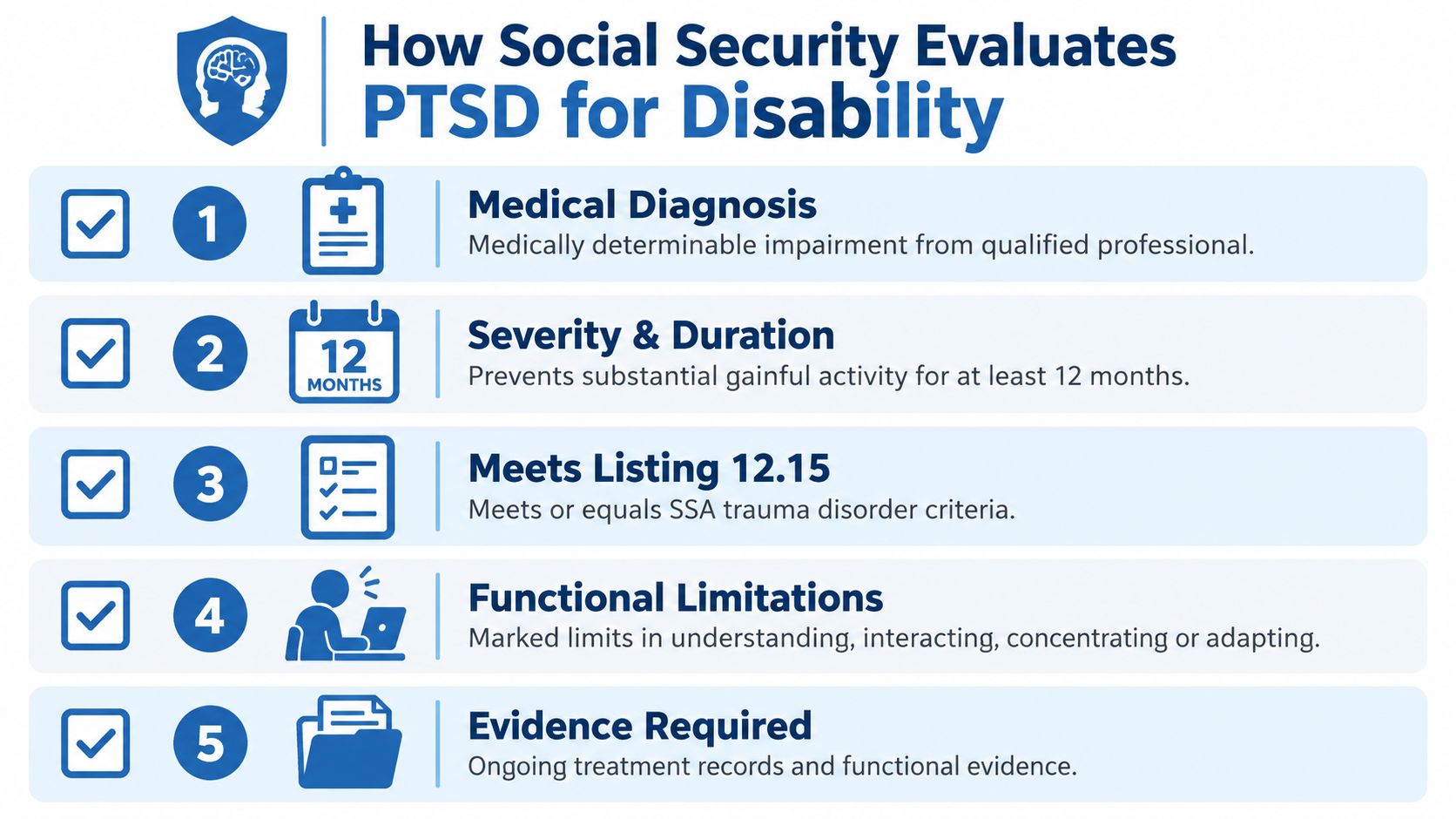
A PTSD diagnosis can explain suffering without automatically establishing eligibility for Social Security benefits. SSDI and SSI ask a narrower question: does the condition prevent substantial gainful activity for at least 12 months, or is it expected to result in death? PTSD may be considered alone or together with another impairment. This standard differs from the ADA workplace test and the VA's service-connected rating process, so one evaluation may need to be explained in different ways.
Adults are generally evaluated under Listing 12.15, which covers trauma- and stressor-related disorders. Children under 18 are evaluated under Listing 112.15. A claimant may meet or medically equal a listing. If not, PTSD can still support disability later in the sequential evaluation process when symptoms prevent sustained work.
Listing 12.15 and the functional domains
Social Security considers documented trauma exposure, the required symptom clusters, and the effect of PTSD on four functional domains. The listing generally requires an extreme limitation in one domain or a marked limitation in two (SSA Listing 12.15 guidance):
Understanding, remembering, or applying information: Difficulty learning instructions, recalling steps, solving ordinary problems, or completing familiar tasks.
Interacting with others: Difficulty responding appropriately to supervisors, coworkers, family members, customers, or unfamiliar people.
Concentrating, persisting, or maintaining pace: Losing focus, needing frequent redirection, abandoning tasks, or working too slowly to remain reliable.
Adapting or managing oneself: Difficulty regulating emotions, maintaining hygiene, handling routine changes, managing stress, or functioning independently.
“Marked” and “extreme” describe severity and consistency, not the simple presence of a symptom. Occasional distraction may not meet the standard. Repeated problems sustaining attention, interacting appropriately, or adapting to ordinary demands provide more meaningful functional evidence when treatment records document the same pattern over time.
The Paragraph C pathway
Some claims rely on Paragraph C rather than Paragraph B. This pathway requires a medically documented history of the disorder for at least 2 years, ongoing treatment, therapy, psychosocial support, or a highly structured setting that reduces symptoms, along with marginal adjustment. Marginal adjustment means having minimal ability to adapt to changes or demands outside familiar daily routines (Paragraph C criteria).
A structured appointment may show only one part of the picture. The record should explain what happens with schedule changes, unfamiliar environments, conflict, and independent responsibilities. Functional notes are most useful when they connect symptoms to reliability, attendance, task completion, and workplace demands.
People comparing mental health claims can also learn when depression qualifies as a disability. For readers considering applying for disability with PTSD, legal guidance may clarify the application process. A psychiatrist can document diagnosis, symptoms, treatment response, side effects, and limitations, but Social Security decides whether the legal requirements are met.
PTSD as a Disability at Work and Your Rights Under the ADA
Workplace protection is a different question from benefit eligibility. Under the ADA, PTSD may qualify as a disability when it substantially limits a major life activity, including activities related to concentration, interacting with others, sleeping, or working. The ADA and Equal Employment Opportunity Commission guidance explain that a person may qualify for reasonable accommodations even when they remain able to perform their job.
Social Security generally requires much stronger proof, namely inability to sustain full-time work for at least 12 months (EEOC and ADA guidance for returning service members). This creates an important practical distinction: an employee may qualify for an accommodation without qualifying for SSDI or SSI benefits.
Feature | ADA Workplace Protections | Social Security Disability Benefits |
|---|---|---|
Main question | Does PTSD substantially limit a major life activity? | Does PTSD prevent substantial gainful activity for at least 12 months or meet the applicable standard? |
Possible outcome | Continued employment with reasonable accommodation | Disability benefits if the legal requirements are met |
Disclosure | Usually optional unless accommodation is needed | Medical and functional evidence is central to the claim |
Examples | Remote work, modified schedules, quieter spaces, or treatment-related leave when reasonable | Evidence showing sustained inability to perform work reliably |
Decision maker | Employer and applicable employment law process | Social Security Administration |
Disclosure isn't automatically required. An employee generally discloses a disability when requesting an accommodation, and the employer may request appropriate supporting documentation. You don't have to share every trauma detail. A clinician may instead describe functional restrictions, such as difficulty with unpredictable interruptions, crowded environments, extended shifts, or sleep-related fatigue.
Practical distinction: An accommodation helps you do the job. Social Security benefits address circumstances in which you can't sustain substantial work under the agency's rules.
Potential accommodations vary by job and employer. A quieter workspace may reduce hypervigilance. A modified schedule may support treatment attendance or sleep stabilization. Remote work may reduce exposure to certain triggers, but it won't be reasonable for every position. The accommodation must relate to the functional limitation and allow essential duties to be performed.
VA Disability for PTSD and How Ratings Work for Veterans
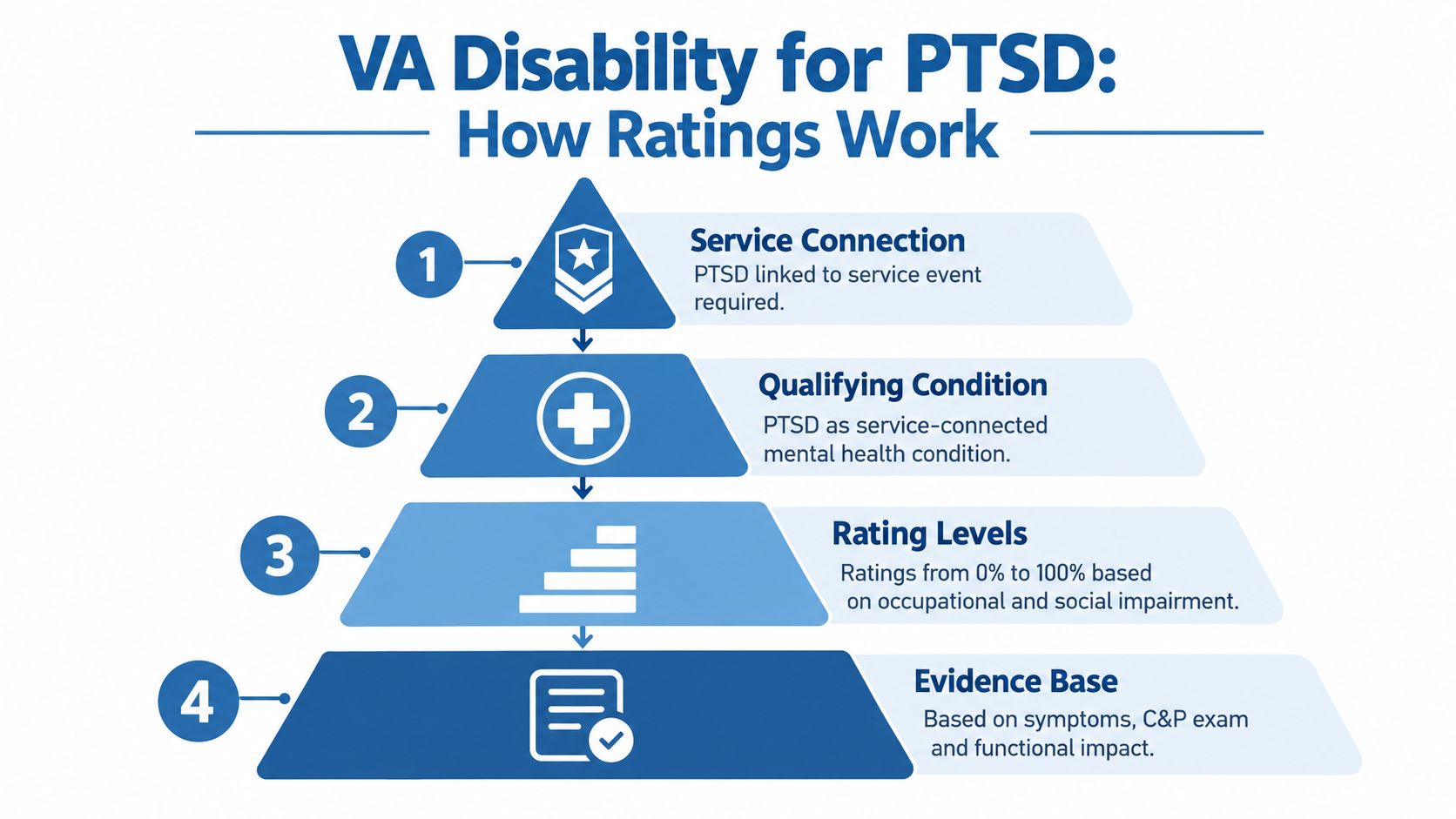
For veterans, the VA asks a service-connection question first. The VA states that a veteran may be eligible for disability compensation when there is a service-related stressor and a doctor has diagnosed PTSD (VA PTSD disability eligibility). PTSD may develop before, during, or after service, but eligibility depends on the applicable service-connection rules and evidence linking the condition to service.
A diagnosis alone doesn't automatically produce a compensable rating. After service connection, the VA evaluates how symptoms affect occupational and social functioning. The rating schedule uses the General Rating Formula for Mental Disorders in 38 CFR 4.130, Diagnostic Code 9411, with levels of 0%, 10%, 30%, 50%, 70%, and 100% (VA PTSD rating schedule guide).
Reading the VA rating levels
The percentages describe increasing functional impact:
0%: PTSD is diagnosed, but symptoms don't interfere enough with occupational and social functioning under the rating criteria.
10%: Mild or transient symptoms reduce work efficiency during significant stress, or symptoms are controlled by medication.
30%: Symptoms cause an occasional decrease in work efficiency and intermittent difficulty performing occupational tasks, while general functioning remains satisfactory.
50%: PTSD causes reduced reliability and productivity, with more persistent effects on concentration, mood, judgment, memory, or relationships.
70%: Symptoms produce deficiencies in most areas, such as work, school, family relations, judgment, thinking, or mood.
100%: PTSD causes total occupational and social impairment.
The rating isn't a symptom-counting contest. Two veterans may have different symptoms but similar levels of occupational and social impairment. A careful account of frequency, severity, duration, treatment response, and day-to-day consequences can help the VA understand the condition's actual impact.
Documentation and Evidence That Strengthen a PTSD Disability Claim
A strong claim connects three points: the diagnosis, the symptoms, and the functional consequences. A note stating “PTSD continues” may be accurate, yet it does not explain whether you can attend work reliably, follow instructions, tolerate routine interactions, or adapt to changes. Those details matter because SSDI and SSI, ADA workplace protections, and VA ratings apply different standards to disability.
Research has found impairments in several areas of functioning among people with PTSD. Greater symptom severity was also linked with more educational difficulty and lower academic performance, supporting a practical rule: functional evidence should accompany symptom descriptions. For a closer look at how PTSD can affect functioning, see this research on PTSD and functional impairment.
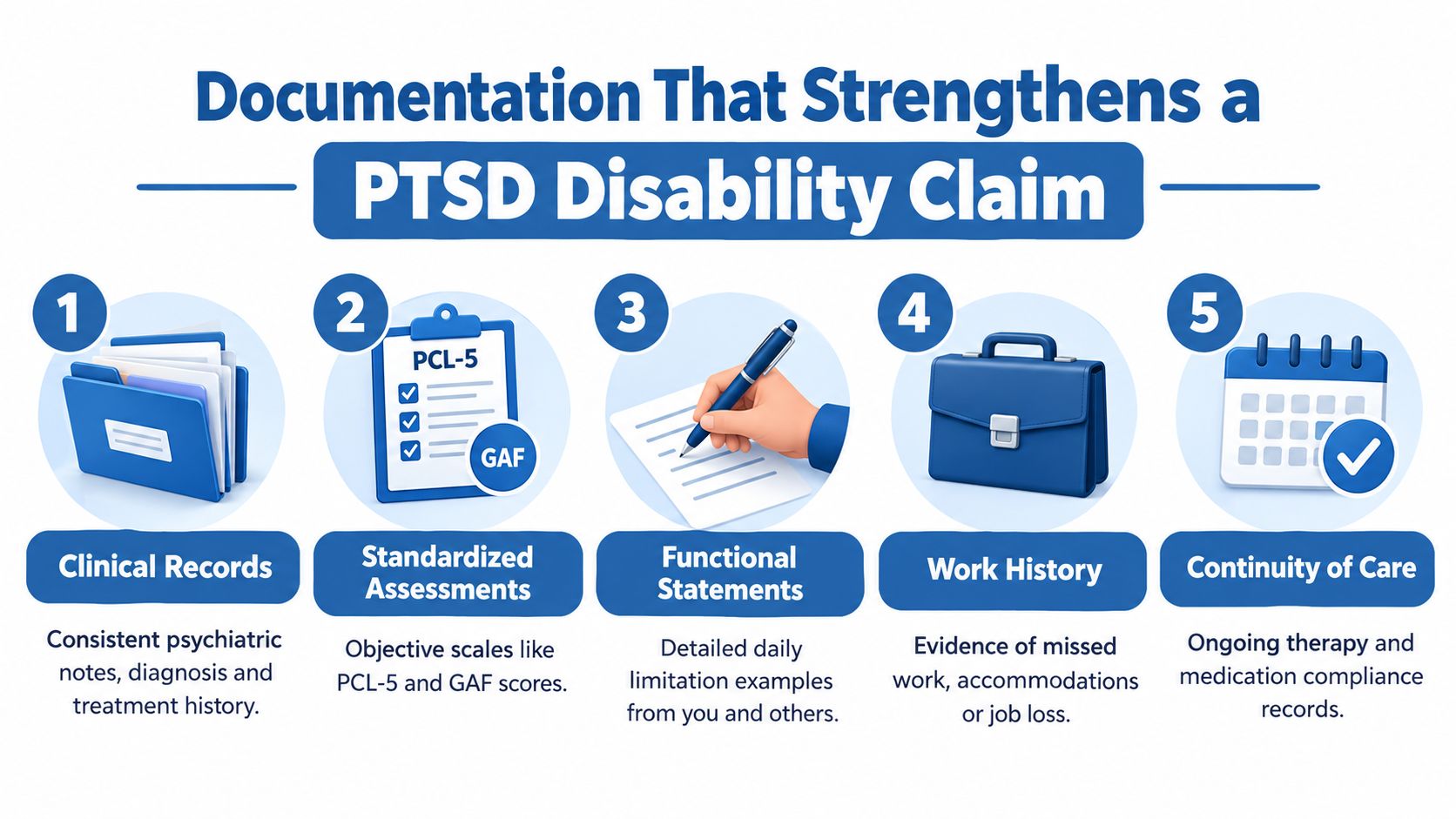
What to gather
Clinical records: Psychiatric evaluations, diagnoses, medication history, therapy notes, and treatment response.
Functional examples: Missed work, unfinished tasks, panic, avoidance, disrupted sleep, isolation, or difficulty managing ordinary responsibilities.
Collateral observations: Statements from family members, trusted friends, supervisors, or caregivers who have noticed changes over time.
Work or school records: Attendance problems, performance changes, accommodations, leave, interrupted education, or incomplete assignments.
Continuity of care: Records showing treatment, medication management, therapy, or structured support over time.
For Social Security, organize examples around the four Paragraph B domains. Replace “I cannot concentrate” with a specific account of what happens while reading instructions, attending meetings, changing tasks, or working without reminders. Paragraph C evidence should describe the documented history, ongoing support, and difficulty handling changes outside a predictable routine.
The evidence should match the benefit being sought. Social Security focuses on sustained work-related functioning, the ADA focuses on limitations and reasonable accommodations, and the VA considers service-related PTSD and occupational and social impairment. A clinician can provide a functional assessment or accommodation letter, but it must remain accurate and clinically supported. Consistency is more persuasive than dramatic wording.
Dissociation can affect memory, attention, and continuity of experience. Reviewing what dissociation can look like may help you describe episodes clearly during an evaluation.
Next Steps for Evaluation Treatment and Support in Florida
If PTSD is affecting work, benefits, or daily routines, begin with a psychiatric evaluation. Bring prior diagnoses, medication lists, therapy and hospital records, plus work or school documentation. A brief timeline can show when symptoms began and how they affect sleep, concentration, relationships, attendance, and ordinary tasks.
Choose the goal that fits your situation:
Workplace support: Ask a qualified clinician to describe functional limitations and discuss reasonable accommodations with your employer.
Social Security: Gather records showing how symptoms affect sustained work activity, review the duration requirements, and consider legal guidance if you file or appeal.
VA benefits: Collect service records, stressor information, diagnostic documentation, and evidence of occupational and social impairment.
Treatment: Discuss trauma-focused therapy, medication management, sleep problems, avoidance, dissociation, and safety concerns with a mental health professional.
These paths use different standards. Social Security examines whether a condition limits sustained work over the required period. The ADA focuses on disability-related limitations and reasonable support that may help someone continue working. VA review connects PTSD to military service and considers its effect on occupational and social functioning. One diagnosis can therefore lead to different answers depending on the question being asked.
Florida residents can choose in-person care or HIPAA-compliant telepsychiatry. A virtual evaluation may help when leaving home, traveling, or waiting in an office increases distress. This guide to finding a psychiatrist offers practical starting points.

This blog is for informational purposes only and does not constitute medical advice. Please consult a qualified mental health professional for personalized guidance.
Refresh Psychiatry & Therapy offers psychiatric evaluations, medication management, and individual therapy for PTSD and related trauma conditions through Florida telepsychiatry. Visit Refresh Psychiatry & Therapy or call (954) 603-4081 to schedule your evaluation. We accept Aetna, United Healthcare/UHC, Cigna, Blue Cross Blue Shield, Humana, Tricare, UMR, and Oscar insurance plans.