
🧠 Depression with Anhedonia Explained

You may still answer emails, attend work, and keep your usual routines, yet feel strangely absent from your own life. A favorite song sounds flat, a meal is only something to finish, and plans with people you care about feel like obligations rather than something to anticipate. You may even wonder why you can't “snap out of it” when nothing obvious has changed.
That experience can reflect depression with anhedonia, a form of depression in which the brain's ability to anticipate, pursue, and experience reward becomes impaired. It isn't laziness, ingratitude, or a character flaw. It's a clinically recognized symptom that deserves specific assessment and treatment.
Recognizing the Loss of Joy and Motivation
Saturday morning arrives, but the plans that once pulled you out of bed no longer create any inner movement. You may still make coffee, run, meet a friend, or play music, yet each activity feels difficult to start, flat while it happens, and empty afterward. This pattern points to more than reduced energy. It suggests that the brain is assigning less value to anticipated rewards.
That distinction helps separate depression with anhedonia from ordinary tiredness or a passing low mood. Fatigue often improves with rest. Sadness can come in waves and still allow moments of pleasure. Anhedonia can reduce both interest and pleasure, so someone may continue working and socializing while feeling detached from the experiences that once mattered. Some people describe feeling emotionally numb. Others feel frustrated because they remember enjoying life but cannot generate the expectation that enjoyment will return.
What anhedonia can look like
The loss may appear in several areas:
Hobbies: Reading, gaming, cooking, exercise, and creative work feel unrewarding or difficult to begin.
Relationships: You still care about loved ones but feel little anticipation about seeing them or answering messages.
Sensory pleasure: Food, music, sex, touch, or attractive surroundings have less emotional impact.
Achievement: Finishing a task brings relief because it is over, not satisfaction or pride.
Future plans: You struggle to identify anything you genuinely want to happen.
The clinical pattern is often more specific than “I feel depressed.” Ask yourself whether the problem is starting activities, looking forward to them, enjoying them during the experience, or feeling satisfied afterward. Those distinctions help a psychiatrist assess whether reduced anticipation, motivation, consummatory pleasure, or several processes are involved. They also explain why a standard treatment may improve sadness while leaving reward and initiative impaired.
French psychologist Théodule-Armand Ribot formally defined anhedonia in 1896 as an inability to experience pleasure. The symptom later entered formal depression criteria in DSM-III in 1980, became part of the melancholic features specifier in DSM-IV in 1994, and remained central in DSM-5 in 2013, as described in this historical review of anhedonia.
A useful distinction: Clinically meaningful anhedonia does not require complete joylessness. A marked reduction in pleasure, motivation, or anticipation can warrant evaluation.
Anhedonia commonly occurs with major depressive disorder, though estimates vary by population and assessment method. Reviews report rates ranging from 35% to 70%, and one review found that more than 57% of 2,186 patients with MDD reported clinically relevant anhedonia (review of prevalence and clinical impact). It is associated with greater depressive severity, poorer quality of life, increased suicidality, and less favorable treatment outcomes. A focused assessment can therefore guide treatment toward the reward deficits that remain after low mood receives attention.
The Brain Reward Circuit and Dopamine Signaling
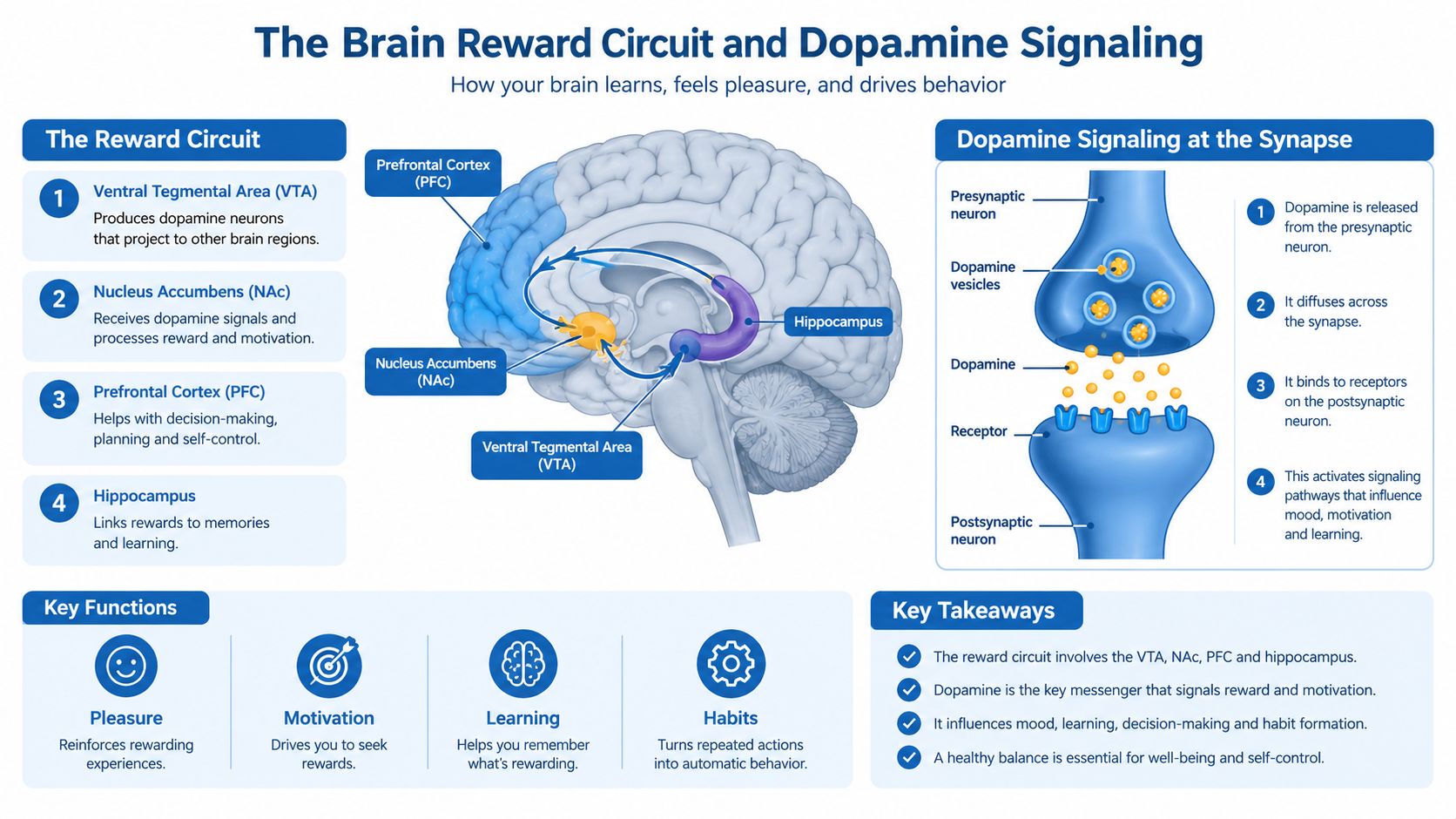
Pleasure doesn't come from a single “happiness center.” It emerges from communication among brain regions that help you notice a possible reward, decide whether it's worth effort, pursue it, experience it, and learn from the result. In depression with anhedonia, those steps can become poorly coordinated.
The frontostriatal reward circuit connects areas in the frontal cortex with the striatum and related mesocorticolimbic structures. A simple analogy is a navigation system. The frontal regions help evaluate a destination and organize the trip. The striatum helps assign motivational value and mobilize effort. Dopamine contributes to the signal that says, “This may be worth pursuing,” rather than acting as a simple chemical equivalent of pleasure.
Wanting is not the same as liking
Researchers often separate reward into three related processes:
Wanting: The drive to pursue something.
Liking: The pleasurable experience while receiving or doing it.
Learning: The brain's ability to remember what was rewarding and use that information next time.
A person may have reduced wanting but still experience some pleasure once an activity begins. Another person may initiate activities but find that the experience itself remains flat. A third may enjoy something briefly but fail to learn from it, so the activity doesn't become motivating in the future. This three-part model distinguishes anhedonia from general low mood alone (systematic review of reward subtypes.
Neuroimaging reviews describe striatal hypoactivation during reward liking and wanting, along with reduced frontostriatal sensitivity to positive feedback during reward learning. Reduced dopaminergic signaling and altered mesocorticolimbic circuitry help explain why a patient may understand intellectually that an activity should feel good but still lack the internal momentum to start it (neurobiology review of anhedonia).
Why this changes treatment conversations
If the dominant problem is reward-circuit dysfunction, reducing sadness alone may not restore motivation or pleasure. A medication can calm anxiety or improve sleep while the patient still feels unable to look forward to anything. Conversely, a treatment that targets motivation and reward processing may be useful even when the patient describes emotional emptiness more than sadness.
This is one reason patients shouldn't change medication without psychiatric guidance. Dopamine-related medications, glutamatergic treatments, and antidepressants each carry different benefits, contraindications, and risks. The practical question isn't whether dopamine is “good” and serotonin is “bad.” It's which symptoms are most impairing, what diagnosis is present, what previous treatments did, and which intervention offers a reasonable balance of benefit and risk. A plain-language explanation of dopamine versus serotonin can make that discussion easier.
Assessing Anticipation Versus Consummatory Pleasure
A standard depression screening question may ask whether you have “little interest or pleasure in doing things.” That's useful as a starting point, but it doesn't tell a clinician where the reward system is failing. A careful evaluation separates anticipatory anhedonia, motivational and effort-related deficits, consummatory pleasure, and reward learning.
Start with anticipation
Ask yourself what happens before an activity:
Do you look forward to meeting a friend, eating a favorite meal, or completing a project?
Does the activity feel worth the effort required to begin?
Can you imagine feeling better afterward, or does the future seem emotionally blank?
Do you avoid activities because they're unpleasant, or because they seem pointless?
Anticipatory anhedonia often creates the most disabling cycle. If nothing sounds appealing, you stop initiating activities. Without activity, the brain receives fewer opportunities for positive feedback, connection, mastery, or pleasure. The resulting inactivity can reinforce the sense that nothing matters.
Then examine the experience itself
Consummatory pleasure refers to what you feel during an activity. You might have no desire to watch a movie but discover that you enjoy parts of it once it starts. Or you might force yourself to attend dinner and remain unable to taste, connect, or relax. Those patterns provide different clinical information.
A psychiatrist may also ask whether accomplishments produce a reward signal. If cleaning a room, finishing an assignment, or helping someone brings only exhaustion, the issue may include impaired reward learning rather than simple unwillingness.
Validated tools can make these changes easier to track. The Snaith-Hamilton Pleasure Scale, or SHAPS, is one measure used to assess hedonic capacity, while broader interviews can examine motivation, effort, pleasure, and learning separately. The purpose isn't to reduce your experience to a score. It's to establish a clearer baseline and determine whether a treatment is improving the specific symptom that matters most to you.
“I'm functioning, but I'm not getting anything from it” is clinically meaningful information. Tell your clinician exactly that, rather than reporting only whether you feel sad.
A complete assessment also considers medication effects, substance use, sleep, anxiety, trauma, bipolar symptoms, psychotic symptoms, medical conditions, and suicidal thoughts. Emotional blunting from a medication can resemble depression with anhedonia, but the treatment response may require a different adjustment. If you're having thoughts of suicide or believe you may act on them, seek emergency help immediately by calling 911 or going to the nearest emergency department.
Evidence-Based Treatments for Reward Deficits
Treatment should address the depressive illness as a whole while targeting the specific reward symptoms. Standard treatments can reduce sadness, anxiety, or emotional distress, yet their effect on hedonic capacity may remain limited. A 2026 systematic review and meta-analysis found a small overall effect on anhedonia compared with inactive controls, with an SMD of 0.26 and a 95% confidence interval of 0.10 to 0.43 (2026 treatment meta-analysis). This helps explain why someone may feel less overwhelmed while still saying, “I don't enjoy anything.”
Medication and therapy options differ in their targets, benefits, and risks:
Treatment Class | Primary Target | Impact on Anhedonia |
|---|---|---|
SSRIs and other standard serotonergic antidepressants | Mood, anxiety, and serotonergic signaling | May improve anhedonia indirectly. Some patients experience emotional blunting or ongoing reward deficits. |
Bupropion | Dopamine and norepinephrine signaling | May offer stronger anti-anhedonic effects for some patients, although medical history and diagnosis determine suitability. |
Vortioxetine and agomelatine | Multimodal serotonergic or circadian-related pathways | May help reward symptoms in some patients, with response and tolerability guiding treatment. |
Ketamine-based treatment | Rapid glutamatergic effects and downstream plasticity | Can improve reward symptoms quickly for some patients, but requires screening, monitoring, and a careful risk discussion. |
Brexpiprazole and related augmentation strategies | Dopamine and serotonin receptor modulation | May help persistent reward symptoms in selected treatment-resistant cases, balanced against medication-specific adverse effects. |
CBT and behavioral activation | Avoidance, reinforcement, behavior, and reward learning | Helps patients take structured action before motivation returns and can complement medication. |
rTMS and other neuromodulation | Activity in targeted neural networks | May help depressive and reward-related symptoms when medication or psychotherapy has not provided enough benefit. |
There is no universal best medication. Pre-treatment anhedonia may predict poorer response and slower remission in some studies of SSRIs, CBT, and rTMS. A 2026 review of 28 studies found mixed results: 32.1% associated higher baseline anhedonia with worse response, 14.3% with better outcomes, 39.3% with mixed results, and 14.3% with no significant relationship (review of baseline anhedonia and treatment response). Anhedonia should guide treatment planning, not determine a patient's prognosis in advance.
Research is also moving toward more precise treatment selection. Studies are examining whether medications that act on dopamine-related motivation circuits, anti-inflammatory strategies for patients with increased inflammation, and other approaches can improve anticipation, effort, and reward learning. These findings are promising areas for clinical research, but they do not justify requesting a particular drug or supplement without an individualized evaluation.
A psychiatrist may consider bupropion, vortioxetine, agomelatine, ketamine-based options, brexpiprazole, psychotherapy, or neuromodulation according to the diagnosis and risk profile. Bipolar disorder, seizure history, substance use, psychosis, cardiovascular conditions, pregnancy, medication interactions, and suicidal risk can change the treatment calculation. Pramipexole or anti-inflammatory treatment may be considered only in carefully selected circumstances, if the potential benefits and risks fit the clinical picture.
Describe the symptom precisely: “My sadness is somewhat better, but I still cannot anticipate pleasure or initiate effort.” That distinction can shift treatment toward the reward system rather than adding another intervention aimed at low mood.
Practical Coping and Behavioral Activation Strategies
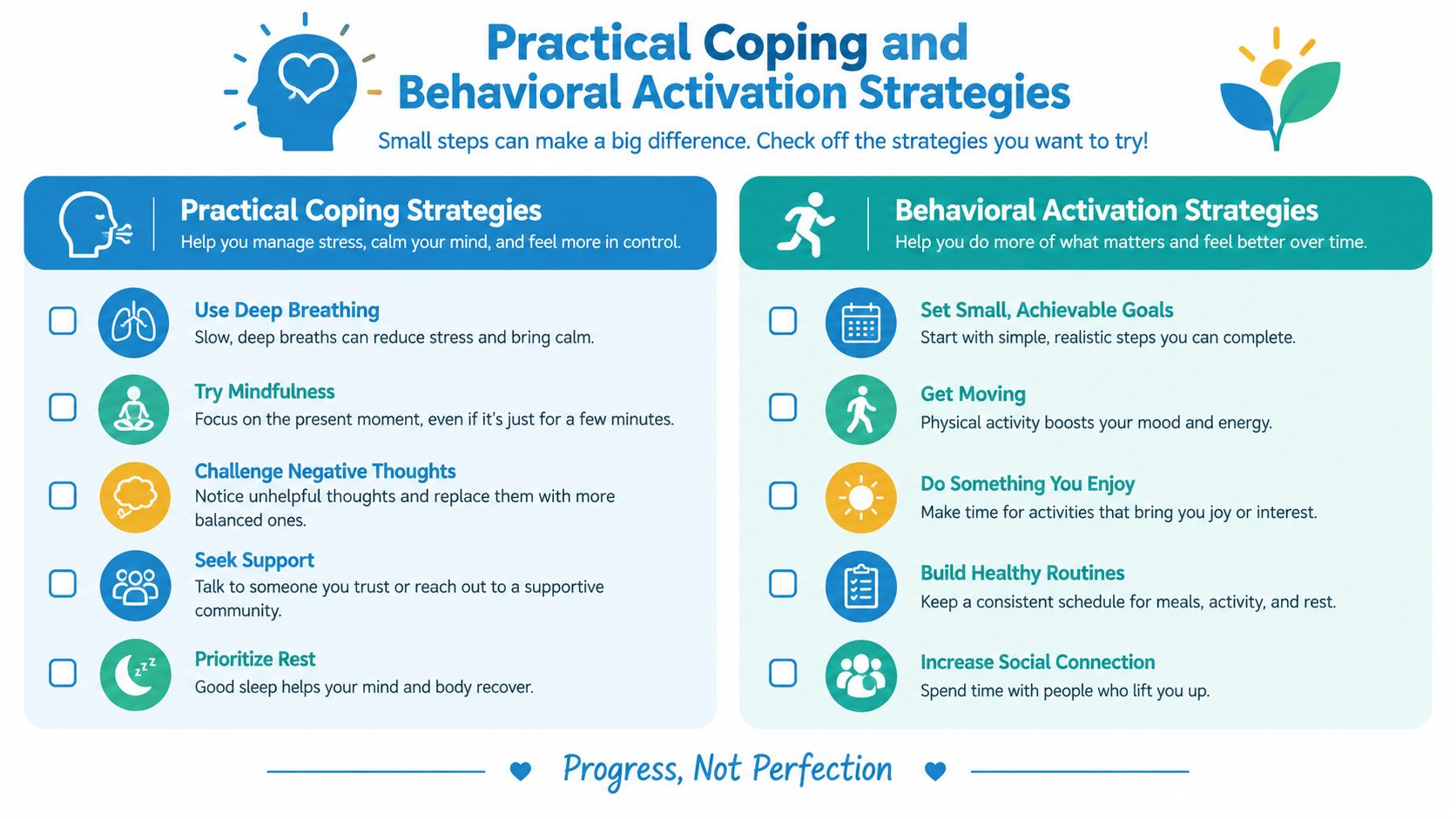
When motivation is impaired, waiting to feel ready usually prolongs inactivity. Behavioral activation reverses that order by using planned, manageable action to create opportunities for reinforcement. The first activity may feel neutral. That doesn't mean it failed.
Make the starting point almost too easy
Choose one action that supports either pleasure, mastery, or connection. Open the curtains, shower, stand outside, send one message, prepare a simple meal, or listen to one song. Define success as completing the action, not enjoying it. This prevents the common trap of judging yourself harshly because the first attempt didn't produce an immediate emotional shift.
Use an implementation statement: “After I brush my teeth, I'll stand outside for a few minutes.” Keep the task specific and attach it to a routine you already complete. If the activity feels impossible, reduce it again. A short walk to the mailbox is a valid starting point.
Track effort and response separately
After each activity, record three observations:
Before: How difficult did starting feel?
During: Did anything feel even slightly engaging?
After: Did your energy, tension, or sense of accomplishment change?
You're looking for patterns, not dramatic results. An activity may not feel pleasurable but may reduce isolation or increase a sense of competence. Those are clinically useful signals that can guide future choices.
Movement can be part of this plan, but it shouldn't become a test of willpower. If running feels accessible, Swift Running's guidance on running and mood provides a practical resource for considering how activity may fit into emotional well-being. Start at a level that matches your current energy and medical needs, and choose walking or gentle stretching if running is too demanding.
Protect the basics
Regular sleep and wake times, consistent meals, prescribed medication use, and contact with supportive people give the reward system a steadier environment. Avoid using alcohol or non-prescribed substances to force pleasure or motivation, because they can worsen mood instability and complicate assessment.
A therapist can help you build an individualized plan through behavioral activation for depression. If anhedonia is severe, behavioral strategies work best alongside professional care rather than as a substitute for it. Treat the process as rehabilitation, not a moral examination.
Accessing Specialized Telepsychiatry Care in Florida
Depression with anhedonia can make the logistics of seeking help feel absurdly difficult. A virtual psychiatric evaluation removes some of the friction. You can meet with a clinician from home, avoid travel, and schedule follow-up around the routines you're trying to rebuild. HIPAA-compliant telepsychiatry is available to Florida residents through secure visits on a device, making continuity easier when motivation and energy are limited.
An evaluation should go beyond asking whether you feel depressed. The clinician can examine anticipation, motivation, effort, consummatory pleasure, reward learning, sleep, anxiety, medication effects, and safety. From there, care may combine medication management with evidence-based psychotherapy such as CBT, DBT, psychodynamic therapy, or trauma-focused treatment, depending on your needs. Telemedicine psychiatry in Florida can help you understand how virtual care works before scheduling.
Refresh Psychiatry & Therapy provides psychiatric evaluations, medication management, and individual therapy for depression and related conditions through telepsychiatry. Insurance coverage varies by plan and location, so confirm benefits before your appointment. The practice accepts Aetna, UnitedHealthcare/UHC, Cigna, Blue Cross Blue Shield, Humana, Tricare, UMR, and Oscar insurance plans. You can review information from Aetna, UnitedHealthcare, Cigna, Blue Cross Blue Shield, Humana, Tricare, UMR, and Oscar when checking your plan details.
If you're in immediate danger, experiencing suicidal intent, or unable to care for yourself, use emergency services rather than waiting for a routine telepsychiatry appointment.
Refresh Psychiatry & Therapy offers coordinated psychiatric evaluation, medication management, and evidence-based therapy for depression with anhedonia, including care that looks beyond low mood to motivation and reward symptoms. Visit Refresh Psychiatry & Therapy to request an appointment, or contact us or call Refresh Psychiatry at (954) 603-4081 to schedule your evaluation. We accept Aetna, United Healthcare/ UHC, Cigna, Blue Cross Blue Shield, Humana, Tricare, UMR, and Oscar insurance plans. This blog is for informational purposes only and does not constitute medical advice. Please consult a qualified mental health professional for personalized guidance.