
💊 Luvox for OCD: A Complete Patient Guide

You may be waking up already exhausted by an argument happening entirely in your mind. The thought arrives, anxiety surges, and a ritual seems like the only way to get temporary relief. Then the cycle starts again. If you're researching Luvox for OCD, you may also be wondering whether it can help, how long it takes, and whether you're expected to wait through weeks of discomfort before deciding it isn't working.
Fluvoxamine, sold as Luvox, is an evidence-based option for obsessive-compulsive disorder. But OCD treatment often differs from treatment for depression: clinicians may use a gradual titration, higher doses, and a longer therapeutic trial. The most useful question isn't, "Does Luvox work?" It's, "What does an adequate trial look like, and how will we know whether it's helping me?"
Understanding Luvox and How It Quiets the OCD Loop
Consider a person who spends hours checking a locked door, reviewing conversations, or seeking reassurance about contamination. The problem isn't a lack of insight. Many people with OCD recognize that their fears and rituals are excessive, yet the internal alarm still feels urgent and convincing.
Luvox is a selective serotonin reuptake inhibitor, or SSRI. Rather than erasing thoughts, it can help reduce the intensity of the alarm attached to them. A useful way to think about this is a volume knob. The intrusive thought may still appear, but the emotional volume can become lower, giving you more room to choose a response instead of automatically performing a compulsion.
Serotonin is involved in communication between brain regions that regulate mood, anxiety, and repetitive behavior. Clinicians often discuss OCD in relation to cortico-striato-thalamo-cortical circuits, networks involved in evaluating threat, forming habits, and deciding when an action is complete. Luvox doesn't remove responsibility from you or replace behavioral treatment. It may make the loop less overpowering so that psychological work becomes more manageable. For broader context about serotonin and related brain signaling, you can read this overview of dopamine versus serotonin.
Why its OCD approval matters
The U.S. Food and Drug Administration approved fluvoxamine specifically for OCD in 1994, and the medication is indicated for adults and pediatric patients aged 8 and older, according to this clinical review of fluvoxamine. An extended-release formulation received approval in 2008, reflecting its continuing role in OCD care. Major OCD organizations identify fluvoxamine as one of only five FDA-approved medications for OCD in the United States, alongside fluoxetine, sertraline, paroxetine, and clomipramine.
That history doesn't mean Luvox is automatically the right medication for every person. It does mean its use in OCD isn't an accidental extension of a depression treatment. Fluvoxamine was the first SSRI registered for OCD, and placebo-controlled studies helped establish SSRIs as a central medication option for the disorder.
Practical perspective: Luvox may lower the intensity of the OCD alarm, but recovery still involves learning that you can tolerate uncertainty without completing the ritual.
What the Clinical Evidence Says About Symptom Relief
Patients often ask whether “working” means every intrusive thought disappears. In practice, a more meaningful outcome is a reduction in the time, distress, and behavioral control those thoughts exert over your day.
Researchers commonly measure OCD severity with the Yale-Brown Obsessive-Compulsive Scale, or Y-BOCS. It evaluates obsessions and compulsions by considering factors such as time consumed, interference, distress, resistance, and control. A lower score indicates fewer or less disruptive symptoms, but the scale isn't a simple pass-or-fail test. Someone may still have intrusive thoughts while gaining enough control to stop checking, washing, confessing, or seeking reassurance.
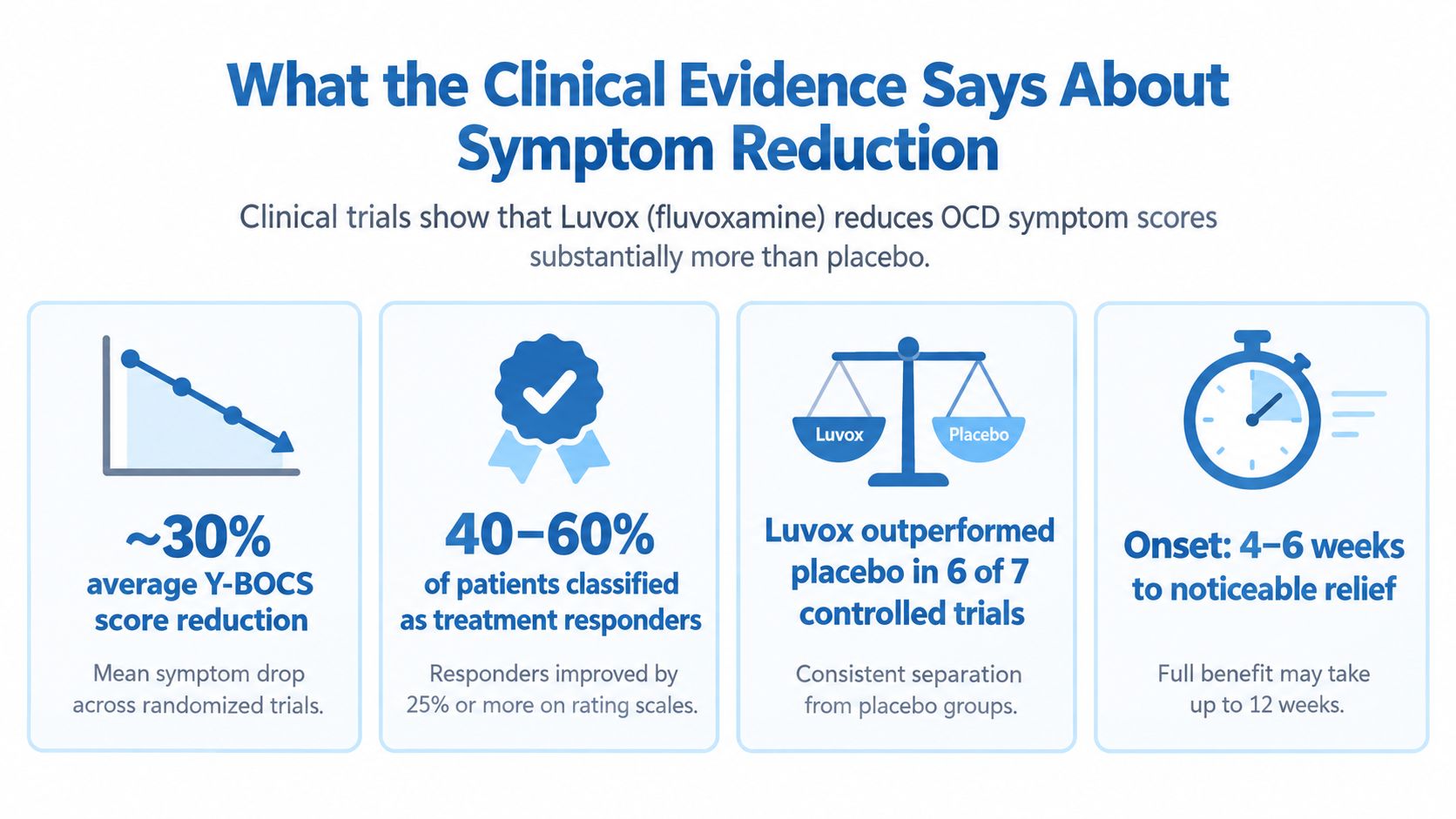
What one controlled trial showed
In a 12-week double-blind study of 253 adults with DSM-IV OCD, 127 patients received controlled-release fluvoxamine at 100 to 300 mg once daily, while 126 received placebo. By the endpoint, the fluvoxamine group had an 8.5-point mean reduction in total Y-BOCS score, representing a 31.7% decrease from baseline. The placebo group had a 5.6-point reduction, representing a 21.2% decrease. These findings are reported in the published fluvoxamine clinical trial.
The difference matters, but it also illustrates an important clinical reality. Improvement doesn't necessarily equal remission, and a medication can be effective without producing a dramatic overnight transformation. In that trial, fluvoxamine separated from placebo beginning at week 2, while the full endpoint was assessed after 12 weeks. Early changes can be subtle, such as spending less time ruminating or resisting a ritual for a little longer.
Broader OCD guidance commonly cites that about 40% to 60% of patients achieve clinically significant improvement with a given SSRI trial, while responders often experience an average symptom reduction of 40% to 50%. Those figures describe group patterns, not a promise for an individual patient. Your response depends on diagnosis, dose, adherence, side effects, co-occurring conditions, and whether treatment includes ERP.
If contamination fears dominate your day, the goal may not be to feel certain that everything is clean. It may be to wash once rather than repeatedly, or to leave home without returning to check. Resources on contamination OCD can help clarify how symptoms may show up in daily life.
Navigating the Dosing Schedule and the Waiting Game
The dosing process is one of the main reasons people conclude that Luvox has failed before they've completed an adequate OCD trial. Early side effects can appear before symptom relief, and the dose used for OCD may be higher than the dose a person expects from general anxiety treatment.
The FDA labeling provides a structured adult titration. Patients start at 50 mg at bedtime, then increase by 50 mg every 4 to 7 days as tolerated. The maximum is 300 mg per day, and doses above 100 mg per day are divided rather than taken all at once, as described in the FDA Luvox prescribing information.
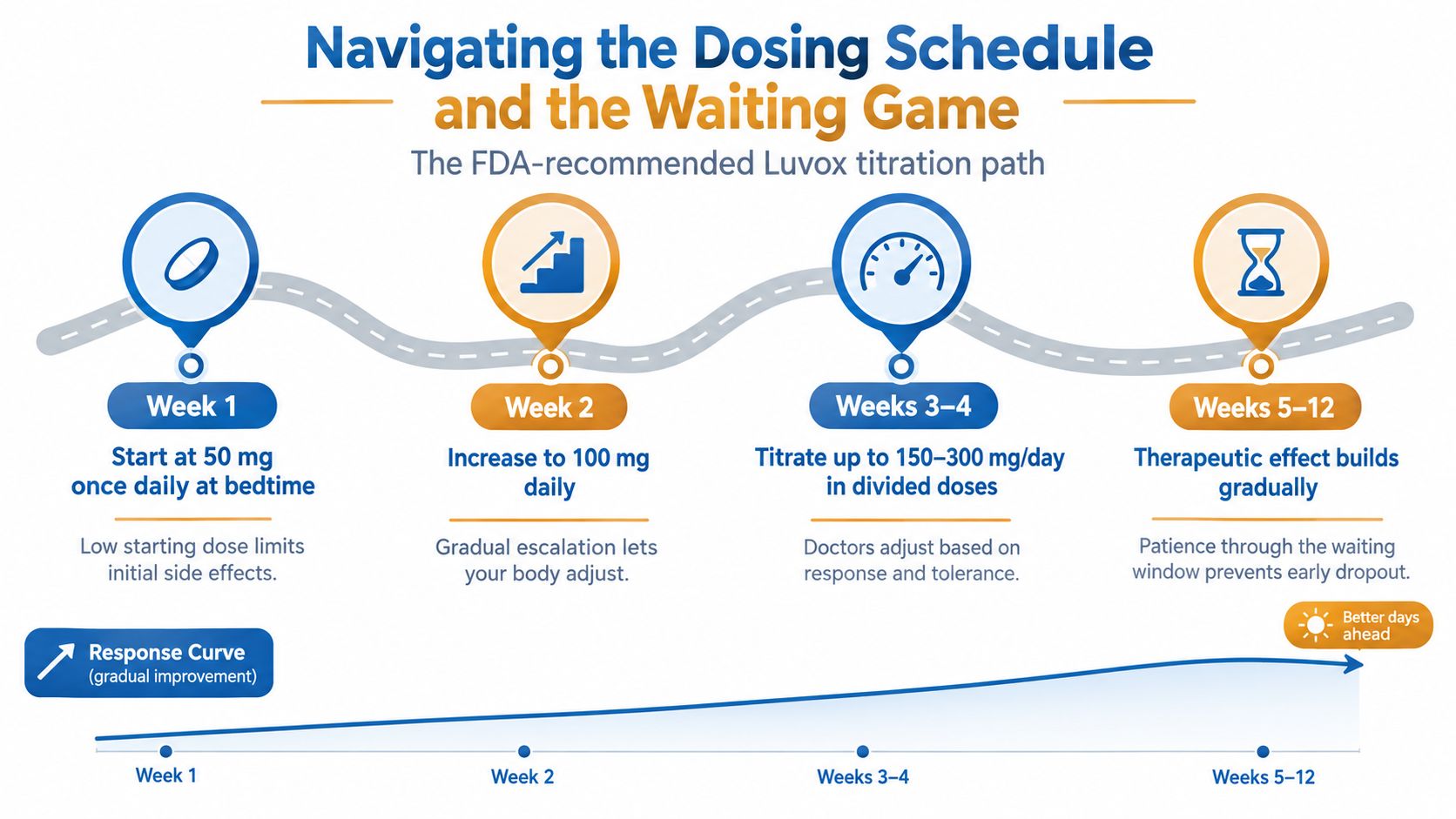
Why gradual increases are used
Starting lower gives your prescriber a chance to assess tolerability before moving toward a dose more likely to help OCD. Nausea, sleep changes, activation, headache, or gastrointestinal symptoms can occur with SSRIs, and your clinician may adjust the pace if these problems interfere with daily functioning.
A titration plan isn't a race to the maximum. Some people improve at a lower dose, while others need a higher dose within the approved range. The correct dose balances symptom response with tolerability, other medications, medical conditions, and your personal treatment goals.
A useful rule: Never raise, lower, split, or stop Luvox on your own. Report side effects and worsening symptoms promptly so your prescriber can decide whether to change the schedule.
Why four weeks may be too early
OCD guidance describes an adequate SSRI trial as 8 to 12 weeks, with at least 6 weeks at moderate to high doses when tolerated. Other guidance notes that a clinically meaningful OCD trial often requires 10 to 12 weeks at the maximum comfortably tolerated dose. This is why clinicians may recommend patience even when you haven't noticed a major change during the first several weeks.
That waiting period can feel especially difficult when anxiety rises before it settles. Track concrete measures instead of relying only on your overall mood. Record how long rituals last, how often you seek reassurance, whether you can delay a compulsion, and how much time intrusive thoughts consume. These observations give your prescriber useful information and may reveal progress that isn't obvious from day to day.
The same principle applies when comparing medication timelines. A general explanation of how long Prozac takes to work can be useful, but OCD medication decisions still need to follow an individualized plan.
A partial response is not the same as no response. If Luvox reduces the intensity of obsessions but compulsions remain strong, your psychiatrist may review adherence, dose, duration, diagnosis, ERP access, medication interactions, and possible augmentation strategies. Recent literature has discussed adjunctive approaches such as granisetron or L-theanine, but these aren't routine replacements for careful assessment and should only be considered with a qualified prescriber.
Comparing Luvox to Other OCD Medications
Luvox isn't automatically stronger than sertraline, fluoxetine, paroxetine, or clomipramine. Current independent guidance describes fluvoxamine as a first-line SSRI for OCD, while also noting that it has not been shown to be clearly superior to other SSRIs. The International OCD Foundation similarly reports that available data don't establish fluvoxamine superiority, as summarized in these CANMAT and ICOCS OCD guidelines.
That doesn't make the choice arbitrary. Two medications with similar average efficacy can feel very different to one person. A prescriber may consider previous medication trials, sleep, gastrointestinal sensitivity, sexual side effects, other prescriptions, dosing preferences, anxiety symptoms, and the risk of interactions.
A practical comparison
Medication | Class | Typical OCD dose range | Key clinical considerations |
|---|---|---|---|
Fluvoxamine, Luvox | SSRI | 100 to 300 mg/day in OCD trials | FDA-approved for OCD in adults and children aged 8 and older. Doses above 100 mg/day are often divided. Review medication interactions carefully. |
Sertraline | SSRI | Varies by individualized prescription | Commonly considered for OCD. The decision may depend on prior response, tolerability, and interaction profile. |
Fluoxetine | SSRI | Varies by individualized prescription | Another established SSRI option. Its longer-lasting medication profile can influence prescribing decisions. |
Paroxetine | SSRI | Varies by individualized prescription | May be considered based on individual history, but side effects and discontinuation planning matter. |
Clomipramine, Anafranil | Tricyclic antidepressant | Varies by individualized prescription | An effective OCD option for some patients, with a different side-effect and monitoring profile from SSRIs. |
The table is deliberately practical rather than prescriptive. Dose ranges differ by formulation, age, medical history, and clinician judgment. A medication should never be selected or changed from a table without a psychiatric evaluation.
Drug interactions can be especially important with fluvoxamine because it can affect how the body processes other medications. Give your prescriber a complete list of prescriptions, over-the-counter products, supplements, and substances. If you're comparing medication categories, this explanation of SSRIs versus SNRIs may provide useful background, although SNRIs aren't the central first-line comparison for OCD.
Combining Medication with ERP Therapy for Lasting Results
Medication can reduce the intensity of OCD symptoms, but it doesn't teach you what to do when uncertainty appears. Exposure and Response Prevention, or ERP, addresses that learning problem directly. With guidance from an ERP-trained therapist, you gradually face feared situations or thoughts while resisting the compulsion that normally provides short-term relief.
Suppose you fear that touching a doorknob will make someone ill. An ERP plan might involve touching the doorknob and postponing washing, then observing what happens to the anxiety without using the ritual. The work is uncomfortable by design, but the aim isn't to force certainty. The aim is to build confidence that you can tolerate distress and choose not to obey the compulsion.
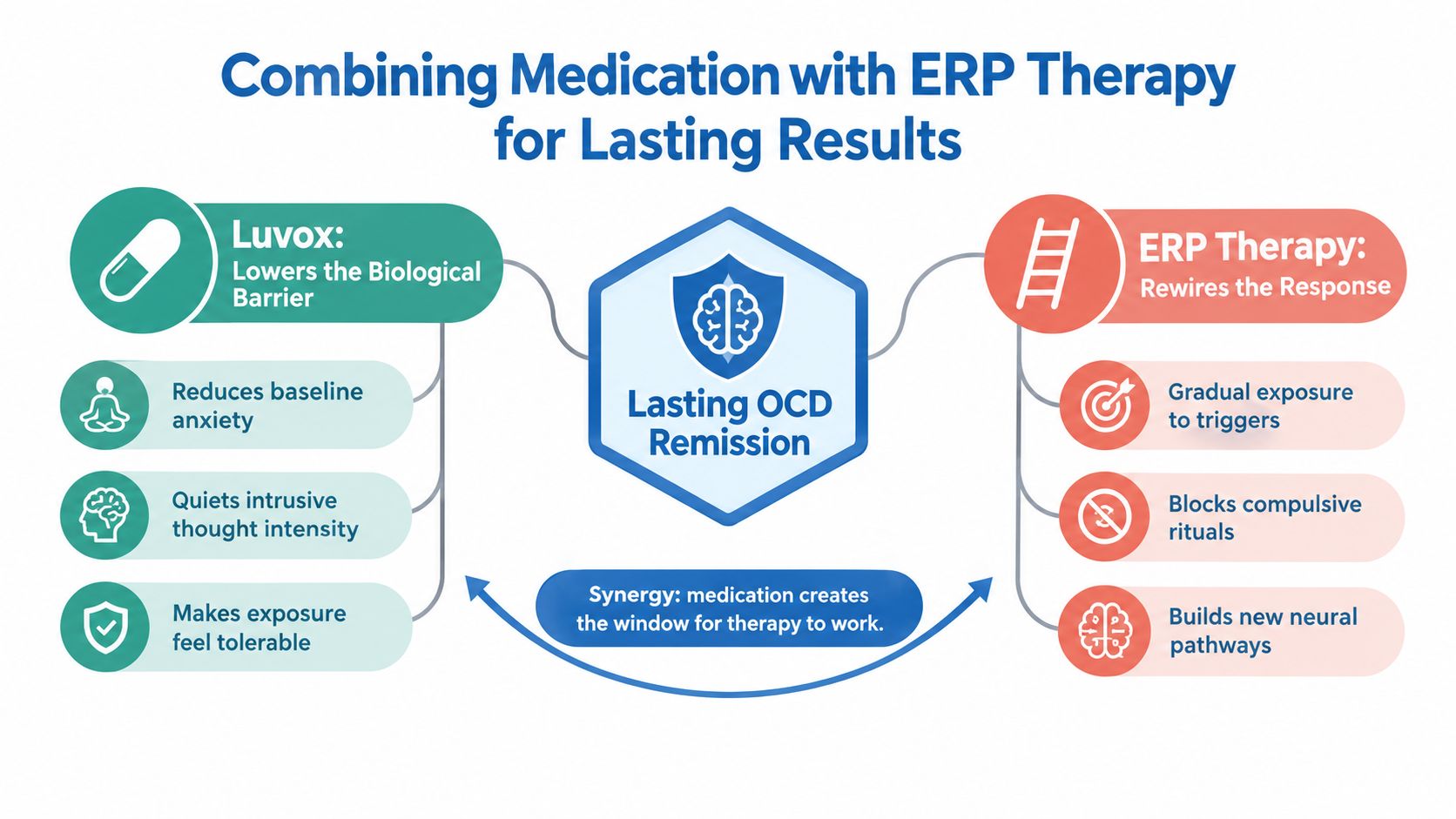
What each treatment contributes
Luvox may lower the biological intensity of anxiety and intrusive thoughts. ERP supplies the structured practice that changes the relationship with those thoughts. Neither approach guarantees an immediate cure, and medication doesn't make exposures effortless. It can, however, create a more workable starting point for therapy.
A coordinated plan usually includes:
Medication monitoring: Your prescriber tracks response, side effects, sleep, activation, and changes in functioning.
ERP planning: Your therapist builds a hierarchy that matches your symptoms and progresses at a tolerable pace.
Shared goals: Both clinicians measure meaningful changes, such as fewer rituals, less reassurance seeking, and greater participation in work, school, or family life.
Family guidance: Loved ones learn how to avoid reinforcing compulsions while remaining supportive.
The treatment target isn't a life without intrusive thoughts. It's a life in which intrusive thoughts no longer dictate your actions.
Fluvoxamine's FDA approval includes adults and children aged 8 and older, making it one of the few SSRIs with a pediatric OCD indication, according to NAMI's medication overview. Children and adolescents still need age-appropriate assessment, family involvement, careful monitoring, and therapy adapted to developmental needs. Parents should ask how the prescriber and therapist will communicate about progress, school functioning, side effects, and exposure practice.
Accessing Expert OCD Care via Telepsychiatry in Florida
Starting OCD treatment can feel like another task added to an already crowded mental checklist. Telepsychiatry can reduce some practical barriers by allowing appointments from a private location in Florida, without a commute or time spent in a waiting room. For people whose symptoms make travel, schedule changes, or unfamiliar environments difficult, a consistent virtual format may make follow-up easier to maintain.
A first evaluation generally focuses on the symptom pattern, the amount of time OCD consumes, compulsions and avoidance, prior treatments, sleep, medical history, other medications, and possible co-occurring conditions. Your clinician may also assess whether symptoms could reflect another diagnosis, including an anxiety disorder, depression, trauma-related condition, or bipolar-spectrum illness. That distinction matters because medication planning should match the full clinical picture rather than one search phrase.
What to prepare for an evaluation
Bring or write down:
Your main symptoms: Include intrusive thoughts, rituals, mental compulsions, avoidance, and reassurance seeking.
Your current medications: List prescriptions, nonprescription products, supplements, and approximate timing.
Your treatment history: Note medications tried, doses if known, duration, benefits, and side effects.
Your goals: Identify the activities you want to reclaim, such as leaving home, sleeping, studying, working, or participating in family life.
Your therapy preferences: Ask whether ERP is available or whether the practice can coordinate with an outside therapist.
Refresh Psychiatry & Therapy provides psychiatric evaluations, medication management, and therapy through telepsychiatry in Florida, with care for adults, children, and adolescents. Its clinicians can discuss OCD medication options and coordinate treatment with evidence-based therapy. You can learn more about telemedicine psychiatry before deciding whether virtual care fits your needs.
Do not stop Luvox abruptly or change the dose because symptoms fluctuate. Contact your prescriber if you experience severe side effects, a marked worsening of mood or agitation, unusual behavioral changes, or thoughts of harming yourself. Seek emergency help immediately if you're in danger or unable to stay safe.
This blog is for informational purposes only and does not constitute medical advice. Please consult a qualified mental health professional for personalized guidance.
Refresh Psychiatry & Therapy offers Florida telepsychiatry for OCD evaluations, medication management, and coordinated therapy matched to your symptoms and treatment goals. Visit Refresh Psychiatry & Therapy or call (954) 603-4081 to schedule your evaluation. We accept Aetna, United Healthcare/UHC, Cigna, Blue Cross Blue Shield, Humana, Tricare, UMR, and Oscar insurance plans.