
OCD vs OCPD: A Psychiatrist's Guide to Key Differences

🧠 OCD vs OCPD: A Psychiatrist's Guide to Key Differences
You may have searched “OCD vs OCPD” after noticing a pattern that doesn't fit the label you've been using. Perhaps you check locks repeatedly because an intrusive fear says someone will be harmed, or perhaps you rewrite a report because no one else seems capable of meeting your standards. Both experiences can involve order, control, and perfectionism, but the internal drivers are different.
The distinction matters because OCD and OCPD are separate diagnoses, and treatment planning changes when a person has one, the other, or both. OCD affects about 2% to 3% of the general population, while OCPD estimates vary by method and population. Community estimates commonly range from 0.9% to 2%, with broader DSM-based lifetime estimates of 3% to 8%. In one large U.S. community study involving 43,093 participants, OCPD prevalence reached 8% using DSM-IV criteria (reviewed prevalence data).
Feature | OCD | OCPD |
|---|---|---|
Core pattern | Intrusive obsessions and compulsions | Pervasive perfectionism, orderliness, and control |
Experience of symptoms | Usually unwanted and distressing, or ego-dystonic | Often experienced as reasonable or correct, or ego-syntonic |
Main driver | Reduce anxiety or prevent a feared outcome | Follow standards, preserve control, and maintain order |
Time course | Symptoms can fluctuate or intensify around triggers | Long-standing pattern across settings, often present by early adulthood |
Diagnostic threshold | Obsessions and/or compulsions that are time-consuming or impairing | At least 4 of 8 specified personality traits |
Common treatment emphasis | ERP, CBT, and medication when appropriate | Psychotherapy focused on flexibility, insight, and relationships |
Why OCD and OCPD Get Confused So Often
A 34-year-old attorney arrives convinced she has OCD. She reorganizes her desk every night, labels files precisely, and becomes visibly tense when a coworker changes the filing protocol. During the interview, however, she doesn't describe intrusive images, unwanted urges, or a feared catastrophe that the organizing prevents. Her distress comes from the belief that the coworker's method is careless and professionally unacceptable.
That distinction changes the clinical picture. The desk is organized in both conditions, but the behavior means something different. In OCD, a ritual commonly answers an intrusive fear. In OCPD, order may express a strongly held standard about competence, responsibility, morality, or the correct way to work.
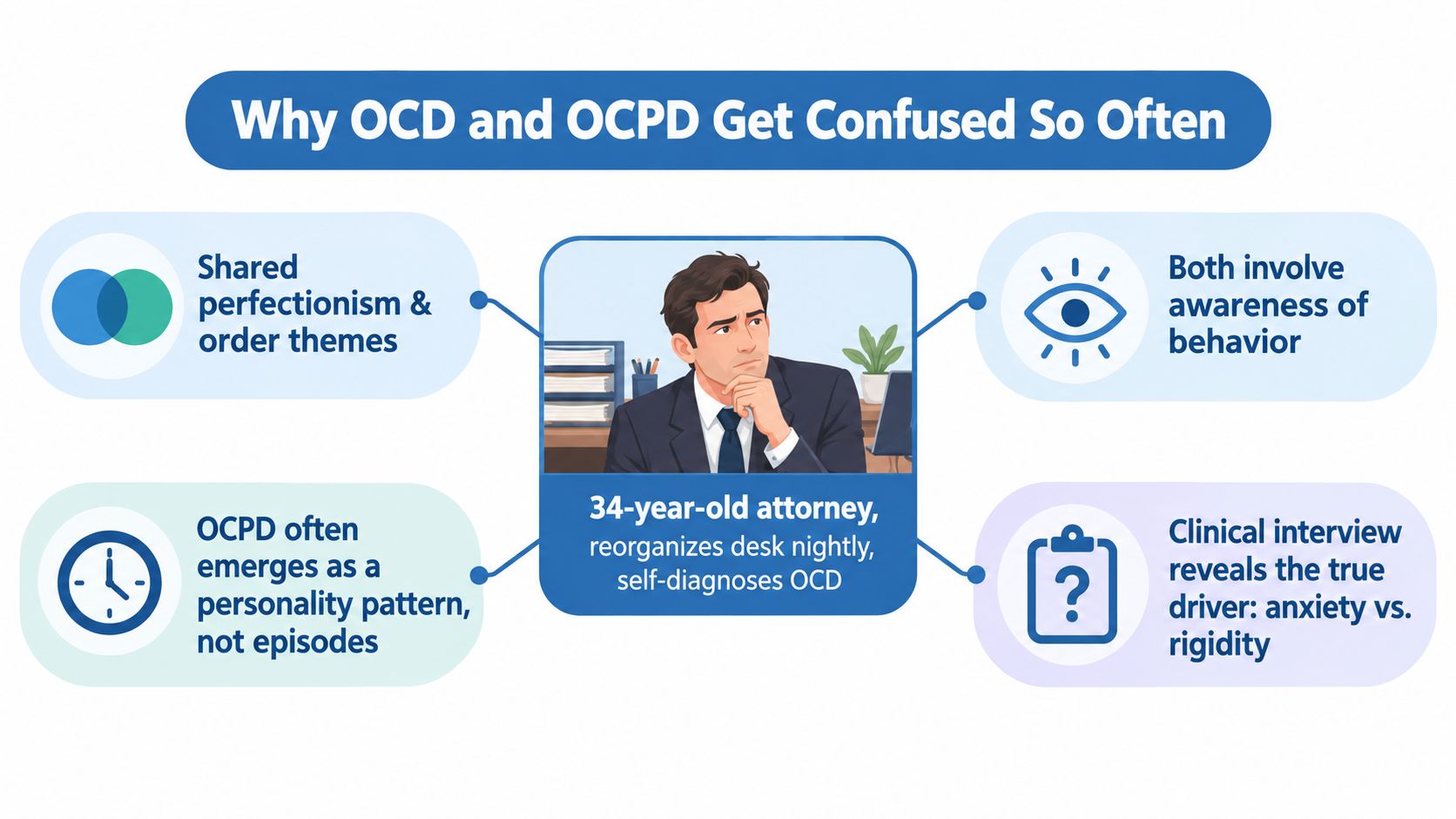
Shared language creates false equivalence
The shared acronym doesn't help. Popular culture also uses “OCD” as shorthand for neatness, checking, or a preference for symmetry. That casual usage erases the difference between a distressing disorder and a personality pattern that may feel justified to the person who has it.
Primary care clinicians can face the same challenge, especially when a brief visit reveals only visible behavior. Both conditions may involve lists, rules, repeated checking, rigidity, or distress when standards aren't met. The interview has to uncover what starts the behavior, what the person expects it to prevent, and how the person evaluates the behavior afterward.
Four questions resolve much of the confusion
A useful assessment examines:
Symptom type: Are there intrusive thoughts, images, or urges, or primarily enduring traits?
Insight: Does the person recognize the pattern as excessive, or does it seem sensible?
Ego-syntonicity: Does the behavior conflict with the person's values, or express them?
Treatment response: Does anxiety fall when rituals stop, or does progress require work on flexibility and interpersonal conflict?
Historically, the diagnoses were conceptually closer. Pierre Janet described a syndrome in 1903, Freud's 1908 writings influenced early ideas about perfectionism and control, and OCPD appeared in the first DSM in 1952 under “compulsive personality.” The DSM-II later used “anankastic personality” to distinguish it from OCD (historical and diagnostic overview).
Defining Each Diagnosis in Plain Language
OCD is built around obsessions, compulsions, or both. An obsession is a recurrent, intrusive thought, image, or urge that feels unwanted and produces distress. A compulsion is a repetitive behavior or mental act performed to reduce that distress or neutralize a feared outcome.
A person might repeatedly check a stove because an intrusive fear says the house will burn down, wash their hands because contamination feels dangerous, or repeat a mental phrase to prevent harm. The ritual may provide temporary relief, but it reinforces the cycle. OCD requires symptoms that are time-consuming, typically at least 1 hour per day, and/or cause significant distress or impairment (DSM-style OCD and OCPD comparison).
OCD symptoms are often ego-dystonic. The person doesn't want the thought or ritual and may describe it as irrational, embarrassing, or inconsistent with their values. Insight can vary, however, and some people have poor insight into the accuracy of their feared beliefs.
OCPD, by contrast, is a Cluster C personality disorder marked by a pervasive pattern of preoccupation with orderliness, perfectionism, and control. The pattern usually begins by early adulthood and appears across multiple settings, such as work, family life, finances, and moral decision-making. It isn't limited to discrete episodes of anxiety.
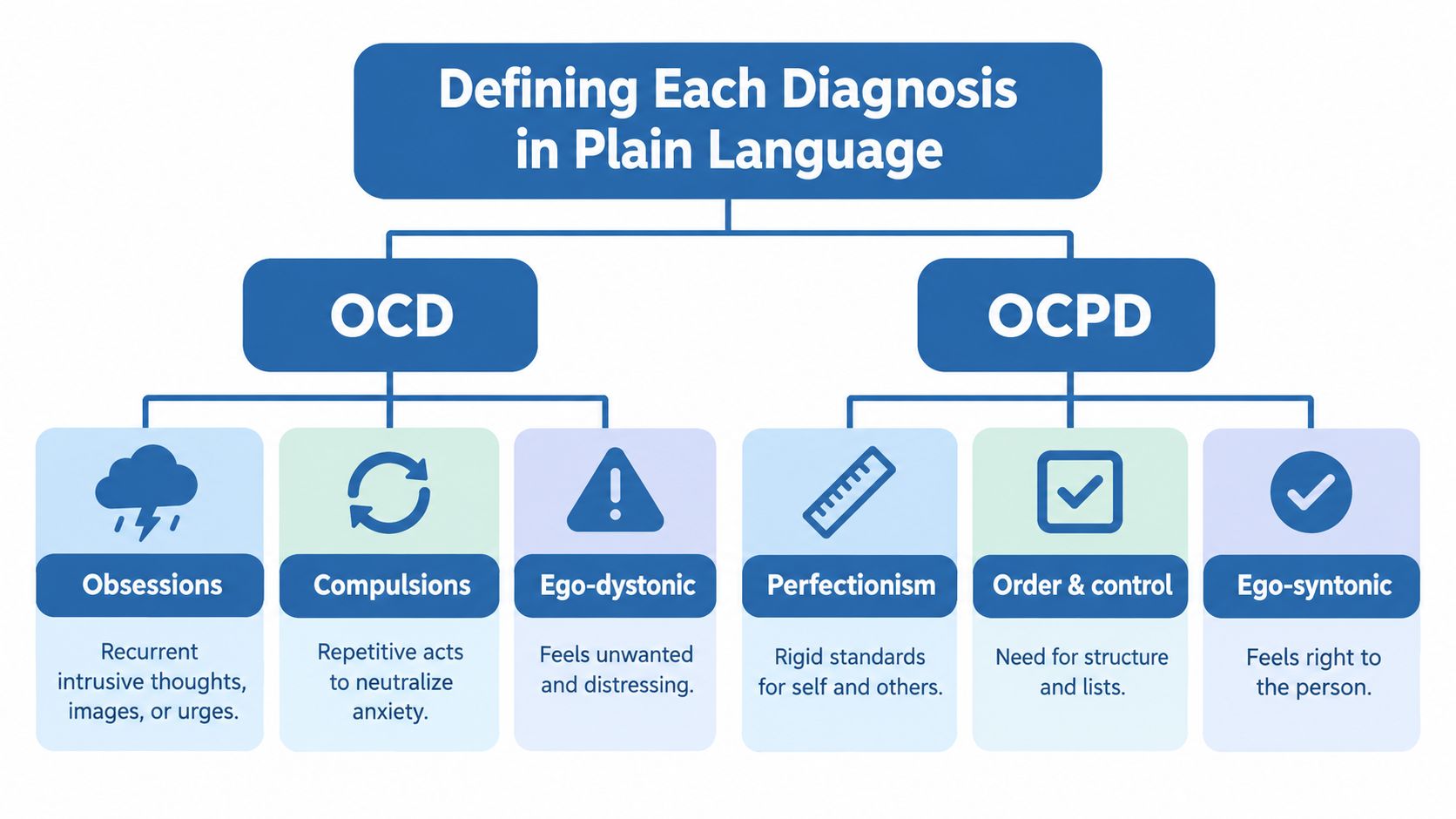
The OCPD threshold is more specific than “being organized”
DSM-style OCPD criteria include:
Preoccupation with details, rules, and lists to the point that the main purpose of an activity is lost.
Perfectionism that interferes with completion because standards remain impossible to satisfy.
Excessive devotion to work at the expense of leisure and relationships.
Overconscientiousness about morality, ethics, or values.
Difficulty discarding worn-out objects, even when they have little practical value.
Reluctance to delegate unless others agree to do tasks exactly the same way.
Miserly spending toward self or others.
Rigidity and stubbornness.
A diagnosis requires at least 4 of these 8 traits, not just neatness or high standards (official DSM-style criteria discussion). OCPD is therefore not “a stronger form of OCD.” It describes an enduring personality pattern that affects how a person interprets responsibility, competence, control, and relationships.
For readers trying to understand intrusive thoughts more specifically, this guide to whether you may have OCD can provide useful educational context. A formal diagnosis still requires an individualized assessment.
Hallmark Differences Between OCD and OCPD
The most useful comparison asks what happens inside the person, not just what an observer sees. Two people may arrange objects symmetrically, but one may fear catastrophe if the arrangement changes while the other may believe symmetry demonstrates proper standards.
Feature | OCD | OCPD |
|---|---|---|
Symptom type | Obsessions and compulsions | Rigid personality traits and behavioral standards |
Emotional experience | Symptoms are often intrusive, unwanted, and distressing | Traits often feel reasonable, necessary, or morally correct |
Insight | Often good to fair, though insight can be limited | Frequently limited regarding the rigidity itself |
Time course | Can worsen in episodes or around specific triggers | Chronic baseline pattern across life domains |
Trigger pattern | Intrusive fears, images, urges, or “just right” sensations | Violations of standards, inefficiency, disorder, or perceived irresponsibility |
Functional impact | Time lost to rituals and avoidance; internal distress | Conflict, inflexibility, delayed completion, and difficulty delegating |
Treatment entry | The person often seeks relief from symptoms | A partner, employer, anxiety, depression, or conflict may prompt evaluation |
Why the internal driver matters
OCD compulsions are attempts to manage an obsession. A person checks a lock because uncertainty feels dangerous, not because checking reflects a preferred workplace standard. OCPD behaviors, such as maintaining elaborate lists or micromanaging a project, are more likely to reflect devotion to rules and conviction that the person's method is correct.
This difference also shapes distress. In OCD, distress often centers on the obsession and the inability to stop the ritual. In OCPD, distress may center on other people's perceived failures, interruptions, inefficiency, or refusal to follow the person's preferred method.
Clinical rule: Ask what the person believes will happen if the behavior stops. A feared catastrophe points toward an OCD process. A perceived collapse of standards or competence points toward an OCPD pattern.
Insight deserves careful handling. OCD commonly involves recognition that symptoms are excessive or unwanted, but DSM-5 includes an insight specifier because some patients have poor insight. OCPD traits are typically ego-syntonic, meaning they fit the person's self-concept. That doesn't mean people with OCPD never suffer. They may experience anxiety, depression, loneliness, or work stress, even while seeing their rigidity as justified.
For a symptom-focused discussion, this overview of OCD types may help readers identify patterns that deserve professional evaluation.
When the Two Conditions Overlap
A patient may recognize that contamination fears are excessive, yet insist that every family routine follow a personal system. That presentation is not unusual. OCD and OCPD can occur in the same person, and the overlap changes both assessment and treatment planning.
Standardized assessments have found OCPD in 16% to 44% of patients with OCD. More recent reviews commonly place comorbidity in the 20% to 49% range (review of OCD personality comorbidity). OCPD has also been reported in 7.2% to 7.7% of community samples and up to 26% of clinical populations, with results varying by sample and assessment method (clinical review).
The two diagnoses can reinforce one another clinically. OCD produces intrusive fears and rituals. OCPD adds a durable commitment to control, rules, and precision, which can make uncertainty feel irresponsible rather than merely uncomfortable. A patient may therefore accept the need to reduce compulsions while defending rigid standards in work, morality, or relationships.
Outcome | OCD Only | OCD + OCPD |
|---|---|---|
Onset | OCD symptoms may begin at varied points | Reviews associate comorbidity with younger onset |
Symptom severity | Can range from mild to severe | Associated with greater OCD severity |
Insight | May be good, fair, or poor | OCD insight may coexist with rigid, ego-syntonic traits |
Mood symptoms | Depression and anxiety may occur | Higher comorbid depression and anxiety are reported |
Functioning | Rituals and avoidance impair daily life | Greater functional impairment is associated with the combined presentation |
Treatment planning | ERP and medication can target OCD | Treatment often needs additional work on motivation, flexibility, and alliance |
One clinical study reported OCPD in 55.12% of its OCD patient sample and found higher scores on measures including Y-BOCS, BABS, HDRS, and YMRS in the combined group (study findings). These findings should not be generalized to every patient, but they reinforce a practical point: OCPD can act as a severity amplifier.
Prognosis depends partly on whether the patient can participate in treatment. Perfectionism may turn ERP homework into another performance test. Poor insight can limit collaboration, while work devotion may leave little time for therapy. Treatment usually requires direct work on OCD rituals alongside motivation to tolerate imperfection, share control, and accept uncertainty. OCD and depression is also relevant when the combined presentation includes low mood, withdrawal, or reduced functioning.
Differential Diagnosis Tips for Clinicians and Patients
A strong differential diagnosis starts with the behavior's purpose. Ask, “What thought or feeling appears immediately before this action?” Then ask, “What does the person believe the action accomplishes?” The answers often separate a fear-driven ritual from a value-driven rule.
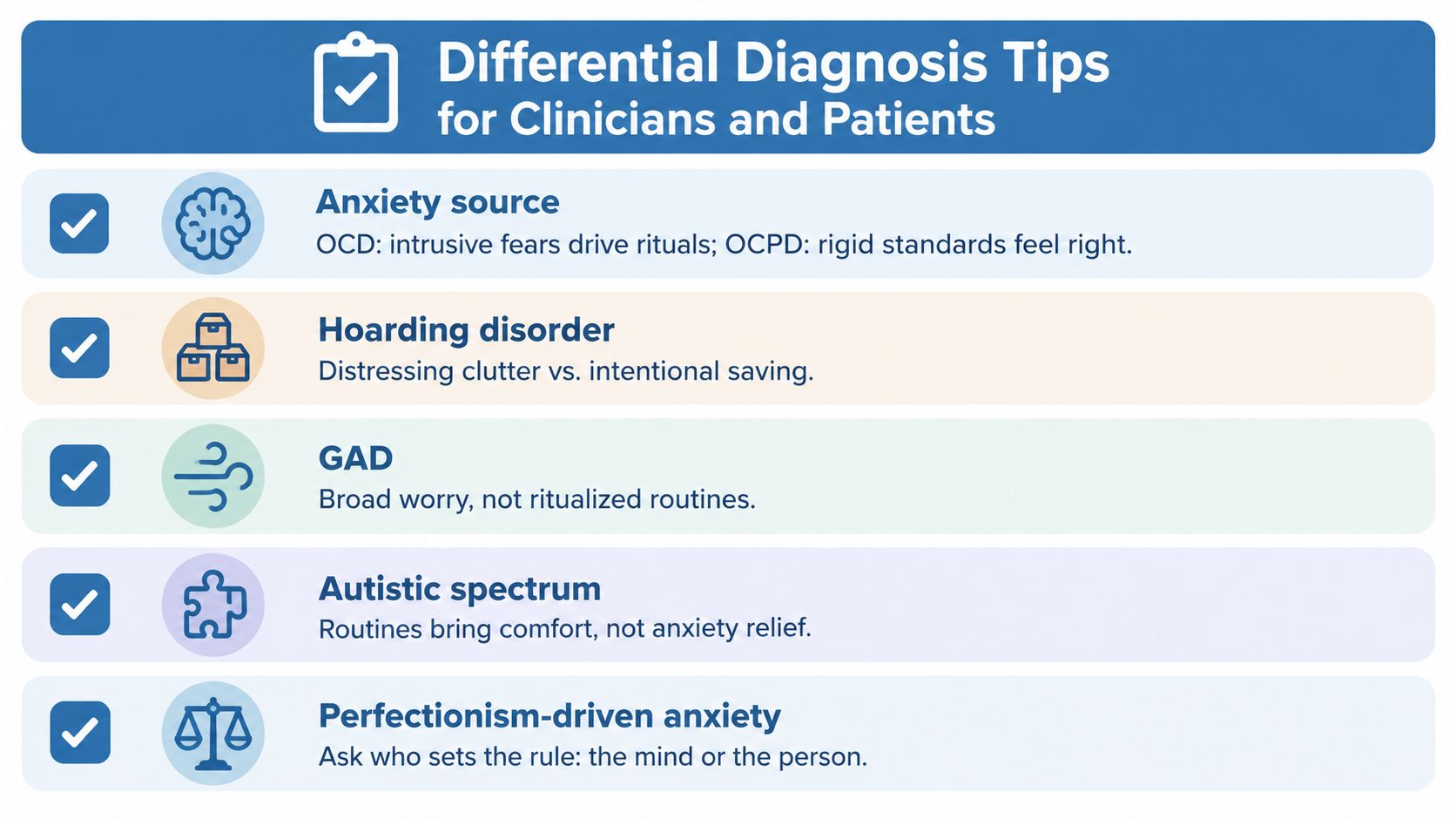
Questions that sharpen the diagnosis
OCD: Is there an intrusive fear, image, or urge that the person tries to neutralize?
OCPD: Does the person endorse the rule as correct and become distressed when others don't comply?
Hoarding disorder: Is saving driven by persistent difficulty discarding and distress about losing possessions, rather than a broader pattern of perfectionism and control?
Generalized anxiety disorder: Is worry broad and persistent without a ritualized act intended to neutralize a specific obsession?
Autistic spectrum rigidity: Do routines provide predictability, comfort, or sensory regulation rather than relief from an obsessional fear?
Perfectionism-driven anxiety: Who sets the rule, the intrusive mind or the person's enduring standards?
A clinician should examine the timeline. OCD symptoms may rise and fall with triggers, while OCPD is a stable pattern reported across relationships, education, employment, and home life. Collateral information can be decisive because a patient may describe their own standards as reasonable while a partner or coworker reports chronic criticism, refusal to delegate, or conflict over minor deviations.
A practical office checklist
Identify obsessions, compulsions, avoidance, and mental rituals.
Clarify whether the behavior is unwanted or self-consistent.
Establish whether the pattern is episodic or lifelong.
Assess impairment in time, work, relationships, and self-care.
Screen for mood symptoms, substance use, trauma, and other anxiety disorders.
Observe how the person responds when the clinician offers an alternative explanation.
The distinction isn't a moral judgment. Calling someone rigid doesn't establish OCPD, and visible orderliness doesn't establish OCD. A careful interview must determine whether the person meets the full criteria for a disorder and whether another condition better explains the presentation.
For a related discussion of fear-based symptoms, OCD versus anxiety offers additional educational context.
Treatment Approaches and What Actually Works
OCD and OCPD require different therapeutic targets. For OCD, the clinician must interrupt the obsession-compulsion cycle. For OCPD, treatment usually focuses on flexibility, emotional awareness, insight, and the interpersonal costs of rigid standards.
Exposure and Response Prevention, or ERP, is the central psychotherapy for OCD. ERP gradually exposes a patient to feared thoughts, situations, or sensations while helping them refrain from the ritual. The aim isn't to prove that every feared outcome is impossible. It's to help the person learn that anxiety and uncertainty can be tolerated without compulsive action.
Medication can support this work. Common OCD medication strategies include SSRIs, sometimes at higher doses than those used for depression, such as fluoxetine 60 to 80 mg, fluvoxamine up to 300 mg, and sertraline up to 200 mg. Clomipramine may be considered as a second-line option, and low-dose antipsychotic augmentation may be used in refractory cases under psychiatric supervision. These dosing figures require individualized medical assessment and shouldn't be treated as self-treatment instructions.
Psychotherapy for OCPD has a different target
OCPD has no FDA-approved medication specifically for the personality disorder itself. Clinicians may consider SSRIs when anxiety or depression co-occurs, but the evidence for treating OCPD traits directly is limited and remains less established than the medication evidence for OCD.
Psychotherapy may include:
Psychodynamic therapy, which examines enduring relational patterns and defenses.
Supportive therapy, which builds trust and helps connect rigidity with current consequences.
CBT, adapted to challenge all-or-nothing standards and avoidance of delegation.
Schema therapy, which addresses long-standing beliefs about control, defectiveness, responsibility, and emotional restraint.
ERP generally isn't the primary intervention for OCPD unless the patient also has OCD. In combined presentations, ERP may reduce rituals while a broader therapy process addresses perfectionism and resistance to uncertainty.
Treatment Modality | OCD | OCPD |
|---|---|---|
ERP | Core evidence-based psychotherapy | Relevant when comorbid OCD is present |
CBT | Targets obsessions, compulsions, avoidance, and beliefs | Targets rigidity, perfectionism, and interpersonal patterns |
SSRIs | Common medication option | May help co-occurring anxiety or depression; direct evidence is limited |
Clomipramine | Possible second-line OCD medication | Not a standard treatment for OCPD traits |
Psychodynamic therapy | May support formulation and comorbid concerns | Often used to explore personality patterns and relationships |
Schema therapy | Optional adjunct in selected cases | Useful for entrenched beliefs and inflexible coping |
Family involvement | Helps reduce accommodation of rituals | Can clarify interpersonal impact and support boundary changes |
Comorbid OCPD often calls for more motivational work before or alongside ERP. A patient may agree to reduce compulsions but reject any suggestion that their standards are contributing to conflict. Family involvement can help when relatives accommodate rituals, while couples or family work may be more central when rigid control is damaging relationships.
When to Seek Help and How Refresh Psychiatry Can Support You
A formal evaluation is appropriate when obsessions or compulsions consume more than 1 hour daily, cause significant distress, or interfere with work, sleep, relationships, or self-care. Seek assessment as well when rigid perfectionism leads to repeated conflict, unfinished projects, inability to delegate, excessive work, or persistent criticism from family members.
OCPD traits can warrant consultation even when the person doesn't feel distressed by the traits themselves. The relevant question is whether the pattern limits functioning or causes harm in relationships, employment, health, or emotional wellbeing. Co-occurring depression, substance use, severe anxiety, or thoughts of self-harm require prompt professional attention.
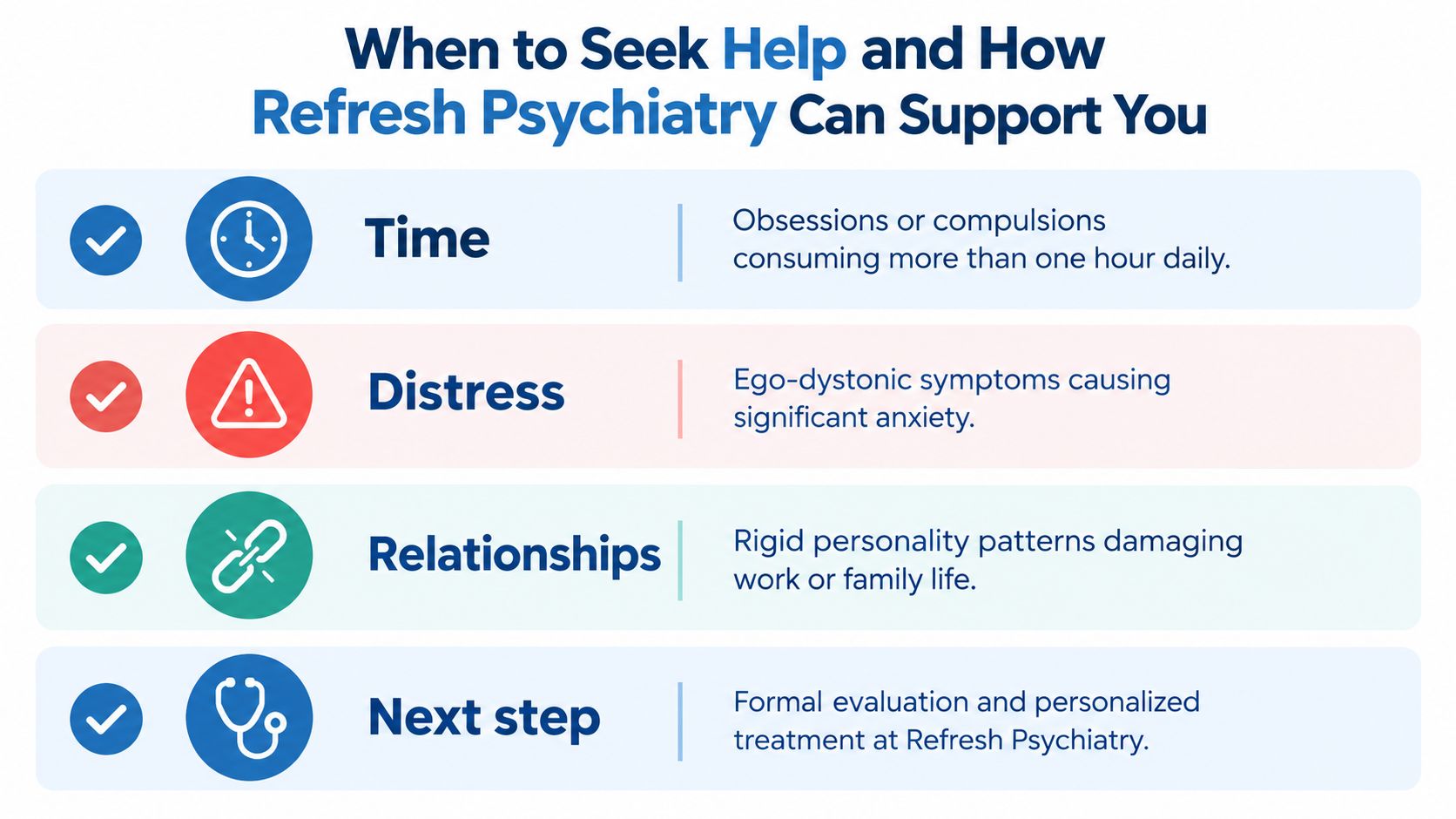
What an evaluation should include
A full psychiatric assessment is more useful than requesting a medication refill without examining the underlying pattern. The clinician should review symptom onset, intrusive thoughts, rituals, personality traits, insight, functional impairment, medication history, mood symptoms, family observations, and treatment goals.
Florida residents can use telepsychiatry for secure video visits, including psychiatric evaluation and medication management. Refresh Psychiatry & Therapy is a Florida-based telemedicine practice that can coordinate psychiatric care and therapy referrals, with insurance coverage to be verified and self-pay options available. Learn more about telemedicine psychiatry services before scheduling.
Refresh Psychiatry accepts Aetna, United Healthcare/ UHC, Cigna, Blue Cross Blue Shield, Humana, Tricare, UMR, and Oscar insurance plans. Coverage and benefits should be confirmed directly with the practice, and patients can ask about combining medication management with therapy referrals when OCD and OCPD features appear together.
Frequently Asked Questions About OCD and OCPD
Can someone have both OCD and OCPD, and how often does this occur?
Yes. Research has reported OCPD in 16% to 44% of people with OCD, with later reviews commonly finding comorbidity in the 20% to 49% range (comorbidity review). Having both diagnoses can affect symptom severity, insight, daily functioning, and treatment planning. Treatment usually needs to address OCD symptoms and longstanding personality patterns together.
Is OCPD on the obsessive-compulsive spectrum?
The relationship remains debated. OCD and OCPD are separate diagnoses, although they share some clinical features and may involve partly related traits or mechanisms (review of spectrum questions). A family history can inform assessment, but it cannot establish either diagnosis.
Why might someone with OCPD not recognize their rigidity?
OCPD traits are often ego-syntonic. The person may experience strict rules, perfectionism, and high standards as responsible or correct. Relatives and colleagues may see the cost more clearly through repeated criticism, controlling behavior, or difficulty compromising.
Do SSRIs and ERP work for OCPD the same way they work for OCD?
No. SSRIs and exposure and response prevention, or ERP, are established treatments for OCD. OCPD has no FDA-approved medication specifically for its personality traits, so psychotherapy generally focuses on flexibility, emotional awareness, and relationships. ERP becomes relevant when OCD is also present.
How long does treatment take before improvement is visible?
There is no dependable timetable. OCD treatment often involves repeated ERP practice and medication monitoring. OCPD treatment may take longer because it addresses enduring patterns that feel closely tied to identity and values.
Should family members participate in treatment?
Family participation can reduce accommodation of OCD rituals and clarify how OCPD rigidity affects relationships. The clinician should set boundaries, protect confidentiality, and match involvement to the patient's goals and safety.
Refresh Psychiatry & Therapy provides psychiatric evaluations, medication management, and coordinated therapy referrals through Florida telemedicine. Contact Refresh Psychiatry & Therapy or call (954) 603-4081 to schedule an evaluation. Insurance plans include Aetna, United Healthcare/UHC, Cigna, Blue Cross Blue Shield, Humana, Tricare, UMR, and Oscar. Coverage should be confirmed directly.
This blog is informational and does not replace personalized medical advice.