
🧠 Emotional Blunting Antidepressants: A Patient Guide

You take your antidepressant every morning because it helped. The crushing heaviness eased. You're meeting deadlines, sleeping more reliably, and answering messages again. Yet laughter at a friend's joke arrives late, hugs feel muted, and news about a parent's illness lands with the emotional force of a paragraph you're reading about someone else.
This is a particularly confusing kind of improvement. Functioning has returned, but aliveness hasn't fully returned with it. You may feel better than before treatment and still worry that being “fixed” cost you something essential.
The question is not only whether antidepressants cause emotional blunting. The more useful clinical question is whether your reduced emotional range comes from the medication, depression that hasn't fully resolved, or both. That distinction determines whether changing treatment is sensible, risky, or unnecessary. Before making any adjustment, a psychiatrist should examine timing, dose changes, mood symptoms, motivation, pleasure, relationships, and safety. Patients can start that process by reviewing their medication management options and preparing a clear account of what has changed.
When the Medication Works but You Feel Missing
“I'm not depressed anymore,” a patient might say from the chair across from me. “But I'm not myself either.”
They describe a familiar pattern. Crying has stopped, the constant dread has lifted, and ordinary responsibilities are possible again. They still attend a child's school event or meet a friend for dinner, but the internal response feels faint. A favorite song sounds good without moving them. A painful conversation feels important intellectually, yet the expected sadness or anger never quite arrives.
The trade-off deserves attention
This experience can create guilt. The person may think they should be grateful because the medication is helping, so they keep the concern private. Partners may interpret detachment as indifference. Parents may worry that they're present physically but emotionally distant. Someone grieving a parent's illness may wonder whether the lack of tears means they've become cold.
I don't dismiss that concern, and I don't automatically blame the medication. Emotional restriction can be part of depression itself, particularly when pleasure, motivation, connection, and emotional responsiveness remain impaired. A medication can also reduce painful reactivity while narrowing positive feeling. Both explanations can be true at the same time.
Clinical rule: Relief from depression is valuable, but emotional flatness shouldn't be accepted automatically as the price of treatment.
The first task is to describe the change precisely. Did you lose pleasure, or do you still enjoy activities but feel less intensity? Are you less motivated, or do you complete tasks without emotional reward? Has anxiety improved in a way that feels calming, or has all emotional response become dampened?
Those details matter more than the single word “numb.” A careful evaluation treats this as a differential diagnosis, not a footnote under side effects. The aim isn't to remove every strong feeling. It's to help you retain safety, stability, and meaningful emotional connection.
What Emotional Blunting Actually Is
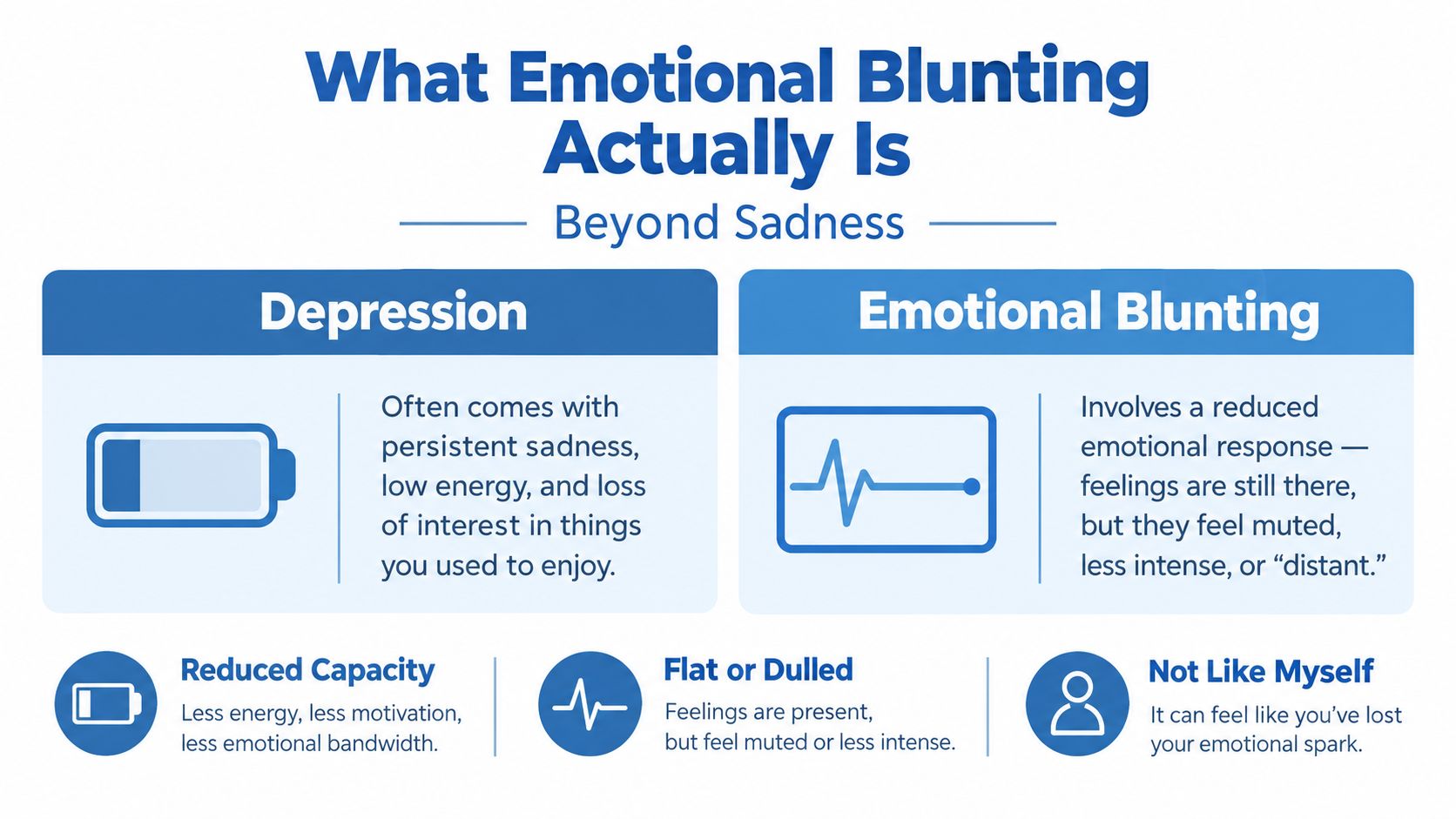
Emotional blunting is a reduced capacity to feel both positive and negative emotions with the usual intensity. People describe feeling flat, dulled, detached, or “not like myself.” The experience may involve fewer tears during a sad film, less anticipation before an event, muted excitement after good news, or less emotional connection during an intimate conversation.
It overlaps with depression, but the two aren't identical. Untreated depression may bring hopelessness, heaviness, guilt, emptiness, low motivation, and a loss of interest. Anhedonia refers more specifically to reduced pleasure. Emotional blunting describes a broader narrowing of emotional range, including emotions that are not merely pleasurable.
Name the pattern before changing treatment
A useful assessment asks about separate emotional domains:
Positive feeling: Can you experience joy, excitement, affection, pride, or anticipation?
Negative feeling: Can you access appropriate sadness, anger, concern, or grief?
Connection: Do conversations, touch, music, and family relationships feel emotionally present?
Drive: Are you initiating activities, or has motivation also declined?
Contrast: Does the experience feel neutral and muted, or painful and hopeless?
The Oxford Depression Questionnaire, or ODQ, is a validated instrument designed to assess emotional blunting in people with depression, including those taking antidepressants. It examines recent emotional experience, including reduced positive and negative affect, detachment, and diminished responsiveness. Clinicians can use it alongside depression measures and repeat it after a treatment change, rather than relying on an unclear description such as “I feel numb.” Details about the instrument are available in this clinical overview of the Oxford Depression Questionnaire.
A questionnaire doesn't decide whether medication is responsible. It gives the conversation more precision. Naming the pattern accurately is the first step toward deciding whether anything should change at all.
How Antidepressants Change the Volume on Your Emotions
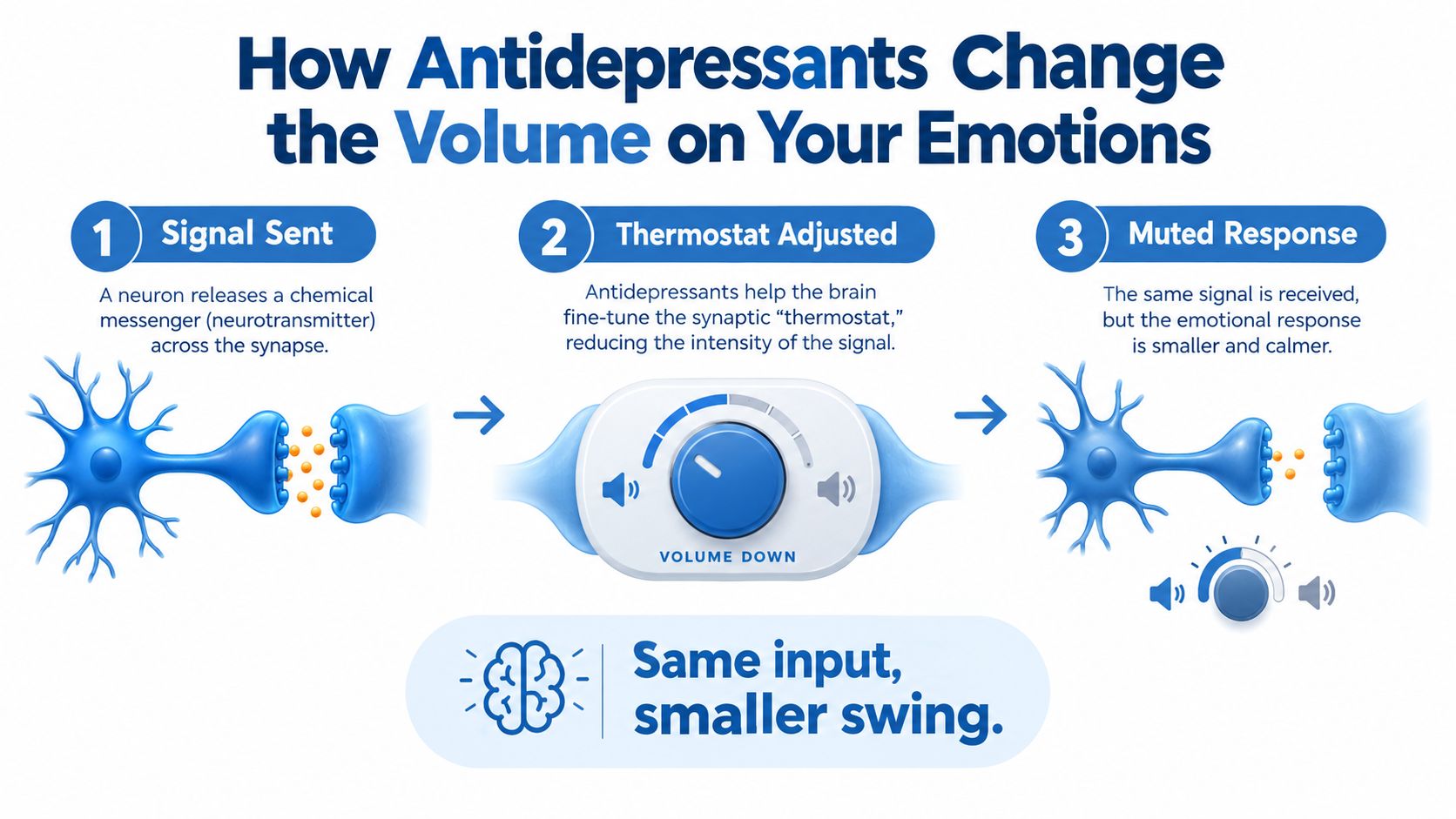
One useful way to understand emotional blunting is to picture a synaptic thermostat. The emotional signal still arrives, but the nervous system may register the same input as a smaller swing on the dial. A joyful event produces less lift, and a painful event produces less drop.
That model is a proposed explanation, not a final verdict. Serotonin influences emotional processing and can reduce the amplification of certain responses. Norepinephrine contributes to alertness and salience, meaning how strongly something captures attention. Dopamine participates in motivation, reward, and the sense that an activity is worth pursuing. These systems interact rather than operating as separate volume controls.
Why the same effect can help and hurt
A lower emotional response may be therapeutic when panic, intrusive anxiety, or overwhelming reactivity keeps someone from functioning. The same dampening can become unwanted when it removes pleasure, motivation, empathy, creativity, or intimacy. Proposed explanations include serotonergic modulation of dopamine pathways in the prefrontal cortex, which could contribute to reduced reward sensitivity or motivation in some patients. The evidence does not establish one universal mechanism or identify a single medication that is safest for everyone. A recent review emphasizes that studies use different definitions and measures, with very high variation between prevalence estimates, reported as I^2 = 98 in the cited analysis (review of antidepressant-associated emotional blunting).
The practical implication is important: mechanism isn't destiny. If a medication is contributing, a prescriber may be able to adjust exposure, change the medication, or address another part of the treatment plan. Emotional blunting may relate more closely to dose and medication level than to the simple amount of time someone has taken a drug, but that relationship must be assessed individually.
This video offers another plain-language visual explanation of the volume-knob idea:
The key question remains clinical: are you experiencing useful emotional relief, unwanted flattening, residual depression, or a mixture?
Which Antidepressants Carry the Highest Risk
The evidence doesn't justify treating emotional blunting as an SSRI-only problem. In a survey of 669 adults with major depressive disorder receiving antidepressant monotherapy, 46% reported emotional blunting, with rates generally between 43% and 56% across individual agents. Bupropion appeared lower in one subgroup, at approximately 33%, but the study did not establish a statistically clear difference between individual antidepressants. The findings are summarized in this systematic review of antidepressant-associated apathy.
Drug Class | Representative Agents | Reported Blunting Risk | Notes |
|---|---|---|---|
SSRIs | Citalopram, escitalopram, fluoxetine, paroxetine, sertraline | Frequently reported | Risk varies by person, dose, illness, and definition |
SNRIs | Venlafaxine, duloxetine | Blunting has been reported | They aren't exempt simply because they also affect norepinephrine |
TCAs | Tricyclic antidepressants | Blunting has been reported | Side-effect burden and medical suitability also matter |
Atypical antidepressants | Bupropion, mirtazapine, vortioxetine | Some may have a lower reported tendency, but none is risk-free | Comparative evidence remains limited |
MAOIs and augmentation agents | Individualized choices | No simple class-wide conclusion | Selection depends on diagnosis, prior response, interactions, and safety |
A separate review describes some SSRI rates around 40% to 60% across studies of adults with major depressive disorder treated with SSRIs or SNRIs, while emphasizing that definitions and measurement tools differ (clinical review of emotional blunting). These figures describe groups, not your personal probability.
For families weighing an SSRI prescription for an adolescent, the parent guide to Lexapro and teens provides broader medication context. It shouldn't replace an individualized discussion with the prescribing clinician.
What the comparison means in practice
Bupropion often appears lower in reported blunting research, but it may not fit someone whose anxiety is prominent or who has other contraindications. Mirtazapine and vortioxetine may be considered based on the symptom pattern, yet “lower risk” never means “no risk.” Pharmacogenomic information may sometimes help organize a complicated history of medication response, although pharmacogenomic testing can't predict emotional blunting with certainty or replace clinical judgment.
Head-to-head evidence is thin. A thoughtful choice considers what the medication is treating, what it has improved, what it has worsened, and which trade-offs you're willing to accept.
Is It the Pill or the Depression
“Numb means the antidepressant is suppressing my emotions” is an understandable conclusion, but it's not always correct. Depression itself can reduce pleasure, motivation, emotional responsiveness, and connection. The medication may be contributing, the illness may still be active, or both processes may be present.
A large patient survey found that 56% attributed their emotional blunting to depression, while 45% believed their antidepressant was negatively affecting their emotions. Thirty-nine percent said they were considering stopping or had already stopped medication because of perceived emotion-related side effects. Clinicians identified emotional blunting in 23% overall, including 32% during acute depression and 14% among patients in remission, according to the clinical study reviewing patient and clinician assessments.
The timeline usually provides the first clue
Ask yourself:
What was present before treatment? If low pleasure, detachment, and reduced motivation preceded the antidepressant, residual depression deserves serious consideration.
What changed after starting or increasing the dose? A new flattening that follows a medication change raises suspicion of a medication contribution.
What improved first? If hopelessness and anxiety improve while joy, empathy, and excitement become muted, the treatment may be helping one domain while creating a problem in another.
What happens to core depression symptoms? Persistent hopelessness, guilt, emptiness, or suicidal thinking points to illness activity, not merely a side effect.
Don't test the theory by taking a drug holiday or stopping suddenly. Instead, bring a timeline to your prescriber. Note the medication, dose, dates of changes, emotional response, sleep, anxiety, motivation, and any safety concerns. If depressive symptoms remain active, a dose reduction could worsen the illness even if it improves emotional range.
The discrepancy between what patients notice and what clinicians identify doesn't mean patients are mistaken. It means emotional blunting is easy to miss when routine assessments focus on sadness and anxiety. A structured conversation, supported by your depression treatment evaluation, gives your observation the clinical detail it needs.
What Emotional Blunting Does to Daily Life
Emotional blunting can be subtle until it begins affecting the people and activities that give life meaning. You may still go to work, care for your children, answer emails, and keep appointments. From the outside, you appear functional. Internally, you feel like a competent observer of your own life.
Relationships often reveal the change first. A partner may notice that affection seems less spontaneous. A friend may receive a thoughtful response without sensing emotional warmth behind it. A parent may understand that a child's achievement matters while struggling to feel excitement or pride in the usual way.
Function can improve while connection declines
At work, blunting may reduce emotional distress and help you stay focused. It can also flatten curiosity, creative risk-taking, enthusiasm, and satisfaction after completing something difficult. Parenting can feel especially complicated because dependable behavior may remain intact while delight, tenderness, or emotional spontaneity feels harder to access.
Grief can expose the difference between reduced suffering and reduced connection. Difficulty crying at a funeral doesn't prove that you don't care, but it may signal a change worth discussing. Music, sexual intimacy, humor, religious practice, and friendships can all become less vivid.
The context matters. Reduced reactivity may be useful when intrusive anxiety, obsessive fear, or trauma-related activation is overwhelming. A calmer nervous system can give someone room to function and recover. But if the same dampening removes caring, pleasure, motivation, or closeness with children, it may represent a meaningful loss.
The relevant question isn't “Do I feel less?” It's “Which feelings are less, and is that helping me live according to my values?”
A 2025 analysis of 3,376 adults with major depressive disorder found that “not caring” and reduced positive emotion were the emotional-blunting domains most strongly associated with impaired social functioning and higher PHQ-9 scores, while greater blunting severity was also associated with anxiety, depressive symptoms, and poorer quality of life (analysis of emotional blunting and functioning). Men and unemployed participants were more likely to underestimate their blunting severity compared with validated questionnaire scores, which supports asking trusted people what they've noticed.
The same symptom can be relief, neutrality, or harm. Treatment should be judged by the life it helps you live, not only by whether distress has become quieter.
Practical Steps to Bring Your Emotions Back
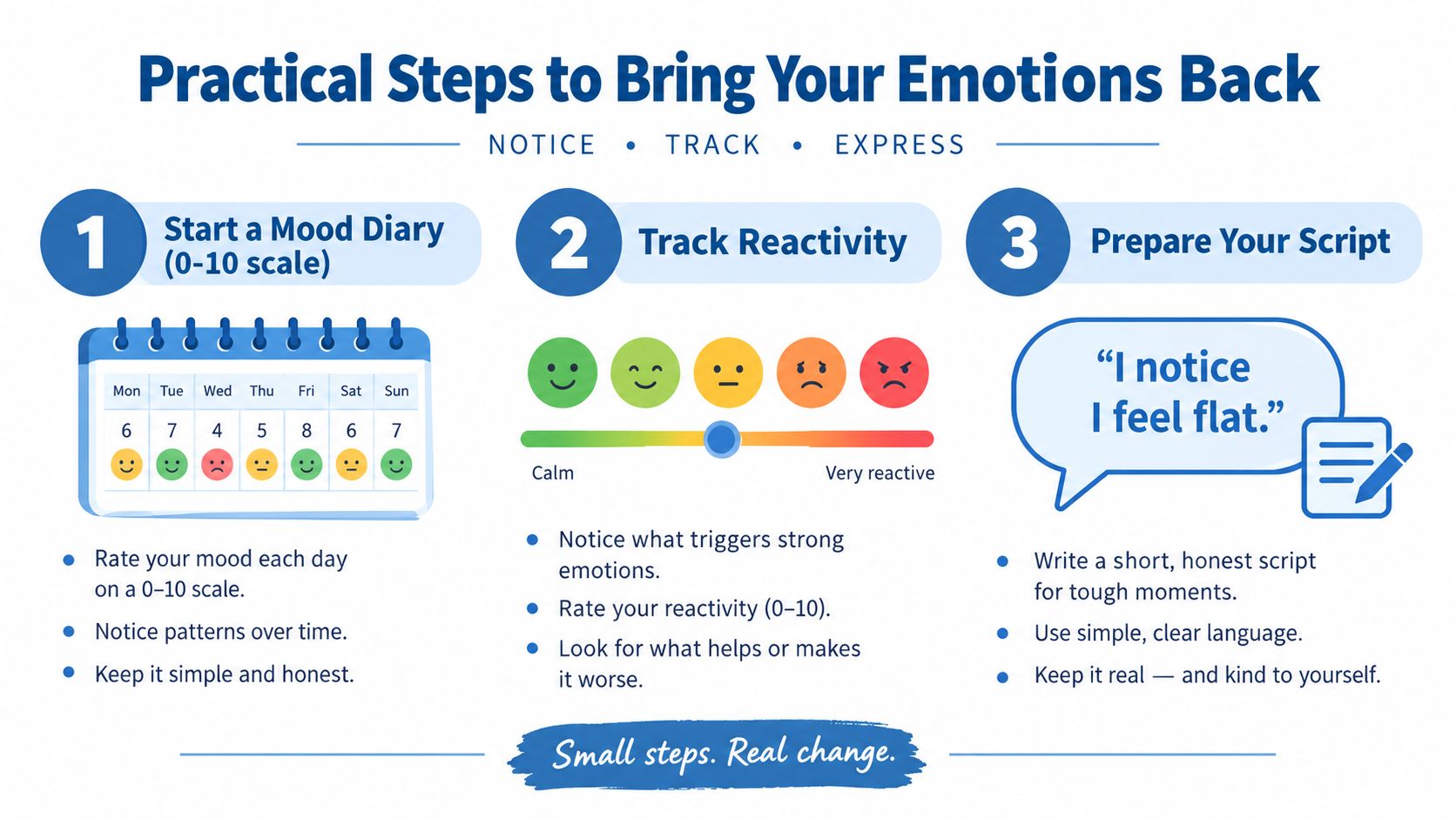
You notice the change most clearly during an ordinary moment: your child laughs, a favorite song plays, or a close friend shares difficult news, and your response feels muted. Before changing medication, document the pattern. For two weeks, keep a brief daily record of mood, pleasure, motivation, anxiety, connection, and emotional responsiveness. Use a 0 to 10 scale for each item and add one concrete example, such as “laughed with my child but felt little warmth” or “music moved me more than usual.” This record helps separate a medication effect from depression, stress, sleep disruption, or another cause.
Bring a usable script
At the appointment, give your prescriber a timeline rather than only saying, “I feel numb.” You can say:
“My sadness and anxiety improved, but since starting or increasing this medication I've noticed less joy, excitement, empathy, and emotional connection. My motivation is [better, unchanged, or worse]. Can we review whether this is residual depression, a medication effect, or both?”
Bring your medication list, recent dose changes, past treatment responses, sleep pattern, substance use, and any suicidal thoughts. If you work with a therapist, ask whether they have noticed changes in your affect, motivation, or engagement with other people. A practical discussion of St. Petersburg holistic depression help can also help you consider psychotherapy, routines, relationships, and other non-medication supports alongside psychiatric care.
Discuss options in a safe sequence
Dose adjustment: If depression is stable and the dose may be contributing, your prescriber might consider a carefully supervised reduction. Do not reduce the dose yourself or stop an SSRI abruptly. Monitor for returning depression, anxiety, withdrawal symptoms, and suicidal thinking.
Switching medication: Bupropion, mirtazapine, or vortioxetine may be options when their overall profiles fit your symptoms and medical history. Each carries trade-offs, and none guarantees restored emotional range.
Augmentation: A clinician may discuss adding bupropion or, in selected cases, an agent such as aripiprazole. The choice depends on diagnosis, current medication, interactions, side effects, and safety. Treatment specifically for emotional blunting remains limited, so agree on a clear target and monitoring schedule.
Psychotherapy: Behavioral activation can keep meaningful activities in your life while pleasure is muted. CBT, DBT, psychodynamic, or trauma-focused therapy may address residual depression, avoidance, relationship strain, and the meaning you attach to feeling different.
Structured deprescribing: If a medication is no longer needed or its harms outweigh its benefits, a clinician can create a gradual, monitored plan. Guidance on safely deprescribing medications can help frame that conversation.
Pharmacogenomic review: After several difficult or confusing medication trials, pharmacogenomic information may add context. It supports decision-making but does not guarantee the right medication.
Change one major variable at a time whenever possible. That makes it easier to identify what helped and what caused a setback. Improvement may unfold over two to six weeks, depending on the intervention, medication, illness severity, and individual response. Your prescriber should set the observation period and decide when to reassess.
When to Get Help Right Away and How to Reach Refresh Psychiatry
Emotional blunting needs same-day psychiatric contact when it appears with suicidal thoughts, new urges to self-harm, worsening hopelessness, or a sudden emotional change after a dose increase. Don't wait for a routine appointment if you feel unsafe, can't control an impulse to harm yourself, or believe you may act on suicidal thoughts. Contact emergency services or go to the nearest emergency department in an immediate crisis.
Use this quick screen:
Have suicidal thoughts or self-harm urges returned?
Has hopelessness worsened even though your emotions feel flatter?
Did the change begin soon after starting or increasing medication?
Can you safely wait for a scheduled appointment?
Symptom | Urgency | Action |
|---|---|---|
Emotional flatness with stable mood and no safety concern | Routine | Track symptoms and schedule a medication review |
New blunting after a dose change | Prompt | Contact the prescriber for guidance before changing the dose |
Worsening hopelessness or major functional decline | Same day | Call your psychiatric clinician or urgent mental health service |
Suicidal thoughts, self-harm urges, or immediate danger | Emergency | Call emergency services or go to the nearest emergency department |
A psychiatric evaluation can review your diagnosis, medication timeline, emotional symptoms, safety, and treatment goals. For a first visit, bring your current medication bottles or a complete list, previous medication names and responses, relevant medical history, therapy contacts if you want care coordinated, and your symptom timeline. Telepsychiatry may be available for Florida residents, subject to clinical and administrative requirements.
Frequently asked questions
How long does blunting take to improve? It depends on whether the cause is medication exposure, residual depression, or both. Some people notice change after a supervised adjustment, while others need a broader treatment plan and continued monitoring.
Is stopping an antidepressant ever the right answer? It can be appropriate in some situations, but the decision should weigh relapse risk, current stability, side effects, and alternatives. Abrupt discontinuation is not a safe self-treatment strategy.
Can psychiatric care coordinate with my therapist? Yes, with your permission. Medication review and psychotherapy work better when clinicians understand the same goals, warning signs, and functional changes.
This blog is for informational purposes only and does not constitute medical advice. Please consult a qualified mental health professional for personalized guidance.
Refresh Psychiatry & Therapy offers psychiatric evaluations, medication management, therapy, and clinician-guided medication changes for people who feel emotionally flat while treating depression or anxiety. Contact us or call Refresh Psychiatry at (954) 603-4081 to schedule your evaluation. We accept Aetna, United Healthcare/ UHC, Cigna, Blue Cross Blue Shield, Humana, Tricare, UMR, and Oscar insurance plans.