
🎭 Masking Depression: Signs and Help

You finish a full day of work, answer every message, smile through dinner, and tell everyone you're fine. Then the door closes, the performance ends, and you're left with exhaustion, numbness, guilt, or a heaviness you haven't told anyone about. That disconnect can feel confusing, especially when your responsibilities are still getting done.
Masking depression describes depressive symptoms that remain hidden behind productivity, humor, emotional control, or a cheerful public image. It isn't a formal diagnosis called “smiling depression,” and it isn't proof that someone is being dishonest. It's often a coping behavior that helps a person meet expectations while their private experience becomes increasingly difficult to manage.
The Hidden Reality of Masking Depression
A person can lead a meeting, care for children, complete assignments, attend social events, and still feel profoundly unwell. They may know how to sound upbeat on a video call, make a joke at dinner, and reassure loved ones without revealing that sleep has become difficult, pleasure has faded, or hopeless thoughts are becoming harder to dismiss.
That effort has a cost. Camouflaging, a term used in recent research, refers to concealing depressive symptoms so that other people see a more capable, positive, or controlled presentation than the individual privately experiences. A 2025 study involving 292 people with depression developed a 14-item Camouflaging Depression Scale and found that camouflaging occurred across different depression severities and demographic groups. It was associated with depression, distress, fatigue, self-monitoring, and internalized stigma. The NIH-indexed study describes camouflaging as a measurable pattern rather than a personality quirk.

Functioning doesn't equal feeling well
A high-achieving student may submit excellent work and then spend the evening unable to recover from ordinary social contact. A parent may organize the household while privately feeling detached from family life. A professional may appear calm and dependable but rely on constant self-monitoring to prevent anyone from noticing how depleted they feel.
The important clinical question isn't only, “Are you still functioning?” It's also, “What does functioning cost you?” Recovery that requires hours of isolation, emotional shutdown, excessive sleep, or relentless self-criticism may indicate that the visible success is being maintained through unsustainable effort.
Clinical perspective: A convincing smile can describe a social skill. It can't reliably describe a person's mood, safety, or need for care.
Depression may remain hidden when stigma makes disclosure feel dangerous. A systematic review found a small-to-moderate negative association between mental-health stigma and help-seeking, with a median effect size of d = -0.27, and ranked stigma as the fourth-highest barrier to seeking help. The systematic review explains how disclosure concerns can delay access to care.
Your distress doesn't become less real because you hide it skillfully. In many cases, the ability to keep performing is precisely what prevents people around you from asking better questions.
Recognizing the Signs and Patterns of Concealment
Masking depression often appears as a mismatch between external performance and internal experience. One isolated behavior doesn't establish depression. Clinicians look for meaningful changes from a person's usual pattern, persistent internal symptoms, and the effort required to maintain everyday roles.
Outward Presentation | Internal Reality |
|---|---|
Cheerful, funny, or reassuring | Emotional numbness, sadness, or hopelessness |
Productive at work or school | Severe fatigue, concentration problems, or declining pleasure |
Socially engaged | Needing extensive recovery time after interactions |
Calm under pressure | Agitation, anxiety, or emotional suppression |
Highly organized and dependable | Fear that any mistake will expose personal inadequacy |
Still meeting responsibilities | Feeling detached from accomplishments and relationships |
“I'm fine” in routine conversations | Difficulty describing symptoms because disclosure feels unsafe |
The concealed pattern may be emotional, cognitive, physical, or behavioral. Internally, someone may notice loss of interest, guilt, self-criticism, sleep disruption, fatigue, irritability, difficulty concentrating, or recurring thoughts of death. Outwardly, they may compensate by overpreparing, joking, staying constantly busy, or avoiding situations where their control might weaken.
Look for the cost of performance
Ask what happens before and after the visible success. Does the person need to withdraw completely after social contact? Do they experience no pleasure from achievements that once mattered? Are ordinary tasks possible only through intense pressure, caffeine, perfectionism, or fear of disappointing others?
Self-monitoring can also become exhausting. Someone may continually scan their voice, facial expression, messages, and behavior for signs that their distress is showing. That vigilance can reduce authentic connection, because every interaction becomes a performance rather than a source of support.
A 2025 study of expressive suppression among 483 first-year college students found that greater suppression predicted higher anxiety and depression and lower life satisfaction over time. Students who felt more authentic experienced fewer negative effects associated with suppression, while those who felt conflicted or uncertain about emotional expression had poorer outcomes. The NYU summary discusses the relationship between suppression, authenticity, and student mental health.
If these patterns feel familiar, a mood disorder evaluation can help distinguish depression from anxiety, burnout, trauma-related symptoms, bipolar-spectrum conditions, substance effects, sleep disorders, or medical contributors. The goal isn't to label every difficult period. It's to understand what's happening accurately enough to choose appropriate care.
Why People Mask Their Mental Health Struggles
People often assume that masking is driven mainly by fear of other people's judgment. That fear matters, but it isn't the whole explanation. Many people conceal depression because they've absorbed the belief that needing help means they're weak, dramatic, unreliable, or no longer in control of their lives.
Self-reliance can look admirable from the outside. A person may tell themselves, “I should be able to handle this,” “Other people have it worse,” or “I'll seek help once my responsibilities are under control.” The problem is that depression often makes responsibilities feel more urgent while reducing the energy available to address the underlying illness. Waiting for a perfectly convenient time can become a way of postponing care indefinitely.
Why broad anti-stigma messages miss the target
A general message such as “there's no shame in getting help” may be well intended, but it doesn't always address the specific fear behind avoidance. Someone may not be worried about public opinion at all. They may be afraid of losing autonomy, being treated as incapable, having symptoms minimized, or being pressured into treatment they don't understand.
Evidence supports this distinction. A systematic review and meta-analysis found that personal negative attitudes toward mental-health help-seeking were associated with lower active help-seeking, while perceived public stigma wasn't consistently associated with seeking care. The review examines the difference between internalized attitudes and perceived public stigma.
A more useful approach respects the person's need for control. Instead of demanding a complete emotional disclosure, offer a manageable first step:
Name the discrepancy: “You're handling everything, but you seem exhausted when the day is over.”
Reduce the threat: “You don't have to explain everything right now.”
Protect autonomy: “We can look at options together, and you can decide what feels appropriate.”
Ask about experience, not appearance: “What is this like when you're alone?”
A person who has been masking may need practical information before they can accept encouragement. They may want to know what an evaluation involves, how confidentiality works, whether medication is required, and whether a clinician will take their symptoms seriously if they're still working or studying. Addressing those questions is often more effective than repeating reassurance.
Clinical Risks and the Impact on Diagnosis
Outward competence cannot establish psychological wellness. A person may arrive on time, meet deadlines, care for others, and answer “fine” while spending significant energy concealing anhedonia, sleep disruption, fatigue, guilt, irritability, poor concentration, physical symptoms, or suicidal thoughts. Camouflaging is an exhausting coping behavior, not a personality quirk. It can also shape the clinical encounter, because a polished presentation may hide how much effort daily functioning requires.
In primary care, depression has historically gone unrecognized in roughly half of symptomatic patients. A systematic review found detection rates of 0% in 4 of 12 studies and below 12% in 5 others. Under-reporting, stigma, limited clinician training, and competing medical priorities contributed to missed recognition. The review explains why depression can remain undetected in primary-care settings.
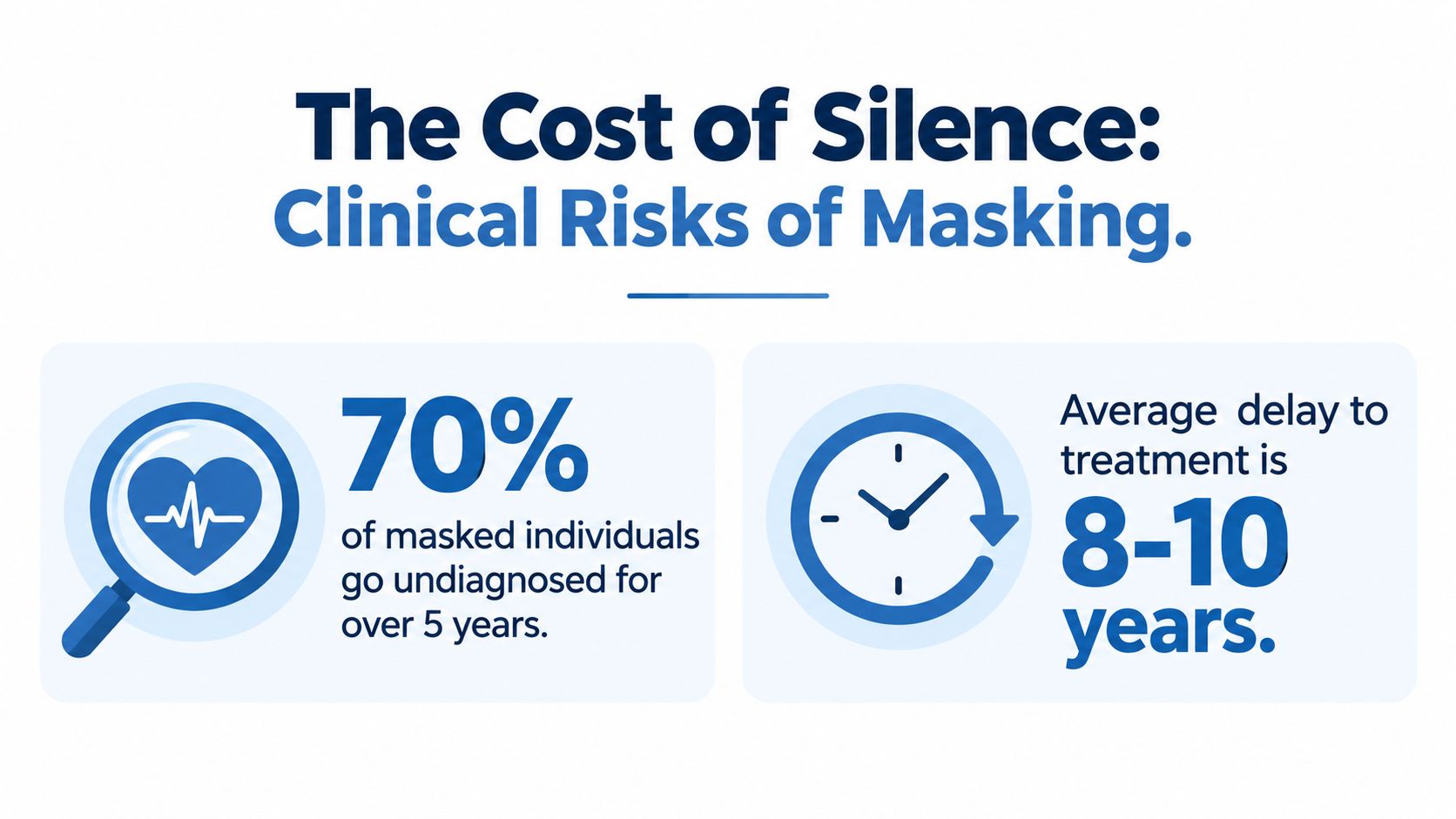
Eye contact, grooming, employment, and conversational warmth are limited clinical signals. If an assessment relies on them, it may miss the condition beneath the mask.
What a careful evaluation should include
A structured instrument such as the PHQ-9 can support case finding, but it does not establish a diagnosis alone. A clinician should combine the score with:
Symptom pattern: mood, pleasure, sleep, appetite, energy, concentration, guilt, and hopelessness.
Functional cost: what the person can do, the effort required, and how they feel afterward.
Differential diagnosis: bipolar-spectrum symptoms, substance use, trauma, medical conditions, and sleep disorders.
Safety: direct questions about suicidal thoughts, intent, planning, access to lethal means, and changes in risk.
Longitudinal change: what differs from the person's baseline and whether symptoms are worsening.
Routine assessment helps because people who camouflage distress may not volunteer a clear account. They may minimize symptoms, organize their story around responsibilities, or describe physical exhaustion before emotional pain. The clinician's role is to ask about the cost of functioning, not merely whether the person is still functioning.
Chronic emotional suppression also warrants attention to physical health. In a nationally representative U.S. sample followed for 12 years, people at the 75th percentile of emotional suppression had a hazard ratio of 1.35 for all-cause mortality compared with those at the 25th percentile. The observed association for cancer mortality was a hazard ratio of 1.70. These observational findings do not prove that masking directly causes death or predict an individual's risk. The study reports the long-term associations between emotional suppression and mortality.
A psychiatric evaluation should examine the polished presentation without treating the patient as deceptive. Careful questioning makes hidden suffering clinically visible.
Practical Steps to Recognize and Respond
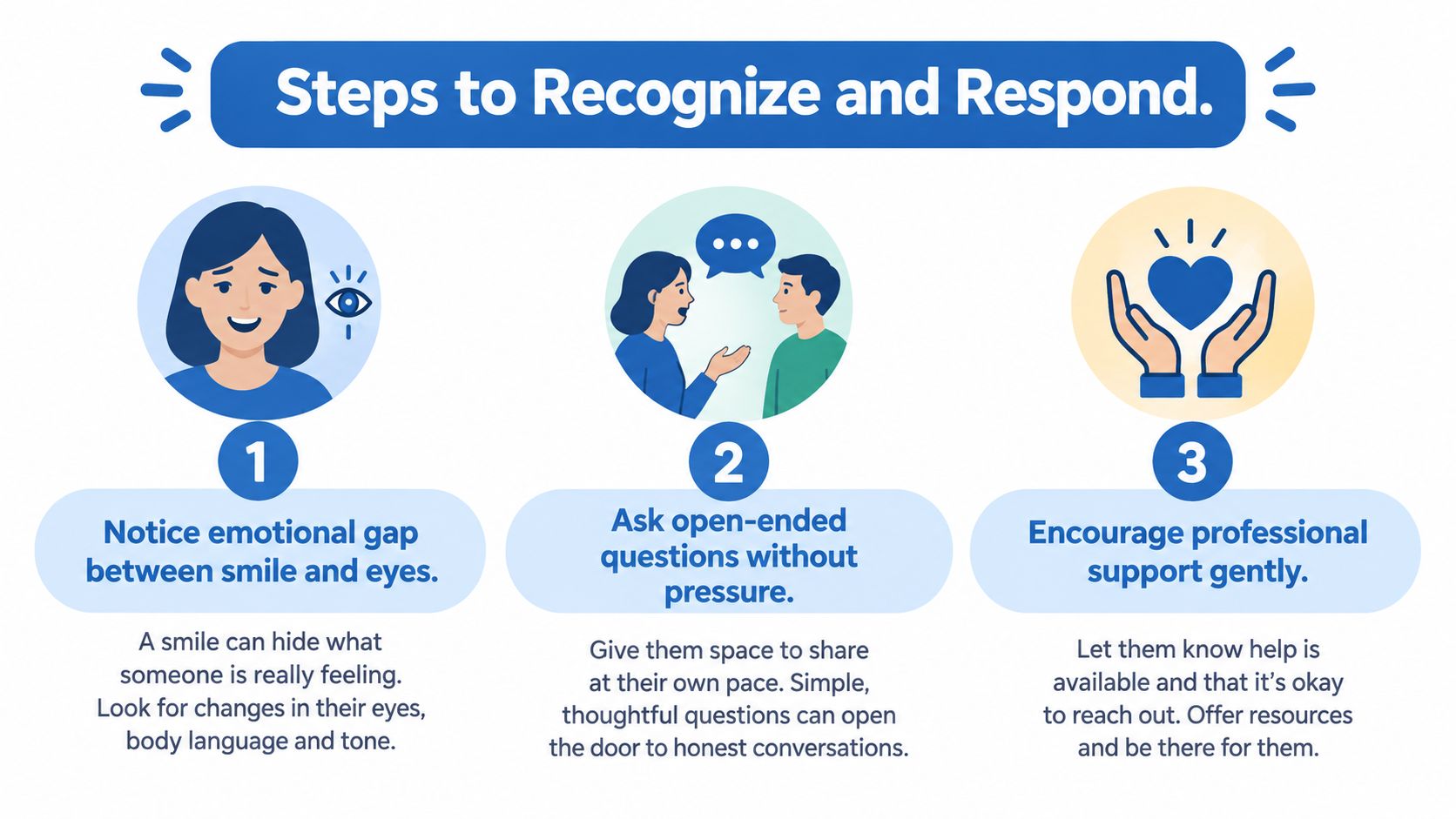
Start with the private experience, not the public image. For several days, notice whether your emotional state changes when nobody is watching. Pay attention to the gap between what you accomplish and how you feel while doing it.
For the person who may be masking
Measure recovery, not only output. After work, school, or social contact, do you feel restored or emptied out? Needing substantial isolation to recover may be clinically meaningful, especially when it represents a change from your usual pattern.
Track pleasure separately from participation. You may continue attending a favorite activity while feeling no enjoyment. Write down what you did and whether it brought interest, connection, relief, or only a sense of having completed an obligation.
Name the symptoms you edit out. Include sleep disruption, fatigue, guilt, hopelessness, irritability, emotional numbness, concentration problems, and thoughts about death. A private note can make it easier to describe the full picture during an appointment.
Ask what the mask protects you from. Is it judgment, loss of autonomy, disappointing someone, appearing incompetent, or being forced to change your routine? Naming the fear gives a clinician something specific to address.
Choose a low-pressure entry point. You don't need to arrive with a diagnosis. You can say, “I'm functioning, but I'm not okay when I'm alone, and I want help understanding why.”
For friends and family
Don't demand a confession or argue with the person's reassurance. Mention a concrete observation, such as missed hobbies, unusual withdrawal, irritability, exhaustion, or a change in communication, then leave room for an honest answer.
“You don't have to convince me that you're okay. I want to know how things feel when you're by yourself.”
Offer something specific and manageable. A quiet walk, a meal, help with an appointment, or a regular check-in may be more useful than “Let me know if you need anything.” If the person mentions suicidal thoughts, ask directly about safety and seek urgent professional or emergency support. A friendly appearance should never be used to dismiss a safety concern.
You can also watch this practical guide before starting a conversation:
For ongoing support, therapy services can provide a confidential setting where the person doesn't have to maintain the role of the cheerful, capable one.
Evidence-Based Treatment and Telepsychiatry Access
Treatment begins with accurate assessment, not with an assumption that every hidden struggle requires the same intervention. A clinician may recommend psychotherapy, medication management, or both, depending on symptom severity, duration, safety concerns, medical history, previous treatment, and personal preferences.
Cognitive behavioral therapy can address depressive thought patterns and behaviors that maintain withdrawal or self-criticism. Dialectical behavior therapy can strengthen emotional regulation and distress-tolerance skills. Trauma-focused approaches may be appropriate when concealment developed in response to unsafe relationships or earlier experiences. Medication can be considered when symptoms are persistent, severe, recurrent, or difficult to shift through therapy alone.

What the first appointment can accomplish
An initial psychiatric appointment generally examines mood symptoms, sleep, energy, concentration, substance use, medical history, past treatment, family history, and safety. It should also explore the difference between how you appear to others and what you experience internally. You can ask how confidentiality works, what treatment options are being considered, and how progress will be measured.
Telepsychiatry can reduce practical friction for people who already spend much of their energy maintaining work, school, caregiving, or household responsibilities. A HIPAA-compliant virtual visit can allow care from a private location in Florida, provided the setting supports confidentiality and the clinician can assess safety appropriately. Telepsychiatry services may also make follow-up easier when travel or scheduling has become a barrier.
Care outside the appointment matters, but lifestyle practices shouldn't be presented as a substitute for evaluation when depression symptoms persist. For a low-pressure introduction to sustainable routines, you can browse mindful daily habits that fit around existing responsibilities rather than adding another demanding performance standard.
The most effective plan is one you can participate in. If you're hiding symptoms from your clinician, say so. That information helps the professional understand the coping pattern and adjust questions, treatment goals, and follow-up accordingly.
Taking the Next Step Toward Authentic Healing
Dropping the mask means allowing at least one safe person or qualified professional to understand the gap between public functioning and private distress. Masking is an exhausting coping behavior, not a personality quirk. You can remain competent, responsible, and deserving of support at the same time.
A clinical conversation matters when symptoms persist, pleasure declines, sleep is disrupted, fatigue limits your life, or hopelessness and suicidal thoughts appear. Seek help before work, school, relationships, or self-care collapse. Virtual support groups can offer connection when direct disclosure feels difficult, while psychiatric or therapy care provides personalized assessment and treatment.
Contact Refresh Psychiatry & Therapy or call Refresh Psychiatry at (954) 603-4081 to schedule your evaluation. We accept Aetna, United Healthcare/UHC, Cigna, Blue Cross Blue Shield, Humana, Tricare, UMR, and Oscar insurance plans.
This blog is for informational purposes only and does not constitute medical advice. Consult a qualified mental health professional for personalized guidance.
Refresh Psychiatry & Therapy offers coordinated psychiatric evaluations, medication management, and evidence-based therapy for depression hidden behind daily performance. Visit Refresh Psychiatry & Therapy to explore confidential care options and begin feeling better without carrying the mask alone.