
Propranolol vs Buspirone: A Clinical Comparison

You've got a presentation tomorrow, and your heart is already racing just thinking about it. Or perhaps the problem isn't one presentation at all. Your mind has been running through worst-case scenarios every day, your muscles stay tense, and you're looking for something that can help without leaving you sedated or dependent. During a telepsychiatry appointment, those two situations can sound similar, but they often call for very different treatment strategies.
🩺 Propranolol vs Buspirone: A Clinical Comparison
The central distinction is straightforward: propranolol is mainly a situational medication for physical symptoms, while buspirone is an ongoing treatment option for generalized anxiety disorder, or GAD. Neither medication is universally “better.” The useful question is which symptom pattern you're trying to treat, how quickly you need relief, and what medical risks or practical demands shape your options.
Understanding Your Anxiety Medication Options
A patient joins a video visit from her parked car before work. She says her anxiety is worst before presentations. Her hands shake, her voice becomes unsteady, and her heart pounds, but she doesn't feel persistently worried once the meeting is over. She wants to know whether there's a medication she can take only when necessary.
That situation is clinically different from another patient who reports constant worry about health, finances, family, and work. He wakes with muscle tension, spends much of the day anticipating problems, and feels anxious even when nothing specific is happening. A medication aimed at a single surge of physical arousal may not address the broader pattern.
The first prescribing question is not “Which drug is stronger?” It's “What kind of anxiety are we treating?”
Buspirone is an established anxiolytic for GAD and is labeled for the short-term symptomatic relief of excessive anxiety. Its prescribing information describes a usual starting dose of 15 mg per day, with gradual titration and a maximum of 60 mg per day. Meaningful improvement generally requires consistent daily treatment rather than a single dose taken during a stressful event. (Buspirone prescribing information)
Propranolol works differently. It's a beta-blocker that can reduce some of the body's adrenaline-driven responses, including a pounding heartbeat, shaking, and sweating. That can make it useful before a performance situation, but it doesn't function as a broad treatment for persistent worry, intrusive anxious thoughts, or the emotional patterns that maintain GAD.
A practical telepsychiatry distinction
During a virtual evaluation, I'd want to know:
When does anxiety appear? Is it present most days, or does it occur around specific events?
What does anxiety feel like? Is the main problem worry, panic, tremor, rapid heartbeat, sweating, or several symptoms together?
What do you need to remain able to do? Driving, exercising, presenting, caring for children, and concentrating at work all affect medication selection.
What else is part of the picture? Asthma, a slow heart rate, depression, medication interactions, substance use, and past treatment response can change the risk calculation.
Patients who want a broader overview of common medication categories can review this psychiatrist's guide to common anxiety medications, but a general list can't replace an individualized assessment. Therapy also matters. CBT can help identify and challenge anxious predictions, while exposure-based work can reduce avoidance. Medication may lower symptom intensity, but it doesn't automatically teach the skills needed to respond differently to fear.
How Propranolol and Buspirone Work in the Body
Buspirone and propranolol are sometimes discussed together because both may be considered when a patient wants to avoid routine benzodiazepine treatment. Pharmacologically, however, they target different systems and solve different clinical problems.
Buspirone is not a benzodiazepine. The FDA label describes it as an antianxiety agent that isn't chemically or pharmacologically related to benzodiazepines. It has a high affinity for serotonin 5-HT1A receptors, and it doesn't produce the prominent sedative, anticonvulsant, and muscle-relaxant effects associated with typical benzodiazepines. (FDA buspirone label)
That doesn't mean buspirone has no side effects or that it feels identical for every patient. It means its intended role is different. It's usually taken on a schedule, titrated gradually, and evaluated over time. It isn't designed to provide an immediate calming effect during a sudden panic episode or before a speech.
Propranolol is a beta-adrenergic blocker. Rather than directly reducing anxious thoughts, it dampens some of the physical effects associated with adrenaline. A person may notice less tremor, a slower or less forceful heartbeat, and less visible autonomic arousal. Those changes can be valuable when the body's reaction is the main source of distress, particularly during public speaking, auditions, interviews, or similar performance situations.
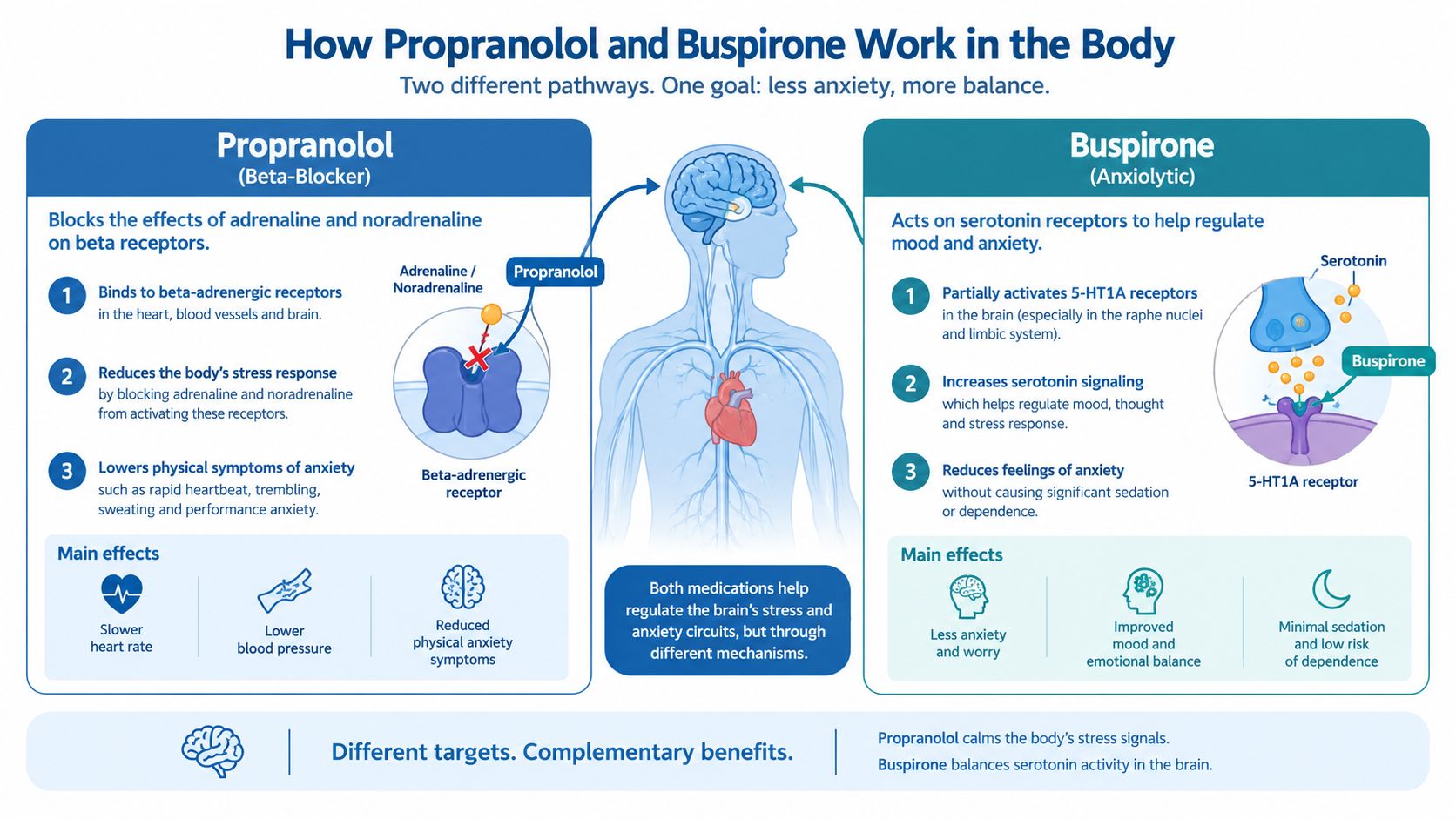
Why the distinction changes prescribing
A beta-blocker can reduce the physical feedback loop that makes a person feel visibly anxious. It generally won't address the content of worry, such as repeated thoughts that a relationship will fail, a minor symptom signals serious illness, or a work mistake will have catastrophic consequences.
Buspirone is positioned more broadly for anxiety disorders, especially GAD, but its delayed onset makes it unsuitable as a same-day rescue medication. A patient who takes it once before a stressful appointment may conclude that it “doesn't work,” when the underlying issue is that it's being used for a purpose it wasn't designed to serve.
Propranolol also requires attention to cardiovascular and respiratory factors. A clinician needs to consider blood pressure, heart rate, asthma history, athletic demands, and other medications before recommending it. That's why an evaluation should include more than a description of feeling nervous.
Patients interested in the physical-symptom use of propranolol can read this guide to propranolol for performance anxiety. The key takeaway is that symptom targeting matters. A medication can work well on one part of anxiety and do very little for another.
Comparing Clinical Evidence and Real-World Efficacy
A patient may schedule a telepsychiatry visit after propranolol helped with a presentation, then ask whether the same medication should manage anxiety every day. The clinical evidence supports a narrower role. A 2024 peer-reviewed review found limited evidence for propranolol's effectiveness in anxiety and noted that NICE and the British Association for Psychopharmacology do not recommend it for routine anxiety treatment. The review also described the latest systematic review and meta-analysis as insufficient to support regular use. (2024 review of propranolol for anxiety)
Propranolol can still be a reasonable option when anxiety produces a predictable physical response in a specific setting. Tremor, sweating, and a racing heart before an audition or presentation raise a different treatment question from persistent worry that continues across work, health, relationships, and sleep. In telepsychiatry, that distinction must be clear because a medication may reduce visible physical symptoms without changing the thoughts driving anxiety.
Buspirone has a more established role in generalized anxiety disorder, including labeled use for anxiety disorders and short-term symptomatic relief of excessive anxiety. It is generally considered a scheduled treatment rather than an event-day rescue option. Its delayed benefit can frustrate patients who expect immediate relief, particularly when they take it inconsistently or judge it after a single dose. (Buspirone clinical prescribing information)
Comparative evidence summaries place buspirone's effect for GAD below the pooled effects reported for several other medication classes, including SSRIs, benzodiazepines, SNRIs, hydroxyzine, and pregabalin. These group-level findings describe average differences across studies, not the outcome one patient will have. A clinician still needs to match the medication to the diagnosis, symptom pattern, medical history, and treatment priorities.
Propranolol vs Buspirone Clinical Profile
Feature | Buspirone | Propranolol |
|---|---|---|
Primary clinical role | Ongoing treatment for generalized anxiety symptoms | Situational treatment of physical anxiety symptoms |
FDA-labeled anxiety indication | Yes, for anxiety disorders and short-term relief of excessive anxiety | No established FDA-labeled generalized anxiety indication |
Main symptom target | Persistent worry and generalized anxiety | Tachycardia, tremor, sweating, and other somatic symptoms |
Onset | Delayed, with meaningful benefit requiring consistent treatment | Used around a specific event, with timing set by the prescriber |
Typical use pattern | Scheduled dosing with gradual adjustment | As-needed use for selected performance situations |
Evidence for routine GAD treatment | Established, though average comparative effects are modest | Limited support for routine anxiety treatment |
Sedation and dependence considerations | Not a benzodiazepine and has minimal abuse potential | Not a sedative anxiolytic, but cardiovascular and overdose risks require review |
Patient-reported experience | Online ratings are anecdotal and may reflect varied uses | Online ratings are anecdotal and may reflect a well-matched situational use |
Best fit | Chronic generalized anxiety when a non-benzodiazepine option is appropriate | A predictable performance situation dominated by physical symptoms |
Online patient reviews can show how people describe benefits, side effects, and discontinuation, but they do not replace efficacy trials. Buspirone anxiety reviews may help a patient prepare questions for an appointment, yet those reports cannot establish whether buspirone or propranolol is more effective for that individual.
The practical decision is symptom-specific. Buspirone may suit daily worry that needs ongoing treatment. Propranolol may suit a limited performance situation dominated by physical activation. A careful telepsychiatry assessment tests that match, reviews medical risks, and gives the selected medication an appropriate trial before judging the result.
Dosing Strategies and What to Expect During Treatment
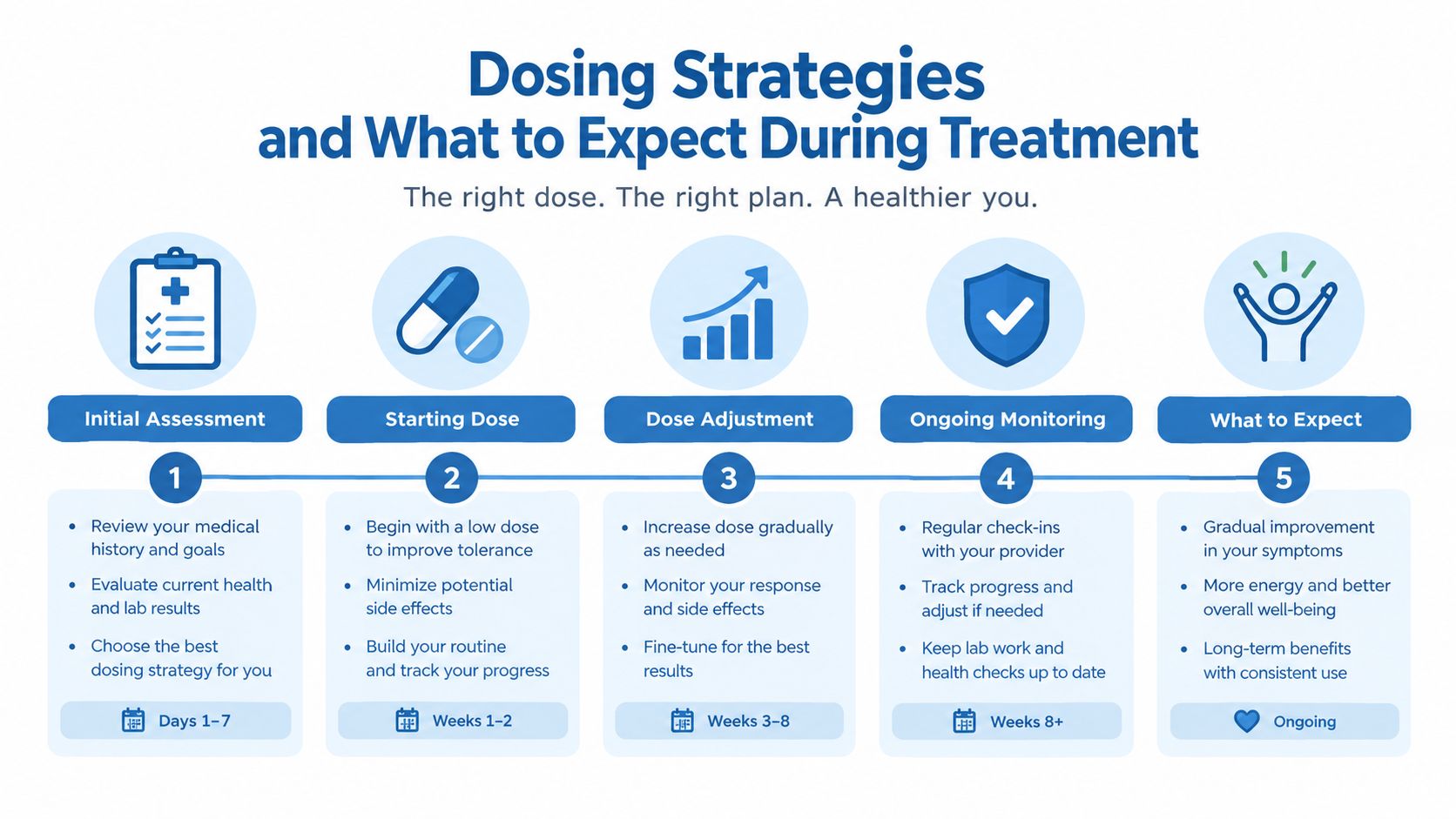
Dosing can determine whether a patient gets a fair trial of treatment. Buspirone and propranolol call for different routines, monitoring, and expectations. In telepsychiatry, the plan should make clear what the patient will take, when to take it, what to track, and when to contact the prescriber.
Buspirone requires consistency
The U.S. prescribing information lists 15 mg per day as a usual starting dose for buspirone. A clinician may divide that amount across doses and adjust it in 5 mg increments every 2 to 3 days, based on response and tolerability. The maximum daily dose is 60 mg. (Buspirone dosage and titration information)
Buspirone is intended for scheduled treatment, not occasional use when anxiety suddenly rises. Meaningful improvement typically requires 2 to 4 weeks of continuous dosing, so the first few days may not show the eventual result. Some patients notice side effects before they notice less worry. A telepsychiatry follow-up gives the prescriber an opportunity to distinguish early discomfort from a dose that needs adjustment.
Patients seeking more detail on starting doses can review this guide to buspirone dosing for anxiety.
A practical treatment plan should identify:
The target symptom. Specify whether the goal is less daily worry, reduced muscle tension, better functioning, or another measurable change.
The schedule. Take buspirone as prescribed instead of adding occasional doses during stressful moments.
The adjustment period. Track side effects, sleep, concentration, and anxiety while the medication is being evaluated.
The review point. Discuss the response with the prescriber before changing the dose or stopping treatment.
Missing doses, changing the schedule independently, or stopping after a few days can prevent a patient from learning whether buspirone helps. Persistence still requires judgment. Report new or severe reactions promptly rather than waiting for the next routine appointment.
Propranolol requires planning
Review-based clinical dosing guidance describes 10 mg as a test or starting dose for performance situations, with a usual as-needed range of 10 to 40 mg. The dose should be tested before the important event, with blood pressure and heart rate monitored. (Anxiety pharmacotherapy guidance)
A supervised test matters because reducing physical arousal can also cause lightheadedness, unusual fatigue, or discomfort during exercise. A patient should not take propranolol for the first time immediately before a speech, exam, interview, or performance without medical guidance.
This limited, event-based role explains the clinical shift away from treating propranolol as a general anxiety medication. It may help when predictable physical symptoms dominate a specific performance situation. It is a poor match for persistent worry, avoidance, or anticipatory fear that continues across the workday. If those symptoms remain, the treatment plan may need therapy, a scheduled medication such as buspirone, or evaluation for another condition.
A dosing plan should account for other prescriptions, baseline heart rate, blood pressure, asthma, exercise, and the exact event being treated. Do not borrow tablets or copy an online schedule. The same dose can feel different depending on a patient's physiology and medical history.
Safety Profiles and Hidden Trade-Offs
Patients often ask which medication is safer for long-term use. That question is understandable, but “safer” only has meaning in relation to a particular patient, diagnosis, dose, medical history, and treatment goal.
Buspirone has minimal abuse potential and no pronounced rebound on abrupt discontinuation. Those features can make it appealing when a patient wants to avoid benzodiazepine dependence or prominent withdrawal concerns. It still isn't automatically effective for everyone. The medication may be less effective after extensive prior benzodiazepine exposure, and interactions involving CYP3A4 can affect its use. (NHS anxiety management guidance)
Buspirone can also cause side effects or fail to provide enough relief. A non-sedating profile doesn't guarantee that a patient will feel comfortable taking it, and it doesn't make follow-up optional.
Propranolol has a different risk map
Propranolol's trade-offs are primarily cardiovascular, respiratory, and overdose-related. Clinicians should be cautious with patients who have asthma or bradycardia, and they need to consider blood pressure, exercise demands, and other medical conditions. The 2024 review literature also highlighted toxicity concerns in overdose, which becomes particularly relevant when a patient has depression or increased suicide risk.
That doesn't mean propranolol is unsafe. It means a medication that appears simple because it's taken only as needed still deserves a complete medical review. A patient may have an athletic baseline heart rate, use other medications that affect cardiovascular function, or have respiratory symptoms they haven't connected to the prescribing decision.
A medication can have a favorable profile for one person and a poor profile for another. Safety is individualized, not a label attached to the drug alone.
Tell your prescriber about asthma, fainting, slow heart rate, low blood pressure, depression, suicidal thoughts, pregnancy, alcohol or substance use, and every prescription or supplement you take. Don't stop or change either medication without professional guidance, especially if it's part of a broader treatment plan.
Accessing Psychiatric Care and Insurance Coverage in Florida
Choosing between propranolol and buspirone is only one part of effective care. The other part is having enough continuity to clarify the diagnosis, review medical risks, evaluate response, and adjust the plan when the first option isn't the right fit.
For Florida residents, HIPAA-compliant telepsychiatry can make that process more practical. A virtual appointment allows you to discuss symptoms from home, review medication bottles and pharmacy information, and schedule follow-up without traveling to an office. Telepsychiatry can also support coordinated medication management and therapy, including CBT and DBT, when both are appropriate for the patient.
What to bring to an evaluation
A clinician can make a more precise decision when you provide:
Your symptom pattern: Explain whether anxiety is constant, event-specific, physical, cognitive, or a combination.
Medication history: List what you've tried, the dose if known, how long you took it, and whether it caused side effects or did not help.
Medical information: Include asthma, bradycardia, blood pressure concerns, fainting, pregnancy, and other relevant diagnoses.
Current substances and medications: Mention stimulants, migraine treatments, sleep aids, alcohol, cannabis, supplements, and nonprescription products.
Your treatment priorities: Say whether you're trying to preserve alertness, reduce daily worry, manage a performance event, improve sleep, or avoid dependence.
Insurance questions should be addressed before the appointment whenever possible. This guide to insurance coverage for psychiatric care can help Florida patients understand what to ask about benefits, referrals, deductibles, copays, telehealth coverage, and in-network care.
Refresh Psychiatry & Therapy provides Florida telepsychiatry, psychiatric evaluations, medication management, and therapy for anxiety and related conditions. The practice accepts Aetna, United Healthcare/UHC, Cigna, Blue Cross Blue Shield, Humana, Tricare, UMR, and Oscar insurance plans. Availability, benefits, and coverage details can change, so verify your plan before scheduling.
The right next step may be a medication evaluation, therapy, a review of an existing prescription, or a coordinated plan that combines both. If anxiety is persistent, interferes with work or relationships, or includes thoughts of self-harm, seek qualified professional help promptly. If you're in immediate danger or may act on suicidal thoughts, call emergency services or go to the nearest emergency department.
Refresh Psychiatry & Therapy offers virtual psychiatric evaluations, medication management, and evidence-based therapy for Florida residents, including care focused on the different treatment needs behind propranolol and buspirone. Visit Refresh Psychiatry & Therapy to request an evaluation, or call Refresh Psychiatry at (954) 603-4081 to schedule your evaluation. We accept Aetna, United Healthcare/UHC, Cigna, Blue Cross Blue Shield, Humana, Tricare, UMR, and Oscar insurance plans. This blog is for informational purposes only and does not constitute medical advice. Please consult a qualified mental health professional for personalized guidance.