
🧠 Anxiety Paralysis: What It Is and How to Get Moving Again

A deadline sits one hour away. Your laptop is open, the document is blank, and your fingers hover above the keyboard. You know what needs to happen, yet your breath has become shallow, your chest feels tight, and every possible mistake is replaying in your mind. The harder you try to force yourself to begin, the more immovable you feel.
That experience has a name people commonly use: anxiety paralysis. It describes a fear-driven freeze state in which the nervous system overwhelms motivation, planning, speech, or movement. You aren't lazy, undisciplined, or necessarily burned out. Your brain and body may be responding to perceived threat as though action itself carries danger.
An episode may last minutes or hours and appear around a particular task, conversation, decision, or memory. More persistent paralysis can interfere with ordinary responsibilities for days or weeks. Either pattern deserves attention, especially when avoidance begins to affect work, relationships, sleep, eating, or safety.
Anxiety disorders affect a large global population. The World Health Organization's overview of anxiety disorders reports that 5.8% of the global population currently experiences an anxiety disorder, with an estimated 470 million people living with one in 2023. The symptom called anxiety paralysis isn't a standalone formal diagnosis, but its clinical importance becomes clearer within that broader burden.
What Anxiety Paralysis Actually Feels Like
I often hear a version of the same story in the office. A person opens an email, sees a difficult request, and immediately starts imagining every way the reply could go wrong. Their shoulders rise, their limbs feel heavy, and the simple act of typing a greeting seems impossible. They may stare at the screen, scroll without absorbing anything, or close the laptop while feeling ashamed that they couldn't complete such a small task.
That is different from not caring. In anxiety paralysis, the person usually cares. The assignment, phone call, appointment, or decision has become so emotionally loaded that the nervous system treats starting as a threat. The mind may race while the body seems frozen, creating the painful impression that you want to act but have lost access to action.

The experience is more than procrastination
People describe:
A mental lockup, where choices blur and even familiar tasks feel confusing.
A physical heaviness, including tense muscles, weak-feeling limbs, shallow breathing, or slowed speech.
A fear loop, in which the person predicts criticism, failure, rejection, illness, or irreversible consequences.
Shame after the episode, which adds self-criticism to the original anxiety and makes the next attempt harder.
Chest tightness can be frightening, particularly when someone isn't sure whether anxiety or a medical problem is responsible. A resource such as anxiety chest pain explained can help clarify common anxiety-related sensations, but new, severe, or unusual chest symptoms still warrant medical assessment.
Acute anxiety paralysis tends to have a recognizable trigger and can ease when the threat passes or the person receives support. Chronic paralysis is less tidy. It may show up as repeatedly postponing messages, remaining in bed, avoiding decisions, neglecting meals, or feeling mentally checked out from daily life. If that description fits, this discussion of feeling mentally checked out may help you recognize how disengagement and anxiety can overlap.
Clinical perspective: A freeze response is a nervous-system state, not a verdict on your character.
The first practical move is to stop arguing with the symptom. Telling yourself to “just do it” often adds pressure without restoring the brain functions required to begin. Recognition creates a small amount of distance, and that distance makes the next physical or behavioral step more possible.
The Brain and Body Behind the Freeze
The freeze response begins with threat detection. The amygdala can identify danger cues faster than the prefrontal cortex can evaluate whether the danger is real, current, or manageable. When the alarm rises, the hypothalamus activates the autonomic stress system, involving hormones such as adrenaline and cortisol.
A useful analogy is a car with the engine running and the brake pedal stuck. The road may be clear, the destination may matter, and the driver may want to move, but pressing the accelerator harder won't help while the brake remains engaged. In anxiety paralysis, the body's protective braking system can dominate the planning system.
The prefrontal cortex normally supports inhibition, working memory, flexible thinking, and decision-making. A large review of 82 meta-analyses found associations between anxiety constructs and cognitive domains including attention, executive function, memory, processing speed, and visuospatial ability, as described in this review of anxiety and cognitive performance. Under intense stress, threat processing consumes cognitive bandwidth, leaving less capacity for organizing a task or selecting a response.
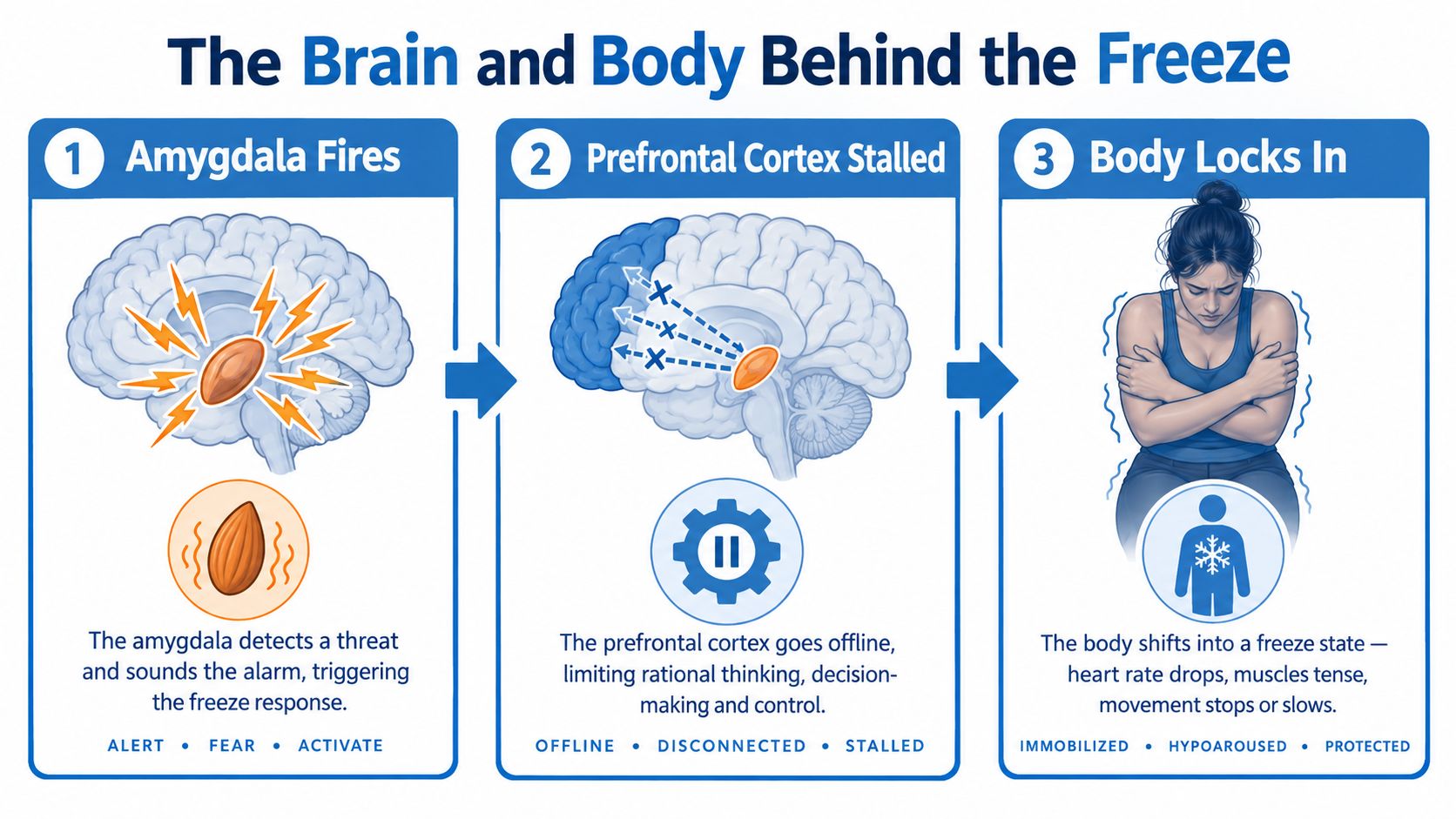
Why awareness can remain while action disappears
A person may remain conscious and know exactly what they want to say while being unable to speak. Threat-induced immobility can include motor and vocal inhibition, abrupt onset, and abrupt release. In a laboratory carbon dioxide challenge involving 404 people, 13% reported immobility and 20% reported a strong urge to flee, with freeze reports associated with greater subjective anxiety and panic, according to this study of defensive freezing and anxiety.
The insula contributes to awareness of internal sensations. When the brain monitors heartbeat, breathing, stomach sensations, and muscle tension as possible danger signals, ordinary bodily changes can feel urgent. That heightened body awareness can reinforce the alarm, especially when a person interprets heaviness or chest pressure as proof that something is terribly wrong.
Past trauma can teach the nervous system to respond rapidly to cues that resemble earlier danger. Perfectionism can make any imperfect outcome feel unsafe. Decision overload can create so many possible consequences that the person stops selecting among them. Chronic anxiety keeps the alarm system sensitized, while repeated avoidance teaches the brain that freezing was necessary.
Treatment works best when it addresses more than thoughts. Breathing and movement can lower arousal, behavioral work can restore initiation, and therapy can examine trauma, perfectionism, or beliefs that keep the brake engaged. A practical explanation of how prolonged stress affects the body is also available in this overview of Hans Selye's general adaptation syndrome.
Common Triggers and Symptoms to Recognize
Anxiety paralysis often follows a threat to safety, competence, belonging, or control. The trigger might be obvious, such as a confrontation, exam, financial decision, or medical appointment. Sometimes the trigger is subtle, such as opening an unanswered inbox after a difficult week.
Common triggers
High-stakes decisions: Choosing a treatment, changing jobs, ending a relationship, or making a financial commitment can create an intolerable fear of choosing incorrectly.
Perfectionistic standards: If “good enough” feels like failure, starting becomes a test of identity rather than a routine action.
Unresolved trauma: A tone of voice, setting, deadline, or bodily sensation may resemble an earlier threatening experience.
Work or caregiving strain: Sustained demands can leave the nervous system with little reserve for additional stress.
Major transitions: Pregnancy, childbirth, relocation, bereavement, school changes, and relationship shifts can destabilize familiar coping patterns.
Overlapping conditions: Anxiety may coexist with depression, trauma-related symptoms, obsessive-compulsive symptoms, attention difficulties, or sleep problems.
Three symptom groups
Cognitive symptoms include racing thoughts, mental blankness, indecision, intrusive “what if” scenarios, and catastrophic predictions. A person may understand the logical response but be unable to hold that reasoning in mind long enough to act.
Emotional symptoms include dread, shame, numbness, irritability, dissociation, and a sense of unreality. Dissociation can make the person feel distant from their body or surroundings, while shame often appears after the freeze and increases future avoidance.
Physical symptoms may include chest tightness, shallow breathing, muscle heaviness, stomach upset, cold hands, trembling, fatigue, or slowed speech. Anxiety can produce these sensations, but it can't safely explain every sudden physical symptom.
Symptom | Anxiety Paralysis | Call 911 / Seek Urgent Care |
|---|---|---|
Movement or speech | Often temporary, stress-linked, and accompanied by awareness | Sudden one-sided weakness, facial drooping, new severe confusion, or inability to speak normally |
Chest discomfort | May occur with fear, rapid breathing, or a familiar panic pattern | New, severe, persistent, or exertional chest pressure, especially with fainting, sweating, or trouble breathing |
Breathing | Shallow or rapid breathing during an anxiety surge | Severe breathing difficulty, blue lips, collapse, or symptoms that don't ease |
Mental state | Fear, racing thoughts, numbness, or dissociation with awareness | Loss of consciousness, seizure-like activity, hallucinations, or severe confusion |
Course | Improves as the trigger and arousal decrease | Sudden, worsening, unfamiliar, or physically dangerous symptoms |
Call 911 for suspected stroke, heart attack, severe breathing difficulty, loss of consciousness, or sudden neurological changes. Don't try to label a potentially dangerous event as anxiety just because you've experienced panic before. For a structured review of common symptoms before a clinical appointment, use this anxiety symptom checklist.
The pattern also offers clues. Freezing only before presentations may point toward performance anxiety or perfectionism. Freezing around intimacy, conflict, or specific reminders may suggest trauma-related work. Episodes that spread across many domains, persist, or accompany low mood and sleep disruption deserve a broader psychiatric evaluation.
Grounding Techniques to Break the Freeze in the Moment
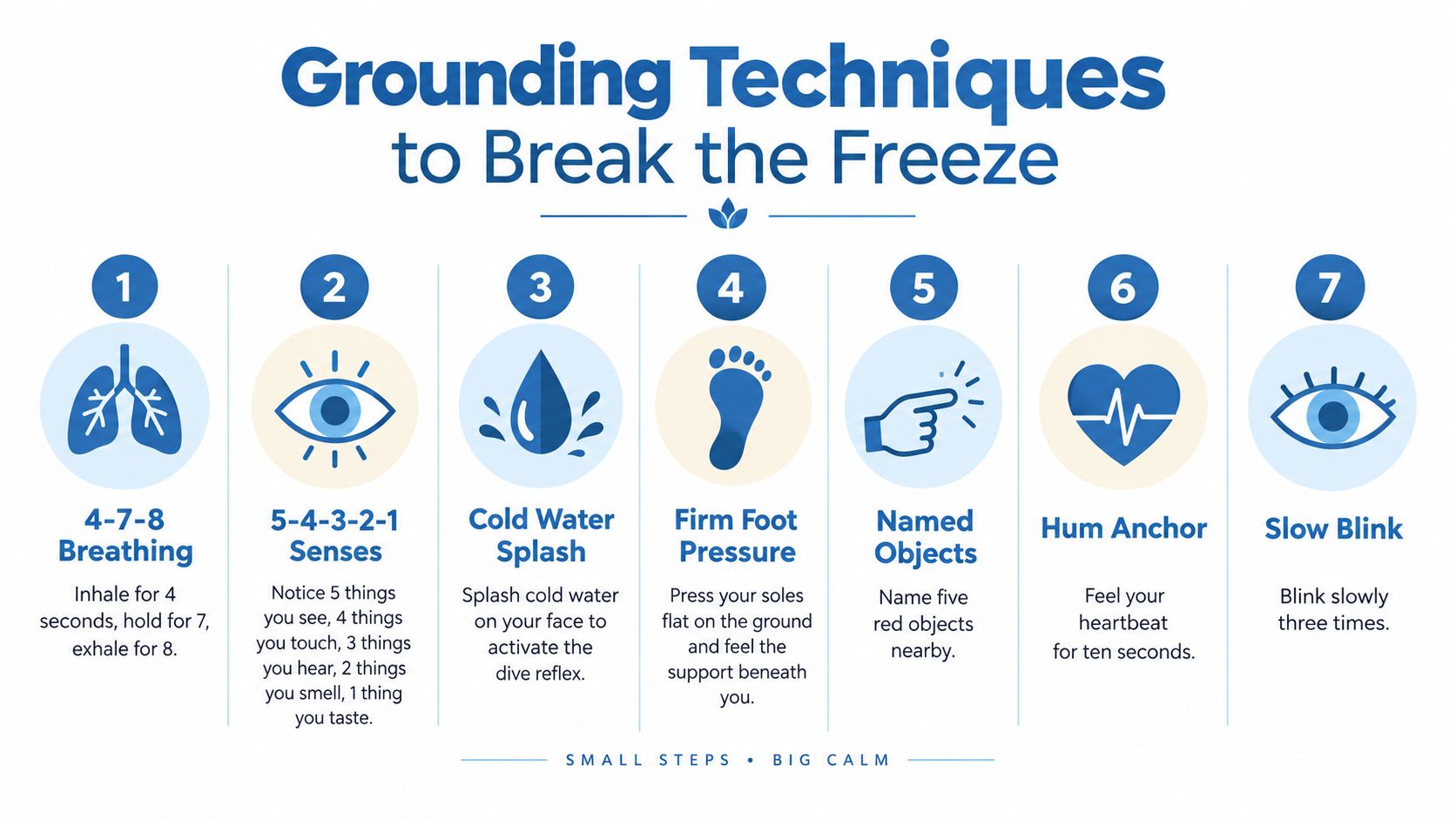
Grounding isn't a collection of pleasant distractions. Used correctly, it gives the brain a clear sensory or motor signal that competes with the threat loop. Choose one technique, apply it briefly, and assess whether you can take one small action. Trying every strategy at once can become another form of decision overload.
Start with the body
Use paced breathing. If the pattern feels comfortable, inhale for 4 seconds, hold for 7, and exhale for 8. Repeat for several cycles. The longer exhale gives your attention a rhythm and may reduce escalating arousal. Stop if breath-holding makes you dizzy or more frightened.
Press your feet into the floor. Keep both soles flat, press through the heels for about 10 seconds, release, and repeat several times. Firm pressure provides proprioceptive feedback and turns “I can't move” into one deliberate movement.
Add micro-movement. Stand if you can, push gently through your heels, roll your shoulders, or walk to the nearest doorway and back. The aim isn't exercise. It's to show the motor system that movement remains available.
Try a cool sensory cue. Splash cool water on your face or hold a cool object briefly. Use a mild sensation, not an extreme one, and avoid this method if cold exposure is medically unsafe for you. The sharp sensory change interrupts inward attention and can help you reorient.
A bilateral rhythm can also help. Alternate tapping on the thighs or pressing the left and right knees in turn for about a minute. Keep the pace slow and comfortable, especially if trauma symptoms or dissociation become stronger with repetitive stimulation.
Give the mind one safe instruction
Use the 5-4-3-2-1 scan. Name five things you see, four things you can touch, three sounds, two smells, and one taste. You aren't trying to prove that the feared outcome is impossible. You're moving attention from imagined consequences to current sensory information.
Then choose one present-tense statement, such as, “I am in my room, and my next action is to open the document.” Repeat it once or twice, then complete the smallest visible step. A short guide to grounding for panic attacks offers additional ways to practice this skill.
For a demonstration, this video may help you rehearse a grounding sequence before you need it:
Grounding buys time and restores agency. It doesn't treat trauma, recurrent panic, depression, or a persistent anxiety disorder by itself. If the freeze keeps returning, use the episode as information and bring the pattern to a clinician. You can also review these grounding techniques when you're calm, because skills become easier to use when they've been practiced in advance.
Evidence-Based Treatments That Address the Root Cause
The right treatment depends on what the freeze is protecting you from. A person immobilized by catastrophic predictions needs a different emphasis from someone whose body shuts down around trauma reminders. Medication, psychotherapy, and behavioral practice can work together, but they shouldn't be assembled mechanically.
Cognitive behavioral therapy examines the thoughts and predictions that make starting feel dangerous. The therapist may identify an all-or-nothing belief, test it against evidence, and design a graded behavioral experiment. Behavioral activation then turns insight into action, often by scheduling a small, observable behavior before motivation returns.
Dialectical behavior therapy can be useful when shutdown includes intense emotion, dissociation, impulsive coping, or difficulty returning to baseline. Distress-tolerance and emotion-regulation skills give the patient a way to survive the surge without escaping every trigger. The therapist may also practice mindfulness of body signals while keeping the person oriented to the present.
Medication management can lower the background level of anxiety enough for therapy and exposure work to become possible. Clinicians may consider SSRIs or SNRIs for ongoing anxiety, while short-term adjuncts require careful assessment of risks, benefits, interactions, and the patient's history. Medication isn't a substitute for learning how to approach avoided situations, and no medication should be started, stopped, or changed without a prescriber.
For a plain-language overview of commonly prescribed options, see common anxiety medications.
Matching treatment to the pattern
Paralysis Pattern | First-Line Therapy | Medication Role | Trauma-Focused Add-On |
|---|---|---|---|
Catastrophic worry and perfectionism | CBT with graded behavioral activation | Consider ongoing anxiety treatment when symptoms are persistent or disabling | Usually not needed unless trauma symptoms are also present |
Shutdown with emotional volatility or dissociation | DBT-informed therapy and stabilization skills | May reduce baseline arousal and support participation | Add trauma work after sufficient stabilization |
Fear linked to a specific situation | CBT with gradual exposure | Can support participation when anxiety blocks exposure | Consider only if the trigger is trauma-related |
Freeze around identifiable traumatic memories | Trauma-informed therapy and safety-building | May reduce anxiety, sleep disruption, or mood symptoms | EMDR, Prolonged Exposure, or carefully paced somatic work |
Widespread anxiety with depression or sleep disruption | Integrated psychotherapy and psychiatric evaluation | Treatment may address multiple symptom clusters | Select based on history and readiness |
EMDR and Prolonged Exposure approach trauma memories differently, while somatic work pays close attention to body-based defensive responses. The trade-off is that trauma processing can be powerful but poorly timed if the patient lacks stabilization, safety, or sufficient support. A careful clinician adjusts pace rather than pushing through a freeze response to prove progress.
How Refresh Psychiatry and Therapy Can Help
Consider a graduate student who freezes every time a deadline approaches. The first appointment might clarify whether the pattern reflects performance anxiety, perfectionism, depression, attention difficulties, sleep disruption, or several factors together. A therapist could use CBT to break assignments into graded starts, while a psychiatrist evaluates whether medication is appropriate for the broader anxiety pattern.
A new mother may experience shutdown after a difficult birth. Her care plan would need to consider trauma symptoms, sleep, mood, intrusive fears, physical recovery, and the demands of caring for an infant. Therapy might begin with stabilization, grounding, and compassionate behavioral structure before moving toward trauma-focused work.
A professional whose freeze appears during conflict may discover that present-day conversations activate an older trauma pattern. In that case, medication management can address the baseline anxiety while a therapist uses EMDR, somatic work, or another trauma-informed approach when the patient is ready. The psychiatrist and therapist should share the relevant clinical picture rather than treating each symptom in isolation.
Refresh Psychiatry & Therapy provides coordinated psychiatric and therapy services, including medication management, CBT, DBT-informed skills, EMDR, and somatic approaches. The practice offers telepsychiatry across Florida for children and adolescents age 6 and up, adults, and older adults, with care delivered through a telemedicine model.
An intake generally involves reviewing symptoms, history, current medications, medical factors, safety, functioning, and treatment goals. The clinician then discusses diagnostic possibilities and options rather than assigning a generic plan. Patients can ask about telehealth logistics, self-pay rates, and coverage before scheduling.
The practice lists Aetna, United Healthcare and UHC, Cigna, Blue Cross Blue Shield, Humana, Tricare, UMR, and Oscar among accepted insurance plans. Coverage depends on the specific policy, so verify benefits directly with the practice and your insurer before the visit.
When to Seek Help and How to Take the Next Step
Use three levels of response.
Seek same-day or emergency help for suicidal thoughts, escalating self-harm, psychotic symptoms, severe confusion, inability to eat or drink, severe weight loss, or any immediate threat to your safety. Call 911 or go to an emergency department for a medical emergency. If you're in emotional crisis, contact a local crisis service or emergency resource rather than waiting for a routine appointment.
Schedule a psychiatric evaluation within the next couple of weeks when freeze episodes keep recurring, last longer than 20 minutes, erode work or relationships, or lead you to rely increasingly on alcohol, cannabis, sedatives, or other substances to get moving. You don't need to wait until you lose a job, fail a class, or reach a crisis point. Maintenance visits can help people who are already improving protect gains and adjust treatment as circumstances change.
Make the appointment easier to complete
Call the practice or submit its online form. Ask the scheduling team to verify your Florida or out-of-state commercial plan, confirm self-pay rates if relevant, and identify whether the available appointment is telehealth. Because the practice is telemedicine only, you can ask about a HIPAA-compliant virtual visit and the technology required.
Prepare a one-page timeline before the assessment. Include when the freezing began, common triggers, how long episodes last, sleep and substance use, medications, trauma history if relevant, missed responsibilities, and what has helped or worsened the pattern. This gives the clinician a starting map even if anxiety makes it difficult to explain everything in the moment.
The initial assessment is expected to address diagnosis, safety, medication options, and appropriate therapy modalities. Patients can ask how the psychiatrist and therapist will coordinate, what improvement will look like, how quickly follow-up occurs, and what to do outside business hours. If symptoms become dangerous while you're waiting, use emergency services rather than the scheduling process.
Anxiety paralysis can feel like proof that you can't change. Clinically, it is better understood as a state that can be mapped, treated, and practiced through. The first step may be small, but it should be specific, such as pressing your feet into the floor, opening the message, or making the call.
Refresh Psychiatry & Therapy offers coordinated psychiatric evaluation, medication management, and evidence-based therapy for anxiety paralysis and related mood or trauma symptoms through Florida telepsychiatry. Visit Refresh Psychiatry & Therapy to review care options and begin scheduling. Contact us or call Refresh Psychiatry at (954) 603-4081 to schedule your evaluation. We accept Aetna, United Healthcare/ UHC, Cigna, Blue Cross Blue Shield, Humana, Tricare, UMR, and Oscar insurance plans. This blog is for informational purposes only and does not constitute medical advice. Please consult a qualified mental health professional for personalized guidance.