
🧠 Emotional Permanence: What It Is and How to Build It

Emotional permanence is the internal sense that care, affection and relational safety continue during separation, silence or conflict, and it is not a formal psychiatric diagnosis.
Why can you know that someone loves you yet feel abandoned when they don't reply? That gap doesn't necessarily mean you've forgotten the relationship or discovered something wrong with it. You may be struggling to retrieve comforting memories, tolerate uncertainty or settle an alarmed body. Sometimes, though, the other person's behavior really is inconsistent. Understanding the difference matters more than assigning yourself a label.
What Emotional Permanence Means in Everyday Life
Emotional permanence means holding onto a sense of connection when care isn't immediately visible. Say your partner leaves for work after a warm conversation. Later, an unanswered message feels less like a busy afternoon and more like evidence that their feelings have changed.
Think of a lamp in another room. You can't see its light from where you're standing, but you don't automatically assume it's switched off. Relationships are more complicated than lamps, of course. The analogy divides what you can perceive right now from what you have reason to believe continues.
The connection can remain meaningful even when people aren't physically together.

From hidden toys to an inner sense of connection
Object permanence describes understanding that a hidden object still exists. Object constancy concerns maintaining a stable inner representation of another person, including during absence or disappointment. Emotional permanence is a popular umbrella term overlapping with object constancy, attachment security and emotional regulation, rather than a standalone diagnosis, as the Simply Psychology explanation describes.
These ideas are related, but they aren't interchangeable. An adult who feels disconnected doesn't necessarily lack the developmental understanding that people exist outside their sight. Our explanation of object permanence and ADHD explores that commonly confused distinction.
Knowing, feeling and having evidence
Separate the experience into these questions:
Knowledge: Do I believe this person cares about me?
Felt connection: Can I access a sense of being cared for while I'm upset?
Relationship evidence: Does this person repeatedly behave in caring, dependable ways?
You might answer yes to the first and last questions while struggling with the middle one. Alternatively, you might feel attached to someone whose behavior offers little actual security.
Practical distinction: Feeling unloved deserves attention, but it isn't automatically proof that you're unloved.
Attachment categories can help describe patterns, but they aren't diagnostic labels or personality verdicts. This week, notice a moment when distance felt like rejection. Write down a specific caring action you could have recalled, while staying honest about whether that action fits the person's broader behavior.
How Emotional Permanence Develops From Infancy to Adulthood
Emotional permanence develops gradually through experiences of care, and people's responses to separation keep changing through adolescence and adulthood. It isn't a skill that switches on at a single birthday.
The age bands below are broad discussion prompts, not validated emotional-permanence milestones or screening cutoffs. A child's behavior needs interpretation in the context of development, communication abilities, temperament, health and recent changes.
Emotional permanence milestones by age
Age or stage | Key milestone | On track looks like | Support needed when |
|---|---|---|---|
0–8 months | Distress ends with comfort | Calms when held and reconnects after upset | Little response to soothing over several weeks |
Around 8–12 months | Understanding that hidden objects remain | Searches for a hidden toy as this ability emerges | Caregivers notice broader developmental concerns |
18–36 months | Object constancy begins developing | Increasingly tolerates brief separations with a familiar caregiver | Intense distress at every separation past 3 years warrants discussion, not an automatic diagnosis |
3–6 years | Brief self-reassurance | Uses words or a comfort object to settle | Cannot settle even after a caregiver returns |
Adolescence, broadly 10–18 years | Greater independence alongside continuing need for connection | Uses growing peer support and reconnects after conflict | Distress disrupts school, friendships or family life |
Adulthood | Relatively stable internal working model | Uses reassurance briefly and recovers from doubt | Doubt lasts for weeks and disrupts work or relationships |
A toddler may need a familiar caregiver and a comfort object. An adolescent may reject a parent's hug yet still need a dependable conversation after an argument. Neither response can be judged accurately without considering the situation.
A review of parent-child attachment and emotion regulation found secure attachment more consistently associated with emotional recovery than lower emotional reactivity alone. That distinction changes what caregivers should watch: not just how strongly a child reacts, but how they recover with support.
A child who cries intensely and then reconnects isn't necessarily less secure than a child who stays silent.
Look for a developmental pattern, not a deadline
Repeated experiences of comfort and repair matter more than performing perfectly during every goodbye. Illness, family disruption, unfamiliar settings and stressful transitions can temporarily increase support needs without proving that development has failed.
Don't use this table to decide that a child is several months behind. Instead, record concrete examples, ask teachers or other caregivers what they notice, and discuss concerns with the child's pediatrician or qualified mental health professional. They can assess broader development rather than treating emotional permanence as a standardized test.
Adults can also revise longstanding relationship expectations. Learning about an anxious attachment style may provide useful language, but a description should help you understand a pattern, not become a permanent identity.
Signs Emotional Permanence Is Underdeveloped
Feeling that someone has stopped caring may reflect an emotion-regulation pattern rather than a relationship change. The feeling is real; the conclusion still needs checking.
An analysis published through APA PsycNet, combining eight experience-sampling datasets collected between 2009 and 2021, with 948 participants and 73,472 momentary assessments, found significant carryover in positive and negative affect. This is emotional inertia, the persistence of feelings over time, not a measure of emotional permanence.
Current hurt can also distort expectations about tomorrow. A 2025 experiment involving 173 participants examined emotion regulation and forecasting errors related to overlooking future coping and adaptation. It doesn't establish a treatment for emotional permanence, but it helps explain why predicting that distress will never ease can be misleading.
A three-layer reality check
Use these questions as a decision aid, not a diagnostic test:
Emotion memory: Can I recall specific caring interactions, or does distress make them feel inaccessible?
Relationship security: Does this person generally keep agreements, respond respectfully and repair mistakes?
Moment-to-moment regulation: Does reassurance help briefly before bodily alarm and doubt return?
When reassurance repeatedly fades despite dependable care, regulation or memory retrieval may need attention. When the pattern occurs across otherwise supportive relationships, an internal vulnerability becomes more plausible. When someone repeatedly breaks promises, withdraws affection to punish you or dismisses reasonable needs, the relationship itself deserves scrutiny.
These possibilities can coexist. Being anxious doesn't make another person's harmful behavior acceptable.
What the pattern can look like
In children:
Repeated checking: Asking whether a caregiver will return after ordinary separations.
Prolonged upset: Remaining distressed well beyond the immediate trigger.
Inaccessible comfort: Struggling to remember a parent's support while overwhelmed.
Repeated promises: Needing renewed assurances before school or bedtime.
In adults:
Short-lived relief: Reassurance fades within minutes.
Threat interpretations: Silence or a brief reply feels like abandonment.
Rapid reversals: Closeness shifts into withdrawal after an ambiguous interaction.
Protective distancing: Pulling away first to avoid anticipated rejection.
A highly reactive child isn't necessarily insecure, and a quiet adult isn't necessarily well regulated. Neither list establishes a diagnosis.
Try a two-week observation log as a practical exercise. Record the trigger, body sensations, distress duration, reassurance requests, how long reassurance helped and the other person's observable behavior. Write what happened, not just what you feared it meant.
How Anxiety, Trauma and Mood Disorders Affect It
Condition | How low emotional permanence may show up | What a clinician screens for |
|---|---|---|
Generalized anxiety | Constant reassurance-seeking and catastrophic reading of silence | Duration of worry, avoidance and sleep disruption |
Panic disorder | Separation becomes linked with fear of physical danger or being without help | Panic episodes and avoidance of places or situations |
PTSD | Attachment figures may feel unsafe; hypervigilance or numbing interferes with connection | Intrusive memories, nightmares and trauma-related avoidance |
Depression | Warmth feels unreachable even when loved ones are present | Low mood, loss of interest, sleep and appetite changes |
Bipolar disorder | Perception of closeness shifts alongside mood episodes | Periods of elevated mood or depression and their timing |
ADHD | Emotional shifts feel fast and intense, making reflection difficult | Emotional reactivity alongside attention and impulse symptoms |
These are possible presentations, not defining symptoms or diagnostic shortcuts. Difficulty maintaining a felt connection doesn't establish any condition in the table. Someone can also struggle during a stressful relationship transition without having a psychiatric disorder.
The same outward behavior can serve different purposes. A person with panic symptoms might call repeatedly because they're afraid of being alone during a physical crisis. Someone experiencing depression might seek reassurance because affection no longer feels emotionally reachable. Another person may be responding to an actual pattern of disappearance or broken agreements.
Match the response to the underlying problem
An attachment and self-regulation review describes links between attachment anxiety, impaired self-regulation and greater reliance on others for emotional regulation. That framework helps explain vulnerability, but it doesn't justify assuming that all reassurance-seeking comes from attachment anxiety.
Add two observations to your log: whether the pattern began after a particular event, and whether sleep, energy or mood changed alongside it. Bring information about medications, substance use and major life changes to an assessment too.
For trauma-related questions, DeTalks' explanation of how healing from childhood trauma begins offers context for considering past experiences without reducing every current difficulty to childhood. Our comparison of complex PTSD and PTSD can also help clarify terminology before an evaluation.
Choose care, not endless reassurance
Individual therapy may fit persistent fear or difficulty regulating distress. Couples-focused work may help when communication and repair are central, provided the relationship is safe. A medication evaluation may be appropriate when an underlying condition is disrupting mood, attention, sleep or arousal.
Threats, coercion and abuse require a different response: prioritize confidential support and safety planning rather than trying to become more tolerant. Only a qualified licensed clinician can diagnose the underlying condition and recommend personalized treatment.
Therapies That Build Emotional Permanence
Therapy choice depends on the diagnosis and the main difficulty, not on the label emotional permanence alone. Combined care can address both distressing interpretations and symptoms that make those interpretations harder to reconsider.
Different approaches address different parts of this experience.
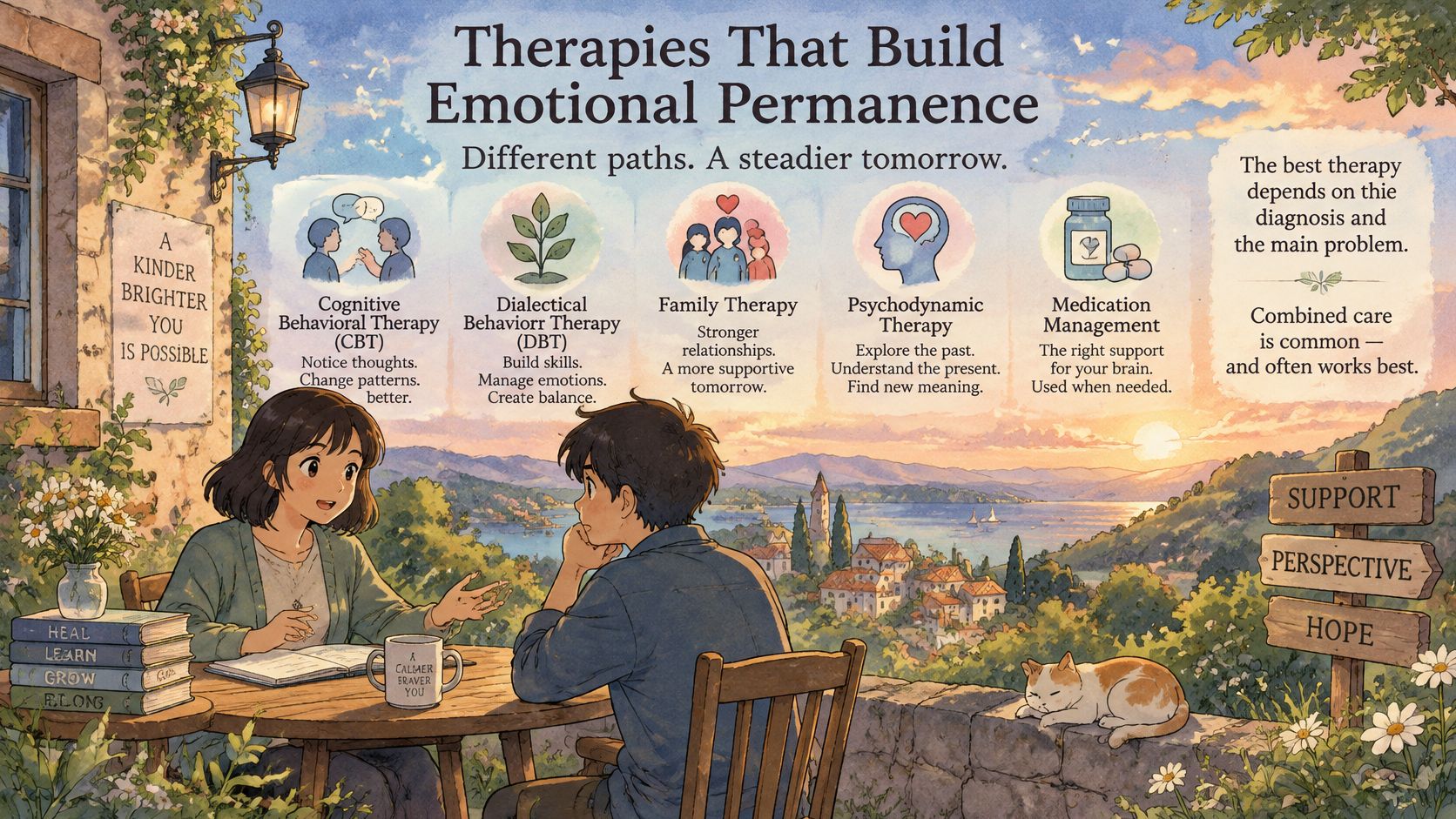
Evidence-based approaches and their best fit
Approach | What it targets | Best fit |
|---|---|---|
Cognitive behavioral therapy (CBT) | Catastrophic interpretations of silence and reassurance-checking cycles | Anxiety, depression and rejection sensitivity |
Dialectical behavior therapy (DBT) | Intense emotional shifts, distress tolerance and interpersonal skills | Severe emotional dysregulation and intense abandonment fears |
Trauma-focused therapy | Trauma memories that make closeness feel unsafe | PTSD in children, adolescents and adults |
Family interventions | Caregiver responses, consistency and repair after conflict | Children and teens with attachment or behavior difficulties |
Medication management | Mood, attention and arousal symptoms that interfere with reassurance | Mood disorders, ADHD and selected PTSD symptoms when a clinician prescribes |
These approaches treat established problems; the table doesn't imply that each has been tested specifically for an emotional-permanence diagnosis.
CBT might examine the jump from an unanswered message to certainty of rejection, then reduce checking behaviors. DBT adds ways to survive emotional intensity without impulsively escalating conflict. Practicing DBT skills for emotional regulation can help make those alternatives concrete.
Trauma-focused options include trauma-focused CBT for children and cognitive processing therapy or prolonged exposure for adults when clinically appropriate. Family approaches, including parent-child interaction therapy for suitable younger children, focus on observable interactions rather than expecting a child to reason their way out of distress. Medication doesn't create relationship security; it addresses a diagnosed condition that may interfere with functioning.
Why calming and remembering both matter
An adult attachment and emotion-regulation review explains how attachment-related threat appraisals shape support-seeking and emotional responses. A 2024 attachment study found expressive suppression less effective than cognitive reappraisal, while anxious attachment was associated with difficulty reducing physiological arousal using instructed strategies.
The practical implication isn't to force yourself to feel secure. First reduce the intensity enough to consider another explanation; then examine the evidence.
This video offers an additional format for reflecting on the topic.
Rehearse access to supportive memories
Write down three specific supportive interactions from the past month. Include what happened and what the person did, rather than broad statements that everything is fine. Practice recalling them while calm, before trying the exercise with an ambiguous message.
Affective working-memory research distinguishes actively maintaining emotional information from experiencing emotion. This supports considering memory access separately from relationship knowledge, although it doesn't validate this exercise as a standalone treatment.
Over several weeks, look for shorter distress episodes, less urgent checking and more deliberate conversations. Those are useful progress markers, not a promised treatment timeline.
How Parents and Caregivers Can Support It at Home
Emotional permanence grows through predictable care and repair, not constant reassurance. Children need adults who acknowledge distress while helping them practice manageable steps toward recovery.
Use the visual guide as a reminder, then adapt the practices to your child's developmental and communication needs.
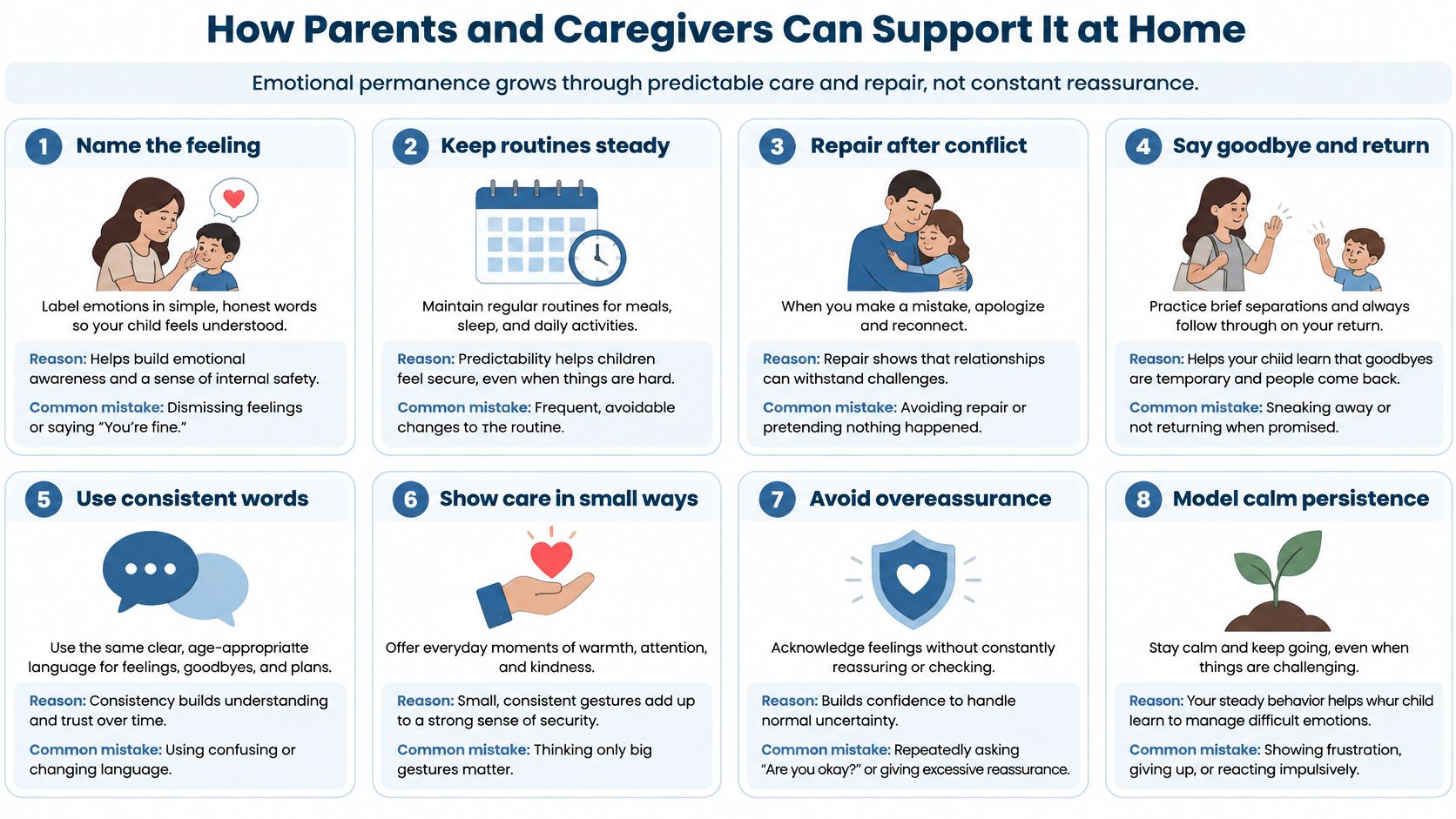
Everyday practices that make care predictable
Name the feeling and the fact separately. Help your child distinguish feeling forgotten from noticing that someone hasn't replied yet; this separates emotion from evidence. The common mistake is either treating the feeling as proof or arguing that the child shouldn't feel it.
Create a dependable reconnection ritual. Use a familiar goodbye and explain when you'll return in terms your child understands. Predictability makes separation easier to anticipate; avoid promising a precise return you can't keep.
Validate, then set a gentle reassurance limit. Acknowledge the fear, answer clearly and help the child use a practiced settling strategy. Answering every repeated question can leave little opportunity to practice tolerating uncertainty, but abruptly withholding comfort isn't the solution.
Repair after conflict promptly. When everyone is calm, ideally within a day when feasible, name what happened, take responsibility and explain what will change. Repair demonstrates continued connection; the mistake is waiting until everyone has stopped mentioning the argument.
Build an evidence memory. Keep notes, photos or drawings of supportive moments that the child can revisit during ordinary calm time. These are reminders of care, not rewards to earn or evidence used to shut down distress.
Practice regulation outside meltdowns. Rehearse comfortable slow breathing, emotion naming or a short movement break when your child is receptive. Teaching a new skill only during peak distress makes it harder to use.
Protect sleep and reduce overload. Notice whether difficult days follow disrupted rest, packed schedules or demanding transitions. The common mistake is judging behavior without checking the child's current capacity.
Act on persistent impairment or safety concerns. Seek professional input for prolonged distress, school refusal or self-harm talk rather than waiting indefinitely. Self-harm statements require prompt assessment, even when a child later appears calm.
Support without demanding perfect attunement
Caregivers won't interpret every signal correctly. Understanding the attunement gap can help parents notice mismatches and reconnect without expecting constant emotional availability.
Aim for a child who can receive help and recover, not a child who never protests separation.
Our child mental health care uses personalized treatment plans, with parents and caregivers involved at every step of treatment. That collaboration helps align home practices with the child's actual needs rather than applying reassurance limits mechanically.
When to Seek Help and Schedule an Evaluation
Seek an evaluation when these difficulties persist for weeks or months, cause repeated conflict or avoidance, or interfere with school, work and relationships. Panic, trauma symptoms, depression, major mood changes, substance use or self-harm thoughts make assessment especially important.
You don't need to prove that you lack emotional permanence before asking for help. Bring your observation log, examples of relationship interactions and information about sleep, mood and recent events. A clinician can use that context to distinguish an internal regulation difficulty, a psychiatric condition and an interpersonal problem.
What evaluation and follow-up involve
Our telemedicine-only practice provides HIPAA-compliant telepsychiatry throughout Florida, accessible on any device. Psychiatric evaluation supports diagnosis and treatment planning, rather than treating a popular psychological term as a diagnosis.
Care can include medication management and individual therapy using CBT, DBT, psychodynamic and trauma-focused approaches. Therapy services address grief, depression, mindfulness, anxiety, mood disorders, behavioral and emotional disorders, PTSD and borderline personality disorder. We closely monitor clients' progress and adjust medications as necessary.
If there's immediate danger or you believe you may act on self-harm thoughts, seek emergency help rather than waiting for a routine appointment.
Contact us or call Refresh Psychiatry at (954) 603-4081 to schedule your evaluation.
We accept Aetna, United Healthcare/UHC, Cigna, Blue Cross Blue Shield, Humana, Tricare, UMR and Oscar insurance plans.
This blog is for informational purposes only and does not constitute medical advice. Please consult a qualified mental health professional for personalized guidance.
Refresh Psychiatry & Therapy offers personalized psychiatric evaluation, medication management and therapy to help identify what's making connection feel uncertain. Visit Refresh Psychiatry & Therapy to schedule an evaluation and develop a plan for managing distress, communicating needs and building more dependable emotional connections.