
🧠 Types of Depression: Symptoms and Treatment Options

40% of U.S. high-school students reported persistent sadness or hopelessness that interrupted their usual activities in 2023, according to the Centers for Disease Control and Prevention. That measure describes depressive symptoms, not a confirmed diagnosis, but it challenges the idea that depression is an occasional low mood.
Understanding the types of depression starts with a different question than “How sad do you feel?” A psychiatrist also asks when symptoms began, how long they've lasted, whether they return in a pattern, and whether there have been periods of unusually high energy. Those details help determine which treatment is appropriate and what needs closer monitoring.
Depression Types at a Glance
Type | Core Pattern | Minimum Duration | Distinguishing Feature |
|---|---|---|---|
Major depressive disorder | Depressed mood or loss of interest plus other symptoms | At least 2 weeks | One or more episodes without a history of mania or hypomania |
Persistent depressive disorder | Low mood most days over a long period | At least 2 years in adults, 1 year in children and teens | A chronic course that may be less intense but remains disruptive |
Bipolar depression | Depressive episodes within an illness involving mania or hypomania | Assessed using the depressive episode and lifetime mood pattern | A history of elevated or unusually high-energy mood episodes |
Seasonal affective disorder | Depression returning in a seasonal pattern | At least 2 weeks per depressive episode | Commonly linked to shorter daylight in fall and winter |
Peripartum depression | Depression beginning during pregnancy or shortly after delivery | At least 2 weeks per depressive episode | The formal onset specifier covers pregnancy or about 4 weeks after birth |
These names don't all describe the same kind of category. Major depressive disorder and persistent depressive disorder are diagnoses. Seasonal and peripartum patterns describe the timing of episodes, while bipolar depression occurs within bipolar disorder.
The scale is substantial: the National Institute of Mental Health estimated that 21.0 million U.S. adults, or 8.3%, experienced at least one major depressive episode in 2021, alongside 20.1% of adolescents aged 12 to 17. An episode is a clinically meaningful period of symptoms, not just a difficult day.
What each label adds
With major depression, someone may describe a noticeable change from their usual self: work becomes harder, meals lose their appeal, and enjoyable activities feel empty. Persistent depression can be harder to recognize because the person may no longer remember what feeling well was like. “I've always been this way” deserves exploration, not automatic acceptance.
Bipolar depression may look similar during a low period. The distinction comes from the person's broader mood history, including episodes they may have interpreted as unusually productive or energetic rather than concerning.
Seasonal depression requires attention to the calendar, not just the current symptoms. A discussion of seasonal affective disorder treatment can help readers understand why recurring seasonal changes deserve a planned response.
Peripartum depression adds pregnancy and birth timing to the assessment. The formal diagnostic window is narrower than the broader period in which clinicians screen for pregnancy-related and postpartum mental health difficulties.
Practical rule: Treat this table as a map, not a verdict. Recognizing your experience in a row is a reason to arrange an evaluation, not to assign yourself a diagnosis.
How Clinicians Tell the Types Apart
Clinicians distinguish depression types through duration, impairment, recurrence, and lifetime mood history. The National Institute of Mental Health's depression guide describes a major depressive episode as depressed mood or loss of interest lasting most of the day, nearly every day, for at least two weeks, with meaningful interference in daily functioning; recurrent depression involves at least two episodes.
Duration alone isn't enough. A psychiatrist asks what changed at work, school, home, and in relationships, then considers other explanations for those changes.
The mood history that's easy to overlook
A particularly important distinction is unipolar depression versus bipolar depression. Someone seeking help during a low period may not mention a past stretch of unusually high mood because it felt good, happened long ago, or didn't seem connected.
Ask about increased activity, racing thoughts, impulsivity, unusually irritable mood, and reduced need for sleep. That last feature differs from insomnia: lying awake exhausted isn't the same as sleeping little and feeling unusually energized.
Depression and activating symptoms can also occur together. A review of depression with mixed features describes this overlap and the difficulty of identifying it consistently. Restlessness or irritability alone doesn't establish bipolar disorder, and mixed features don't automatically mean someone has a bipolar diagnosis.
The practical comparison in bipolar depression versus major depression is therefore about the whole history, not which condition sounds more severe.
Question to Ask | If Yes, Consider | Why It Changes Care |
|---|---|---|
Have you had stretches of unusually high energy, racing thoughts, or needing little sleep? | Bipolar depression or mixed features | Antidepressants alone may trigger mood switching in susceptible people |
Has low mood been present most days for at least 2 years in an adult? | Persistent depressive disorder | A chronic course calls for sustained treatment and monitoring |
Do symptoms return at about the same time each year? | Seasonal affective disorder | Treatment timing and light exposure can be planned |
Did symptoms start during pregnancy or within about 4 weeks after birth? | Peripartum depression | Obstetric and psychiatric care should be coordinated |
Have symptoms lasted at least 2 weeks with impairment at work, school, or home? | A possible major depressive episode | A full assessment establishes the diagnosis and treatment intensity |
Are there thoughts of self-harm or death? | Urgent evaluation | Immediate safety assessment takes priority over subtype classification |
What to bring to the appointment
Prepare a symptom timeline with approximate start dates, periods of recovery, previous treatments, and any family history of bipolar disorder. Include antidepressant-related changes such as feeling unusually activated, impulsive, or unable to slow down.
Don't wait for a routine appointment if safety is uncertain. Anyone thinking about self-harm should call or text 988 in the United States; call 911 for an immediate emergency.
Symptoms and Risk Factors Across Types
Say someone stops answering friends, abandons a favorite hobby, and begins making mistakes at work. Their family may notice withdrawal before the person identifies sadness. Depression can affect emotions, physical routines, and thinking at the same time.
This illustration highlights how those experiences can overlap.
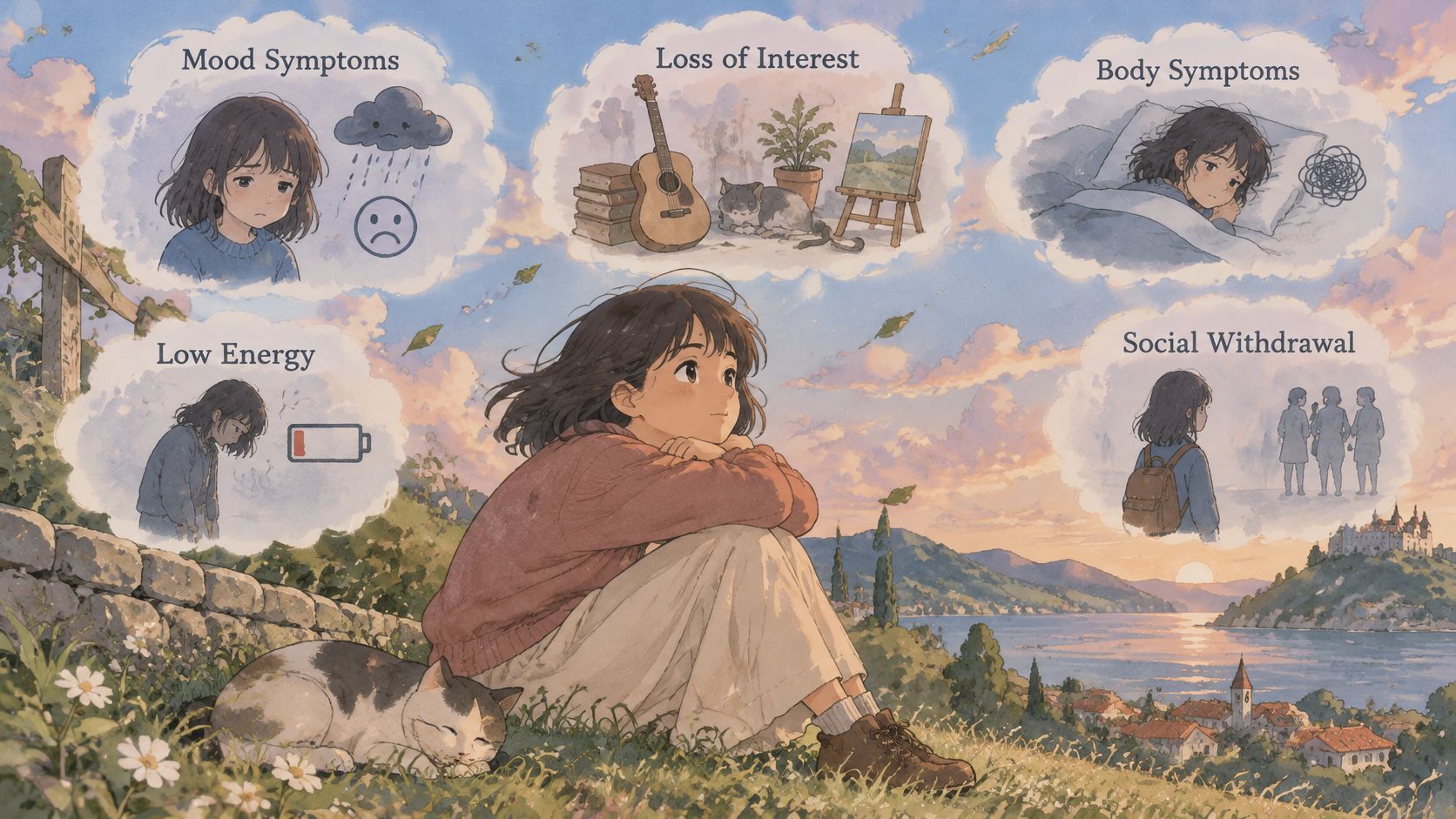
Mood symptoms: Sadness, emptiness, irritability, or feeling emotionally numb.
Loss of interest: Less enjoyment in hobbies, friendships, intimacy, or everyday pleasures.
Body changes: Disrupted sleep, appetite or weight changes, fatigue, and unusually slowed or restless movement.
Thinking difficulties: Poor concentration, indecision, excessive guilt, or worthlessness.
Safety concerns: Thoughts of death, suicide, or self-harm.
A major depressive episode typically involves five or more symptoms, including low mood or loss of interest. Clinicians also assess persistence, impairment, and possible alternative explanations. Counting symptoms on your own can't establish the diagnosis, and ordinary sadness doesn't become a disorder because it feels intense.
Risk isn't blame
Family history, previous depressive episodes, chronic illness, persistent pain, substance use, trauma, ongoing stress, and hormonal transitions can all influence vulnerability. They don't determine someone's future, and they don't mean the person caused their illness.
Depression also affects people across demographic groups. The World Health Organization estimates adult prevalence at 6.2% among women and 4.1% among men. Population patterns can guide public-health planning, but they can't tell an individual whether their symptoms qualify for a diagnosis.
Some people try to escape distress through spending, alcohol, or constant distraction. If buying things has become a coping habit, ThriveXDNA's resource on healthier alternatives to shopping for relief offers a practical starting point for changing that behavior alongside appropriate mental health care.
The accompanying video offers another way to engage with depression education.
Similar symptoms can appear across different types of depression. Their timing, duration, and relationship to other mood changes help clinicians sort them out.
Depression in Children, Teens and Postpartum
A child may become clingy and complain of stomachaches. A teenager may seem angry and stop seeing friends. An older adult may focus on fatigue or memory problems rather than describing sadness. The same underlying concern can look different across life stages.
According to the CDC's National Center for Health Statistics, depression prevalence during August 2021 through August 2023 was 19.2% among U.S. adolescents aged 12 to 19, compared with 8.7% among adults aged 60 or older. Those figures describe specific age groups and a particular measurement period, not an individual child's or parent's likelihood of having depression.
Life Stage | How It Often Looks | Warning Sign to Act On | Next Step |
|---|---|---|---|
Children under 12 | Irritability, stomachaches, headaches, school decline, clinginess | Withdrawal from play, frequent crying, talk of being bad | Child psychiatry evaluation and a personalized plan |
Adolescents aged 12 to 19 | Anger, sleep changes, withdrawal from friends, falling grades | Self-harm, a sharp academic decline, substance use | Prompt psychiatric evaluation and safety planning |
Adults aged 60 and older | Fatigue, memory complaints, pain, withdrawal | Symptoms dismissed as aging or medical illness | Medical review plus psychiatric assessment |
Pregnancy and postpartum through the first year after birth | Low mood, anxiety, guilt, difficulty bonding | Thoughts of harming oneself or the baby | Immediate assessment, with emergency care when safety is uncertain |
Respond to changes, not stereotypes
For children and teens, compare behavior with their own usual pattern rather than with siblings or classmates. A previously sociable student who repeatedly avoids friends needs a different conversation from a student who has always preferred quieter activities.
Parents can document changes in sleep, attendance, appetite, and activities without interrogating the child. Ask calmly what feels hardest and whether they feel safe. Our child mental health assessments lead to personalized treatment plans, rather than assuming every young person needs the same intervention.
Older adults need the same careful attention. Pain, medication effects, sleep problems, and medical illness may coexist with depression, so physical and psychiatric assessment should work together.
Pregnancy and postpartum care need coordination
Postpartum depression can develop during the first year after birth, beyond the narrower formal peripartum-onset specifier. Anxiety, guilt, and trouble bonding deserve attention even when a parent continues feeding the baby, working, or managing household tasks.
For readers balancing recovery with a professional identity, Acheloa Wellness's discussion of postpartum wellbeing for professional women provides context for those pressures. It complements, rather than replaces, clinical assessment.
An overview of treatment for postpartum depression can help families prepare for a care discussion. Thoughts of harm require immediate assessment; confusion, hallucinations, or an inability to keep the parent or baby safe call for emergency care.
A parent doesn't need to prove they're struggling enough before asking for help. Describe what's happening, including thoughts that feel frightening or embarrassing.
Treatment Pairs Medication With Psychotherapy
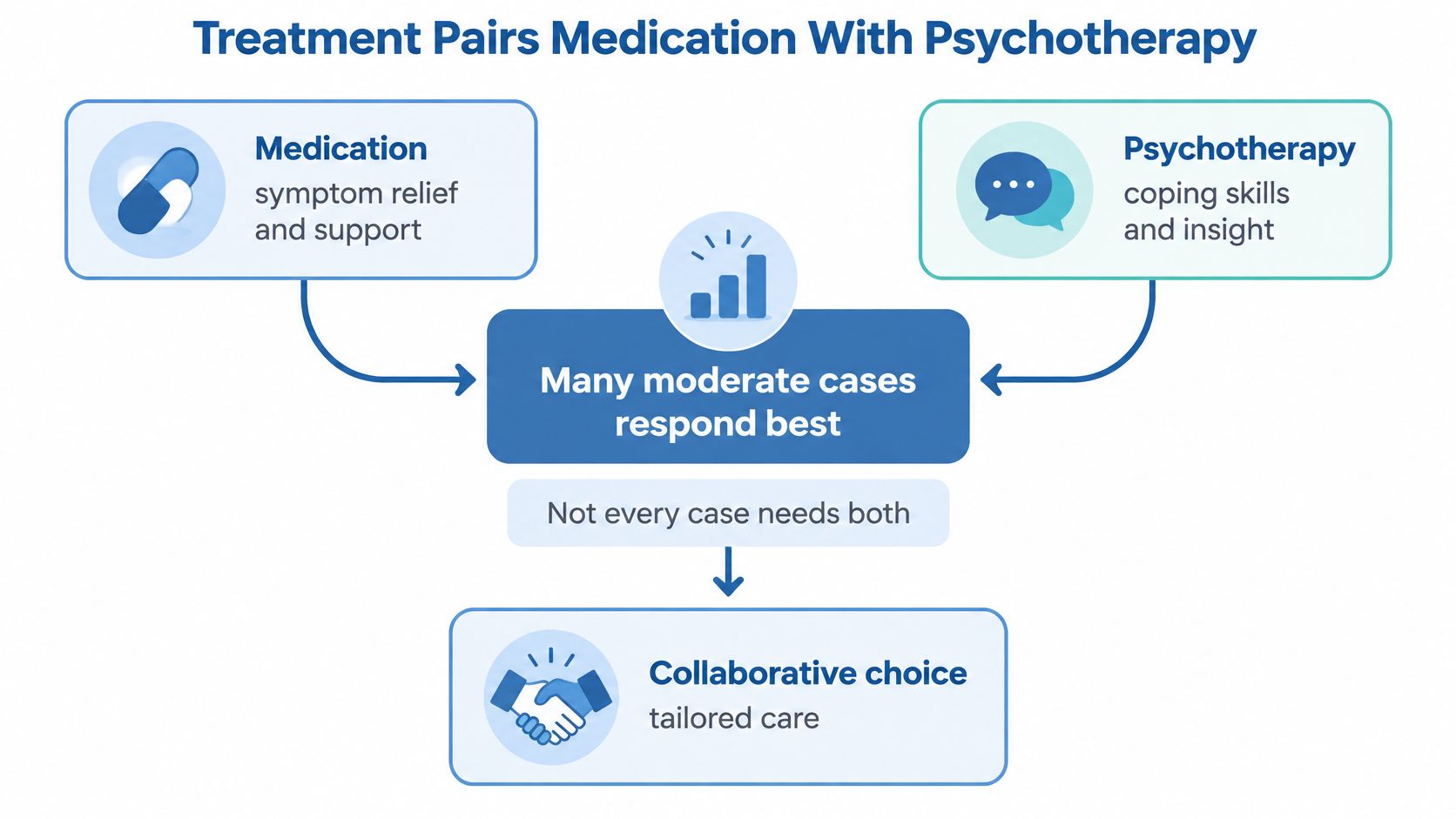
Medication and psychotherapy address different parts of depression. Medication may reduce symptoms enough to make everyday functioning more manageable, while therapy helps people change patterns, strengthen coping skills, and work through problems that medication alone can't resolve.
Many moderate cases benefit from combining them, but not every person needs both. At Refresh Psychiatry, psychiatrists assess symptoms, medical history, previous treatment, and personal preferences before making recommendations. Medication isn't always recommended, and the decision is collaborative.
The diagram illustrates how these approaches can fit within an individualized plan.
What therapy contributes
Cognitive behavioral therapy, or CBT, focuses on connections among thoughts, emotions, and behavior. A person who withdraws because they expect every interaction to go badly might practice testing that prediction and taking manageable steps toward connection.
Dialectical behavior therapy, or DBT, emphasizes distress tolerance, emotion regulation, and other skills that can be useful when depression includes intense emotions or self-harm behaviors. Interpersonal and psychodynamic approaches examine relationships, grief, recurring conflicts, and life transitions.
A practical approach such as behavioral activation for depression helps people rebuild meaningful activity without waiting for motivation to return first. The goal isn't to stay busy at any cost, but to choose achievable actions that support daily functioning.
Option | What It Involves | Best Suited For |
|---|---|---|
Cognitive behavioral therapy | Structured work on thought and behavior patterns | Major or persistent depression and stress-related symptoms |
Dialectical behavior therapy | Emotion regulation and distress-tolerance skills | Depression with intense emotion or self-harm risk |
Psychodynamic or interpersonal therapy | Exploring relationship patterns, grief, and transitions | Depression connected with conflict, loss, or major change |
Antidepressant medication | Daily medication, such as an SSRI, with monitoring and adjustment | Major or persistent depression when severity and history support its use |
Mood stabilizer or antipsychotic | Medication selected to treat bipolar mood episodes | Bipolar depression, with psychiatrist-directed prescribing |
Light therapy | Planned exposure to a therapeutic bright-light box | Seasonal depression after appropriate assessment |
Why the same label can lead to different plans
The National Institute of Mental Health's depression publication explains assessment and treatment in the context of symptoms and individual circumstances. Age, suicide risk, sleep and energy changes, anxiety, trauma, psychotic symptoms, substance use, pregnancy, and previous treatment response can all change the recommendation.
For example, someone with disabling insomnia and a history of medication side effects needs a different discussion from someone whose main difficulties are withdrawal and relationship conflict. Medical contributors and the person's ability to attend follow-up also matter.
Antidepressants alone may be inappropriate for bipolar depression because of mood-switching risk. Light therapy also requires clinical guidance when there's a history of heightened mood.
Treatment plans may include therapy, medication management, and lifestyle strategies. Review benefits, side effects, functioning, and safety regularly; when reducing medication is appropriate, use a clinician-guided, personalized taper rather than stopping abruptly.
How to Book a Depression Evaluation in Florida
You don't have to identify the correct subtype before scheduling. A useful starting point is a short description of what has changed, how daily life is affected, and what you want help understanding.
Refresh Psychiatry's psychiatrists conduct thorough assessments to develop personalized treatment plans, including medication management when appropriate. Visits are provided through telemedicine, so Florida residents can attend securely from a private location using a phone, tablet, or computer.
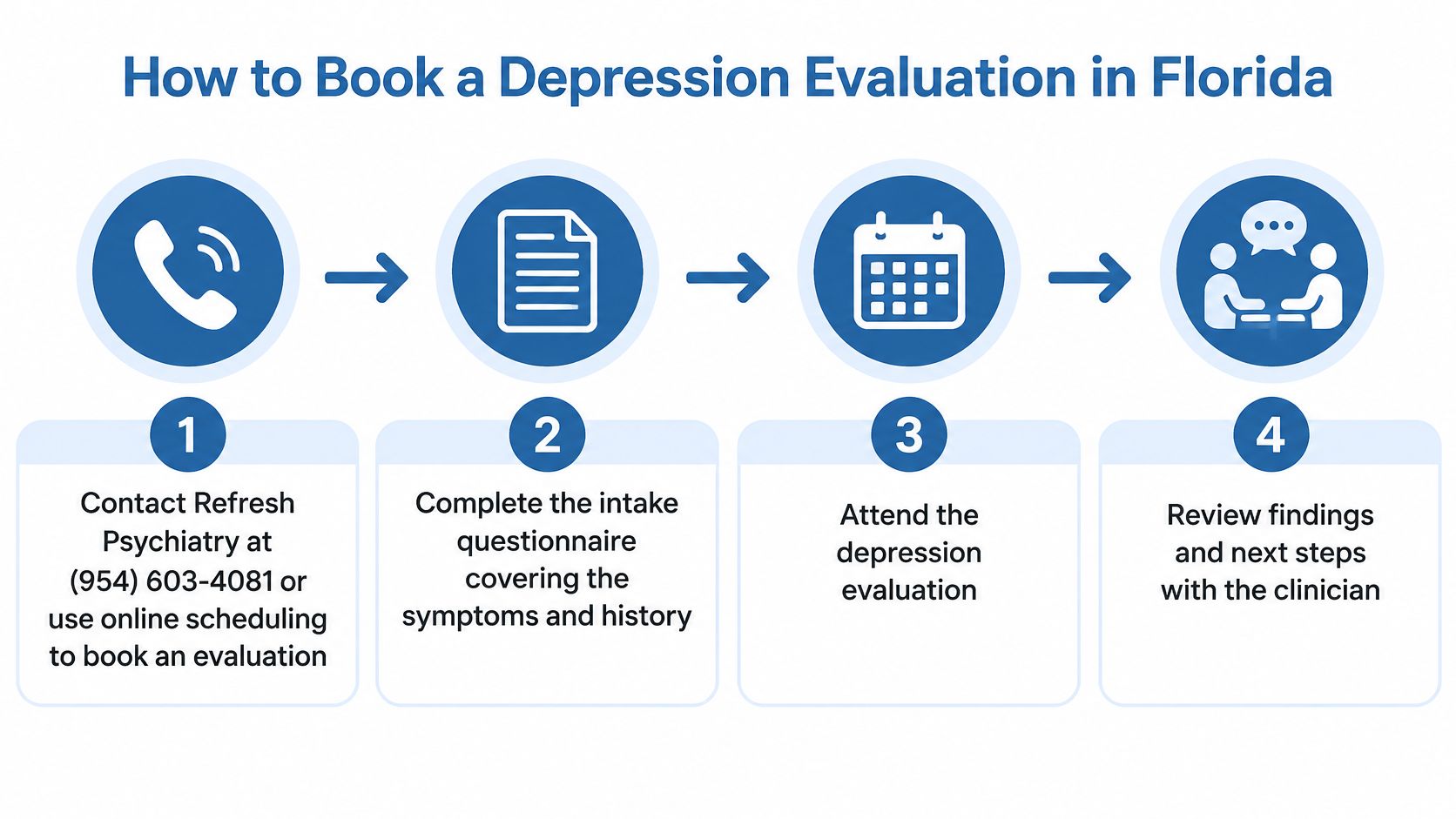
This visual summarizes the booking process.
Prepare for a useful conversation
Contact the practice to arrange an evaluation. Call Refresh Psychiatry at (954) 603-4081 or use online scheduling. Have your availability and insurance information ready so you can discuss appointment arrangements.
Complete the intake questionnaire. Describe current symptoms, earlier mood episodes, family and medical history, and previous treatment. Bring a simple symptom log, even if dates are approximate, rather than delaying until you can reconstruct everything perfectly.
Set up your secure video visit. Choose a private space, check your device's camera and microphone, and keep your medication list nearby. Include prescriptions, nonprescription products, supplements, and any side effects you've noticed.
Review the full mood history with the psychiatrist. Be prepared to discuss low periods, unusually energized periods, substance use, sleep, and physical health concerns. Previous treatment records can help distinguish a medication that didn't work from one that wasn't tolerated or wasn't tried long enough.
Agree on the next steps together. Discuss the proposed diagnosis or working hypothesis and the reasons for recommending therapy, medication, both, or further assessment before treatment. Bring questions about side effects, alternatives, and what improvement would look like in your daily life.
Arrange follow-up and monitoring. Ask what changes to track, how to communicate concerns, and what symptoms require urgent attention. Keep a brief record of sleep, mood, functioning, and treatment effects to make future decisions more concrete.
Know what you should leave with
Reading about what a psychiatric evaluation involves can make the first conversation feel more predictable. You should understand the clinician's current explanation, what remains uncertain, and what happens next.
If you already have a diagnosis, a second opinion is also an option. Bring the existing treatment plan and describe what feels unresolved, whether that's limited improvement, side effects, or uncertainty about mood changes.
Aim to leave with a clear diagnosis or working hypothesis, a written plan, and an agreed follow-up date. A careful assessment can acknowledge uncertainty without leaving you without direction.
Schedule Your Depression Evaluation Today
Book an evaluation if symptoms are affecting your life, even if you're unsure which label fits. The types-of-depression table is educational, not diagnostic. You don't need certainty before asking a professional to help you understand your experience.
Psychiatric evaluations are a first step in understanding a wide range of mental health conditions. At Refresh Psychiatry, the conversation can address both the symptoms you want relief from and the history that may change how they're treated.
Care that can match your needs
Psychiatric evaluation: Assessment to clarify symptoms, diagnosis, and next steps.
Medication management: Collaborative prescribing and monitoring when medication is appropriate.
Individual therapy: CBT, DBT, trauma-focused therapy, and psychodynamic approaches.
Child and adolescent psychiatry: Personalized attention to developmental, family, and school concerns.
Second opinions: Psychiatrist review of an existing diagnosis and plan, including medical history, current symptoms, and previous treatments.
Our licensed psychiatrists can prescribe a full range of psychiatric medications, including controlled substances when appropriate. That prescribing capability doesn't mean a particular medication is necessary or will be recommended.
We accept Aetna, UnitedHealthcare/UHC, Cigna, Blue Cross Blue Shield, Humana, Tricare, UMR, and Oscar insurance plans.
Contact us or call Refresh Psychiatry at (954) 603-4081 to schedule your evaluation. Bring your questions, your concerns, and whatever history you can gather. You don't have to arrive with the answers.
This blog is for informational purposes only and does not constitute medical advice. Please consult a qualified mental health professional for personalized guidance.
Refresh Psychiatry & Therapy offers depression evaluations, individualized therapy, and collaborative medication management through telemedicine across Florida. To understand your symptoms and build a plan that accounts for your full mood history, visit Refresh Psychiatry & Therapy or call (954) 603-4081 to schedule your evaluation.