
💊 Intuniv for ADHD: What It Is, Dosing and Side Effects

If Intuniv isn't a stimulant, does that mean it needs less medical monitoring? That's an understandable assumption, but it misses the central trade-off: Intuniv can help ADHD symptoms while also affecting alertness, blood pressure, and pulse. Choosing it means choosing a treatment plan that includes careful dose adjustments and reliable follow-up, not just a different pill.
For parents and adults considering Intuniv for ADHD, the most useful questions are practical. What should improve? How will you distinguish benefit from sleepiness? And what needs to be checked before the next prescription?
What Intuniv Is and Who It Is Approved For
Intuniv is the brand name for guanfacine extended-release, a nonstimulant ADHD medication. It acts on alpha-2A adrenergic receptors, rather than working through the same mechanism as stimulant medications. The extended-release formulation is designed for sustained delivery, which matters when a family is trying to manage symptoms beyond a single classroom period.
Say a child can finish some schoolwork on a stimulant but still struggles with interrupting, restlessness, or difficult transitions. Another child might have stopped a stimulant because its side effects were too disruptive. Both situations can lead to a conversation about Intuniv, but they don't automatically lead to the same prescription.
The medication pictured below is one option within a broader ADHD treatment plan.

Where the approval applies
The FDA approved Intuniv on September 2, 2009, for children and adolescents ages 6 through 17, initially as treatment on its own, according to the FDA clinical review. Later labeling also established its use alongside stimulant medication. Clinicians call these approaches monotherapy and adjunctive therapy, respectively.
Use in younger children hasn't been established. The original pediatric approval also didn't establish an adult ADHD indication, so adults need a separate discussion about current labeling, off-label prescribing, and individual risks.
An approval describes where evidence supports a medicine's use. It doesn't mean that every eligible patient should take it, or that someone outside that group can never be considered for treatment.
A useful way to set expectations
Think of a dimmer switch, not an on-off switch. Intuniv may help a person regulate attention and behavior more consistently, but a quieter child isn't necessarily a better-treated child. The important question is whether the child can participate, learn, and manage impulses while remaining appropriately alert.
Our overview of nonstimulant medication for ADHD can help you place Intuniv among the available options without assuming all nonstimulants work alike.
Bring these details to the initial evaluation:
Age and weight: These help the clinician interpret the prescribing options.
Every medication: Include stimulants, nonprescription products, supplements, and medicines taken only occasionally.
Heart and fainting history: Include personal and family heart problems, plus any episodes of fainting or low blood pressure.
The decision should connect a specific symptom problem with a realistic treatment goal, not replace one medication category with another.
How Intuniv Works in the Brain and Body
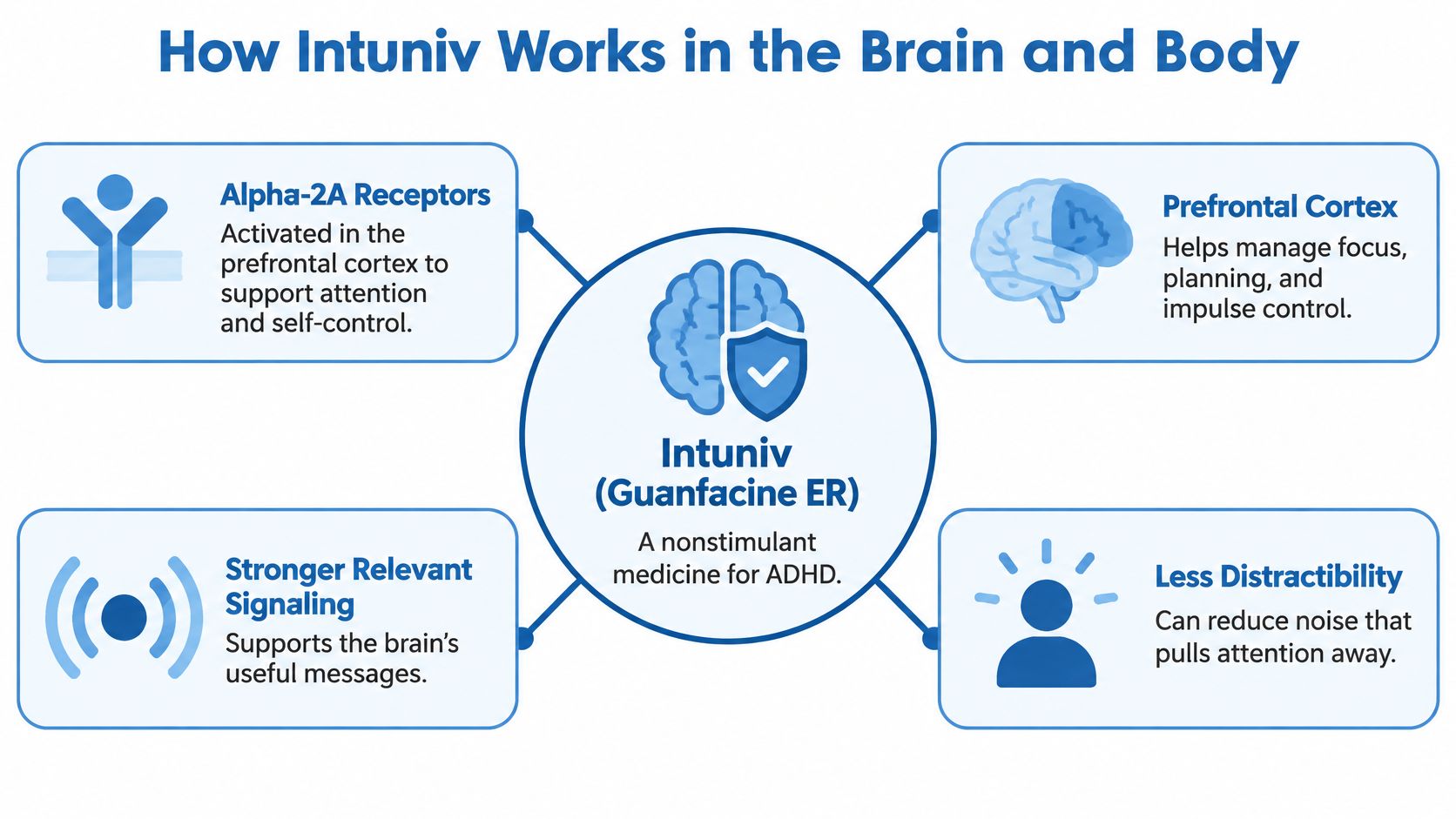
The prefrontal cortex helps people direct attention, plan actions, and pause before responding. Guanfacine activates alpha-2A receptors involved in signaling in this region. This activity may strengthen useful signals and reduce the distractibility or impulsive responses that interfere with everyday tasks.
A control-room analogy can help: the aim is to make important messages easier to follow amid background noise. It isn't to turn down every part of a person's personality or make them sleepy enough to sit still.
This diagram summarizes the brain regions and signaling involved.
Blood levels aren't the same as clinical benefit
The FDA prescribing information supports once-daily administration and reports that peak plasma concentration occurs at approximately 5 hours in pediatric patients. That peak doesn't tell you when a child will achieve the best ADHD response. Blood concentration and improvement in daily functioning are different measures.
Clinical benefit is assessed during gradual titration, as the prescriber weighs symptom changes against tolerability. A child who feels sleepy soon after starting hasn't necessarily reached an effective treatment dose. Likewise, the absence of an immediate change doesn't establish that the medicine won't help.
For readers comparing mechanisms, our explanation of why stimulants help ADHD provides additional context. Different mechanisms can lead to overlapping treatment goals without producing identical experiences.
Food can change medication exposure
In the prescribing information's food-effect assessment, a high-fat meal increased peak concentration by approximately 75% and total exposure by approximately 40% compared with fasting. Avoid taking Intuniv with high-fat meals, and establish a consistent routine relative to food rather than changing the conditions from day to day.
For example, taking a tablet with a light breakfast on school days and a large, high-fat brunch on weekends is not an interchangeable routine. Tell the prescriber how the medicine fits into the household schedule so the instructions are practical.
Practical rule: Consistency helps the clinician interpret whether a change came from the dose, the administration routine, or something else.
Abrupt discontinuation can cause rebound increases in blood pressure and heart rate, so stopping requires the prescriber's taper instructions rather than an improvised medication holiday.
The following video offers another way to understand this treatment.
In daily life, the relevant goal is sustained, usable symptom control as treatment is adjusted over weeks. Intuniv may be worth considering when a child needs ongoing daytime support or can't tolerate a stimulant, but the mechanism alone can't predict that child's response.
Intuniv Dosing, Starting and Adjusting
Group | Starting dose | Dose increase | Usual range and maximum |
|---|---|---|---|
Children ages 6-12 | 1 mg once daily | No more than 1 mg per week | Usual 1-4 mg per day; maximum 4 mg per day |
Adolescents ages 13-17 | 1 mg once daily | No more than 1 mg per week | Usual 1-7 mg per day; maximum 7 mg per day |
Pediatric weight-based range | Titrated from the starting dose | Per prescriber | 0.05-0.12 mg per kg per day |
Adults | Not established by the original pediatric approval | Individualized | Discuss with a prescriber |
Children under 6 | Not established | Not established | Not established |
Find the age row first, then treat the table as a discussion aid, not a self-adjustment schedule. The FDA dosing label describes the starting and titration framework; prescribing information and subsequent adolescent labeling support the age-specific limits summarized here. The applicable current label, other medicines, response, and tolerability must guide the actual prescription.
A listed maximum isn't a goal. A patient who functions better at a lower dose doesn't need an increase just because the table permits one. Conversely, a dose that causes troublesome symptoms isn't automatically appropriate because it falls within the labeled range.
How weight informs the decision
Weight-based dosing is a clinical cross-check, not a calculation families should use to select tablets. For a hypothetical child weighing 30 kg, multiplying by the table's weight-based range gives approximately 1.5 to 3.6 mg daily. That arithmetic doesn't mean the child should start within that range, split a tablet, or move directly to the calculated amount.
The prescriber also considers whether the patient is dizzy, sleepy, faint, or experiencing changes in blood pressure and pulse. A dose can make mathematical sense while still being poorly tolerated.
Swallow the tablet whole. Crushing, chewing, or breaking an extended-release tablet can change its absorption. Intuniv also isn't interchangeable milligram-for-milligram with immediate-release guanfacine, so a pharmacy substitution or formulation change needs explicit instructions.
A start-and-adjust routine
Confirm the written starting instructions. Use the prescribed starting dose shown in the table and choose a fixed daily administration time. Morning or evening dosing is permitted, but changing the time should be a planned decision rather than a response to each day's schedule.
Record early tolerability. During the first two weeks, keep a brief log of sleepiness, dizziness, and any fainting. Note when symptoms occur relative to the tablet, meals, getting out of bed, and school or work activities. Fainting needs urgent assessment, not just an entry in the log.
Increase only after review. Follow the table's maximum titration pace only when the prescriber approves the next change after reviewing symptoms, blood pressure, and pulse. A slower adjustment or a pause may be appropriate when tolerability is uncertain.
Keep a parallel function log. Ask a teacher or another observer to report task completion, interrupting, and alertness. For adults, a short record of starting work, following conversations, and finishing routine responsibilities can reveal changes that a general impression misses.
Plan for missed doses before they happen. Don't deliberately skip doses or double up to compensate. Ask for written missed-dose instructions, including what to do after several missed tablets, rather than guessing before the next dose.
Get a stopping plan in writing. If treatment needs to end, follow a prescriber-directed taper. Don't turn a difficult school day, vacation, or an empty prescription bottle into an unplanned abrupt stop.
These steps work best when one person is responsible for maintaining the record. In households where caregivers share medication duties, use a common log so uncertainty about whether a dose was given doesn't lead to accidental duplication.
Bring the same checklist to every follow-up
Actual administration: Current dose, formulation, timing, food routine, and missed doses.
Observed benefit: Concrete examples from home, school, or work.
Tolerability: Sleepiness, dizziness, bowel or stomach symptoms, and changes in mood.
Measurements: Blood-pressure and pulse readings obtained as instructed, plus updated growth information when relevant.
Medication changes: New prescriptions, supplements, or nonprescription products.
Next decision: Continue, adjust, reassess, or taper, with clear instructions for whom to contact if problems arise.
A useful appointment ends with an understandable plan, not just a renewed prescription.
How Well Intuniv Works for ADHD
Intuniv has evidence of benefit for pediatric ADHD, but that evidence needs its proper boundaries. The DailyMed prescribing information describes five controlled monotherapy trials lasting up to 15 weeks, a randomized-withdrawal study, and an 8-week adjunctive trial with psychostimulants in children and adolescents ages 6 to 17. These studies support its use both alone and as an addition to stimulant treatment.
The same prescribing information describes an adolescent study involving 314 participants ages 13 to 17 in a 15-week, randomized, double-blind, placebo-controlled dose-optimization trial. Intuniv produced statistically greater improvement in ADHD Rating Scale-IV total scores than placebo.
What improvement does and doesn't mean
A symptom scale gives researchers a structured way to compare treatment groups. It doesn't tell a parent whether a particular child will start homework without repeated reminders, or tell an adult whether meetings will become easier to follow.
A responder also isn't necessarily symptom-free. In the pooled trial analysis discussed under safety monitoring, response meant at least a 30% reduction in ADHD Rating Scale-IV total score. Someone can meet that threshold and still need school accommodations, therapy, or help organizing daily tasks.
The evidence is strongest for short-term pediatric symptom improvement. It doesn't establish that Intuniv is the best medication for every child, that it outperforms every stimulant, or that a benefit will remain unchanged indefinitely. Adult treatment and long-duration comparisons require particular caution.
Measure participation, not just quietness. A child who interrupts less because they're struggling to stay awake hasn't achieved the same outcome as a child who listens and joins the lesson appropriately.
Build a baseline before deciding whether it works
Before treatment, record examples across several areas:
Attention: Can the person follow directions and return to a task after an interruption?
Impulsivity: Are conversations, turn-taking, or unsafe actions causing problems?
Mood: What happens during frustration, transitions, or disagreements?
Sleep: Is the person rested, struggling to settle, or sleepy during the day?
Appetite: Are eating patterns already difficult before medication begins?
Repeat the same observations at follow-up. Parents and teachers may see different behavior because the demands differ, not because one observer is wrong.
For example, a child may manage structured classroom tasks but struggle during noisy transitions. Keeping that distinction in the record helps prevent a broad statement such as the medication isn't working from hiding a narrower problem.
Families can also explore age-appropriate routines and play options, including Playz's sensory activities for kids. These can provide ideas for structured activity, but they aren't substitutes for medication monitoring or evidence that guanfacine is effective.
The question for ongoing care is specific: Does the observed improvement justify continuing this medication, given its side effects and monitoring needs? That question remains relevant even after a successful start.
Side Effects and Safety Monitoring
Effect | When it shows up | What to do |
|---|---|---|
Sleepiness | Early treatment; may recur with dose changes | Ask about bedtime dosing; report persistent or function-limiting sleepiness |
Dizziness on standing | Especially during early adjustment or after an increase | Stand up slowly; get urgent help for fainting |
Slow pulse or low blood pressure | May be detected at follow-up checks, with or without symptoms | Keep scheduled checks and report symptoms |
Rebound high blood pressure | After abrupt stopping | Follow a prescriber-directed taper |
Mood or behavior change, thoughts of self-harm | Any time | Contact the prescriber promptly; seek emergency care for immediate danger |
In a pooled analysis published in European Psychiatry, sedative adverse events occurred in 13.9%-18.7% of guanfacine-treated participants during week 1, compared with 8.7% receiving placebo; by week 8, rates had fallen to 0%-1.4%. The analysis separated symptom improvement from sedation, an important distinction when evaluating treatment.
That pattern doesn't mean every patient's sleepiness will resolve. A child who can't stay awake in class, or an adult who feels unsafe driving, needs a treatment review rather than reassurance based on an average.
What should be checked
Nonstimulant doesn't mean low-monitoring. Plan blood-pressure and pulse checks, height and weight tracking for children, and review of dizziness, alertness, dry mouth, stomach upset, and constipation. For telepsychiatry, decide how physical measurements will be obtained and shared before titration begins.
If home readings are requested, use an appropriately sized upper-arm cuff and follow the clinician's measurement instructions. Record the reading with the dose and symptoms; don't change medication based on an isolated result without guidance.
The FDA pediatric safety review supports continued attention to serious concerns including suicidal ideation or behavior, pancreatitis, and medication errors. Report severe abdominal pain, significant mood changes, severe dizziness, or a very slow or irregular heartbeat promptly. Monitoring a reported concern doesn't mean the medication necessarily caused it.
Our guide to psychiatric medication side effects can help you organize what to report.
Interactions and adult safety
Review every medicine, including stimulants, blood-pressure medicines, sedating drugs, and nonprescription products. Combined effects on alertness, blood pressure, and pulse matter, and some interactions also change guanfacine exposure.
Adult safety evidence requires careful interpretation: in a 191-participant, long-term, open-label extension study, 94.2% reported a treatment-emergent adverse event and 19.9% discontinued because of one, according to the BMC Psychiatry study. Common events included somnolence, thirst, dizziness, decreased blood pressure, bradycardia, and constipation; there were two serious adverse events and no deaths. Those figures shouldn't be presented as placebo-controlled randomized-trial rates.
Call the prescriber for sleepiness that persists or interferes with function. Call emergency services for fainting, chest pain, difficulty waking, or an immediate risk of self-harm.
Intuniv Compared With Stimulant Medications
Feature | Intuniv (guanfacine ER) | Stimulant medications |
|---|---|---|
Drug class | Alpha-2A adrenergic agonist, nonstimulant | CNS stimulant |
Dosing frequency | Once daily | Once or more daily, depending on formulation |
Time to noticeable effect | Gradual, built over weeks of titration | Often within hours of a dose |
Controlled substance | No | Yes, for most stimulants |
Common early side effects | Sleepiness, dizziness, lower blood pressure | Appetite loss, trouble sleeping, nervousness |
Main monitoring | Blood pressure, pulse, alertness, and function | Appetite, weight, sleep, blood pressure, and heart rate |
The practical distinction is speed versus the experience of gradual adjustment, not safe medicine versus dangerous medicine. Stimulants can produce noticeable effects on the day they're taken. Intuniv requires a longer process of finding a useful, tolerable dose.
Neither pattern guarantees a better outcome. A quick effect can be valuable when symptoms are seriously disrupting learning or work, while a gradual nonstimulant approach may fit someone whose stimulant experience has been difficult.
Match the choice to the problem
A nonstimulant discussion makes sense when appetite loss, insomnia, or nervousness limits stimulant treatment. A family may also prefer to avoid a controlled medication, or want to explore a treatment approach aimed at symptoms that continue into the evening.
Those preferences still need clinical context. A person with low blood pressure or disabling daytime fatigue may find Intuniv's trade-offs particularly important. Someone concerned about appetite may prefer its profile but still need monitoring for other effects.
Stimulants remain a strong option when a rapid, substantial change in core ADHD symptoms is a priority. The choice should account for medical history, previous response, daily demands, and what the person can tolerate, rather than a fixed rule that one category is always better.
Our comparison of stimulant versus nonstimulant ADHD medications offers a broader framework for discussing these decisions.
Sometimes the decision isn't either-or
A stimulant may help attention while leaving troublesome impulsivity or symptoms later in the day. In that situation, the prescriber may consider adding Intuniv rather than escalating the stimulant or abandoning a partially helpful treatment.
A published clinical-trial report describes evidence supporting guanfacine extended-release for adolescent ADHD and discusses its place within treatment. Adjunctive prescribing is also supported by the pediatric prescribing program, but a combination needs its own assessment of benefit, adherence, and tolerability.
For adults thinking about work performance, Jan Kutschera's discussion of medication choices and ADHD productivity can help frame questions about everyday goals. It's a perspective resource, not a prescribing guideline.
A useful goal might be following a meeting while staying alert, rather than working longer. For a child, it might be joining family dinner without repeated conflict, rather than becoming unusually quiet. Choose the outcome first, then judge whether the medication strategy helps achieve it.
Book an Evaluation Before You Start Intuniv
What should an Intuniv evaluation cover before the first dose? The appointment should answer three questions: what is causing the impairment, whether Intuniv is a reasonable fit, and who will track the response after the prescription starts. Difficulty concentrating can occur with sleep problems, anxiety, depression, and other conditions, so the assessment needs to establish what is driving the problem.
Before starting, the clinician should review medical and family history, current medications, blood pressure, and pulse. The plan should also name who will manage dose adjustments, how measurements will be obtained, and which symptoms warrant contact between appointments. The monitoring plan is part of the treatment.
Prepare for a useful evaluation
Bring prior treatment records when available, along with examples of difficulties at home, school, or work. Include what improved or worsened with previous medications. Our guide to ADHD testing for adults explains why a full assessment matters more than a quick checklist.
If you're unsure which clinician to contact, reVIBE Mental Health's resource on choosing an ADHD provider can help you understand professional roles. For medication treatment, ongoing prescribing and follow-up arrangements matter as much as the initial diagnosis.
At Refresh Psychiatry & Therapy, ADHD assessment uses evidence-based tools and thorough evaluations. Board-certified psychiatrists provide medication education and regular follow-ups, and treatment plans may combine medication management, therapy, and coping strategies within one coordinated practice.
Plan physical monitoring alongside virtual care
Refresh Psychiatry & Therapy is a telemedicine-only practice serving patients across Florida. Virtual appointments can support continuity, but they don't remove the need for reliable blood-pressure and pulse readings. Tell the care team if you cannot obtain requested measurements so an appropriate plan can be arranged instead of leaving monitoring unfinished.
A Florida guide to ADHD medication through telehealth explains considerations for virtual treatment.
Before the visit, prepare questions about:
Treatment targets: Which problems should improve, and how will improvement be documented?
Safety arrangements: Where will measurements come from, and how should concerning symptoms be reported?
Adjustment decisions: What would lead to continuing, changing, or stopping treatment?
Daily logistics: Who will give the dose, at what time, and what should the family watch for during the first weeks?
Refresh Psychiatry & Therapy currently accepts Aetna, Cigna, UnitedHealthcare/Optum, Oscar, AvMed, UMR, and Blue Cross Blue Shield of Texas. Confirm your plan's benefits and network participation before scheduling.
This blog is for informational purposes only and does not constitute medical advice. Please consult a qualified mental health professional for personalized guidance.
Refresh Psychiatry & Therapy offers coordinated ADHD evaluation, medication management, and therapy to help you decide whether Intuniv fits your symptoms and monitoring needs. Contact Refresh Psychiatry & Therapy through the practice website to schedule an ADHD evaluation.