
🧠 Does My Child Have ADHD? a Guide

Occasional distractibility or high energy doesn't mean your child has ADHD; symptoms lasting at least six months in two settings, with real impairment, are a reason to seek an evaluation. What if the most important clue isn't how much your child moves, but how much everyday life has become a struggle?
When you're asking, “Does my child have ADHD?” it helps to sort the concerns rather than rush toward yes or no. Start with what's expected for your child's age, consider other explanations, and notice difficulties that don't disrupt a classroom. The aim is to understand what support your child needs, not attach a label.
Signs That Deserve a Closer Look by Age
A distracted afternoon doesn't tell you much. A recurring pattern of missed instructions, unfinished routines, strained friendships, or unsafe impulses deserves more attention, especially when your child struggles despite reasonable support.
Compare your child with children at a similar developmental stage, not an older sibling or an unusually independent classmate. Preschoolers need more reminders and supervision than teenagers. The question is whether the difficulty is excessive for your child's development and interferes with daily functioning.
When child behavior deserves an ADHD evaluation
Age band | Often typical | Raises concern | Clinical bar |
|---|---|---|---|
Preschool, about 3–5 | Short attention, high energy, big feelings | Cannot settle for any activity, repeated safety risks, similar problems at daycare and home | Persistent for six months and impairing, not a diagnosis from energy alone |
Elementary, 6–11 | Occasional distraction on boring tasks | Lost materials, unfinished work, blurting, constant fidgeting in class and at home | Generally six or more symptoms in a cluster, frequent, and hurting learning or friendships |
Adolescence, 12–17 | Some moodiness or phone distraction | Inner restlessness, chronic late work, risky impulses with problems dating back before age 12 | Impairment across settings, including school, friendships, family routines, or driving when applicable |
The symptom-count and duration requirements in this screening table come from CDC clinical guidance, which generally requires at least six symptoms in a category for children ages 4 through 16, alongside persistent, developmentally inappropriate impairment. Older adolescents have an age-adjusted threshold, so don't use the elementary-school row to diagnose a teenager.
In a 2022 U.S. national parent survey, the CDC reported ever-diagnosed ADHD in 2.4% of children ages 3–5, 11.5% of children ages 6–11, and 15.5% of adolescents ages 12–17. These are diagnosis rates within age groups, not the probability that your particular child has ADHD.
A parent observation checklist
Answer these questions using the past several months, rather than your child's hardest day:
Materials: Does your child repeatedly lose or forget schoolwork, clothing, or supplies?
Task completion: Do homework and ordinary chores require much more adult supervision than you'd expect for their age?
Impulse control: Do interruptions or acting before thinking cause difficulties at home and school?
Shared concerns: Do teachers or caregivers describe problems similar to those you notice?
Daily impact: Are learning, friendships, routines, or safety suffering?
Several yes answers justify a conversation with a qualified clinician. They don't establish a diagnosis.
For example, forgetting a worksheet occasionally isn't the same as understanding the work but repeatedly failing to bring it home, complete it, and return it. Describe the sequence that breaks down, including what happens when an adult helps.
Intense reactions also need context. Our guide to ADHD meltdowns in children can help you describe those episodes without assuming every outburst means ADHD.
When to Seek Help Right Away
Safety concerns take priority over an ADHD appointment. A sudden crisis needs attention even if you haven't yet gathered teacher reports or completed screening forms.
Don't assume dangerous behavior is impulsivity. A child who is suicidal, severely distressed, medically unwell, or affected by a substance needs an urgent assessment of that problem.
Choose the response that matches the risk
Immediate danger: Call 911 if your child is in immediate danger, has seriously harmed someone, or needs emergency medical assistance.
Suicide or self-harm concerns: In the United States, call or text 988 for crisis support if your child mentions suicide, self-harm, or feeling unsafe. If there's imminent danger, use emergency services rather than waiting for a crisis conversation.
Sudden behavioral change: Contact your pediatrician promptly, within days or sooner depending on severity, if changes in behavior, sleep, or appetite follow a new medication or illness. Suspected poisoning, overdose, or serious substance exposure needs immediate medical guidance.
School deterioration: Contact the school counselor when bullying, school refusal, or a sharp decline in functioning appears. Ask for a safety and support plan, not just a disciplinary response.
Ongoing concerns without danger: Arrange a routine clinical evaluation and begin collecting concrete examples.
Safety first: You don't need to know whether your child has ADHD before asking for urgent help.
Stay with a child who may act on suicidal thoughts, and reduce access to medications, weapons, or other means of injury when you can do so safely. Tell the responding professional exactly what your child said or did, rather than describing the situation only as a behavior problem.
How Clinicians Recognize the Three ADHD Presentations
Think of attention as a spotlight and activity level as an engine. A child may struggle to aim the spotlight, slow the engine, or regulate both. ADHD isn't a measure of intelligence, and difficulty completing a task doesn't automatically mean a child isn't trying.
Say a child understands a classroom lesson but misses instructions, skips parts of the assignment, and forgets to hand it in. Another child knows the classroom rules but repeatedly leaves their seat and answers before the teacher finishes speaking. Those patterns raise different questions during an assessment.
The diagram distinguishes the main presentations.
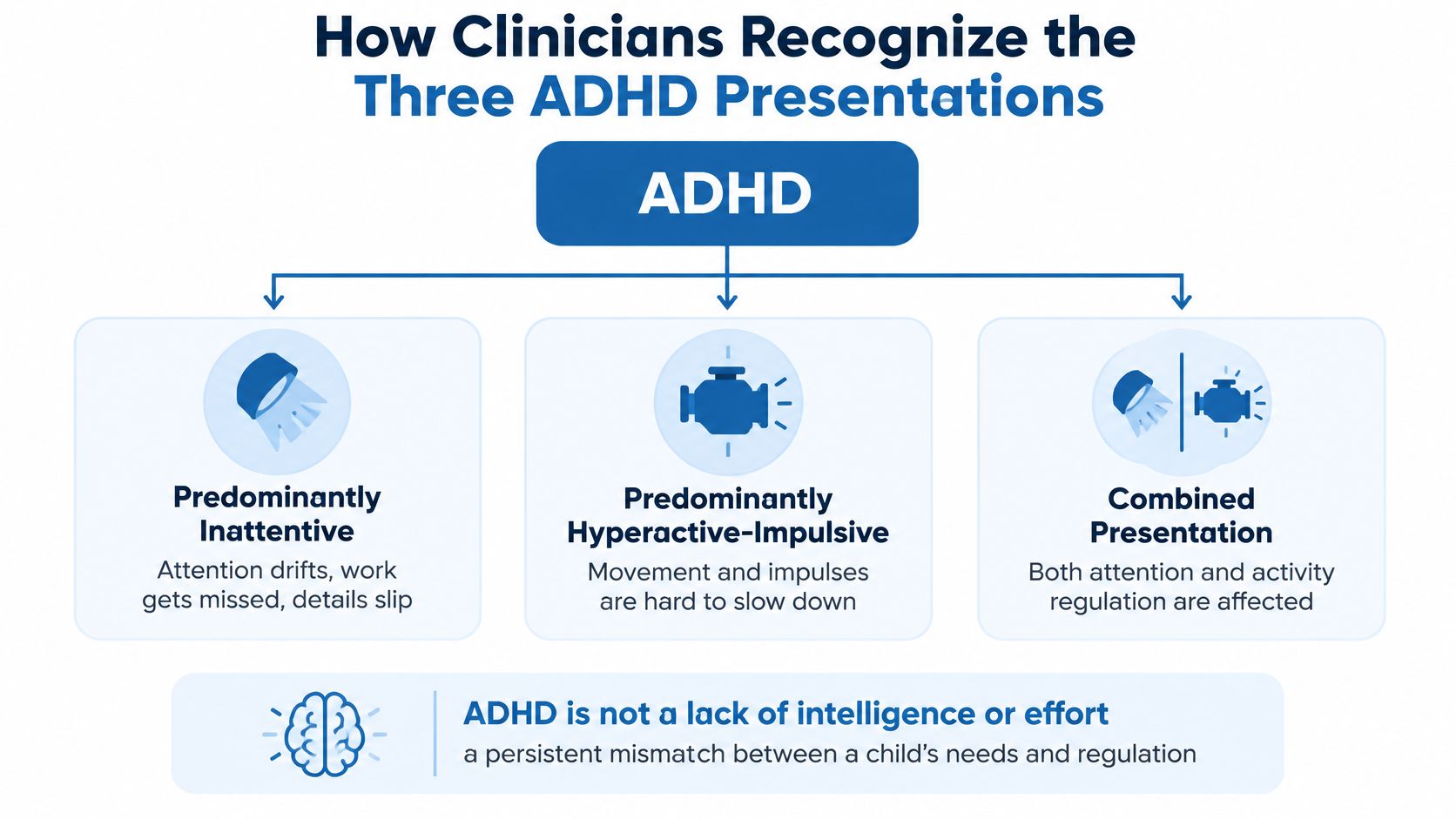
What each presentation means
Predominantly inattentive: The central difficulties involve attention, organization, follow-through, or remembering everyday responsibilities. Disruptive behavior may be absent.
Predominantly hyperactive-impulsive: Movement, excessive talking, interrupting, or acting without pausing are more prominent.
Combined presentation: Both inattentive and hyperactive-impulsive symptoms meet the relevant clinical requirements.
A clinician examines the pattern and its consequences, not just which description sounds familiar. A presentation describes the symptoms that currently predominate; it isn't a fixed personality type.
The National Institute of Mental Health reports that, in national 2022 data, 77.9% of children with current ADHD had at least one co-occurring disorder. That's why a useful assessment doesn't stop after recognizing inattentiveness or hyperactivity.
For parents, the distinction matters because similar outward behavior may need different support. The child who misses instructions may benefit from written prompts, while the child who interrupts may need an explicitly practiced pause-and-wait routine. Neither example determines a diagnosis or a medication choice.
Bring descriptions of what your child couldn't manage and what happened next, rather than labels such as lazy, defiant, or hyper.
Conditions That Can Look Like ADHD
Inattention and impulsivity aren't unique to ADHD. Before deciding what treatment fits, a clinician needs to consider whether another condition explains the behavior or whether several conditions are present together.
A clinical abstract published in Archives of Clinical Neuropsychology highlights symptom overlap and the limitations of relying on a single rating scale. Considering alternatives protects your child from a narrow assessment; it doesn't dismiss your concerns.
These common overlaps help explain why the same school complaint can lead to different clinical questions.
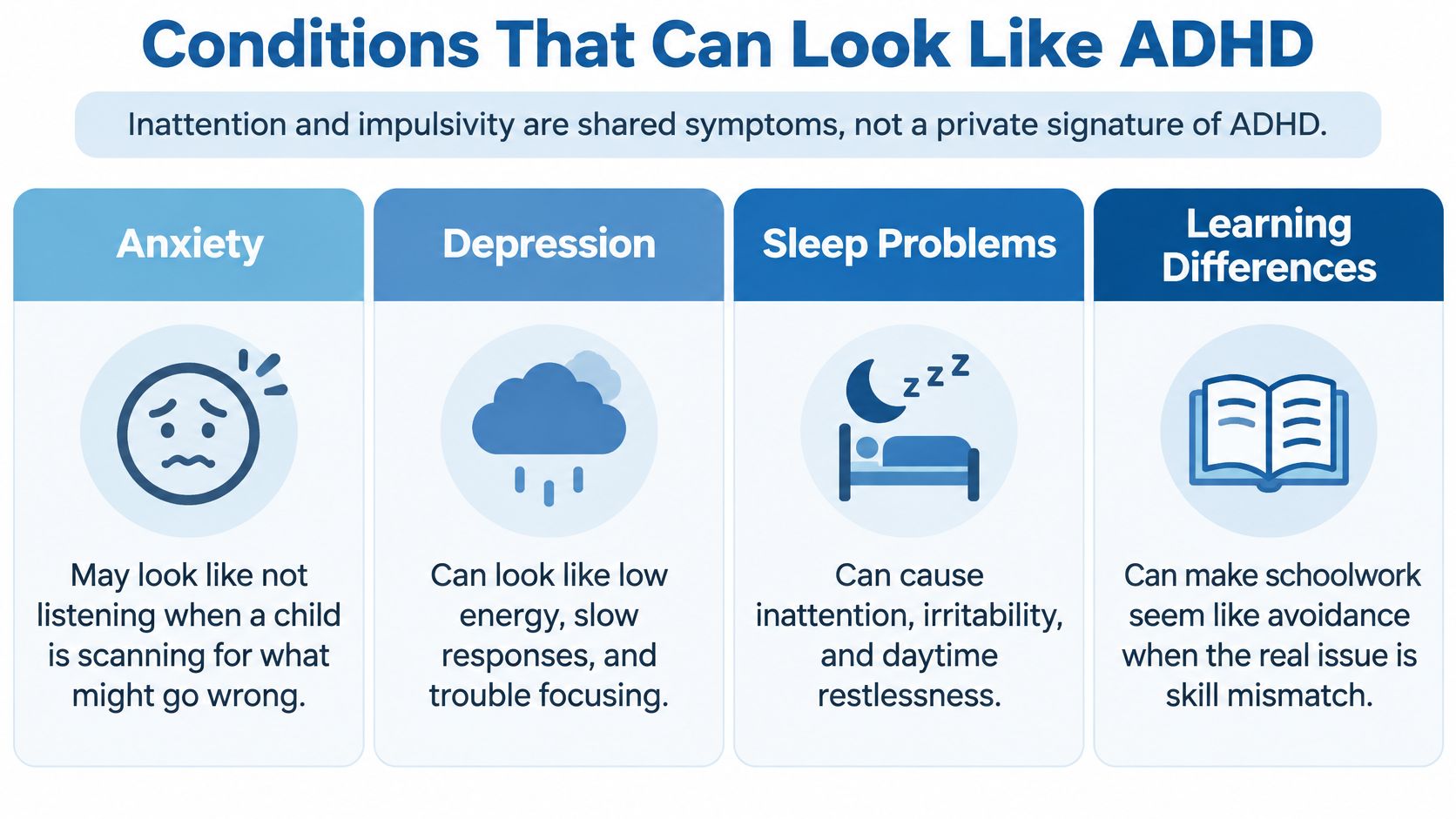
Problems that overlap with child ADHD
Look-alike | Shared symptoms | Clue to investigate |
|---|---|---|
Anxiety | Seems not to listen, avoids tasks, restlessness | Symptoms intensify before tests, separation, or social demands |
Depression | Slow work, forgetfulness, low motivation | Low mood, withdrawal, loss of interest |
Sleep problems | Irritability, poor focus, hyperactivity | Short sleep, snoring, or daytime sleepiness |
Learning or language disorder | School failure, task avoidance | Skill-specific difficulty while attention holds elsewhere |
Autism | Restlessness, social friction, rigid routines | Social-communication differences and restricted interests |
Trauma or major stress | Hypervigilance, impulsivity, emotional swings | A clear stressor followed by changes in behavior |
Hearing, vision, medicine, or substances | Missed instructions, fogginess, behavior change | Sensory difficulty or a timing link to medication or substance exposure |
These clues are questions to investigate, not rules that exclude ADHD. A child can have both ADHD and anxiety, for example, and classroom difficulty may reflect both attention regulation and an unrecognized reading problem.
Consider a child who avoids reading aloud but stays engaged during discussion and hands-on activities. That pattern deserves a close look at reading skills rather than an immediate assumption of poor attention. Similarly, a child who seems distracted because they're anticipating embarrassment may need anxiety assessment.
Our explanation of ADHD and anxiety explores why those difficulties can be hard to separate.
Track timing rather than guessing
Write down whether problems follow a poor night's sleep, cluster around a particular subject, or began after a stressful event. Include medication changes and physical symptoms, even if they don't seem related to school performance.
Don't stop a prescribed medicine on your own to test a theory. Bring the timeline to the prescriber so changes can be made safely and interpreted accurately.
When Quiet ADHD Gets Missed
A child can sit politely through class and still struggle to complete almost anything independently. The absence of office referrals doesn't tell you whether assignments, organization, or everyday responsibilities are manageable.
Quiet difficulties may be easier to overlook than visible disruption. This illustration captures daydreaming, but a still image can't show the effort or impairment behind it.

CDC ADHD diagnosis rates by group, 2022 to 2023
The CDC's ADHD statistics report the following diagnosis rates among U.S. children for 2022–2023.
Group | Diagnosis rate | Source |
|---|---|---|
Boys | 13% | CDC 2022–2023 |
Girls | 7% | CDC 2022–2023 |
Black and White children | 11% | CDC 2022–2023 |
Asian children | 3% | CDC 2022–2023 |
Non-Hispanic children | 11% | CDC 2022–2023 |
Hispanic children | 8% | CDC 2022–2023 |
Diagnosis gaps don't establish biological differences in how common ADHD is. Access to assessment, language barriers, expectations about behavior, and whether adults notice inattentive symptoms can influence who gets referred.
A daughter may earn acceptable grades only because a parent monitors every assignment. A quiet child may spend the evening recovering from the effort of keeping up. Neither situation proves ADHD, but both deserve more useful questions than whether the child causes trouble.
For additional discussion of attention difficulties, the video below offers another format.
Ask about the work behind the result
Instead of asking only whether grades are good, ask how the work gets done. Does the child need continual prompting, lose track of deadlines, or spend the evening completing work classmates finish at school?
Our guide to inattentive ADHD describes this less disruptive pattern. A teacher's reassuring comment matters, but follow-up questions about independence, completion, and organization may reveal a more complicated picture.
The goal is equitable assessment, not assuming that a girl, quiet child, or child from any particular background must have a missed diagnosis.
What a Proper Evaluation Includes
A useful evaluation produces an explanation you can act on. You should understand what the clinician considered, which difficulties need support, and what remains uncertain.
The American Academy of Pediatrics' rating-scale guidance recommends DSM-based scales with reports covering at least two major settings. Comparing observers helps the clinician understand where symptoms occur and how they affect functioning.
The process includes several connected tasks, rather than a single pass-or-fail test.
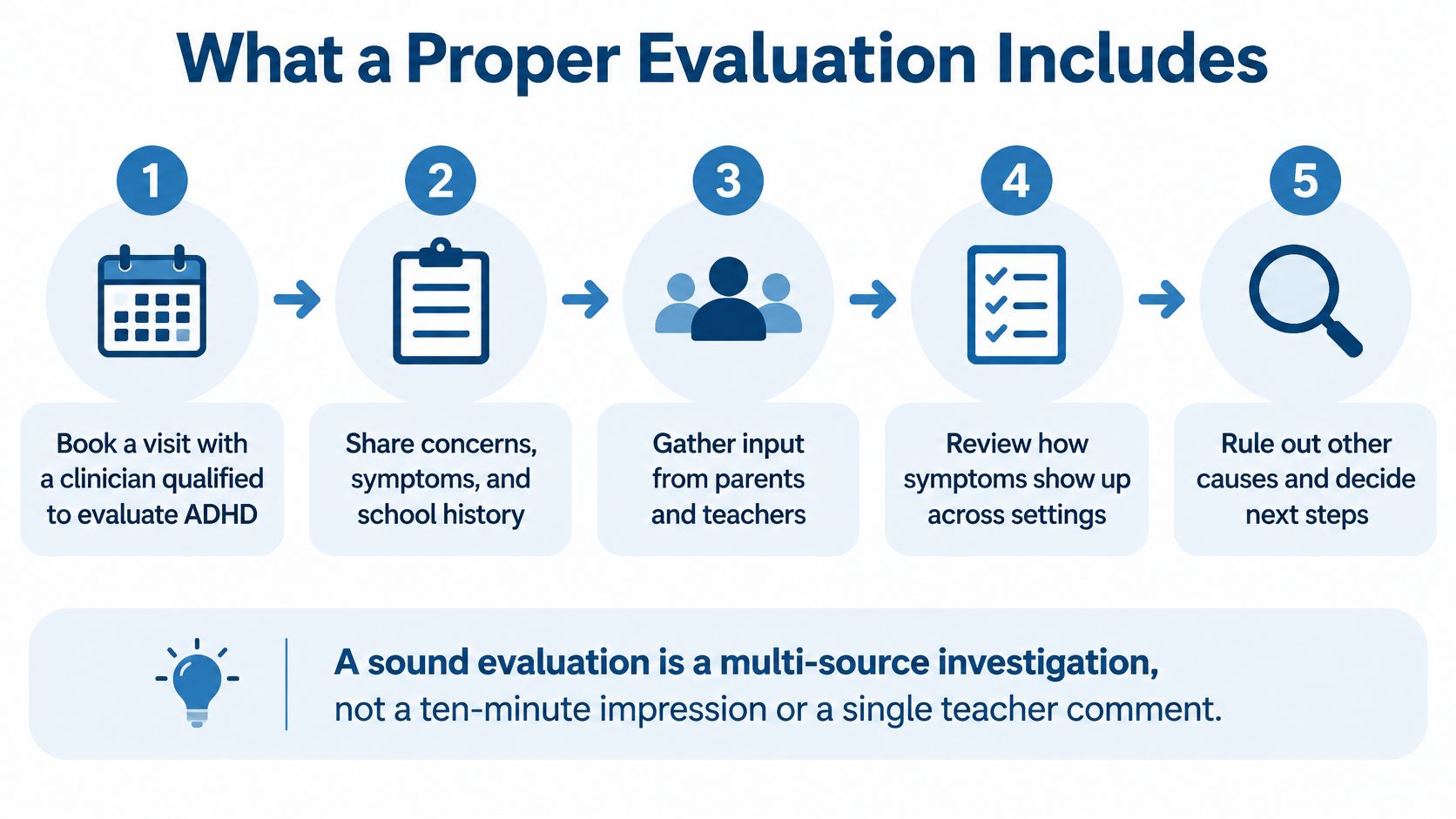
Prepare for the appointment
Book with a qualified clinician. A pediatrician, child psychiatrist, or appropriately qualified mental health professional can assess concerns or arrange a referral. Confirm that the clinician evaluates children in your child's age group.
Complete the history carefully. Include development, health, family history, sleep, previous treatments, and when difficulties first became noticeable. Describe strengths as well as problems.
Gather independent observations. Let teachers and caregivers complete their own forms. Don't coach them toward agreement.
Bring examples. Report cards, unfinished work, accommodation records, and a short symptom timeline help turn general concerns into observable patterns.
Expect broader screening. The CDC's diagnostic guidance explains that assessment may include a medical examination and hearing or vision testing, with additional screening guided by the child's history.
Request clear feedback. Ask whether criteria are met, which presentation fits, what else was identified, and what the next steps are.
When reports don't match
Disagreement between home and school isn't a reason to discard either account. Ask about classroom structure, adult support, task difficulty, and whether another teacher notices a different pattern.
A highly structured classroom may conceal difficulties that become obvious during independent homework. Conversely, problems confined to a particular lesson may point toward instructional or learning needs.
Bring evidence, not a verdict: Your job is to describe your child accurately, not persuade the clinician to confirm ADHD.
For parents wondering how overlapping developmental concerns are assessed, Guiding Growth's autism and ADHD testing guide provides additional context for questions to bring to an appointment. Families considering local assessment can also read about ADHD testing in Davie.
First Steps After the Pattern Is Clear
Treatment should address the difficulties the evaluation identified. A plan for a preschooler struggling with unsafe impulses won't necessarily resemble a teenager's plan for missed assignments, anxiety, and sleep disruption.
The CDC's treatment recommendations support behavior-focused parent training as the starting point for preschool-aged children, with age-appropriate combinations of behavioral care, school support, and medication considered for older children. Medication isn't automatically required after diagnosis, but avoiding it at all costs can also leave significant impairment untreated.
These supports work best when home, school, and clinical care have shared goals.
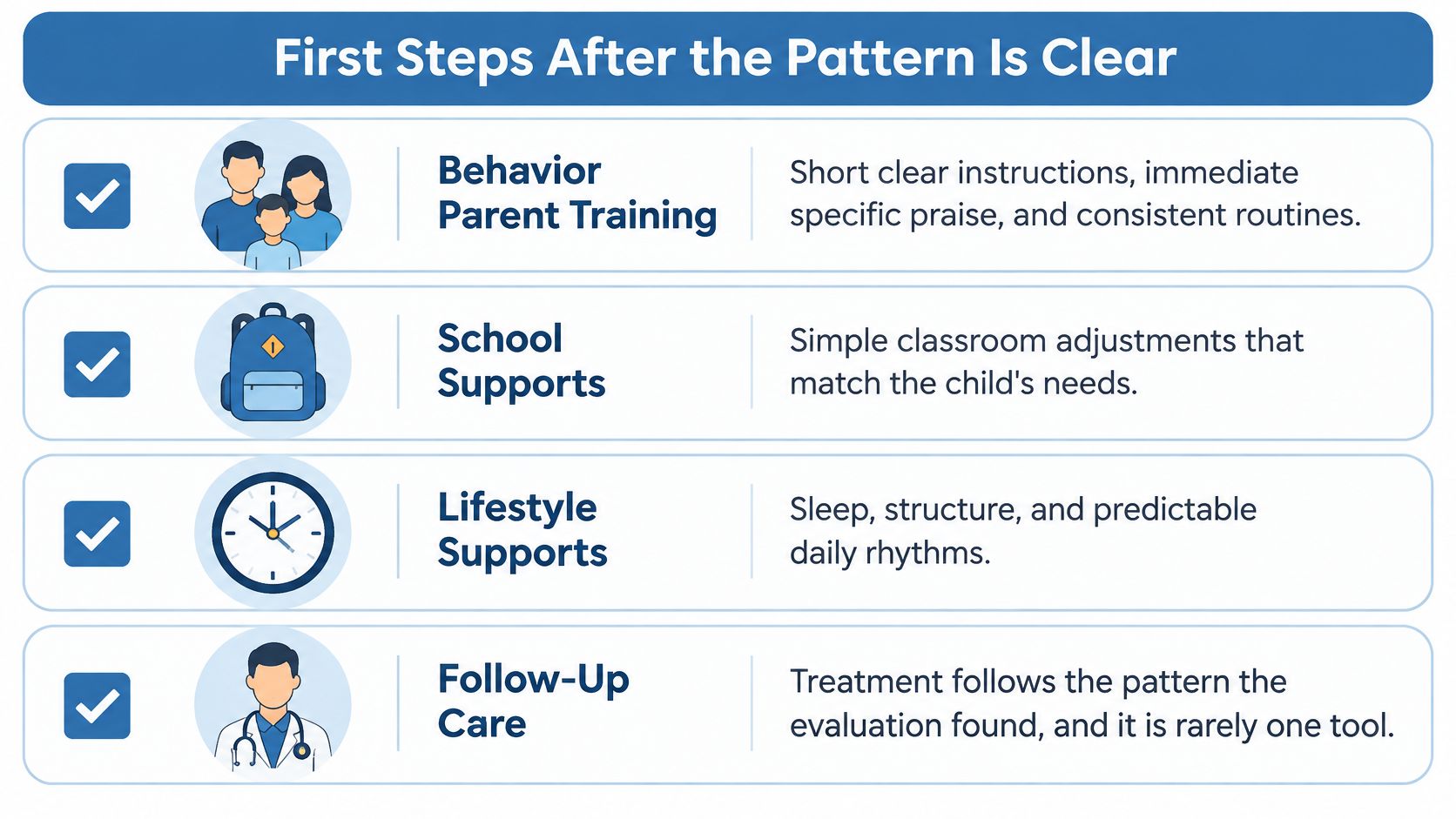
Starting points for child ADHD care
Option | Usually first when | What parents do |
|---|---|---|
Behavior parent training | Preschool impairment, and alongside other care later | Give short instructions, specific praise, predictable routines, and consistent consequences |
School accommodations | Learning or classroom functioning is impaired | Request a school meeting; discuss a 504 plan or IEP evaluation, assignment chunking, seating, and homework check-out |
Stimulant medication | A school-age child has clear impairment after evaluation | Give only as prescribed; track sleep, appetite, mood, and school response |
Nonstimulant medication | Stimulants are a poor fit or aren't tolerated | Discuss atomoxetine, guanfacine, or clonidine with the prescriber |
Therapy for co-occurring needs | Anxiety, depression, trauma, or family strain is also present | Coordinate therapy goals with the wider treatment plan |
Make improvement observable
Choose a concrete goal, such as getting through the morning routine with fewer repeated prompts. Praise the behavior you want to see: putting shoes in the agreed place is more specific than being good.
School supports should address the actual barrier. Written instructions may help a child who loses track of spoken directions; breaking an assignment into parts may help a child who can't organize a long task. Eligibility for a formal school plan requires the school's assessment process.
Stimulants include medicines in the methylphenidate and amphetamine families. Nonstimulants offer alternatives, but a child's anxiety, sleep, medical history, and prior response need individual review rather than a blanket rule about which drug is best.
Medication decisions need follow-up. Ask what improvement to expect, which side effects to watch for, and how to contact the prescriber if problems arise. Sleep, movement, and predictable routines support care, but they aren't substitutes for treatment when impairment remains substantial.
How Florida Families Schedule an Evaluation
If your child's difficulties are persistent and interfere with daily life, the next useful step is a qualified assessment, not another online quiz. You don't need to arrive certain that ADHD is the answer.
Refresh Psychiatry & Therapy is a telemedicine-only practice serving children, adolescents, and adults across Florida. Our ADHD assessments use evidence-based tools and detailed evaluations; personalized plans may include therapy, medication management, and coping strategies.
Get ready for a secure video visit
Collect school information: Have teacher examples, recent report cards, and relevant support or disciplinary records available.
Write a short timeline: Note when problems began, important health or family changes, and what you've already tried.
Prepare your questions: Include concerns about diagnosis, school needs, treatment choices, and follow-up.
Confirm coverage: Check the specific plan's network, referral, and benefit requirements before the appointment.
Parents and caregivers remain involved throughout our child mental health care. Our licensed psychiatrists can prescribe the full range of psychiatric medications, including controlled substances when appropriate, but an evaluation doesn't commit your child to medication.
If you're comparing clinicians, our guide to finding an ADHD doctor near you can help you prepare questions about assessment and ongoing care.
Contact us or call Refresh Psychiatry at (954) 603-4081 to schedule your evaluation.
We accept Aetna, United Healthcare/UHC, Cigna, Blue Cross Blue Shield, Humana, Tricare, UMR, and Oscar insurance plans.
This blog is for informational purposes only and does not constitute medical advice. Please consult a qualified mental health professional for personalized guidance.
Refresh Psychiatry & Therapy offers ADHD evaluations and coordinated care for Florida children and adolescents. Visit Refresh Psychiatry & Therapy to arrange an evaluation, and bring your child's school examples and symptom timeline so we can help you understand what support fits.