
🧠 Long Term Effects of Adderall: What Research Shows

If Adderall still helps you focus, does that mean it's still the right treatment for your body, sleep, and mood years later? Symptom relief matters, but it doesn't answer every question about the long term effects of Adderall.
A useful review separates three things: expected, measurable changes during treatment; uncommon but serious complications; and symptoms that appear after a dose is lowered or stopped. Each calls for a different response. The aim isn't to assume that long-term treatment is dangerous or harmless, but to check whether its benefits still outweigh its risks for you.
Long-Term Adderall Effects at a Glance
Long-term Adderall use more often involves predictable, measurable changes than sudden damage. Blood pressure, pulse, appetite, sleep, and daily functioning give you and your prescriber practical ways to evaluate treatment. Monitoring helps identify problems, but it can't guarantee that serious complications won't occur.
The FDA prescribing information describes average blood pressure increases of approximately 2–4 mmHg and heart rate increases of approximately 3–6 beats per minute. These are averages, not upper limits, and some people experience larger increases.
Long-term effects by domain
Domain | Typical long-term effect | Typical size or pattern | What to track |
|---|---|---|---|
Blood pressure | Modest rise | Average increases described above; larger increases can occur | Home or clinic readings at each review |
Heart rate | Modest rise | Average increases described above; individual increases can be greater | Resting pulse at each review |
Appetite and weight | Reduced appetite, possible weight change | Common; the individual weight trend matters | Weight trend and meal pattern |
Sleep | Insomnia or delayed sleep in some users | Can persist during treatment | Sleep hours and dose timing |
Tolerance | Same dose gives less effect over time | May develop gradually; not inevitable | Symptom and daily functioning scores |
Physical dependence | Withdrawal-like symptoms after abrupt cutback | Can occur even when taken as prescribed | Mood, fatigue, and sleep after any dose change |
Serious cardiac events | Rare; concern is heightened with misuse or existing heart disease | Uncommon; population studies are mixed | Chest pain, fainting, palpitations |
Some changes can begin early and remain relevant throughout treatment. For example, reduced appetite deserves attention if you're routinely missing meals, even if you haven't noticed dramatic weight loss. Sleep deserves the same attention when you're getting work done but struggling to rest.
Understanding why stimulants help ADHD also helps distinguish therapeutic benefit from just feeling more awake. Better task completion and fewer preventable mistakes are more useful treatment goals than a noticeable stimulant sensation.
Practical rule: Treat the monitoring column as a conversation checklist, not a reason to change your prescription yourself.
The FDA also advises avoiding Adderall XR in serious cardiac conditions and notes isolated reports of cardiomyopathy with chronic amphetamine use. Such reports warrant attention, but they don't establish that Adderall caused every case. A new change in any row deserves discussion with your prescriber, with urgent symptoms handled promptly.
Dependence, Tolerance and Stopping Adderall
Physical dependence can develop during prescribed treatment. It doesn't require taking extra doses, and it isn't the same as addiction.
This illustration offers a simplified view of changing experiences during use and discontinuation, not a sequence everyone follows.
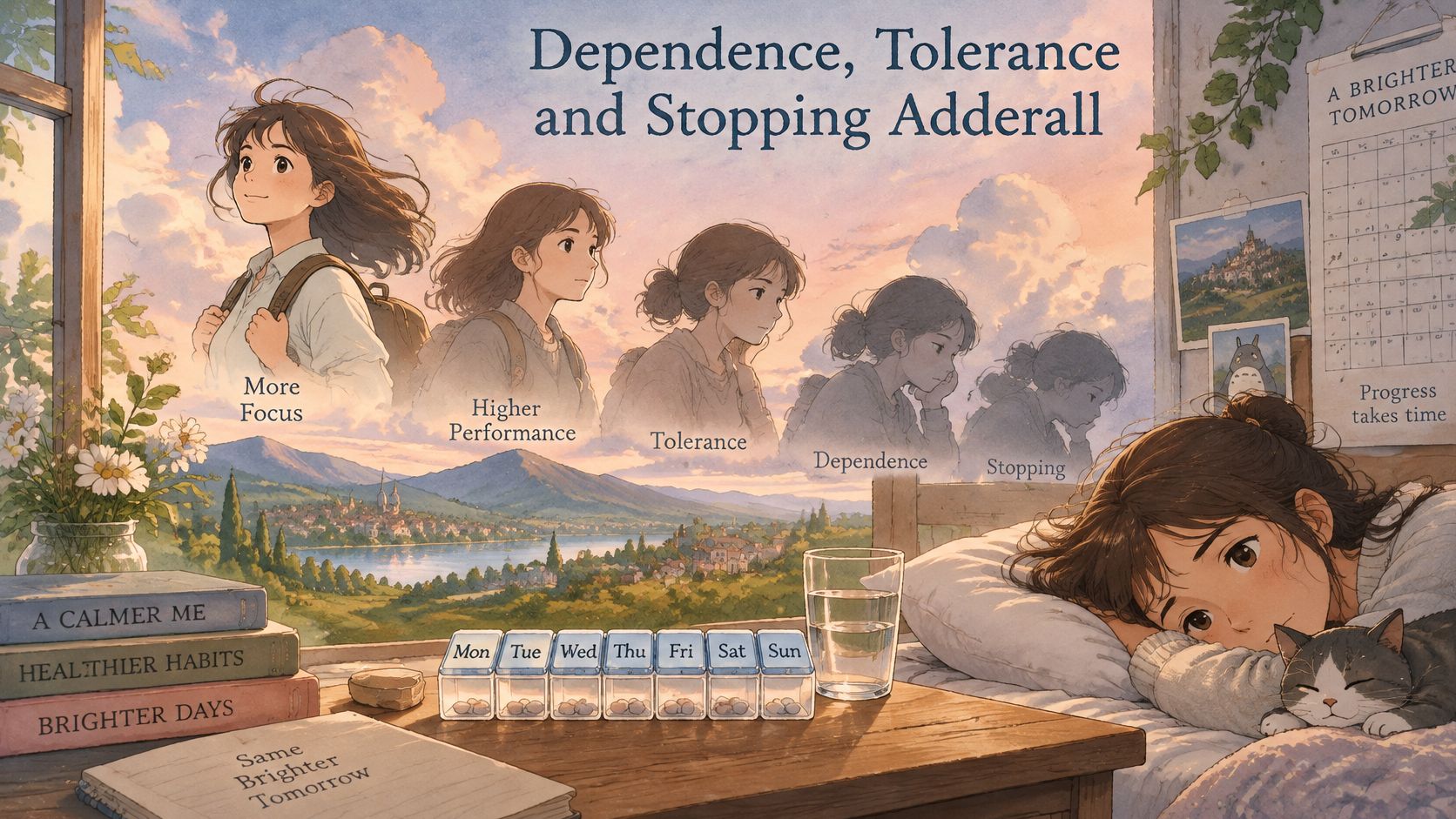
The FDA's Adderall XR labeling explains that prolonged use can produce physiological adaptation, including when medication is taken exactly as prescribed. Abrupt discontinuation or a substantial dose reduction can cause depressed or dysphoric mood, fatigue, sleep disruption, increased appetite, vivid unpleasant dreams, psychomotor slowing, or agitation.
Psychomotor slowing means that thinking, movement, or responses feel unusually slowed. These symptoms need assessment rather than an assumption that someone has become addicted.
Three experiences that can feel similar
Withdrawal: Symptoms follow stopping medication or substantially reducing the dose after the body has adapted.
Rebound: ADHD symptoms return, sometimes noticeably, as a dose wears off.
Untreated ADHD: The original attention, organization, or impulse-control difficulties remain when medication isn't providing coverage.
A clinician considers the timing, the symptom pattern, and functioning before treatment to distinguish them. Tolerance is another issue: the same dose may produce less effect over time, but feeling less stimulated doesn't by itself prove that the medication has stopped helping.
Addiction involves impaired control, compulsive use, continued use despite harm, or prioritizing the drug over important responsibilities. Adderall's status as a Schedule II controlled substance makes screening and ongoing discussion important, without making dependence proof of addiction.
The video below provides additional context for discussing medication-related concerns.
Say someone stops over a weekend and feels exhausted, low, and unable to organize work on Monday. That experience may include withdrawal and returning ADHD symptoms; it doesn't establish permanent harm. A clinician-guided reduction, when appropriate, allows symptoms to be assessed and the plan adjusted instead of leaving the person to manage an unplanned crash.
Questions for your prescriber
My symptoms: Which changes would suggest withdrawal rather than returning ADHD?
My treatment: How will we judge whether tolerance is affecting actual functioning?
My stopping plan: If I want to reduce treatment, what supervision and follow-up should we arrange?
Key Studies on Heart Risk and Their Limits
A heart-risk warning and a reassuring population study can both be valid. They answer different questions: whether a serious event is possible, and whether researchers detect a higher event rate across groups. A warning label works like a smoke detector. It signals that a fire is possible, while population studies estimate how often fires occur.
The FDA prescribing information for Adderall warns about heart attack, stroke, and sudden death, particularly in people with structural heart disease, cardiomyopathy, serious arrhythmias, or coronary disease. Adderall increases cardiac stimulation and can constrict blood vessels through its effects on norepinephrine. These are the expected physiologic changes behind the warnings: modest average increases in blood pressure and pulse that matter most when a heart already carries a vulnerability.
The comparison below separates warning language from study findings and their limits.
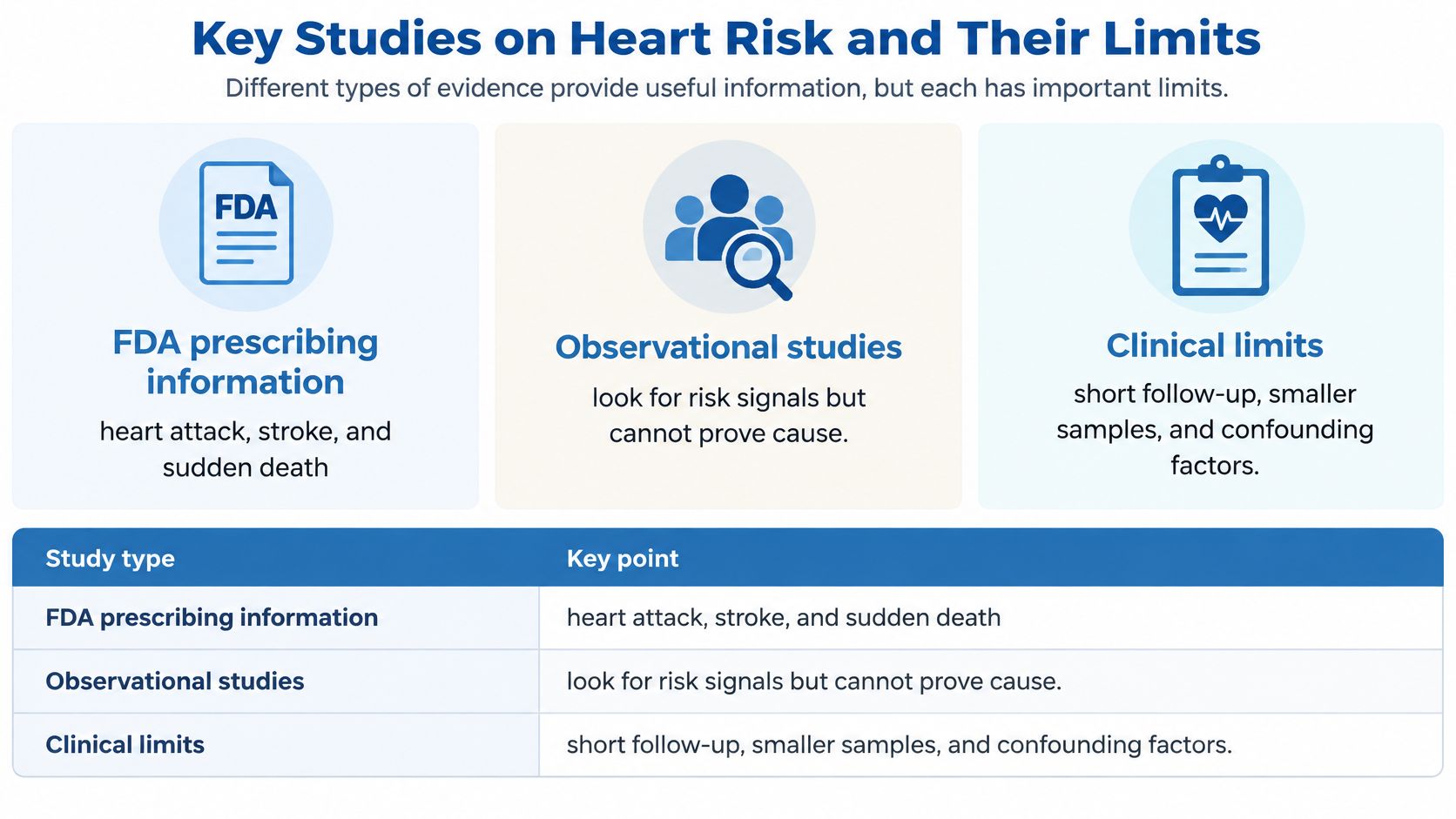
Key studies and their limits
Source | Design | Main finding | Limit |
|---|---|---|---|
FDA prescribing information | Regulatory label | Modest average blood pressure and pulse increases; warnings about heart attack, stroke, and sudden death | Isolated cardiomyopathy reports don't establish causation in every case |
Systematic review and meta-analysis | Observational evidence pooled across age groups | No statistically significant association with cardiovascular events | Observational results cannot prove causation or establish zero risk |
Journal of the American College of Cardiology review | Review of ADHD medications | Modest resting vital-sign increases; reports of arrhythmia, nonischemic and Takotsubo cardiomyopathy, and sudden death | Case reports don't prove causation; long-term adult randomized evidence is sparse |
Registry studies | Large observational cohorts | Cardiovascular disease associations and possible rhythm-related signals in some groups | Differences between treated and untreated people can influence results |
Interview study on abrupt loss of prescription stimulants | Participant interviews | Participants described substantial effects on ADHD symptoms and functioning | Captures experience, not long-term cardiac outcomes |
Reassuring findings at the group level do not exclude risk for a particular patient. Observational results describe averages across large populations, and an individual with an undiagnosed arrhythmia sits outside that average.
A Journal of the American College of Cardiology review describes reported arrhythmias, nonischemic cardiomyopathy, Takotsubo cardiomyopathy, and sudden death, while emphasizing that these reports don't prove causation and that long-term randomized safety evidence in adults is sparse.
What changes clinical care
Each layer of evidence points to a different monitoring step. Expected vital-sign changes call for tracking blood pressure and pulse over time, since persistent hypertension or palpitations deserve reassessment. Rare serious events call for a careful history first: clinicians document personal and family cardiac history and investigate unexplained fainting or exertional chest pain. An ECG or cardiology consultation may be appropriate when symptoms, examination findings, or history raise concern.
Lowering or stopping the dose shifts the question again, away from cardiac risk and toward how symptoms and functioning respond, which is why dose changes belong inside a supervised plan with follow-up rather than a sudden gap in treatment.
A reassuring study headline is not permission to ignore symptoms, and a warning label is not proof that heart damage is inevitable.
Mood, Sleep, Thinking and Functioning Over Time
A stimulant that still works can feel like it has stopped. Early doses often produce a noticeable lift in energy and focus, and that lift tends to fade as the body adjusts, even while attention stays better than it was without treatment. Judging the medication by that sensation works like judging a pair of glasses by whether you notice them sitting on your nose. The test is whether you can see.
Historical FDA Adderall XR labeling states that effectiveness beyond 3 weeks in children and 4 weeks in adolescents and adults wasn't systematically evaluated in the controlled trials cited there. Treatment can keep helping well past those windows, but those trials cannot confirm years of benefit on their own. The American Academy of Family Physicians' adult ADHD clinical resource supports individualized assessment of ongoing treatment and functioning, because some people maintain benefit for years while others notice it slowly erode.
Measure your life, not the stimulant feeling
Expected changes over time fall into a few trackable patterns. Irritability, anxiety, or low mood that appears as a dose wears off points to timing and coverage. Persistent insomnia points toward dose size or how late in the day it is taken. The overlap between Adderall and anxiety often requires a closer look at dose timing, sleep, and co-occurring symptoms before any conclusion makes sense. Recording when each problem occurs separates a medication pattern from an ordinary difficult week.
Functioning goals worth measuring include:
Work or school: completing assignments, meeting deadlines, and making fewer avoidable errors.
Home: following through on bills, appointments, and shared responsibilities.
Relationships: listening, managing frustration, and staying engaged rather than withdrawn.
Wellbeing: sleep, appetite, mood, and a treatment routine you can sustain.
A 34-year-old accountant, as a hypothetical example, might log missed deadlines, sleep, and mood once a week for three months before a review. If deadlines improve while sleep and relationships deteriorate, a symptom score alone misses the trade-off, and the log gives the prescriber something concrete to adjust against.
Continue, adjust, or taper
A structured review weighs three options: continue because benefits remain meaningful, adjust because coverage or side effects need attention, or begin a supervised taper with a personalized plan because the balance has changed. Each concern pairs with its own check. Wear-off irritability calls for timing notes, insomnia for a sleep log, and fading benefit for a comparison on the same functioning measures, alongside blood pressure, appetite, substance use, and quality of life at each visit.
Children's reviews add school participation, peer relationships, and growth, while adult reviews add work relationships and household responsibilities. Group figures, such as the citable mental health numbers gathered for population-level context, describe averages rather than any one person, so your own months of notes carry the most weight in the room. Whatever the decision, CBT, organizing systems, sleep treatment, and school or workplace accommodations remain useful supports whether medication continues, changes, or stops.
Who Faces Higher Long-Term Risk
The same prescription doesn't carry the same long-term profile for everyone. Age, cardiovascular health, other substances, and the presence or absence of medical supervision all affect the decision.
A clinical review of ADHD medication and cardiovascular risk describes mixed observational findings, including cardiovascular disease associations and possible small increases in cardiac arrest or abnormal rhythms in certain groups, including some women and people with preexisting cardiac disease. These signals don't establish that medication caused each event.
Long-term concerns and monitoring by group
Group | Main long-term concern | Monitoring emphasis |
|---|---|---|
Children and adolescents with ADHD | Growth, sleep, appetite, and mood across treatment | Height, weight, sleep, and blood pressure at routine visits |
Adults with diagnosed ADHD | Dependence, sleep, and cardiovascular load | Blood pressure, pulse, functioning, and substance use |
Adults using it without an ADHD diagnosis | Misuse and dependence concerns with unmonitored dosing | Misuse signals, cardiac history, and medication source |
Women | Possible rare rhythm-related signals; limited long-term adult trial evidence | Cardiac history and symptoms at each review |
Older adults | Greater baseline cardiovascular risk | Blood pressure, pulse, and interactions with heart medicines |
People with hypertension, obesity, or sleep apnea | Additional cardiovascular strain | ECG or specialist input when clinically indicated |
People with known serious heart disease | Label advises avoiding Adderall XR in serious structural or coronary conditions | Specialist input before treatment decisions |
For children and adolescents, good grades aren't the only outcome. Eating adequately, sleeping, growing, and maintaining friendships belong in the review. Adults need similarly broad goals rather than a narrow focus on productivity.
Using someone else's medication removes safeguards around diagnosis, dosing, and interaction checks. Tell the clinician what you've taken and where it came from; accurate information is necessary for a safer plan.
Compare treatment with realistic alternatives
Avoiding medication isn't automatically safer. Untreated ADHD is associated with accidents and other adverse outcomes, and registry studies have linked stimulant treatment with lower rates of accidents and criminal acts, although observational associations cannot establish causation.
The decision is about your absolute risk and functional benefit, not simply how long you've had a prescription.
Review caffeine, decongestants, and other stimulants because they can add cardiovascular strain. A baseline ECG isn't automatically necessary for everyone, but symptoms and cardiac history may justify one.
When a stimulant isn't a good fit, discussion can include nonstimulant options such as guanfacine for ADHD, alongside behavioral supports. Alternatives still require individualized assessment and monitoring.
Warning Signs That Need Prompt Medical Care
Severe chest pain, collapse, or severe psychiatric symptoms require urgent action. Don't wait for your next medication appointment, and don't assume a symptom is harmless because you've taken the same prescription for a long time.
Most routine treatment changes develop gradually. The following signs deserve a different response because they may indicate a cardiac problem, unsafe medication use, or a serious psychiatric effect.
Warning signs, possible causes and what to do
Warning sign | What it may indicate | What to do |
|---|---|---|
Chest pain or pressure, especially during exercise | Possible cardiac strain or reduced blood flow to the heart | Call emergency services if severe, persistent, or accompanied by other concerning symptoms; otherwise contact your prescriber the same day |
Fainting or near-fainting | Possible rhythm problem | Seek urgent evaluation; call emergency services for collapse or associated chest symptoms |
Persistent palpitations or racing heartbeat | Tachycardia or rhythm change | Contact your prescriber promptly; an ECG may be ordered |
Blood pressure that stays high on repeated checks | Possible stimulant-related hypertension | Report readings; don't change the dose alone |
Taking more than prescribed or early refills | Possible misuse or dependence concern | Talk with your prescriber about a safer plan |
Needing higher doses for the same effect | Possible tolerance or another treatment problem | Schedule a dose review rather than increasing it yourself |
Crash, low mood, or agitation after missed doses | Withdrawal-like effects or rebound | Contact your prescriber; avoid self-tapering |
Hallucinations, paranoia, or severe agitation | Serious psychiatric effect | Seek emergency care immediately |
Match the response to the urgency
For chest symptoms, tell emergency clinicians that you take Adderall and describe any other medications or substances used. Don't drive yourself if you feel faint or seriously unwell.
For persistent but non-emergency concerns, call your prescriber the same day and provide a clear account: what happened, when it started, when you took the medication, and whether you missed or added doses. Repeated home blood pressure readings are more useful when you also note symptoms and medication timing.
If you're having thoughts of self-harm, call or text the U.S. crisis line at 988. If you might act on those thoughts or cannot stay safe, call emergency services or go to an emergency department.
Safety first: An emergency needs emergency assessment, not an experiment with a different dose.
A guide to psychiatric medication side effects can help you prepare for a conversation, but it can't rule out an emergency. Let the treating clinician direct immediate medication decisions when a serious reaction is suspected.
How to Monitor Long-Term Adderall Use Safely
A useful follow-up connects physical measurements with the reason treatment began. Bring your medication list, home readings if available, and concrete examples of what's easier or harder in daily life.
This checklist summarizes the main clinical tasks.
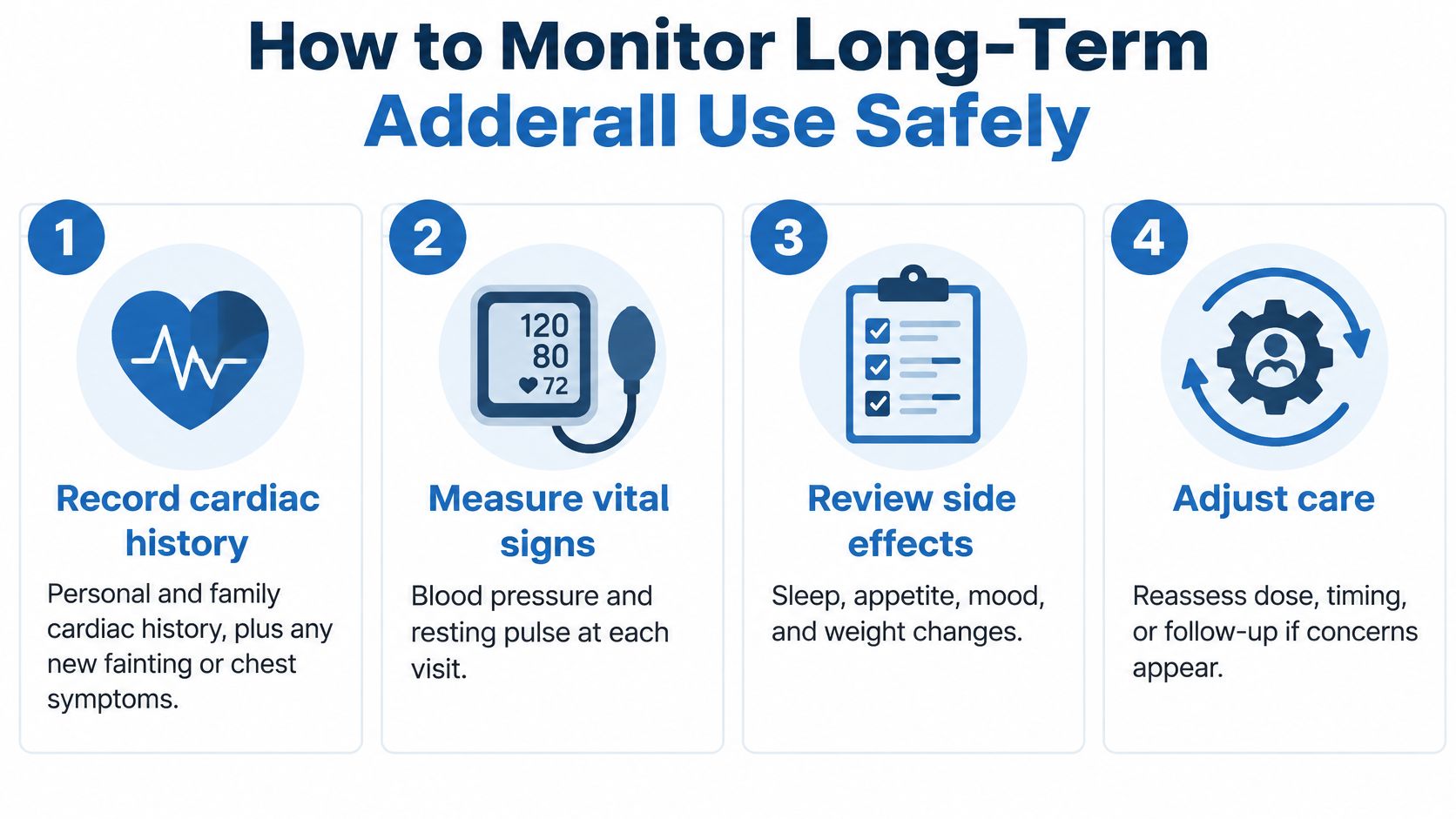
A repeatable review routine
Update cardiac history. Report new fainting, chest symptoms, exercise intolerance, and changes in family history, including sudden unexplained death.
Measure blood pressure and resting pulse. Use a properly fitting blood pressure cuff, rest before measuring, and record the result with medication timing. Ask the clinician how they want home readings collected.
Check functioning against treatment goals. Bring examples from work, school, and home. Fewer unfinished tasks matters more than feeling energized.
Review sleep, appetite, and weight. Note bedtime, sleep interruptions, skipped meals, and unintentional weight changes. For children, include growth measurements.
Discuss medication use openly. Report extra doses, early refill requests, cravings, or pressure to share medication. These conversations should support safety, not punishment.
Check interactions. Include caffeine, energy drinks, decongestants, supplements, other stimulants, and all prescription medicines. Bring product names rather than relying on memory.
Decide whether to continue, adjust, or taper. Compare the same functioning measures over time. Consider whether the current dose remains necessary and whether side effects justify changing the plan.
A stable prescription doesn't mean follow-up is optional. The clinician should set the visit schedule according to symptoms, cardiovascular concerns, treatment changes, and other health conditions.
What supervised deprescribing involves
Deprescribing means gradually reducing a psychiatric medication under professional guidance with a personalized tapering plan. It isn't a universal schedule or a test of willpower.
In practice, a clinician may use smaller dose reductions, arrange check-ins, and pause further reductions if troubling mood, fatigue, sleep, or functioning changes appear. The plan should also explain whom to contact, which symptoms require urgent care, and how ADHD supports will continue.
Don't split, crush, or otherwise alter a formulation unless a pharmacist or prescriber confirms that it's appropriate. A taper may require a different prescribed strength or formulation rather than improvised adjustments.
Where genetic testing fits
Pharmacogenomic analysis examines how genetic differences may affect medication processing. It doesn't directly measure whether Adderall is helping your relationships, sleep, or work.
Evidence supporting routine pharmacogenomic testing for stimulant treatment is limited. Discuss whether a result would change a specific prescribing decision before treating testing as a necessary step or a substitute for clinical monitoring.
Book a Review Before Changing Your Dose
Book a review if you're unsure Adderall still helps, you've noticed a warning sign, or you want to lower or stop treatment. Taken it for six months or more without a meaningful reassessment? That's a practical reason to arrange one too. It isn't a medical threshold at which harm begins.
A useful review covers the same three tracks this article followed: expected changes such as sleep, appetite, and blood pressure; rare cardiac symptoms that call for faster action; and what happens to your functioning if the dose drops or stops. An evaluation can bring together medication history, vital signs, daily functioning, mood, substance-use screening, and cardiac history. If a change is appropriate, the discussion should end with a personalized plan and scheduled follow-up, not a stopped prescription.
Prepare for a useful appointment
Bring your treatment history: current doses, previous medications, missed doses, and unwanted effects.
Choose concrete goals: what you want to preserve, such as completing schoolwork, and what needs improvement, such as sleep.
Name your concerns: dependence, heart symptoms, mood changes, or stopping safely.
Knowing what to expect lowers the barrier to booking. Our guide to what happens at a psychiatry appointment walks through the visit format. At Refresh Psychiatry & Therapy, medication management is provided by board-certified psychiatrists who monitor progress and adjust medications as necessary. They can prescribe controlled substances when appropriate and create personalized tapering plans when reduction is the right choice. Care is delivered through HIPAA-compliant virtual visits throughout Florida as a telemedicine-only practice.
We accept Aetna, UnitedHealthcare/UMR, Cigna, Blue Cross Blue Shield, Humana, Tricare, and Oscar Health insurance plans. Confirm your individual coverage before booking, since network participation doesn't determine every plan's benefits.
For an individualized review of Adderall's benefits, side effects, and options for supervised dose changes, visit Refresh Psychiatry & Therapy to request an evaluation. This blog is for informational purposes only and does not constitute medical advice. Please consult a qualified mental health professional for personalized guidance.