
🪞 the Vulnerable Narcissist: Signs, Struggles, and Support

You leave a routine meeting and spend the next several hours replaying one harmless comment. Maybe you decide you sounded arrogant, incompetent, or oddly needy. By evening, you've withdrawn from the group chat and snapped at your partner, not because they caused the problem, but because irritation feels safer than admitting how exposed you feel.
That experience can resemble what clinicians describe as vulnerable narcissism, a pattern involving shame sensitivity, defensiveness, and withdrawal after a perceived threat to self-esteem. It isn't a diagnosis by itself, and recognizing one feature doesn't make you a narcissist. A careful assessment matters because anxiety, depression, trauma-related shame, and ordinary insecurity can look remarkably similar.
The Quiet Side of Narcissism
Narcissism is often pictured as loud confidence, relentless self-promotion, and a demand for attention. That describes one presentation. Another can remain hidden behind competence, restraint, and a polished public life. An adult may function well while privately scanning conversations for signs of rejection, failure, or humiliation.
A capable parent may perform well at work, run a household, and seem quiet at social events, then spend hours analyzing a colleague's expression. A high-performing student may refuse an opportunity because being visible feels too risky. A caring partner may feel overlooked, become irritable, and withdraw instead of saying, “That hurt my sense of importance.”
The clinical pattern beneath the behavior
The pattern may include shame sensitivity, withdrawal after a perceived threat to self-esteem, and quiet defensiveness. Entitlement may remain indirect. Rather than demanding special treatment, the person may resent others for failing to notice their effort, understand their pain, or recognize their importance without being told.
Self-criticism can look humble while remaining intensely self-focused. Attention often stays on protecting the self and responding to unmet expectations. The person may ask what another person's reaction proves about their own worth, or why they were not treated as exceptional, instead of considering the impact of their behavior.
Clinical perspective: A painful reaction to criticism is information about a pattern, not proof of a personality disorder.
Vulnerable narcissistic traits occur on a spectrum. Occasional defensiveness does not establish Narcissistic Personality Disorder. Diagnosis depends on a persistent pattern, meaningful impairment, and the way personality functioning appears across relationships and settings. Anxiety, depression, trauma-related shame, and ordinary insecurity can produce similar reactions, so internet checklists cannot settle the question.
Curiosity is safer than self-labeling
Online descriptions can create false certainty. If you recognize yourself here, pause before adopting the identity of a “covert narcissist.” If you recognize a partner or parent, remember that a blog cannot determine a diagnosis or establish whether that person is emotionally unsafe.
Ask more precise questions: What triggers the reaction? How long does it last? Can you repair after conflict? Do you repeatedly expect others to regulate your self-esteem? Can you acknowledge another person's experience without returning the conversation to your own injury?
Those questions help distinguish a stable interpersonal pattern from symptoms better explained by anxiety, depression, or trauma. They also point toward the kind of assessment and treatment that may help.
What Vulnerable Narcissism Is
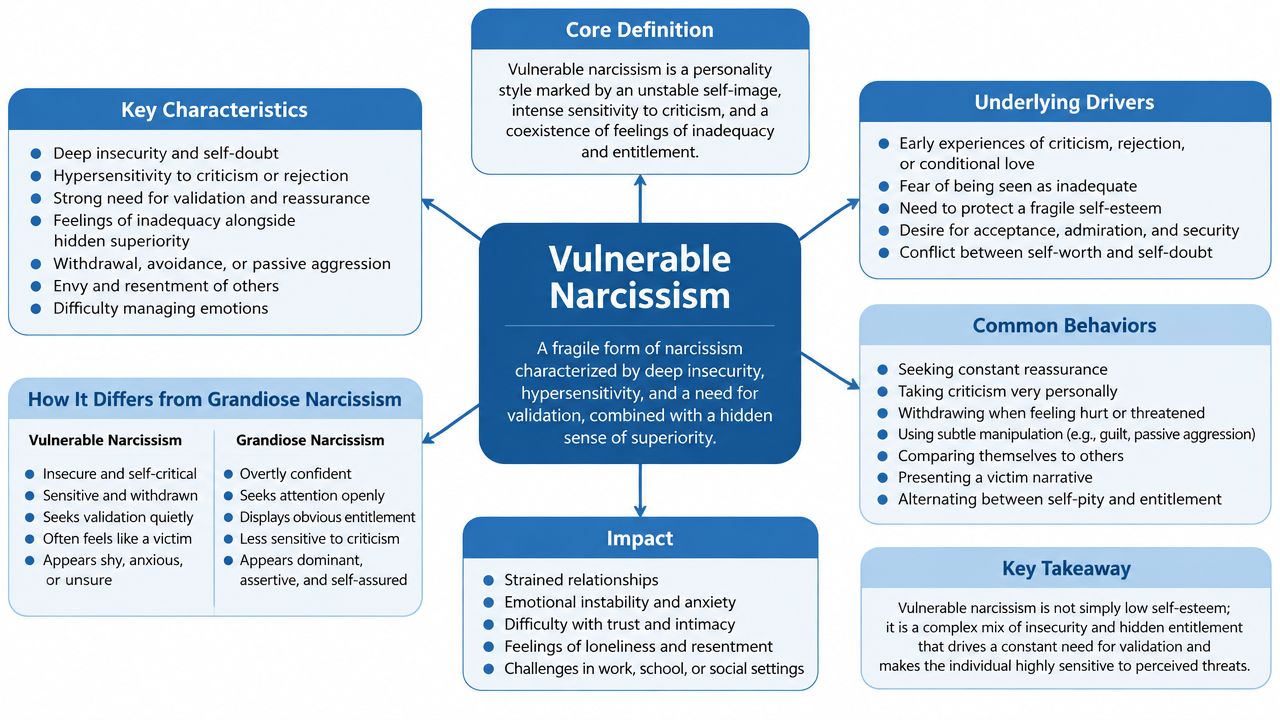
A person may seem quiet, self-critical, and easily hurt, yet still organize relationships around protecting a threatened sense of importance. Vulnerable narcissism describes this presentation: chronic shame, criticism sensitivity, withdrawal, emotional reactivity, and a fragile need to feel significant that may remain hidden beneath self-deprecation. It is a pattern of personality functioning, not a synonym for being introverted, anxious, or insecure.
While grandiose narcissism expresses entitlement through dominance, attention-seeking, overt self-enhancement, and visible demands for admiration, vulnerable narcissism channels similar needs through rumination, avoidance, resentment, and protection of a threatened self-image. These patterns can shift within one person. Someone may appear defeated and ashamed in one setting, then become controlling or dismissive when they feel more powerful.
A concept map, not a rigid category
Narcissistic traits exist along dimensions rather than in two sealed categories. Vulnerable and grandiose patterns can both involve entitlement, self-importance, reduced empathy under stress, and a strong need to stabilize self-esteem. The difference lies partly in how those needs are expressed. Vulnerable traits often become visible through shame, withdrawal, grievance, and preoccupation with perceived injury.
The Hypersensitive Narcissism Scale and later Narcissistic Vulnerability Scale research shows that researchers have developed multiple ways to measure these traits. The HSNS was introduced in 1997 as a 10-item self-report measure. The NVS was validated in 2018 as an 11-item adjective-based measure using a combined sample of 1,613 participants across three studies. These instruments support research and clinical discussion. A score cannot establish a diagnosis.
Where diagnosis fits
The DSM-5-TR does not list vulnerable narcissism as a separate diagnosis. Clinicians may understand it within the broader Narcissistic Personality Disorder framework while assessing severity, flexibility, impairment, and personality structure.
Rejection sensitivity alone does not establish narcissistic pathology. Intense responses to perceived criticism may also relate to rejection-sensitive dysphoria, anxiety, depression, trauma, ADHD-related emotional sensitivity, or several factors at once. A self-test can help organize experiences for a clinical appointment, but it cannot determine which explanation fits. Differential diagnosis requires attention to patterns across relationships, settings, and time.
Signs and Internal Experiences You Can Recognize
Vulnerable narcissism usually appears less like bragging and more like a repeated struggle to recover from perceived exposure. A casual comment can feel like a verdict. Neutral feedback can sound contemptuous. A delayed text can become evidence of rejection.
The 2022 clinical review by Miller and colleagues links vulnerable narcissism with introversion, anxiety, avoidance, anger, shame, depression, hostility, lower self-esteem, lower trust, and reduced relationship satisfaction in its review of the construct. It also describes reduced optimism, future orientation, agency, and personal-growth striving. Those findings help distinguish a broad pattern from simple introversion or a temporary dip in confidence.
The signs are behavioral, not just emotional
Shame sensitivity: After a minor correction, you may attack your own character rather than evaluate the specific behavior. You replay a casual email for tone errors, then avoid the colleague who sent it.
Defensiveness: A challenge may produce sulking, irritability, protest behavior, or an explanation that becomes much longer than the original disagreement. The goal often shifts from solving the issue to restoring your injured self-image.
Withdrawal: You may skip a gathering where comparison feels possible, decline a promotion that would increase visibility, or leave a group chat after assuming everyone noticed your mistake.
Ego-threatening criticism: Neutral feedback can feel personal when it implies you're ordinary, replaceable, or less competent than you hoped. The reaction may involve anger, shame, or a sudden conviction that the other person is unfair.
Covert grandiosity: Publicly, you may minimize yourself while privately imagining recognition as uniquely talented, morally superior, or finally understood. The fantasy isn't the diagnosis. The clinical question is whether it regulates a fragile sense of worth and fuels resentment when recognition doesn't arrive.
Pattern matters more than a single reaction
Everyone becomes defensive sometimes. A painful childhood, a humiliating workplace, or a difficult relationship can make anyone hyperalert to criticism. Vulnerable narcissism becomes more clinically relevant when the pattern is persistent, rigid, self-focused, and damaging to work, intimacy, or recovery after conflict.
If emotional intensity is a recurring concern, understanding why you may feel so emotional can help you describe the experience without prematurely assigning a personality label. The next question is not “Which checklist matches me?” It's “What explanation best accounts for the pattern over time?”
How Vulnerable Narcissism Differs From Anxiety, Depression, and Trauma
“Isn't this just anxiety?” Sometimes it is. “Could this be depression or trauma?” It could be. Vulnerable narcissism overlaps with internalizing conditions so substantially that a self-report questionnaire can't reliably settle the difference.
The distinction rests less on whether someone feels shame and more on what organizes the shame. In vulnerable narcissism, distress often follows a threat to status, specialness, admiration, or the preferred self-image. In social anxiety, fear centers more broadly on scrutiny and negative evaluation. In depression, worthlessness tends to spread across life rather than appearing mainly when self-esteem is challenged.
Feature | Vulnerable Narcissism | Social Anxiety | Major Depression | Trauma-Related Shame |
|---|---|---|---|---|
Primary threat | Injury to importance, competence, or specialness | Negative evaluation or embarrassment | Broad loss of worth, pleasure, energy, and hope | Danger, betrayal, helplessness, or moral injury linked to trauma |
Typical response | Shame, resentment, defensiveness, withdrawal, or devaluation | Avoidance, anticipatory worry, physical anxiety | Withdrawal, hopelessness, slowed functioning, and self-criticism | Avoidance, hypervigilance, intrusive memories, dissociation, or self-blame |
Interpersonal focus | Recognition, entitlement, grievance, and repair of self-image | Fear of being judged or rejected | Reduced engagement and reduced capacity for connection | Safety, trust, control, and trauma reminders |
Key clinical question | Does the person expect special consideration or become resentful when it's absent? | Is fear present even without a narcissistic injury? | Are symptoms pervasive across contexts and accompanied by depressive changes? | Are reactions tied to traumatic experiences and threat cues? |
Similar feelings can have different functions
A socially anxious adult may avoid a meeting because they fear embarrassment. A vulnerable narcissistic pattern may involve avoiding the meeting because being ordinary, corrected, or overlooked feels intolerable. A depressed adult may withdraw because effort feels pointless. A trauma survivor may withdraw because the setting resembles a prior threat.
These explanations can coexist. Someone may have trauma, depression, and narcissistic traits. The aim isn't to choose the most dramatic label. It's to identify the mechanisms that maintain suffering and determine which treatment targets them.
Research summarized in the clinical review notes that measures such as the Five-Factor Narcissism Inventory can have difficulty cleanly separating vulnerable narcissism from internalizing disorders. That limitation is one reason a longitudinal interview matters more than a viral quiz. A clinician needs to understand developmental history, relationships, mood changes, trauma exposure, coping strategies, and the person's ability to take responsibility.
For readers trying to distinguish post-traumatic symptoms from broader personality patterns, a careful discussion of complex PTSD versus PTSD can provide useful language, but neither a comparison table nor an online test can replace assessment.
A practical distinction: Ask whether the central problem is fear of danger, fear of rejection, loss of energy and hope, or collapse of a preferred self-image. The answer may be more than one.
Evidence-Based Treatments That Help
Treatment should target the processes sustaining distress rather than rely on a label alone. In vulnerable narcissism, these processes often include shame, emotional dysregulation, rigid self-evaluation, rumination, avoidance, and conflict patterns that protect self-esteem briefly while weakening relationships over time. Differential diagnosis still matters, because similar patterns can arise alongside depression, anxiety, or trauma.
Unified Protocol
The Unified Protocol, a transdiagnostic treatment for emotional disorders, may fit when vulnerable narcissism occurs with depression, anxiety, anger, or emotional volatility. A randomized controlled trial found that both the Unified Protocol and Schema Focused Therapy helped people with Narcissistic Personality Disorder. In that trial, the Unified Protocol reduced narcissistic vulnerability, anger, shame, and emotion dysregulation more than Schema Focused Therapy.
The trade-off is time and effort. UP asks patients to recognize emotional avoidance, approach uncomfortable experiences, and revise habitual interpretations. Reassurance alone will not address resentment, entitlement, or the fear attached to criticism, so the work can feel demanding for someone seeking immediate relief.
Schema Focused Therapy
Schema therapy examines enduring patterns such as defectiveness, emotional deprivation, mistrust, entitlement, and unrelenting standards. In narcissistic presentations, therapists may work with a defective or unlovable self-mode while addressing protective modes that seek admiration, punish vulnerability, or withdraw from relationships.
This approach can help when a person understands their reactions intellectually yet continues to repeat them. Its experiential and relational focus makes therapist fit important. Excessive confrontation can intensify shame, while reassurance without examination may preserve avoidance.
CBT and DBT-informed skills
Traditional CBT can challenge rigid beliefs such as “If I'm not exceptional, I'm worthless” or “Any criticism proves they want to humiliate me.” Behavioral experiments then test those assumptions in real interactions, where the person can observe whether criticism always signals rejection or humiliation.
DBT-informed work provides practical tools for emotion regulation, distress tolerance, mindfulness, and interpersonal effectiveness. These skills are useful when anger, withdrawal, or impulsive messages appear before reflection is possible. Guidance on DBT skills for emotional regulation can supplement individualized treatment, but it cannot replace assessment or a customized therapy plan.
Medication does not treat narcissistic personality itself. There are no approved medications for narcissism itself, so psychiatrists may treat co-occurring depression, anxiety, trauma symptoms, or severe irritability when medication is clinically appropriate. Meaningful personality change usually requires sustained psychotherapy, often over many months, with frequency and intensity adjusted to impairment and risk. Intensive outpatient care may suit severe disruption of functioning or safety concerns, while consistent outpatient treatment may be more appropriate in other cases.
Why Asking for Help Is So Hard and How to Start Anyway
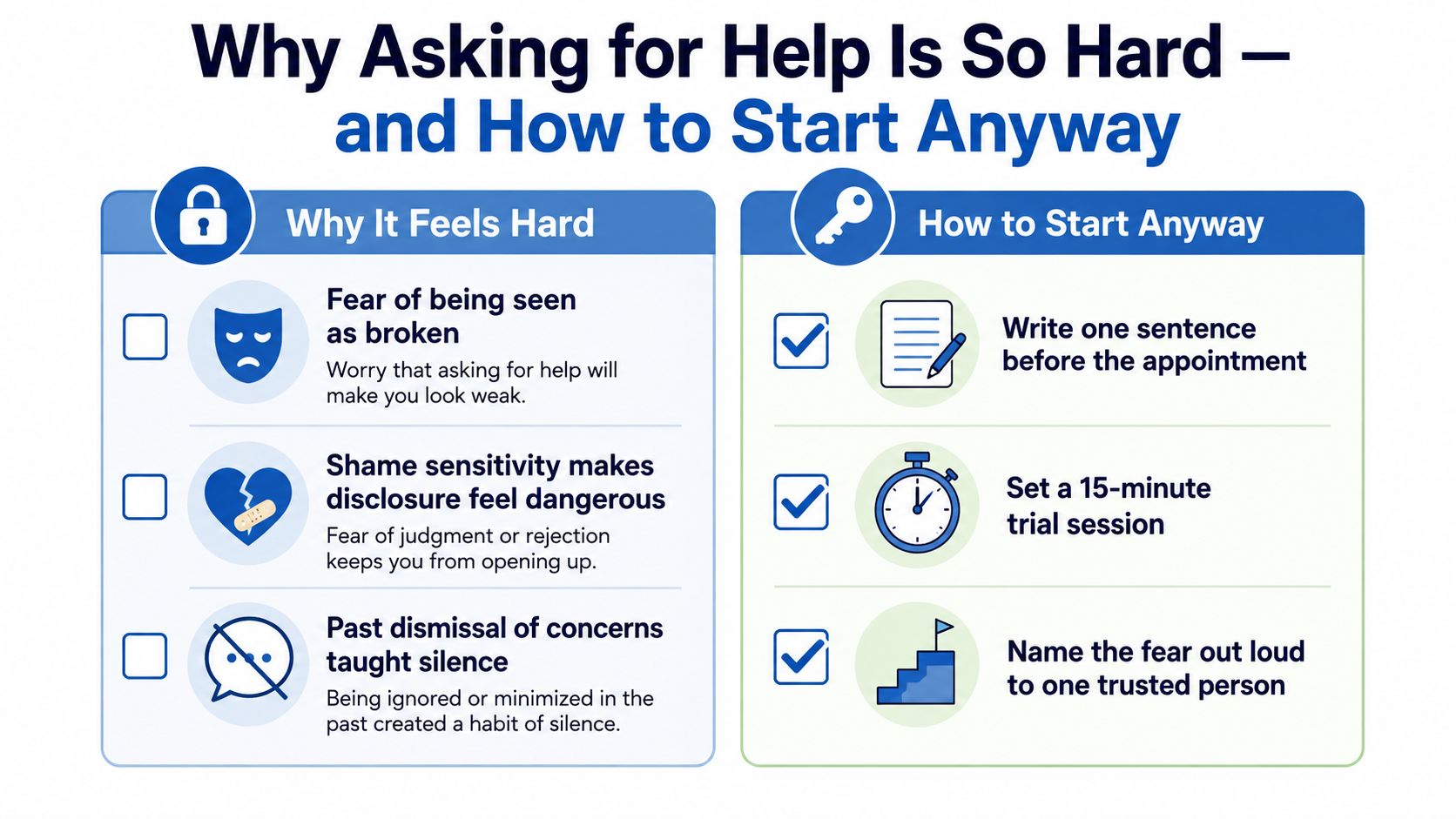
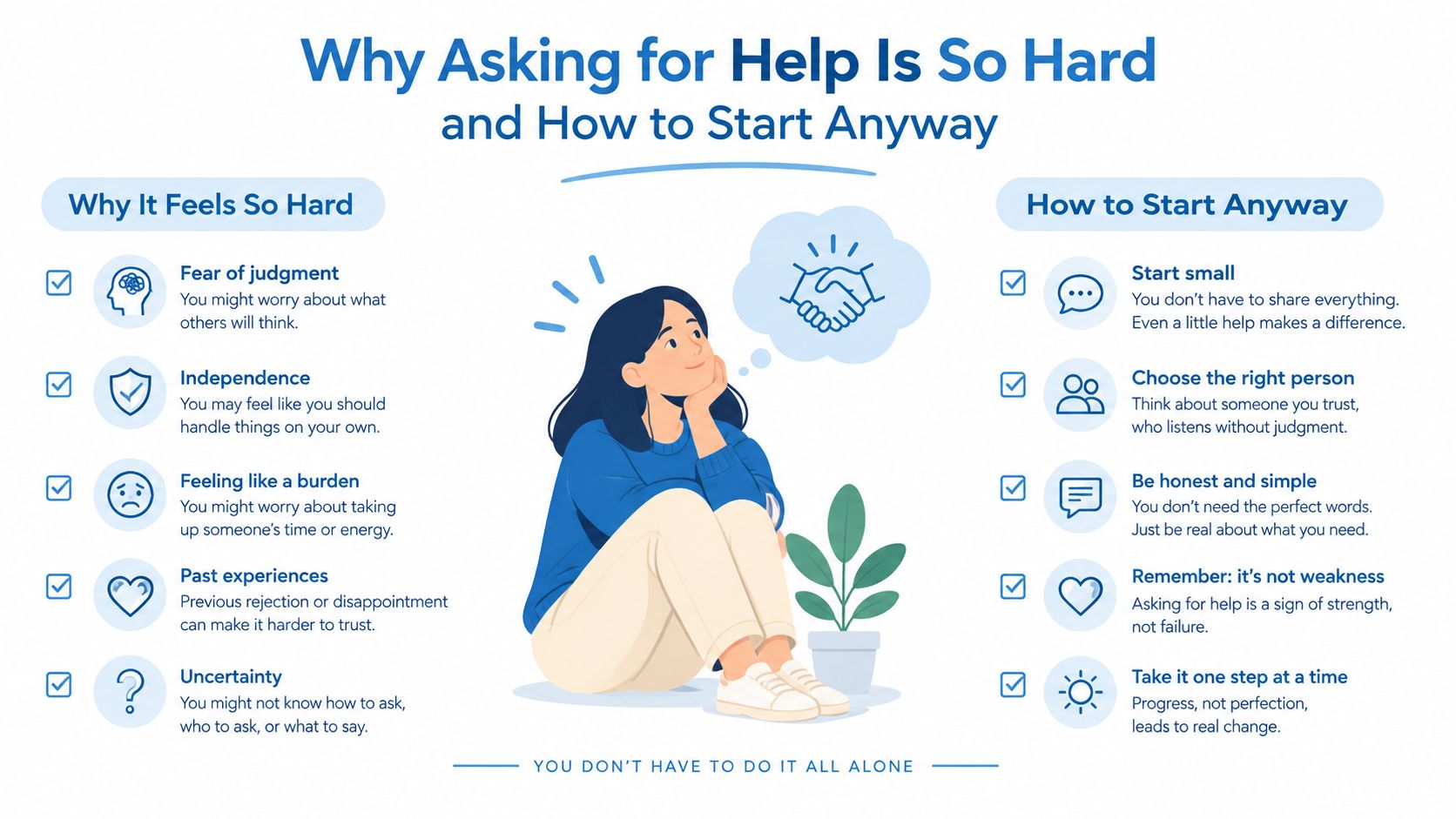
Reluctance to seek care is often part of the clinical picture, not a character flaw. Shame makes disclosure feel dangerous. Fear of being seen as broken encourages self-monitoring. Past experiences of being told to “be more confident” or “stop taking things personally” can teach a person to stay silent until distress becomes unmanageable.
A student may want help but worry that a clinician will judge their need for recognition. A caregiver may dismiss their own symptoms because other family members appear to have greater needs. Someone using telehealth may still delay an appointment because appearing on camera feels like another performance.
Start with a low-stakes action
A useful first step doesn't need to be dramatic:
Write one private observation. Record the trigger, the interpretation, the emotion, the behavior, and what happened afterward. “My supervisor corrected a sentence, I felt exposed, I stopped responding, and I resented the team” gives a clinician more useful information than “I'm a narcissist.”
Name the concern to a primary care clinician. You can ask for an evaluation of anxiety, depression, trauma symptoms, emotional reactivity, or relationship distress without requesting a personality diagnosis.
Book an assessment rather than promising treatment. The first appointment is an information-gathering process. You're not consenting to a label, medication, or a long-term commitment by showing up.
Say the feared sentence aloud. “I'm worried that asking for help will make me look defective” is clinically meaningful and gives the therapist a way to begin with validation before introducing change.
Validation-first care doesn't mean agreeing with every interpretation. It means acknowledging the emotional reality before examining the belief behind it. That balance is especially important when shame causes people to disengage quickly.
Telepsychiatry can reduce practical friction for Florida residents who struggle with office visits, although access and fit still depend on the clinician, insurance, scheduling, and clinical needs. If shame, avoidance, or previous dismissal has kept you stuck, barriers to mental health treatment are worth discussing directly rather than treating them as evidence that care won't work.
Taking the Next Step Toward Care
Understanding the pattern is useful only if it changes what you do next. Start with the problem you can describe clearly, not the label that feels most compelling. You might seek help for rumination after criticism, relationship conflict, depressive symptoms, panic, trauma reactions, or a persistent inability to recover from shame.
A practical route into treatment
Primary care consultation: Ask for an initial review of mood, anxiety, sleep, substance use, trauma history, and any physical factors affecting concentration or emotional regulation.
Licensed psychotherapy: Look for a clinician familiar with Unified Protocol, schema therapy, CBT, DBT-informed treatment, or trauma-focused care. Ask how they balance validation with accountability.
Psychiatric evaluation: A psychiatrist can assess co-occurring depression, anxiety, trauma-related symptoms, irritability, or other conditions that may respond to medication, psychotherapy, or both.
A first evaluation generally includes your history, current symptoms, relationships, functioning, previous treatment, safety concerns, and goals. The clinician should discuss competing explanations rather than just confirm an internet diagnosis. A treatment plan may include therapy, medication management when indicated, skills practice, or referral to a higher level of care.
For adults in Florida who prefer virtual appointments, Refresh Psychiatry & Therapy provides statewide telepsychiatry with board-certified psychiatrists and licensed therapists. The practice treats anxiety, depression, ADHD, PTSD, bipolar disorder, OCD, insomnia, and related mood and trauma conditions, with care options that can include psychiatric evaluation, medication management, and individual therapy.
Insurance coverage can vary by service and plan. Refresh Psychiatry & Therapy accepts Aetna, United Healthcare or UHC, Cigna, Blue Cross Blue Shield, Humana, Tricare, UMR, and Oscar insurance plans. Confirm current benefits and availability directly with the practice.
This blog is for informational purposes only and doesn't constitute medical advice. Please consult a qualified mental health professional for personalized guidance, and seek urgent help if you're at immediate risk of harming yourself or someone else.
Refresh Psychiatry & Therapy offers psychiatric evaluations, medication management, and evidence-based therapy for Florida adults dealing with shame, emotional reactivity, anxiety, depression, trauma symptoms, and relationship distress. Visit Refresh Psychiatry & Therapy to explore telepsychiatry care, insurance options, and an evaluation focused on your actual symptoms rather than a self-diagnosed label.