
Going Back on Antidepressants After Stopping: What to Know

You stopped your antidepressant because you were feeling steady, sleeping better, and ready to see how you'd manage without it. Then, days or weeks later, dizziness, strange electric sensations, anxiety, low mood, or hopelessness appeared. The difficult question is whether your brain is adjusting to the medication being gone or whether depression or anxiety is returning.
Going back on antidepressants after stopping can be a sensible clinical option. It isn't a personal failure, and it shouldn't be treated as an automatic decision either. The safest next step depends on the timing, the symptoms, the medication, the length of the treatment break, and your current health.
Why People Stop and What Happens Next
A common story sounds simple at first. Someone has taken an antidepressant long enough to feel stable, decides that they're ready to stop, and reduces or discontinues it. At first, nothing seems wrong. Later, they notice disrupted sleep, irritability, loss of motivation, or a heavy sadness that feels familiar. They may wonder whether stopping was a mistake.
Stopping can be a reasonable goal when it's planned with a prescriber. Treatment decisions change as symptoms, stressors, therapy, physical health, pregnancy plans, side effects, and personal preferences change. The problem usually isn't that someone wants to stop. The problem is trying to interpret what happens afterward without clinical support.
A large observational study followed 89,442 people who discontinued antidepressants. Within one year off medication, 35.8% restarted treatment, a measure the authors used as an indicator of relapse. Restart rates were 37.4% after treatment lasting under four months, 35.1% after four to six months, 35.0% after seven to nine months, and 32.8% after ten to twelve months (the observational study in PMC). The study also reported that 32,033 of 89,442 patients restarted within a year.
Those figures don't mean every person who restarts has relapsed. Some people restart because withdrawal is severe, because life circumstances change, or because they and their clinician decide that continued prevention is appropriate. They do show that returning to treatment is a familiar clinical path, not evidence that someone has failed at recovery.
A useful reframe: needing medication again is information about your current needs, not a verdict on your character.
People also look beyond prescription treatment while trying to understand their options. For a neutral overview of the research around nonprescription approaches, including limitations and unanswered questions, see these CBD depression studies from HempWell USA. CBD products shouldn't replace an individualized psychiatric assessment, particularly when symptoms are severe or medications may interact.
It also helps to question common assumptions about antidepressants, including the belief that stopping is always proof of wellness or that restarting is always a sign of dependence. Refresh Psychiatry's discussion of common antidepressant myths can provide additional context. The immediate priority, however, is identifying whether your symptoms resemble withdrawal, relapse, or something else.
Withdrawal Versus Relapse
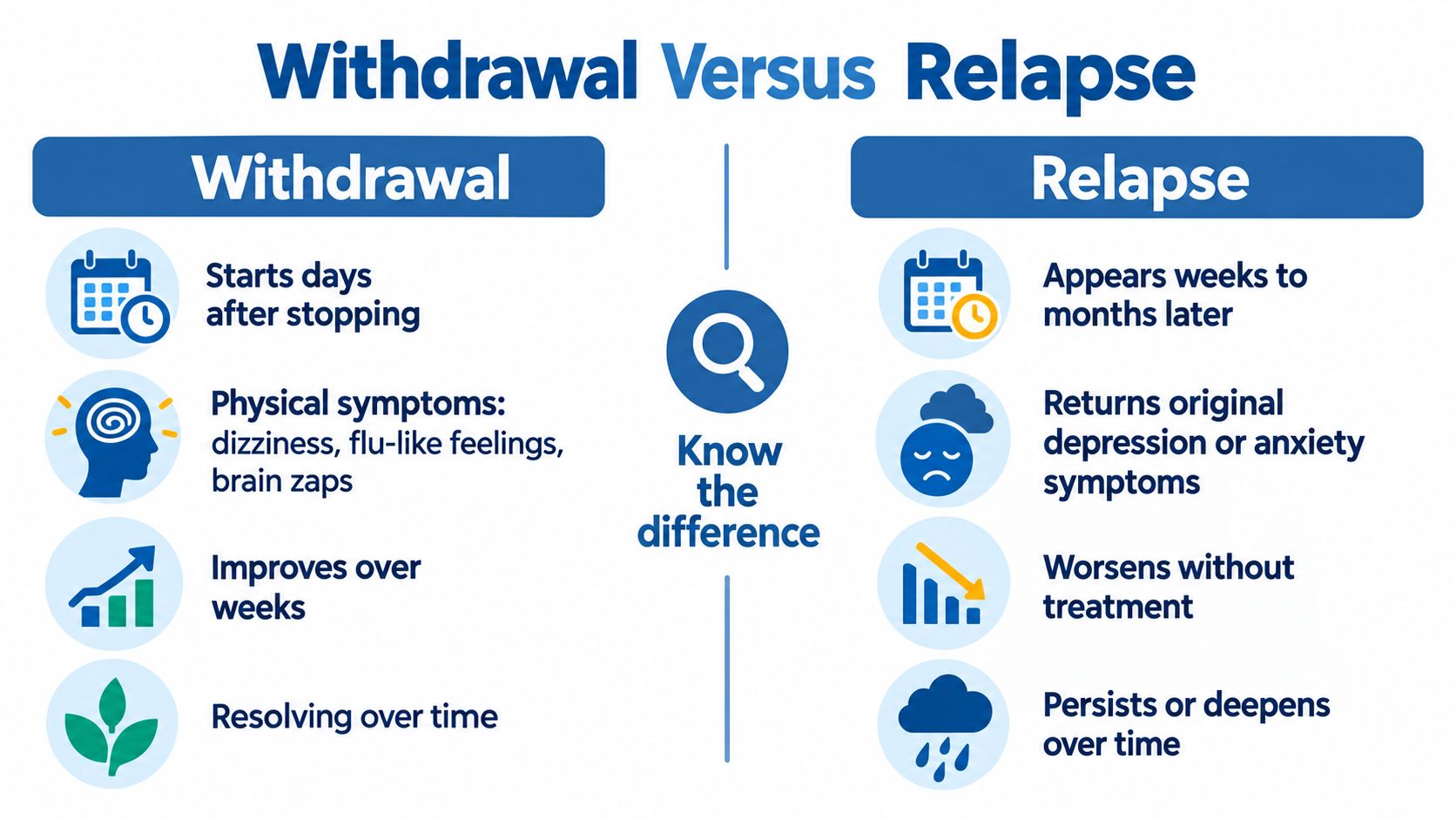
Withdrawal, also called antidepressant discontinuation symptoms, is a physiological response to reducing or stopping a medication. Relapse is the return of the depression or anxiety condition the medication had been treating. They can overlap, and the distinction matters because the appropriate response may differ.
Withdrawal often begins relatively soon after a dose reduction or missed medication. Dizziness, nausea, flu-like sensations, irritability, sleep disruption, and electric shock sensations commonly point clinicians toward discontinuation symptoms, especially when they appear alongside physical sensations that weren't part of the original illness. Relapse more often resembles the original pattern, such as persistent hopelessness, loss of interest, worsening guilt, impaired concentration, or a return of anxiety that increasingly disrupts daily life.
The timeline helps, but it doesn't diagnose the problem by itself. A person can experience withdrawal first and relapse later. Someone with depression may also describe physical symptoms, while someone experiencing withdrawal may feel emotionally distressed. Your clinician needs the medication history and symptom sequence, not just a single symptom.
What the evidence shows
The UK ANTLER randomized trial found that 56% of patients who discontinued long-term antidepressants relapsed over 52 weeks, compared with 39% who continued treatment. A separate health-technology assessment reported that 53% of those who discontinued chose to recommence antidepressants. Scottish real-world follow-up data found that, during a 52-week period, 56% of people who discontinued experienced depressive relapse, while 39% of that discontinuation group restarted antidepressants (the RACGP summary of this evidence).
These findings describe a population, not your personal forecast. They also don't tell us that every restart followed relapse. They show why clinicians take symptom return seriously and why stopping plans need monitoring rather than a single goodbye appointment.
Withdrawal can be temporary and may improve as the nervous system adjusts, while untreated relapse can persist or deepen. Yet waiting indefinitely for symptoms to pass isn't a sound strategy if you're becoming less functional, withdrawing from people, unable to work, or losing hope.
Questions that clarify the pattern
Write down the date of your last dose, the date symptoms began, and whether symptoms changed after missed doses or dose reductions. Describe the sensations in plain language, including dizziness, “brain zaps,” nausea, agitation, insomnia, sadness, panic, or loss of interest.
Compare the current experience with your pre-treatment illness. Ask whether the same thoughts, behaviors, and functional problems are returning, or whether this feels physically unfamiliar. A symptom diary can help your prescriber see a pattern that's difficult to reconstruct during a brief appointment.
For a more detailed discussion of symptom duration and clinical interpretation, read how long antidepressant discontinuation syndrome can last. If suicidal thoughts, psychosis, mania, or an inability to care for yourself appears, don't wait for the pattern to become clearer. Seek urgent help.
When to Consider Restarting Antidepressants
The decision to restart should answer two separate questions. First, are discontinuation symptoms severe enough to require relief? Second, has the treated condition returned enough to warrant renewed treatment? The same medication may be relevant to both questions, but the reasoning is different.
NICE advises that when severe discontinuation symptoms occur, the original antidepressant can be restarted at the previous dose and then reduced more slowly once symptoms resolve (NICE recommendations). Specialist guidance notes that discontinuation symptoms often resolve within about 24 hours after reinstatement. That rapid improvement can support the clinical impression that withdrawal is contributing, although it doesn't prove that relapse is absent.
Don't treat this as permission to restart from an old prescription without checking first. Your previous dose may no longer be appropriate, the medication may have expired, another clinician may have prescribed something that interacts with it, or your symptoms may now require a different assessment.
A practical decision path
Start with severity. Contact your prescriber promptly if symptoms are intense, rapidly worsening, or interfering with eating, sleeping, work, school, parenting, or basic self-care. Severe withdrawal deserves attention, and returning depression deserves attention too.
Then identify the sequence. Record when you reduced the dose, when you took the last tablet, and when each symptom began. Note whether the symptoms are physical, emotional, or both. Sudden dizziness and sensory disturbances soon after stopping may suggest withdrawal, while a progressive return of hopelessness and loss of pleasure may suggest recurrence.
Review what you've tried. List sleep changes, therapy, exercise, support from family, coping skills, and any other treatment. This isn't a test you need to pass. It gives your clinician useful information about what is helping and what isn't.
Bring the original treatment context. Tell the prescriber why you stopped, how well the medication worked, whether you had side effects, and whether you've had previous episodes. Include current medications, supplements, alcohol or substance use, medical changes, and pregnancy or contraception considerations when relevant.
Agree on a monitoring plan. A restart should include a clear follow-up arrangement, symptoms to track, expected benefits, side effects that require contact, and what to do if the medication doesn't help. Signs that an antidepressant dose may be too low can help you organize questions, but dose changes should be made with your prescriber.
Don't make the decision based on one bad day or one good morning. Look at the pattern, the level of impairment, and the risk of waiting.
If you have active suicidal intent, a plan to harm yourself, severe agitation, confusion, or symptoms of mania such as dramatically reduced need for sleep and unusually heightened or irritable energy, seek urgent psychiatric or emergency care. Those situations require more than a routine medication refill.
How to Restart Safely and Effectively
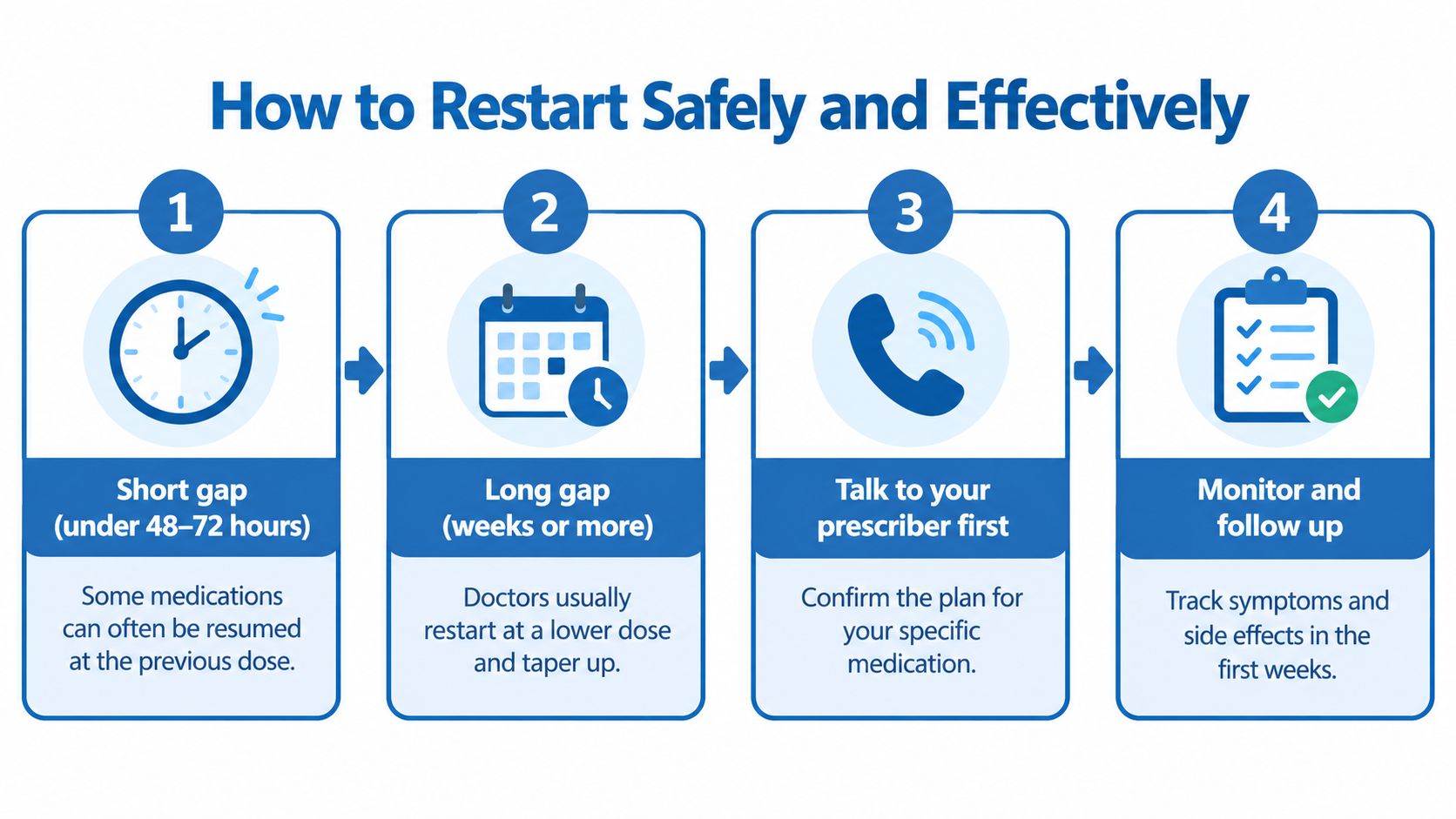
The most commonly missed detail is how long the medication break has lasted. Restarting after a brief interruption is not always handled the same way as restarting after weeks or months. The medication's half-life, formulation, previous dose, side-effect history, other prescriptions, and medical conditions all affect the plan.
Neutral psychotropic guidance describes a practical distinction. After a short gap of roughly 48 to 72 hours, some medications may be resumed at the previous dose for many patients. After a gap longer than one to two weeks, clinicians often treat the situation as a new initiation, using renewed titration and monitoring (guidance on restarting psychotropics after a treatment break). These are general principles, not a universal rule for every antidepressant.
The short-gap approach
A short gap may leave enough medication in your system that resuming the old regimen is clinically reasonable. That decision still depends on the drug, the dose, why doses were missed, and whether new medications or health conditions have appeared. Don't double a dose to compensate for missed medication unless your prescriber specifically tells you to.
A longer gap usually calls for a lower starting dose and gradual increases. This approach can reduce early side effects and lets the clinician see whether your current response resembles the original one. It also prevents the assumption that prior tolerance guarantees current tolerance.
The systematic review of antidepressant re-exposure found non-response rates ranging from 4% to 57% among studies of people who stopped and later restarted a previously effective antidepressant (the systematic review in PMC). A previously helpful medication may work again, work only partly, or fail to provide the same benefit. If recovery is incomplete, the clinician may reassess the diagnosis, adjust the treatment, or consider another medication rather than repeatedly increasing the dose without a plan.
Months later requires more caution
Restarting months after stopping deserves particular care. Recent professional guidance warns that resuming a withdrawn medication at a low dose can have unpredictable effects, including paradoxical worsening of symptoms, and emphasizes that many oral psychotropics should be treated as a new start after a longer interruption (the Therapeutics Letter on restarting psychiatric medication).
Before a telepsychiatry appointment, prepare a concise medication record:
Current treatments: Include prescriptions, over-the-counter medicines, supplements, and substances.
Previous regimen: Record the antidepressant name, dose, schedule, duration, and last date taken.
Past response: Note what improved, how long benefit took to appear, and whether symptoms returned during earlier changes.
Side effects: Include sexual effects, sleep changes, nausea, agitation, emotional blunting, or anything else that affected adherence.
Current pattern: Describe mood, anxiety, sleep, appetite, concentration, energy, safety concerns, and functional changes.
The aim isn't to recreate the old prescription automatically. It's to give your clinician enough detail to choose between reinstatement, a slower taper, a new start, a different treatment, or urgent evaluation.
This short video may also help you identify questions to bring to a medication-management visit.
A systematic review cautions that withdrawal can be confused with recurrence, leading to premature or unnecessary re-initiation. It supports tapering over weeks in most cases and, when symptoms emerge, resuming the antidepressant and tapering more gradually rather than stopping abruptly (the review of antidepressant discontinuation). If you're considering combinations such as Wellbutrin and Lexapro together, ask a prescriber to review the full regimen rather than relying on an old plan.
Safety, Follow-Up, and Getting Help in Florida
A restart plan should include supervision and follow-up, especially for adolescents, people with bipolar-spectrum symptoms, those taking several medications, and anyone with a history of severe depression, self-harm, psychosis, or medication sensitivity. Abruptly changing the dose can make symptoms harder to interpret and may create avoidable withdrawal or side effects.
A review in the British Journal of General Practice states that discontinuation symptoms usually resolve fully within about 24 hours after the original antidepressant is recommenced. It also recommends that severe withdrawal symptoms prompt increasing the dose to the lowest dose that prevented symptoms, followed by a slower taper (the review on recognizing and managing discontinuation symptoms). Your own clinician must determine whether that approach fits your medication and circumstances.
Safety boundary: Severe depression, suicidal thoughts, inability to function, hallucinations, extreme agitation, or possible mania calls for urgent professional assessment.
After reinstatement begins, track sleep, anxiety, mood, physical symptoms, activation, and daily functioning. Contact your prescriber if symptoms worsen, side effects become difficult to tolerate, or the medication doesn't seem to help. If you need help locating care, how to find a psychiatrist offers practical guidance.
Refresh Psychiatry & Therapy provides Florida telepsychiatry evaluations, medication management, therapy, and clinician-guided tapering or reinstatement planning for adults, children, and adolescents. The practice accepts Aetna, United Healthcare/UHC, Cigna, Blue Cross Blue Shield, Humana, Tricare, UMR, and Oscar insurance plans.
This blog is for informational purposes only and does not constitute medical advice. Please consult a qualified mental health professional for personalized guidance.
Refresh Psychiatry & Therapy can help you sort out withdrawal versus relapse, review your previous medication history, and create a monitored restart or tapering plan through telepsychiatry. Visit Refresh Psychiatry & Therapy or call (954) 603-4081 to schedule your evaluation.