
🧠 Online Psychiatrist Hollywood Florida: What to Know

You're sitting in your Hollywood home with a refill deadline approaching, wondering whether an online psychiatrist can provide the same thoughtful care as an office visit. Maybe your schedule makes an appointment across town difficult, or you're unsure whether your medication can legally be prescribed through telepsychiatry. Those are reasonable questions. Online psychiatric care isn't a video call and a prescription. The right process includes Florida licensure, a careful evaluation, secure technology, medication rules, follow-up planning, and a clear answer about insurance.
Why Hollywood Residents Are Choosing Online Psychiatry
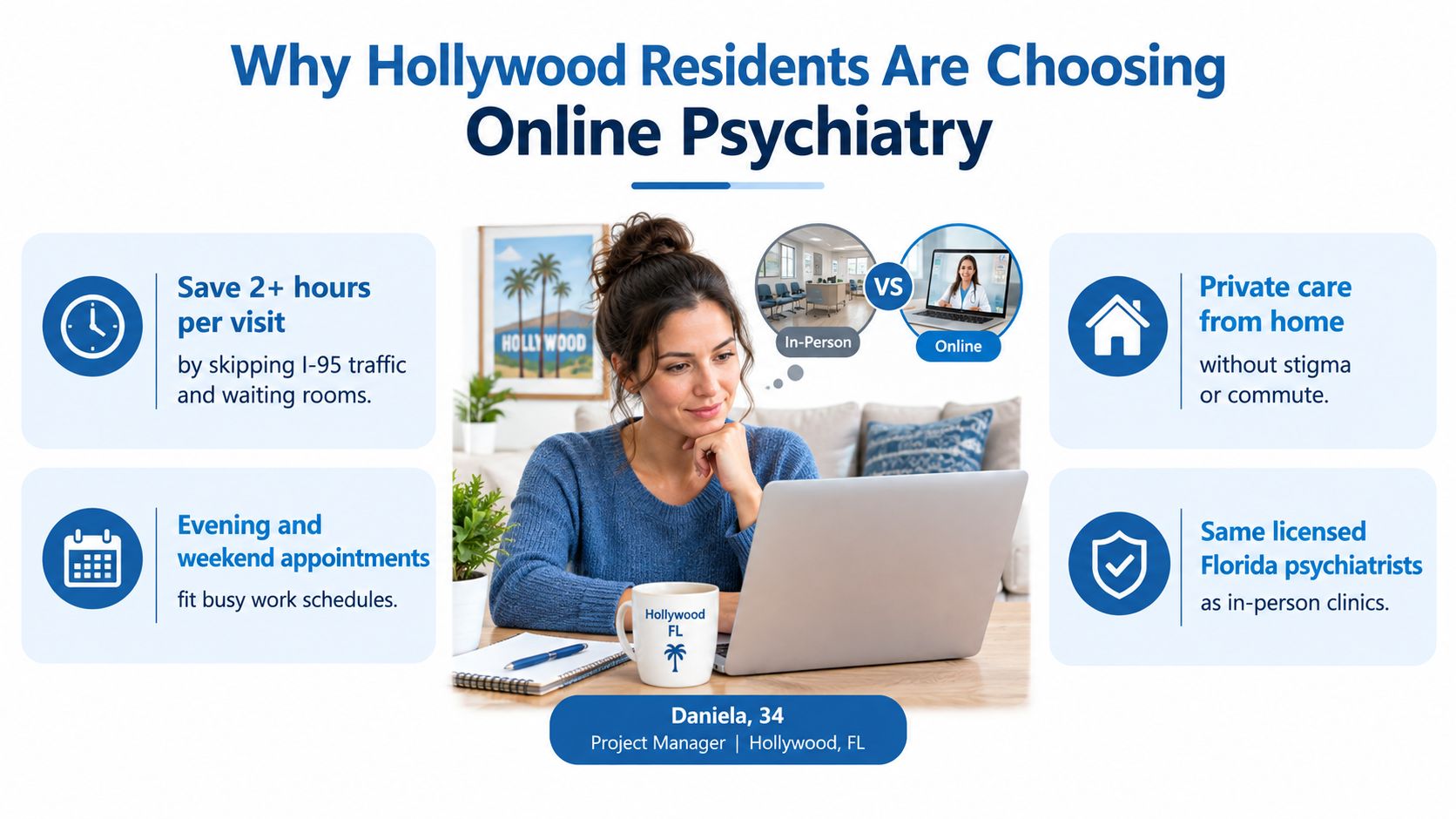
Daniela is a 34-year-old project manager living near Hollywood Boulevard. After waiting eight weeks for an in-office psychiatric appointment, she's sitting in traffic on US-1 while watching her refill window get shorter. Her appointment is only fifteen minutes long, but the trip involves parking, waiting-room time, and arranging coverage for work. She's now debating whether to drive across town or meet a psychiatrist from her living room.
That decision reflects the practical pressures many Hollywood residents face. Traffic on I-95 and A1A, childcare and eldercare responsibilities, inflexible work schedules near Port Everglades, and South Florida weather can all turn a routine appointment into a complicated outing. A private online visit may fit more naturally between work responsibilities, school pickup, or care for a family member.
Florida's behavioral-health system demonstrated how quickly virtual care could scale. By April 2020, one statewide assessment reported that behavioral-health telehealth use had risen more than 3,000%, from 842 to 29,173 instances, and that more than 30% of services delivered by the measured providers had moved to telehealth that month. The Florida behavioral-health assessment describes the foundational shift that made virtual psychiatric care a mainstream delivery channel rather than a temporary experiment.
Florida also has substantial unmet need. A Florida behavioral-health planning document reports that 23% of Florida adults, about 3.3 million people, have a mental-health need, while nearly 40% of school-aged children and youth ages 6 to 17, about 920,000 children and adolescents, have a mental-health need. The same source cites pre-pandemic data showing that 17.5% of Florida adults had a mental illness. Another report summarized in that document placed Florida 49th nationally for access to mental-health care and described per-person mental-health treatment spending of $36.59.
For Daniela, the question isn't whether online care sounds convenient. It's whether a licensed psychiatrist can evaluate her properly, prescribe within Florida and federal rules, protect her information, and provide continuity after the first appointment. A detailed telehealth psychiatrist guide should answer those questions directly.
How Online Psychiatry and Telepsychiatry Actually Work
Think of telepsychiatry as a private medical office that travels through a secure connection. The conversation remains clinical and personal, just as it would across an exam-room table. The difference is that the patient and psychiatrist meet through protected audio and video rather than in the same physical room.
Online psychiatry refers to psychiatric evaluation and treatment delivered through digital appointments. Telepsychiatry is the psychiatric branch of telemedicine. A psychiatrist is a medical doctor who can assess symptoms, diagnose mental-health conditions, prescribe when clinically and legally appropriate, and monitor medication. Teletherapy focuses on psychotherapy, such as cognitive behavioral therapy, coping skills, or trauma work. Some patients need one service, while others benefit from coordinated medication management and therapy.
The technology behind a virtual visit
A typical Florida video appointment follows a sequence that resembles entering a secure bank vault:
You open a protected connection. The practice sends a browser link or app invitation. You join from a phone, tablet, or computer in a private space.
The practice verifies who and where you are. Staff may confirm your identity with photo identification, review your medications, and verify your current physical location. You must be physically located in Florida during the appointment, even if you're traveling temporarily.
The platform protects the conversation. HIPAA compliance depends on the communication method. A standard landline audio-only call is treated differently from VoIP, mobile, or internet-based calling. Platforms used for virtual care generally need encryption and a Business Associate Agreement, as explained in this telemedicine compliance resource.
The psychiatrist documents the encounter. The clinician records the history, assessment, diagnosis, prescriptions, and follow-up plan in a secure electronic health record, not on a personal device.
Before treatment begins, you may also complete electronic consent. A plain-language resource about patient consent with BoloSign from Closer Innovation Labs Corp. can help explain what telehealth consent commonly covers, including privacy, technology limits, and the patient's agreement to participate.
A secure platform doesn't replace clinical judgment. It creates the protected room in which the clinical work occurs. The telemedicine psychiatry overview provides additional context for patients comparing virtual and in-person care.
Conditions Treated and Services Available Online
Psychiatry translates well to video because many psychiatric decisions depend on conversation, observation, history, symptom patterns, and medication response rather than the hands-on examination used in cardiology or orthopedics. A psychiatrist can observe speech, attention, thought organization, emotional expression, and behavior while asking detailed questions about daily functioning.
Refresh Psychiatry addresses common concerns through telemedicine, including:
Depression: Low mood, loss of interest, guilt, low energy, and related changes in functioning.
Anxiety disorders: Persistent worry, social anxiety, health anxiety, and physical tension.
Panic disorder: Recurrent panic episodes and fear of their return.
ADHD: Attention, organization, impulsivity, and executive-function difficulties.
Bipolar disorder: Mood episodes involving depression, high mood, reduced need for sleep, or increased activation.
PTSD: Trauma-related memories, avoidance, hypervigilance, and emotional distress.
OCD: Obsessions, compulsions, and the cycle that maintains them.
Postpartum mood changes: Depression, anxiety, intrusive thoughts, and mood symptoms after childbirth.
Sleep difficulties linked to mood: Insomnia or disrupted sleep occurring alongside anxiety, depression, or another psychiatric condition.
The services work best as a coordinated plan rather than as unrelated appointments.
How the pieces fit together
An initial psychiatric evaluation establishes the history, diagnostic possibilities, current risks, previous treatment response, and baseline symptoms. Medication management then focuses on refills, side effects, dose adjustments, and the timing of follow-up. Therapy addresses behavioral patterns, emotional regulation, coping skills, relationships, and practical changes that medication alone may not resolve.
Service | Primary Conditions Addressed | Typical Format |
|---|---|---|
Psychiatric evaluation | Depression, anxiety, ADHD, bipolar disorder, PTSD, OCD, postpartum mood changes | Comprehensive video assessment |
Medication management | Mood, anxiety, attention, trauma, and sleep-related symptoms | Follow-up visits with prescription review |
Individual therapy | Anxiety, depression, trauma, coping, relationships, and behavior patterns | Scheduled psychotherapy sessions |
Coordinated care | Conditions requiring medication and therapy together | Shared treatment plan and ongoing monitoring |
When one clinical team coordinates these elements, a medication adjustment can reflect what's happening in therapy, sleep, work, school, and relationships. That reduces the chance that separate providers make decisions without seeing the same picture. Patients should also understand situations that may need another setting, which is why conditions that may not fit telehealth psychiatry deserve careful review.
What Your First Online Psychiatry Visit Looks Like
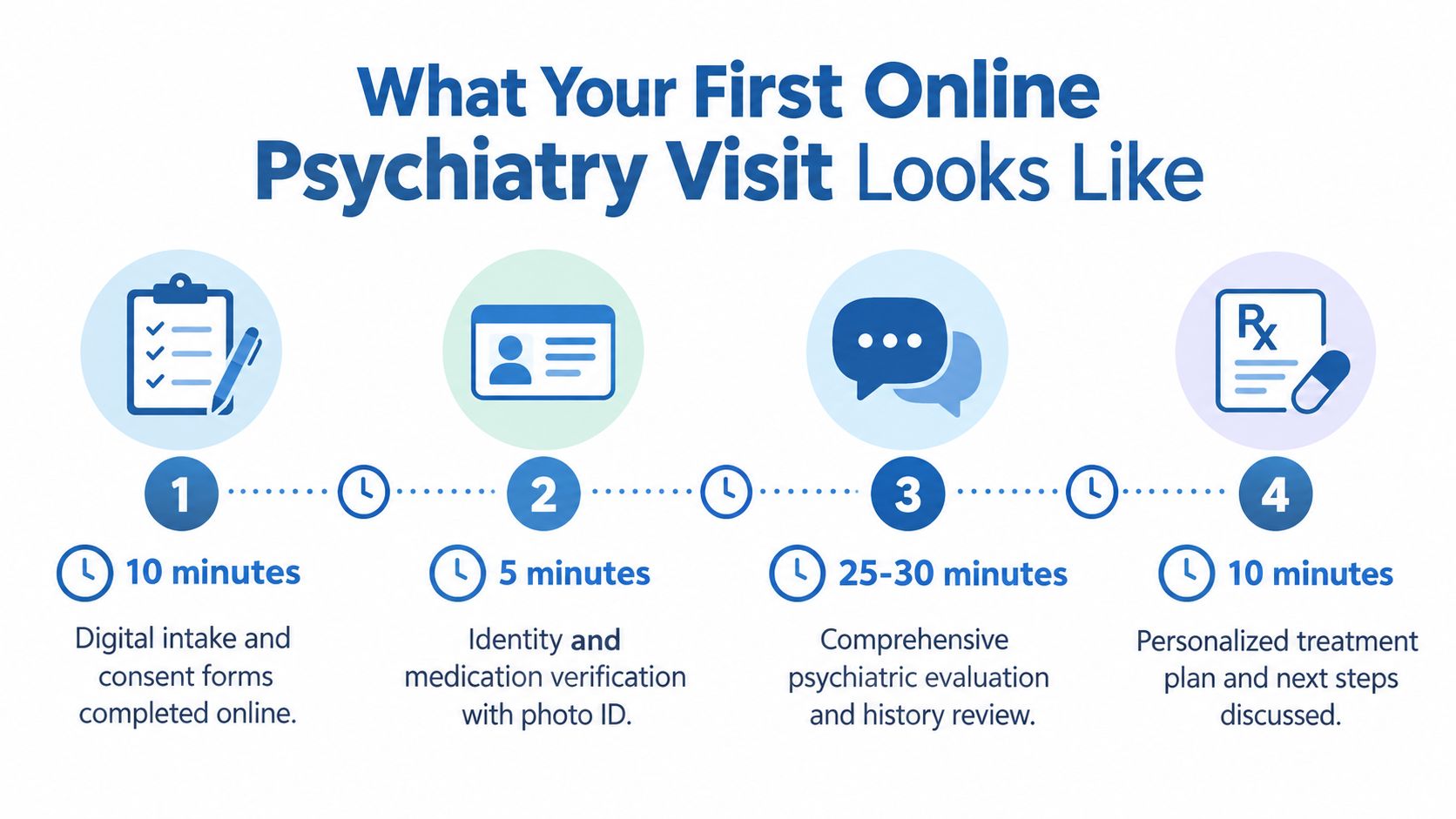
A first appointment should feel structured, not rushed. The exact timing varies by practice and clinical complexity, but a typical visit can be organized into four stages.
The opening paperwork
The first 10 minutes may involve digital intake forms and consent documents. You'll enter contact details, symptoms, medical history, pharmacy information, prior treatment, and emergency contacts. Completing these forms carefully gives the psychiatrist more time to focus on the clinical conversation.
The next 5 minutes typically cover identity and medication verification. Keep a photo ID, prescription bottles or an accurate medication list, your pharmacy details, and relevant prior records nearby.
The psychiatric evaluation
The video evaluation commonly takes 25 to 30 minutes, although a complex history may require more time. The psychiatrist may ask:
When did the symptoms begin?
What was happening in your life when they started?
What makes them better or worse?
How are mood, sleep, appetite, energy, concentration, and motivation changing?
Has anyone in your family experienced depression, bipolar disorder, ADHD, addiction, or suicide?
What medications, supplements, alcohol, cannabis, nicotine, or other substances do you use?
Which psychiatric medications have you tried, at what doses, and for how long?
Have you had therapy, hospitalization, self-harm thoughts, or previous psychiatric diagnoses?
These questions aren't a test you can fail. They help distinguish overlapping conditions. Trouble concentrating, for example, can arise from ADHD, depression, anxiety, insomnia, medication effects, or more than one issue.
Diagnosis and the written plan
The final 10 minutes may focus on discussing diagnostic impressions, treatment choices, risks, alternatives, and next steps. The plan might include medication, therapy, additional records, laboratory coordination with another clinician, or a decision to gather more information before assigning a diagnosis.
Florida's telehealth framework provides a specific prescribing pathway for Schedule II controlled substances when they're prescribed to treat a psychiatric disorder, as described in this Florida online psychiatry prescribing explanation. That doesn't mean every medication is appropriate or automatically available online. Federal requirements, state rules, clinical judgment, pharmacy policies, and documentation still matter.
Ask the practice whether a refill is handled the same day or within 48 hours, and whether appointments occur weekly during stabilization, biweekly during adjustment, or monthly once stable. Those schedules are examples of common clinical planning, not guarantees.
Prepare before you click: Choose a quiet room, charge your device, write down every medication, and keep your pharmacy and photo ID within reach.
Insurance Coverage and HIPAA Rules in Florida
Insurance coverage and privacy are separate questions. A platform can be secure while a plan applies a copay, deductible, or out-of-network rule that you didn't expect. Conversely, an insurance card doesn't tell you whether the provider's video system handles health information appropriately.
Florida generally doesn't require insurers to cover telehealth or reimburse telehealth claims at the same rate as in-person care. Reimbursement is generally governed by voluntary contracts between providers and insurers, and lower telehealth payment terms must be agreed to in writing, according to this Florida telehealth reimbursement overview. Ask whether the clinician is in network, what your estimated patient responsibility is, and whether authorization is required.
Refresh Psychiatry's published network information includes Aetna, United Healthcare or UHC, Cigna, Blue Cross Blue Shield, Humana, Tricare, UMR, and Oscar. The list can change, and coverage depends on your specific policy, so verify benefits before scheduling. Medicare rules also have their own mechanics. Traditional Medicare Part B paid telehealth at the same rate as in-office care through December 31, 2023, while current rules include an in-person visit requirement for certain home-based sessions beginning October 1, 2025, as summarized by the Florida Academy of Family Physicians.
Plan Category | Examples Accepted by Refresh Psychiatry | Telehealth Coverage | HIPAA Requirement |
|---|---|---|---|
Commercial insurance | Aetna, UHC, Cigna, Blue Cross Blue Shield, Humana, Oscar | Confirm benefits and network status | Secure platform and Business Associate Agreement |
Employer-linked coverage | UMR and other participating networks | Confirm copay, deductible, and authorization | Encrypted communication and controlled access |
Military coverage | Tricare | Verify regional plan and behavioral-health benefits | Protected clinical records |
Self-pay or other coverage | Ask the practice about available options | Confirm price before the appointment | Same privacy safeguards apply |
HIPAA protection depends on the platform and workflow. Legitimate telehealth systems commonly use encryption, a signed Business Associate Agreement, access controls, audit logs, and recording restrictions. Don't assume that FaceTime or Facebook Messenger is suitable for a clinical appointment because the call is private between two people.
Use this short check before your visit:
Coverage: Ask whether the clinician is in network for your exact plan.
Cost: Confirm copay, deductible, coinsurance, self-pay pricing, and cancellation rules.
Location: Tell the practice where you'll physically be during the appointment.
Security: Confirm the platform is designed for HIPAA-covered care.
Prescribing: Ask how medication and controlled-substance policies apply to your situation.
The online psychiatrist insurance guide can help you prepare those questions.
How to Choose the Right Online Psychiatrist in Florida
A polished website isn't enough. Choose a clinician by checking the same practical details you'd review before entering any medical practice.
Four checks that matter
1. Verify Florida authority. Confirm an active Florida license through the Department of Health portal. If controlled-substance prescribing may be relevant, ask whether the clinician has the required DEA registration and understands the applicable federal and state requirements.
2. Review psychiatric credentials. Look for board certification in psychiatry and experience with the condition you want assessed. Child, geriatric, or addiction psychiatry training may matter more than a generic promise of online convenience when the patient is a child, an older adult, or someone managing substance-use concerns.
3. Inspect the care platform. The practice should explain how it verifies identity, protects the video connection, stores records, limits access, and handles technical failures. A signed Business Associate Agreement with the technology vendor is an important part of a HIPAA-covered workflow.
4. Ask about the difficult moments. Find out how appointments are scheduled, how refills are requested, what happens when the clinician is unavailable, and how urgent concerns or crises are handled. Transparent policies are more useful than vague claims about immediate access.
Warning signs
Be cautious if a prescriber issues a diagnosis and medication after only a few minutes, hides the license number, uses an unencrypted consumer video app, or refuses to coordinate with your primary care physician. A responsible psychiatrist should be willing to explain uncertainty, discuss alternatives, review records, and communicate with other clinicians when you authorize that collaboration.
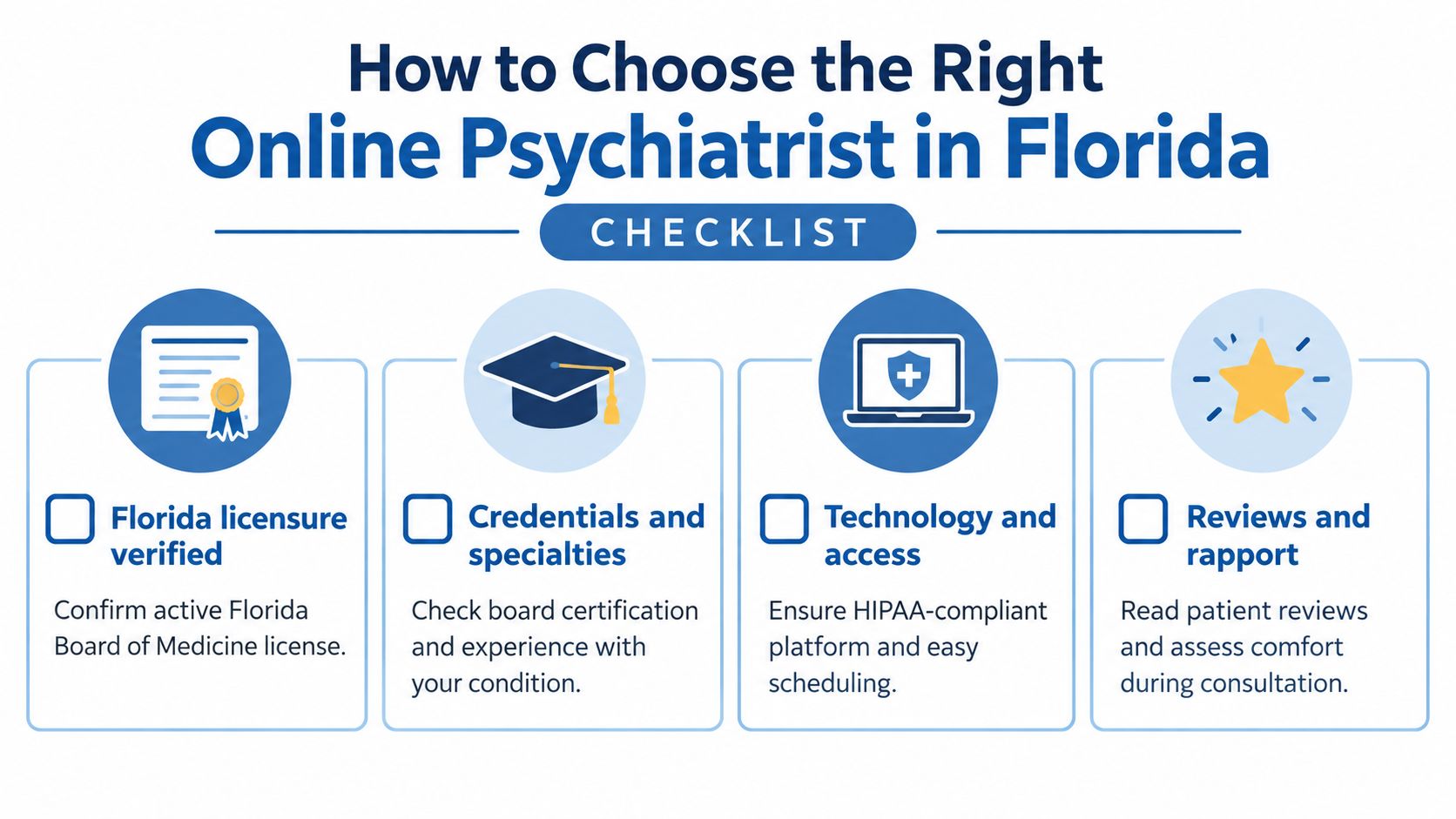
Use the checklist as a self-score. Refresh Psychiatry & Therapy is one Florida telepsychiatry option that provides psychiatric evaluations, medication management, therapy, and statewide virtual visits. Compare its published licensure information, insurance participation, appointment process, privacy practices, and crisis policy with other providers before choosing.
Schedule Your Evaluation with Refresh Psychiatry
A Hollywood resident may be deciding whether an online evaluation can lead to careful diagnosis, safe treatment, and follow-up that fits work, family, and daily life. Telepsychiatry can take place from home, an office, or another private location in Broward County. You must be physically in Florida during the appointment and able to speak confidentially.
Refresh Psychiatry & Therapy provides HIPAA-compliant telemedicine evaluations throughout Florida. Call (954) 372-7571, submit an online request form, or message the front desk. Listed insurance plans include Aetna, Blue Cross Blue Shield, Cigna, Florida Blue, UnitedHealthcare, Humana, and self-pay. Confirm your benefits before the first visit, since coverage and your portion of the cost depend on your policy.
The booking sequence
Choose an appointment slot. Set aside enough time to remain somewhere quiet and private.
Complete the digital intake. Share your psychiatric history, current medications, previous treatment, and available records.
Attend the video evaluation. Join from a phone or laptop through the practice's secure process.
Review the plan. The practice states that patients may receive a written treatment plan within 48 hours, depending on the clinical workflow and the information required.
The psychiatric evaluation service can be a starting point for an initial diagnosis, medication review, therapy recommendations, or a combined plan. Bring medication bottles or a current list, pharmacy details, your insurance card, photo ID, and relevant records. Parents and caregivers should prepare examples from home, school, work, or relationships. Specific examples give the clinician a clearer picture than trying to recall everything during the visit.
Adults can request an evaluation for anxiety, depression, ADHD, PTSD, insomnia, or mood symptoms. Parents and caregivers can ask about child and adolescent services. Students may discuss academic stress, sleep, attention, mood, or relationships. The clinician will determine whether virtual care suits your needs and what level of support is appropriate.
Refresh Psychiatry & Therapy offers Florida telepsychiatry for psychiatric evaluations, medication management, therapy, and coordinated mental-health care. Contact us to schedule, or call Refresh Psychiatry at (954) 603-4081. The practice accepts Aetna, United Healthcare or UHC, Cigna, Blue Cross Blue Shield, Humana, Tricare, UMR, and Oscar insurance plans. This blog provides information, not medical advice. Consult a qualified mental-health professional for personalized guidance.