
🛌 Postpartum Male Depression: A Father's Guide

About 8.75% of fathers experience postpartum depression during the first year after birth, according to a large meta-analysis of paternal cases worldwide (PubMed). That makes postpartum male depression common, clinically significant, and easy to miss, especially when a father's distress appears as anger, overwork, emotional numbness, or avoidance rather than visible sadness.
I treat fathers regularly, and the same pattern appears repeatedly. A man says he's exhausted, but the problem is that he no longer enjoys anything. A partner reports that he's “just irritable,” while he's privately drinking to sleep and wondering whether his family would be better off without him. These aren't character flaws or proof that he's failing at fatherhood. They can be signs of a depressive illness that requires assessment.
Why Postpartum Male Depression Deserves Its Own Conversation
A widely cited analysis found that paternal depression reached 25.6% during the 3 to 6 month postpartum period, while the broader estimate across 43 studies in 16 countries was 10.4% overall (foundational review of paternal postpartum depression). The important point isn't that every new father becomes depressed. It's that postpartum male depression is common enough to demand routine attention, and the period when symptoms may be strongest often arrives after the early newborn visits have ended.
Clinically, I don't view this as a maternal disorder that occasionally spills over onto dads. Paternal postpartum depression is its own perinatal mental health condition, with its own symptom patterns, barriers to disclosure, and screening problems. Fathers can become depressed during pregnancy or after birth, whether they're biological fathers, non-gestational parents, or adoptive parents. The arrival of a child can intensify biological vulnerability, role disruption, financial pressure, sleep loss, and relationship strain.
The family consequences make this a public health issue. Paternal depression has been associated with later child emotional and behavioral difficulties, as well as deterioration in the couple relationship. Those associations remain clinically important even when the mother's mood is considered, because a father's untreated depression changes how he communicates, responds to stress, and participates in caregiving.
Practical rule: If a father's behavior has changed for weeks, evaluate the change instead of explaining it away as normal new-parent exhaustion.
That evaluation starts with language that fathers recognize. A clinician should ask about anger, withdrawal, work, alcohol, risk-taking, physical symptoms, bonding, and hopelessness, not only whether the patient feels sad. This guide addresses what the condition is, how it presents differently, why standard screens miss it, which risks matter, how treatment works, what partners can do, and how Florida fathers can access telepsychiatric care. Grief and major life transitions can overlap with depression, and disenfranchised grief may also deserve attention when a new father feels loss that others don't recognize.
What Postpartum Male Depression Actually Is
Postpartum male depression, also called paternal perinatal depression or paternal postpartum depression, is a depressive episode occurring during pregnancy or within the first year after a child's birth. A clinician applies standard diagnostic criteria, including persistent mood or loss of interest and associated cognitive, physical, or behavioral symptoms that cause meaningful impairment.
That definition separates depression from the ordinary strain of caring for a newborn. Sleep deprivation can make anyone impatient. Adjustment disorder can develop when a major life change produces distress that doesn't meet full criteria for another disorder. The so-called baby blues are generally brief and self-limited, while depression persists and affects functioning. A father doesn't need to be crying every day to meet criteria.
Timing is broader than most families expect
Paternal symptoms often build gradually. A large review found the highest prevalence in the 3 to 6 month postpartum window, and another NIH-indexed review describes depression developing across the first year rather than only during the first four weeks (NIH review of paternal postpartum depression timing). A separate pooled analysis estimated 7.82% at 1 to 3 months and 9.23% at 3 to 6 months (meta-analysis indexed by PubMed).
This timing creates a practical trap. Everyone asks about the baby during the first weeks, but fewer people ask the father how he's functioning once the initial support fades. By the time he presents, the family may have adjusted to his withdrawal or anger, and he may describe the problem as relationship conflict rather than depression.
The causes rarely fit one category
Postpartum male depression can involve biological, psychological, and relational processes at the same time. Hormonal changes may affect vulnerability, while disrupted sleep and altered responsibilities reduce coping capacity. Attachment stress can make a father feel disconnected from the infant, and relationship conflict can then reinforce shame and avoidance.
Recent syntheses estimate postnatal prevalence at 8.75% in men, while pooled estimates vary substantially with case definition and timing, reaching 24.06% in some reviews (2024 systematic review). Those differences don't mean the condition is unreliable. They show why clinicians must interpret a screening score alongside symptoms, duration, impairment, and safety.
For fathers who recognize persistent symptoms, treatment of postpartum depression should be discussed with a qualified professional rather than postponed until the child is older.
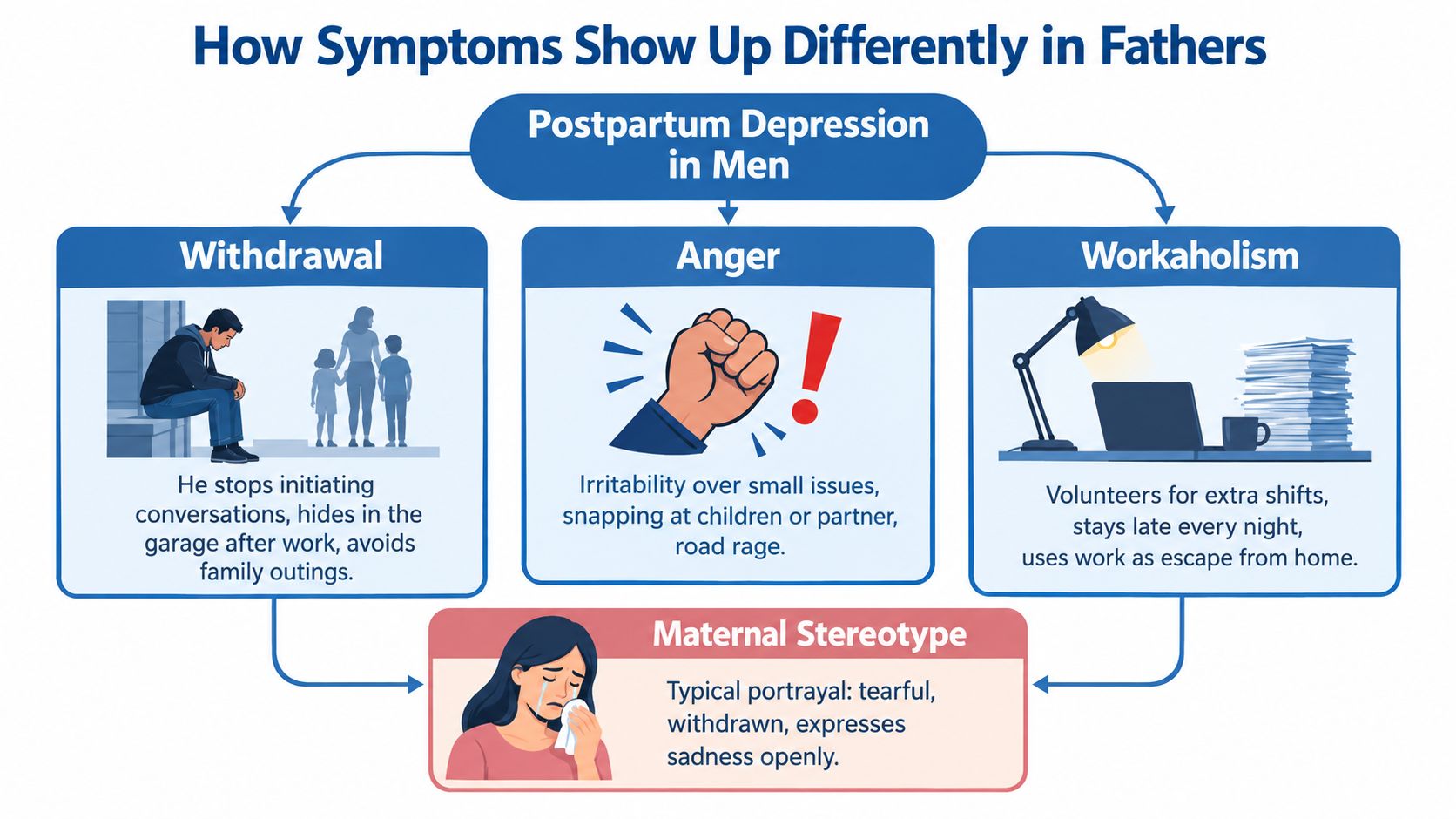
How Symptoms Show Up Differently in Fathers
A father may satisfy the clinical picture of depression without ever saying, “I'm depressed.” In practice, I often hear about behavior first.
One new father buried himself in overtime. He volunteered for extra shifts, stayed late, and arrived home after the baby was asleep. His explanation was that the family needed the money. Further assessment showed that work also gave him a reason to avoid a home environment where he felt incompetent, disconnected, and ashamed.
Another father became increasingly irritable. Small household decisions triggered shouting, door-slamming, and road rage. He denied sadness and insisted that everyone else was unreasonable. Yet he had lost interest in friends, slept poorly even when the baby was quiet, struggled to concentrate, and felt persistently hopeless.
A third father started drinking after bedtime feeds. He called it a way to “take the edge off,” but the alcohol worsened sleep, increased emotional distance, and made morning caregiving harder. He felt numb rather than tearful and had begun avoiding time alone with his child.
The behavioral proxies matter
Fathers may show:
Externalized distress: Anger, impatience, cynicism, or explosive reactions can replace openly reported sadness.
Avoidance: Work, gaming, gambling, pornography, excessive phone use, or time in the garage can function as escape.
Somatic symptoms: Headaches, chest tightness, stomach problems, and constant exhaustion may be the entry point into the conversation.
Emotional blunting: Stoicism may be numbness, especially when pleasure, affection, and motivation have disappeared.
Risk-taking: Reckless driving, substance use, impulsive spending, or other dangerous behavior may signal worsening regulation.
The maternal stereotype tends to emphasize tearfulness, guilt, rumination, and visible sadness. Those symptoms can occur in fathers too, but clinicians and partners shouldn't wait for that presentation. A father may report only anger, fatigue, and “stress,” while the underlying syndrome includes depressed mood, anhedonia, impaired concentration, sleep or appetite change, worthlessness, and thoughts of death.
The signs and symptoms of depression in men are often easier to identify when family members describe concrete changes rather than asking a yes-or-no question about sadness.
Why Standard Screens Miss So Many Dads
The Edinburgh Postnatal Depression Scale, or EPDS, is useful, but it wasn't designed to capture every way paternal depression presents. Items emphasizing tearfulness, sleep, and bonding may not adequately reflect a father whose primary symptoms are rage, detachment, somatic complaints, or compulsive work.
The problem isn't that fathers are poor screening subjects. The screen may be measuring the wrong surface features. A man can answer that he hasn't cried and still have severe hopelessness, loss of interest, substance misuse, or suicidal thinking. Sleep is also difficult to interpret when an infant wakes repeatedly, so clinicians must determine whether the sleep disturbance exceeds what the baby explains.
A practical comparison
Tool | Validated in Fathers | Key Limitation | Recommended Cutoff |
|---|---|---|---|
EPDS | Widely used, but not specifically designed for fathers | Can under-detect anger, withdrawal, numbness, and atypical symptoms | No universally recommended father-specific cutoff |
PHQ-9 | General adult depression screening tool | Doesn't specifically account for paternal role change or externalized symptoms | Interpret with clinical assessment |
Gotland Male Depression Scale | Developed around male-pattern depressive symptoms | Father-specific postpartum validation remains limited | No universally established paternal postpartum cutoff |
Clinical interview | Yes, when conducted by a qualified clinician | Requires time, training, and direct disclosure | DSM-5 diagnostic judgment |
Recent reviews conclude that the EPDS can inadequately capture atypical depressive symptoms in men and that there is still no universally recommended instrument specifically for fathers or non-gestational parents (Frontiers review and Danish cohort). In that 2026 Danish cohort of 42,680 fathers, 3.29% screened positive, 2.69% had a recorded diagnosis, and only 0.49% had both, illustrating how different detection methods identify different groups (same Danish cohort report). Because that source URL should appear only once, the figures belong here, where screening limitations are the focus.
A clinician can still make a formal depressive-disorder diagnosis through DSM-5 or applicable ICD coding pathways. The diagnosis shouldn't depend on a questionnaire alone. If a father's symptoms are impairing his work, relationship, sleep, safety, or caregiving, a negative screen doesn't close the case.
Access barriers amplify the problem. Fathers may avoid care because they expect judgment, lack time, or assume the appointment is meant for the mother. These barriers to mental health treatment are clinical obstacles, not evidence that the condition is mild.
The Risk Factors That Move the Needle
The strongest warning sign is depression in the mother. A government perinatal mental health resource identifies maternal depression as the most important risk factor for depression in fathers and also points to relationship dissatisfaction, financial instability, and prior mental health history (Kansas perinatal mental health resource). A father whose partner is depressed may be carrying his own symptoms while also managing caregiving demands, household strain, and concern for her safety.
Risk tends to stack. A prior history of depression or anxiety can make sleep loss harder to tolerate. Financial pressure can reduce access to leave and treatment. Relationship dissatisfaction can remove the very support that would otherwise help a father recover.
Separate fixed vulnerabilities from modifiable pressure
Some factors aren't immediately changeable. Prior illness, an unplanned pregnancy, limited social support, or a difficult work situation may already be part of the family's circumstances. Those factors should prompt earlier monitoring, not shame.
Other factors can be addressed directly:
Sleep fragmentation: Protecting a reliable period of uninterrupted sleep can improve emotional regulation, though it may require relatives, paid help, or a deliberate night-shift arrangement.
Financial strain: A social worker, benefits counselor, or trusted family member may help identify practical support. A psychiatrist should ask about money instead of assuming medication is the only issue.
Relationship strain: Couples work can clarify responsibilities and reduce hostile communication, but it shouldn't replace individual treatment when one partner has a major depressive episode.
Isolation: A father may accept a practical invitation more readily than a vague offer to talk. Walking with another parent or attending a group can create a lower-pressure entry point.
Prior mental health history: Prenatal assessment gives clinicians time to create a plan before sleep deprivation and caregiving demands intensify.
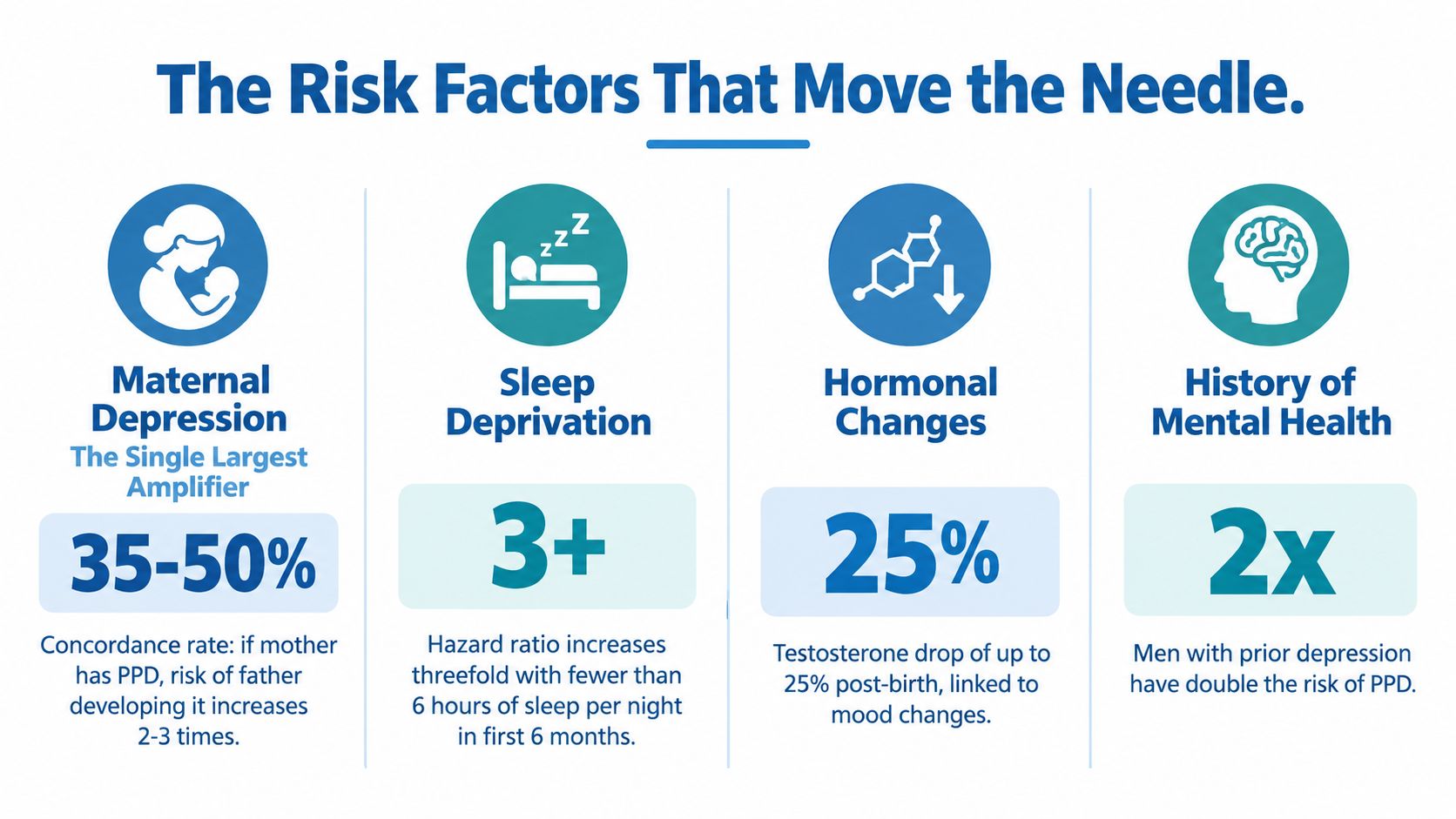
The practical conclusion is straightforward. Fathers should be screened during pregnancy and repeatedly after birth, particularly when a partner has postpartum depression or the father's behavior changes. Screening works best when it opens a conversation about functioning, safety, and support rather than acting as a pass-fail test.
Evidence-Based Treatments That Work for Men
Treatment should match severity, safety, preferences, and family circumstances. I start by clarifying what has changed, how long it has lasted, whether the father can care safely for himself and the infant, and whether anxiety, substance use, bipolar symptoms, or trauma are also present.
For mild to moderate depression, cognitive behavioral therapy can target thoughts such as “I'm failing my family,” avoidance, perfectionism, and catastrophic interpretations of infant care. Therapy should adapt examples to paternal roles, including work pressure, identity changes, conflict over caregiving, and fear of emotional vulnerability.
Match the therapy to the problem
Behavioral activation is particularly practical when a father has stopped doing anything restorative. The therapist helps him schedule small, achievable actions, such as a walk, a meal with a friend, or a defined caregiving task, then tracks whether behavior changes precede mood improvement.
Interpersonal therapy addresses the transition into fatherhood, grief over the old routine, conflict with a partner, and isolation from friends. Brief dynamic therapy may help when ambivalence about fatherhood, shame, or unresolved family experiences keeps the father emotionally detached.
Medication becomes more important when depression is moderate to severe, persistent, recurrent, or accompanied by significant functional decline. SSRIs are commonly discussed, but the choice depends on prior response, side effects, other medications, bipolar risk, substance use, and the father's preferences. Since he isn't the breastfeeding parent, lactation exposure from his own prescription isn't the same concern as it is for the mother, but household caregiving and infant contact still make sedation, activation, and adherence relevant.
Ask the prescriber: What diagnosis are we treating, what improvement should we monitor, which side effects matter for infant care, and when will we reassess?
Combined therapy and medication often make sense when symptoms are more severe or when depression has disrupted the relationship, work, sleep, and caregiving at the same time. A partner can participate in shared decision-making if the father agrees, but confidentiality and autonomy remain important.
Testosterone deserves caution. Hormonal changes may be relevant to mood, but self-directed testosterone treatment isn't a substitute for psychiatric evaluation. For readers seeking a broader discussion of men's mental health and hormone treatment, Integrative Psychiatry of America's resource on TRT provides additional context. Any hormone decision should follow appropriate medical assessment and monitoring.
Self-Management and Partner Support That Actually Helps
Self-management should support treatment, not replace it. The most useful strategies reduce physiological strain and make symptoms visible before they become a crisis.
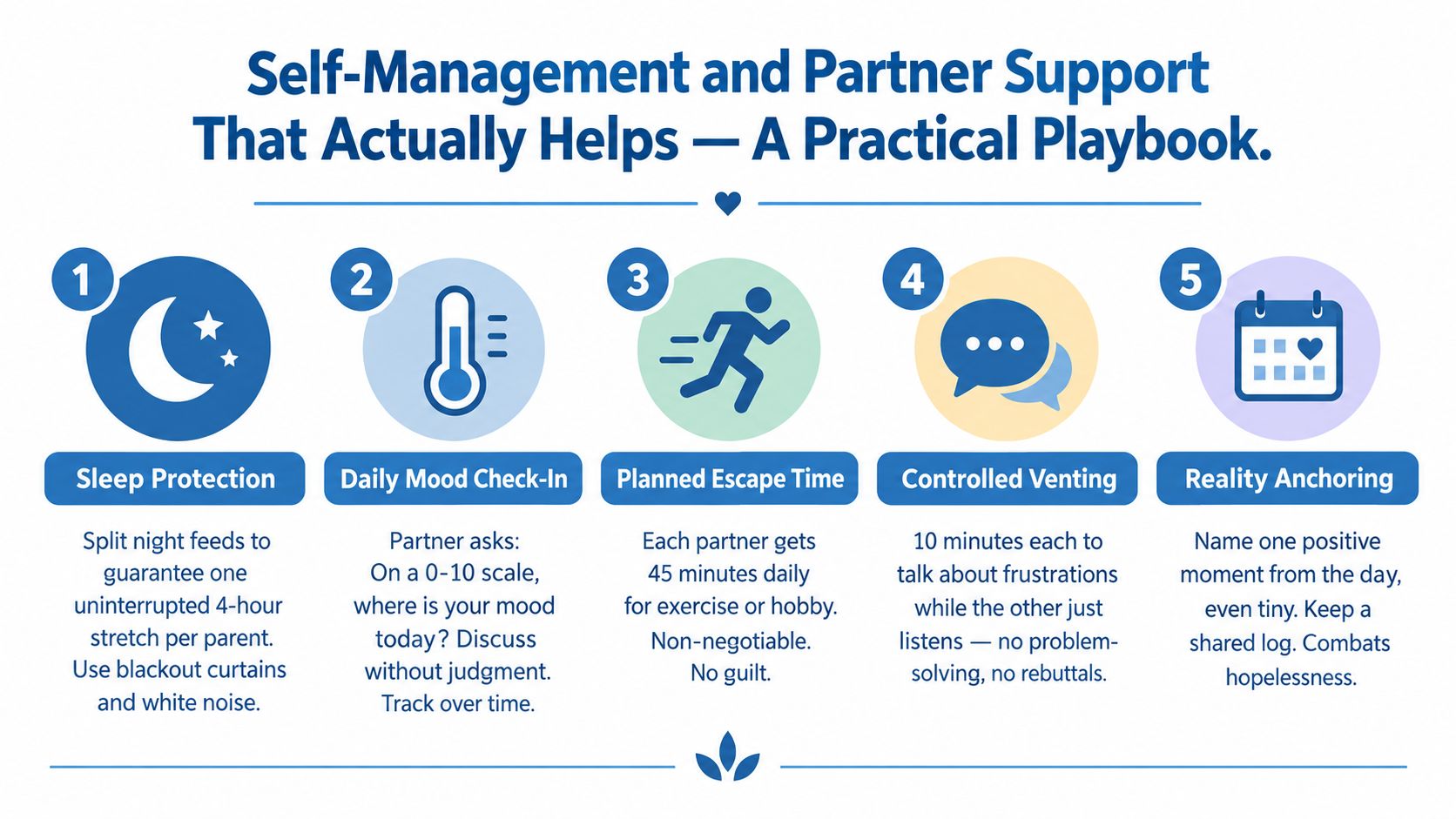
Start with sleep protection. Split night feeds or arrange outside help so each parent gets a protected, uninterrupted stretch when possible. Track mood on a 0 to 10 scale once a day, using the same question each time: “Where is your mood today?” The number isn't a diagnosis, but a downward pattern gives the couple and clinician something concrete to discuss.
Make support specific
Schedule 15 minutes of partner connection without discussing the baby, logistics, or chores. Give each person brief, planned personal time for exercise or a hobby. Limit alcohol, because using it to calm down can worsen sleep, irritability, and mood.
A partner might say:
“I notice you're more withdrawn. I'm not asking you to fix it. I'm asking you to let me in.”
That approach names an observable change without imposing a diagnosis. Avoid starting the conversation during an argument, during a feeding, or immediately after an angry incident. Choose a calm moment, describe what you've noticed, and offer to attend an appointment.
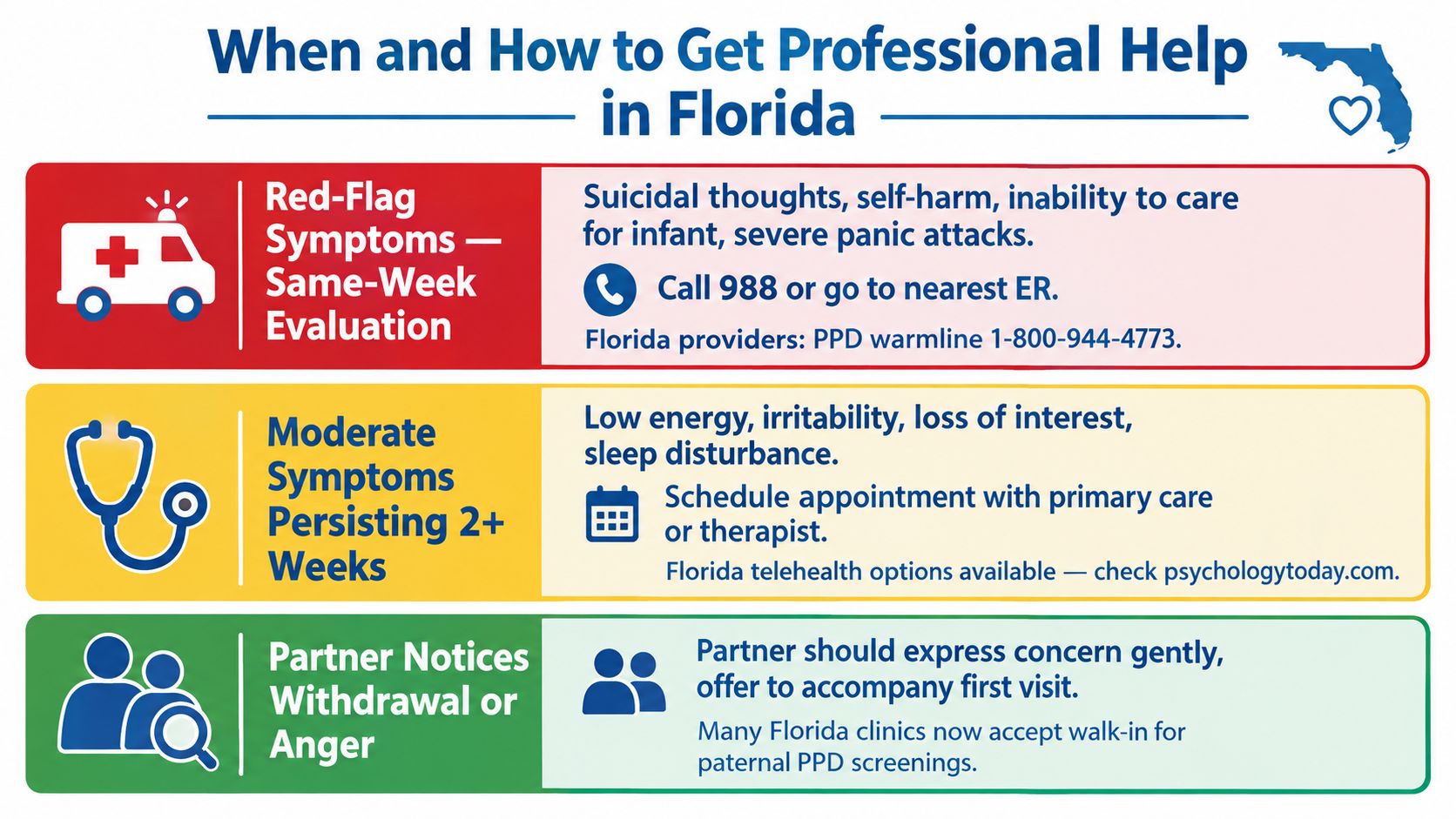
Self-management isn't enough when there are suicidal thoughts, thoughts of harming someone, inability to care safely for the infant, severe panic, psychotic symptoms, or depression that persists beyond two weeks. Those signs call for prompt professional assessment. In an immediate crisis, call or text 988 or seek emergency care.
When and How to Get Professional Help in Florida
A same-week evaluation is appropriate when a father has suicidal thoughts, escalating rage, severe panic, inability to care safely for the infant, or rapidly worsening substance use. Moderate symptoms that persist for two or more weeks also deserve an appointment, especially when low energy, irritability, loss of interest, sleep disturbance, or emotional numbness are affecting family life.
Start with primary care if that's the fastest route. Ask for a depression and anxiety assessment, explain that the symptoms began during pregnancy or after the birth, and mention behavioral changes that may not appear on a mood questionnaire. A therapist or psychiatrist can then evaluate diagnosis, safety, medication needs, substance use, bipolar symptoms, and relationship stress.
Florida fathers can also use telepsychiatry when leaving home is difficult. Refresh Psychiatry & Therapy offers psychiatric evaluation, therapy, and medication management through HIPAA-compliant virtual visits for Florida residents. Care can coordinate psychotherapy and medication follow-up, which is useful when symptoms affect both mood and family functioning. Insurance verification should happen before the first visit, and fathers should ask whether their plan covers the specific clinician and service.
Partners living temporarily in Florida may need to confirm provider licensing and telehealth eligibility based on where the patient is physically located during the appointment. A clinic can explain those requirements during scheduling. If you're unsure how to choose the right clinician, this guide on how to find a psychiatrist offers practical questions to ask about fit, credentials, treatment approach, and access.
Treatment is a family-level intervention. Helping the father regain sleep, emotional regulation, interest, and connection can reduce strain on the partner and improve the caregiving environment for the infant. You don't need to wait for a perfect explanation or a positive questionnaire before asking for an evaluation.
Refresh Psychiatry & Therapy provides Florida telepsychiatry with psychiatric evaluations, therapy, and medication management for postpartum male depression and related mood symptoms. Visit Refresh Psychiatry & Therapy to request care, or contact us or call Refresh Psychiatry at (954) 603-4081 to schedule your evaluation. We accept Aetna, United Healthcare/ UHC, Cigna, Blue Cross Blue Shield, Humana, Tricare, UMR, and Oscar insurance plans. This blog is for informational purposes only and does not constitute medical advice. Please consult a qualified mental health professional for personalized guidance.